



Abstract
This article analyzes the relative age effect (RAE) in German elite youth soccer. We hypothesize that, to get selected by elite youth academies, players with relative age disadvantages must be relatively more talented; especially at the margin of getting selected. Using data on 2,383 former elite youth players and their later market values, we show that the RAE was substantial in German elite youth soccer between 2000 and 2020. Moreover, in the sample of former elite youth academy players, those with relative age disadvantages reach significantly higher market values. Our results indicate that relative age disadvantages of elite academy players are positively correlated with their unobserved ability; suggesting that, on average, the RAE results in a loss of talent—and market value. We find that clubs could generate 30.6 to 72.8% higher market values without the RAE.
Keywords
Introduction
In talent selection, it is crucial to distinguish between current and potential performance levels. The person who is the best right now need not be the same as the person who will be the best in five years. Evaluating a heterogeneous talent pool based on current performance only can therefore have negative effects in the long run. In soccer, for instance, many young athletes who are considered elite today will no longer be elite tomorrow. These young athletes will be called fading shooting stars in this article. Fading shooting stars, in this sense, shine bright today but will never appear on the sky of professional soccer.
It would, of course, require clairvoyant abilities to predict which soccer talent will eventually make it to the professional stage. Performance development in soccer as well as in most other settings is too complex and ambiguous to make exact predictions. Yet, there is also a systematic reason for the abundance of fading shooting stars, which can easily be identified and targeted: the relative age effect (RAE). In youth soccer, athletes are grouped by years of birth in most countries. This creates an arbitrary age cut-off. Consequently, adolescents born in January are almost one year older than their December born peers. When playing in the same team, players born in January have a relative age advantage. They are relatively faster, stronger, more mature, and therefore momentarily better athletes on average. Under the ‘‘non-astrology” (Allen & Barnsley, 1993) assumption that ability is uncorrelated with birth dates, observing elite youth academies to select more relatively older players would mean that clubs focus too much on current performance rather than the potential performance level of players. The resulting over-representation of relatively older players likely leads to a waste of talent and resources.
A large literature documents the existence of the RAE, drawing on data from several countries, soccer teams, and time periods (e.g., Ashworth & Heyndels, 2007; Barnsley et al., 1985; Cobley et al., 2008; Jackson & Comber, 2020; Mujika et al., 2009; Musch & Grondin, 2001; Musch & Hay, 1999; Pérez-González et al., 2021; Tribolet et al., 2019). Many publications also provide recommendations on how to mitigate the RAE in talent selection processes (Cumming et al., 2018; Lagestad et al., 2018; Mann & van Ginneken, 2017; Martindale et al., 2005; Roberts et al., 2021). Yet, little has changed: Even though the RAE in professional soccer is known since 35 years, it is still very prevalent and, overall, even intensified over time (Sierra-Díaz et al., 2017). Roberts et al. (2021) thus argue that researchers need to consider new approaches to target the RAE in professional soccer to better understand the phenomenon and quantify its consequences.
Our article investigates the RAE in German elite youth soccer. We use data on 2,383 former youth players of the 17 most successful German Bundesliga Youth Academies (BYA) and their market values in the period between 2002 and 2020. Our article contributes to the literature in four dimensions. First, despite the attempts to mitigate the problem, we show that the RAE is still prevalent in German BYAs. Second, we introduce a new theoretical model of a player’s performance development over time, which facilitates the understanding and analysis of the RAE, and allows us to derive testable hypotheses. Third, using econometric methods and novel data on former German BYA players, we test the implications of the RAE for talent selection and the distribution of unobserved ability in elite youth academies. Fourth, using data on players’ market values, we aim to quantify the costs caused by the RAE in professional German soccer, which, in today’s highly capitalized soccer, could be a strong argument for changing talent selection practices.
Specifically, we derive from our theoretical model the hypothesis that, among all players selected into BYAs, players with relative age disadvantages have on average higher unobserved ability than their relatively older peers. This builds on the simple observation that relatively younger players must compensate the disadvantages caused by their relative age with more ability to still get selected. We further hypothesize that this effect is particularly pronounced among those players who, at the point of selection, just met the threshold requirements.
Our first finding is that the RAE in BYAs is both substantial and persistent. 71.5% of former Under-19 (U19) BYA players were born in the first half and 44.6% in the first quarter of the year. Moreover, the RAE has even increased slightly in the last two decades. Second, we find that, elite youth players that were born towards the end of the year, in fact, reach significantly higher market values on average. Using an instrumental variable approach, we further show that, at the margin of getting selected, relative age disadvantages are positively correlated with (unobserved) ability. This empirical result supports our theoretical hypotheses and rationalizes also why we find a positive correlation between relative age disadvantages and market values on average in our sample of former elite youth players. Our third finding is that the RAE is very expensive for BYAs: we estimate that Bundesliga clubs could generate 30.6 to 72.8% higher market values through their BYAs when eliminating the RAE in talent selection. This result can be considered as rather conservative as we only model the costs of bad selection related to the RAE. Relative maturity differences during adolescence presumably cause additional costs.
The findings and mechanisms we describe are also relevant for talent identification, development, and recruitment outside of sports. Various studies from different fields show that initial differences in (relative) performance have significant consequences on selection outcomes and achievement, and that eliminating structural biases in recruitment comes with sizeable (economic) gains (e.g., Balboni et al., 2022; Cullen et al., 2006; Dustmann et al., 2016; Friebel et al., 2019; Hanushek & Rivkin, 2009; Hsieh et al., 2019; Murphy & Weinhardt, 2020). The world of soccer lends itself, in particular, to the analysis of how initial performance differences affect selection and individual careers in the short and long run because of the excellent data available. 1
The article is organized as follows. Section “Related Literature” discusses the related literature on the existence and consequences of the RAE. Section “Theoretical Framework” proposes a model of player’s performance development, which allows to illustrate the mechanisms involved in the RAE as well as derive hypotheses for the empirical analysis. Section “Empirical Setting” describes the institutional setting in Germany and our data. Section “Empirical Results” presents our empirical analysis and results. Finally, Section “Conclusion” discusses the implications of our analysis and concludes.
Related Literature
The Relative Age Effect in Soccer
The existence of the RAE in sports was for the first time shown by Barnsley et al. (1985), who report skewed birth date distributions in Canadian youth ice hockey. In the 1990s, first soccer-related RAE studies were published. Musch and Hay (1999), for example, find evidence for strong RAEs in professional soccer across several countries including Germany. Decades of research have produced a large body of evidence on the RAE. Yet, the RAE has continued to exist in both youth and professional soccer. Therefore, Roberts et al. (2021) see the need to identify new data capture techniques and more sensitive measures of the RAE to foster a deeper understanding of the effect and its consequences.
While Allen and Barnsley (1993) outline a basic model, the only formalized model of the RAE in sports so far is developed by Pierson et al. (2014), who model the RAE as a reinforcing feedback loop and apply it to Canadian youth hockey. Moreover, Dawid and Muehlheusser (2015) present a dynamic model of repeated talent selection with heterogeneity in ability and relative age, which can also be applied to sports. Besides that, most publications have only relied on descriptive statistics so far.
Cobley et al. (2008) track the RAE in professional German soccer from 1963 to 2007. Using
Approaches to relate the RAE to players’ monetary valuations, have not yet yielded conclusive results. Pérez-González et al. (2020), for instance, analyze players of ten highly successful European soccer clubs and show that players’ market values are not significantly correlated with their relative age. Moreover, Fumarco and Rossi (2018) show that professional soccer players born in the last quarter of the year earn significantly lower wages than players born in the first quarter. However, with similar statistical precision, they find that players born in the third quarter of the year earn substantially more than those born in the first quarter. Ashworth and Heyndels (2007) use data from professional soccer players in the German Bundesliga for the seasons 1997/1998 and 1998/1999. Based on estimated gross wages, they find that the late-born players in a cohort earn higher wages. Hence, within the sample of professional soccer players—those shooting stars that made it to the professional stage—the relation between players’ monetary valuation and relative age is not unambiguously clear.
Production Function of Elite Youth Academies and the Optimal Selection Policy
The existence and implications of the RAE in German elite youth soccer highly depend on the production function of elite youth academies; in other words, on how elite youth academies employ different kinds of training and selection strategies to optimally exhaust the talent pool. Dawid and Muehlheusser (2015) show that, when initial relative age advantages are strong, clubs can maximize the quality of the talent pool in the long term if they initially resist the temptation to select players based on momentary performance signals. 3 In other words, scarce training resources are misallocated if clubs always select the momentarily best despite strong relative age advantages.
While Dawid and Muehlheusser (2015) assume that “planners” want to maximize the average talent level in a given population at the end of the training process, which we will call the average shooting star strategy, it could be possible that soccer clubs have different objectives and thus a different production function. For example, clubs could consider it most effective to focus on the performance development of a small subgroup of 3 to 5 very promising players, which we will denote as the top shooting star strategy. To support the few top shooting stars optimally, clubs might surround them at every given stage with the currently best players available which tend to be relatively older and more mature on average. This strategy of largely utilizing the RAE might even be necessary to retain and attract the best. To give a better-informed assessment of the production function of the elite youth academies, we briefly summarize the relevant literature.
In terms of short-term success, it is optimal to fully follow the average shooting star strategy. Grossmann and Lames (2013) show that youth clubs can increase their momentary competitiveness by exploiting the RAE. As the RAE tends to be more pronounced in elite youth leagues (Del Campo et al., 2010; Jackson & Comber, 2020) and in clubs which are regarded as successful and have an excellent reputation (Jiménez & Pain, 2008), elite youth clubs indeed show a preference for short-term success and momentary competitiveness. Moreover, Jiménez and Pain (2008) argue that the first aim of clubs is to be successful at all stages instead of promoting the greatest talents and taking a long-term perspective. This short-term orientation is further intensified by coaches’ incentives who perceive pressure to select players based on short-term goals (Hill & Sotiriadou, 2016; Roach, 2022). While these findings do not necessarily contradict the top shooting star strategy which also largely relies on the utilization of the RAE, it is apparent that talent development does not just follow a long-term plan but is subject to many short-term constraints.
Furthermore, the top shooting star strategy requires that elite youth academies are able to identify top talents already at early stages of selection and that the selection of these top shooting stars is independent of the RAE. Both are rather strong assumptions. The RAE, in fact, is still significant in adult elite leagues (see Sierra-Díaz et al., 2017 and Figure C3 in Appendix C) which indicates the inability of elite youth academies to identify their top players independently of the RAE. Although we cannot fully dismiss the top shooting star strategy, in this article, we will assume that elite youth academies cannot identify the most promising talents at early stages of selection but, being subject to short-term constraints, primarily aim at maximizing the average talent level.
Stylized Facts on the RAE and Performance Development
Before developing our model, we present stylized facts from the literature on the RAE and youth players’ performance development. A model that is faithful to the evidence must recognize these empirical findings. First, relative age and maturity advantages are generally beneficial in soccer (Lovell et al., 2015; Malina et al., 2007, 2000; Rommers et al., 2019; Rösch et al., 2000; Votteler & Höner, 2014). Second, relative maturity differences can be substantial during adolescence, are greatest around the age of 13 and decline afterwards (Malina et al., 2004; Walker, 2016). Third, the RAE in elite youth soccer follows this maturity pattern, increasing initially and peaking around the age of 13 to 15. Yet, the RAE does not disappear eventually but remains significant even at the professional level (Cobley et al., 2008; Patel et al., 2019; Pierson et al., 2014; Sierra-Díaz et al., 2017). Fourth, initial age and maturity advantages likely lead to a path dependency due to access to better training and other factors such as players’ increased self-confidence, parents’ behavior, and coaches’ perceptions (Musch & Grondin, 2001; Pierson et al., 2014). Fifth, as discussed above, the RAE is more pronounced in elite leagues and youth clubs can increase their momentary competitiveness by exploiting the RAE (Del Campo et al., 2010; Grossmann & Lames, 2013; Jackson & Comber, 2020; Jiménez & Pain, 2008).
From these stylized facts, it is also apparent that the RAE is complemented by a relative maturity effect (RME), that is, differences in maturation status which are independent from relative age (see Malina et al., 2000). Hence, analyzing the impact of only the RAE (and not the RME) on talent allocation will most likely lead to conservative results when it comes to skewed talent selection and misallocation of talent.
Theoretical Framework
Basic Setup
The simple theoretical model introduced in this section aims to illustrate the problems caused by the RAE. The model goes beyond the previous analysis of ability, relative age, selection, training, and monetary valuation in soccer (e.g., Ashworth & Heyndels, 2007) and will serve as the basis for deriving our hypotheses. Let
Let

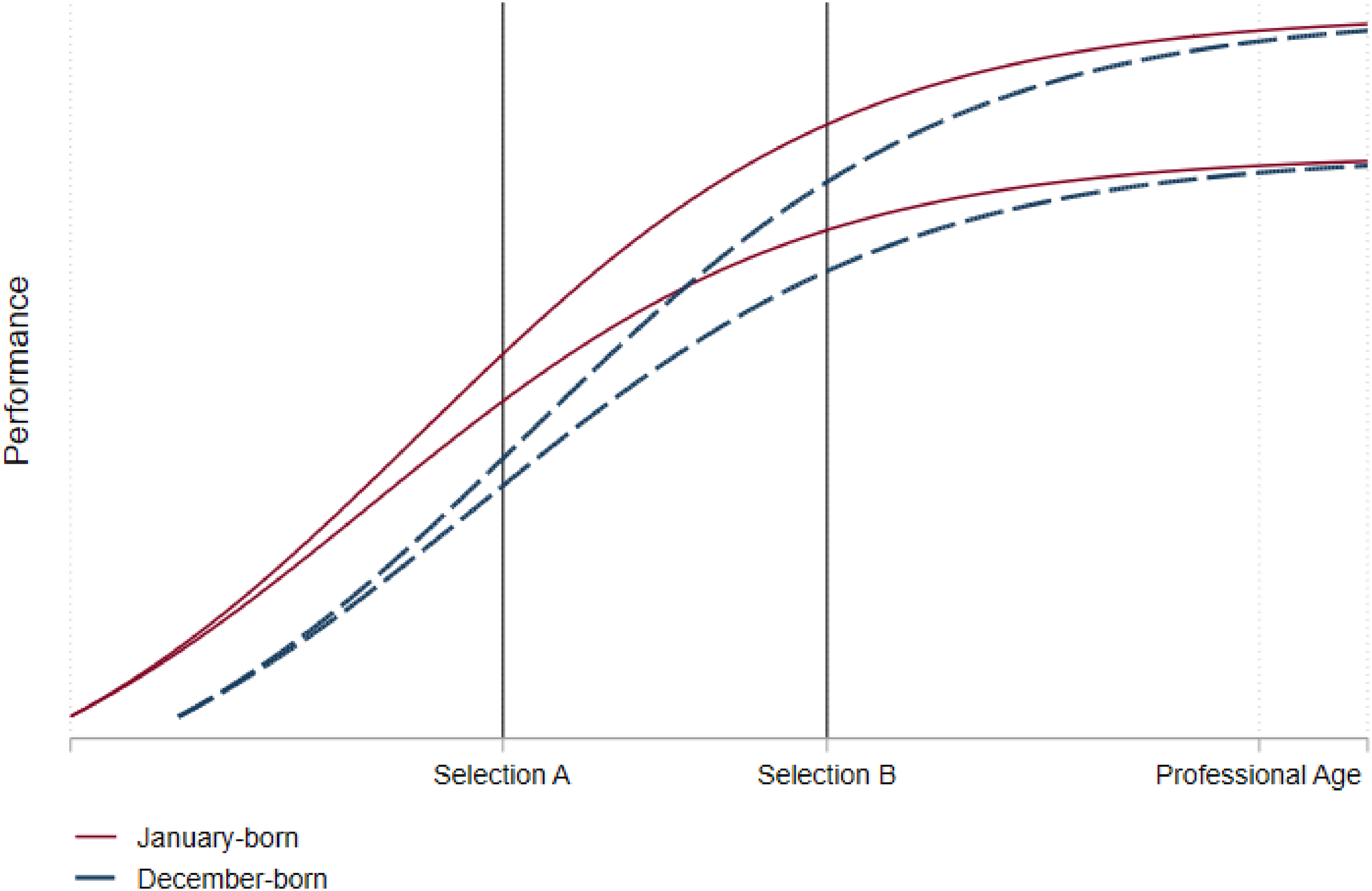
Simple performance development model with two different birth months and two different talent levels.
For illustration, assume that only two players can get selected by an elite youth academy at selection point
The Effect of ‘Superior’ Elite Academy Training
So far, the model did not incorporate the training effect of soccer elite academies relative to other youth clubs. We assume that elite youth academies indeed offer superior training—the treatment—and let the maximum performance level of player


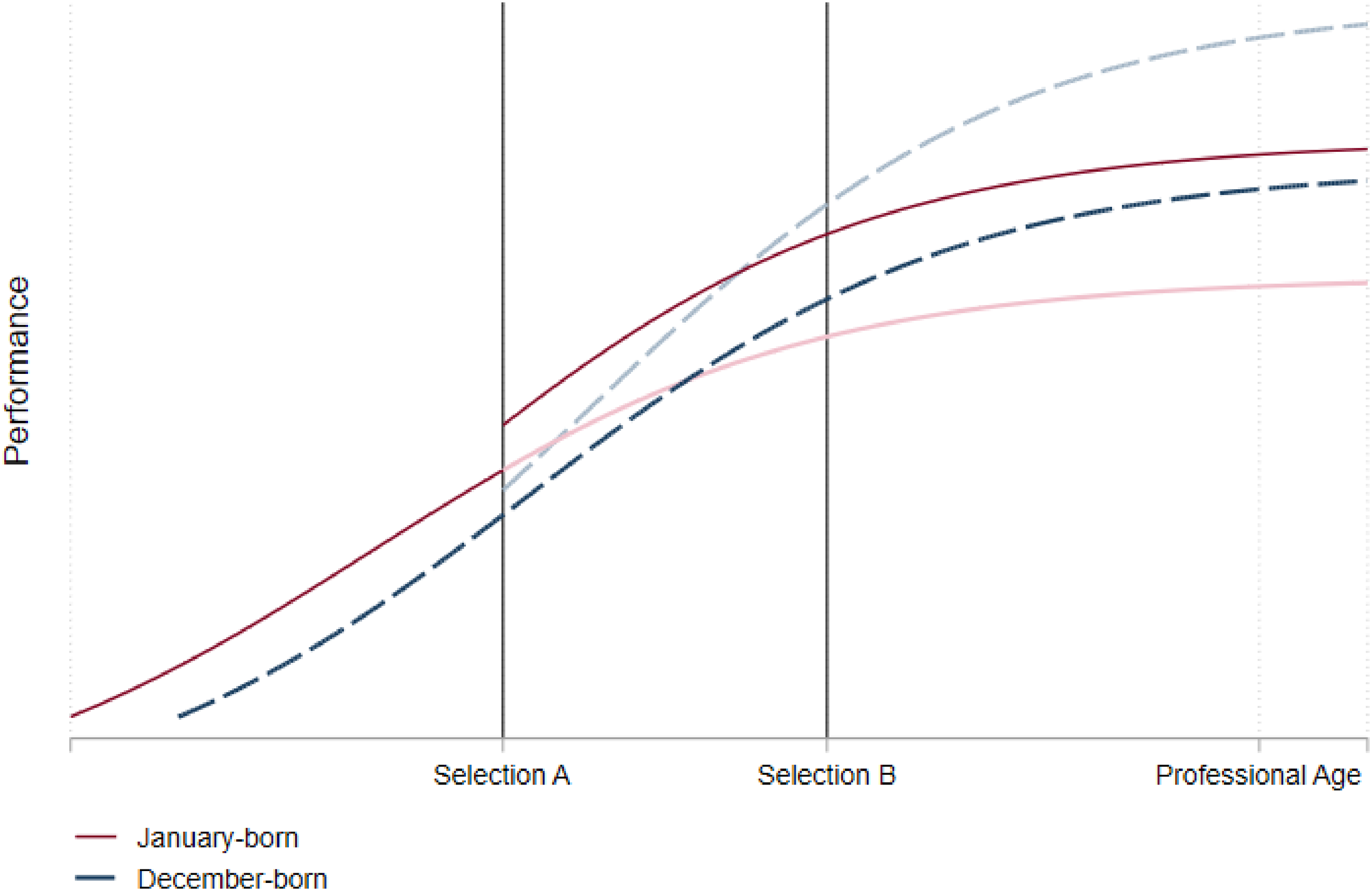
Performance development model: Illustrating fading and late blooming shooting stars.
The lighter red and blue lines represent possible examples of the counterfactuals. Selection of the relatively untalented January-born player lifts his performance level after selection point A, so that even at selection point B it remains higher. This visualizes the main problem caused by the RAE: Although, at selection point A, the relatively talented December-born was currently worse than the relatively untalented January-born, the long-term return of selecting the December-born is much higher. At selection point B, the counterfactual performance of the relatively talented and treated December-born is higher than the performance of the relatively untalented and treated January-born. Eventually, the maximum performance level of the relatively talented and treated player exceeds the maximum performance level of the relatively untalented and treated considerably. Meanwhile the performance curve of the relatively untalented January-born presents the case of fading shooting stars vividly: Shining lightly in early selection rounds due to their relative age advantage, they eventually fade before entering the professional soccer stage. In line with existing evidence on the RAE, the model illustrates how the RAE remains even when maturity differences vanish, in particular, in a highly competitive environment. Based on this, we derive our first hypothesis:
Given (i) selection cut-offs during performance development, (ii) relative age-based performance differences, and (iii) positive effects of elite youth academy training, the RAE occurs in a competitive environment and is sustained even when relative age differences fade.
As described in Section “The Relative Age Effect in Soccer”, the existence of the RAE in professional youth sports is a well-established result, as is its persistence when relative age differences fade. While Hypothesis 1 can therefore almost be considered a stylized fact, it also provides a mechanism behind the RAE which can be related to other fields.
Marginally Selected Players and Ability
Our theoretical considerations suggest that the ability of those players who were just good enough to get selected into elite academies is not evenly distributed over birth months, although, in the general population, ability is uncorrelated with birth dates. Players who just got selected will be denoted as the marginally selected. To define the concept of the marginally selected, we assume that, at selection point A (



Based on Equation (6), we derive the following hypothesis:
Among the marginally selected players, relative age disadvantages (later birth months) are positively correlated with players’ maximum performance levels:
As maximum performance levels reflect players soccer-specific ability, we can rephrase this hypothesis as: Among the marginally selected, those with relative age disadvantages have relatively higher unobserved ability. We will test this hypothesis in Section “Relative Age Advantages, Training, Market Values, and Ability”.
Figure 3 illustrates that marginally selected players from different birth months eventually end up having very different maximum performance levels. The player born in December who was just good enough to get selected has a much higher maximum performance level than the January-born marginally selected.
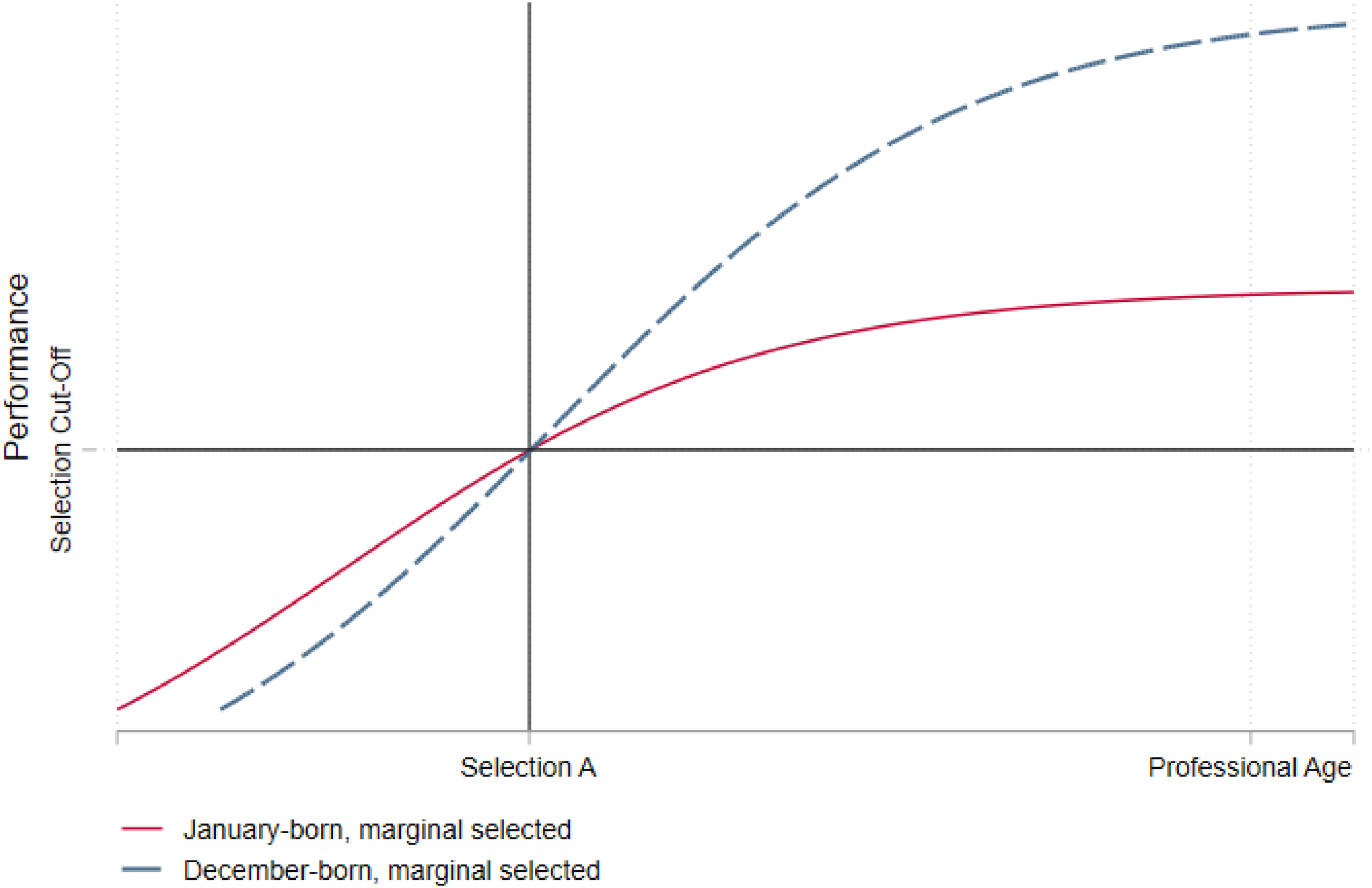
Marginally selected players and maximum performance levels.
In terms of ability, the upper bound of the players—the very best—selected into BYAs per birth month is assumed to be identical for all birth months, as ability is evenly distributed in the general population. However, the lower bound—the marginally selected—is skewed with the January-born marginally selected being less talented than the December-born marginally selected. Consequently, the theoretical model suggests that also the average ability of selected January-born players is lower than the average ability of their December-born peers. In general, the average ability—and thus their average maximum performance level

Average performance levels are positively correlated with players’ relative age disadvantages in elite youth academies.
Maximum Performance Levels and Foregone Market Values
Our main empirical approach is to rely on the highest market values HMV as a proxy for the maximum performance level
(Foregone Market Value ):
Among former youth elite academies players, market values are positively correlated with relative age disadvantages; implying that recruiting players more evenly across birth months increases average market values generated by elite youth academies.
In the following sections, we will empirically test our hypotheses after presenting our data and the setting we analyze.
Empirical Setting
Bundesliga Youth Academies
As a response to the bad performance of the German national team in the World Cup of 1998 and the European Championship of 2000, 7 German youth soccer was radically reorganized and modernized. A new licensing regulation, passed in 2001, required every club in the first two divisions (Bundesliga and 2. Liga) to build up Bundesliga youth academies (BYA, German: ‘Nachwuchsleistungszentren’). The two primary goals of BYAs are ‘internationally outstanding Bundesliga and German national teams’ and ‘optimal exhaustion of the talent pool’ (Deutsche Fußball Liga, 2020a). 8 Linking BYAs’ talent selection to the RAE, unobserved ability, and market values, this article will particularly address the second goal by asking whether BYAs exhaust their talent pool optimally.
BYAs are highly standardized, which will prove to be of great advantage for our analysis. 9 The focus of soccer training is accurately regulated for certain age cohorts. Only from the U15 onwards, BYAs are allowed to conduct ‘performance-oriented training’, where specializations are stabilized and further developed as direct preparation for a professional soccer career (Deutsche Fußball Liga, 2020a). 10 Between the U15 and U19, investments are highest, competition is biggest, and training is most intensive. As players develop most during this performance-oriented training, U15 to U19 squad selection is pivotal.
Today’s Bundesliga teams invest millions in their BYAs, while most money is spent on the U15 to U19 teams (Sponsors, 2019). Hoffenheim, for instance, has a staff of more than 50 full-time employees responsible for about 150 youth players which play in Hoffenheim’s seven BYA teams (Sponsors, 2019). In total, 5.400 adolescents played for 279 teams in 54 BYAs
11
in Germany in 2017 (Franzke, 2017). To put this figure into context, about 484.000 adolescents between the age of 15 to 19 play soccer in Germany (Deutscher Fußball Bund, 2020). Hence, only about 1% of active adolescent players make it to a BYA. From this top one percent, again less than 5% (60–70 players per year) will eventually succeed in getting a professional contract in Europe’s top leagues (Franzke, 2017; Sponsors, 2019). The total investment of the 36 Bundesliga and
Data
In this subsection, we summarize the most important aspects of the data. A more detailed description is provided in Appendix B. We use data on former BYA youth players retrieved from the sports website transfermarkt.de. 12 Next to other information about professional soccer players (name, birth date, strong foot, height, transfer history, etc.), the focus of the website relies on market values. Market values are estimated and discussed by non-expert users for more than 800,000 soccer players worldwide and are regularly updated (Keppel & Claessens, 2020). Data from transfermarkt.de was used before in different scientific publications (e.g., Augste & Lames, 2011; Grossmann & Lames, 2013; Herm et al., 2014; Bryson et al., 2013; Pérez-González et al., 2020). While the data quality was viewed with criticism first (e.g., Sundermeyer, 2009), market values on transfermarkt.de were found to be highly correlated with expert estimates from well-respected sources (Franck & Nüesch, 2012). Peeters (2018) finds that transfermarkt.de data on market values performs better than other indicators in predicting a team’s strength. Moreover, he does not find evidence for ‘wishful thinking bias’, which would result in overestimating market values of popular players and teams. Müller et al. (2017) show that the crowd-based estimates from transfermarkt.de are equally accurate as estimates from a multiple regression algorithm and even outperform the algorithm for high-priced players.
When constructing the data set, there was a trade-off between quality and quantity. In other words, the aim was to include as many BYAs as possible without jeopardizing completeness and quality of the data. As a baseline, we examined the aggregated standings of the U19 Bundesliga since 2001. We further supplemented this information with rankings of the most successful BYAs from two different websites (fussballfieber.de, 2017; ran.de, 2015) and compiled a short list of the 36 most successful BYAs. Yet, going from the top to the bottom of the list, the data became increasingly incomplete. Finally, our data set consists of the U17 and U19 Bundesliga cadres of the 17 most successful youth teams between 2001 and 2020. 13 Every additional club would have implied incomplete data.
We restrict our data to players with German nationality, as other players might have undergone elite youth academies of different qualities in their home countries before being selected. Additionally, players who were mentioned in BYA cadres but without concordant reference to this in their transfer history were dropped. This was necessary because we need to calculate the number of days that youth players spent in BYAs based on their transfer histories. The final data set contains 3,835 observations. Among them, 2,383 played for a U19 BYA and were born between 1988 and 2001, that is, could potentially have gotten five full years (U15-U19) of BYA performance-oriented training.
The variable BYAyears captures the time a player spent in one of the 17 BYAs chosen, ranging continuously from zero up to a maximum of five years. We only consider the period of performance-oriented training between the U15 and U19 as competition, investment, and training quality are highest in these years. BYAyears excludes spells during which players were first trained at one of the remaining 37 BYAs and joined one of the 17 selected clubs later. 14 Two main arguments justify this specification: First, close examination of the data reveals that transfers from other BYAs (out of the sample) to the 17 first-tier BYAs (in the sample) are rather rare. Second, not all BYAs provide the same quality of training. More than 70% of total BYA investment is made by the 18 Bundesliga clubs (Sponsors, 2019). Investment in BYAs is, thus, likely to be skewed towards the most successful ones. Hence, BYAyears is an appropriate measure for the years that adolescents received distinguished soccer training, guaranteeing the highest possible level of homogeneity by not treating first- and second-tier BYAs as the same.
In the last two decades, a sharp increase in market values could be observed, so that highest market values are hardly comparable across years. To overcome this issue, we calculate Bundesliga market value inflation rates based on the total market values of all Bundesliga teams’ 11 most expensive players in all years between 2005 and 2020. We chose the 11 most expensive players from all 18 Bundesliga clubs in every given year because this yields a ‘‘player basket’’ of 198 players in each year which remains comparable over time. When merely looking at absolute market values or average market values, the inflation rate might be skewed by the number of players which clubs register in different years. While the number of players per club is also motivated by the ’starting eleven’, the 198 players in the player basket is a large enough number that the absolute market values are not influenced too much by individual players.
Absolute market values of all Bundesliga teams’ top 11 players and the respective inflation rates are shown in Figure C1 in Appendix C. On first sight, inflation rates of over 30% might appear unrealistic, but Poli et al. (2019) also find inflation rates above 30% for European soccer leagues between 2011 and 2019. Using the calculated inflation rates and the date when a player’s highest market value was reached, we convert highest market values to 2020 inflation-adjusted highest market values (HMV). 15 In our analyses, we rely on logarithmized values (logHMV) to counteract the progressive nature of market values.
All variables are available for all observations except for the players’ specific positions and body height which are missing for about 5 and 20% of the observations, respectively. Table 1 reports descriptive statistics of our data set.
Descriptive Statistics of Key Variables.
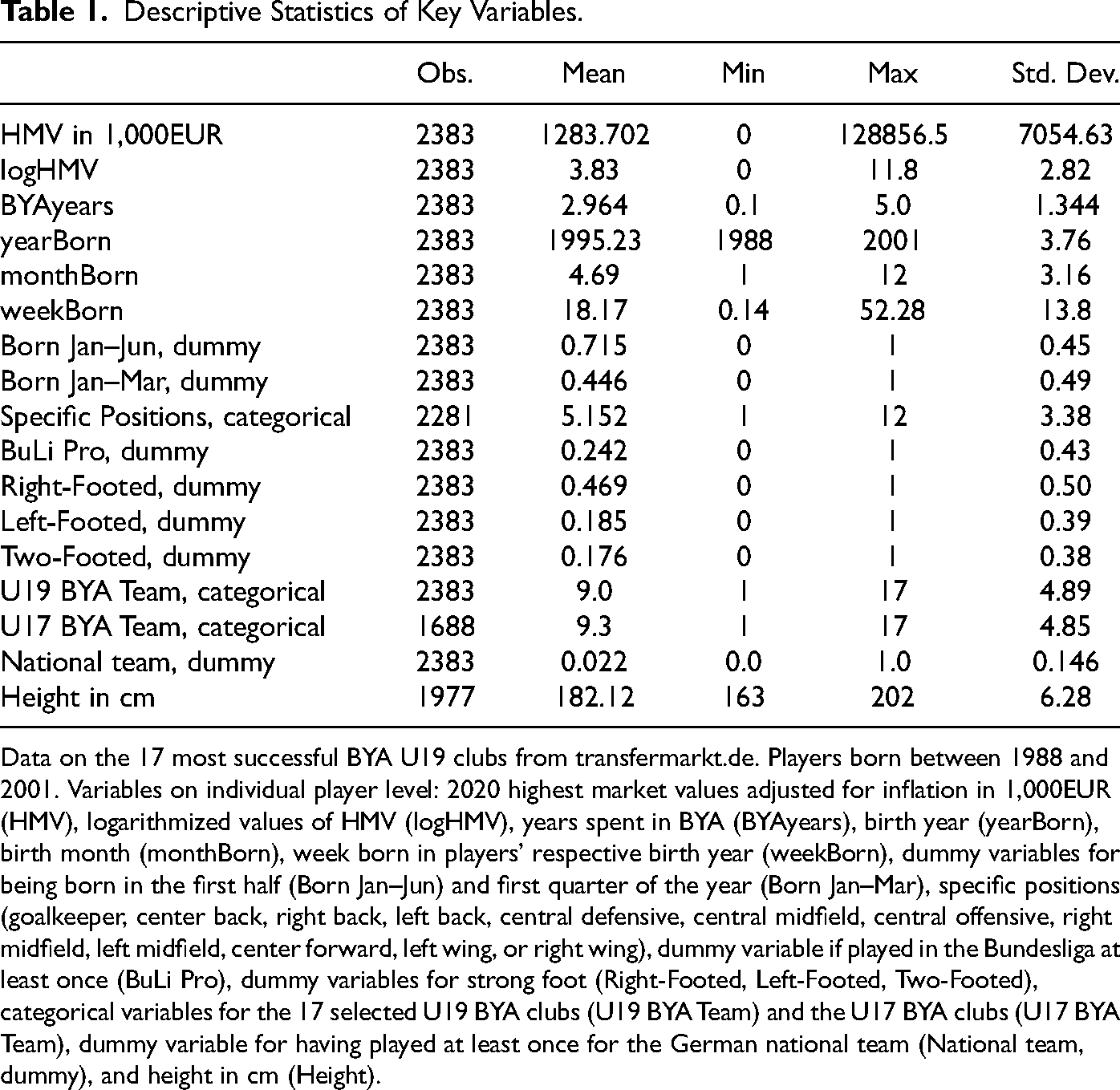
Data on the 17 most successful BYA U19 clubs from transfermarkt.de. Players born between 1988 and 2001. Variables on individual player level: 2020 highest market values adjusted for inflation in 1,000EUR (HMV), logarithmized values of HMV (logHMV), years spent in BYA (BYAyears), birth year (yearBorn), birth month (monthBorn), week born in players’ respective birth year (weekBorn), dummy variables for being born in the first half (Born Jan–Jun) and first quarter of the year (Born Jan–Mar), specific positions (goalkeeper, center back, right back, left back, central defensive, central midfield, central offensive, right midfield, left midfield, center forward, left wing, or right wing), dummy variable if played in the Bundesliga at least once (BuLi Pro), dummy variables for strong foot (Right-Footed, Left-Footed, Two-Footed), categorical variables for the 17 selected U19 BYA clubs (U19 BYA Team) and the U17 BYA clubs (U17 BYA Team), dummy variable for having played at least once for the German national team (National team, dummy), and height in cm (Height).
Empirical Results
Relative Age Effect in Bundesliga Youth Academies
To test Hypothesis 1 and quantify the RAE in BYAs, we calculate the share of players born in the first half and the first quarter of the year; two well established RAE indicators (see, e.g., Jackson & Comber, 2020; Mujika et al., 2009; Musch & Grondin, 2001; Tribolet et al., 2019). Table 2 shows that 71.5% of U19 youth players were born in the first half and 44.6% in the first quarter of the year. Both numbers are well above the equal birthday distributions, 50% and 25%. 16 Table 2 reveals that the RAE is very pronounced across all the 17 BYAs. While certain differences exist, they are not extremely large. The proportion of players born in the first half of the year varies between 77.1% (VfL Wolfsburg) and 65.8% (Schalke 04), while the share of players born in the first quarter of the year ranges between 56.7% (Borussia Dortmund) and 38.0% (Hoffenheim).
The Relative Age Effect: Summary Statistics by U19 BYA.
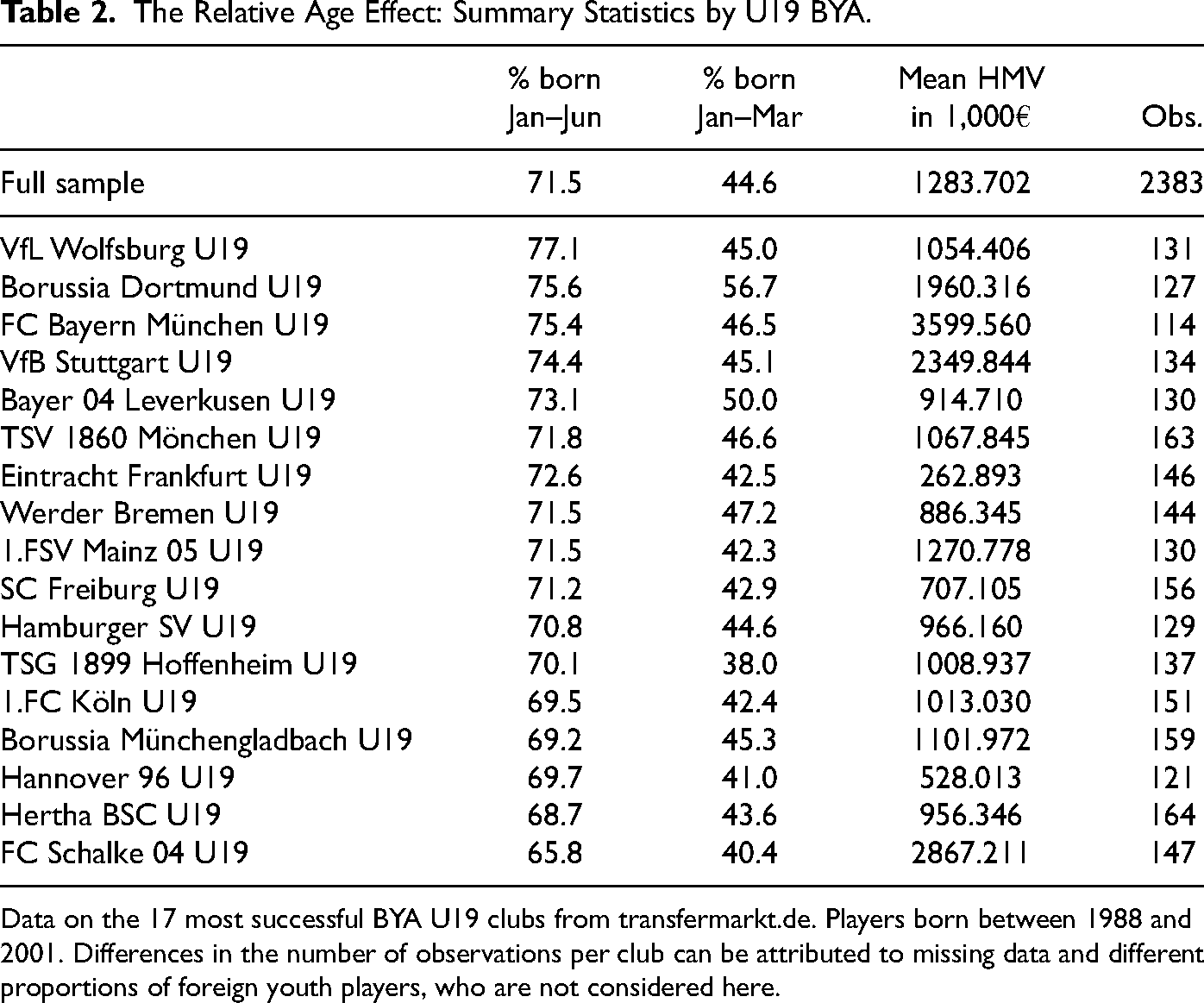
Data on the 17 most successful BYA U19 clubs from transfermarkt.de. Players born between 1988 and 2001. Differences in the number of observations per club can be attributed to missing data and different proportions of foreign youth players, who are not considered here.
Table C1 in Appendix C replicates these findings for the U17 BYA teams, showing an even larger RAE than in U19 BYA teams. The pattern of stronger RAE in U17 teams and a slightly smaller RAE in U19 teams, presumably owing to declining maturity differences, was also found in other studies which we discussed in the literature review (e.g., Jackson & Comber, 2020; Malina et al., 2004; Patel et al., 2019).
Relative age differences should have faded to a large extent already in U19 BYA teams, and fully in professional adult leagues. The finding that a significant RAE still exists in U19 BYA teams (see Table 2) as well as in the two top German professional adults leagues (see Figure C3 in Appendix C), highlights the persistence of the RAE and is in line with Hypothesis 1. In the context of selection cut-offs during performance development, initial relative age-based performance differences, and positive effects of elite youth academy training, the RAE does not only arise, but it also persists.
Table 2, furthermore, presents average highest market values (HMV). As there is only little variation in the size of the RAE and market values are influenced by various other factors, it is not surprising that the size of the RAE and HMV do not seem to be correlated across clubs. Average HMV, however, need to be treated with caution as values are likely to be affected by a few very expensive players. Yet, it is clear that the existence of the RAE is economically interesting given BYA players’ (future) market values.
Figure 4 illustrates the development of the RAE over time, by showing the proportion of players born in the first half of the year between 1985 and 2005. The two main insights from this figure are that, first, the RAE did not decline since the introduction of BYAs and, second, the proportion of players born in the first half of a year is significantly different from 50% (i.e., the equal distribution) at the 95% confidence interval for every birth cohort. At the beginning of the period examined in this article (birth cohorts 1988 and 1989), the proportion of players born in the first half of the year was around 65%. The RAE indicator increased to around 75% in the following 10 years and remained approximately unchanged since then.
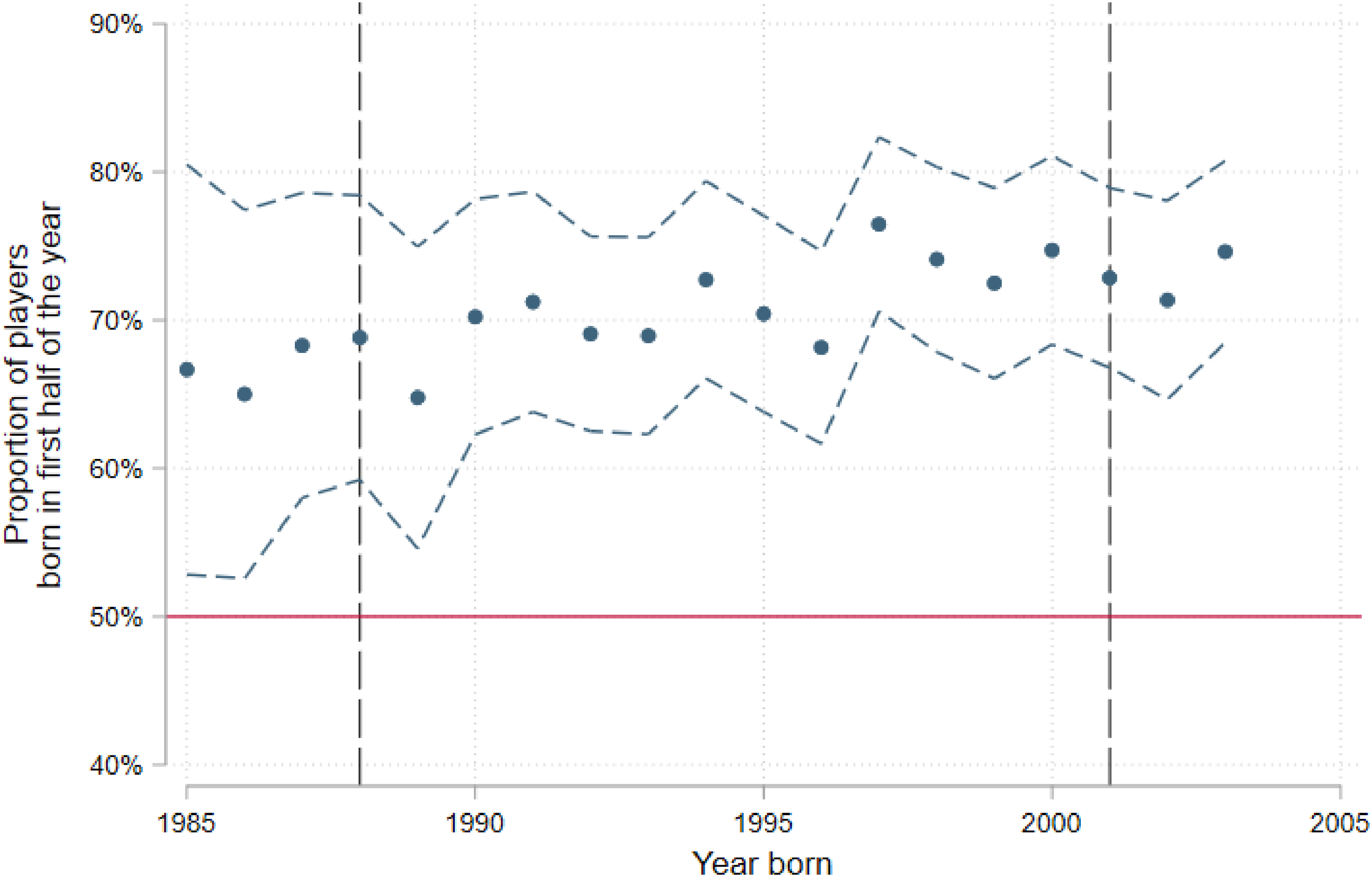
The RAE over time: Proportion of BYA players born in first half of the year by age cohorts. Figure displays values of all former U19 BYA players born between 1988 and 2001. The respective age cohorts are indicated by vertical lines. Confidence intervals at 95% and equal distribution as reference.
Overall, the descriptive statistics show that the RAE has not declined, but was rather amplified since the introduction of BYAs. The primary goal of BYAs, the ‘‘optimal exhaustion of the talent pool’’ (Deutsche Fußball Liga, 2020a), is thus probably missed. 17 As unobserved ability is plausibly independent of birth dates, the preferred selection of relatively older adolescents suggests that talent is lost: Some late blooming shooting stars are deprived of the chance to shine.
Relative Age Advantages, Training, Market Values, and Ability
To test our Hypotheses 2 and 3—that performance levels are positively correlated with players’ relative age disadvantages, at the margin of getting selected as well as on average—we first run regressions of logHMV on players’ quarters of birth. In doing so, the logHMV serve as a proxy for players’ maximum performance levels. In all specifications, we control for year of birth and U19 club fixed effects. Column 1 of Table 3 shows a clear picture: BYA players born later in the year reach significantly higher market values during their careers. Specifically, former U19 youth players that were born in the third (fourth) quarter of the year reach 41.9% (58.7%) higher market values compared to their peers born in the first quarter of the year. Our results are supported by quantile regressions (see Table C3 in Appendix C).
OLS Regressions of Market Values, BYA Training, and Birth Quarters.
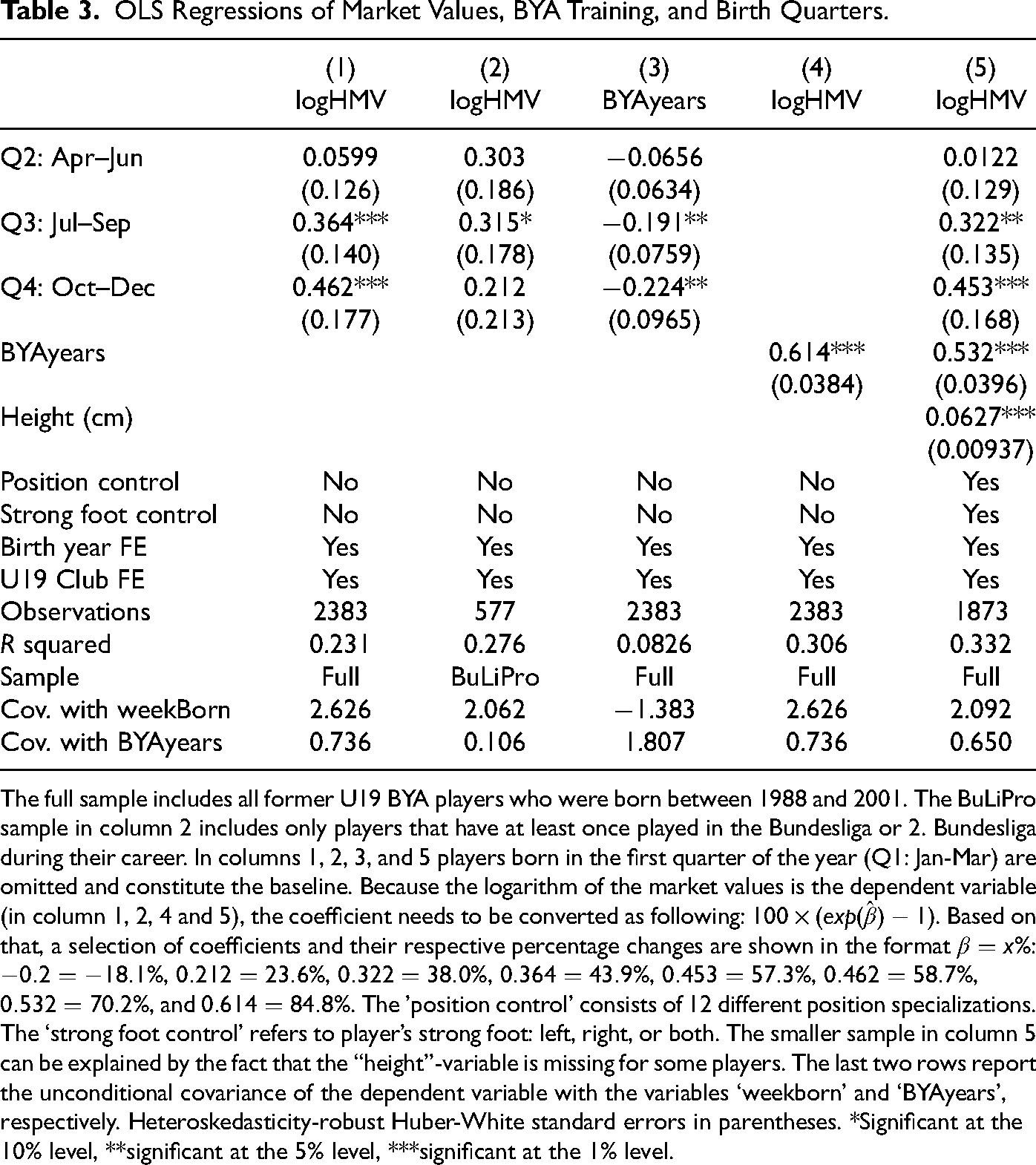
The full sample includes all former U19 BYA players who were born between 1988 and 2001. The BuLiPro sample in column 2 includes only players that have at least once played in the Bundesliga or 2. Bundesliga during their career. In columns 1, 2, 3, and 5 players born in the first quarter of the year (Q1: Jan-Mar) are omitted and constitute the baseline. Because the logarithm of the market values is the dependent variable (in column 1, 2, 4 and 5), the coefficient needs to be converted as following:
At first sight, this result appears to contradict the findings of Fumarco and Rossi (2018); Pérez-González et al. (2020) who show that professional soccer players’ monetary valuations are not significantly correlated with their relative age. However, this can partly be explained by different samples. We study former U19 BYA players, while Fumarco and Rossi (2018); Pérez-González et al. (2020) concentrate only on professional adult players. Our results, however, are more in line with Ashworth and Heyndels (2007) who analyze the (estimated) wages of professional players from the German Bundesliga for two seasons between 1997 and 1999 and find that the late-born players receive a wage premium. In Column 2 of Table 3, we similarly restrict our sample to those former U19 BYA players who have at least once played in one of the top two German professional adult leagues. When doing so, the association between players’ quarter of birth and their market values declines and loses significance; while still being positive. Our findings are thus generally in line with the literature. Within the sample of those players who made it to the professional stage, the association between players’ monetary valuations and relative age does neither seem to be clearly positive nor clearly negative. In fact, we would not expect significant differences, if players with relative age advantages are a bit less talented, on average, but receive a bit more time of distinguished elite academy training. Yet, in our sample of all former U19 BYA players—including the fading shooting stars that never make it to the professional stage—the unambiguously positive association between relative age disadvantages and market values is striking.
As players’ quarter of birth is, by nature, uncorrelated with their talent, skill and thus maximum performance level, the positive correlation between relative age disadvantages and logHMV can be explained by unobserved ability and sample selection: Players born towards the end of the year need to compensate with higher ability for their relative age disadvantage in order to get selected by BYAs.
Still, the simple estimates presented in Column 1 of Table 3 might be biased: Column 3 of Table 3 shows that players with relative age disadvantages are selected relatively later by BYAs and therefore receive, on average, less distinguished elite training. At the same time, years of BYA training are strongly positively associated with market values (see Column 4 of Table 3). Moreover, other factors such as players’ positions, their height or even their strong foot, might be correlated with their relative age, unobserved ability and thus market values. In Table C2 in Appendix C, we report additional results on the association between players’ market values and player specific characteristics. We obtain three main results: (i) the positions of former BYA players that are associated with the highest market values are right wing, left wing, and central midfield, while center backs, right midfielders, and left midfielder reach the lowest market values, (ii) taller players reach on average higher market values, and (iii) two-footed players reach on average significantly lower market values than right-footed players, which indicates that BYAs overrate the importance of two-footedness when it comes to talent selection.
In Column 5 of Table 3, we therefore add controls for these player characteristics and also control for the number of BYA training years the players received. This does, however, not affect the results: The association between former BYA players’ relative age and their market values is still significantly positive. Players born in the last quarter of the year still have market values which are 57.3% larger than the market values of their peers born in the first quarter of the year. This indicates that in the sample of BYA players, relative age and unobserved ability are not evenly distributed. In other words, relatively disadvantaged players that still get selected are relatively more talented. While this finding strongly supports Hypothesis 3—that average performance levels are positively correlated with relative age disadvantages in elite youth academies—it does not directly verify Hypothesis 2. Based on the regressions in Table 3 alone we cannot conclude that it is indeed the marginally selected players who drive this positive correlation between relative age disadvantage and ability as stated in Hypothesis 2.
To test Hypothesis 2, we therefore need to go one step further. We do this by slightly abusing an instrumental variable (IV) approach: Instead of using an unbiased IV estimate to measure a causal effect, we use a biased IV estimate to learn about the covariance of some part of the error term (unobserved ability) and the instrument (relative age disadvantage) at the margin of getting selected. In the following paragraphs, we describe how we do this in detail.
The following two-stage least squares (2SLS) estimation equations provide the basis for testing Hypothesis 2:

The instrument is motivated by the fact that relatively older adolescents have a higher propensity of getting selected early by BYAs. The literature suggests that performance differences between boys of contrasting maturity status are most pronounced between the age of 13 and 16 (see Section “Stylized Facts on the RAE and Performance Development”) so that boys with a relative age advantage are more likely to be selected at the U15 stage. As the maturity advantage of relatively older players decreases subsequently, some relatively younger players make it into the team at later stages. In the U19 team, then, relatively older players should have gotten more years of BYA training on average. Moreover, Column 3 of Table 3 and also Columns 1 and 3 of Table 4 show that relative age is significantly correlated with BYAyears.
Two-Stage Least Squares: Identifying the Marginally Selected Talent Bias.
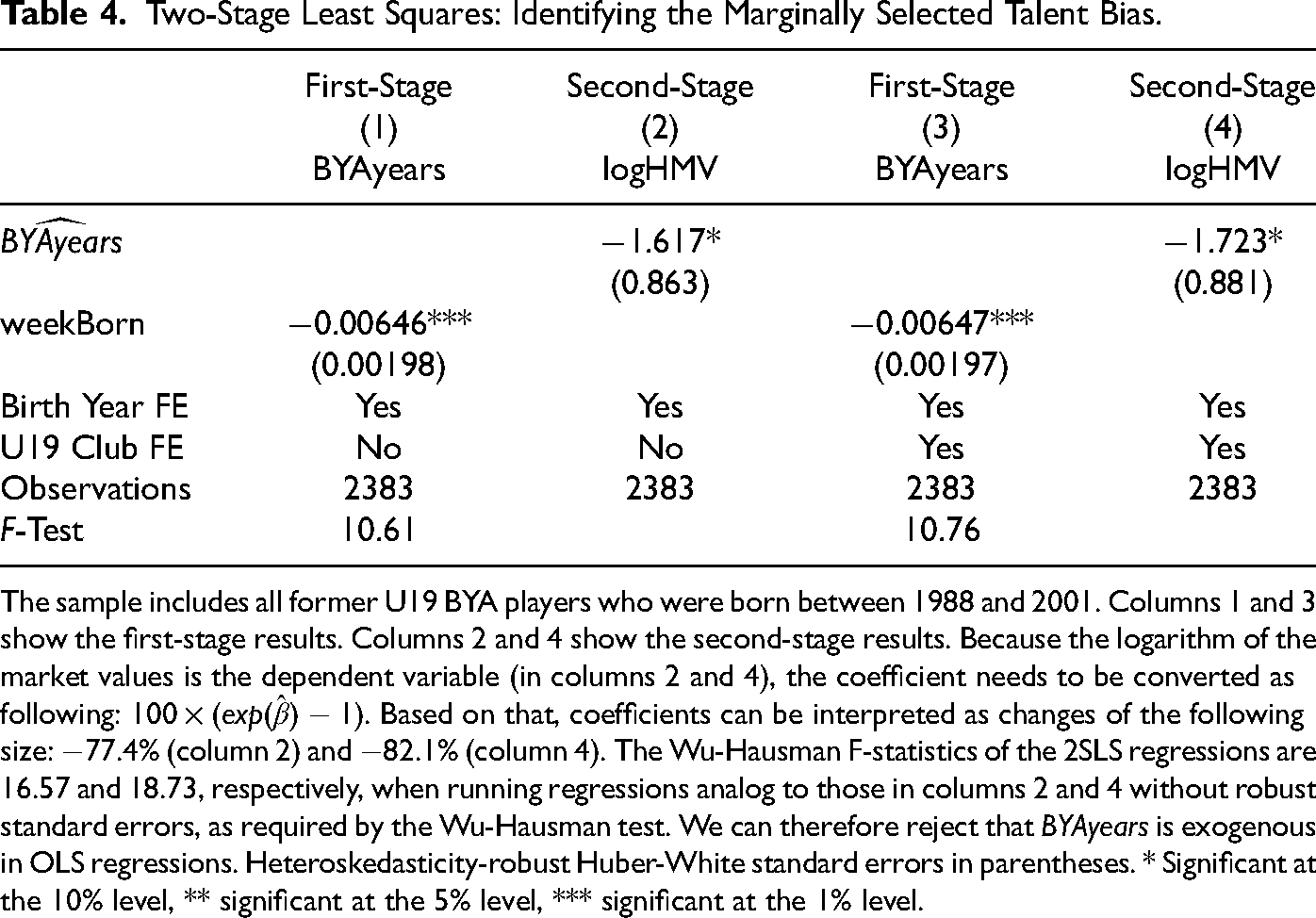
The sample includes all former U19 BYA players who were born between 1988 and 2001. Columns 1 and 3 show the first-stage results. Columns 2 and 4 show the second-stage results. Because the logarithm of the market values is the dependent variable (in columns 2 and 4), the coefficient needs to be converted as following:
Following the idea of Angrist and Krueger (1992), birthdays are generally a valid instrument as they are plausibly random and uncorrelated with possible confounders. As Musch and Grondin (2001) argue, there are no seasonal circumstances which could explain why youth players are more likely to be selected by elite youth academies apart from relative age. Players born in December of one year and those born in January of the next year are exposed to the same conditions while growing up. 18 It is therefore safe to assume that unobserved ability is distributed equally across birth months in the whole population.
However, unobserved ability is likely not independently distributed in our sample of those players that were selected into BYAs while it is in the general population. As unobserved ability likely influences how early a player gets selected and also how much BYA training he gets, it is also linked to market values. In our sample, the exclusion restriction—the necessary assumption to identify causal effects using IV—therefore likely fails. The IV estimation is biased. This implies that we cannot identify the causal effect of BYAyears on market values. Still, we can use the biased IV estimation to learn something about the covariance of the instrument (the relative age) and the confounder (unobserved ability).
Note that the biased IV estimator, not conditioning on fixed effects for simplicity, can be expressed as follows:
19

The only part of Equation (10) which we do not know the sign of is the covariance of the 2SLS regression error
In fact, Columns 2 and 4 of Table 4 show that the 2SLS estimator is significantly negative at the 10% level. Based on Equation (10), we thus conclude that the covariance of unobserved ability and relative age disadvantage is positive.
Using another feature of IV estimation, we can go even one last step further. The IV estimator
In conclusion, we have utilized a biased IV estimator to establish that the covariance of unobserved ability and relative age disadvantage is positive at the margin of getting selected. This does not only support Hypothesis 2, but also explains why we find an ability premium for those with relative age disadvantages on average (Hypothesis 3).
Finally, we want to note that the instrumental variable approach is very promising for further analyses of the mechanisms involved in the RAE. New data on both elite and non-elite youth players would promise two advantages. First, the prevalence of the RAE in BYAs would likely further increase the instrument’s strength. Second, the exclusion restriction would hold, as talent in the whole population is independent from birth dates so that a causal effect of elite youth academy training on market values could be estimated. IV regressions can therefore be a promising starting point for further research.
Foregone Market Values
This section aims to test Hypothesis 4. The key questions are: Do BYAs forego higher market values by not selecting youth players evenly across birth months? And, can we quantify how much additional market value, if any, BYAs could generate when eliminating the RAE in talent selection? To answer these questions, we start with the findings derived in the previous section. We found that, in the sample of former BYA youth players, those with relative age disadvantages have on average higher ability levels; in particular, at the margin of getting selected. This implies, for example, that the December-born player who was just not selected by a U15 BYA is likely to have higher (unobserved) ability than the January-born player who just got selected by the U15 BYA. From Figure 3 in Section “Theoretical Framework”, it is apparent that this exemplary selection decision can be improved: By selecting the marginal December-born instead of the marginal January-born, ability in the BYA could be increased; as well as market values in the long term.
Of course, one would need clairvoyant abilities to predict the actual performance potential of youth players. The relationships established in Hypotheses 2 and 3 are obviously not valid for each individual player. Still, the positive association of relative age disadvantages and unobserved ability, which exists on average, indicates that selecting more evenly across months of birth will also have effects on average. To test Hypothesis 4, we therefore compare groups of players, not individual players. The idea is rather simple: We compare a group of players that is representative for the current average level of ability in BYAs to a group of players that is representative for the average level of ability that would emerge if selection was independent of the RAE.
Specifically, using month of birth as a grouping variable, we compare a credible status quo reference group (ref) to a plausible state-of-no-RAE group 
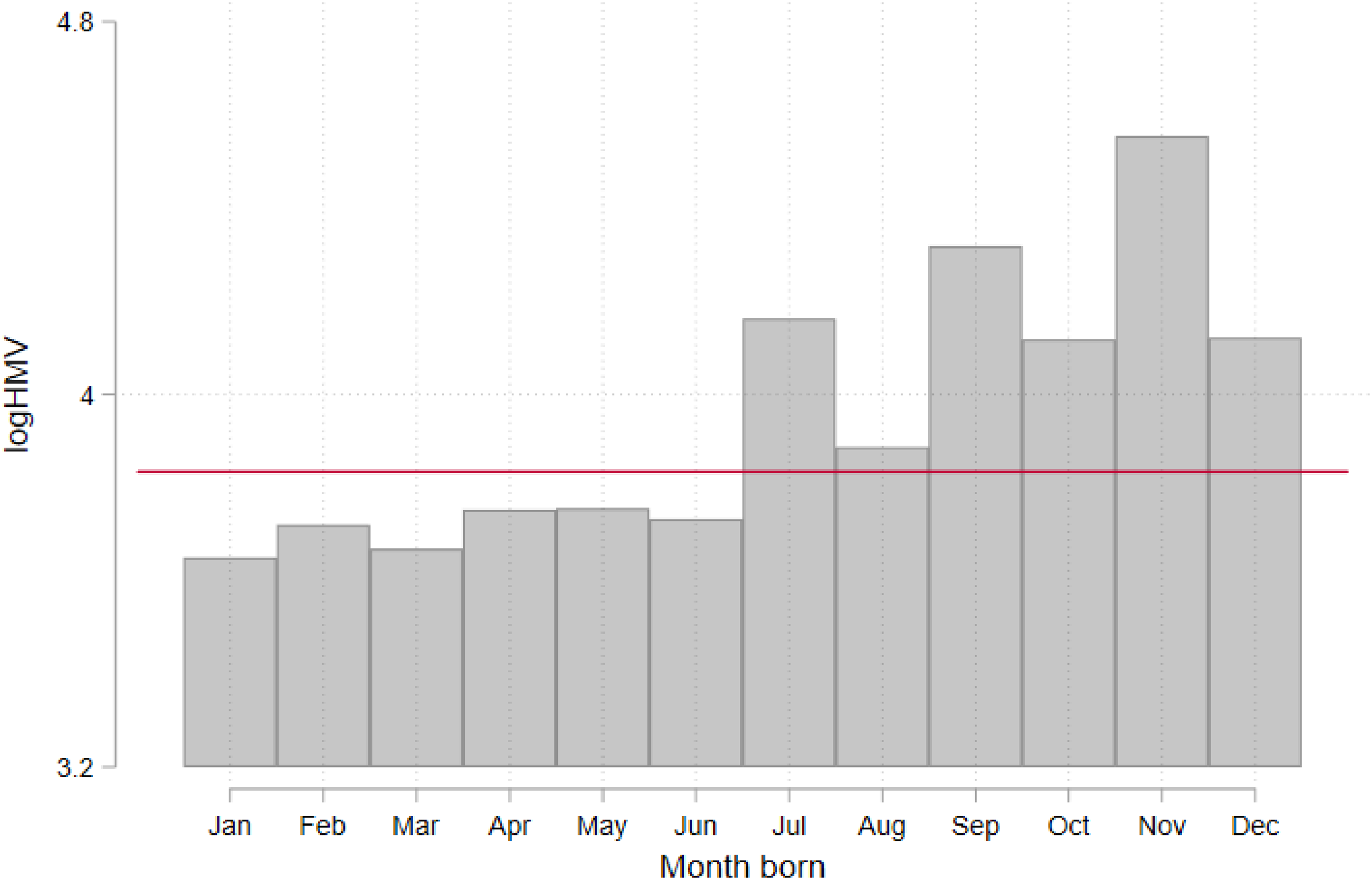
Mean logarithmized highest market values by month of birth. Note: The sample includes all former U19 BYA players who were born between 1988 and 2001. The red line refers to the average logHMV of all players born between 1988 and 2001.
We now turn to the question of how high the average talent level in BYAs could be when eliminating the RAE. The natural choice for the state-of-no-RAE group are players born between September and December. We split this group into a September–October and a November–December group. In forming these groups, we can account a bit for the fluctuations in logHMV across birth months (see Figure 5). We consider the November–December group as a more optimistic state-of-no-RAE group, as among these players the average talent level should be the highest, while the September–October state-of-no-RAE group is a more conservative choice.
Building on Equation (11), we estimate the cost of the RAE in BYAs using OLS regressions. For each status quo reference group (ref), we estimate differences in means with respect to a set of state-of-no-RAE groups 

Table 5 reports the coefficient estimates for different status quo reference groups and state-of-no-RAE groups. Columns 3 to 5 show estimates with players born between May and August as the reference group which, as discussed above, constitute the most credible baseline for how high the average talent level currently is in BYAs. Taking players born between September and October and those born between November and December as the state-of-no-RAE groups and following our reasoning above, we find that BYAs could generate 30.6 to 72.8% higher HMV when eliminating the RAE.
The Foregone Market Values and the Relative Age Effect in Bundesliga Youth Academies.
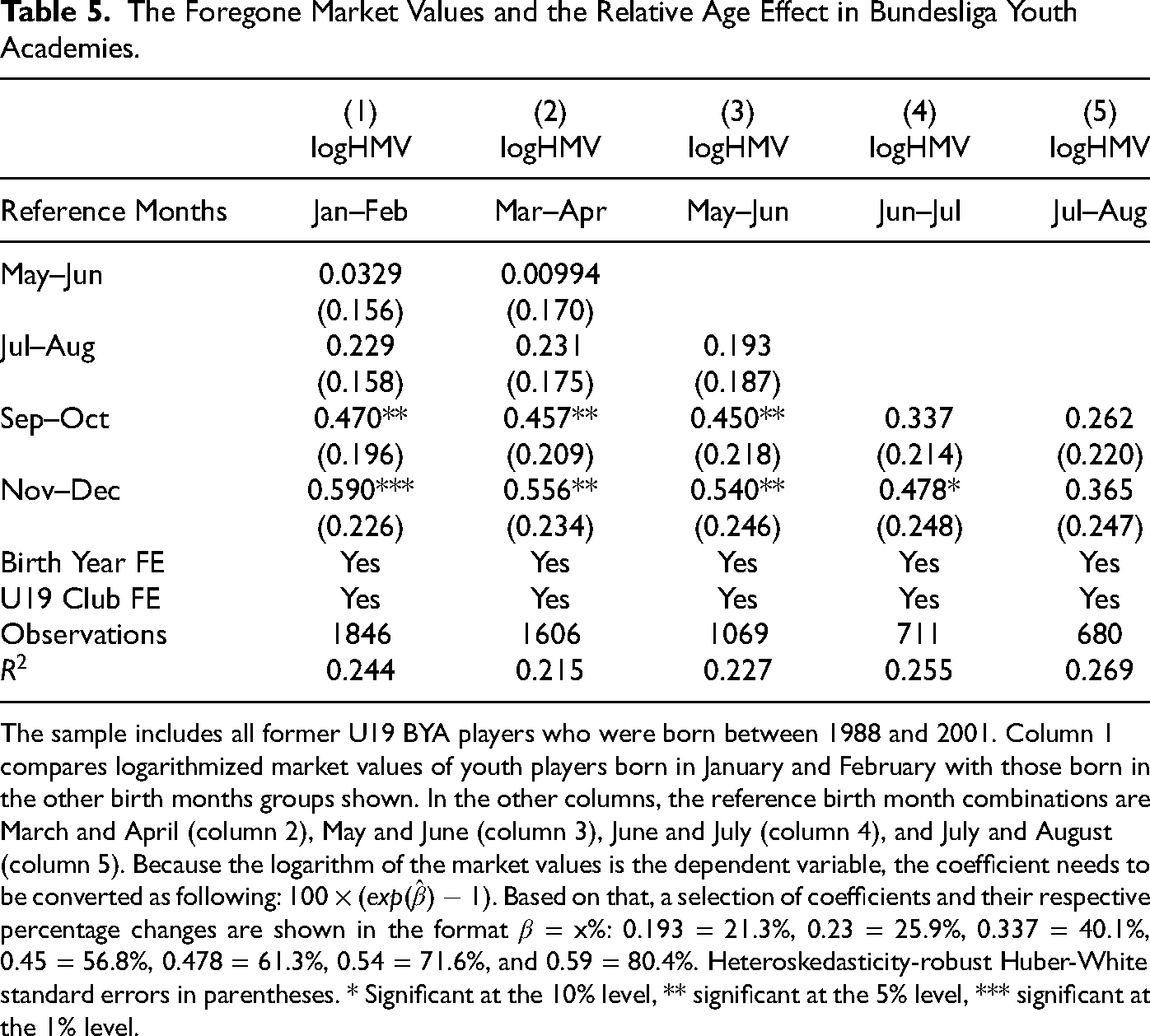
The sample includes all former U19 BYA players who were born between 1988 and 2001. Column 1 compares logarithmized market values of youth players born in January and February with those born in the other birth months groups shown. In the other columns, the reference birth month combinations are March and April (column 2), May and June (column 3), June and July (column 4), and July and August (column 5). Because the logarithm of the market values is the dependent variable, the coefficient needs to be converted as following:
Taking the natural choice for the status quo group, players born in June and July, as reference (Column 4 of Table 5), eliminating the RAE in talent selection is associated with 38.8 to 64.5% larger HMV. The estimator of the September–October state-of-no-RAE group, however, is not statistically significant. The estimate of the November–December state-of-no-RAE group is meanwhile statistically significant at the 5%-level. Overall, the estimates show that eliminating the RAE could lead to sizeable effects on average market values of former elite youth players.
Considering the alternative status quo groups, May–June (Column 3) and July–August (Column 5), we see that the estimates follow the expected patterns. Mean differences are larger in size and statistically significant for the May–June reference group, while they are smaller and insignificant for the July–August reference group. Moreover, the November–December state-of-no-RAE group leads to generally larger mean differences than the September–October group. Hence, the difference in logHMV between the July–August and the September–October groups (Column 5, 30.6%) plausibly constitutes a lower bound for the opportunity costs of the RAE in BYAs. Likewise, the difference in means between the May–June and November–October groups (Column 3, 72.8%) can be considered an upper bound. The estimates are robust to controlling for individual player’s height and strong foot (see Table C4 in Appendix C).
Overall, these results support Hypothesis 4: BYAs forego higher average market values by maintaining selection characterized by the RAE instead of selecting youth players evenly across birth months. Market values differ considerably over birth months with players born later in the year having generally higher market values. Eliminating the RAE in talent selection, average unobserved ability levels in BYAs could be increased. We find that this higher average ability would translate into 30.6 to 72.8% higher market values of former U19 BYA players. Hence, professional German clubs could generate substantially more value through their BYAs than they are currently doing. To express this in numbers, if the average former BYA player sells for 1.284 million EUR today (see Table 1), he could sell for 1.677 to 2.219 million EUR in absence of the RAE.
One could criticize our calculations arguing that relatively younger players might compensate for their relative disadvantage with greater effort and might even adapt their performance level to the relative physiological advantage of their peers (see Mann & van Ginneken, 2017; Votteler & Höner, 2014). In other words, relative age disadvantages could come with positive spillovers from relatively advantaged team mates. This is also discussed as peer effects in the literature (see, e.g., Ashworth & Heyndels, 2007). A disproportionately higher share of older players within a youth team would then not be an indication of the RAE, but could be a strategic tool to promote a few exceptionally promising players (see Section “Production Function of Elite Youth Academies and the Optimal Selection Policy”). Two important observations speak against this argumentation. First, evidence suggests that relatively younger and relatively less physically developed youth players tend to receive less match playing time than their relatively older and stronger peers (Deprez et al., 2015; Sæther, 2016; Vaeyens et al., 2005). This is also in line with the observation that clubs aim to be successful at all stages and utilize the RAE in pursuit of short-term success (Jiménez & Pain, 2008). For relatively younger players, positive spillovers during training might thus be balanced out by the negative effect of less and shorter match experience. Second, the RAE can still be observed at the professional level (see Sierra-Díaz et al., 2017 and Figure C3 in Appendix C) which indicates the inability of elite youth academies to identify their top players independently of the RAE.
Finally, we need to emphasize again that we only estimate the possible gains of eliminating the RAE. We have not considered the opportunity costs of the relative maturity effect which co-exists next to the RAE and is also influential in BYA talent selection (see Malina et al., 2000). The overall costs of selecting along the lines of momentary instead of potential performance levels are therefore expected to be even higher.
Conclusion
This article investigates the RAE in German elite youth soccer. We develop a simple theoretical model which illustrates the underlying mechanism in talent selection and the negative consequences of the RAE. Based on our model, we derive four hypotheses: First, given selection cut-offs during performance development, relative age-based performance differences, and positive effects of elite youth academy training, we hypothesize that the RAE occurs in an competitive environment, and is sustained even when relative age differences fade. Second, we hypothesize that among marginally selected players, relative age disadvantages (later birth months) are positively correlated with players’ unobserved ability. Third, we derive from the second hypothesis that, among all youth players selected by elite academies, average ability levels are positively correlated with players’ relative age disadvantages. Fourth, we postulate that elite youth academies forego the creation of higher market values by not selecting youth players more evenly across months of birth. Our data includes information on the players of the most successful German Bundesliga Youth Academies (BYAs) for the period 2002–2020.
Even though the RAE has been well-documented since decades, our results show that it still exists in German elite Bundesliga youth academies. While there is no reason to assume that ability is not distributed evenly across birth dates, we find that 71.5% (44.6%) of the players in BYAs in the under 19 teams were born in the first 6 (3) months of a year. In this competitive environment with key date assessments, relatively older players within a cohort accordingly have a higher probability of getting selected. Moreover, the RAE also persists in professional German adult soccer. This supports our first hypothesis.
We show that elite youth players who were born towards the end of the year, on average, reach significantly higher market values during their career. This suggests that, within the sample of all players that were selected by BYAs, elite youth players must compensate for their relative age disadvantage by having higher ability. This is also expressed in market values and supports our third hypothesis.
With respect to our second hypothesis, we rely on an instrumental variable approach to learn about the covariance of some part of the error term (unobserved ability) and the instrument (relative age disadvantage). We find that relative age disadvantages are positively correlated with unobserved ability at the margin of getting selected. This supports our second hypothesis and explains the significantly positive relation between market values and relative age disadvantages.
Finally, the results of our analyses reveal that the RAE causes substantial financial losses for the clubs as it reduces players’ market values. According to our estimations, future market values of BYA players could be between 30.6 and 72.8% higher if the clubs were able to eliminate the RAE in talent selection. These figures support our fourth hypothesis and show that the RAE does not only cause substantial costs in terms of team performance, but also in the financial dimension.
The mechanisms we have described are also relevant for talent identification, development, and recruitment outside of sports. There are many (structural) reasons that give individuals short-term advantages or disadvantages (e.g., parental background, gender, ethnicity, networks, ordinal ranks, language, mobility, environmental shocks, etc.) which might mask their real potential. This can be the case in several contexts: firms’ hiring or promotion decisions, the admission to certain schools or study programs, tracking decisions in school, allocation to math or reading groups or other enrichment programs in (primary) school, the award of scholarships, program participation among unemployed or in development aid, et cetera. Failing to account for these short-term factors reproduces and deepens inequalities (e.g., Hanushek & Rivkin, 2009; Murphy & Weinhardt, 2020) and poverty (e.g., Balboni et al., 2022), leads to a waste of talent, and makes later compensatory investments more expensive, especially if relative disadvantages occur in early childhood (see Cunha & Heckman, 2007).
We show that distinguishing between adolescents’ current and potential performance levels is crucial for the efficient allocation of talent and resources. Beyond that, our article contributes in two ways to the debate on how to improve the allocation of talent in society. First, we offer a conceptional framework and an exemplary application, highlighting the key mechanisms and implications of talent selection in the nexus between current and potential performance levels. Second, we show that the economic gains can be large if initial differences are eliminated rather than perpetuated.
Footnotes
Declaration of conflicting interests
The authors declared no potential conflicts of interest with respect to the research, authorship, and/or publication of this article.
Funding
The authors received no financial support for the research, authorship and/or publication of this article.
