



Abstract
It is common in international football for the same agent to be paid both commission fees by the purchasing club for negotiating a player salary and a transfer fee. This dual representation creates a potential conflict of interest for the agent. The agent may not negotiate the highest salary for the player if a higher salary reduces the likelihood of a successful transfer by lowering the resources available for the transfer fee. We construct a gamble model of the transfer process and simulate the ex-ante agent commissions rates, expected player salary, transfer fee and club profit under the assumption of dual representation where the buying club pays all agent commissions. The assumption that the quality of the agent increases with the commission rate is essential to the model. Both the player and the club are better off when the club pays both commissions, however the agent is worse off.
Introduction
A curious feature that distinguishes the English Football Association (FA) from the major North American Leagues is that player agent regulations allow the agent to be paid directly by the club for negotiating salary contracts with the consent of the player (Geey, 2019). This payment can be a fixed fee or a commission rate based on the value of the contract (paid on an annual basis). FIFA regulations refer to this feature as “dual representation”. Agent fees are substantial in the English Premier League (EPL) amounting to £320 million in the 2022–2023 season (Stone, 2023). The accepted practice in the FA is to state a 50:50 split in the agent's fees paid by the player and the club, largely because of tax considerations. 1 However, agent fees charged to the player are often paid by the club in which case the VAT-inclusive cost of that fee to the club is a taxable benefit for the player. The player and the club will also be liable for a national insurance contribution to fund government social programs. The club is essentially paying for access to bargain with the player when it pays the agent's fee, hence the agent is representing two clients.
The same agent selected by the player typically negotiates a transfer fee between a selling club and a buying club for the player's services. A maximum commission rate of 10% paid to agents on transfer fees was proposed by the FIFA Football Stakeholders Committee in 2019. The committee also recommended a maximum commission rate of 3% for the negotiation of player salaries, paid by the player or by the club. 2 Both of these measures were intended to ensure fair and cost-effective player representation, however, they also constrain the ability of clubs to pay commission rates that maximize profit. Changes to FIFA regulations in late 2023 cap the agents commission rate for negotiating transfer fees but do not cap the rates paid for salary negotiations.
The problem of dual representation does not exist in North American professional sports leagues. The player hires an agent to negotiate a salary contract and pays the agent's commission. In the case of international football leagues, the process is more complicated. We assume here that clubs pay 100% of the player salary and agent commissions to keep the problem tractable. Two effects are at work on club profits. Paying higher commission rates will reduce the profitability of acquiring the player when the revenue generating potential of the player is fixed since fewer resources are left for the player salary. However, if higher commissions attract better quality agents and incentivize the agent to spend more effort on negotiating with the selling club and the player, the probability of acquiring the player increases and improves the expected profitability of the transaction. 3 Players already suffer reduced compensation due to the transfer fees that clubs must pay to each other that eat into the revenue generated by the player. Without the ability to pay the agent to negotiate a greater salary than its already depressed value, players could receive an even lower wage after paying the commission, particularly for players at the lower end of the salary distribution. Although somewhat costly for clubs, paying the agents commissions could be more profitable for them.
We build a simple model of this trade-off that assumes an expected utility maximizing player and an expected profit maximizing club and compute simulation results to determine the expected salary of the player, the expected transfer fee and the expected profit for the club under different scenarios. This determines the base case as it exists today in the FA. We then allow the player to pay the agent's commission for facilitating the player salary contract, while the same agent facilitates a transfer fee between the selling and buying club. The two problems are connected by the fixed revenue generating potential of adding the player to the club roster. Paying a higher transfer fee, that increases the probability of a successful purchase of the player, reduces the revenue available to pay the player salary, reducing the probability of an acceptable salary. By simulating the resulting expected transfer fee, player salary and club profit, it can be determined under what scenarios the player is better off in a monetary sense. This is an important policy question for an organization such as FIFA is the objective is to maximize the welfare of players. However, FIFA may have competing objectives for club owners.
Our approach will model the salary and transfer fee processes as the product of two gambles with uncertain outcomes. One might suggest a Nash bargaining model as an alternative approach to the problem of commission rates in salary negotiations. This could be done in the case of a player in a North American professional sports league that avoids the complications of a transfer fee and dual representation. The standard Nash bargaining model of wage negotiations is developed in McDonald and Solow (1981). However, the model is not suitable to the unique aspects of the elite professional sports player market. The standard Nash model assumes a two-step process: in the first step, a market wage is negotiated for the homogeneous supply of workers; in the second step, firms decide how many workers to hire at the market wage. This modelling process has been used in different applications for decades (Haake et al., 2022).
Professional sports players are not homogeneous and salary negotiations do not take place in an atomistic labor market. Rockerbie (2009) builds a Nash bargaining model of a player entering potential free agency when facing the prospect of a supply of free agents available in the market at the same playing position. The player has the option to remain with his club for an additional season (an option year) and must decide whether to enter the free agent market. Players should exercise their option right when a condition for the expected salary is met. Solow and Krautmann (2011) developed a Nash bargaining model of elite free agent professional players salaries. The model requires full information of the players marginal revenue product to the negotiating club, the same for the next best competing club and its salary offer, and the same for the players “replacement” player if negotiations fail. The resulting salary falls within an upper and lower bound with the final solution determined by the bargaining powers of the player and the club owner, requiring that parameter values must be assumed. Rockerbie (2020) uses an auction model to analyze posting fees (essentially transfer fees) and player salaries in the Major League Baseball–Nippon Professional Baseball posting system. The result is a range of possible equilibrium salaries and posting fees with no unique solution, unless specific probabilities are assumed.
In general, Nash bargaining models of isolated labor negotiations can yield instances of multiple equilibria, a single unique equilibrium, or no equilibrium depending upon the specification of parameter values, usually probabilities that determine a position, or multiple positions, in a payoff matrix. The advantage of the gamble model used here is that salary and transfer fee probabilities of success are determined within the model. The “negotiated” salary, transfer fee, and commission to the agent maximize the joint probability that a successful transfer takes place. Whether the actual transfer is successful is not known, however a league policy maker is assumed to write a regulation regarding the payment of player agents with the welfare of the player being the sole concern. The policy maker is not concerned if the buying club overpays for the player or if the selling club receives too little or even if the parties do not agree on a transfer. In addition, the policy rule must be general enough to apply in all situations without any prior knowledge of the financial constraints, demands or identities of the parties involved by the policy maker. The simulation of the expected salary of the player allows the league policy maker to make comparisons between different agent compensation rules in an equivalent way to an optimal portfolio decision in choosing the portfolio with the highest expected mean return (although the method here does not incorporate risk).
We assume that the buying club is not competing with other buying clubs for the player's services. Relaxing this assumption would require determining the best response function for each buying club and solving for the Nash equilibrium, an unnecessary complication since our objective is partial in the sense that we wish to isolate the single buying clubs expected salary offer, profit and transfer fee with and without dual representation. Doing so for two competing clubs with the same objective function will not likely change the qualitative results concerning dual representation for each club.
Although our model is not a Nash bargaining model, it incorporates many of its features, such as an upper and lower bound for the salary range, determined by the players anticipated marginal revenue product for the buying club, and a minimum transfer fee that is acceptable to the selling club. Bargaining power is obtained by the player when hiring a skilled agent with bargaining power measured by the probability of negotiating the upper bound salary and thereby extracting surplus from the club owner. We believe that our model allows for richer comparative static results although the broad conclusions are likely the same as those found in a Nash bargaining model.
Background
The four major professional sports leagues in North America all feature players associations that negotiate a collective bargaining agreement that governs many of the regulations regarding the league treatment of its players. Unlike other unionized industries, player wages are not negotiated by players associations, but instead are left for each player to bargain with the assistance of an agent. Agency problems include adverse selection, choosing a quality agent when information is incomplete, and moral hazard, ensuring the agent acts in the best interests of the player after being hired. The latter is particularly difficult when it is costly for the player to monitor the effort of the agent (Jones & Butler, 1993). Incentive problems of agents have largely focused on the shareholder-manager relationship since Jensen and Meckling (1976) but have been explored in the professional sports industry in the vast legal literature that we summarize here with a few references. Legal concerns include what governing body should regulate agents: state governments, federal government, or the players associations (Karcher, 2006); the legalities of the existing regulations governing the behavior of agents (Balsam, 2018); and the unique services and agency problems particular to representing a professional sports player (Bull & Faure, 2022). An excellent overview of legal agency issues in professional sports is Mason and Slack (2005). Agency problems are a particularly acute issue with student athletes who aspire to enter a professional sports league. Student athletes often have little guidance in selecting an agent (adverse selection) and can fall victims to misrepresentation and misinformation by their agents. Some progress has been made on the legal front from regulations imposed by the National Collegiate Athletic Association (NCAA). A good survey is Shropshire and Davis (2008).
In international football, the agent's commission for both the negotiation of the transfer fee and the player's salary is paid by the club acquiring the player. This is the standard agreement in the FA. This dual representation introduces agency problems that are worthy of discussion. Player agents in the English FA face largely the same certification process as in the North American leagues. An application to the FA, if approved, is followed by an exam followed by certification. There are no education requirements and family members and spouses of a player may receive certification without writing an exam to negotiate on behalf of the player only, not the club. 4 There is no maximum fee and compensation can take the form of a commission or fixed fee. Player agents in all the professional leagues already mentioned are required to submit timely statements of their transactions and pay annual fees to their respective governing bodies in order to maintain their certifications.
A player who is “out of contract” in a football league outside of North America is a free agent and may negotiate, through his agent, to join another club. 5 However, a player who is still under contract may submit a written request to transfer to another club with some restrictions (proper representation and paperwork). 6 If approved by the player's club, the player is placed on a transfer list that notifies other clubs that the player is available for purchase. In almost all cases, the player is sold to another club when the player makes the transfer request since the request usually follows a disagreement with the club regarding salary negotiations for a new contract or some other issue. The player is moved to another club in most of these cases. 7 Also, a player may be put on a transfer list by the club if it no longer wishes to keep the player for the same reasons, a lack of performance on the pitch, or if it receives potentially lucrative interest in the player from another club. The selling club negotiates a transfer fee with another club through agents as intermediaries. The agents collect a fee that could be a percentage of the transfer fee or a fixed fee. Clubs typically do not negotiate with each other directly. International transfers must be entered into the FIFA's Transfer Matching System to ensure that both parties agree on the conditions of the transfer. If negotiations over the transfer fee fail, the player remains with his existing club. The agent does his or her best to negotiate a successful transfer for the acquiring club and negotiate a new contract for the player. Clubs use the transfer system as an efficient way to acquire players from other clubs. Clubs can simply purchase players that best fit the needs of the club on the field without trading away valuable talent that may have been developed at significant costs. In addition, transfer fees assist clubs in capturing the surplus revenue from the players instead of allowing players to capture their own surplus in a free agent bidding market. This keeps surplus revenue with club owners and maintains player salaries lower than they may otherwise be. The four North American professional sports leagues discourage large case sales (essentially transfer fees), and they are very rare. 8
Economics suggests that a club owner will estimate the value of the contract based on the expected future revenue that the player brings to the club and the surplus revenue over and above the player's compensation. It could be the case that the expected future revenue is exhausted by the player salary, the payment to his or her agent, and any transfer fee paid to another club. 9 Hence any payment made by the club to the agent could reduce the negotiated salary of the player. This sets up an obvious conflict of interest for the player-agent relationship. The agent could receive a higher fee from the club in exchange for increasing the likelihood that the club acquires the player. However, dual representation could in efficiency gains if negotiation time and monetary costs are reduced.
Previous economic research has focused on compensation schemes for agents in markets other than the professional sports industry. Knoll (1988) constructs a model of commission fees in the real estate market in which the builder of a property must borrow funds for construction. The optimal commission rate is found to be an increasing function of the market value of the property due to interest charges and the opportunity cost of delays in selling the property after construction is completed. It is quite common in the real estate market for agents to charge progressive commission rates for higher property values, say 2% for the first $300,000 and 4% for any amount over and above. Levmore (1993) explores why progressive commission rates have not developed in other markets, such as lawyers and finance. When facing a portfolio of principals to represent with different market values, an agent will exert the efficient amount of total effort when charging a uniform commission rate. Inderst (2015) explores caps on commission rates, mandatory disclosure of commissions, limiting progressive commission rates, and the mandatory deferral of commissions as policies to limit the moral hazard behavior of agents who sell products on behalf of firms. A cap on commissions can raise consumer welfare if the agent has an incentive to steer consumers to products that do not fit their needs. Commissions can be eliminated if the producer can guarantee the quality and attributes of the product (perhaps through higher product prices as a signal). However, firms could find it profit maximizing to “mis-sell” products to consumers that do not match their needs, imposing negative reputational costs on the firm, if the commissions necessary to incentivize the agent to steer the consumer to the right product are high (Inderst & Ottaviani, 2009).
Issues of agents in professional sports leagues have received little attention in the economics literature, much less commissions paid to them. Krautmann et al. (2017) found that agents who represent a large portfolio of NFL players put in less effort and achieve inferior salary contracts than for agents who represent just one or a few players. Conlin et al. (2013) found that it acquires a minimal amount of expertise (measured by years of experience) to negotiate a satisfactory salary for NFL players, but expertise is valuable in negotiating other attributes of the contract, such as contract length and incentive clauses. However, we could not find any previous research that addresses commission rate caps in professional sports leagues and their welfare consequences for the players.
The next section models the expected profit-maximizing decision facing a club owner who pays the player salary, transfer fee and agent commissions on both negotiations.
The Dual Representation Model of Agent Commissions
We treat the transfer fee and salary negotiations as simultaneous events. The club owner must keep his or her expectation of the transfer fee and player salary in mind when determining an optimal commission rate to pay the agent. Here we are modeling the club owner's ex ante maximization problem without any constraint on the commission rate paid to the agent. One could argue that in the real world the transfer fee must be agreed upon first since this confers the right to negotiate with the player. The maximization problem would then be a simple matter. The transfer fee and agent's commission would be determined in the first stage with the residual surplus left to negotiate in the player contract in the second stage. One ends up with a very simple two stage maximization process. However, it stands to reason that a club owner would rationally anticipate these two stages before any negotiations commenced since he or she faces a budget constraint given by the expected present value of revenue that the player will bring to the club. Negotiating a higher transfer fee increases its likelihood of being accepted but reduces the amount of surplus available to sign the player, reducing the probability that the player agrees. The transfer process then fails.
To keep the model simple, we assume that the player faces a high (







What does this result mean for the player? The gamble model here is not a model of optimal salary determination so the player is not likely going to receive £7.37 million. The result states that the player has a probability of 0.711 of receiving his maximum salary request, £10 million, but the actual salary resulting from negotiations is only known to be between £5 million and £10 million if the transfer is successful. The same logic applies to the selling club – the model here does not predict the optimal transfer fee. Rather, there is a probability of 0.459 that the club receives its maximum transfer fee demand of £25 million but the actual transfer fee is only known to fall between £15 million and £25 million. The league policy maker considers the expected outcomes of the model when formulating the policy regarding which party should pay the agent, but cannot guess the actual outcomes, much like the decision whether to buy a lottery ticket.
A lesser player on a lower quality club should expect a smaller salary and transfer fee. we use R = £4.5 million,
Superstar players demand high salaries and the clubs selling them demand large transfer fees. We use an example of a very high-quality player whose selling club is demanding a large transfer fee with the potential for a high range. we use R = £150 million,
Salary or transfer fee negotiations that are more difficult to complete could be reflected in higher values of
Player Pays the Salary Commission
The player's problem is to choose a commission rate that maximizes his expected utility from his salary while the club owner pays the commission to negotiate the transfer fee that maximizes expected profit. The player's expected utility of the new salary is given by



We check for robustness of this result by simulating the cases for a lower quality player and a superstar player using their assumed values for the exogenous variables stated earlier. The solutions for the low-quality player are α = 0.0501, γ = 0.0716, p = 0.580, z = 0.727, S = £1.47 million, T = £0.977 million and an expected club profit of £0.6 million. The commission paid to the agent for the salary agreement is lower resulting in a lower expected salary, the transfer fee is largely unchanged, and the expected club profit is slightly higher. The net salary for the player is £0.734 million. Again, it is preferable for all parties to have the club pay all commissions to the agent, although the gain is small due to the small figures. The solutions for the superstar player are α = 0.044, γ = 0.0434, p = 0.502, z = 0.495, S = £35.89 million, T = £71.6 million and an expected club profit of £9.8 million. The net salary for the player is £34.31 million. The upshot is the same as for the two previous cases: all parties are better off when the club pays all the commissions, in the player's case by £4.28 million.
The agent acts as a third player in this process but has no say in the setting of the commission rates. In all three cases simulated above, the agent suffers a lower expected total commission fee when the player pays the commission for the salary negotiation. Hence the agent will prefer acting as a dual representative for the player and the club, rather than represent the player only. Assuming larger values for
Since each transaction in the transfer market requires a seller and a buyer, a split vote might result if the issue came to a referendum voted on by the clubs. Logically smaller low revenue clubs that invest in young talent to sell to the larger revenue clubs would vote against the policy. If they are large in number, the policy would revert to the North American practice if a binding vote were to be held. However, individual clubs have little influence since FIFA regulations are approved by its Governing Council (a body of 37 individuals) that governs its six continental federations worldwide. Clubs only have influence on policy through their continental federations. Organizing the smaller market clubs around the world to change FIFA policy governing the rules of agents is difficult, costly and might not be worth the effort if the loss of transfer fees is marginal.
Player Pays Both Fees
Although not existing in Europe, we can consider the case of the player paying both commissions as an aside. The objective function for the player is given below.



Solutions When Player Pays Both Commissions.
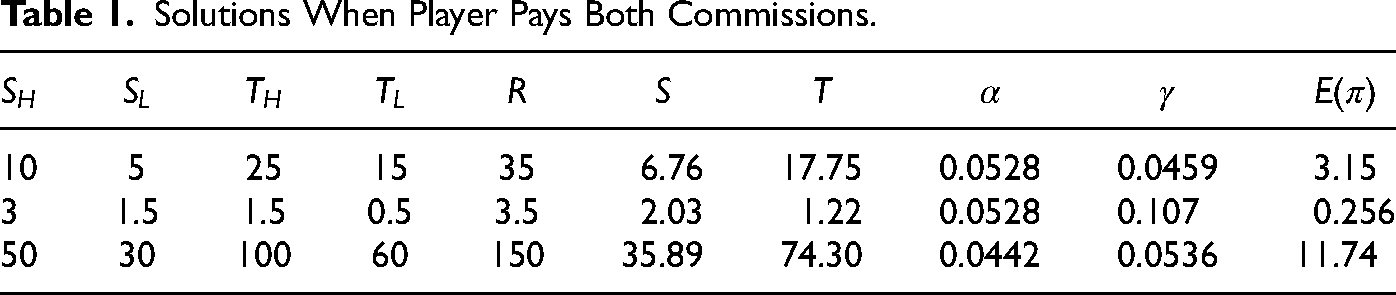
The player earns a lower expected salary in the first and third cases in Table 1 and is marginally indifferent in the second case compared to having the club pay both commissions. The buying club experiences a lower expected profit in the second case and is very marginally better off in the first and third cases, however any fixed transactions costs could easily turn all three cases into a loss in expected profit. The selling club experiences a higher expected transfer fee in the third case. However, it is not the case that all parties are better off in any of the three cases (excluding the agent). Having the buying club pay both commissions is a preferred policy for the league policy maker as it yields more certain results with no difficult trade offs between the parties involved.
Conclusions
This paper has questioned why the system of dual representation has persisted in international football while it is not allowed in North American professional leagues. An agent representing both the player and the club in salary negotiations introduces a potential conflict of interest since it might be in the interests of the agent to secure a contract agreement with the club to receive a commission. The same agent typically negotiates a transfer fee between the selling and buying clubs. If the transfer fee is large, the agent could recommend the player sign an inferior salary contract to receive the commission from the transfer. Yet, the policy is sanctioned by FIFA, the world football governing body and players participate in the system freely. It could be the case that the player benefits with a higher net salary with dual representation since the player is not paying the commission for the salary negotiation, however the player might agree to an inferior salary that makes him worse off. We investigate this trade-off by constructing a model of salary and transfer fee negotiations that treats both as an uncertain gamble with known upper and lower bound salaries and transfer fees.
The model is simulated yielding realistic parameter results for the profit-maximizing commission rates when the club pays both fees and when the utility-maximizing player pays the commission fee for the salary agreement, but not the transfer fee. The assumption of a risk-neutral players allows for the direct comparison of the expected salary, transfer fee and club profit under both scenarios. The player, the buying club and the selling club achieve a better outcome when the buying club pays both commissions. This result arises from the assumption that a higher commission rate incentivizes the agent to achieve a higher salary for the player. The optimal commission rate is lower when the player pays the commission for the salary agreement, resulting in a lower expected salary even before paying the commission. This result is robust to different values for the salary range, transfer fee range and maximum commission rates. The agent suffers a smaller total commission fee from the salary and transfer fee negotiations when the club pays the agent both commissions. However, agents have little influence in FIFA policy regarding agents and the market for agents is competitive, particularly in the international football market in which the qualifications for agents are somewhat lacking compared to North American standards.
We do not suggest that North American leagues adopt the system of dual representation existing in the international football market. The structure and business practices of North American leagues is alien to the international football leagues. The lack of a promotion-relegation system gives fewer clubs the incentive to act as player developers and sellers. More equitable revenue sharing of media revenues already gives small market clubs a better chance of survival, 15 as does the sharing of local revenues not practiced internationally. 16 Salary cap systems limit the salaries of players in the NFL, NBA and NHL, reducing the bargaining powers of players and agents. The cash transfer market is largely non-existent in the North American leagues except for small “cash considerations” to facilitate trades.
Footnotes
Funding
The author received no financial support for the research, authorship, and/or publication of this article.
