



Abstract
The proposal of the European Super League and the 2024/25 reform of the UEFA Champions League are both major events in European club football. This study compares the competitive balance (CB) of these new tournament formats with the previous Champions League format. Short-, mid- and long-term CB are quantified by measuring the average uncertainty of match outcomes, the ratio of stakeless matches, and the recurrence ratio of teams in knockout rounds. A simulation method is applied using the teams, their seeding, and Elo ratings in the 2020/21 and 2021/22 Champions League seasons. Results suggest that the 2024/25 reform improves CB, especially in match uncertainty and the occurrence of stakeless matches. In comparison, the Star League of the European Super League concept of December 2023 is superior concerning average match uncertainty. However, it has a worse CB regarding stakeless matches and dynamic CB. Reasons and suggestions for improvement are also discussed.
Keywords
Introduction
The UEFA Champions League (CL) has been the most prestigious club football tournament in Europe since the 1992/93 season. The format of the CL was constantly changing during the early years, but the tournament design was unchanged between 2003/04 and 2023/24. After a qualification process, 32 teams entered the group stage with eight groups of 4 teams each. The group stage is played in a double round-robin format, where the first two-placed teams advance to the knockout stage, and the third-placed team qualifies for the UEFA Europa League. 1 Then a single-elimination knockout phase starts for the best 16 teams in the competition.
However, a need for a major change has emerged in recent years. Criticism of the CL appeared because the most well-known teams rarely play against each other in this format. Besides those big clashes, other matches might not be attractive for neutral spectators and new audiences who follow the tournament from other continents. With the increasing financial dominance of big clubs, advancing from the group stage is often decided early, resulting in several matches without a real stake. Although the competition becomes stronger in the knockout stage, there are large differences between the 32 participants, both in terms of playing strength and financial resources.
Although huge prize money makes participation in the CL financially advantageous, some clubs are not satisfied with the security of financial growth the CL can offer. The first major reform attempt was that 12 of the largest European teams founded the European Super League Company and proposed a new tournament called the Super League in April 2021, intended to be a rival competition of the CL. The idea of a European Super League (ESL) has long been on the agenda (Solberg & Gratton, 2004; Vrooman, 2007). These early studies already highlight the importance of the ESL format chosen in its economic success.
The main reason for founding the ESL is that the best teams would play more matches against each other, making it more exciting and attractive to consumers, which would ultimately mean higher revenues for the participating clubs. The idea of guaranteed participation would also benefit the member clubs’ financial stability. The ESL concept was criticized for harming competition in domestic leagues and reducing diversity in top-level football, making guaranteed members too dominant in their domestic leagues. Since then, the ESL has been suspended due to the boycott of the UEFA and its fans.
However, the European Court of Justice ruled on 21st December 2023 that FIFA's and UEFA's approach to prohibit clubs from participating in the ESL was against the law. This decision led sport development company A22 2 to announce a new proposal for the ESL that would feature 64 men's teams in a three-tier open competition (A22 Sports Management S.L., 2023). It is promised to be “the world's most exciting club football competition” by A22, suggesting an improved competitive balance (CB) over previous competition formats. The top-tier tournament called the Star League, which we exclusively refer to as ESL, would feature 16 teams. According to this plan, 8-8 teams would play in two groups in a double round-robin format. 3 The first four placed teams of both groups would advance directly to the single-elimination knockout stage, while the two 8th-placed teams are relegated to the lower tier Gold League.
In response to the original ESL initiative, UEFA has developed another idea to reform the CL, which is to be launched in the 2024/25 season (therefore, we will call it post-2024 CL format from here on). The number of participants is expanded to 36 teams, but the biggest change is that the groups are completely abandoned. Instead, the first stage of the post-2024 CL is a so-called Swiss system 4 single league table competition (UEFA, 2022), unprecedented in the history of UEFA competitions. Each team plays 8 matches (4 home, 4 away) against randomly selected opponents from the 36. To somewhat ensure balance, the teams are allocated into 4 pots based on seeding, and each team plays against one opponent from each pot at home and against a different opponent from each pot away. After this league phase, which, for comparability, we will also call group stage, a single league table determines the top 8 teams that directly advance to the knockout stage. The 9th–24th teams qualify for a playoff for the other 8 slots; then the total 16 advancing teams start the single-elimination knockout stage, just like in the previous CL format.
Figure 1 provides an overview of the competition structure along with the other formats. UEFA (2023b) states, “The new format is expected to provide greater sporting fairness for all clubs, a more dynamic ranking, wider diversity of opponents and a greater level of sporting interest until the last matchday.” These claims suggest that the expected improvement in CB plays a role in the reform. At the same time, UEFA president Aleksander Čeferin explicitly said, “We are convinced that the format chosen strikes the right balance and that it will improve the competitive balance” (UEFA, 2022).
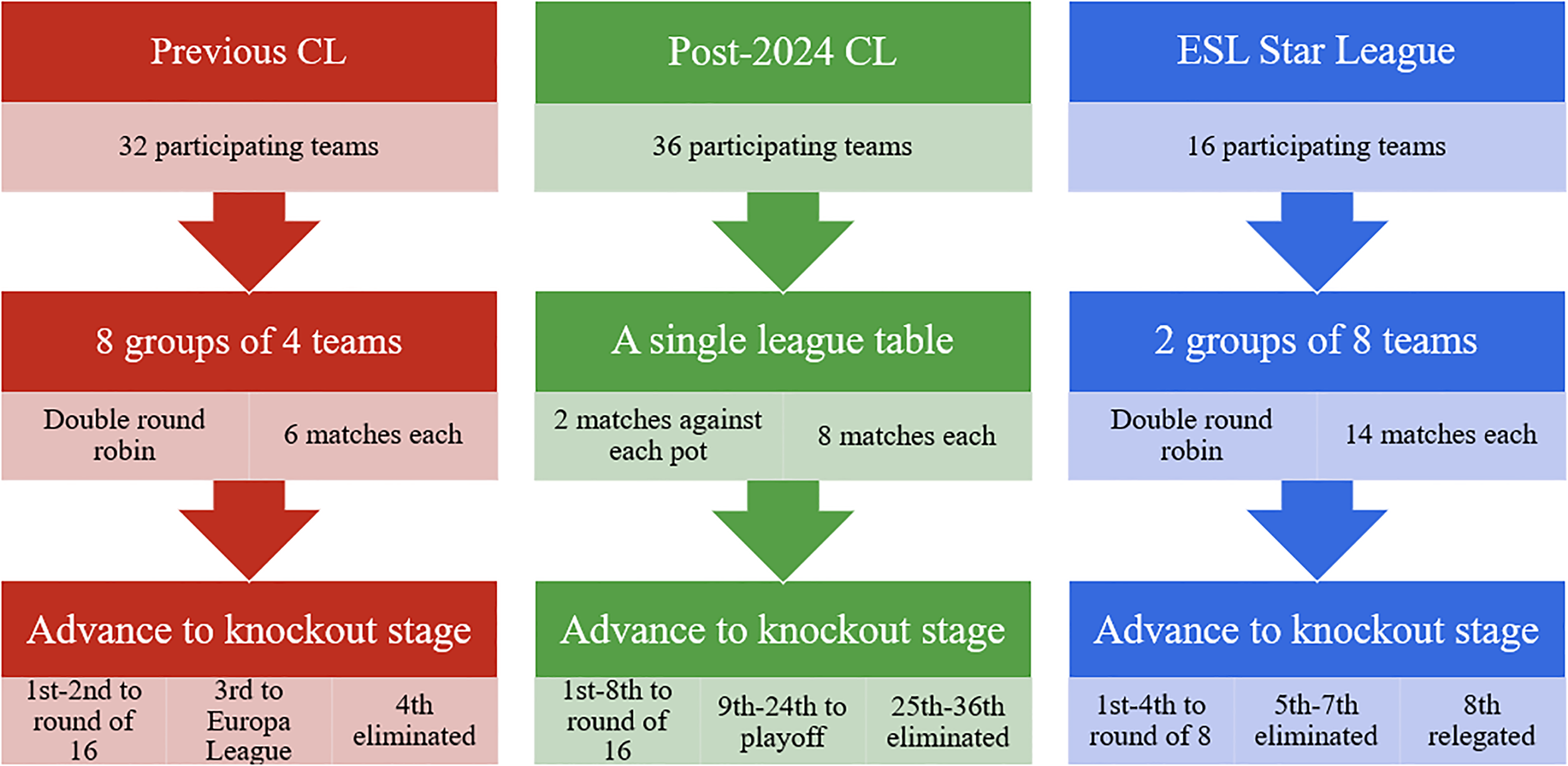
Overview of the CL, post-2024 CL, and ESL competition formats.
The question arises: would the post-2024 CL or the ESL concept really improve CB? Would any of these lead to a more competitive tournament that carries more excitement for the fans and attracts higher demand for European football? The nature of criticism of both the CL and original ESL already highlights the need for CB at the highest level of European football. The previous CL was criticized for having many predictable matches and matches without a real stake. On the other hand, the original ESL was attacked partly for its lack of a relegation system, which would entrench the same teams in the top positions, damaging the long-term CB.
We aim to compare the balance of competition between the previous CL, the post-2024 CL, and the new ESL Star League tournaments in three different ways. Based on the literature, we separate three different dimensions (short-, mid-, and long-term) of CB (Pawlowski & Nalbantis, 2019). We use this distinction to calculate three different indicators for the three competition formats. First, we compare the outcome uncertainty of their matches; second, the number of stakeless matches; finally, the recurrence of teams advancing to the late knockout stage.
Instead of a random distribution, we use data of teams participating in the CL group stage in the 2020/21 and 2021/22 seasons to obtain a realistic distribution of teams’ playing strengths and group allocation. Also, we are able to determine which clubs would have benefited from adopting a new format for those seasons. We simulate the group and knockout stages under all three formats. The simulation method ensures that the pool of teams in both seasons is the same for the three formats but allows for varying group allocations.
Our main findings reveal that compared to the previous CL format, the post-2024 CL format would improve the short- and mid-term CB in its initial league phase. Compared to the post-2024 CL, the ESL comes with a substantially worse mid-term and long-term CB while benefitting top clubs. However, it improves the short-term CB due to its fewer participants. Based on these results, we discuss the points where the post-2024 CL and ESL concepts could be enhanced to organize a more competitive tournament than the previous CL.
Review of the Literature
Levels of Competitive Balance
CB is a widely discussed issue in sports economics. A certain level of competition is necessary to attract fans and spectators, so it is a crucial goal for sports leagues and tournaments to maintain it (Szymanski, 2003). The famous uncertainty of outcome hypothesis based on the study of Rottenberg (1956) says that if the outcome of a game or tournament is less certain, it leads to increased spectator interest and higher demand. This hypothesis has been examined in numerous studies with mixed results. Besides the potential financial disadvantage, the risk of splitting up or the emergence of a rival league also threatens unbalanced tournaments (Michie & Oughton, 2004). The foundation of the ESL as a rival competition of the CL is a good example of that.
CB has three different approaches according to the classification of Pawlowski and Nalbantis (2019). Short-term CB is related to the uncertainty of the outcome of a single match. A group of studies analyses the relationship between match-level uncertainty and demand for football matches. There is evidence that the television audience is affected by the uncertainty of outcome. Previous studies found significant positive effects in football in the case of the English (Forrest et al., 2005), Spanish (Buraimo & Simmons, 2007), and German (Schreyer et al., 2018) first divisions. 5 For top-level European teams, broadcasting plays a much larger role in generating revenue than matchday income. Hence, these teams are financially interested in playing close games as the increased uncertainty is attractive to television audiences.
The second approach is mid-term or seasonal CB, which has the time scope of a single season and is based on the closeness of competition for positions with important stakes. Andreff and Scelles (2015) call this competitive intensity. For example, competitive intensity will be higher if the uncertainty regarding the identity of the ultimate winner remains high over the season. This kind of tournament might be more interesting for spectators than one with a clear winner from the beginning. Budzinski and Pawlowski (2017) and Andreff and Scelles (2015) support the hypothesis that mid-term CB influences the attendance of sports leagues. A driving force in this connection might be that spectators are less interested in matches where one or both teams have no chance to reach a different prize point; therefore, the stake associated with the match is negligible. Stakeless matches occur if at least one team is indifferent to the result (Chater et al., 2021). Their frequency is shown to be influenced by various details of the tournament format, such as the tie-breaking rules (Csató, 2023a) and the match schedule (Chater et al., 2021; Csató et al., 2024).
The third level is long-term CB, which takes multiple seasons into account. It is related to the uncertainty of the outcome of a tournament. For example, if a team dominates the competition for several seasons, it will likely win again, so the outcome is predictable, and long-term CB will be low. Of course, other important positions also matter, not only the winner. The dynamic approach of long-term CB is based on the variability of team-specific performances over time (Buzzacchi et al., 2003). If the performances fluctuate heavily, the long-term dominance of a few teams is less likely, and the long-term dynamic CB will be higher. It is reasonable to assume that fans do not want to see the same teams entering the top positions each season. The dynamic fluctuation is shown to have a positive effect on attendance in baseball (Humphreys, 2002; Krautmann & Hadley, 2006) and European football (Gyimesi, 2020).
The Evolution of Competitive Balance in European Football
Numerous studies analyze the level of CB in domestic football leagues (e.g., Buzzacchi et al., 2003; Groot, 2008; Pawlowski et al., 2010; Ramchandani et al., 2018; Scelles et al., 2022). A general remark is that European football leagues are less balanced in the long term than the American major leagues. The CB of the big five domestic football leagues decreased in the past decades after the 1999/2000 change in the CL payout system (Pawlowski et al., 2010), and the introduction of the Financial Fair Play rules failed to improve competition (Scelles et al., 2022). The main explanation of this trend in the literature is the increased financial advantage of top clubs. However, a well-chosen tournament format can certainly affect the fans’ perception of CB.
The evolution of CB in the CL is also a popular topic in the literature. UEFA introduced the CL instead of the European Cup in 1992/93, replacing a knockout tournament with a combination of round-robin group and knockout stages. This structural change also affected CB. Earlier stages have become more predictable because it is easier for the best teams to advance from a group of four after six games than in a single-elimination clash against a random opponent (Milanovic, 2005; Schokkaert & Swinnen, 2016). On the other hand, the final rounds of the competition have become more unpredictable because generally stronger teams have reached the last stages of the knockout phase (Schokkaert & Swinnen, 2016).
Another novelty in the new format was the seeding system. The evaluation of a given team depends on how it has performed in the European cups in recent years and what results the other teams in its country have achieved in these cups. Seeding aims to avoid drawing the best teams into the same group, leading to the early elimination of some strong teams, while weaker teams from other groups can qualify for the knockout phase. This system also contributed to the aforementioned change to more predictable early stages and less predictable later stages of the competition. However, the applied seeding system is not an unbiased method to evaluate teams, and for this reason, it might even decrease the overall CB (Plumley & Flint, 2015). The empirical results of Triguero-Ruiz and Avila-Cano (2023) confirm a notable decreasing trend in the CB of the group stage between 1999/2000 and 2017/2018.
To prevent drawing several domestic champions to the same group, 6 UEFA changed the seeding system in the 2015/16 season. Besides the titleholder, the champions of the seven strongest domestic leagues received the seven highest seedings. The issue is that these teams rarely coincide with the strongest seven. Therefore, this reform increased the uncertainty over advancing from the group stage (Corona et al., 2019). In another perspective, it also led to a decrease in CB because of the increasing probability of a less competitive final and a higher chance of weaker teams reaching the final (Dagaev & Rudyak, 2019). Csató (2022b) analyses a reform concerning the 2018/19 season qualification procedure. As a result, fewer domestic champions get the opportunity to participate in the CL group stage, which caused an expected financial loss for several smaller associations.
Several studies mentioned above dealing with the CL use a simulation methodology to compare different tournament formats (e.g., Corona et al., 2019; Csató, 2022b; Csató et al., 2024; Dagaev & Rudyak, 2019; Scarf et al., 2009). Monte Carlo simulation is a popular and well-established way to generate possible outcomes of any tournament. This paper draws from previous studies by using a simulation method, which allows us to measure the CB of both the ESL and the post-2024 CL and compare them to the CL for the first time.
Simulation Methodology
Match Results
To obtain the final result of each season, we simulate the outcome of every match. To capture the playing strength of each club, we use the clubs’ Elo ratings. The Elo rating system was developed in the 1950s by Árpád Élő to rate chess players based on their previous results (Elo, 1978). Since then, this method has become widely popular in chess and has been adopted in many other sports and games, such as football, board games, and eSports (Herbrich et al., 2006). The current official FIFA World Ranking is also based on a modified version of the Elo system for ranking national teams since 2018 (FIFA, 2018). The system is based on the assumption that the winning probability of opposing players/teams is a function of their rating difference. After each match, the ratings are updated depending on the difference between the actual and expected outcome. This system is proven to reflect the true chances of winning quite well and performs better than most other methods in the field of forecasting football matches (Aldous, 2017; Csató, 2024; Hvattum & Arntzen, 2010; Lasek et al., 2013). The basic formula for calculating winning probabilities (

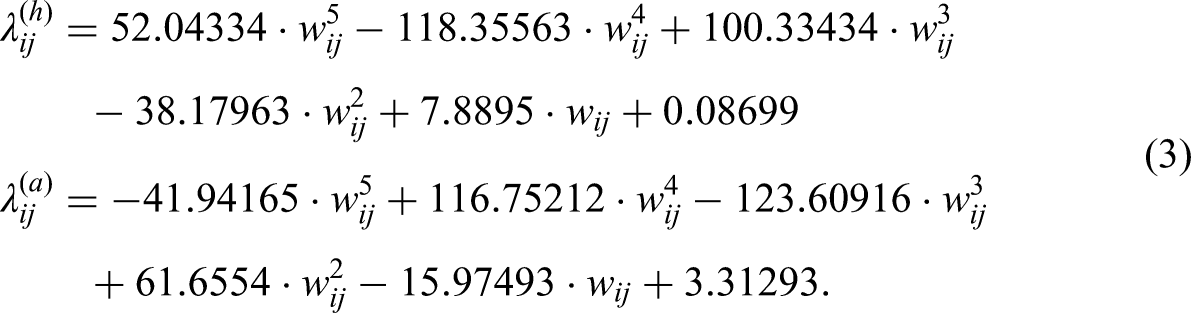
We simulate the outcome of each group stage match (home and away goals) by using the standard Poisson distribution (applied by, e.g., Chater et al., 2021; Dagaev & Rudyak, 2019; Csató, 2022a, 2023a, 2023b; Csató et al., 2024), which yields the probability that team i scores k goals against team j as


Data
To simulate a season using the methods described in section “Match Results,” we need assumptions on the distribution of participating teams’ Elo ratings and group allocation. We have chosen to adopt the actual list of participants of the 2020/21 and 2021/22 CL seasons and use their Elo ratings. We stick to those lists of participants as closely as possible for all three formats. The data source is the website http://elofootball.com/, where the Elo ratings of football clubs have been tracked since 1955. It is common to round the Elo rating to the nearest integer, which is also true in our dataset. Club Elo ratings between the two seasons, on June 30th, 2021, were obtained. For simplicity and avoiding arbitrary decisions, the playing strengths of teams are assumed to remain constant during the simulation period. Figure 2 shows an S-shaped Elo rating distribution, where Bayern München and Manchester City were the two strongest sides at our time of analysis.
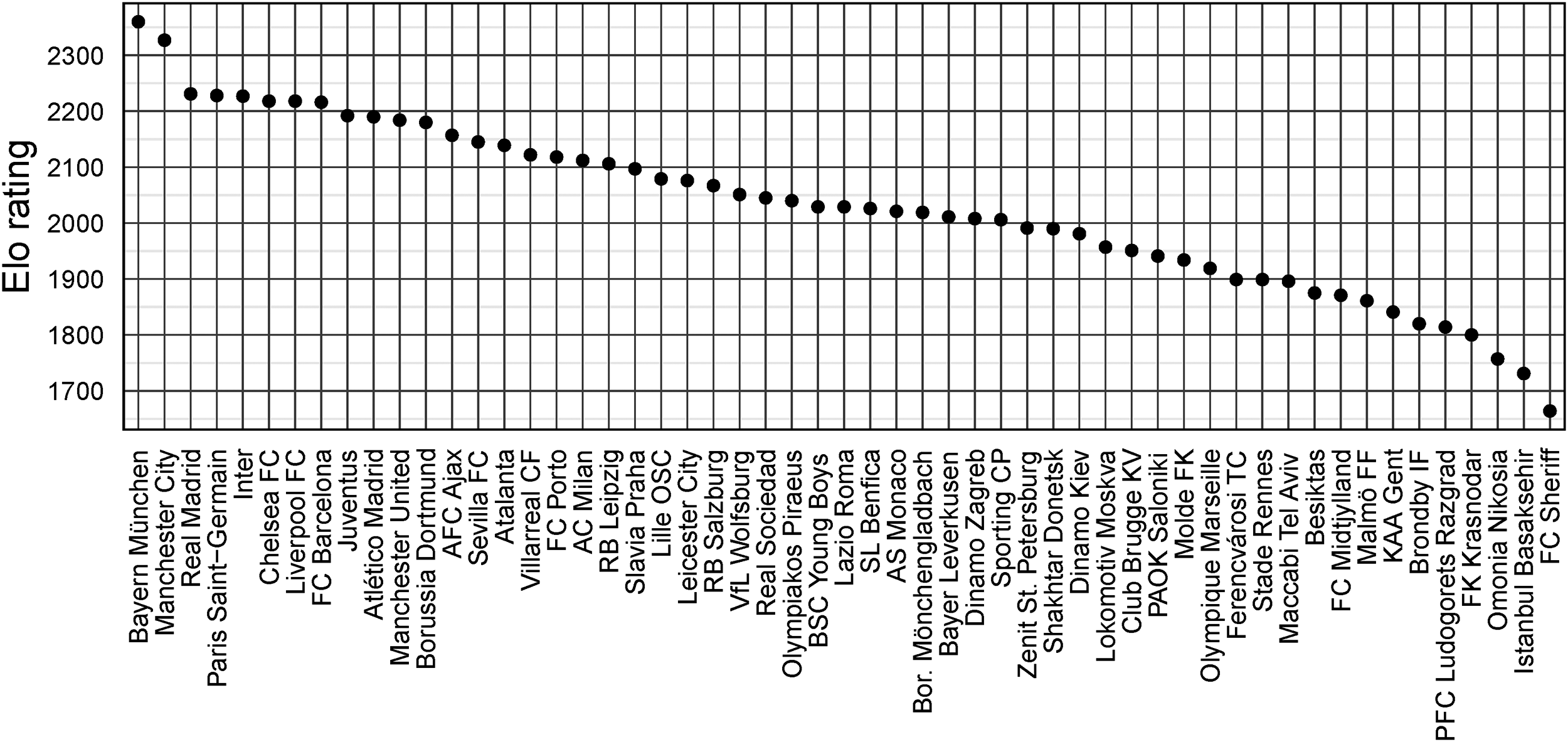
Elo ratings of the possible participating teams on June 30th, 2021.
We also adopt the seeding system of the CL, where teams are allocated into 4 pots based on their championship titles and previous results captured by their UEFA coefficients. We use the actual pot allocations for the two seasons of the CL and to select the initial participants of the ESL. The same UEFA coefficients are used for the post-2024 CL seeding. Simulations and all additional analyses were conducted in R (R Core Team, 2021).
The Champions League
The 2020/21 and 2021/22 seasons of the Champions League have already finished, but we want to simulate those seasons as if the group draws or matches happened differently in order to get large samples. We follow the same method in the case of the ESL and post-2024 CL, as if those seasons were played under the changed rules.
In the CL, the 32 qualified teams are allocated into 8 groups as follows. Each season a random draw is simulated, where every group consists of a team from each Pot 1 to 4. The pot allocations for the two seasons are shown in Table 1. In reality, UEFA imposes other constraints, such as no team from the same country can play in the same group. In the simulation, we do not use those constraints to be consistent with the other two formats where these rules are still unknown, and secondly, because they should not largely influence the measured CB. After drawing the groups, the group stage matches are simulated using the method discussed in section “Match Results.” The final group tables determine the 1st and 2nd teams that advance to the knockout stage. Knockout stage clashes are simulated via Equation (4), except for the final, since it is one match in a neutral field.
Participants and Pot Allocations of the 2020/21 and 2021/22 Seasons Under the Three Formats.
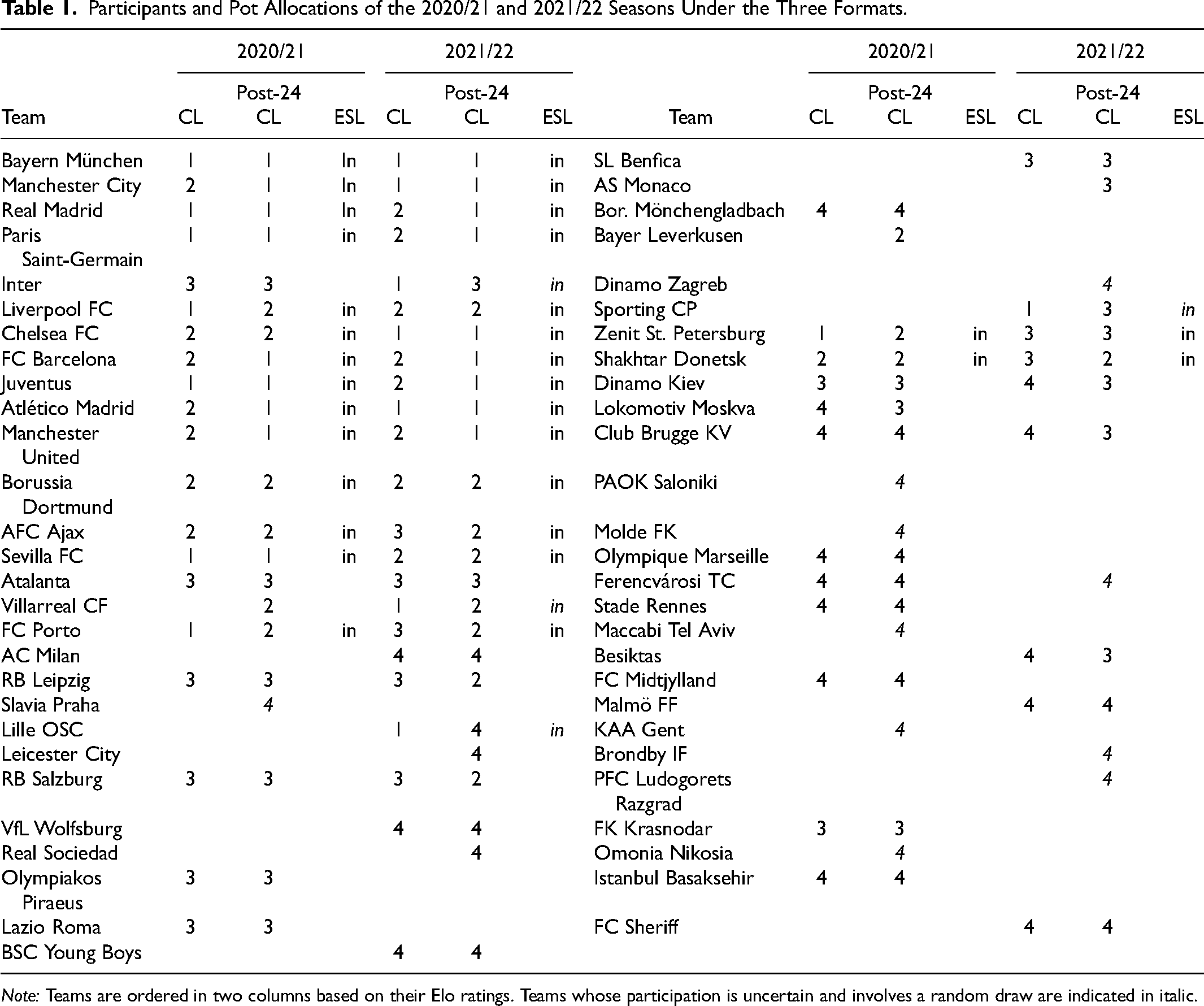
Note: Teams are ordered in two columns based on their Elo ratings. Teams whose participation is uncertain and involves a random draw are indicated in italic.
In case of points equality between two or more teams, tiebreakers are applied according to UEFA (2023a, Article 17). We apply the same order of rules up to rule f in the simulations. In the extremely rare cases where this is indecisive, a random order is applied.
The Post-2024 Champions League
For comparability, we simulate the same 2020/21 and 2021/22 seasons as if they were played under the post-2024 CL format. According to the plans, the number of participants will be expanded to 36. The four additional slots are allocated as follows (UEFA, 2023b):
Two slots to the two associations with the highest 1-year UEFA country coefficient in the previous season (2020/21 Spain, Germany; 2021/22 England, Spain). One for the 3rd placed team from the 5th ranked association in the UEFA association ranking (2020/21 France; 2021/22 France). One for a domestic champion that enters the Champions Path of the qualification process.
This means that in the 2021/22 season, Leicester City, Real Sociedad, and AS Monaco could have directly entered the CL group stage based on their domestic result of the previous season if the post-2024 CL rules applied. For the fourth slot, we simulate a random draw from the 4 teams that were eliminated in the last round of the Champions Path. We apply a similar method in the 2020/21 season, with Bayer Leverkusen and Villarreal CF entering directly. This season, Stade Rennes, as the 3rd placed French team, already qualified through the qualification event. Instead, we draw one additional team from the two eliminated teams in the last League Path round.
According to UEFA (2023b) rules, unlike the previous CL format, no exclusive seeding for domestic champions is applied post-2024. Therefore, we allocate the four pots of 9 teams based entirely on pre-season UEFA club coefficients of the respective season, 2020/21 or 2021/22. The resulting pot allocations for the two seasons are shown in Table 1.
In the planned single league phase, every team would play two games against two teams from each of the 4 pots. At the time of writing, there is no additional information about the match schedule, so we assume it is random as long as each team plays one match every round. This way, 8 rounds are simulated with the method in section “Match results,” after which the final league table is determined. In this format, teams with equal points likely did not play against each other, so we only apply rules e and f (goal difference and number of goals scored) of UEFA (2023a) tie-breaking rules, then a random order.
The 1st–8th placed teams advance directly to the knockout round, the 9th–24th teams advance to the playoff round, and the rest are eliminated. In the playoff, 9th–16th ranked teams are seeded to play against those that finished 17th–24th, and then the 1st–8th play against playoff winners in the round of 16. From the playoff round on, the knockout stage simulation method applies, with double clashes except for the single-game final. The pairings of the knockout rounds are almost deterministic and follow the illustrated bracket in UEFA (2023b, enclosure).
The European Super League
Similarly to the other two formats, we perform simulations of the 2020/21 and 2021/22 seasons using information from the A22 Sports Management S.L. (2023) concept. There is no information on how the initial set of participants are chosen. For comparability, we assume that the initial qualification is similar to the CL procedure, so we take the 16 teams assigned to CL Pots 1 and 2 as the participants. The two last clubs in both groups are relegated each season, and the lower-tier Gold League finalists replace them. Since no information is available for the initial Gold League participants either, for 2021/22, we replace the relegated teams with two random remaining teams from Pots 1 and 2 in the CL 2021/22 season (Inter, Villarreal CF, Lille OSC, Sporting CP). This simple method has limitations as it might result in an unrealistic selection (e.g., multiple teams are selected from the same country), but it ensures a variety of selections from a pool that is as similar to the CL as possible. This is important in order to estimate differences in CB that do not originate from different pools of teams. Table 1 shows the possible participants in the ESL simulation along with the pot allocation of the other two formats.
During each simulation, we divide the 16 teams into two groups. We have no official information on the method that allocates the teams into the groups, so we assume it is random. The group stage is a double round-robin format where each team plays two matches against every other group member, one at home and one away. After every team has completed its 14 matches, the final rankings of both groups are formed based on the number of points. We use the same tie-breaking rules of UEFA (2023a) as for the CL. According to the ESL plans, the top 4 teams of each group qualify for the quarter-finals, where the single-elimination knockout phase starts. The pairings follow the traditional method of Group A 1st place playing against Group B 4th, and Group A 2nd place playing against Group B 3rd.
Indicators of Competitive Balance
Based on the categorization of low-, mid-, and long-term CB, we can assume that (a) large differences in probabilities of winning; (b) matches with no effect on advancing from the group stage; and (c) the same teams advancing in consecutive seasons are uninteresting. By capturing these with various indicators, we get a comprehensive picture of how different levels of CB would change after a reform of the top-level European competition.
Uncertainty of Match Outcomes
The review of the existing literature has revealed the importance of uncertainty about the winner of a certain match. Uncertainty translates into the difference in the ex-ante winning probabilities of the two opposing teams, which is captured by the 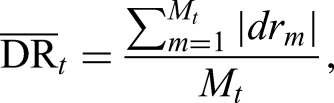
Competitive Intensity
Previous research has shown that if an important stake is linked to the result, it is expected to be more exciting for the audience (Andreff & Scelles, 2015). It is challenging to quantify the importance of different stakes in various tournament scenarios, so we follow a simple approach of analyzing stakeless matches. Following Csató et al. (2024), a match is called weakly stakeless if one team is indifferent and strongly stakeless if both teams are indifferent. We define indifference in terms of the match having no effect on the chance of advancing to a superior stage of a tournament. In other words, if the points difference between a team and the closest position (in terms of points) with a different stake is larger than the maximum obtainable points for the remainder of the group stage.
8
We calculate the Stakeless Ratio (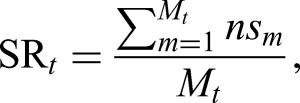
In the post-2024 CL format, three different stakes are related to the 1st–8th, the 9th–24th, and the 25th–36th places in the single league table. In the SL, three different stakes are linked to the first 4, 5th–7th, and 8th places in each group. For better comparison, we also use a method where not all group stage matches are considered, but
Dynamic Competitive Balance
The variation in the identity of teams finishing at the top positions also contributes to the CB of the league. Based on the literature, we call this dynamic CB. A common approach is quantifying the distance between consecutive seasons’ results. For measuring the dynamic CB of the CL, Rohm et al. (2004), Schokkaert and Swinnen (2016), and Csató and Petróczy (2024) use a method that assigns ranks or weights to the teams at the end of the season depending on which round they have reached. Then, they calculate the distance between the rankings of two consecutive seasons. Several methods can be used to calculate the distance between the two rankings, for example, the absolute distance or ranking mobility (applied by Haan et al., 2012 and Gyimesi, 2020 for football leagues) and the squared or Euclidean distance applied by Schokkaert and Swinnen (2016).
Assigning comparable weights for all outcomes in the three formats would be challenging, so again, we pursue simplicity and avoid arbitrary assumptions. As a simple indicator of dynamic CB, we define the recurrence ratio (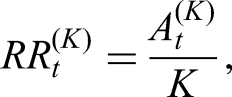
Results
Effects on Competitive Balance
We simulated the group and knockout stages of the 2020/21 and the 2021/22 seasons of the three competition formats 5,000 times each. The mean Elo ratings of the participating teams indicate that the ESL comes with stronger teams on average, which is expected considering its lower number of participants (16 instead of 32 or 36). The average ratings in all competitions were smaller in the 2020/21 season (∼2081 mean Elo rating in the CL) than in 2021/22 (∼2101 mean Elo rating in the CL) due to a lower-rated pool of teams qualified for the CL, which is also reflected in the larger Elo rating differences in the group stage. Figure 3 shows that the ESL would be the most balanced of the three in terms of average uncertainty of outcome in both seasons. This means that matching teams are, on average, closer to each other in terms of the probability of winning in both the group and knockout stages. The post-2024 CL would also bring better (higher) average uncertainty in the league phase than the group stage of the previous CL format. However, the impact on the knockout stage is ambiguous and dependent on the season or the pool of participants. An important observation is that in seasons when strong teams are qualified on average (like in 2021/22), the post-2024 CL can increase the average Elo rating difference in the quarter-finals compared to the CL. We will provide a possible explanation in the section “Effects on Individual Teams.” Figure 4 displays the distributions of Elo rating differences, again showing fewer close games in the previous CL format than in the two novel ones.
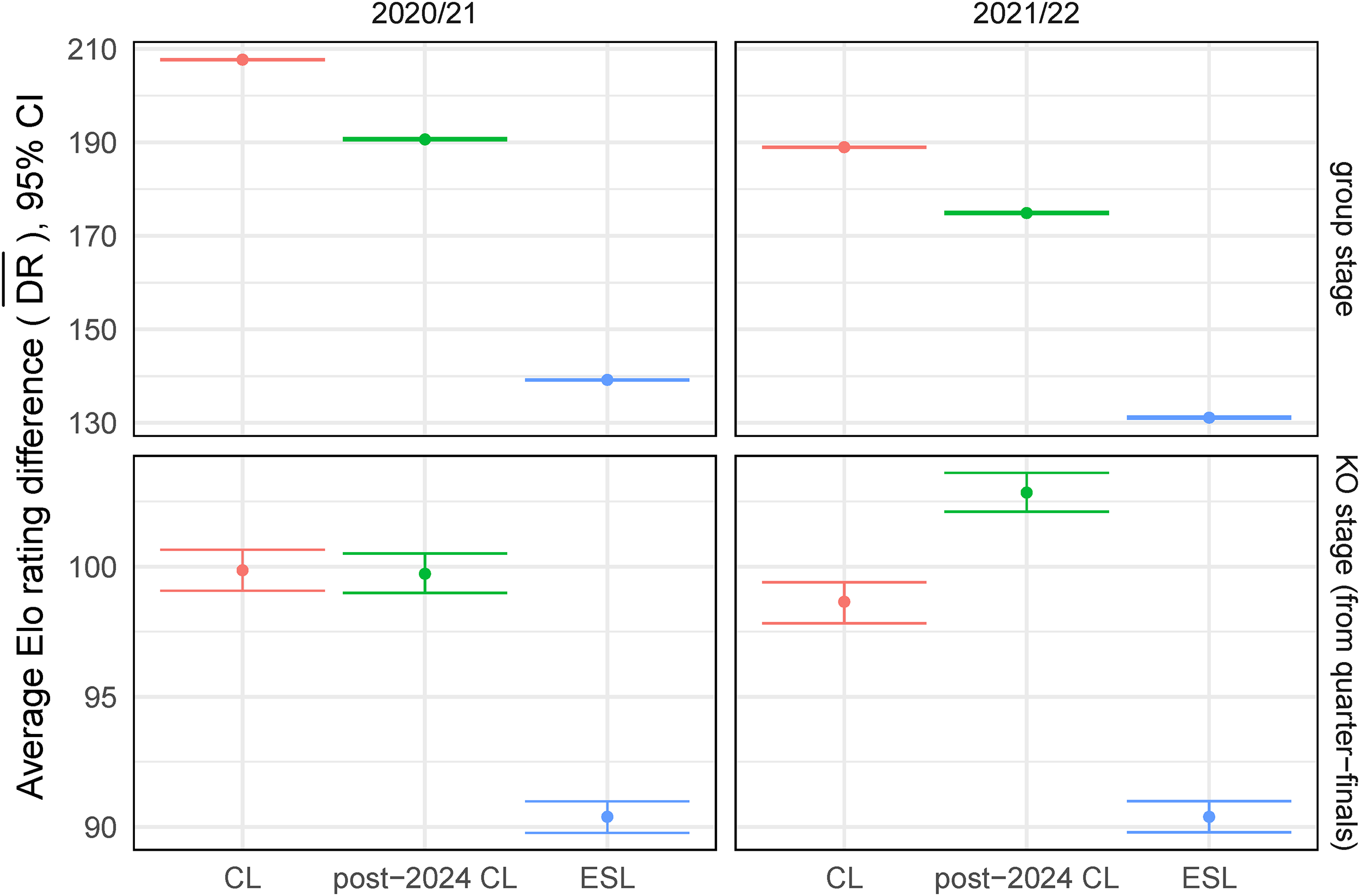
Average Elo rating difference under the three formats.
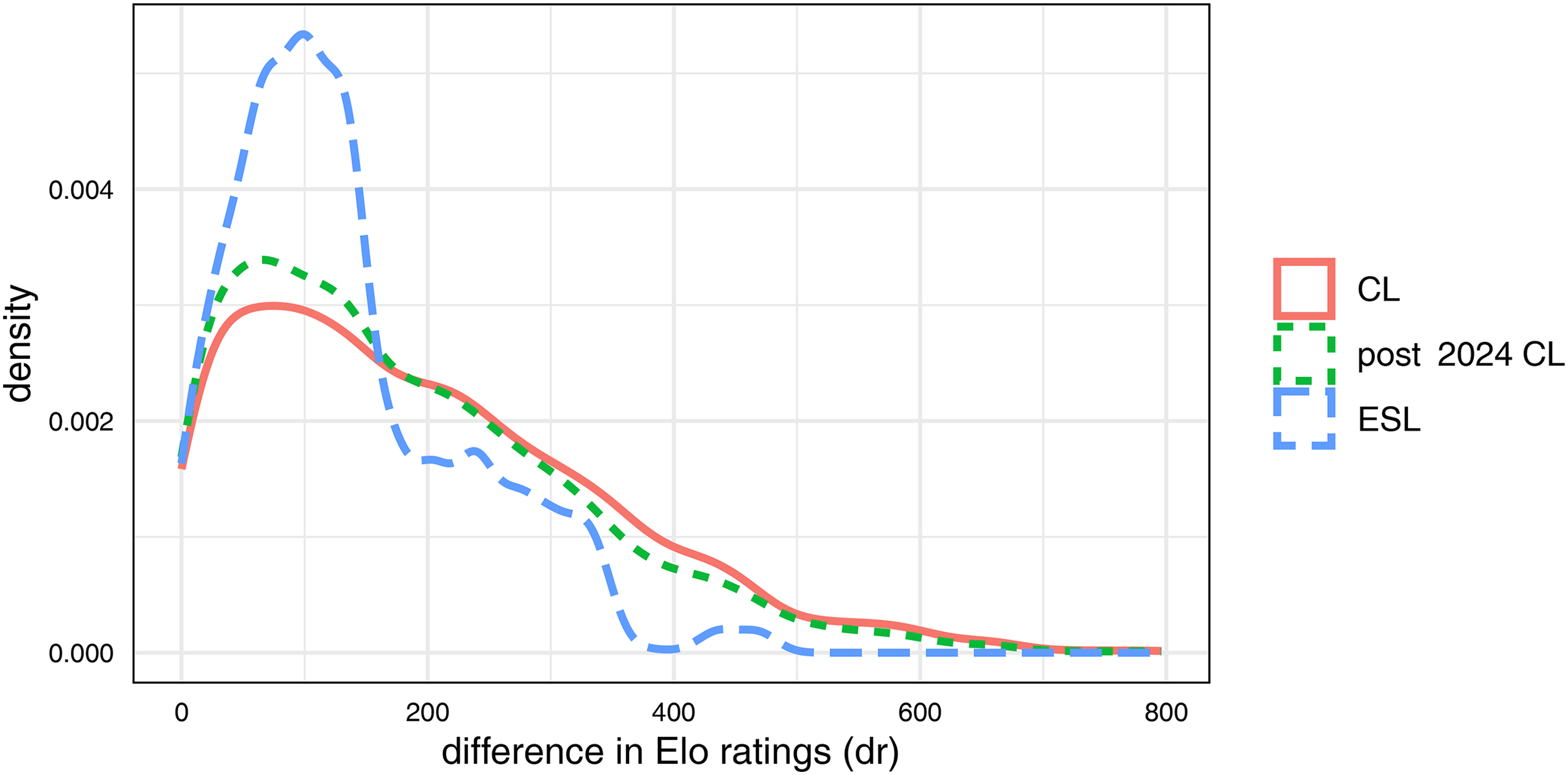
Distribution of Elo rating differences.
Despite the fewer participants, the number of matches in the ESL group stage is higher than in the CL due to more rounds (14 compared to 6 in the CL). The post-2024 CL format also contains more matches because of 4 more participants and two more rounds. The question is, are the additional matches usually important for the teams? In the CL, the Stakeless Ratio is around 15% in the last 3 rounds, while it is an improved 12–13% in the last 6 rounds in the ESL (Figure 5). The indicator shows that, compared to the other two formats, the post-2024 CL would considerably reduce the ratio of stakeless matches, which is 2% of all, and only 6–7% in the last 3 rounds’ matches.
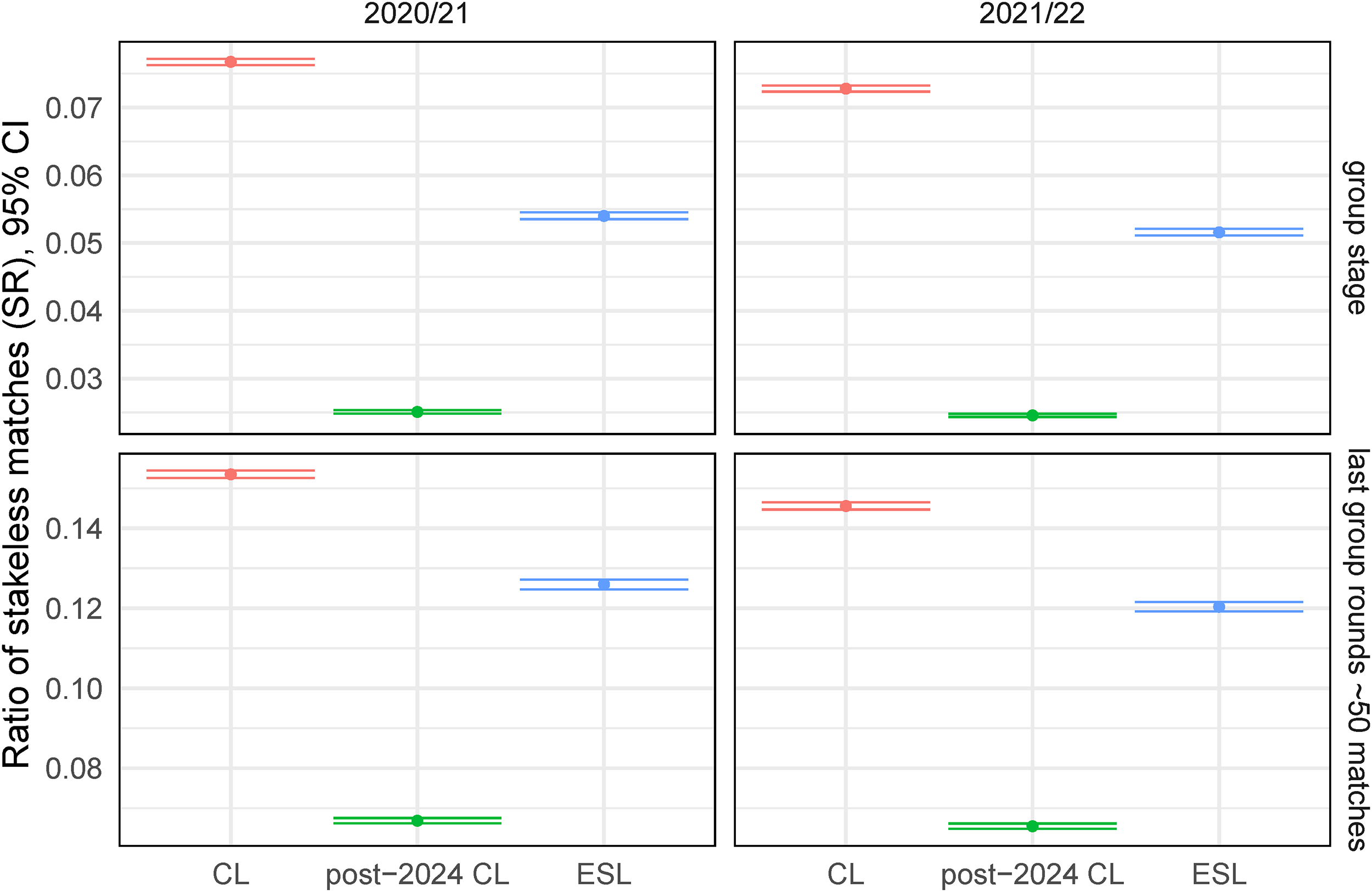
Ratio of stakeless matches under the three formats.
If we look at the connection between a team's Elo rating and the number of matches with no stake for them, unsurprisingly, we see a U-shape relationship (Figure 6). Very low and high-rated teams are more likely to see their fate already decided before the final rounds. However, there is a clear difference among the formats in this relationship. The fitted quartic polynomial curves reflect that the high-rated sides, particularly, have a low expected number of stakeless matches in the post-2024 CL compared to the CL. If we assume that the games of the big teams are more interesting for the fans, then it is favorable that particularly those teams play every match for high stakes. This way, it is more likely that full-strength squads will play in each round. This also means that the ESL has an unfavorable structure of stakeless matches, as particularly the strongest clubs are expected to have multiple of them. They are often indifferent about 3–4 matches, unprecedented in the other two formats.
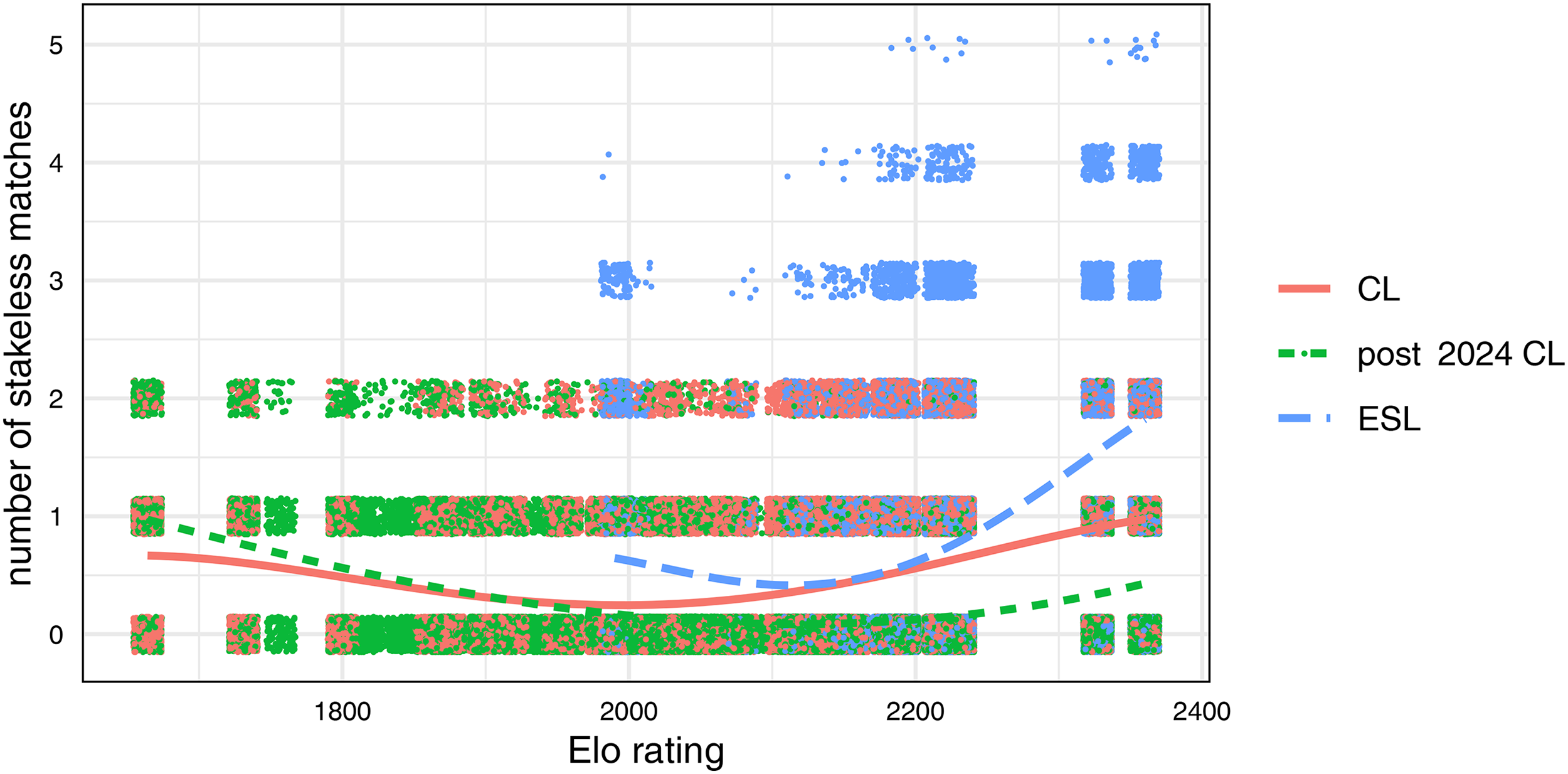
The relationship between Elo rating and the number of stakeless matches.
Dynamic CB is captured by the recurrence of advancing teams in the two consecutive simulated seasons. Figure 7 shows that the ESL has a significantly worse dynamic CB. The probability of the same team winning the competition in both 2020/21 and 2021/22 would have increased to around 21%, and the difference in the Recurrence Ratio is even larger in earlier rounds, with as high as 62% recurrence in the quarter-finals. The differences between the CL and post-2024 CL are less obvious. The post-2024 CL shows a slightly lower recurrence ratio in the quarter-finals, which then turns around in later rounds. This would indicate that the post-2024 CL is somewhat beneficial for the very high-rated title contender teams but also allows for more diversity in the quarter-finals. We further analyze this statement in section “Effects on Individual Teams.” Table 2 provides a ranking of the three formats concerning the three levels of CB.
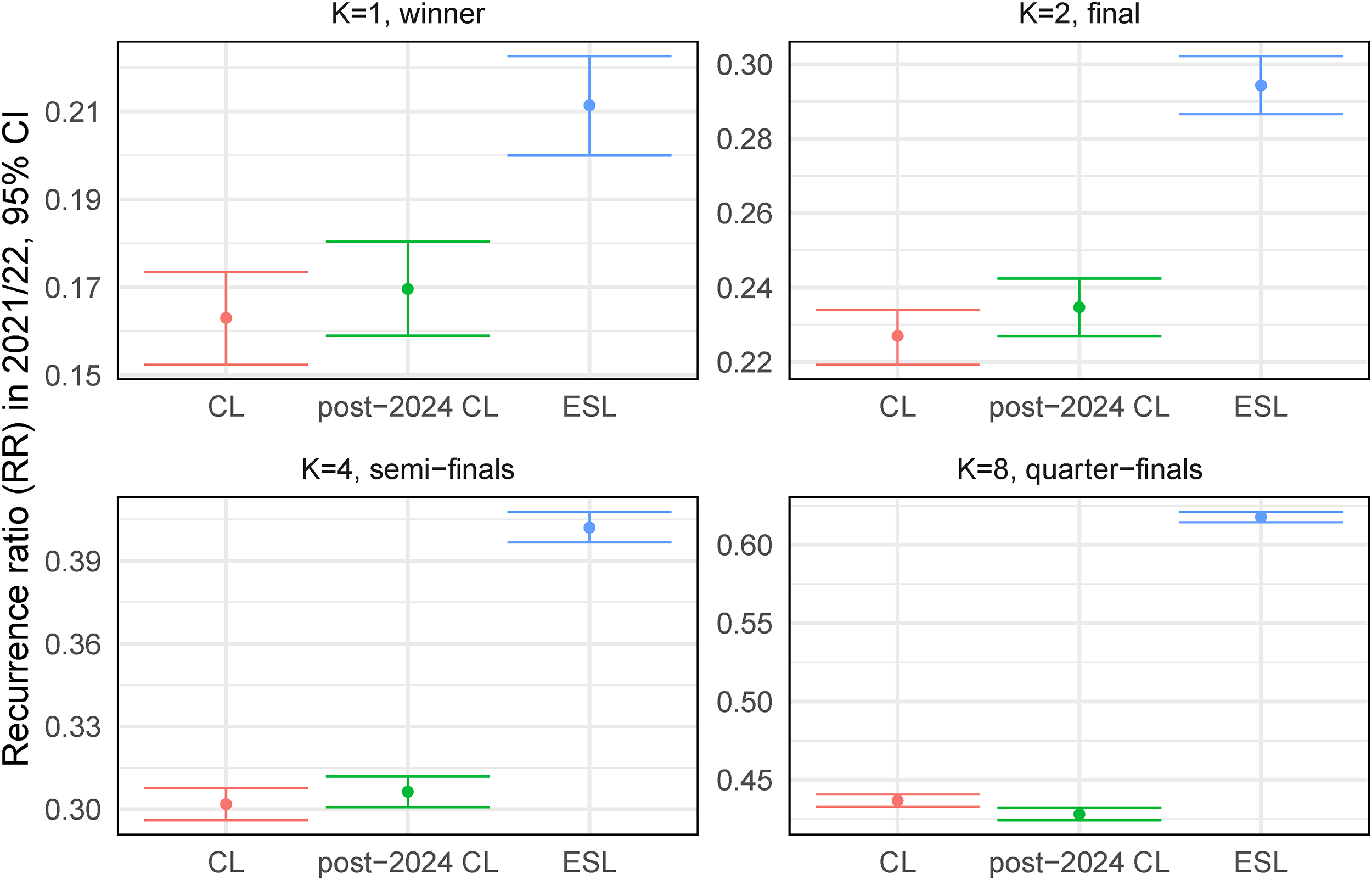
Recurrence ratio of teams in knockout rounds under the three formats.
Ranking of the Three Formats Based on Three Levels of CB.
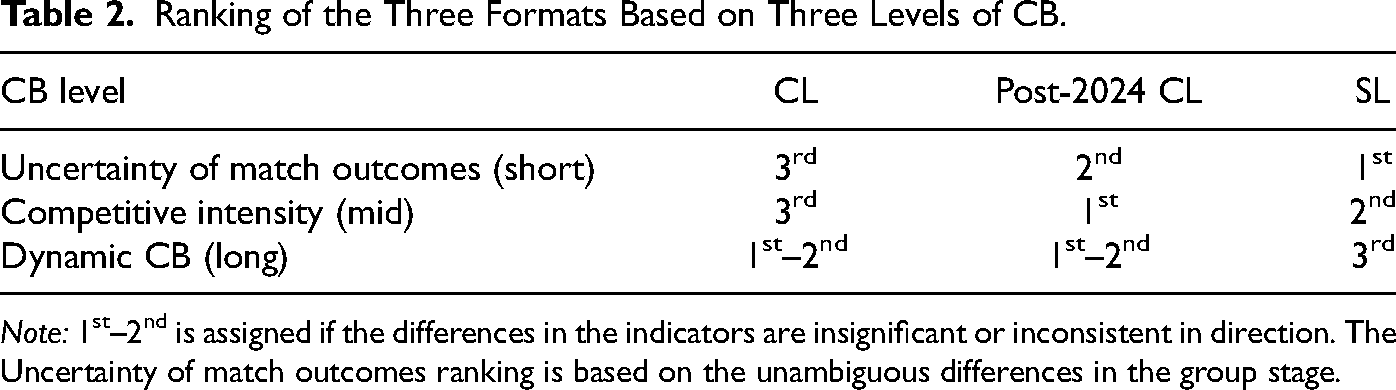
Note: 1st–2nd is assigned if the differences in the indicators are insignificant or inconsistent in direction. The Uncertainty of match outcomes ranking is based on the unambiguous differences in the group stage.
Effects on Individual Teams
Our approach allows a useful analysis of the format's impact on each team's chances of reaching the quarter-finals, as shown in Figure 8. The smaller number of participants (16) suggests that the ESL should increase the chances of all the participants. This is true for high-rated teams, but we see a decreased probability of reaching the quarter-finals for lower-rated teams (e.g., FC Porto, Zenit St Petersburg, Shakhtar Donetsk in 2020/21). Therefore, the ESL format benefits the high-rated clubs and disfavors the lower-rated clubs, even if they are selected for the 16-team ESL.
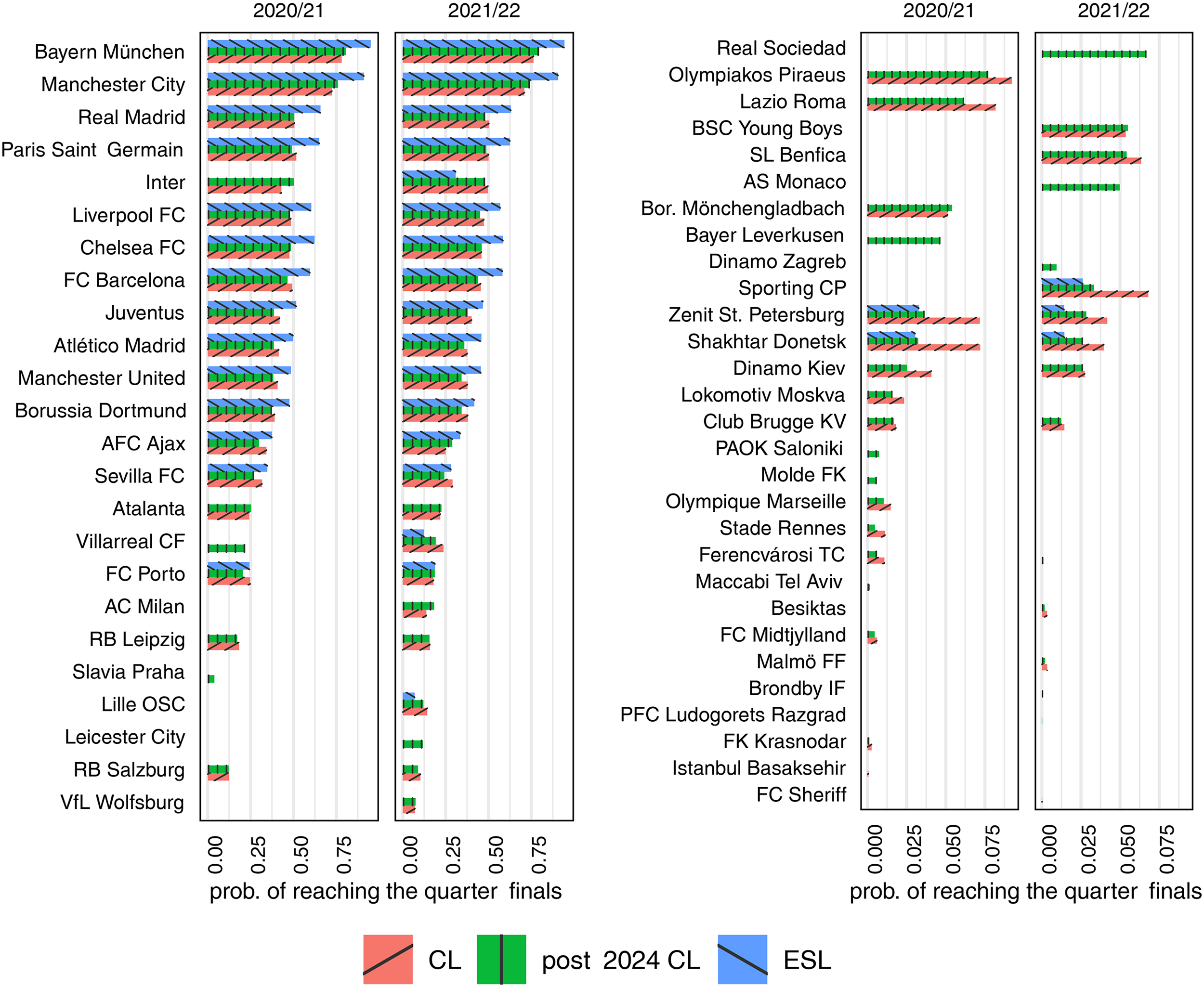
Probability of each team reaching the quarter-finals under different formats (2020/21, 2021/22).
The post-2024 CL expands to 36 participants, which should generally decrease the chances of most teams reaching the quarter-finals. However, a few teams would benefit, like the top two rated Bayern München and Manchester City. This underlines the slightly (but not significantly) higher winner and finalist recurrence (RR) in Figure 8. The other positive exceptions are caused by the pot allocation in the CL (see Table 1). For example, Inter, the fifth-highest Elo-rated team, was assigned to Pot 3 in 2020/21, which hindered its chances in the CL compared to 2021/22. Similar examples are AFC Ajax, Atalanta, FC Porto, AC Milan, and RB Leipzig, all assigned to Pot 3 or 4 in 2021/22. All these teams would have better chances under the post-2024 CL. In contrast, Sporting CP, Zenit St Petersburg, and Shakhtar Donetsk had abnormally high chances under the CL format by being assigned to Pot 1 or 2. Generally, being in Pot 1-2 was advantageous for teams over being in Pot 3-4 in our simulations of CL. The post-2024 CL erases this advantage, so we conclude that pot allocation matters less and team strength matters more in the post-2024 CL. Interestingly, this might explain the worse match uncertainty (higher
Discussion
Our study was inspired by previous research that assesses the effect of certain reforms on the top European Cup competition (e.g., Corona et al., 2019; Csató, 2022b; Dagaev & Rudyak, 2019; Plumley & Flint, 2015; Schokkaert & Swinnen, 2016). We have shown that the post-2024 CL and the ESL format (per the December 2023 proposal) lead to a substantially different CB on all levels. We have provided a simple framework to comprehensively compare CB of knockout-type tournaments, whether a group stage, single league table, or any other kind of elimination format. In the future, it is possible to use this three-indicator framework to compare the CB of tournaments in different regions or sports.
Using data of two actual seasons could mean a limitation, but we argue that this solution leads to valuable conclusions and easier interpretations over choosing a theoretical distribution of teams. Information on the two chosen seasons is used only to determine the Elo rating distribution and pot assignment of the teams. Any potential special characteristic of these seasons’ CL participants affects all competition formats and introduces no systematic bias to the comparison, so the results can be interpreted as general findings.
The new formats were promised to be more competitive than the previous CL, so we will discuss our results concerning how well they achieve this goal. We have found that the ESL would improve the short-term CB, as the average uncertainty of match outcomes is indeed higher in the ESL. However, closeness is easier to achieve with fewer teams, so it could be explained by only hosting 16 in the Star League compared to 32 in the CL. There were no plans for additional mechanisms in the ESL proposal to ensure that stronger teams more often play against other stronger teams. However, the post-2024 CL would also improve the average uncertainty of match outcome in the league phase (although by a smaller margin than the ESL), even though it is expanded to 36 participants. This is because the post-2024 CL does a better job than the previous CL in pairing strong teams with other strong ones since teams play two matches against other (likely similar strength) teams from the same pot. This was impossible in the previous CL, where the groups consisted of 4 teams from different pots. This could also be the main reason why seeding seems to matter less in the post-2024 CL, which is supported by our simulation results. 9 Any other similar mechanisms that enforce the pairing of similar-strength teams while simultaneously ensuring the equality of chances are favorable for improving short-term CB.
The CL is often criticized for having a high proportion of matches with no stake in the last group rounds. Regarding the ratio of stakeless matches, the ESL brings a slight improvement. However, the strongest teams are more affected in the ESL, which could lead them to field subpar squads in the final rounds, which would decrease spectator interest. We argue that this is caused by the high number of rounds and no additional stake introduced after securing a spot among the top four in the group. Relegation ensures another stake for the bottom 4 teams, so it is less of a concern in their case. On the other hand, the post-2024 CL does a better job of maintaining competitive intensity. As the first half of the single league table is expected to be often quite dense, table-leading big teams rarely enjoy the luxury of stakeless matches. 10 Generally, high-stake matches between big teams are what they are looking for, and the post-2024 CL brings improvement to that.
A limitation of our analysis is that the teams could perceive stakes differently and develop certain strategies that are not accounted for in the simulations. For example, an outstanding team (like Bayern München and Manchester City in our simulations) is highly unlikely to be completely eliminated after the league phase in the post-2024 CL. With as many as 24 teams entering at least a playoff stage, they might just extensively rest players in the league phase and concentrate on the playoffs.
Considering long-term dynamic CB, the ESL would be less balanced than the CL. According to our results, we would more often see the same teams reaching the quarter-finals as in the previous year, lowering the diversity in the last stages of European football. This means that even after abandoning guaranteed participation after the failure of the April 2021 plan, the dominance of initially selected teams would still remain. It has two main explanations. First, in 14 rounds, short-term form matters less, so strong teams are less likely to be eliminated than in the 6-round CL group stage. Second, the low number of relegated teams (2 of 16) reduces fluctuation, almost ensuring big teams stay in the competition irrespective of their domestic performance. We found only a small difference between the CL and the post-2024 CL, so the latter would not bring large improvements in the diversity at the top spots either.
In our simulations, a useful simplification is that the strength of the teams stays constant over the two seasons. Therefore (besides the slightly different participating teams), dynamic CB is only a result of the random variation in draws and match results, affected by the tournament format. It is still a limitation, as in reality, team strengths constantly and non-randomly change. Therefore, we might overestimate the Recurrence Ratio (underestimate the dynamic CB) but that does not influence the differences between competition formats. However, there might be opposite effects that could not be accounted for in the simulations. For example, the almost guaranteed participation of some teams in the ESL could instantly increase their financial stability, resulting in investments that improve their sporting performance. This could strengthen their dominance, resulting in an even lower dynamic CB.
Conclusions
According to our simulation results, the structural reform of the CL from the 2024/25 season is expected to bring a competition with better short- and mid-term CB in its initial stage. In this regard, one of the key changes is the single league table format, which makes the last rounds more likely to matter for big teams and reduces the number of stakeless matches for them. The other one is the two additional games against teams from the same seeding pot, which increases the number of uncertain clashes. This is a major reform comparable to the introduction of the group stage in the 1990s. That past reform also affected CB by benefiting stronger teams and making it more likely that the same teams advance to the Round of 16 in consecutive seasons (Milanovic, 2005; Schokkaert & Swinnen, 2016). In that sense, the 2024/25 reform only benefits the top 2-3 outstanding teams and those misallocated into Pot 3 or 4. Therefore, it does not significantly harm long-term dynamic CB and diversity in the later knockout stage.
Comparing the December 2023 proposal of the ESL to the post-2024 CL, it would bring a reduced long-term CB and more stakeless matches, particularly for big teams. Both disadvantages can reduce spectator interest and undermine the financial success of the competition. The large number of unimportant matches shows that either the number of rounds should be reduced or additional stakes should be added for finishing in the top places of the group. For example, a playoff stage could be introduced for 4th to 5th placed sides exactly like in the April 2021 concept. Alternatively, group winners could directly advance to the semi-finals. Further research could analyze the effect of such alternative designs.
To improve the perceived long-term dynamic CB, a reduction in the number of rounds played would make the smaller teams advance from the group more often just by random variance. Alternatively, some handicap method could decrease the chances of previously successful teams. The proposed ESL format would make the domestic leagues far less important in the qualification system compared to the CL. This could prevent the widespread acceptance of ESL as domestic leagues would likely lose spectators and experience a financial loss. The introduction of a qualification route to enter the ESL Star League directly by succeeding in domestic leagues would mitigate this issue, also supporting diversity and long-term CB. Of course, the ultimate success of ESL depends on many other economic factors. More games might lead to higher commercial value (Solberg & Gratton, 2004), and spectators could value the higher number of uncertain matches over other aspects of CB. The ESL would be a move towards an American-type closed league with a far stronger entry barrier to the Star League than the CL. There are arguments that, ultimately, a closed league with salary caps is the economically optimal solution (Vrooman, 2007). Nevertheless, choosing a format that serves a better CB is advantageous, even if the main goal is economic success.
Footnotes
Acknowledgements
The author would like to thank László Csató, Erik Braun, Dániel Kehl, Dávid Zoltán Szabó, and the participants of the 6th International Conference Sport Economics & Sport Management (SESM) for valuable comments and suggestions.
Declaration of Conflicting Interests
The author declared no potential conflicts of interest with respect to the research, authorship, and/or publication of this article.
Funding
The author disclosed receipt of the following financial support for the research, authorship, and/or publication of this article: The research was supported by the National Research, Development and Innovation Office under Grant FK 145838 and TKP2021-NKTA-19. Project no. TKP2021-NKTA-19 has been implemented with the support provided from the National Research, Development and Innovation Fund of Hungary, financed under the TKP2021-NKTA funding scheme.
