



Abstract
Using the assignment of referees to European international association football matches played between 2002 and 2016, we ask whether judgments were biased according to the legacy of the Cold War. We find that referees from post-communist states favored teams from non-communist states, but there was no evidence of favoritism in the other direction. This out-group bias of referees born behind the Iron Curtain was statistically significant for relatively less important and more subjective decisions, namely the awarding of yellow cards for foul play. The bias was particularly large among referees from the former Soviet Union. It has also diminished over time, perhaps due to increased professionalism in European refereeing, or because memories of the Cold War era have diminished among active referees.
Introduction
On 10 September, 1997, on the penultimate matchday of the qualification tournament for the 1998 FIFA World Cup, the Bulgarian men’s national football team played at home in Sofia against Russia. A win would have been good enough for Bulgaria to secure first place in their group and direct qualification for the finals tournament, taking place the next summer in France. Russia was hoping to at least draw the match,
1
because a home win over Bulgaria on the last matchday in October would then have been enough for Russia instead to top the group and qualify for the finals. The September match finished 1-0 in favor of Bulgaria, who thus qualified for the 1998 World Cup finals. Russia finished second in the group and subsequently lost a playoff against Italy, their last chance of qualification. Russian football fans and media widely regard the September 1997 match against Bulgaria as the most biased of the post-Soviet era in terms of referee decisions.
2
The common Russian view is that the referee, Václav Krondl from Czechia, ignored at least five fouls in the Bulgarian penalty area, any one of which would have allowed Russia a 70%–75% chance of scoring a goal from the resulting penalty kick.
3
In the aftermath of the match, the analysis of these non-awarded penalty kicks by the Russian media concluded that the choice of referee had been wrong: “…You don’t have to be a sophisticated politician to understand that it was too risky to appoint a referee from Czechia for our game with Bulgaria. After all, these countries were both offended by the Soviet Union, which is now reflected in the attitude towards Russia …”
4
The number of competitive international football matches in the past two decades involving Russia and referees from other Warsaw Pact countries is too small to directly test the reality of the bias suggested by this quote. But motivated by this anecdote, we can test for broader referee bias related to the influence of the Cold War period. We compare the decision-making patterns within international football of referees from post-communist European states and referees from states with no history of a communist government, and how these patterns depend on the communist history of the teams playing. 5
The phenomenon of in-group/out-group favoritism appears not only in football but also in the general context of judgmental evaluation. A link between evaluation scores and the perceived similarity of the treated agent is documented in various settings; for a detailed review see Hewstone et al. (2002). Political and cultural similarity between nations are also significant predictors of out-group evaluation scores (Henderson-King et al., 1997). In contrast to most laboratory settings, international football provides a high-stakes competitive environment where the evaluators (referees) make decisions that can affect their future careers, and the treated groups (national teams) compete with each other. Therefore, this paper contributes to the literature by estimating the impact of international relations on individual decision-making when a bias (the in-group/out-group favoritism) is costly for the decision-maker.
Typically, the international career of a football referee starts in his or her late 20s/early 30s and ends in their late 40s. Therefore, the European referees who worked internationally in the 2000s and 2010s were born into and lived a significant part of their lives on a divided continent. They also lived through the collapse of the Soviet Union in 1991. We ask whether these events and lived experiences, from either side of the Iron Curtain, could lead to biased decision-making by football officials when adjudicating contests between European nations. 6 The potential direction of this bias is ex ante unclear. On the one hand, if a referee belonged to the same bloc of countries as one of the teams, then it may lead to an in-group bias, due to sympathizing with the team that has stronger cultural, mental or emotional connections with him/herself. On the other hand, the anecdote described earlier of the match between Russia and Bulgaria suggests a potential out-group bias, wherein a referee sympathizes less with post-communist countries and their football teams, perhaps due to the psychology associated with growing up in a communist state themselves. The purpose of this work is to identify whether there is an Iron Curtain bias and its direction. This could also provide new evidence that the utility of decision makers is context specific, depending on social categories and identity (e.g., Akerlof, 1997; Akerlof & Kranton, 2000), in this case because of the distance between a referee’s experience of communism and the nations over which he or she is adjudicating.
In contrast to most of the previous literature that has used quasi-experimental settings in professional sport to document in-group favoritism (e.g., Price & Wolfers, 2010; Zitzewitz, 2006), we find evidence of an out-group favoritism, or bias, whereby the decisions of referees from post-communist states tend to favor national football teams from the other side of the Cold War’s Iron Curtain. We find a significant out-group bias for the number of yellow cards awarded by post-communist referees to the away team within a football match-up (i.e, a match between the same two teams; for example, Germany playing competitively in a men’s senior international against Russia will appear only twice in our dataset, in 2008 and 2009, with referees assigned from Sweden and Switzerland, respectively). In the 2000s and in the first half of the 2010s, when a referee from a post-communist state was assigned to a match-up, 14% fewer yellow cards were awarded to the away team if they were representing a non-communist state. If the home country was non-communist, then 15% more yellow cards were awarded to the away team. However, we found no similarly significant biases when a non-communist referee was assigned to matches involving post-communist countries.
Our findings show that the legacy of the Iron Curtain can lead to bias in individual decision making even decades later. Also, the evidence suggests that the bias in terms of awarding yellow cards has decreased over time. This could mean that the influence and memories of communism in Europe have diminished rapidly. Another explanation consistent with this pattern is that the standard and professionalism of European refereeing increased through the 2000s and 2010s.
The remainder of the paper proceeds as follows: the “Related Literature & Hypotheses” section briefly discusses some closely related literature and our hypotheses; the “European Football Refereeing” section provides a relevant summary of European football refereeing; the “Data” section describes the data; the “Methodology” section explains our methodology; the “Results” section presents the results, and the “Conclusion” section concludes.
Related Literature and Hypotheses
The political science literature suggests that the experience of growing up and living in a communist state affects various aspects of individual decision-making, including civic participation and voting behavior (e.g., Powers & Cox, 1997; Pop-Eleches & Tucker, 2012, 2013). Football referees make a lot of decisions on the field under the pressure of the teams, managers, and the fans in the stadium crowd, who can all influence them (Dohmen & Sauermann, 2016). This vulnerability to social pressure is recognized by the fans, who believe that their support and behavior at a match can make the referees biased in favor of their team (Wolfson et al., 2005). Since international football referees sometimes deal with teams and fans from different sides of the Iron Curtain, we hypothesize that the legacy of communism can potentially affect their decision-making.
Throughout the history of professional team sports, there has been a tendency for a team to win more often when playing in their home stadium, city or country (e.g., Courneya & Carron, 1992; Koyama & Reade, 2009; Nevill & Holder, 1999; Peeters & van Ours, 2021; Schwartz & Barsky, 1977). As summarized in the review by Dohmen & Sauermann (2016), referee bias may be one significant cause of this home advantage, with much of the field evidence on this from coming from professional football. For example, Sutter & Kocher (2004) revealed the presence of a home-away referee bias in the German Bundesliga in two types of decisions: The number of added minutes at the end of a match (referees awarded more additional minutes at the end of a game when a home team was losing by one goal compared to the matches when an away team was losing by one goal) and the number of awarded penalty kicks (home teams were more likely to win a legitimate penalty kick than away teams). Garicano et al. (2005) similarly demonstrated a home-away referee bias in the Spanish La Liga, expressed by referees awarding more additional minutes at the end of a game when a home team was losing by a close margin, giving them a greater chance to recover. For the English Premier League and German Bundesliga, Buraimo et al. (2010) discovered a home-away referee bias in terms of disciplinary sanctions (yellow and red cards), performing a minute-by-minute analysis that took into account the score and other in-game characteristics. Buraimo et al. (2012) further found that the home-away referee bias decreased when a match was played in a stadium with a running track around the pitch, which increased the distance from the action of the mostly home team supporting crowd compared to in a regular football stadium. These results suggested that the social pressure coming from fans in stadiums affects referee decision-making and potentially causes bias. Several recent studies have confirmed that the stadium crowd plays an important role in producing the home-away bias in professional team sports, by studying what happened during the coronavirus disease 2019 (COVID-19) pandemic. In matches played behind closed doors or with a substantially restricted crowd size, home advantage decreased and referees were less biased (e.g., Bryson et al., 2021; Endrich & Gesche, 2020; Fischer & Haucap, 2021; McCarrick et al., 2021; Reade et al., 2022; Scoppa, 2021, and the review by Leitner et al., 2022). Based on this literature, we make two hypotheses. First, any bias in football match outcomes relating to the Iron Curtain relationship of teams and referees will depend on who is playing at home. Second, a larger mostly home-team-supporting crowd will increase social pressure on decision making and potentially any relative bias against away teams.
Some studies have attempted to identify particular group biases that may affect referee decision-making and judgments in professional sports. Focusing on football, Dawson & Dobson (2010) found that the magnitude of the home-away bias varies across referees from different national associations. They also provided some evidence that the national association of the teams playing in European club football could matter for the bias. However, the authors concluded that detecting the role of nationality in referee bias is challenging. Pope & Pope (2015) partly overcame these difficulties by studying the relationship between the referees and players within a football match, using the fact that teams playing in European club football are typically made up of several nationalities. They found that when players were officiated by a referee of the same nationality, they received 10% more calls in their favor, and this advantage, or bias, was greater when playing at home and at the most elite level of European club football. In this paper, we propose a different dimension of nationalistic bias among referees, due to them having experienced a communist past.
As a form of in-group bias not accounted for by nationality, Hlasny & Kolaric (2017) showed that the frequency of interactions between a referee and a team could predict favoritism in the lower leagues of English professional football. In the top leagues, the familiarity of a referee with a team had less of an effect on decision-making, but the distance between the referee’s hometown and the stadium did matter. In a similar study, looking at in-group bias in Swiss football, Faltings et al. (2023) found that the linguistic proximity between a football referee and a team negatively correlated with the referee’s likelihood of punishing a team. In the National Basketball League, referees were biased against players with the opposite skin color (Price & Wolfers, 2010). However, this bias disappeared after the research results attracted a lot of attention (Pope et al., 2018).
Nationalistic in-group bias has also been documented in some other sports settings. Coupe et al. (2018) revealed that experts vote for the players from their own country when selecting the winner of the prestigious Ballon d’Or award for the best football player of the year. Frank & Krabel (2013) demonstrated that professional chess players from the Warsaw Pact countries were favored by jurors also from this bloc, during the annual voting for the most beautiful game of the year. This favoritism disappeared after 1989, and the same in-group bias was not present among jurors who were not from Warsaw Pact countries. Importantly, we will consider the possibility of judgmental bias related to the legacy of the Cold War, decades later, when social and political expectations or pressure to display a related in-group bias or to collude may have disappeared.
The significant favoritism by judges toward athletes with the same nationality has been documented in sports where performance scores and outcomes are dependent on some degree of subjectivity (for ski jumping see Krumer et al., 2021; Zitzewitz, 2006, for figure skating see Zitzewitz, 2006, and for dressage see Sandberg, 2018). In these sports, nationalistic bias should be separated from the strategic or bloc voting of the judges. Zitzewitz (2006) provides evidence that judges in figure skating competitions engage in strategic voting behavior but not in ski jumping. As an extreme example of bloc voting in dressage, Sandberg (2018) found that individual judges sympathized with the athletes performing for any country that had a representative on the panel of judges. However, Krumer et al. (2021) did not find evidence of this same behavior within panels of ski jumping judges, who instead only showed nationalistic bias in favor of their own compatriots, particularly if they were from more corrupt countries. 7
National identities and international relations are important determinants of aggression on the football pitch. Players are punished less often within matches, in terms of the numbers of red and yellow cards awarded and fouls, if they come from two countries without a long history of civil wars (Miguel et al., 2008), or if they play against a tightly connected nation (Caruso et al., 2017), or if there is national political or economic rivalry (Caruso and Di Domizio, 2013; Caruso et al., 2015). These studies acknowledged possible biases related to the referee’s personality, including xenophobia against players from a specific region of the world. However, Caruso et al. (2017) found that many of the results in these and similar studies become insignificant after introducing referee fixed effects to the econometric models, suggesting that referees can be a counter-measure. This implies that not only the teams but also referees and their characteristics affect the recorded level of aggression on the pitch.
In contrast to Caruso et al. (2017), we put referees’ decision-making at the center of our study, motivated by the common belief of football fans that a referee’s connections with the teams matters. We focus on a Europe separated into two blocs by the Cold War. Whereas Caruso et al. (2017) analysed how the numbers of yellow and red cards issued at international football tournaments depend on the various characteristics of the teams, we investigate the role of the three-sided relationship between the teams playing and a referee.
Overall and based on the related literature, we might expect to find an in-group Iron Curtain bias within European international football, due to referees having some sociocultural, political, national, or bloc affinity toward teams from the same side as their birth. However, we also hypothesize that the scarring of growing up under communism, and sympathy towards nations and values on the other side, could explain an out-group bias among post-communist bloc referees. In what follows, we look for sufficient evidence that such bias is present on average within international football adjudication, and at least tends to override any in-group bias. Further, if the judgmental bias is significant, we would expect to find more supportive evidence within more numerous and more minor sub-outcomes of matches, such as the numbers of awarded yellow cards instead of final scorelines, as again consistent with the related literature described above. The bias would need to be large to significantly affect scorelines, and thus be so noticeable to policymakers that they could have quickly stamped it out.
European Football Refereeing
UEFA organizes several international football competitions at the club, national team and junior levels. We focus on the men’s national team tournaments, namely, the two qualification tournaments for the FIFA World Cup and the European Championship, each taking place on a four-year cycle, between 2002 and 2016. Within each qualification group and cycle, teams played each other twice (home and away). Some of these tournaments were concluded by a decisive play-off round, also played over two legs, home and away.
To guarantee the neutrality of refereeing, the UEFA Referees Committee assigns a squad of officials from a third country to each match. Political tensions and historically close cultural connections between states can still lead to concerns about referee neutrality. Recently, the UEFA Referees Committee has tried to avoid such unnecessary complications. 8
Before 2009, the referee team assigned to a match included the referee, two assistant referees and the fourth official. The referee is responsible for all decisions during a match and can overrule the decisions of the other officials. The assistant referees are mainly responsible for offside/onside decisions, but they can also help the referee in other situations that occur close to them. The fourth official is responsible for various duties outside the field, and he should be ready to substitute the referee in case of an injury. In 2009, UEFA began to assign two additional assistant referees to monitor incidents close to the penalty area. However, this practice was used mainly in club competitions and was later abolished in the second half of the 2010s. Video assistant referees (VAR) were introduced to UEFA competitions from 2018. Usually, the whole referee team represents the same country, making communication between the officials easier. 9 Due to the non-uniform introduction of video assistance technologies across European countries, it is considered normal practice for the VAR and the match referee to be of different nationalities. For this reason we will restrict our analysis to the period before the era of the VAR.
In the 21st century, refereeing inside UEFA became more professional and competitive. Each national association, or UEFA member, submits yearly a list of candidates to FIFA for inclusion on their list of referees. After approval by FIFA, the referees are allowed to work in international matches. In Europe, all referees are classified by UEFA. As of 2021, there are four categories for referees in the men’s game: Elite, first, second, and third. Most referees start in the third category, except those from the top national associations (England, Spain, Germany, Italy, and France), who start in the second category. UEFA updates the referee categories twice a year based on a performance principle: Only competitive international tournaments count for promotions and demotions. The assessment of referees is carried out at every match by an assigned UEFA referee observer.
Though payments to referees are not disclosed officially by UEFA, numerous sources indicate that the category of the referee determines his remuneration. Sergey Karasev, a UEFA Elite category referee, mentioned in an interview that a top referee gets 4,500–5,000 euros per regular international club competition match, with this sum increasing at the concluding stages of the tournaments, starting from the quarterfinals. 10 Unofficial sources reveal that, starting from 2016, Elite, first, second, and third category referee received 5,000, 2,700, 1,300, and 1,200 euros per match in the club competitions, respectively. 11 These remuneration and assessment schemes create performance incentives, due to substantial differences not only in the rate of pay but also the likelihood of being assigned to more valuable and prestigious matches.
Data
We collected information on the international football matches between UEFA member national teams from the beginning of the 2002/03 season to the end of the 2015/16 season. We used https://www.worldfootball.net/worldfootball.net to gather the final scorelines of the matches, where they took place and in what tournaments, the numbers of yellow cards, red cards and penalty kicks awarded, and recorded stadium attendances. 12 To construct the form-based Elo (1978) ratings of teams before each match, we used the entire history of international football match results on https://www.worldfootball.net/worldfootball.net. As in many other research studies, we use Elo ratings as measures of relative team strengths, and their implied match outcome probability forecasts, instead of FIFA world ranking coefficients. 13 We obtained the identity of match referees and their nationalities from WorldReferee.com.
The analysis sample includes the matches of men’s senior UEFA competitive international football played at non-neutral venues, i.e., at home for one of the teams and away from home for the other. The sample covers 1,332 matches, played between 51 national associations in 483 match-ups (i.e, a match between the same two teams. For example, Sweden playing against Kazakhstan will appear just twice in our dataset, in 2013 and 2014, with referees from Czechia and Netherlands, respectively) and officiated by 295 referees. Table 1 presents the summary statistics for the variables used in the main analysis. The stated average stadium attendance in these matches was almost 25,000, and ranged between zero and over 88,000. The statistics for home and away wins, yellow cards and penalties demonstrate the well-known and substantial home advantage in professional football. The share of home wins was 45.5%, compared with 31.5% for away wins, with an associated average goal difference in favor of home teams of 0.38. The mean number of home yellow cards in a match, 1.69, was less than the mean number of away yellows, 2.04. Figure 1 shows the sample distributions of yellow cards awarded to the home and away teams. The distribution of home yellow cards is more right-skewed compared to the away yellows. At least one penalty kick was awarded to the home team in 12.2% of matches, compared with 6.8% for away teams.
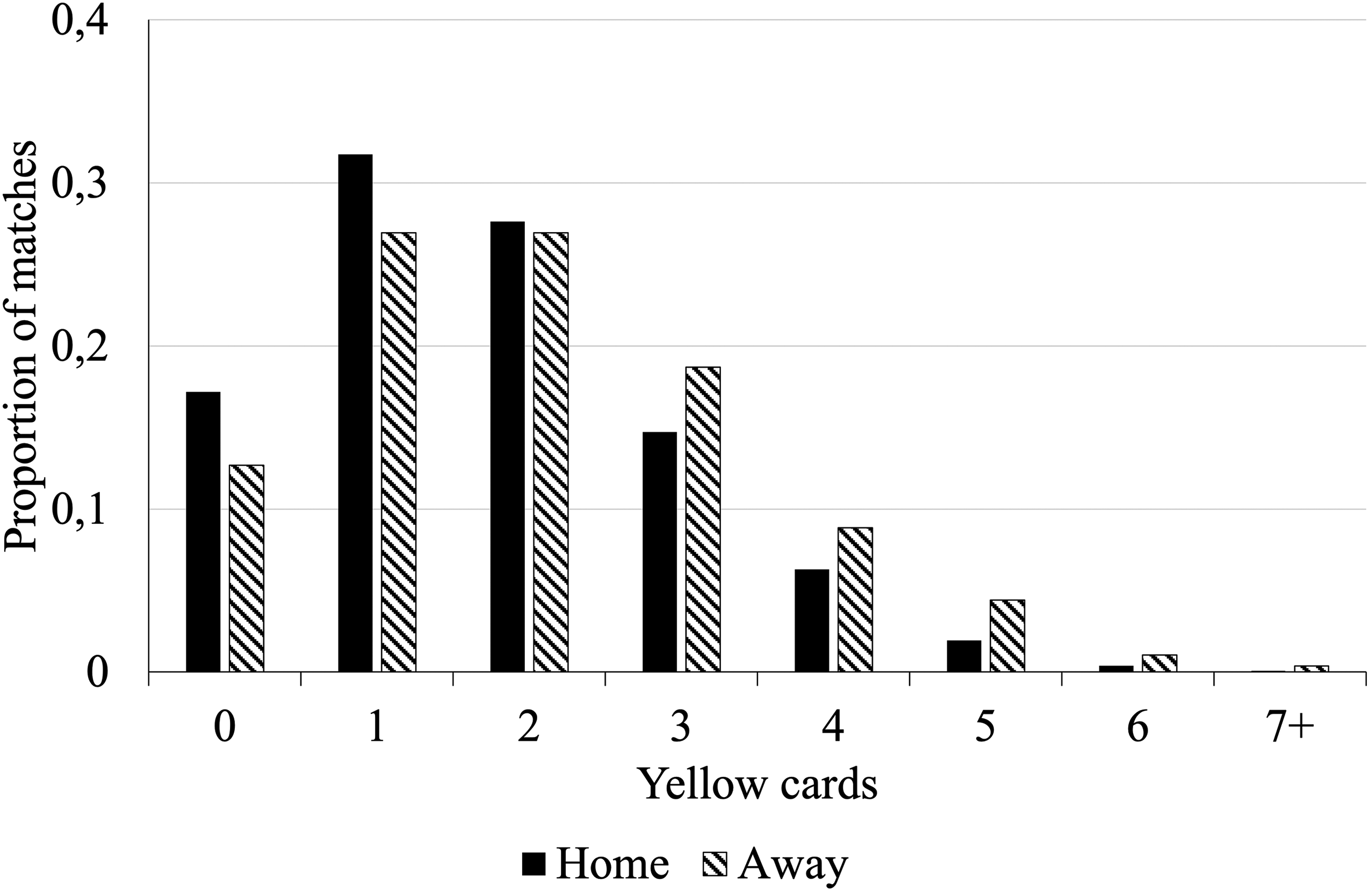
Sample distribution of yellow cards awarded over matches: men’s senior UEFA competitive international football, non-neutral venues, 2002-2016. Notes. All main analysis sample matches. Source. https://www.worldfootball.net; accessed 31 July 2021.
Sample Descriptives, Men’s Senior UEFA Competitive International Football, Non-neutral Venues, 2002-2016.
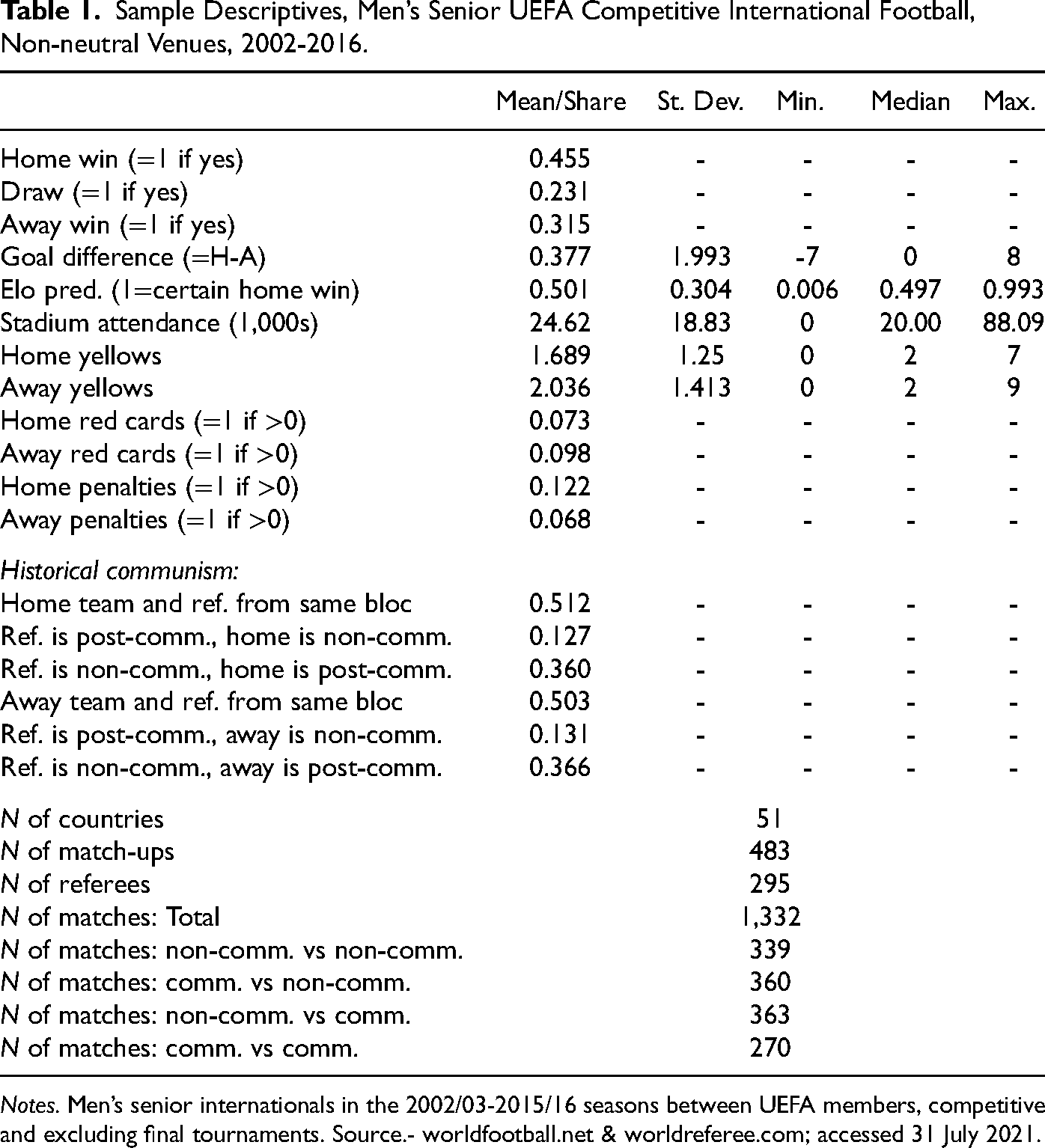
Notes. Men’s senior internationals in the 2002/03-2015/16 seasons between UEFA members, competitive and excluding final tournaments. Source.- worldfootball.net & worldreferee.com; accessed 31 July 2021.
Table 1 also describes indicators for the Iron Curtain status of a match according to the relationships between the referee’s nationality and the teams playing at home or away. We assign the 51 countries to two blocs: Post-communist countries with a minimum 40-year history of communist governments since World War II, and other non-communist countries without such a past. The six indicators shown thus cover all possibilities of the Iron Curtain status of a match over referee-home-away. Around 13% of matches involved a referee from a post-communist country but took place in the home stadium of a non-communist country. A similar proportion of matches involved a post-communist referee and a non-communist team playing away from home. 51% of matches took place with a home team and a referee from the same side of the Iron Curtain.
Our sample is skewed relative to the set of all matches played between UEFA national teams. First, we exclude friendly matches and non-official tournaments, since the importance of the outcome of such games is low and players, for example, are less likely to make potentially risky tackles to avoid unnecessary injuries. 14 As a consequence, referees issue significantly fewer yellow and red cards in these matches, and the pressure or incentives to make correct decisions are surely lower. Also, the decisions of referees in friendly matches have no significant impact on their chances of promotion or demotion. Second, we exclude matches played on neutral ground, so that we can separate out any differences in referee bias toward home or away teams, which may be affected by the social pressure from the mostly home-team-supporting stadium crowds.
Table 2 shows statistics for the numbers of referees, matches, and yellow cards awarded in the analysis sample, according to the nationalities of the referees. Great Britain and Russia had the highest numbers of referees and matches officiated within the non-communist and post-communist blocs, respectively. 15 The mean difference between the numbers of yellow cards awarded to home and away teams was greater among post-communist referees, but not significantly different, at standard levels, to the same difference among non-communist referees. For all nationalities where there was a statistically significant difference in the number of yellow cards awarded by referees to home and away teams, this was in the favor of the home teams.
Mean Yellow Cards Awarded, by Nationality of the Referee, Men’s Senior UEFA Competitive International Football, Non-neutral Venues, 2002-2016.
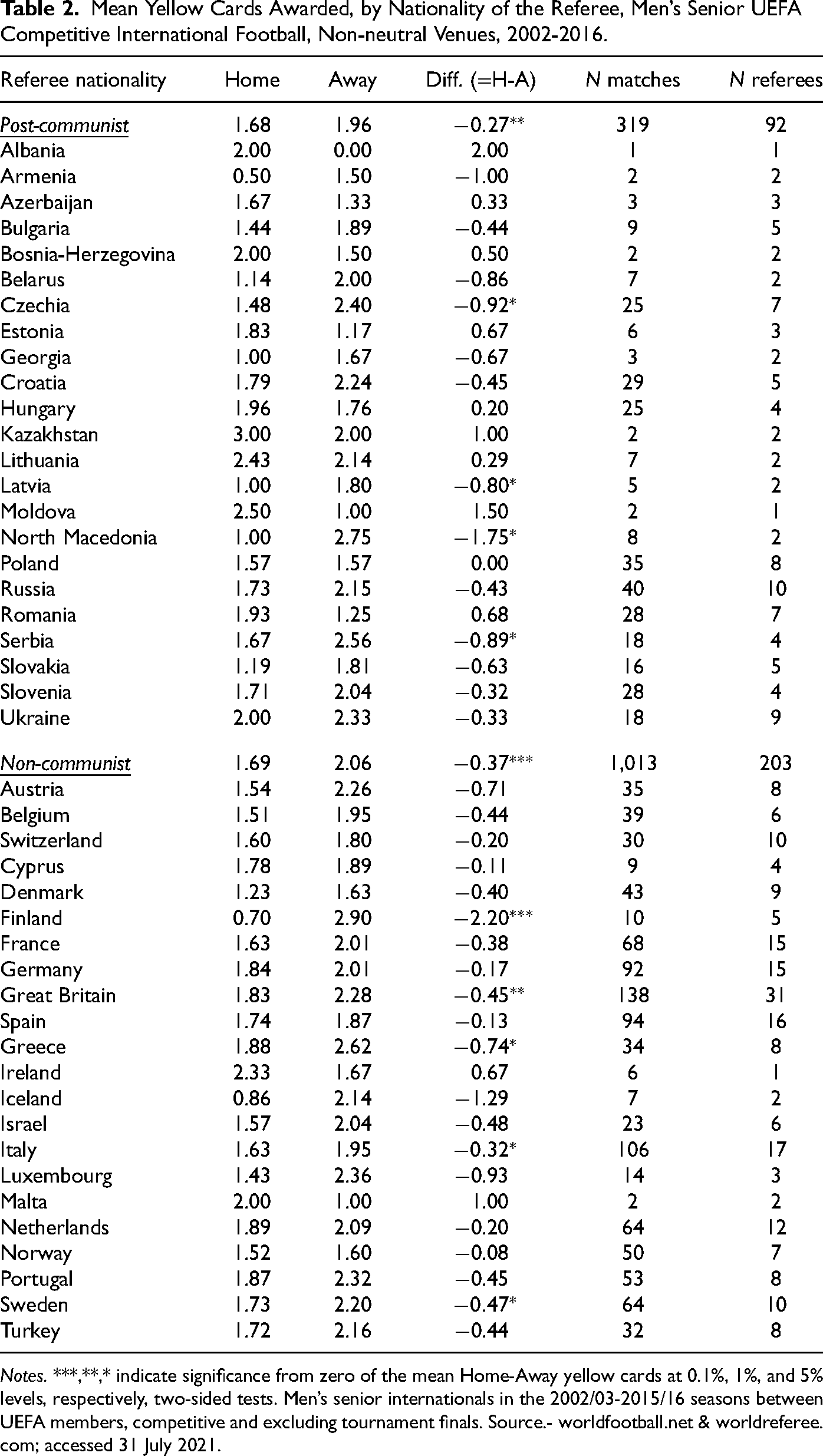
Notes. ***,**,* indicate significance from zero of the mean Home-Away yellow cards at 0.1%, 1%, and 5% levels, respectively, two-sided tests. Men’s senior internationals in the 2002/03-2015/16 seasons between UEFA members, competitive and excluding tournament finals. Source.- worldfootball.net & worldreferee.com; accessed 31 July 2021.
Methodology
Our empirical strategy exploits the way in which referees are assigned to matches. The ideal setting for identification would be one where referees were assigned to matches completely at random. If this were the case, then we could estimate the Iron Curtain effects by comparing average match outcomes according to the different referee-team relationships in the data. However, the assignment of referees is not completely random. Referees are not assigned to matches involving their own country. Referees may be assigned to particular types of matches because of characteristics correlated with their nationality. For example, better or more experienced referees may tend to be assigned to matches involving teams with a history of rivalry, aggression or indiscipline against one another, e.g., England vs Germany, France vs Italy, or Denmark vs Sweden. As Bryson et al. (2011) discuss, the performance or ability of a referee is related to how well they control a football match, indicated by fewer yellow or red cards being awarded. If referees from non-communist countries are generally better, perhaps due to the higher quality domestic leagues in those countries, then it is plausible that they are assigned to high-profile games more often than referees from post-communist countries. 16 Similarly, better referees may be assigned to matches that are expected to be more competitive than others. Patterns of referee assignment such as these could bias our estimates. To address this, we estimate regression models which control for some fixed and time-varying characteristics of football matches. In this way, we identify the referee-team relationship effects on match outcomes by assuming that, conditional on the controlled for match characteristics, the assignment of referees to matches was approximately random.
Specifically, we assume that the conditional mean for some outcome, 
We consider the following match outcomes for
We estimate Equation (1) using Poisson regression for the yellow card counts and linear least squares for all the other dependent variables. We prefer Poisson (QMLE) to negative binomial regression because the former is efficient in the class of consistent estimators with under or overdispersion (variance/mean ratio is constant) for effects on the conditional mean, provided it is correctly specified (Wooldridge, 2010). The match result model can be interpreted as a linear probability model for the home win, but it is also equivalent to having as the dependent variable the change in points gap in some league format (e.g., qualification groups for international finals tournaments) between the home and away team, where the winning team in football is awarded three points, and one point is awarded to both teams in the case of a draw (i.e.,
We considered the following control variables in
Results
Table 3 shows the Poisson regression estimates of Equation (1) for the numbers of home and away yellow cards awarded. A referee’s decision to award a yellow card is far less decisive for a match’s final outcome than awarding a red card or penalty kick (Titman et al., 2015). Column (I) shows that there is no significant evidence that the Iron Curtain relationship between referees and teams affected the numbers of home yellow cards awarded. However, column (II) shows that a post-communist referee significantly favored non-communist home and away teams when deciding whether to award yellow cards to the away team, increasing the number awarded by 15% when the home team was non-communist (
Poison Regression Estimates for the Number of Yellow Cards Awarded, Men’s Senior UEFA Competitive International Football, 2002-2016.
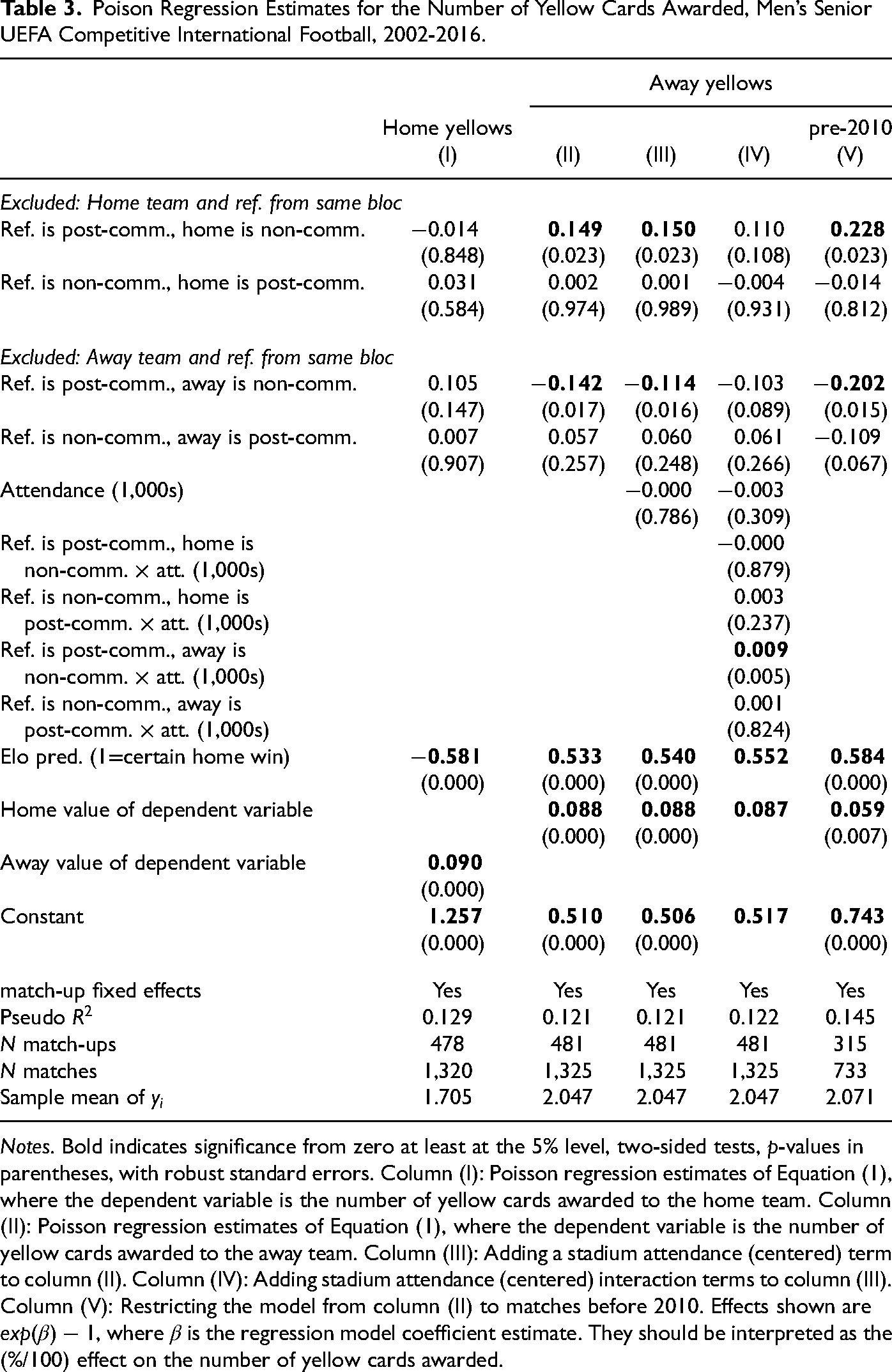
Notes. Bold indicates significance from zero at least at the 5% level, two-sided tests,
Column (III) of Table 3 adds stadium attendance as a potential factor in
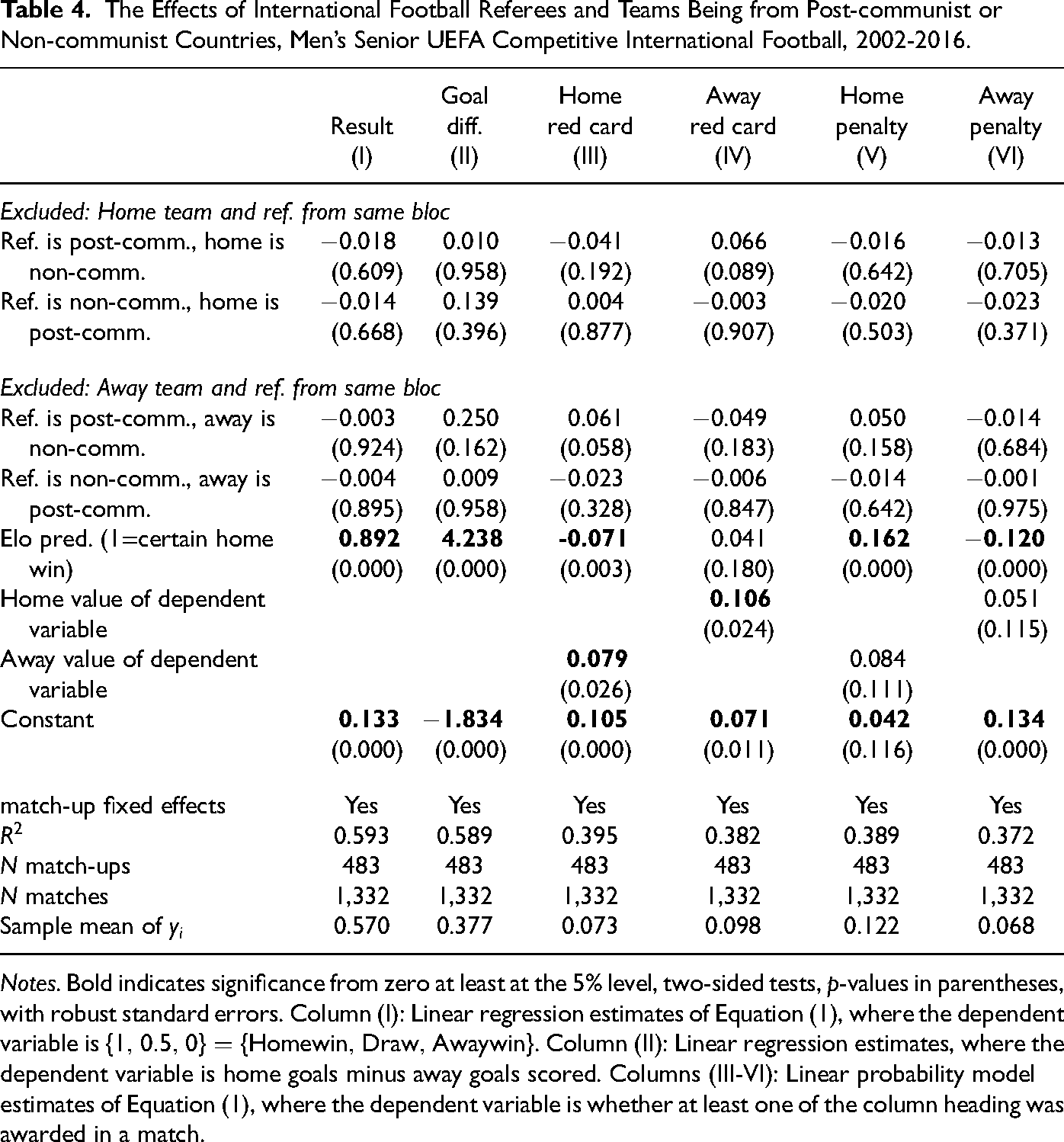
The six columns of results in Table 4 show the linear regression estimates of Equation (1) for match results (I), goal differences (II), whether a red card was awarded to the home and away team (III & IV), and whether a penalty kick was awarded to the home and away teams (V & VI), using the 1,332 men’s senior competitive international fixtures between 2002 and 2016 described in the “Data” section. There is no statistically significant evidence that the final match outcomes and the potentially important decisions of awarding penalty kicks and red cards were affected by the Iron Curtain relationship between the referee and the teams involved. However, some of these tests are under-powered. For example, the model estimates in column (II) of Table 4 show that when a post-communist referee took control of a match involving a post-communist home team and a non-communist away team, relative to a match where the referee and both teams were from the same bloc, home advantage increased on average by a quarter of goal. This is a sizeable modelled effect even if it is statistically insignificant (
The Effects of International Football Referees and Teams Being from Post-communist or Non-communist Countries, Men’s Senior UEFA Competitive International Football, 2002-2016.
Notes. Bold indicates significance from zero at least at the 5% level, two-sided tests,
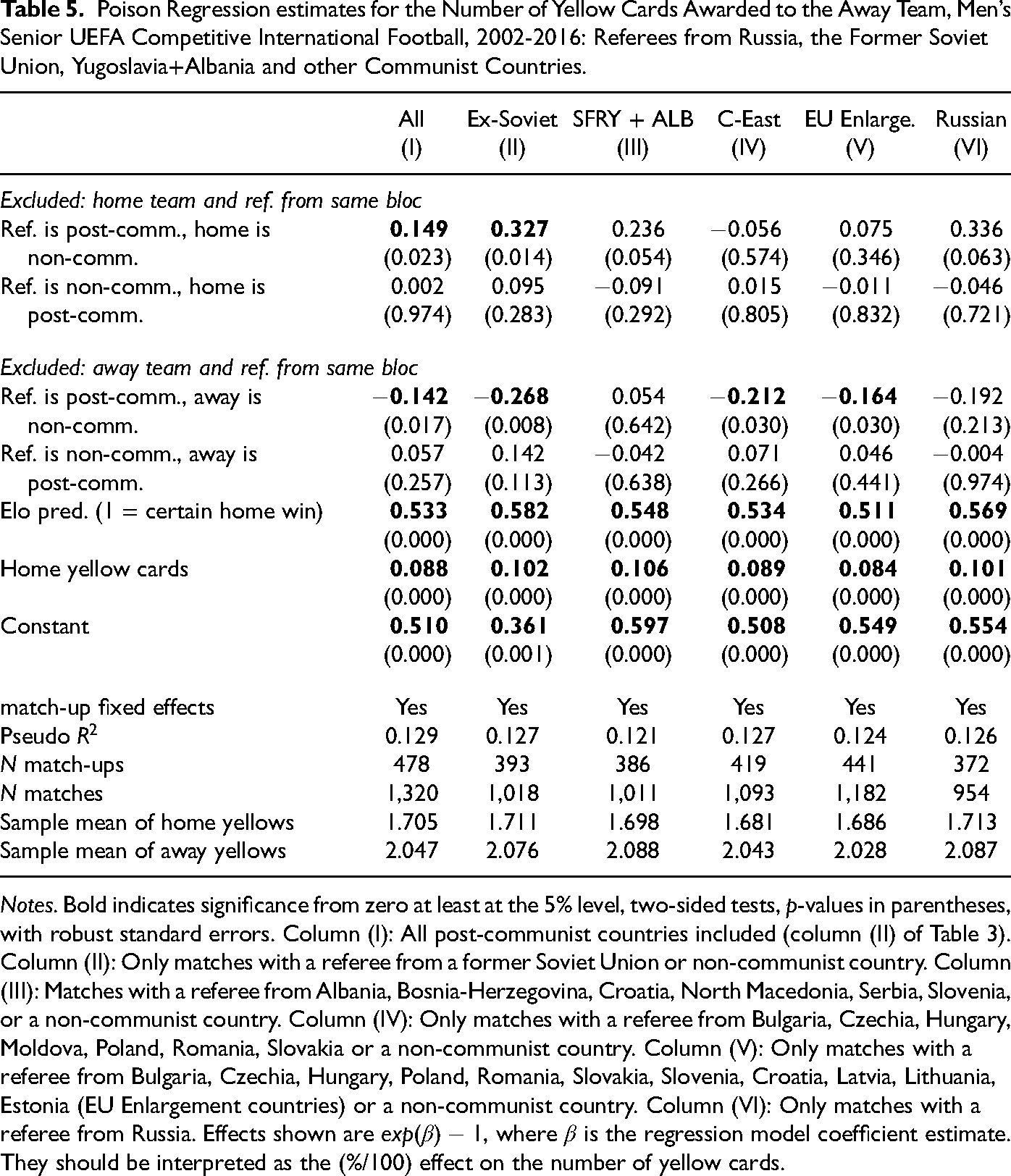
Columns (II)-(IV) of Table 5 turn back to yellow cards and re-estimate the model from column (II) of Table 3, but respectively using only matches officiated by non-communist referees along with those from either the former Soviet Union, the Balkans (Yugoslavia (SFRY) and Albania) other post-communist countries (i.e., the Warsaw Pact minus Albania, SFRY and the Soviet Union), or only Russia. (Note, column (I) of Table 5 repeats the estimates from column (II) of Table 3 for comparison). We choose these groupings of modern countries based on the historical political and geographical similarities within them, e.g., being governed as part of the Soviet Union or Yugoslavia (where Albania is aligned by geography), or being a post-WW2 vassal of the former. The results show that the out-group bias was markedly greater for former Soviet Union referees than those from the other post-communist countries. The ex-Soviet referees awarded 33% more away yellow cards when the home team was non-communist (
Poison Regression estimates for the Number of Yellow Cards Awarded to the Away Team, Men’s Senior UEFA Competitive International Football, 2002-2016: Referees from Russia, the Former Soviet Union, Yugoslavia+Albania and other Communist Countries.
Notes. Bold indicates significance from zero at least at the 5% level, two-sided tests,
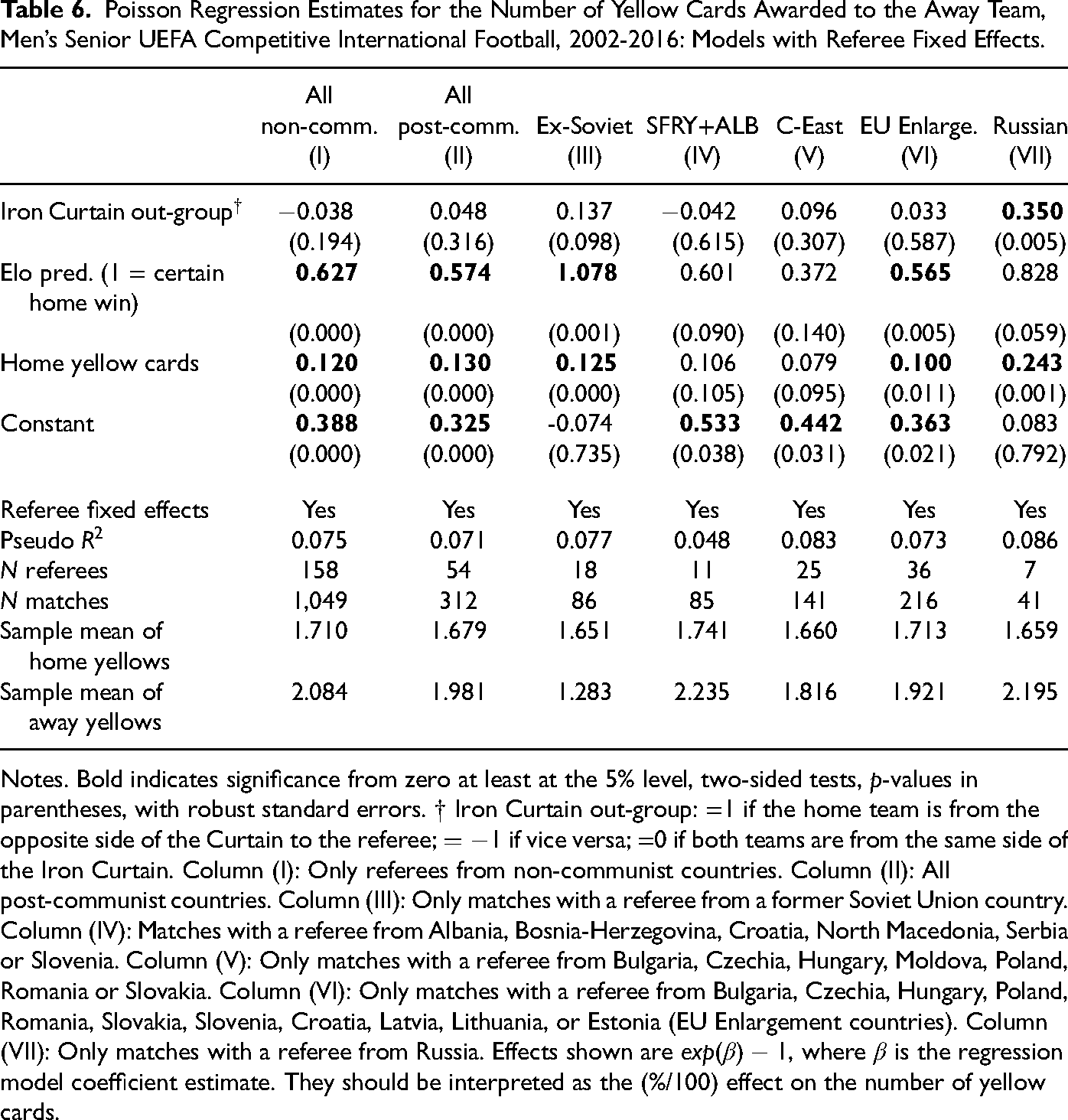
To further address the potential heterogeneity over referees in the Iron Curtain relationship effects for the awarding of yellow cards to an away team, we estimate a version of Equation (1) with referee fixed effects, 
Poisson Regression Estimates for the Number of Yellow Cards Awarded to the Away Team, Men’s Senior UEFA Competitive International Football, 2002-2016: Models with Referee Fixed Effects.
Notes. Bold indicates significance from zero at least at the 5% level, two-sided tests,
Conclusion
In this paper, we asked whether the decision making of referees in the past two decades of European international football matches was biased by the legacy of the Cold War. By exploiting how referees with different nationalities were assigned to matches, we found evidence of significant out-group bias among post-communist referees, who particularly favored non-communist teams in terms of the number of yellow cards awarded to away teams. These findings are consistent with the notion that referees who grew up in communist states have since developed a relative affinity toward countries on the other side of the Iron Curtain and their football teams, which subsequently affected these relatively subjective decisions that they made during a match. We found that this evidence of bias was stronger in the earlier matches we studied, and among the referees from the former Soviet Union compared with those from other post-communist states. There was no evidence of an equivalent out-group bias among the referees from non-communist states. These findings can be compared with the in-group bias observed by Frank & Krabel (2013) during the Cold War, but not after, among the Warsaw Pact judges of high-level chess match beauty, when social and political expectations to display such a bias may have been greater than in the period we have studied.
We cannot be overly confident that referee bias is the only factor driving these findings. Our methodology does not address the possibility that the playing style of teams, the behavior of football players, and the decisions of managers, could all be endogenous to the assignment of a referee to a match-up. Unfortunately, we don’t have measures of player aggressiveness for a long period of European international football, for example, that would allow us to address this issue. However, this is a common concern in the literature that prescribes changes or differences in the punishments of teams to referee bias (e.g., Bryson et al., 2021; McCarrick et al., 2021). More research and better data are needed, to control for any changes in the behavior of all the other agents involved in a sporting event, thus getting even more robust estimates of the nature and magnitude of referee bias. Further, the sample sizes of referees and competitive European football matches between nations in the post-Soviet era are not large. Therefore, it could be interesting to explore whether the out-group bias patterns we have found can be identified within international club football competitions. Although, the affinity and relationships between teams and referees at that level is more complex, not least due to footballers often playing for clubs outside their home nation (see Pope & Pope, 2015).
The unobserved processes determining the assignment of referees to football matches limit our ability to identify referee bias. We do not know exactly how any international relations issues are taken into account by the UEFA Referees Committee. It is possible and plausible that the committee already tries to avoid certain types of referee-match-up assignment related to the legacy of the Cold War, to manage the risk of referee bias. If this were the case, then our estimates would only capture a part of the true effects of assigning a post-communist referee to adjudicate football matches involving non-communist teams.
Footnotes
Acknowledgments
The authors thank Dennis Coates, Kai Fischer, and Dominik Schreyer for comments and advice, as well as seminar participants at the University of Reading (11/2020), the Scottish Economic Society Annual Conference (04/2021) and the 5th Eastern Conference on Football Economics/7th Western Conference on Football and Finance (07/2021).
Declaration of Conflicting Interests
The authors declared no potential conflicts of interest with respect to the research, authorship, and/or publication of this article.
Funding
The author(s) disclosed receipt of the following financial support for the research, authorship,and/or publication of this article: Dmitry Dagaev and Sofia Paklina gratefully acknowledge support from the Basic Research Program of the National Research University Higher School of Economics. The funding source had no involvement in the research.
