



Abstract
We examine the uncertainty of outcome hypothesis and consider direct demand for professional boxing using a new dataset for basic cable broadcasts. Our analysis covers 103 broadcasts in the United States from February 2017 to February 2021 for Premier Boxing Champions (FOX) and Top Rank Boxing (ESPN). Using a generalized linear model, we estimate a demand function for basic cable broadcasts and place specific emphasis on adopting alternative measures of outcome uncertainty. We find no evidence that increasing balance between boxers increases viewership figures on basic cable broadcasts. Consistent with pay-per-view boxing viewership, our results demonstrate that bout quality impacts demand for cable broadcasts. Furthermore, we find no evidence of a declining viewership trend, a finding relevant to the industry given the general decrease in viewership trends for main events and pay-per-view broadcasts. Fans continue to demonstrate a preference for the welterweight division.
Introduction
The connection between outcome uncertainty (OU) and consumer demand for live sport has been a key line of academic enquiry since the seminal contributions of Rottenberg (1956) and Neale (1964). Many studies have tested whether fans have an appetite for greater ex-ante parity between contestants in the tradition of these works and debated the extent of uncertainty required to maintain spectator interest. 1 Despite a well-developed literature across most major sports, some sporting settings have yet to be thoroughly explored. This is most relevant for individual sports, and professional (pro-) boxing is one context where little attention to date has been paid to the relationship between fan interest and outcome uncertainty. 2
An early reference to the economics of boxing is found in Neale (1964) and his description of the Louis-Schmeling paradox. It would take some time for the sport to be considered again and demand for combat sport was first explored by Noll et al. (1978) and Balbien et al. (1981). Such is the significance of these works that this special issue is an attempt to reorient the pioneering work of Roger Noll, Joel Balbien and Jim Quirk. Recently, Butler et al. (2020) offer a contemporary analysis of the uncertainty-of-outcome hypothesis (UOH) for North American boxing broadcasts and explicitly test the relationship between balance and demand for subscription (Main Event) and pay-per-view (PPV) broadcasts. The evidence is mixed with regard to the relationship between viewership and a priori bout balance. Specifically, and contrary to the UOH, viewers favor more dominant bouts broadcast via subscription platforms. However, this effect did not persist for PPV. Given the inconclusive nature of the outcome uncertainty result, we are motivated to access a new dataset from a third source—basic cable broadcasts. This enables a new test of the UOH using data from an additional broadcast category. These data are particularly advantageous as we do not encounter the problem of marked price variations or price endogeneity issues arising from premium broadcasts. 3 Consumers are not required to incur additional costs to view these bouts beyond a basic broadcasting package. Our dataset also lends itself to considering another question relevant to the sport—whether or not the demand to view professional boxing is in systematic decline?
Recent evidence suggests that subscription and PPV boxing viewership has deteriorated in the United States from 2006 to 2018 (Butler et al., 2020). Whether this trend represents a change in tastes, or reflects the obsolescence of traditional methods for consuming premium content, is yet not well understood. Our basic cable data can offer new insights on whether the declining viewership observed from premium sources of demand extends to non-paywalled content. Evaluating the popularity of sports over time and considering how preferences ebb-and-flow is important as it can offer meaningful insights on a sport's health and can expose trends that stimulate clear policy implications for sporting organizations (Buraimo et al., 2021; Fort & Winfree, 2013).
This article continues as follows. The next section offers a brief synopsis of the UOH and introduce studies relevant to our setting. We then outline our data in the third section, focusing on the construction of our outcome uncertainty measures. The fourth section outlines the model and provides summary statistics. The results follows in the fifth section. The sixth section discusses the findings and compares the results from this setting to alternative broadcast categories. The seventh section concludes the article.
Theory and Literature
The UOH is a cornerstone of the sports economics literature (Fort & Maxcy, 2003; Humphreys & Miceli, 2019). Theoretically, it is a significant factor in explaining the interest that a sporting competition draws from audiences and predicts that consumer demand to attend or view live sport will be correlated to the likelihood of the outcomes. At an individual contest or match level, demand for sporting events that are more balanced are expected to be better attended, or viewed more, as it is supposed that fans place a higher value on more uncertain outcomes. Not only is outcome uncertainty theoretically important to consumer decision making, it also informs models of club/broadcast revenue generation.
The hypothesis that fans prefer greater uncertainty is directly traced to Rottenberg (1956) and Neale (1964) and was historically considered in the context of live attendance (Noll, 1974). In general, this literature has pursued approaches set out by consumer modeling theory (see Borland & Macdonald, 2003). Demand is typically assumed to be a function of economic variables, product (sporting) quality, supply-side factors, and consumer preferences. An entire branch of the sports economics literature is now dedicated to empirically testing the UOH at the level of attendance demand and the natural extension of broadcast audiences. While not reserved to individual contests, outcome uncertainty is typically considered on this scale (Fort & Quirk, 1995). Schreyer and Ansari (2022) offer a recent survey of stadium attendance demand, highlighting the recurring theme of outcome uncertainty in the research agenda.
However, despite widespread empirical testing across sports and alternative sources of demand, the evidence on the relationship between consumer interest and a priori contest balance is mixed. The UOH is regularly rejected. Coates et al. (2014) and Budzinski and Pawlowski (2017) demonstrate the lack of empirical support for UOH across sports. Given the lack of support for the UOH, the research agenda is moving toward behavioral theories of consumer demand that consider reference-dependent preferences and loss aversion (Coates et al., 2014; Martins & Cró, 2018). Furthermore, an empirical emphasis is being placed on latent traits regulating outcome uncertainty such as suspense, surprise, and shock (Buraimo et al., 2020). Professional boxing does not have typical aspects of many sports and in particular has disjointed governance structures. For example, the home/away dynamic that exists in most field sports, is for the most part not applicable to this context. Bouts are negotiated by promoters, managers, and boxers themselves, with the primary motive often to maximize the size of the purse (Balbien et al., 1981). The location of the contest often determines this and neutral venues such as Las Vegas, New York, and recently, countries in the Middle East, are used as hosts to maximize the revenues. Consequently, it is often impossible to identify a “home” boxer or even fan favorite prior to the bout taking place. Loss aversion is challenging to model without making major assumptions.
Most tests of UOH have been reserved to male team sports. Increasingly, however, individual and niche sports are attracting interest (see Buraimo et al., 2021; Schreyer & Torgler, 2018; Storm et al., 2018). Primarily due to the growth in mixed martial arts (MMA), demand for combat sport is one setting that has received increased research focus (see Watanabe [2012]). For example, Tainsky et al. (2013) model the demand for Ultimate Fighting Championship (UFC) and show evidence in support of UOH. Watanabe (2015) also considers MMA, evaluating live attendance and broadcasts views at UFC events. Reams and Shapiro (2017) fail to show a relationship between betting odds and PPV buys in the UFC. Most recently, Tereso et al. (2022) have turned attention to the correlation between contest build-up and consumer demand. Analysing press conference communications and tweets, they show that PPV demand can relate to divisive pre-fight engagements.
Although pro-boxing falls within the domain of combat sport, sharing many contextual traits (weight classes, undefeated performers, and marquee fighters) with MMAs, professional boxing is decidedly different to MMA. Meier et al. (2018) and Butler et al. (2020) note the unusual competitive structure of pro-boxing and the absence of any centralized governance to regulate balance. This disjointed organizational structure, and the associated competition problems, have been documented previously (Tenorio, 2006). The absence of any sole governing body presents individual boxers and promoters an opportunity to be highly strategic in attempts to maximize commercial success. This strategic behavior can extend to purse sharing exertion efforts (Akin et al., 2022). For example, uncompetitive bouts may be actively sought to build-up a boxer's reputation. There are many implications of this fragmented institutional make-up in professional boxing. Frequently demanded bouts between elite boxers may not be negotiated, and if they are, may occur at times when boxers are not at the pinnacle of their career. Floyd Mayweather Jr. and Manny Pacquio's “Fight of the Century” in 2015 is a possible example of this type of match.
Preferences to view free-to-air professional boxing have been studied outside of a North American setting. Meier et al. (2018) access a dataset of nonpremium German telecasts of professional boxing bouts and test that demand to view is a function of patriotism and star appeal. The authors find that local star quality is more important to a bout compared to the national background of a boxer and that fans prefer quality over uncertainty. Given data limitations on access to betting odds, Meier et al. (2018) apply performance-based measures to consider outcome uncertainty. Modeling the determinants of subscriber views for main events and PPV buys, Butler et al. (2020) show that viewership is negatively correlated with increasing outcome uncertainty for main events. Limited evidence is found to support UOH at a PPV level, and not robust when omitting outliers.
Given the data we access, it is also possible to consider the question of shifting tastes to view professional boxing. Although changing tastes to consume popular sports have occurred historically, 4 declining PPV buys may not transcend the combat sport category. If so, this would indicate that there is not a social or cultural move away from watching violent sport—a type that has an ancient origin (Jewell et al., 2011). Tainsky et al. (2013) report a general increasing trend in PPV buys for UFC. Watanabe (2015) finds that demand for televised UFC PPVs is not responsive to time trend variables. Furthermore, there is no evidence that declining pro-boxing viewership is causally related to substitutes within the combat sport category. Butler et al. (2020) report that competing UFC broadcasts are not significant determinants of pro-boxing viewership or PPV buys.
Data and Measuring Outcome Uncertainty
This section explores the viewership data used in the empirical estimations that follow and the various measures of outcome uncertainty that are tested. All data is publicly available and extends over a 4-year period.
Viewer Data
Our data is manually collected from a variety of media sources that report bout viewership figures. These include boxing scene.com, boxingnews24.com, badlefthook.com. To our knowledge, these viewer figures represent average bout views for live and same day replays of the main event 5 on a card but do not account for streaming on mobile devices. The sources correspond to Nielsen estimates. The data also represents the English-speaking version of the broadcast and viewer figures are deflated for Fox Deportes views. Our data covers 103 bouts broadcast from February 2017 to February 2021 for Premier Boxing Champions Boxing (FOX) and Top Rank Boxing (ESPN). It is of note that figures are for US broadcasts only and exclude any international audiences. While this sample is relatively small in an absolute sense—compared to the demand literature—in the context of the general combat sport literature, the dataset is comparable in size. As explained, the diversified nature of boxing administration, limited the frequency of bouts so that it takes a period of more than 4 years to amass over 100 observations. If a single, unified body were organizing events, it is likely boxing contests would occur much more frequently.
Outcome Uncertainty
We construct four uncertainty of outcome measures. These are derived from odds probabilities sourced via oddsportal.com and sportsbetlistings.com. Using odds probabilities represents the standard approach to measuring ex-ante outcomes and is typically considered best practice in the measurement of OU as they can include up-to-date and relevant information on potential outcomes. We follow two computation procedures to convert betting odds into outcome probabilities. This approach is motivated by concerns related to variations in estimates from using alternative conversion methods (Berkowitz et al., 2018).
First, we use the basic normalization (BN) approach. This comprises dividing the probability of individual outcomes by the book sum to adjust for an overround (mean = 8.87%). This method corrects for the gambling firm's take but assumes that any profits from establishing the market are distributed evenly across the three discrete outcomes. Second, we use the approach proposed by Shin (1991, 1992, 1993) and implemented by Jullien and Salanié (1994). This method assumes that gambling firms set odds to maximize expected profits in the knowledge that both uniformed and insider trading is present in the market. While gambling firms and a significant proportion of bettors have equal information to form a probabilistic assessment of a given bout, a cohort of bettors could have superior probabilistic beliefs concerning the bout's result ex-ante. This advantage may arise from superior use of public information or due to corruption. We are particularly motivated to use this approach given the sport history.
6
As gambling firms envisage this, the market odds they set protect against private information by including a buffer. Following Štrumbelj (2014), we compute Shin probabilities with Equation 1, using the quoted odds (π), where


Using both sets of probabilities we derive four measures of outcome uncertainty. The first two measures are standard in the combat sports literature—the difference in the probability of success ex-ante between the boxers (

Additional Measures
Table 1 displays the controls in our dataset. The selection of these variables is informed by well-known theoretical contributions on determinants of demand for live sport (e.g., Borland & MacDonald, 2003) and past empirical work in the combat sport setting (Butler et al., 2020; Tainsky et al., 2013; Watanabe, 2012, 2015). For bout specific and scheduling controls, all information is scraped from Box.Rec.com. Data for competing broadcasts is accessed from online television guides.
Variable Overview.
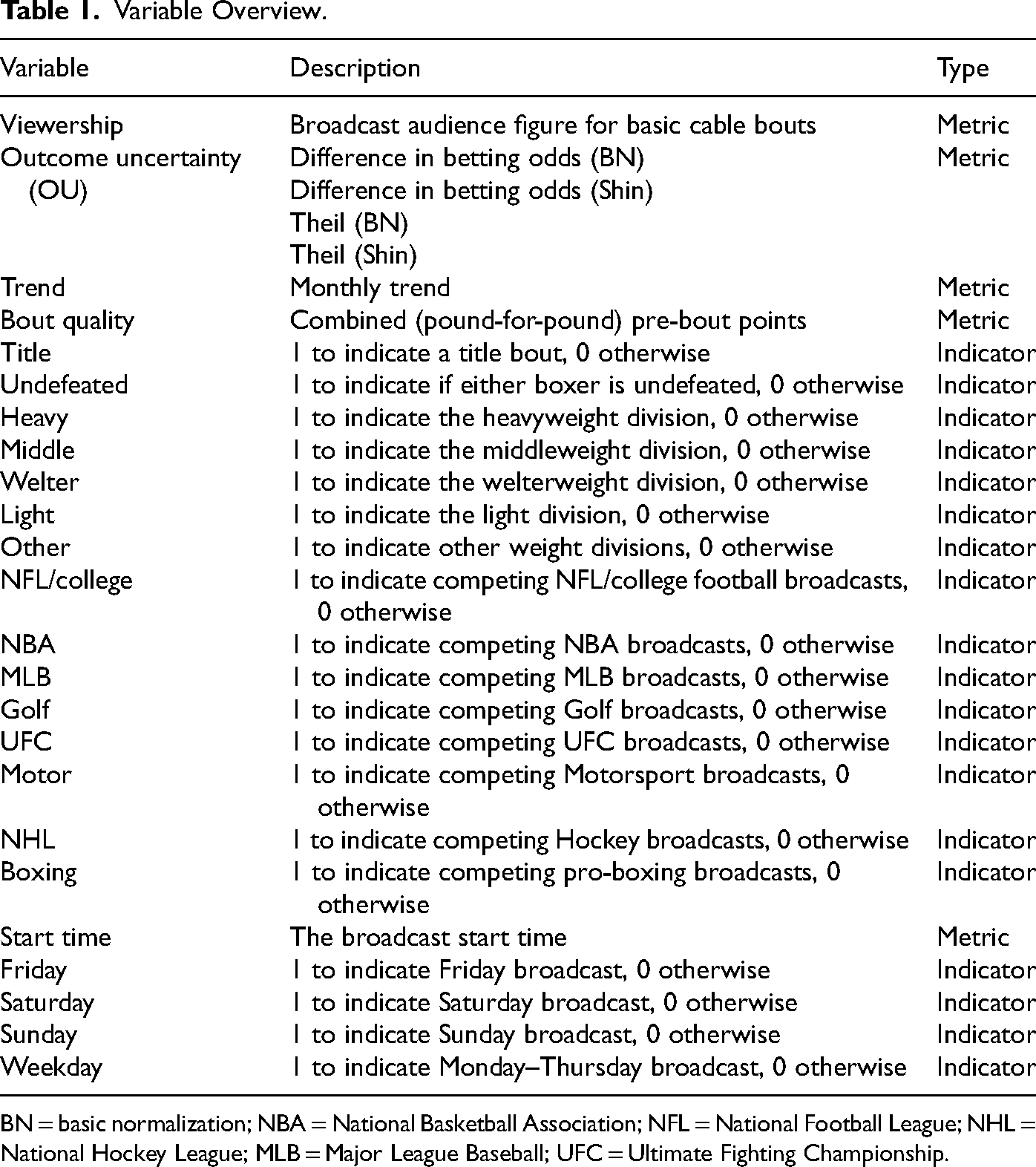
BN = basic normalization; NBA = National Basketball Association; NFL = National Football League; NHL = National Hockey League; MLB = Major League Baseball; UFC = Ultimate Fighting Championship.
Model
We specify a viewer equation that takes the following form:
A standard procedure in the demand literature is often to use the natural logarithm of the Viewers dependent variable, however we do not transform the data and instead adopt a generalized linear model (GLM) based on maximum likelihood. This allows us to control for skewness in the viewer data and is in line with research on combat sport. Furthermore, using GLM facilities meaningful inferences and comparisons to other sources of demand in our setting (Dobson & Barnett, 2018 provide a recent overview of GLM fitting and estimation). It is also worth noting that prior to estimating this model, we conducted a battery of stationary tests on the dependent variable.
There are omissions from the specification that warrant justification. First, no rematches or domestic boxer variables were included as there was so little variation in these characteristics. Second, no bouts fell on (or in proximity) to a public holiday. These annual holidays could impact demand (c.f. Watanabe, 2012, 2015). Third, we did not include any “star” or popularity measures. This is motivated by the nature of the nonpremium bout category. Fourth, we initially experimented with a dummy for the carrier, but this did little to improve the model—the bouts were broadcast via either FOX or ESPN (with the exception of two occasions where a bout was broadcast on ESPN2). Finally, we do not include boxer fixed effects—given the sample size as the number of boxer-level controls needed, estimating many additional parameters would sharply decrease the precision of the model. Unlike tournament designs seen in many sporting settings that provide fixity of fixtures, and allow for the inclusion of unit fixed effects, pro-boxing contests are typically standalone contests. While some boxers in our dataset do feature more than once, in general the combat sport setting does not lend itself to using fixed effects. Table 2 reports the descriptive statistics for all of our variables. The average level of viewership is generally consistent with main event demand and PPV buys.
Descriptive Statistics.
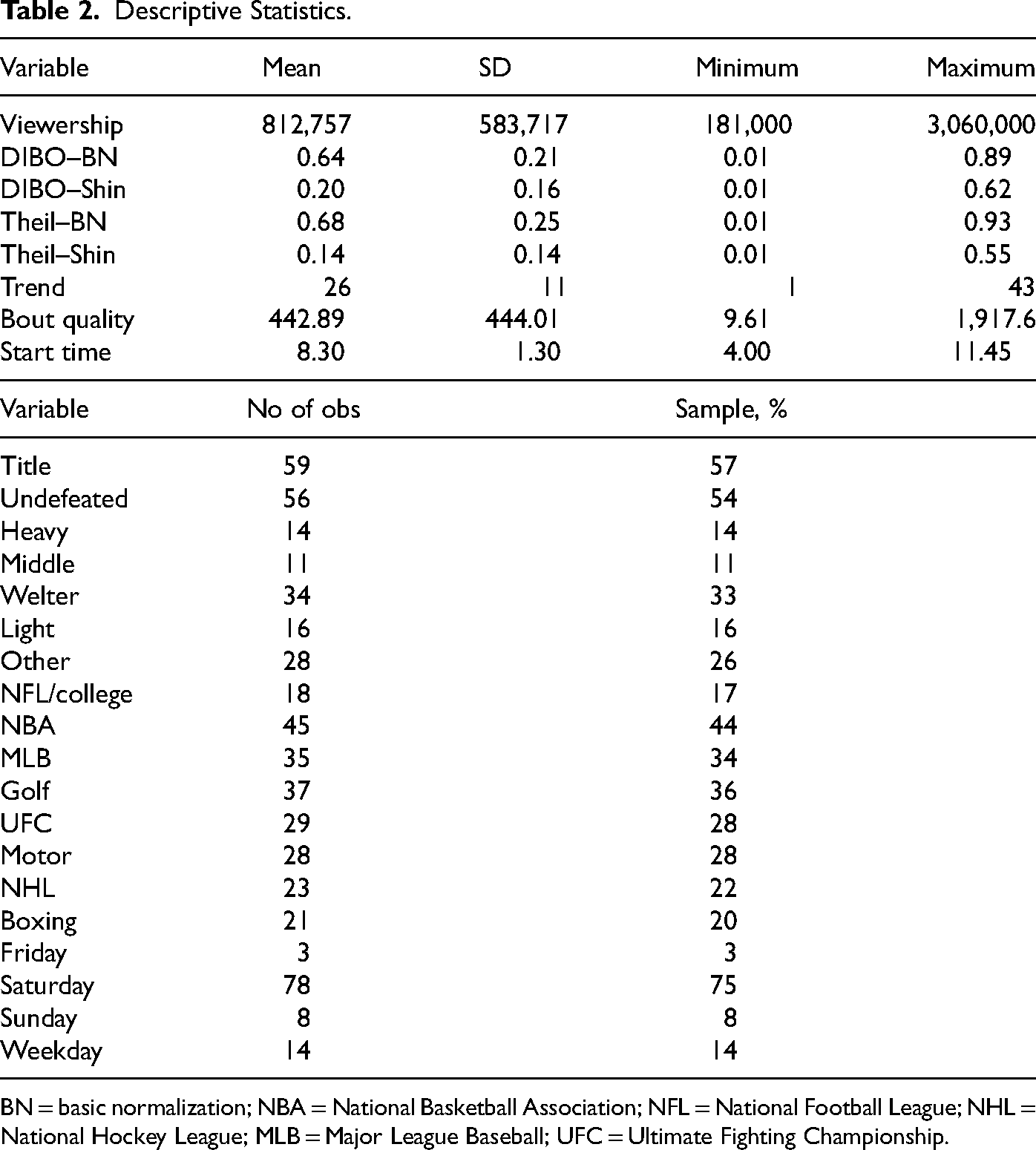
BN = basic normalization; NBA = National Basketball Association; NFL = National Football League; NHL = National Hockey League; MLB = Major League Baseball; UFC = Ultimate Fighting Championship.
However, it should be noted that both sources of direct demand are paywalled beyond basic packages. It is also worth noting that relative to other sporting contexts that these figures are low. This is due to the comparative popularity of boxing (a niche sport), viz-à-viz invasive field sports. Furthermore, this is not the highest quality product category within the sport.
Empirical Results
Table 3 presents the results where we estimate the empirical model with the alternative OU measures. While the direction of the effects is as predicted by the UOH, we fail to observe any statistical effects on OU across all estimations—applying both standard difference in betting odds approaches or controlling for draw probabilities fails to yield any significant effect. This holds when the odds are manipulated via BN and Shin techniques. This lack of any statistical support for fans preferring more balanced bouts is consistent with Butler et al. (2020). In general, the failure to find support for the UOH across alternative sources of demand for pro-boxing, and strong evidence on the contrary for Main Event bouts, is not entirely surprising in the context of the demand literature. As outlined, many studies have failed to find supporting evidence for the UOH across a variety of sports settings. Our tests here are another addition to this catalog.
Empirical Results.
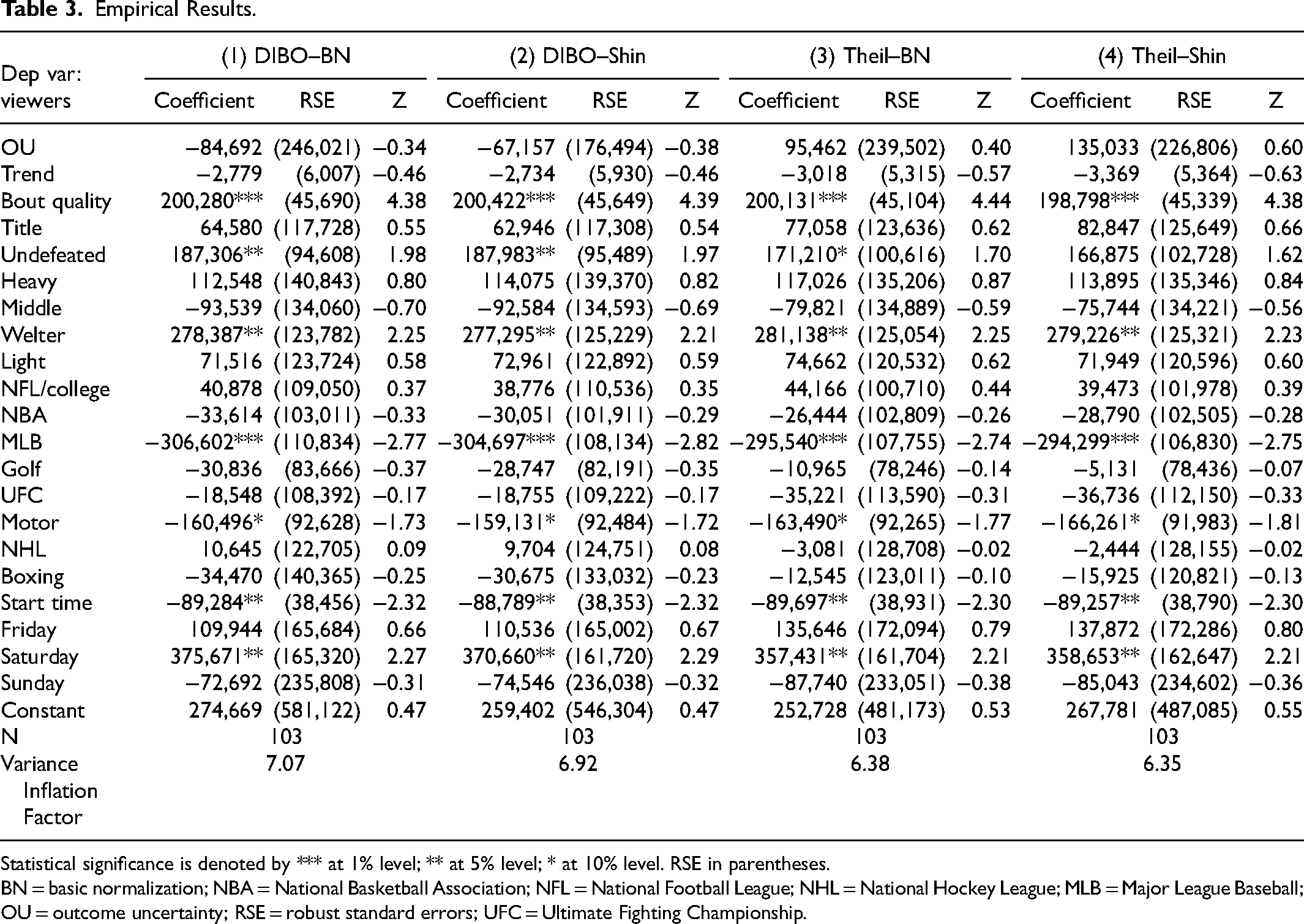
Statistical significance is denoted by *** at 1% level; ** at 5% level; * at 10% level. RSE in parentheses.
BN = basic normalization; NBA = National Basketball Association; NFL = National Football League; NHL = National Hockey League; MLB = Major League Baseball; OU = outcome uncertainty; RSE = robust standard errors; UFC = Ultimate Fighting Championship.
A potential objection to our test of the UOH could be the use of betting odds—while we believe this is justified, as market prices typically serve as efficient aggregators of relevant information on a sport, it is worth noting that betting odds are still indirect predictive measures. Gambling firms ultimately attempt to ensure profits by optimally shifting risk. While accurately estimating outcomes is intrinsically tied to this objective, it is possible that temporal factors could impact the odds offered for a standalone sporting contest (e.g., wider book exposure, competition between rival gambling firms). Also, as we consider a 4-year period, profit margins may change, and recent evidence shows that increasing turnover for more popular contests is a reason to bias odds (Franke, 2020). Given these concerns, we check the OU result by investigating performance data and consider the difference in BoxRec points between opponents at the time of the bout as a measure of OU. We note that the absence of any OU effect is robust to using these performance-based measures.
It is important to note that while the choice of OU measure does impact the coefficient it does not generally impact the results. By not controlling for a draw outcome, we see a positive and significant effect (Models 1 and 2) for undefeated boxers. However, the strength of this effect is reduced with the use of the Theil measure (BN). The effect is not robust to using the Theil measures derived from Shin probabilities. Given that this effect is sensitive to the choice of OU, we propose that this effect is interpreted cautiously. More generally, the inconsistent Undefeated speaks to the need to apply alternative measures of outcome uncertainty.
In contrast to Butler et al. (2020), we do not observe any negative trend. The absence of any Trend effect is encouraging for the pro-boxing industry and indicates that the popularity of viewing the sport is not in decline. A key motivator of this study is that it remained unknown if the worsening viewership for pro-boxing from premium broadcasts was a consequence of changes to the broadcasting landscape or whether shifting consumer tastes have played a role in this deterioration. We observe that nonpremium broadcasts are not following this trend. The absence of any decline in this context lends support to the view that deteriorating viewership via other sources reflects cord-cutting practices of consumers and potentially a switch toward streaming content from a range of digital providers, rather than a systematic popularity decline.
As expected, we see a positive and strong statistical effect on bout quality. This is finding that is generally consistent both within and outside of the combat sport context as fans are acutely aware of talent levels on display. The Welterweight division is also favored by fans—this effect is consistent across all sources of direct demand (PPV through to Cable) and affirms the status of the division. This effect has clear implications for bout organizer seeking commercial success.
Given that out estimations include many scheduling factors that are bout specific (e.g., weight classes), our findings have meaningful significance for parties seeking to design and schedule commercially viable bouts. We note one substitution effect. MLB broadcasts significantly reduce bout viewership. Consistent with Butler et al. (2020), it is worth emphasizing the absence of any UFC effect. Across a suite of boxing broadcasts—PPV through to basic broadcasts—there is no evidence to support the view that UFC broadcasts impact pro-boxing audience size. This has implications for scheduling and bout organization. As we anticipated, later start times negatively impact viewership and we observe a positive effect for bouts that take place on a Saturday. These findings speak to industry leaders as they can aid the design and scheduling of bouts to improve commercial success.
Discussion
Our main finding—that closer bouts are not in greater demand—is relevant as there is now no evidence to suggest the UOH is valid across a suite of broadcast sources for pro-boxing. These broadcast mediums differ according to their cost to the consumer. Also, basic broadcasting could represent demand from a more general or casual fanbase, whereas PPV or subscription markets are likely dominated by core pro-boxing fan. Despite these differences, fans have no preference for increasing a priori parity between boxers.
As noted, boxing is a highly unusual sport insofar as its governance is radically different to typical settings where clear tournament structures exist to match equal competitors. The governance structure of the sport lends itself to the formulation of unbalanced bouts. Mismatches are at times the norm rather than the exception. This raises questions regarding fans expectations of outcome uncertainty. A possible explanation for the lack of support for the UOH could be that fans have become accustomed to the balance levels.
This could also be linked to boxing betting markets. While it is not possible to know the size of the audience that actively bet, identifying this group could allow greater understanding of viewer demand. It may be the case that gamblers are more likely to watch if a boxer they have bet on is expected to win. However, caution is required here. Boxing betting markets are especially uneven. This is largely due to the widespread ability of boxers—particularly champions—to select suitable opponents and dictate the terms of a bout such as weight class or glove weight. Winning bets, where the probability of success is 90% or greater before the bout starts, result in little return and it is logical to assume lower levels of anticipation or excitement. While we believe this may be a motivator to view, the level of demand generated by this alone is possibly negligible and requires further investigation.
Interestingly, we find that demand to view broadcasts of pro-boxing did not decline over the sampling frame. We propose that this is a sharper test of pro-boxing supposed decline in popularity given that we access broadcasting data that is not affected by additional paywalls. Given the stability in viewership for nonpremium content, this result can bust a myth that demand for the sport is in structural decline or that tastes have markedly changed. In addition to this, our data only covers the standard broadcast medium in the United States, excluding any streaming views and international audiences.
A common argument suggested to explain a decline in pro-boxing popularity is that paywalled pro-boxing content stimulated demographic-based taste changes. The widespread use of PPV for elite bouts since the 1990s successfully increased revenues through targeting a niche fan base who were accustomed to viewing boxing broadcasts on basic cable historically. However, this could have diminished the exposure of elite fighters to a wider and younger audience. Taken together, the viewer trends across alternative sources of demand lend support to the hypotheses that the leading cause of the decline in Main Event subscribers and PPV relates to technological change, increased broadcasting competition and/or organizational strategies (e.g., increased use of, or diminished quality of, PPVs).
Our findings affirm the relative popularity of the welterweight division. The preference to watch this category holds across different sources of demand. While this can be explained by a golden generation of boxers participating at this level in the PPV category, the preference is consistent for nonpremium bouts. There are various explanations for this. For example, North American fans may not resonate to lower weight divisions as they tend to be dominated by international boxers. Second, the welterweight limits mostly map into average human physique. Hence, it may be possible that higher levels of competition are available for this division and more talented boxers emerge. Third, this division could present an optimal combination of appealing skills for fans—welterweights must exhibit a more equal combination of technical skills, speed/agility, and power. These traits are often more unevenly balanced in higher and lower weight classes. Finally, like the heavyweight division, welterweight has a strong tradition. Many of the greatest ever pound-for-pound boxers competed in this weight class.
Conclusion
The motivation for this research is to draw connections between early contributions in sports economics, which considered examples and topics from combat sport—Neale (1964), Noll et al. (1978), and Balbien et al. (1981) to contemporary research. Research considering the economics of professional boxing and wider combat sport has moved slowly, despite these early attempts to make these sports relevant. This could be due to the growing popularity of other sports. Regardless of the reason this paper is an attempt to remedy the general shortage of literature considering professional boxing in the field of sports economics. We advance the demand literature by considering outcome uncertainty for a new broadcast category within pro-boxing and contribute to research on demand for individual sports. Given the theoretical importance of outcome uncertainty in determining demand for sport we place an emphasis on adopting multiple measures of a priori balance.
We do not find evidence to support the UOH—the absence of evidence to support fan appetite to view more balanced contests is consistent with past research on pro-boxing. Our dataset also makes the topic of boxing's alleged decline amenable to analysis. We find no evidence of a declining trend over the period, implying that general consumer tastes to view the sport have not subsidized.
When boxing was first explored by Balbien, Noll and Quirk in the late 1970s and early 1980s, professional boxing was very much a sport in vogue. In private correspondence Joel Balbien, recalled how his empirical work and data collection for the 1978 and 1981 papers required attending boxing events at a packed auditorium. A sport very much in its pomp. While the consensus view might be of a sport in decline since those days, our results would suggest otherwise. This is welcome news for the pro-boxing industry but does speak to the challenges of holding commercially successful bouts that are heavily paywalled.
Our viewership data represents aggregated figures. On the surface, pro-boxing appears to have specific spatial characteristics with regional variations in the popularity of the sport. More detailed viewer data could allow insights into these trends. Going forward, measuring advertising or social media effects in the build-up could also be an interesting avenue for future demand research. Outcome uncertainty evidently varies during bouts. Like with all sporting settings, access to richer within-bout viewership and in-play odds data would produce valuable insights. Finally, retrieving viewer data from newer broadcasting mediums such as streaming platforms, would offer meaningful insights on demand. It is our hope that this research can motivate others to continue exploring the economics of boxing and bring further attention to the pioneering work of Balbien, Noll and Quirk in these areas.
Footnotes
Declaration of Conflicting Interests
The author(s) declared no potential conflicts of interest with respect to the research, authorship, and/or publication of this article.
Funding
The author(s) received no financial support for the research, authorship, and/or publication of this article.
