



Abstract
Using stated preferences, this study estimates the determinants of television broadcast demand for current European men's club football competitions and a hypothetical European Super League. The results suggest that demand increases for most competitions with the consumer's level of interest, the accessibility to the matches, and the consumer being fan of a club playing in that competition. No support to the uncertainty-of-outcome hypothesis is found, as perceived competitive balance does not increase demand for most competitions. Conversely, the perception of quality of game played tends to be a more important driver of demand, influencing more competitions and having a larger impact.
Introduction
Professional sport influences the lives of many people around the globe on a daily basis and its impact may not be measured only by the money it generates, but also by its ability to increase social welfare. Men's football is one of the most demanded sports, 1 which may either drive fans across countries to watch a live game or engender astronomical investments from television (TV) broadcasters. However, for some decades now, the polarisation of wealth and talent within and between European football leagues has been growing (Franck, 2018). Despite the Union of European Football Associations (UEFA), the regulator and organiser in Europe, not being blameless (Hoehn & Szymanski, 1999; Késenne, 2007), protests by football fans have been scarce and much less severe than, for example, against the creation of a breakaway league grouping some of the top clubs – the European Super League (ESL) – in April 2021 (Brannagan et al., 2022). Therefore, this raises the question on what determines European football demand.
The first detailed demand specification of professional sports was presented by Rottenberg (1956), and it was followed by several studies, mostly applied to USA major leagues (Daly & Moore, 1981; Jones, 1969; Neale, 1964; Scully, 1974). Apart from a few exceptions in the 1970s (Hart et al., 1975; Sloane, 1971) and the 1980s (Cairns, 1987; Janssens & Késenne, 1987; Jennett, 1984; Peel & Thomas, 1988), economists only started paying attention to football in the 1990s, when there was an increase in the value of broadcasting rights (Hoehn & Szymanski, 1999). Since then, the academic literature focusing on the determinants of football demand grew rapidly using either a revealed preference approach (Cox, 2018; Humphreys & Pérez, 2019; Pawlowski & Anders, 2012; Schreyer et al., 2016, 2019) or a stated preference approach (Nalbantis & Pawlowski, 2016, 2019; Pawlowski, 2013; Pawlowski et al., 2018; Pawlowski & Budzinski, 2013). This latter approach is followed in the present study because, unlike typical aggregate measures of demand (e.g., TV audiences or stadium attendances) used in the revealed preference approach, it allows to consider that consumers’ decision may be influenced by behavioural, cognitive, and emotional factors (Budzinski & Pawlowski, 2017). This is crucial, for example, to study the effect of competitive balance (CB) on demand because, as highlighted by Pawlowski (2013), the perceived competitive balance (PCB) seems to be more meaningful to estimate demand than the observed (and mathematically computed) CB. Since the outcome uncertainty hypothesis (CB should increase the interest of a sporting event) proposed by Rottenberg (1956) and Neale (1964), the impact of CB on demand has been one of the main debates in the literature. However, it may not be found clear evidence for the importance of outcome uncertainty (Pawlowski et al., 2018).
In the last few years before the COVID-19 pandemic crisis, even with less suspenseful domestic championships, 2 the main European football leagues presented similar average match attendance, higher revenues stemming from TV broadcast, and there was no sign of a decline in social media popularity (Union of European Football Associations, 2017, 2018, 2019). Among clubs under UEFA umbrella, domestic broadcast revenues have been growing and have been the main source of revenue for some years now, as, for example, in 2018 they represented 37% of total revenues (Union of European Football Associations, 2019). Although some broadcast rights deals were negatively impacted by the pandemic crisis (Union of European Football Associations, 2021), it should remain the main source of revenue and it is less vulnerable to new COVID-19 waves than, for example, ticket sales, because the matches may still be broadcast even when they are played behind closed doors due to the pandemic context. Therefore, television broadcasts are our focus when addressing the main research question of this study: What are the determinants of demand for European football at the competition-level?
To achieve the goal of this study, two models are estimated, each one with a different demand indicator. The first one is a multivariate ordered probit model (MVOP) to estimate the determinants of viewing frequency and the second one is a two-part model (2PM) to estimate the determinants of willingness-to-pay (WTP). The data was collected by conducting a survey among football-interested individuals and covered the following competitions: English Premier League (EPL), Spanish La Liga (SLL), German Bundesliga (GBL), Italian Serie A (ISA), French Ligue 1 (FL1), Portuguese Primeira Liga (PPL), and Champions League (CL). Furthermore, one of the added values of this study to the existing literature is the comparison of these current competitions with a hypothetical model of ESL, based on the project announced in April 2021 (Macedo et al., 2022a, 2022b).
After this introduction, the remainder of the paper is organised as follows: Literature Review; Data and Model, split into four parts to detail the survey implementation, the model of ESL proposed in the survey, the data collected, and the econometric method of this research; Results; and Conclusion.
Literature Review
Similarly to other goods and services, professional sports have an economic process in which labour (e.g.,: athletes) and capital (e.g.,: equipment) are combined to create a product (Downward & Dawson, 2000). Nevertheless what aroused the interest of economists in demand for professional sport was its “peculiar” nature, as labelled by Neale (1964). Indeed, the product itself is a contest that directly satisfies the demand of consumers attending to the contest, but also satisfies an indirect demand by serving as production input for, among others, TV and general media, merchandise selling, advertising and sponsorship of companies and governments, and production of gambling (Borland & Macdonald, 2003).
The development of the economic theory of professional sports demand has been based on the standard consumer-theory model and Borland and Macdonald (2003) highlights five main groups of determinants: economic aspects, consumer preferences, viewing quality, characteristics of the contest, and supply capacity. This literature has grown considerably since TV revenue increased the economic importance of professional sport in the early 2000s, covering a wide range of regions and sports (Downward & Dawson, 2000). Here the focus is on football.
Regarding the literature on football demand, Pawlowski (2013) highlights two strands: the revealed preference approach and the stated preference approach. The former is more common and is based on the analysis of stadium attendances 3 (Pawlowski & Anders, 2012; Scelles & François, 2021; Scelles et al., 2016; Schreyer et al., 2016, 2019) or TV audiences (Cox, 2018; Humphreys & Pérez, 2019; Scelles, 2017; Schreyer et al., 2018), and Pawlowski (2013) suggests that this strand may well have used inadequate proxies of CB, or even if they were adequate, it is possible that variations in CB would not be sufficient to affect demand. 4 As opposed to the less convincing evidence provided by CB about the impact of outcome uncertainty on demand, the literature published over the last years has shown that the outcome uncertainty regarding several sporting prizes (e.g., winning the title, qualifying for an UEFA competition, or avoiding relegation) has a positive impact on demand (Addesa & Bond, 2021; Andreff & Scelles, 2015; Bond & Addesa, 2019, 2020; Hautbois et al., 2022; Scelles, 2017; Scelles et al., 2013a, 2013b, 2016; Schreyer & Däuper, 2018). This concept, called competitive intensity, is generally applied to the game-level analysis of European men's football demand by taking into account the importance of a match in the race for sporting prizes that home and away clubs might be involved.
The stated preference approach, followed by the present study, is increasingly influenced by behavioural economics and can make the distinction between observed (and mathematically computed) CB and PCB by using primary data (mostly surveys) (Nalbantis & Pawlowski, 2016, 2019; Pawlowski, 2013; Pawlowski et al., 2018; Pawlowski & Budzinski, 2013). Prior to Pawlowski (2013) and Pawlowski and Budzinski (2013), one of the shortcomings that could be pointed out to football demand studies using stated preferences was that the dependent variables used (e.g., enjoyment and attractiveness) were too vague to have direct implications for competition organisers or club managers. To solve this issue, these authors introduced two indicators of demand: intention-to-consume and WTP. Both variables represent specific information for stakeholders, and they may be used for buying tickets or TV broadcasting services.
Pawlowski (2013) found that most GBL fans care about seasonal uncertainty, but it would have to undergo great fluctuation to have a real effect on demand. The author justifies it with the existence of a threshold above which the consumption reaction is rather inelastic to those variations in PCB. Similar results were found by Pawlowski and Budzinski (2013) for Dutch and Danish leagues. However, Danish fans were found to be more sensitive to changes in PCB than German and Dutch fans. Besides, they noticed that Danish fans see competitive imbalance as a more important issue, although objective competitive balance (OCB) measures would suggest it is the most balanced league.
Studying the demand for international football broadcasts in USA, Nalbantis and Pawlowski (2016) and Nalbantis and Pawlowski (2019) also estimated the impact of outcome uncertainty using stated preferences. The former developed an analysis at the league- and game-level, covering the main competitions of the European Big-5 (England, France, Germany, Italy, and Spain), the CL, the main league in USA, and games of the USA men's national team, while the latter used a similar survey but employing different sample restrictions and focusing on the intention-to-consume for specific matches. These studies found several U-shaped relationships between uncertainty and demand, 5 namely between i) PCB and WTP for a single-game ticket, ii) game uncertainty and intention-to-consume, but only for live matches, and iii) seasonal uncertainty and the probability of an individual being a frequent viewer of the EPL, the GBL, and the CL. Nalbantis and Pawlowski (2016) estimated also that WTP is positively affected by seasonal uncertainty in most competitions, except for the CL and the FL1. Besides, Nalbantis and Pawlowski (2016) suggested that long-term uncertainty has a positive impact on intention-to-consume but a less conclusive positive effect was estimated for the WTP.
Using data for the GBL, Nalbantis et al. (2017) and Pawlowski et al. (2018) developed match-level analyses of stadium attendance and TV viewing, respectively. Nalbantis et al. (2017) conducted a survey among fans of a club's Facebook page only three days prior to a match to reduce the number of false statements, while Pawlowski et al. (2018) used a German-wide representative online panel of football-interested individuals. On the one hand, Nalbantis et al. (2017) supported the existence of a threshold effect, finding that consumers have higher WTP for matches perceived as more suspenseful, but only below a certain level. On the other hand, Pawlowski et al. (2018) separated the perception of suspense from the perception of game uncertainty, 6 which leads to a positive impact of suspense on intention-to-consume and a U-shaped relationship between game uncertainty and intention-to-consume.
As mentioned earlier, this article focuses on the demand for televised football and, in addition to outcome uncertainty, published literature suggests a few other determinants. Among the previously covered studies using a stated preference approach, TV broadcast demand is only studied by Nalbantis and Pawlowski (2016) at the match- and league-level and by Nalbantis and Pawlowski (2019) and Pawlowski et al. (2018) at the match-level. These studies tend to suggest that demand is positively related to supporting a club involved in the game or the competition, the level of interest for the competition, respondents’ TV programming including telecasts of the respective competition, income, household size, as well as being male, married, or employed. Conversely, the level of education seems to be negatively related to viewership but positively related to WTP. Taking into account also the studies using a revealed preference approach to study demand for televised football, one can find out that the TV audience of a match can be boosted by the star quality of the teams playing (Scelles, 2017; Schreyer et al., 2018) or the existence of rivalry between the clubs (Humphreys & Pérez, 2019; Scelles, 2017), but they also tend to be undermined by other matches being broadcasted simultaneously (Scelles, 2017; Schreyer et al., 2018). Moreover, the day and month in which the match is played also seems to influence national TV audiences (Cox, 2018; Humphreys & Pérez, 2019; Scelles, 2017; Schreyer et al., 2018), but with some differences between the leagues and markets analysed, which motivates us to consider cross-country differences in our estimations.
Data and Model
Survey Implementation
The data for this study was gathered through convenience methods in an online survey on consumers’ level of interest in and critical assessment of European football (available in Supplementary Material file). The survey was online between April 20 and May 4, 2021 and resulted in 598 responses, being 316 of them complete. 7
The survey contains information about consumption habits, intention-to-consume, WTP, and perceptions of CB and quality of game played for football competitions and football matches. The competitions considered are the CL, the Portuguese top division called PPL, and the so-called Big-5 European leagues. Besides, some questions concerned a model of ESL, presented and explained to respondents. Because some questions require a minimum of familiarity with the subject, the survey starts with a screening question about the usual level of interest in football. Answers from respondents that indicated to have no interest were not considered in the analysis.
A Model of ESL
The ESL proposed in the survey is based on a model recently supported by twelve of the biggest football clubs: Arsenal, Chelsea, Liverpool, Manchester City, Manchester United, Tottenham, Atlético Madrid, Barcelona, Real Madrid, AC Milan, Inter Milan, and Juventus. On 18 April 2021 they announced the launch of this competition to face the uncertainty and financial distress caused by the COVID-19 pandemic, but the competition was cancelled only a couple of days later due to fan protests (Macedo et al., 2022b).
The survey proposed an ESL with 20 clubs, with the twelve founding clubs and three more (Bayern Munich, Dortmund, and Paris St.-Germain) as fixed participants. Annually, five additional clubs of any European league would be invited based on merit (e.g., winners of some secondary championships such as those of Portugal, Russia, or the Netherlands, or through a qualifying round).
In terms of structure, two groups of ten clubs with home and away matches would play to qualify four clubs per group for a knockout stage. This stage would start with quarterfinals, followed by semifinals (both played over two legs), and the final. For clubs to continue playing in national competitions, matches would be played in midweek, but this would lead them to abandon the CL. Besides, solidarity payments proportional to the ESL revenues (estimated equivalent to €10 billion in the first edition) would be made to domestic leagues.
After the presentation of this ESL model to the respondents, they were asked, among other tasks, to indicate their interest and WTP for this competition, as well as their expectations of CB and quality of game played.
Data Collected
The majority of survey respondents are men (92%), undergraduate or postgraduate (75%), and employee or self-employed (75%). The year of birth of the respondents is concentrated between 1971 and 1992 (93%), being age well distributed as 30% were in their twenties, 36% in their thirties, and 25% in their forties. Regarding the responses for annual income per household member, it is summarised using cumulative frequencies (Figure 1). One can observe that, for example, almost 100 answers indicated a minimum of 6000€ and a maximum of 12,000€, and around 200 answers indicated a minimum of 15,000€ and a maximum of 60,000€.
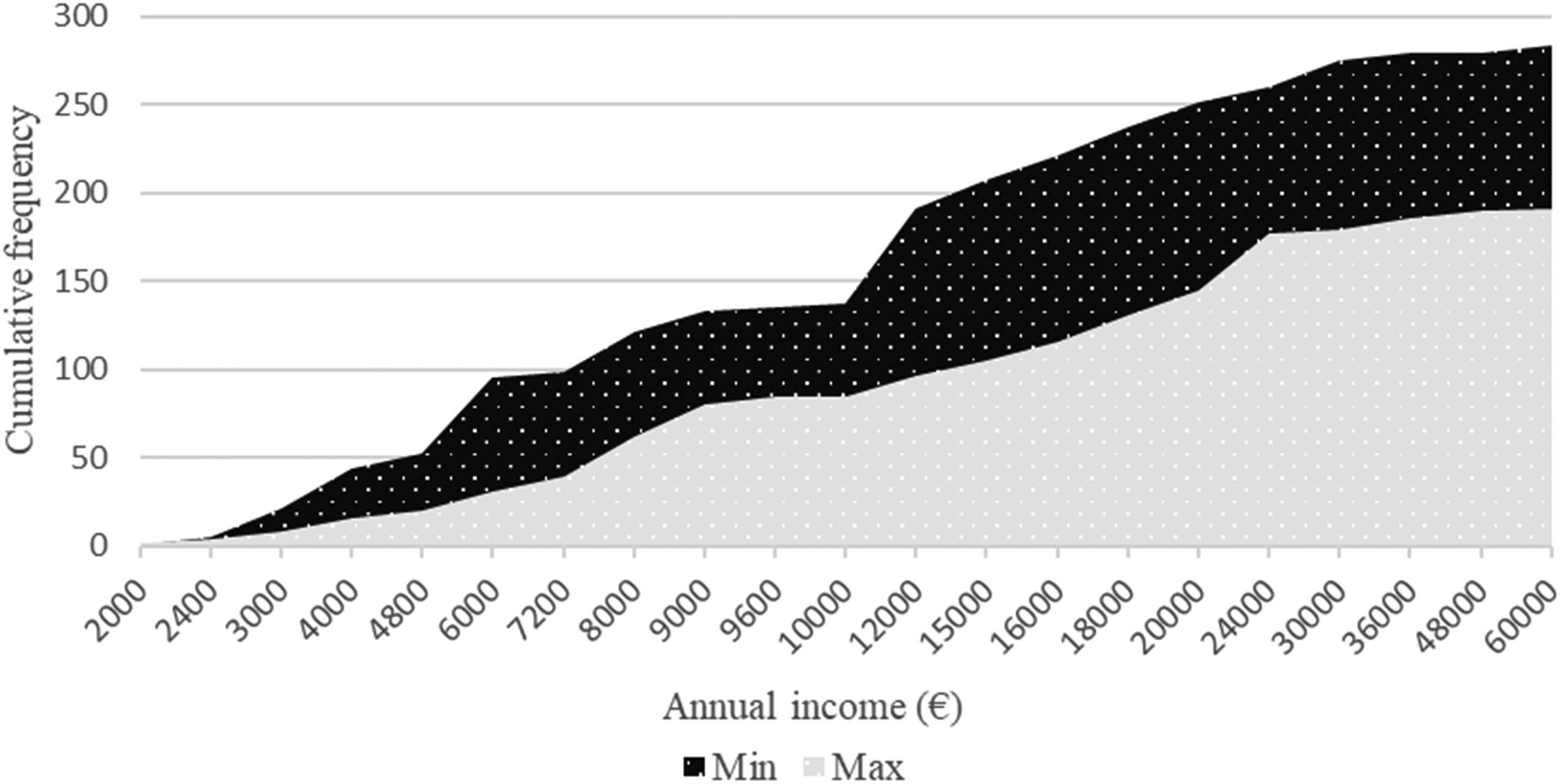
Cumulative frequencies of the minimum and maximum annual income per household member. Source: Own computation based on data collected with a survey.
Although the survey was open to every country, the nature of the survey led to be mostly responded by residents in France (31%) and Portugal (52%). 8 Therefore, the analysis of the results should always be done in light of the sample available. The survey also asked to the respondent if they have the citizenship of Portugal, France, Spain, Italy, UK, or Germany, if they are first- or second-degree descendant of a person from these countries, and if they lived for at least one year in any of these countries. This information can be used to control for potential bias caused by a respondent's historical link to any of these countries. In fact, 13% indicated having an historical link with Portugal, of which 67% live in France.
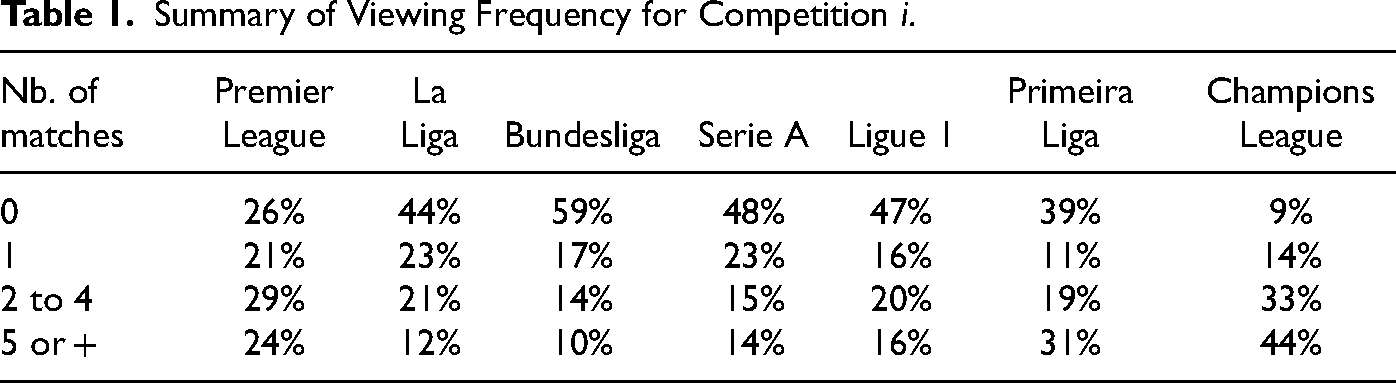
Frequency of consumption, here viewing frequency, is one of the two dependent variables considered in this study. It is about the average number of games of competition i (
Summary of Viewing Frequency for Competition i.
The other dependent variable considered in this study is WTP for competition j
The distribution of answers given to the WTP question is presented in Figure 2 by levels, and it demonstrates a high proportion of respondents with a WTP of 0€ or not over 5€. The CL is the exception, with a high proportion of respondents having a WTP between 6€ and 10€. Consequently, it is also the competition for which the respondents have higher average WTP (8.77€), followed by the EPL (7.30€), the PPL (5.29€), the SLL (4.97€), the FL1 (4.71€), the ESL (4.19€), the ISA (3.88€), and the GBL (3.57€). Notice that there is some cleavage in relation to the ESL as, although 53% of the respondents have a WTP of 0€, there is only the CL and the EPL for which respondents are most willing to pay more than 10 euros per month. Consequently, computing the averages without the zeros would make the ESL the third competition with the highest WTP.
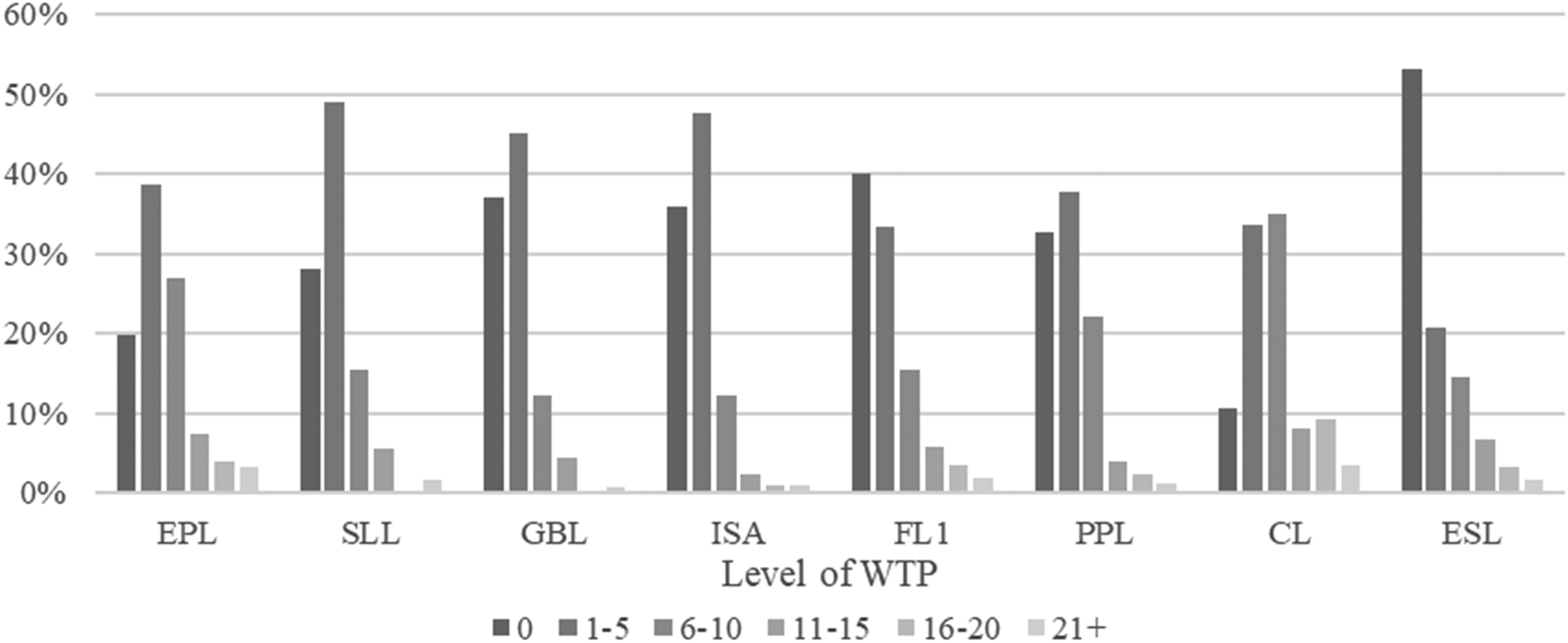
Willingness-to-pay (WTP), in € per month, for competition j, by levels. Notes: EPL = English Premier League, SLL = Spanish La Liga, GBL = German Bundesliga, ISA = Italian Serie A, FL1 = French Ligue 1, PPL = Portuguese Primeira Liga, CL = Champions League, ESL = European Super League.
Two of the explanatory variables are based on respondents’ perceptions: the PCB and the perceived quality (PQ). PCB is a measure to evaluate the CB that respondents attribute to each competition in season 2020/2021 and PQ is a measure to rate the average quality of football played on the pitch in each competition. Both measures are adopted from Nalbantis and Pawlowski (2016) and it was asked to the respondents to use a scale of 0–10, being 0 = “extremely unbalanced” for PCB, 10 = “extremely balanced” for PCB, 0 = “extremely low quality” for PQ, and 10 = “extremely high quality” for PQ. 13 Table 2 shows that the EPL is perceived as the most balanced competition (6.9 in a scale of 0 to 10), but in terms of average quality of football played on the pitch the CL is slightly better (7.89 in a scale of 0 to 10). On the other hand, the respondents consider the GBL to be the most unbalanced competition (4.9) and the PPL to have the lowest quality (4.56). The ordering in PCB and PQ is similar, except for the GBL and ESL, perceived as competitions with more quality than CB. Additionally, it is not surprising to observe that there is a tendency for respondents to watch more matches per fixture of the competitions they consider having a higher CB and quality, and they are also less likely to answer "don't know" to these questions when they watch more games. Besides, the analysis should consider the possibility of a boycott to the ESL, as the percentage of evaluations equal to 0 was much higher than in the other competitions, 14 while the share of evaluations equal to 10 was only higher for the CL. Meier et al. (2022) reinforce that idea by finding that the time period after the announcement of the ESL was the most prone in triggering negative feelings in supporters, although this impact was higher before the first withdrawals of participating clubs and our responses were collected mostly after that.
Average Perceived Competitive Balance (PCB) and Quality (PQ), by Competition j.
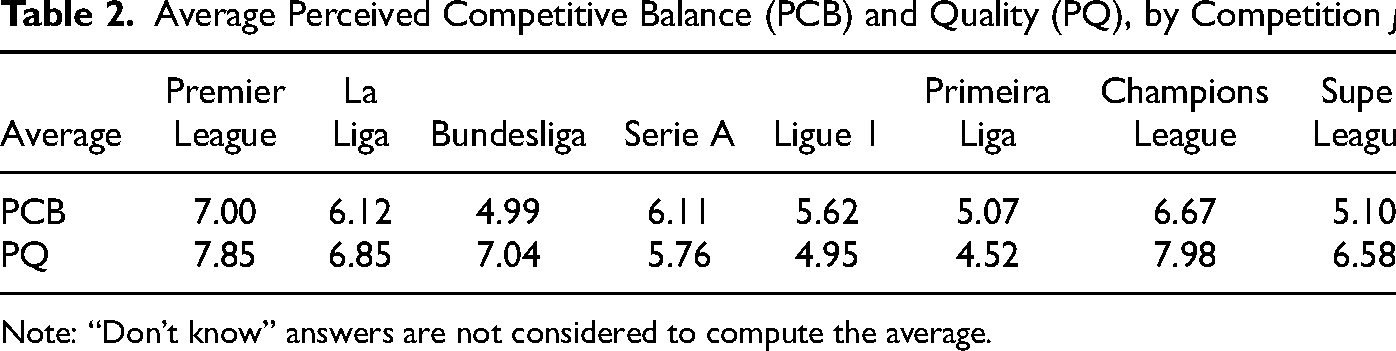
Note: “Don’t know” answers are not considered to compute the average.
Apart from betting odds, studies using revealed preferences to estimate the impact of CB on football demand generally use proxies such as the standard deviation of the share of maximum possible absolute points (Szymanski & Kuypers, 1999), the national measure of seasonal imbalance (NAMSI) concerning points distribution (Goossens, 2006), or the normalised Hirshman-Herfindahl Index (HHI) (Owen et al., 2007). These measures were computed for the six domestic leagues in analysis in season 2020/21 and compared with the PCB collected through the surveys, 15 showing some evidence of differences between PCB and OCB. On the one hand, the GBL and the FL1 are some of the most balanced leagues based on OCB measures, but they are perceived by consumers as the most unbalanced. On the other hand, the ISA and the SLL are perceived by consumers as more balanced than OCB measures would suggest. Concerning the remaining leagues, PCB converges relatively well with some OCB measures, suggesting that the EPL is one of the most balanced leagues and the PPL is one of the most unbalanced.
Budzinski and Pawlowski (2017) discuss several behavioural biases that might explain this difference between OCB and PCB measures, in particular attention level and framing effects. The existence of attention level effects means that perceptions of balance could be more influenced by balance within some sub-competitions than by balance on the overall competition. While framing effects exist when consumers create a reference level of CB based on the past (e.g., previous seasons). However, these behavioural biases explain only part of the difference between OCB and PCB measures, 16 and we argue that another potential explanation is that consumers’ perceptions is far from being based on full information. Proof of this is that around a quarter of the survey respondents admitted, on average, not watching even one match per fixture of the various domestic leagues. Thus, their assessment of CB and quality of game might be based on few matches watched (the average may be zero, but they may have watched some matches), match highlights, past seasons, media opinion, or other sources, which signals a possible inadequacy of OCB measures to study football demand.
To conclude this subsection, other data collected are the level of interest in each competition, the accessibility to the broadcast of the competition, and the supporter status. Interest was indicated by respondents using a scale of 1–7 (being 1 = “not at all interested” and 7 = “extremely interested”) and it tends to follow the WTP. Access at home to full-length broadcasts was also declared by respondents, being the CL the most accessible competition (68.9% of the respondents have access) and the GBL the less accessible (52.1%). Supporter status was deduced asking for each competition if the respondent was fan of any team or not. 17 For all leagues, the most frequent response from respondents was not being a fan of any specific team. As expected, this was more common when the respondent was not living in the country where the league is played.
Econometric Method
Considering the differences in nature of the two dependent variables, there will be two different estimators. Viewing frequency is an ordinal dependent variable with four possible outcomes, so the ordered probit is a possible estimator. However, previous studies suggest that consumer choices for viewing frequency of each competition may be closely related (Nalbantis & Pawlowski, 2016), with the correlation matrix suggesting the same (Table 3). Therefore, assuming that the decisions of an individual are dependent from each other, a MVOP will be estimated. This will allow to consider the full covariance structure, which may be more efficient (Roodman, 2011) than a simple ordered probit.
Correlation Matrix of Viewing Frequency of the Competitions in Analysis.
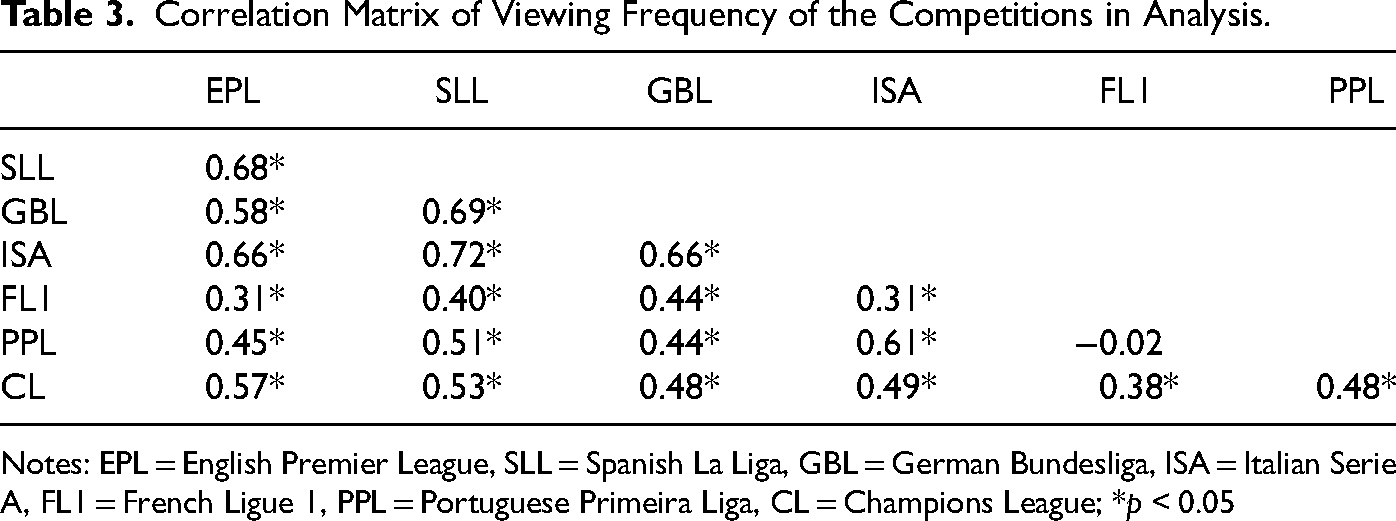
Notes: EPL = English Premier League, SLL = Spanish La Liga, GBL = German Bundesliga, ISA = Italian Serie A, FL1 = French Ligue 1, PPL = Portuguese Primeira Liga, CL = Champions League; *p < 0.05
Following Hill et al. (2011), the empirical model can be presented as follows: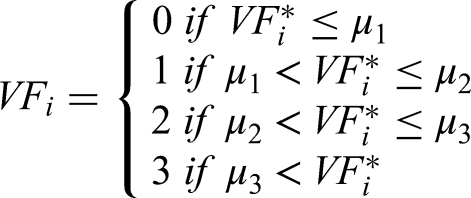
Explanatory Variables.
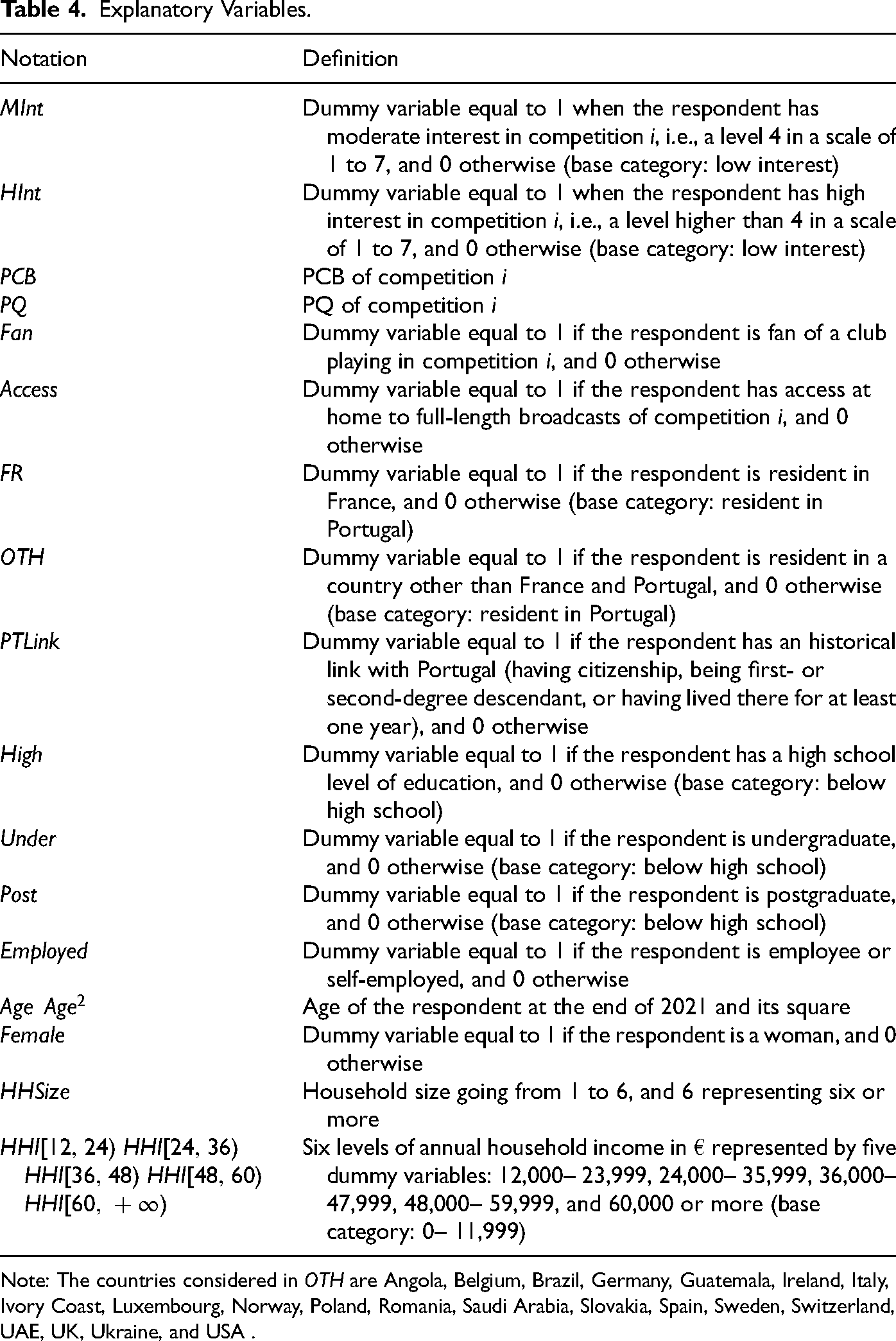
Note: The countries considered in
Modelling WTP requires some caution in choosing the estimator because it is a continuous dependent variable, left-censored at €0, and with relatively high incidence of the value 0. Estimations with OLS would be biased and inconsistent (Hill et al., 2011), but the Tobit estimator could be envisaged. However, when data distribution is nonnormal or heteroskedastic, Tobit estimator generates biased estimates. While heteroskedasticity can be reasonably handled using consistent standard errors (White, 1980), nonnormality is more tricky because log-transforming the dependent variable requires to manipulate the data due to the zeros. Therefore, the 2PM emerges as the most adequate alternative because normality and homoskedasticity hypotheses are not necessary for consistency. Besides, the 2PM is more flexible, allowing the zeros and the positive outcomes to be generated by different mechanisms (Cameron & Trivedi, 2009). This approach is followed by other studies modelling WTP (Funahashi et al., 2020; Leiter & Rheinberger, 2016).
The first part of the 2PM consists of a Probit model in which values of WTP equal to zero and positive values are distinguished. Therefore, this binary indicator can be represented by 
Correlation Matrix of WTP for the Competitions in Analysis.
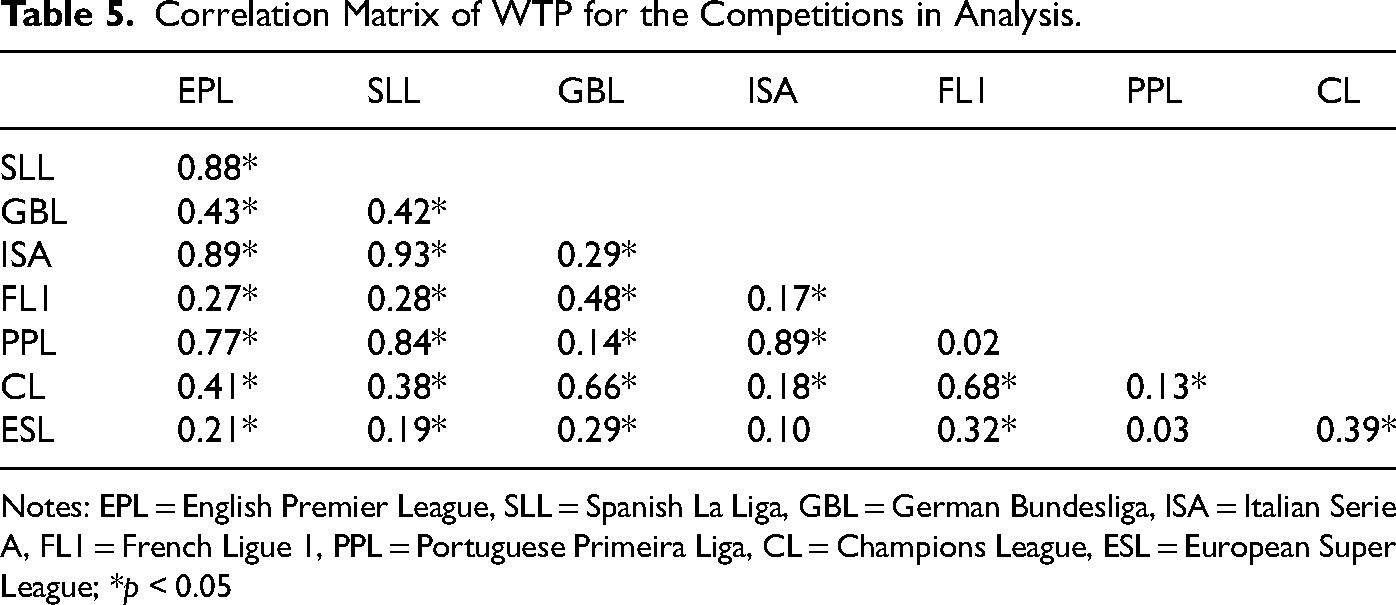
Notes: EPL = English Premier League, SLL = Spanish La Liga, GBL = German Bundesliga, ISA = Italian Serie A, FL1 = French Ligue 1, PPL = Portuguese Primeira Liga, CL = Champions League, ESL = European Super League; *p < 0.05
The two parts are independent and estimated separately, but the same regressors X are considered in both parts. These are the same included in the model for viewing frequency (summarised in Table 4), but now extended to the ESL. There are only two exceptions.
Nalbantis and Pawlowski (2016) do not include PCB and PQ in the same models because they argue that the two variables are highly correlated. With the present collected data, they are not highly correlated, but some concerns of multicollinearity may still exist. Although the rule of thumb of a variance inflation factor (VIF) above 10 is to some extent an arbitrary indicator of multicollinearity (Wooldridge, 2012), only age and age squared have VIFs over 10, which is natural using both variables simultaneously. Additionally, it is not a problem as they are not key variables in the model, playing only a role of control variables. It is also common to observe high VIFs with dummy variables that represent a categorical variable with three or more categories, which might explain VIFs within the range 1.5 to 3.5 for dummy variables concerning the country of residence, the interest in a competition j, and the level of household income. For robustness, estimations will also be carried out excluding PCB and PQ one at a time.
Results
Viewing Frequency
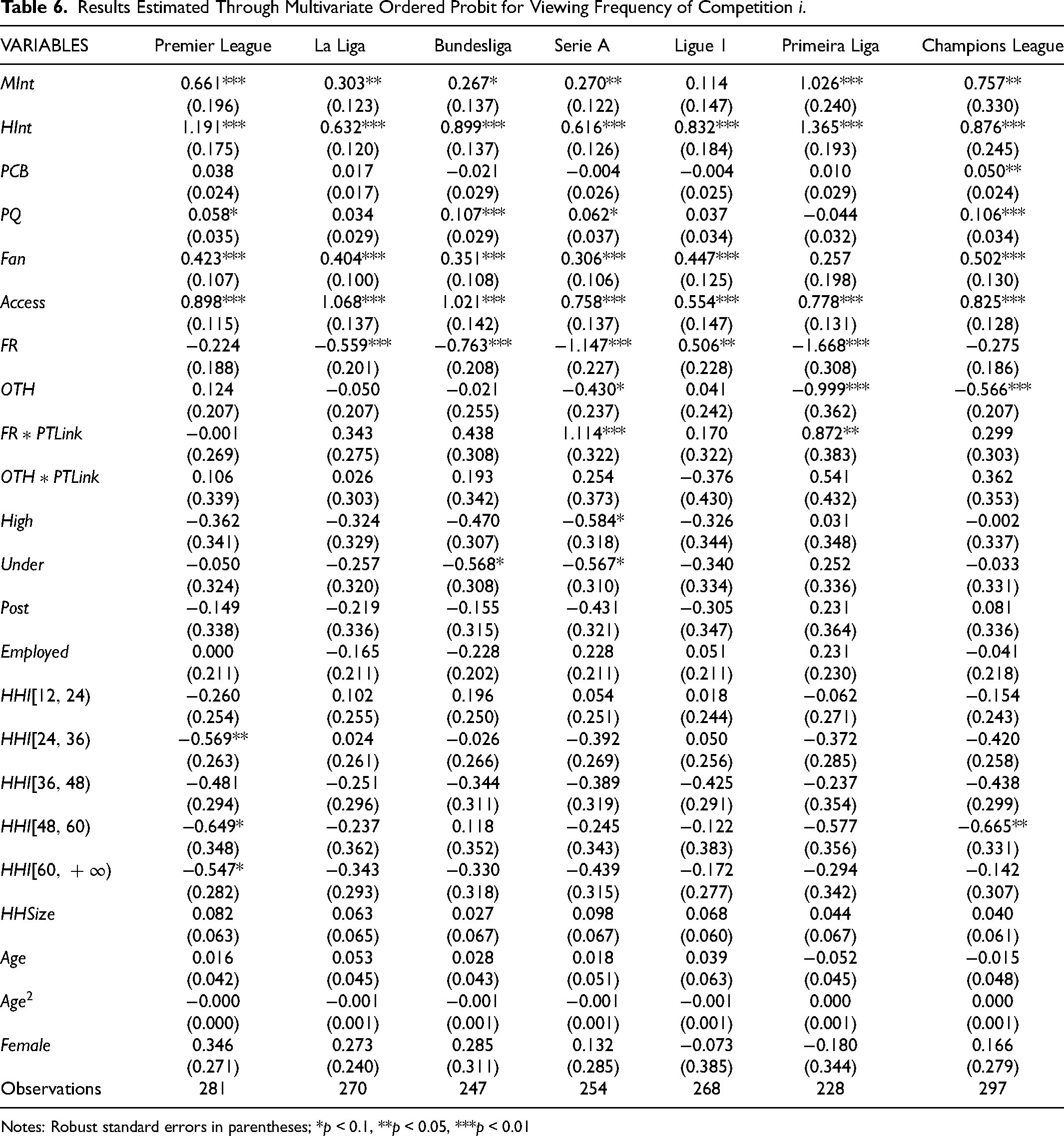
In Table 6 are presented the results of MVOP estimations for viewing frequency. Follows the interpretation of the results using also the marginal effects for each one of the four levels of viewing frequency considered in this study (Tables B.1 to B.4 of Appendix B).
Results Estimated Through Multivariate Ordered Probit for Viewing Frequency of Competition i.
Notes: Robust standard errors in parentheses; *p < 0.1, **p < 0.05, ***p < 0.01
Having moderate or high interest in a competition i is associated with a greater probability of being a frequent viewer of this competition. However, moderate interest is not statistically significant for the FL1. The PPL seems to be the competition whose consumption most depends on interest, and this difference is quite substantial. For example, based on marginal effects (Tables B.1 to B.4 of Appendix B), it is estimated that the probability of watching five or more games per fixture of PPL increases by 37.4% when the consumer has high interest and 23.7% when the consumer has moderate interest, while the impact on the other competitions ranges between 12.1% and 28.8% for high interest and between 4.5% and 22.4% for moderate interest (not considering the impact on FL1 because it is not significant). Such result is not surprising considering that it is the only domestic league in the analysis not being part of the Big-5, being more niche-oriented than the others.
Concerning the effect of PCB, it is mostly not statistically significant, but the effect is positive and significant for the CL. On average, for each additional unit in the evaluation of the PCB (within a scale 0 to 10), the probability of a consumer not watching a single game per fixture decreases 0.4% for the CL. The effect of PQ on viewing frequency is also positive, although only statistically significant for the GBL, the EPL (weakly significant), the ISA (weakly significant), and the CL. On average, for each additional unit in the evaluation of the PQ (within a scale 0 to 10), the probability of a consumer not watching a single game per fixture decreases 3% for the GBL, 1.1% for the EPL, 1.7% for the ISA, and 0.8% for the CL. 19
It is estimated that there is a higher probability of being a frequent viewer of a certain competition i when one is fan of a club playing in this competition. On average, the probability of watching five or more games per fixture increases 16.8% for the CL, 11.8% for the EPL, 7.4% for the SLL, 6.8% for the FL1, 6.3% for the ISA, and 5.6% for the GBL. The PPL is an exception, as the effect is not statistically significant.
Access at home to full-length broadcasts of a specific competition is also a determinant of viewing frequency. It increases the probability of being a frequent viewer of all competitions in analysis. However, the magnitude of influence of this determinant varies among competitions. On average, not having access at home of such broadcasts increases the probability of not watching a single game per fixture by 33.6% for the SLL, 32% for the GBL, 22.6% for the ISA, 20.6% for the EPL, 17.7% for the FL1, 11.8% for the PPL, and 7.2% for the CL.
The results suggest that being resident in France increases the probability of being a frequent viewer of FL1 compared to being resident in Portugal, but it decreases the probability of being a frequent viewer of all other competitions, except the EPL and the CL. On the other hand, compared to other countries considered in the analysis, being resident in Portugal increases the probability of being a frequent viewer of PPL, ISA (weakly significant), and CL. For the PPL it is not surprising because it is the domestic league of that country, however, there are different possible explanations for the positive impact estimated for ISA and CL. One is a specific superstar effect that we could call the “Cristiano Ronaldo effect”, as the Portuguese superstar played in these two competitions during the season in analysis. Concerning the impact in viewing frequency of the CL, another possible explanation is that it is the only competition under analysis for which there are still some matches being broadcast on Portuguese free-to-air TV, and this is not the case in other countries (e.g., France, Spain, and UK).
For the PPL and the ISA, there is also associated with viewing frequency a positive effect of having a link with Portugal while living in France. The explanation for these results is similar to the one previously presented for the country of residence. Besides, the impact for CL is not statistically significant anymore, which turns more reliable the explanation that broadcasts of this competition on free-to-air TV boosts viewing frequency in Portugal.
No statistically significant effect is estimated for the level of education, the employment status, gender, or household size. Although the estimated coefficients for age and its square are not statistically significant, based on marginal effects it is observed a higher probability of being a frequent viewer of the ISA, the FL1, and the PPL associated to younger respondents. Most coefficients related to household income are not statistically significant, being the few exceptions mostly found for the EPL and weakly significant. This gives some indication that consumers in more affluent households are less likely to be regular viewers of the EPL.
These results are comparable to those of Nalbantis and Pawlowski (2016), although it is important to note the differences in samples as their study focuses on U.S. consumers. In line with our results, they estimate that, on average, the probability of being a frequent viewer of a competition i increases when the consumer has moderate or high interest for i, is fan of a club playing in i, and has access to the broadcasts at home. Furthermore, they extend our conclusions regarding the impact of age to the other competitions. Yet, distinctively from our estimations (potentially due to sample differences), they point to statistically significant effects of education, gender, PCB, household income, and household size. They suggest there is a higher probability of being a frequent viewer when the consumer is a male (only regarding the EPL, the SLL, and the CL) not graduated with high PCB and household income.
WTP
As previously explained, the WTP under consideration here concerns how much a consumer would be willing to pay per month in euro to subscribe to an exclusive package giving access to the broadcasts of competition j. Therefore, unlike with the model estimated for viewing frequency, this model can include the ESL. The two following subsections will present the results for the 2PM.
First Part of the 2PM
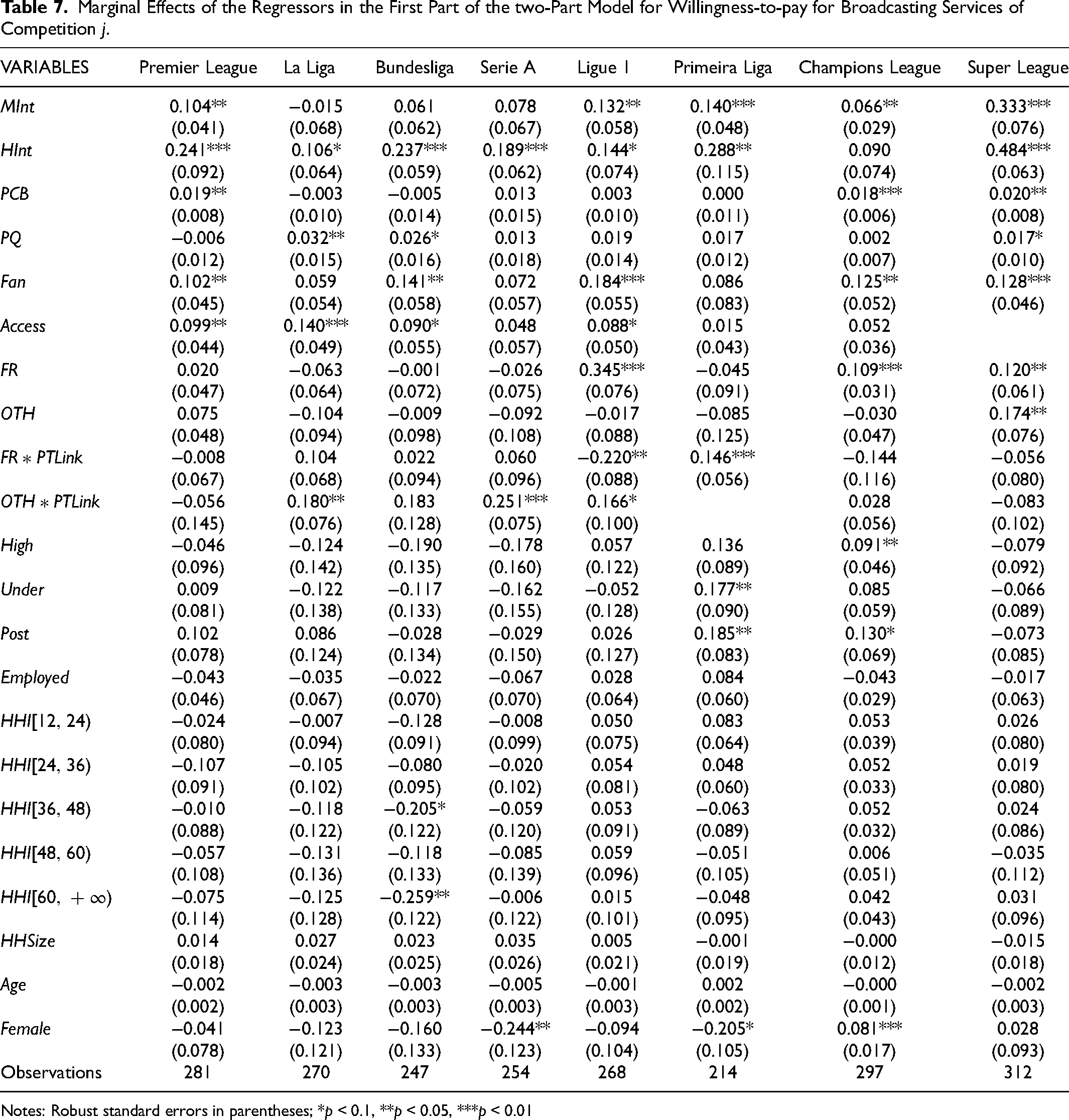
In the first part of the 2PM, a Probit is estimated to analyse how the regressors influence the probability of a respondent having a positive WTP for a competition j. This is usually called the extensive margin (Leiter & Rheinberger, 2016). To properly interpret these results, the average marginal effects of the regressors are presented in Table 7. The (less intuitive) linear effects are available in Table C.1 of Appendix C.
Marginal Effects of the Regressors in the First Part of the two-Part Model for Willingness-to-pay for Broadcasting Services of Competition j.
Notes: Robust standard errors in parentheses; *p < 0.1, **p < 0.05, ***p < 0.01
The results suggest that the level of interest of a respondent for a competition j has impact on the probability of having a positive WTP for this competition. The impact is higher for the ESL, as respondents with moderate or high interest present higher probability of positive WTP than respondents with low interest, being the expected difference in probability, on average, 33.3 percentage points (pp) and 48.4 pp, respectively. The impact of high interest is considerably lower for the domestic leagues in analysis (between 10.6 pp and 28.8 pp) and for the CL no statistically significant effect was estimated. In relation to moderate interest, no statistically significant effect was found for the SLL, the GBL, and the ISA.
For most of the competitions, the perceptions of CB and quality have not a statistically significant impact on the probability of having positive WTP. The exceptions concern the EPL, the CL, and the ESL, for which this probability increases, on average, by about 1.8 pp to 2 pp per each additional unit in the evaluation of the PCB. While per each additional unit in the evaluation of the PQ, the probability of positive WTP for the SLL, the GBL (weakly significant), and the ESL (weakly significant) increases 3.2 pp, 2.6 pp, and 1.7 pp, respectively. 20
For the EPL, the GBL, the FL1, the CL, and the ESL, there is a higher probability of positive WTP associated to respondents that are fan of a club playing in the respective competition. On average, the probability increases by between 10.2 pp and 18.4 pp.
The probability of positive WTP for the EPL, the FL1, the GBL, and the SLL is also higher for respondents having currently access at home to the broadcast of games (only weakly significant impact for the FL1 and the GBL). The expected difference in probability is, on average, between 8.8 pp and 14.0 pp.
The probability of positive WTP for the FL1 is, on average, 34.5 pp higher for residents in France than for residents in Portugal. They also tend to have higher probability of positive WTP for the CL and the ESL, but the impact is considerably lower (respectively, 10.9 pp and 12.0 pp). For a resident in France, having an historical link with Portugal decreases the probability of positive WTP for the FL1 and increases the probability of positive WTP for the PPL. Besides, residents in other countries are associated to a higher probability of positive WTP for the ESL than residents in Portugal, being the difference about 17.4 pp. When these residents in other countries have an historical link with Portugal, the probability of positive WTP increases for the SLL, the FL1 (weakly significant), and the ISA. On the other hand, it is worth noting that it was not estimated with statistical significance that a resident in Portugal has higher probability of positive WTP for the PPL.
The level of education is another significant determinant of WTP, but only for the PPL and the CL. Being undergraduate or postgraduate increases the probability of having a positive WTP for the PPL, while for the CL the probability increases for consumers with high school level.
Regarding gender differences, it is estimated that having a positive WTP for the CL is 8.1 pp more likely for women, but in relation to the ISA and the PPL this probability is, respectively, 24.4 pp and 20.5 pp lower.
The average marginal effects presented in Table 7 suggest that age has not a statistically significant effect but computing marginal effects at specific ages allow to observe two different effects. For the EPL, the GBL, the ISA, the CL, and the ESL, the probability of having a positive WTP is decreasing with age, while for the SLL, the FL1, and the PPL, the probability is decreasing until, respectively, 50, 40, and 24 years old, and increasing after that.
Finally, employment status or household size have not statistically significant impacts on the probability of having a positive WTP. Similarly, the coefficients related to household income are mostly (38 of 40) not significant.
Second Part of the 2PM
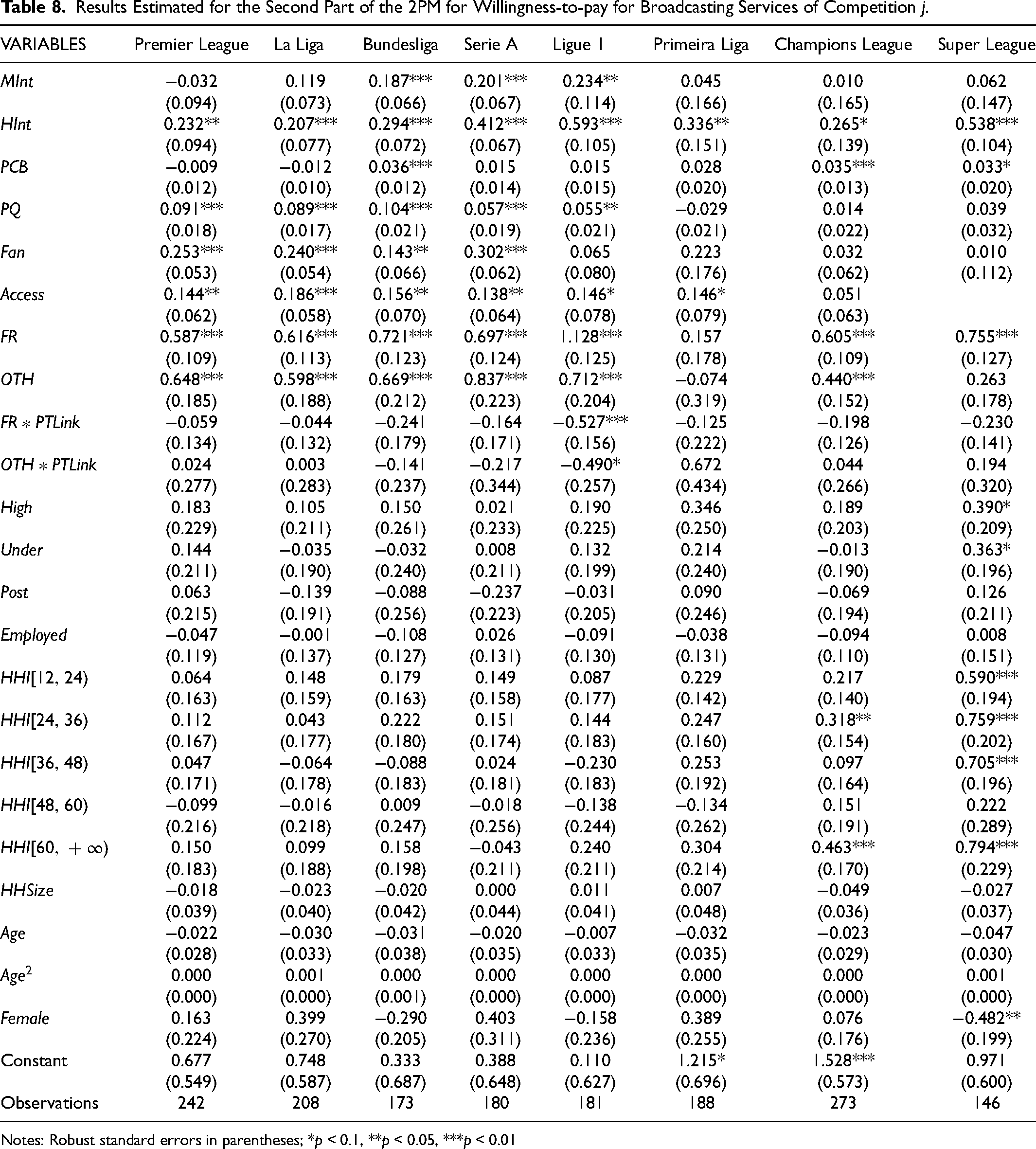
After identifying the impact of the respondents’ characteristics on the extensive margin, it is intended to estimate the impact on the intensive margin, i.e., the size of the WTP (Leiter & Rheinberger, 2016). Accordingly, in the second part of the 2PM, a SUR is estimated on the
Results Estimated for the Second Part of the 2PM for Willingness-to-pay for Broadcasting Services of Competition j.
Notes: Robust standard errors in parentheses; *p < 0.1, **p < 0.05, ***p < 0.01
As observed for viewing frequency, the level of interest for a certain competition is also a determinant of WTP. Having high interest has a statistically significant effect on WTP for all competitions in analysis, although only weakly significant for the CL. On average, the impact of interest is considerably higher for the FL1 and the ESL, for which the WTP is, respectively, 80.9% [
Regarding the impact of perceptions on WTP, it is found that the PCB has only a statistically significant effect for the GBL, the ESL (weakly significant), and the CL, while the PQ has a statistically significant effect for the Big-5 leagues. On average, per each additional unit in the evaluation of the PCB, the WTP increases by between 3.3% and 3.6%. The impact of PQ is slightly higher, as per each additional unit in the evaluation of the PQ, the WTP increases, on average, by between 5.5% and 10.4%. 21
For some of the competitions in analysis, supporter status and accessibility are determinants of WTP. On average, the WTP for the EPL, the SLL, the GBL, and the ISA is between 15.4% and 35.3% higher when a consumer is fan of a club playing in the competition. Regarding access at home to full-length broadcasts, it is significant for the same competitions plus the FL1 and the PPL for which the effect is weakly significant, and it is estimated that it increases WTP by between 14.8% and 20.4%.
There is a negative effect of living in Portugal on WTP for all competitions, except for the domestic league. On average, ceteris paribus, for consumers in France the WTP is between 79.9% and 112.8% higher than for consumers living in Portugal, but the difference is larger when it concerns the FL1 (208.9%). Furthermore, the WTP for these competitions (except the ESL) is also higher for residents in other countries than for residents in Portugal. On average, the difference is between 81.8% and 130.9%, but for the CL it is observed a lower difference (55.3%). It is interesting to notice that, although consumers living in France or other countries are associated to a higher WTP for the FL1 than consumers living in Portugal, this difference is partially reduced when the consumer has an historical link with Portugal.
The ESL is the only competition in analysis for which there is a clear impact of household income on the WTP. Compared to a respondent with an income below 12,000€, the WTP is, on average, 80.4% higher for another one with an income between 12,000€ and 23,999€, and for higher levels of income the difference raises to between 102.4% and 121.2%.
Computing marginal effects at relevant ages for the sample, it is observed that there is an influence of age on WTP. The WTP for the FL1 is increasing with age, while the WTP for the other competitions is decreasing until a certain age and increasing after that. The age of turning point is 29 for the SLL, 30 for the EPL, 34 for the GBL, 35 for the ISA and the PPL, 40 for the CL, and 41 for the ESL.
Finally, the results suggest that the employment status or household size do not have a statistically significant effect. For most competitions, gender and the level of education have no effect either, being the exception the ESL. The WTP for this competition is, on average, 38.2% lower for women, but it was estimated a weakly significant premium for respondents with a high school (47.7%) or undergraduate (43.8%) level of education.
The results presented in this subsection have converging and diverging points with Nalbantis and Pawlowski (2016). Although they also studied the WTP for the Big-5 leagues, their analysis only considered U.S. consumers, they used the Tobit estimator without following a SUR structure, and they do not include a hypothetical model of ESL. Their results suggest common determinants of WTP, such as the level of interest in a competition, supporter status, and accessibility, while they did not estimate significant differences in WTP provoked by gender or household size either. However, they estimate a negative impact of age, but without considering the possible non-linear relationship of age with WTP, as suggested by Pawlowski et al. (2018). Besides, they conclude that income and the level of education play a more important role than we found, which may be explained by the differences in the samples used.
Conclusion
Understanding the determinants of football demand is of importance for a variety of stakeholders, such as club owners, competitions organisers (the current ones or emerging ones), regulators, and public policymakers (Borland & Macdonald, 2003). For the clubs playing in the main European competitions, TV broadcasting rights have been the main source of revenue, so TV broadcast represents a specific demand deserving particular attention. Hence, this study estimated the determinants of TV broadcast demand for current European top competitions and for a hypothetical example of ESL, which allows to infer policy and managerial lessons.
The results overall suggest that the most common competition-specific drivers of demand for football broadcasts are the level of interest, the fact of being fan of a club playing in that competition, and having access at home to the broadcasts. It is found some distinctness between the PPL and the other competitions more internationally recognised in terms of viewing frequency, as the former is the most dependent on interest, but the only one for which fan status does not play a significant role. In terms of impact on WTP, the impact of interest becomes more important for the ESL and the FL1, while fan status is still not a determining factor of demand for the PPL, this time similarly to the ISA. Both dimensions of demand are expected to increase with accessibility, except for the CL, where this is only a relevant determinant for viewing frequency.
On the other hand, in line with the lack of support in the literature to the outcome uncertainty hypothesis in football (Pawlowski et al., 2018), the level of PCB is only a booster of demand for the CL and the ESL, and, to a lesser extent, to the GBL and the EPL in terms of WTP. The level of PQ seems to be a more important driver of demand, having an effect of higher magnitude on demand and influencing more competitions, namely the ISA, the CL in terms of viewing frequency, and the FL1 in terms of WTP.
Additionally, it is observed a general preference for the respective domestic league of consumers. Those living in Portugal have overall lower WTP for every competition (except for the PPL), but they are more likely to be frequent viewers. This was mainly observed for the ISA and the CL, suggesting a potential superstar effect created by the player Cristiano Ronaldo and a bonus in viewing frequency when there are matches broadcasted on free-to-air TV, as it happens with the CL in Portugal. Other sociodemographic characteristics less frequently influencing demand are household income, education, age, and gender.
This study is expected to support policymaking and managerial decisions related to sports, in particular European football. For a competition aiming to increase its demand, investing on the quality of game played seems to be a better strategy than promoting CB. This does not mean that CB should be completely neglected because the long-term consequences could be dire, but when a consumer decides to watch or to acquire the broadcasting service of a certain competition, quality seems to be a more dominant aspect. Future research should explore ways to study the impact of competitive intensity with this type of data, as it could bring new insights into the impact of outcome uncertainty. Besides, the attributes of a football match that are perceived by consumers as aspects of quality received limited attention in academic research, 22 but we might expect that investment in quality may be achieved through acquisition of top coaches and players or through the development of football academies.
The results of this research also show that investing in superstars may attract some markets, as it was found that Portuguese consumers were more likely to watch the games of the league where Cristiano Ronaldo (the biggest national star) played. However, this strategy may not be generalisable to all competitions and all markets, requiring extending the analysis to a bigger sample of countries. For example, we do not find that French consumers are particularly attracted by any competition (other than the FL1), but this can be explained either because of a national specificity of consumers or due to the fact of France having several superstars playing in different Big-5 leagues without any of them standing out clearly from the others as it happens in Portugal.
Over the last decades, the broadcast of matches on free-to-air TV became progressively rarer and, for example, the CL, the main club competition in Europe, is not accessible for free in France, Spain, UK, or Germany. 23 On the other hand, in Portugal, one match per fixture is broadcast on free-to-air TV and the result is that residents in Portugal are more likely to be frequent viewers of this competition. 24 While pay-TV may generate more revenues in the present, European football regulators should consider making at least one match available on free-to-air TV so as not to lose demand in the long-term.
The ESL model presented to the survey respondents created great cleavage, with a majority opposed to the competition and a small fraction with a high WTP for it. The results concerning this competition highlight that the WTP is influenced by both the PCB and the PQ, and it would be of some importance for a consumer to be fan of a club playing in that competition to have a positive WTP for the competition. Besides, unlike for other competitions, the WTP for the ESL is considerably lower for consumers with very low level of household income or for women.
Recommendations for future studies include analysing consumers from additional countries. Previous publications considered consumers from Germany, USA, Netherlands, and Denmark (Nalbantis et al., 2017; Nalbantis & Pawlowski, 2016, 2019; Pawlowski, 2013; Pawlowski et al., 2018; Pawlowski & Budzinski, 2013), while this study, although considering consumers from at least 23 countries, has an important part of them living in France or Portugal. Moreover, a deeper analysis of the ESL should be developed to identify which are the factors leading to the rejection of this competition. The model of ESL considered in this study was the one put forward in April 2021, very criticised for its closed format, so new studies might explore models giving more value to meritocracy. Additionally, game-level analysis of demand using survey data is also a direction for further research.
Supplemental Material
sj-docx-1-jse-10.1177_15270025221143982 - Supplemental material for European Men's Club Football in the Eyes of Consumers: The Determinants of Television Broadcast Demand
Supplemental material, sj-docx-1-jse-10.1177_15270025221143982 for European Men's Club Football in the Eyes of Consumers: The Determinants of Television Broadcast Demand by Anthony Macedo, Marta Ferreira Dias, and Paulo Reis Mourão in Journal of Sports Economics
Footnotes
Acknowledgments
This study was discussed in the XV Gijon Conference on Sports Economics, 17–18 December 2021.
Declaration of Conflicting Interests
The author(s) declared no potential conflicts of interest with respect to the research, authorship, and/or publication of this article.
Funding
This work was financially supported by the PhD grant no. 2020.05672.BD, funded by national funds through FCT - Portuguese Foundation for Science and Technology. This work was financially supported by the research unit on Governance, Competitiveness and Public Policy (UIDB/04058/2020) + (UIDP/04058/2020), funded by national funds through FCT. Paulo Mourão acknowledges the following funding: This paper is funded by national funds of the FCT within the project "UIDB/03182/2020".

Supplemental material
Supplemental material for this article is available online.
Notes
Correction (December 2022):
Article updated to correct the Note no 8, 9, 10, 11, 12, 13, 14, and 17.
Author Biographies
Appendix
References
Supplementary Material
Please find the following supplemental material available below.
For Open Access articles published under a Creative Commons License, all supplemental material carries the same license as the article it is associated with.
For non-Open Access articles published, all supplemental material carries a non-exclusive license, and permission requests for re-use of supplemental material or any part of supplemental material shall be sent directly to the copyright owner as specified in the copyright notice associated with the article.
