



Abstract
European soccer leagues’ internationalization efforts have significantly increased the number of available telecasts abroad. In the US, this has fueled discussions about the degree of audience overlap between networks broadcasting international soccer. However, whether and to what extent telecasts of different leagues indeed constitute substitutes has never been explored empirically. Drawing on US audience data for Bundesliga telecasts, we analyze the impact of scheduling clashes with Premier League, La Liga, and Serie A games. Econometric demand models reveal sizeable substitution effects caused primarily by overlapping Premier League games, suggesting significant competition for the soccer audience in the US market.
Introduction
Considering the massive appeal of sports among the television audience, nowadays, more and more media companies are investing in sports programming to compete effectively. It is indicative that, in 2017, more than 134,000 h of programming were dedicated to sports in the US (Nielsen, 2018). In 2019, 92 of the top 100 most-watched telecasts in the country were sports related (Karp, 2020a), while the US sports media rights market was worth about $22.4 billion (a 34% gain over 2011, Sport Business Media, 2019). Soccer is becoming an increasingly relevant part of this market. With major European soccer leagues already beginning to reap the benefits of their ongoing internationalization efforts in the country, US networks hosted more than 850 soccer teams in their programming and televised more than 3,000 soccer games during 2019 (Koeshartanto, 2020).
This excessive supply of (and demand for) sports broadcasts, paired with the soaring costs of sports media rights, has fueled heated discussions about tier positioning and bundle pricing between sports programming producers and multichannel operators in the US. 1 Such a dispute has recently prompted beIN Sports (a soccer programmer) to file a program carriage complaint against Comcast. 2 beIN Sports accused Comcast of discriminating against their programming in favor of NBC Sports Network's similarly situated sports programming. To be regarded as ‘similarly situated’ requires significant competition between the networks for viewers. On this basis, Comcast refuted the complaint, arguing that the two sports programmers were not similarly situated because (amongst others) “most soccer fans are unlikely to view the various international soccer leagues as substitutes for one another” (Federal Communications Commission, 2018). Theoretically, however, is not clear whether telecasts of different leagues in a transnational setting constitute substitutes. Moreover, this issue has never been tested empirically.
In this study, we address this notable gap in the still-emerging literature on sports demand in two ways. Content-wise, we contribute to the literature by exploring fan substitution for the first time in a transnational setting. To this end, we use FOX audience data for Bundesliga telecasts in the US during 2016–2018 to analyze the impact of scheduling clashes with games from three competing, internationally expanding European soccer leagues, that is, the English Premier League, the Spanish La Liga, and the Italian Serie A. Considering the recent growth of interest in soccer within the country in combination with the integral role of international markets to the revenue growth of leagues and clubs and the ongoing discussions about the degree of audience overlap between US networks, this setting appears to be both particularly interesting and highly relevant from a managerial perspective. Moreover, given the lack of appropriate discussion and treatment of selection issues in earlier TV demand studies, we also contribute method-wise to the sports demand literature by presenting some novel ways to approach such selection issues empirically.
We proceed as follows. In the next section, we provide the theoretical framework and a discussion of the related literature. In the third section, we present relevant background information on the US sports broadcast market. In the fourth section, a description of the data and our methodology is provided as well as we outline the empirical strategy employed. In the fifth section, we present the findings of the study. In the last section, we conclude.
Theoretical Framework and Related Literature
In general, appropriately defining markets is of major relevance for antitrust law and policies (see Kaplow, 2015). Particularly in sports, however, defining markets is not straightforward and has frequently been debated in courts (for a discussion see Seal, 1993; Winfree, 2009; Mills and Winfree, 2016). The idiosyncrasy of the sports industry is that its products (e.g., telecasts) have a nonessential, nonfunctional, ephemeral, intangible and experiential nature (Seal, 1993; Kaynak et al., 2008). Moreover, the product is typically simultaneously produced and consumed with consumer preferences being highly subjective and characterized by emotional ties to the protagonists, organizational identification and brand loyalty (Bergmann et al., 2016; Hoegele et al., 2014). As such, while it is rather simple to examine substitutability between utilitarian goods (e.g., food: Kalnins, 2003; fuel: Pessoa et al., 2019), in sports it is difficult to determine whether products of various leagues are interchangeable. Nonetheless, in several instances US courts have decided that within the same sport, leagues of different tiers (i.e., minor and major leagues) do not compete in the same relevant product market, arguing (amongst others) that top tier leagues generate higher ticket and media revenues as well as player salaries (Philadelphia World Hockey Club, Inc. v. Philadelphia Hockey Club, Inc., 351 F. Supp. 462). However, in cases such as the aforementioned dispute between beIN Sports and Comcast, the international soccer leagues under consideration are of comparable quality and level.
Theoretically, whether (or not) televised games of different soccer leagues constitute substitutes in foreign markets is not clear. In markets in which a large share of the viewers has no particular loyalty to a league or a club, 3 general (i.e., unaffiliated) soccer fans might seek to consume any soccer telecast available. As such, telecasts of different leagues might indeed constitute close substitutes (Mills & Winfree, 2016; Wallrafen et al., 2022). However, since each league has different characteristics (e.g., in terms of (club) brands and/or the style of play), viewers might also be interested primarily in a specific league. As such, while consumers might substitute games of the same league, telecasts of different leagues would not constitute close substitutes (Ross, 2003; Noll, 2007; Winfree, 2009).
Despite this contradiction in theory, no study has yet explored empirically whether and to what extent televised games of different leagues constitute substitutes in foreign markets. 4 Previous work on substitution in televised professional sports has exclusively focused on within-country settings, examining substitution effects within the same league (e.g., Mills et al., 2016; Tainsky et al., 2016; Kang et al., 2018), between different divisions of the same sports (e.g., Hausman & Leonard, 1997; Grimshaw et al., 2013), between different sports leagues (e.g., Kanazawa & Funk, 2001; Berkowitz et al., 2011; Mongeon & Winfree, 2012), or between the domestic league and an international league (e.g., Schreyer et al., 2018a). 5 Studies focusing on transnational demand are generally scarce (exceptions include, for instance, Nalbantis & Pawlowski, 2016, 2019; Schreyer et al., 2018a; Otto et al., 2022). An overview of the studies analyzing substitution for televised sports is provided in Table A1 in Appendix A.
The US Sports Broadcast Market
During the last decade, European soccer leagues have intensified their endeavors to conquer international markets. For instance, in the season 2019/2020, the so-called European ‘Big Five’ soccer leagues (i.e., Premier League, La Liga, Bundesliga, Serie A, and Ligue 1) jointly earned about a third of the overall broadcast income (i.e., €3,234 m of the overall €9,100 m) in international markets (see Table 1). 6 In this regard, the US constitutes a key market for these top leagues, with an annual broadcast income of more than €295 m (excluding Ligue 1). 7 The general growth of interest in soccer within this country is reflected in a sharp increase in broadcast revenues during recent years. For instance, the Bundesliga generated only about €2.6 m annually during the 2012–2015 media rights cycle (with GolTV), while the follow-up deal with FOX generated about €6.1 m per season. The recently signed deal with ESPN for the 2020–2026 cycle is estimated to be worth about €27.1 m annually.
Broadcast Revenues for Season 2019/2020 (in Million €).
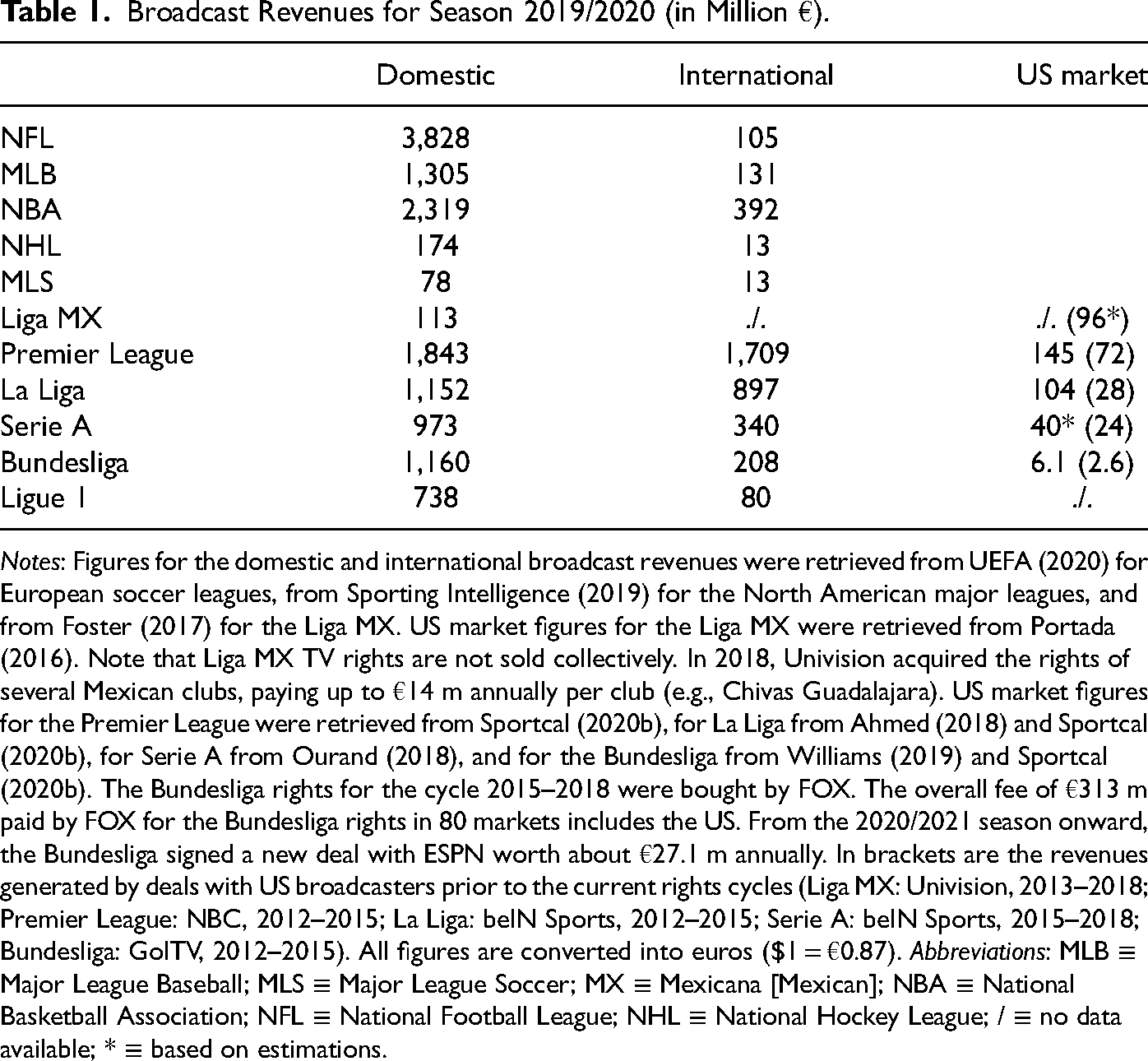
Notes: Figures for the domestic and international broadcast revenues were retrieved from UEFA (2020) for European soccer leagues, from Sporting Intelligence (2019) for the North American major leagues, and from Foster (2017) for the Liga MX. US market figures for the Liga MX were retrieved from Portada (2016). Note that Liga MX TV rights are not sold collectively. In 2018, Univision acquired the rights of several Mexican clubs, paying up to €14 m annually per club (e.g., Chivas Guadalajara). US market figures for the Premier League were retrieved from Sportcal (2020b), for La Liga from Ahmed (2018) and Sportcal (2020b), for Serie A from Ourand (2018), and for the Bundesliga from Williams (2019) and Sportcal (2020b). The Bundesliga rights for the cycle 2015–2018 were bought by FOX. The overall fee of €313 m paid by FOX for the Bundesliga rights in 80 markets includes the US. From the 2020/2021 season onward, the Bundesliga signed a new deal with ESPN worth about €27.1 m annually. In brackets are the revenues generated by deals with US broadcasters prior to the current rights cycles (Liga MX: Univision, 2013–2018; Premier League: NBC, 2012–2015; La Liga: beIN Sports, 2012–2015; Serie A: beIN Sports, 2015–2018; Bundesliga: GolTV, 2012–2015). All figures are converted into euros ($1 = €0.87). Abbreviations: MLB ≡ Major League Baseball; MLS ≡ Major League Soccer; MX ≡ Mexicana [Mexican]; NBA ≡ National Basketball Association; NFL ≡ National Football League; NHL ≡ National Hockey League; / ≡ no data available; * ≡ based on estimations.
With one Bundesliga and Premier League game being weekly broadcast on the PBS network in the 1970s, soccer programming was considered a market niche in the US just few years ago. To take advantage of that and the almost non-existent competition, soccer dedicated channels were launched around the turn of the new millennium (e.g., Fox Soccer in 1997, GolTV in 2003) and a penetration by overseas pay tv sports networks followed (e.g., beIN Sports in 2012). Nowadays, there is a diverse and highly competitive football broadcasting landscape in the US.
In Table 2, we provide an overview of the US networks broadcasting the European soccer leagues, the North American major leagues, and the Mexican Liga MX. While some smaller networks, like beIN Sports and Univision, dedicate a large portion of their programming line-ups to televising soccer, the mainstream networks FOX, ESPN, and NBC have a comparably wider range of different sports telecasts in their portfolio.
US Networks Broadcasting Europe's Big Five Soccer Leagues, Liga MX and Major Leagues.
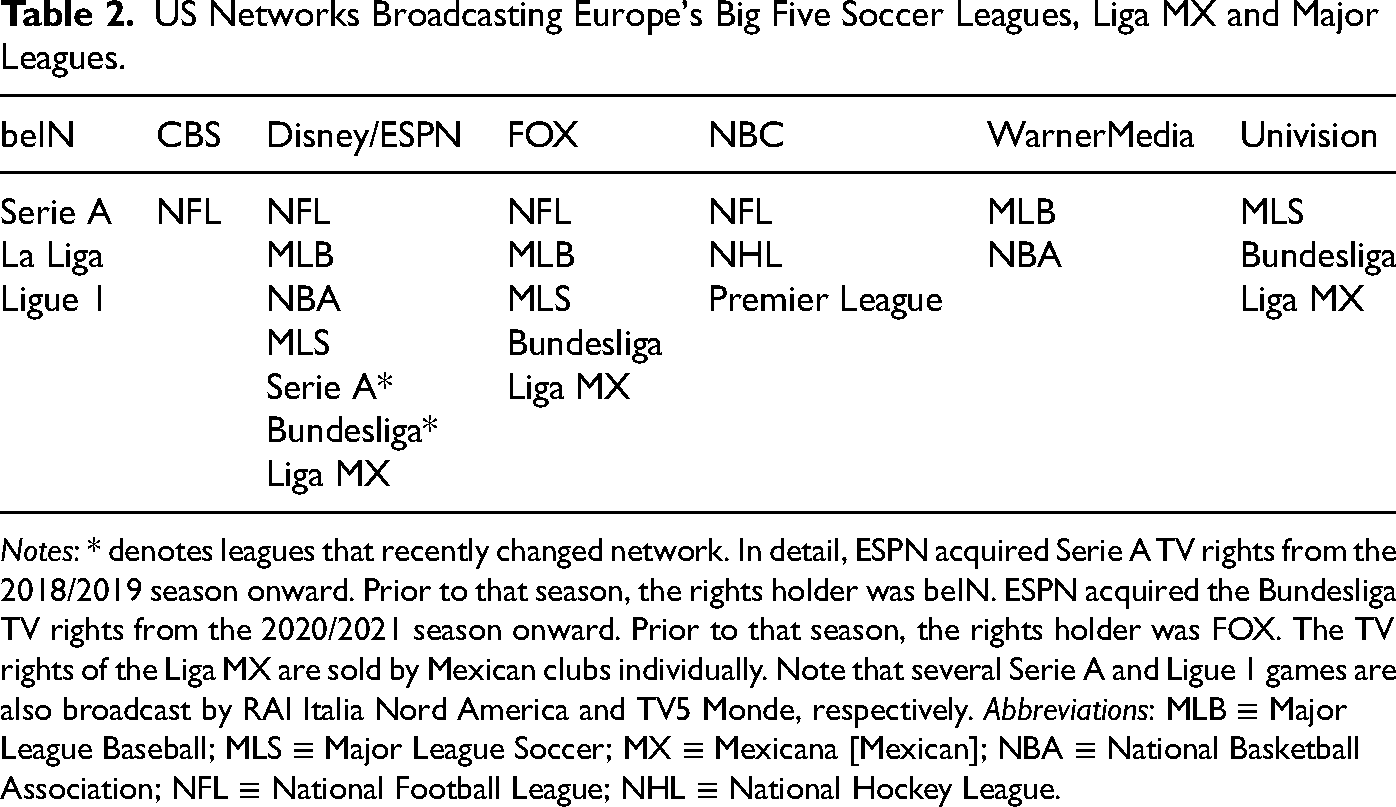
Notes: * denotes leagues that recently changed network. In detail, ESPN acquired Serie A TV rights from the 2018/2019 season onward. Prior to that season, the rights holder was beIN. ESPN acquired the Bundesliga TV rights from the 2020/2021 season onward. Prior to that season, the rights holder was FOX. The TV rights of the Liga MX are sold by Mexican clubs individually. Note that several Serie A and Ligue 1 games are also broadcast by RAI Italia Nord America and TV5 Monde, respectively. Abbreviations: MLB ≡ Major League Baseball; MLS ≡ Major League Soccer; MX ≡ Mexicana [Mexican]; NBA ≡ National Basketball Association; NFL ≡ National Football League; NHL ≡ National Hockey League.
A peculiarity of the US broadcast market is that the audience reach varies not only across channels but also within the same network. Moreover, the estimated coverage is highly volatile and may change significantly due to viewers dropping cable and/or satellite TV subscriptions in favor of streaming services 8 or disputes between programming producers/networks and multichannel operators. 9 The Bundesliga, Premier League, and Serie A (since 2018/2019 after switching to ESPN), similar to the major leagues, enjoy the highest accessibility among the ‘Big Five’ European leagues, reaching up to 100 m homes, while La Liga and Ligue 1 are accessible to fewer than 20 m homes in the US (see Table 3). It is important to note that, next to linear TV, all the US networks operate multiple streaming platforms (e.g., NBC Sports Gold, beIN Sports CONNECT, ESPN + , FOX Sports GO), allowing them to offer all the games of the concerned leagues when capacity constraints arise. These platforms are available either directly through network-operated dedicated apps and websites or via over-the-top services like Fubo TV and SlingTV (a subsidiary of DISH).
Estimated Coverage of Networks Broadcasting Soccer and Major Leagues.
Notes: Figures in million. Total number of TV households: 119.900 m. Nielsen's estimates for cable coverage as of May 2018 (Sports TV Ratings, 2018). * denotes estimates not reported by Sports TV Ratings (2018): CBS, FOX, ABC, and NBC reach about 96% of all TV households; Telemundo and UniMás estimates (as of 2015) according to Nalbantis and Pawlowski (2016); CBS Sports Network and NHL Network estimates (as of 2017) according to SNL Kagan (2016). Abbreviations: MLB ≡ Major League Baseball; NBA ≡ National Basketball Association; NFL ≡ National Football League; NHL ≡ National Hockey League.
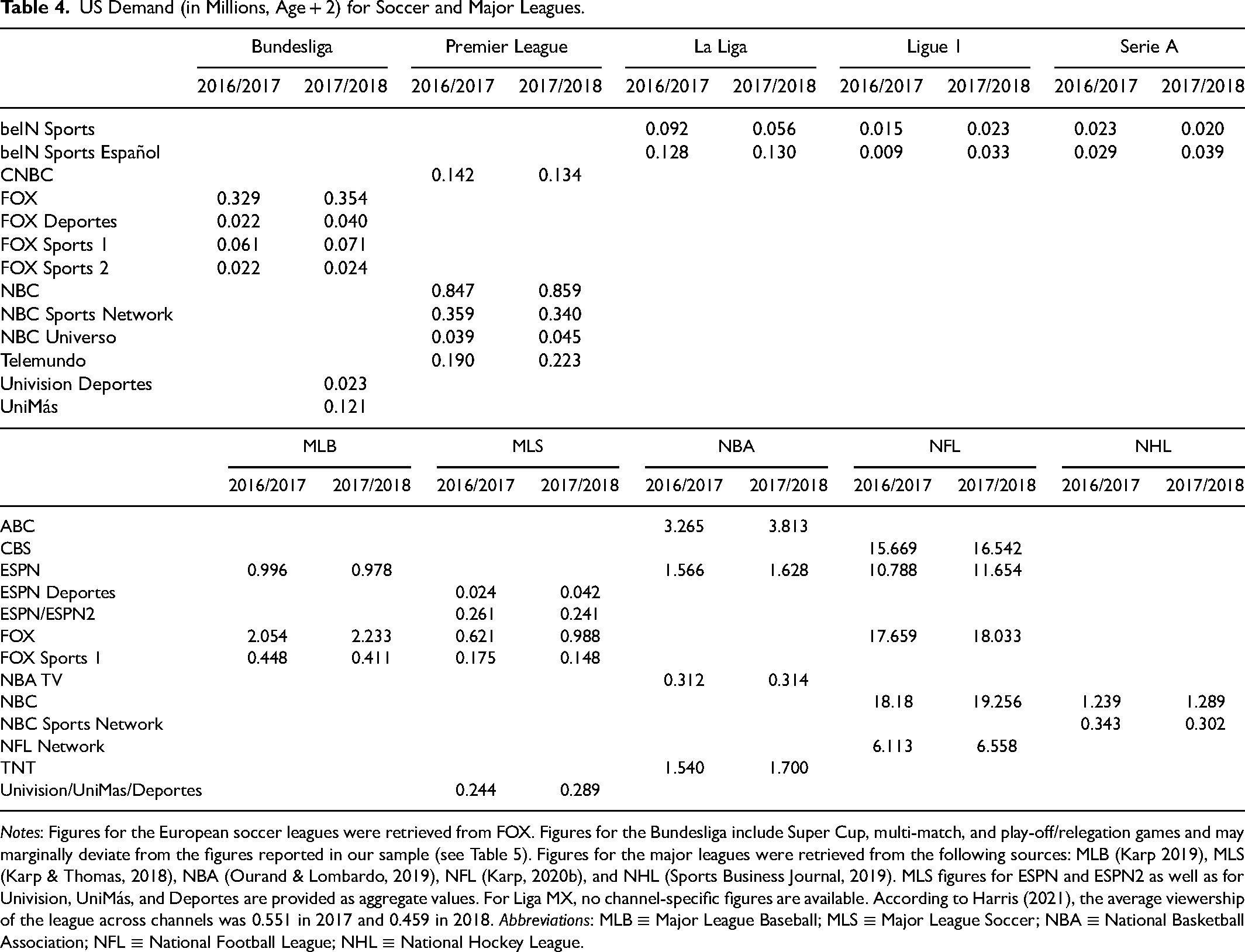
In Table 4, we display the average audience sizes for both European soccer leagues and North American major leagues in the seasons 2016/2017 and 2017/2018 by network. As expected, the audience figures correlate with the audience reach. Moreover, the National Basketball Association (NBA), National Football League (NFL), Major League Baseball (MLB), and National Hockey League (NHL) enjoy on average higher viewership than the European soccer leagues. For instance, in 2018, FOX telecasts of NFL games attracted on average about 18 m viewers, while Bundesliga telecasts on FOX just drew about 0.35 m viewers per game. However, it should be noted that commonly several NFL games are televised in the late-afternoon (16:00 EST [Eastern Standard Time]) and during the US prime time (20:00–23:00 EST), while Bundesliga games are typically aired from early morning (07:30 EST) to early afternoon (14:30 EST). All in all, the most demanded soccer league in the US is the Liga MX, followed by the Premier League and Major League Soccer (MLS).
US Demand (in Millions, Age + 2) for Soccer and Major Leagues.
Notes: Figures for the European soccer leagues were retrieved from FOX. Figures for the Bundesliga include Super Cup, multi-match, and play-off/relegation games and may marginally deviate from the figures reported in our sample (see Table 5). Figures for the major leagues were retrieved from the following sources: MLB (Karp 2019), MLS (Karp & Thomas, 2018), NBA (Ourand & Lombardo, 2019), NFL (Karp, 2020b), and NHL (Sports Business Journal, 2019). MLS figures for ESPN and ESPN2 as well as for Univision, UniMás, and Deportes are provided as aggregate values. For Liga MX, no channel-specific figures are available. According to Harris (2021), the average viewership of the league across channels was 0.551 in 2017 and 0.459 in 2018. Abbreviations: MLB ≡ Major League Baseball; MLS ≡ Major League Soccer; NBA ≡ National Basketball Association; NFL ≡ National Football League; NHL ≡ National Hockey League.
Data and Methodology
To examine competition and fan substitution between international soccer leagues, we rely on US television audience data (in millions, age 2 + ) from German Bundesliga telecasts during two seasons, 2016/2017 and 2017/2018. The data were collected by Nielsen, a global market research company operating in over 100 countries, and were provided by FOX in coordination with the DFL Deutsche Fußball Liga GmbH [German Football League]. In the US, Nielsen measures and reports TV audiences based on information gathered from a panel of about 12,000 households across the country. The reported audiences in our dataset correspond to program audience, that is, they include pre-, post-game and halftime viewership (max broadcast duration: 128 min).
As can be seen in Figure 1, US networks televised a total of 399 out of 612 Bundesliga games in the two seasons. 10 Several games were aired simultaneously on more than one TV network (typically on at least two, i.e., one broadcast in English and another in Spanish language). In total, the English-language TV networks televised 341 Bundesliga games, while the Spanish-language TV networks televised 286. The main carriers of Bundesliga games in each language format were FOX Sports 2 (202 games) and FOX Deportes (190 games). The highest average audience was reported for the free-to-air television networks FOX (0.327 million) and UniMás (0.123 million), while the average viewership for all games was about 68,000.
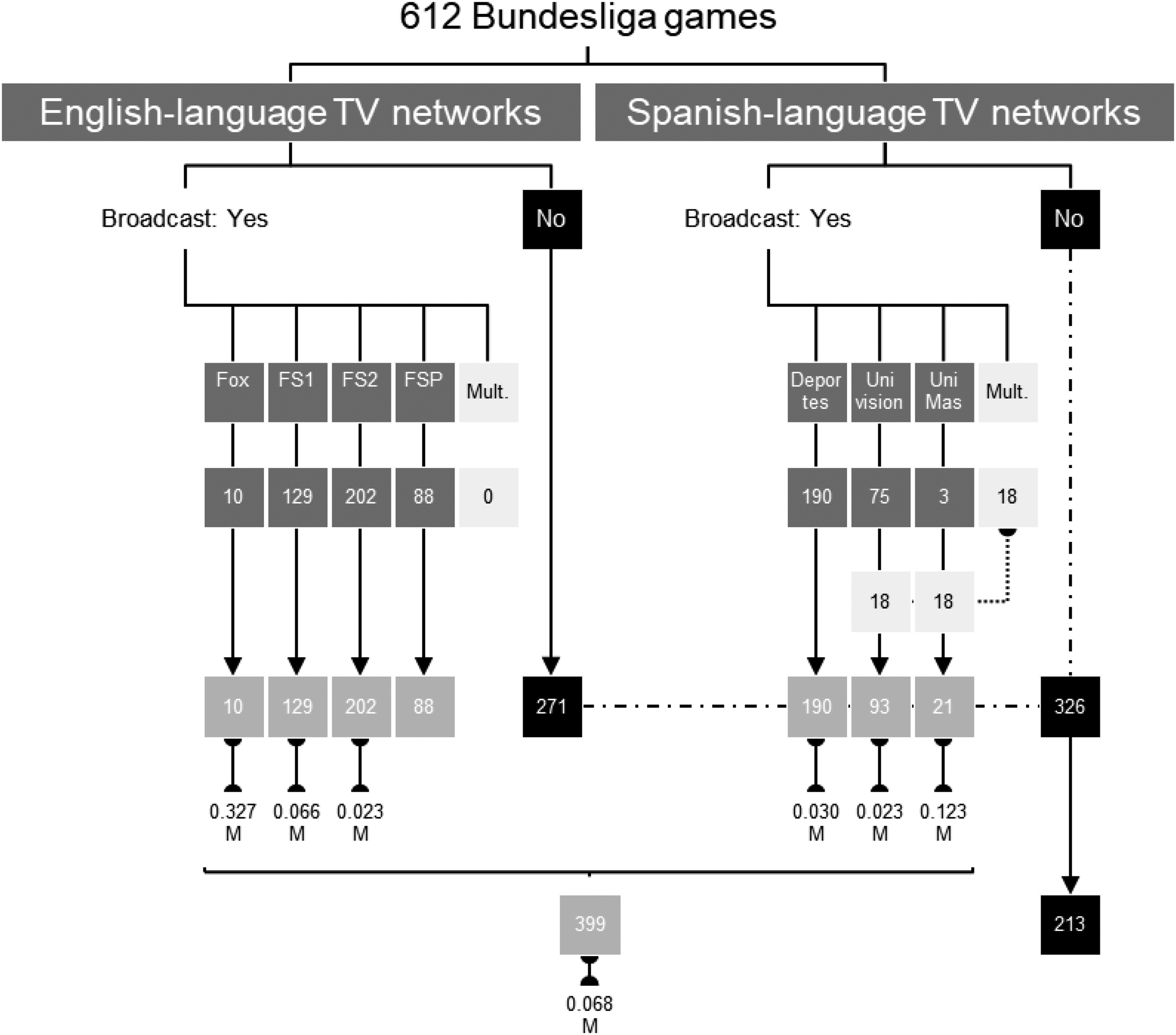
The distribution of Bundesliga telecasts among US networks.
In our analysis, we use the aggregated audience across all the TV networks that aired a given game. The highest aggregated audiences of about 0.434 m viewers were reported in the two home games of FC Bayern Munich against Freiburg (May 20, 2017) and Dortmund (March 31, 2018). In the English-language TV networks the game with the highest audience was Dortmund vs. Bayern (FOX: 0.426 m, November 19, 2016), respectively Leverkusen vs. Bayern (Univision and Unimás: 0.237 m, January 12, 2018) in the Spanish-language TV networks.
Concerning the demand for particular time slots, in Table 5, we provide an overview of both the amount of Bundesliga telecasts per slot and their average audience. While most of the televised games were staged on Saturday at 09:30 EST, the most popular slot among the audience is Saturday 12:30 EST.
The Audience of Bundesliga per Fixture and Network.
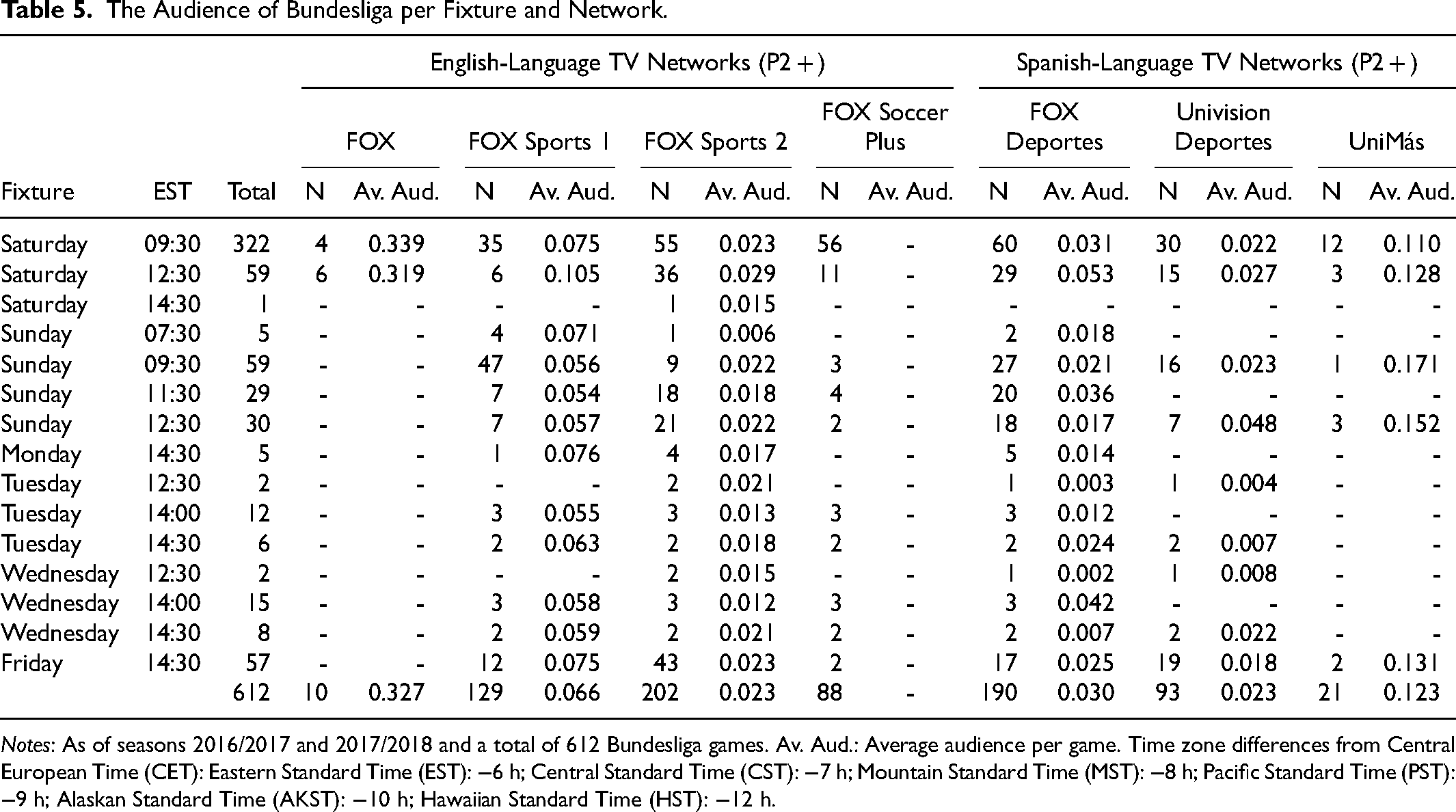
Notes: As of seasons 2016/2017 and 2017/2018 and a total of 612 Bundesliga games. Av. Aud.: Average audience per game. Time zone differences from Central European Time (CET): Eastern Standard Time (EST): −6 h; Central Standard Time (CST): −7 h; Mountain Standard Time (MST): −8 h; Pacific Standard Time (PST): −9 h; Alaskan Standard Time (AKST): −10 h; Hawaiian Standard Time (HST): −12 h.
We evaluate the demand for game i in year t, using ordinary least squares (OLS) regressions. Our baseline model to be estimated is:
Substitution Variables
To capture the effects of overlapping games in international soccer leagues, we consider soccer games of Serie A, La Liga, and the Premier League. 11 Figure 2 provides an overview of the standard slots used by each league during the period under consideration, highlighting how densely scheduled soccer games are. Given the fact that a typical soccer game lasts for about 120 min, next to the substitution effects caused by concurrently scheduled games (0 min), we examine the effects caused by games scheduled up to 120 min before or after the Bundesliga games.
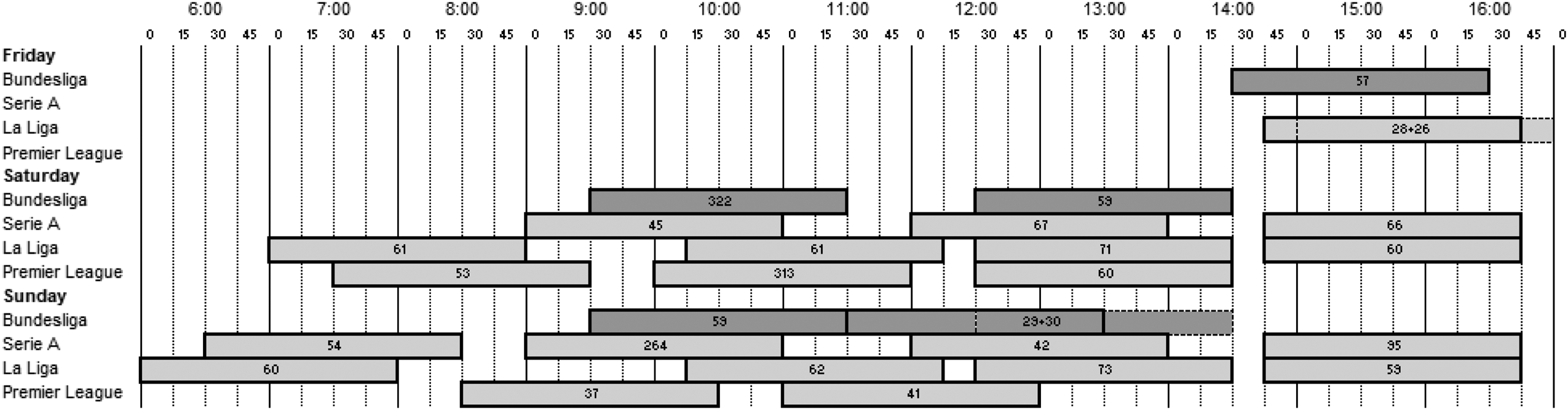
Standard slots of Bundesliga, Serie A, La Liga and Premier League games.
To measure substitution, we utilize two different specifications. First, we generate a binary variable measuring one if at least one game of the leagues concerned was scheduled concurrently or overlapped (up to + /−120 min) with a German Bundesliga telecast. Second, we consider the total number of international soccer games per league that were scheduled concurrently or overlapped (up to + /−120 min) with Bundesliga telecasts. In Figure 3, we provide an overview of the overlaps between the German Bundesliga telecasts and the different leagues being studied. In detail, the binary specification indicates that about 14.5%, 14%, and 4% of the Bundesliga telecasts were scheduled concurrently (0 min) with Premier League, La Liga, and Serie A games, respectively. The number of overlaps increases with increasing temporal distance. Specifically, taking a look at the + /−120 min time frame about 76%, 95%, and 49% of the Bundesliga telecasts collided with a Premier League, La Liga, and Serie A game, respectively. As to the metric specification of our substitution variable, the largest amount of scheduling clashes occurred with Premier League games (0 min: 0.15 games; 120 min: 2.5 games), followed by La Liga games (0 min: 0.15 games; 120 min: 1.2 games) and Serie A games (0 min: 0.05 games; 120 min: 1.1 games). All in all, given (i) the amount and frequency of overlaps, (ii) the estimated coverage of the networks broadcasting European soccer, and (iii) the appeal of the leagues concerned in the US, we expect substitution effects (if any) to arise primarily with regard to Premier League games.
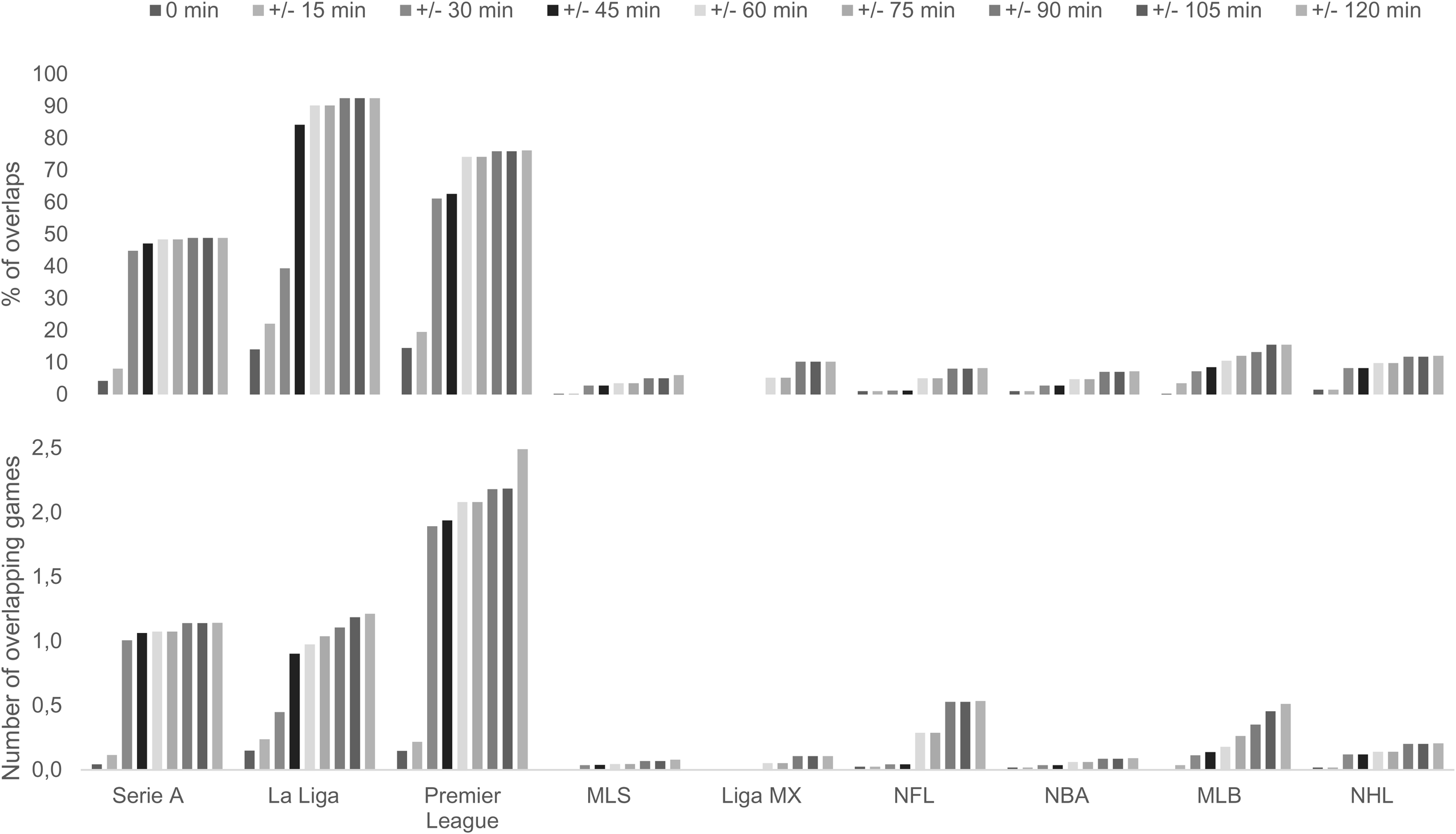
Sports telecasts overlapping with Bundesliga.
Control Variables
We control for factors that have previously been found to influence the demand for televised soccer (for a review, see Nalbantis and Pawlowski, 2016), that is, the patriotic bias, team and game quality, scheduling, and different broadcasting issues.
Patriotic bias: To control for the potential presence of patriotic bias, we include a binary variable that measures one if the teams include at least one player with US citizenship in their squads. Since Hispanics are the largest minority in the US as well as a group that is associated with a greater interest in soccer (Nalbantis & Pawlowski, 2016) and considering the fact that two-thirds of the total Hispanic population in the country is represented by Mexicans (according to US Census 2018), we also include a binary variable that measures 1 if the contestants include at least one player with Mexican citizenship in their squads. Empirical evidence suggests that viewers’ have a preference to watch their compatriots competing (e.g., Nuesch & Franck, 2009), therefore we anticipate that the presence of US and Mexican players will positively affect viewership.
Quality: To take into account the quality of the contestants, we proxy the presence of star players (Hausman & Leonard, 1997) by considering the amount of 2014 World Cup champions in the squads of the two contestants. In addition, we include the contestants’ combined market value (Forrest et al., 2005) of the starting teams at the time of the games (source: transfermarkt.de). As noted by Prockl and Frick (2018) these crowdsourced data appear to be adequate proxies for salaries when such information is not disclosed. We also control for whether at least one of the contestants participated in the UEFA Champions League (UCL) in the season under consideration. Additionally, we consider whether the game involved a team promoted from a lower-tier league (Kuypers, 1996) and whether teams were playing their inaugural season in the 1st German Bundesliga (pioneers). In line with the extant literature, we expect that high market value teams, the presence of World Cup champions, UCL participants, promoted and pioneer teams to positively affect viewership.
To test the much-debated uncertainty of outcome hypothesis (UOH; see Rottenberg 1956) and television audiences’ preferences for game outcome uncertainty (e.g., Pawlowski et al., 2018; Schreyer et al., 2018b), we implement an uncertainty measure that relies on the absolute difference between home win and away win probability as derived from the betting odds (Buraimo & Simmons, 2015). In contrast to the theory, and in line with a plethora of research work on soccer (e.g., Nalbantis & Pawlowski, 2019) we anticipate US soccer viewers to have no preference for uncertainty. We further include two variables capturing whether the game under consideration was relevant for the championship race and the fight to secure a spot in the next year's UCL competition, since these two sub-competitions are frequently associated with increased demand (Pawlowski & Anders, 2012). To do so, we employ an index developed by Janssens and Késenne (1987). Based on this index, games are considered relevant for a sub-competition (1 if ‘yes’) when the difference between points required to be champion (or to secure a spot for the UCL) and the number of points already collected by team i is smaller than the difference between the maximum number of points team i can collect during the season and the maximum number of points that team could have collected until matchday x. As high scoring games might be particularly entertaining for fans, similar to Salaga and Tainsky (2015), we include a variable that denotes the ex-ante probability (derived from betting odds) that more than 2.5 goals will be scored in the game. To account for fans preference for high-performing teams, we include a variable that captures the combined points per game earned by the two contestants (Buraimo & Simmons, 2015). Moreover, we consider quality differences between both teams by including a variable which depicts the absolute difference in pre-game league rankings (Baimbridge et al., 1996). We expect large differences in league rankings to decrease viewership. Finally, since games involving teams that share a similar geographical boundary tend to lead to greater TV audiences (Buraimo, 2008), we control for derbies. 12
Scheduling: Following the previous literature on the impact of the kickoff time (e.g., Feddersen & Rott, 2011) as well as of the day of the telecast on the demand for televised soccer (e.g., Buraimo & Simmons, 2009), we include five binary variables capturing whether the game was scheduled on Friday, Saturday, or Sunday in five different time slots from 07:30 to 14:30 EST, with the reference category being the midweek time slots. Hereto, empirical evidence is inclusive. For instance, Buraimo and Simmons (2009) found increased viewership for Premier League games televised on weekend slots, while Van Reeth and Osokin (2020) reported lower viewership of FIFA World Cup games televised on weekends. Since the European soccer games are televised in the US relatively early in the day, we expect weekend games to attract higher audiences given that the opportunity costs in our setting will be even higher during the week. Furthermore, we control for the number of matchdays (Caruso et al., 2019) to account for the impact of seasonal aspects on demand as well as we include a variable that discriminates between the two seasons under consideration.
Broadcasting: To capture differences between TV networks (Buraimo, 2008), language formats, and audience reach, we include three binary variables denoting whether FOX, FOX Sports 1, and/or FOX Sports 2 (i.e., English-language TV networks) aired the game concerned, with the reference category being Spanish-language TV networks. Finally, we further consider whether the games were broadcast by more than one TV network. We expect that games televised in networks with a higher audience reach (e.g., FOX) to be characterized by larger audiences, as well as that games broadcast by several networks to have a higher aggregate viewership. In Table A3 in Appendix A, we provide the descriptive statistics of all the control variables.
Results and Discussion
In Table 6 we provide the coefficients of the regression estimates focusing on the binary specification of the substitution variables.
Regression Results Estimating the Effect on Bundesliga Television Audience – Binary Specification.
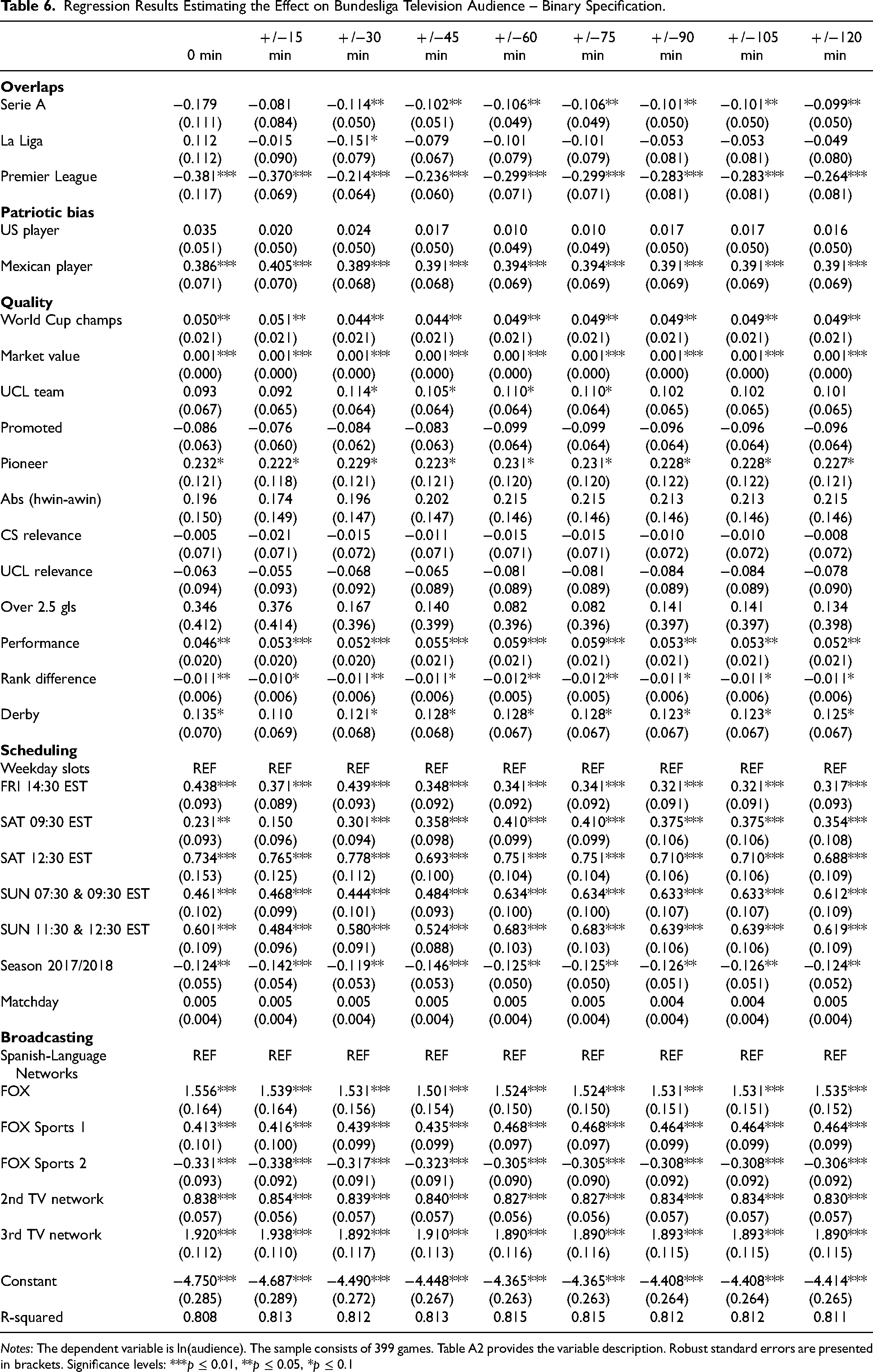
Notes: The dependent variable is ln(audience). The sample consists of 399 games. Table A2 provides the variable description. Robust standard errors are presented in brackets. Significance levels: ***p ≤ 0.01, **p ≤ 0.05, *p ≤ 0.1
Overlaps
We first explore the impact of overlapping international soccer games on the US Bundesliga television demand. Our findings suggest that European soccer games that overlap with Bundesliga telecasts decrease the demand for the latter. Specifically, these negative effects are driven primarily by Premier League games and secondarily by Serie A games, with the impact being greater the closer the temporal proximity between the games. Concerning La Liga games, the results reveal that there is—at least in terms of statistical significance—no consistent negative effect. Figure 4 displays both the relative and absolute impact of overlapping games on viewership. In particular, concurrently scheduled (0 min) Premier League games decrease the viewership of Bundesliga games by up to 32%, which translates into an average reduction of about 21,500 viewers, while the impact of Premier League games scheduled up to 120 min before or after Bundesliga games reduces the demand for the latter by up to 23% (about 16,000 viewers on average).
Unfortunately, the data at hand are insufficient to tease out the mechanism of the substitution effects (e.g., how game dynamics, emotional cues, supporter status etc. affect the decision of fans to switch from one telecast to another). Nonetheless, to explore effect heterogeneity, we test interactions of our substitution variables with several control variables. A summary of these estimations focusing on Premier League overlaps is provided in Table B1 in Online Appendix B. All in all, we find that Bundesliga games featuring Mexican players, UCL teams and/or high-market value teams can mitigate the adverse effects caused by Premier League overlaps.
Control Variables
Regarding the control variables, Bundesliga games featuring Mexican soccer players are characterized by higher viewership. Interestingly, however, the presence of US players has no statistically significant impact on Bundesliga demand. This is in line with the notion, that although soccer is becoming increasingly popular in the US, still, the Hispanic community constitutes the main pillar of international soccer demand (Nalbantis & Pawlowski, 2019).
As far as the product quality is concerned, in line with the empirical work on the impact of stars on sports demand (e.g., Hausman & Leonard, 1997), we find that the number of 2014 World Cup champions featuring in the rosters of the competing teams affects the Bundesliga demand positively. Similarly, in agreement with the extant literature (e.g., Forrest et al., 2005), our estimates show that US fans have a preference for games involving high-market-value starting teams. However, the presence of UCL teams seems to have a marginal impact on demand in terms of statistical significance, while games featuring newly promoted teams have no statistically significant effect at all. On the other hand, along the lines of empirical work showing increased interest for unknown teams with unusual success (e.g., Grimshaw et al., 2013), teams playing for the first time in the Bundesliga attract the fans’ interest. In accordance with previous findings (e.g., Nalbantis & Pawlowski, 2019; Buraimo et al., 2022), our game uncertainty measure shows that US fans do not have a particular preference for close soccer games. However, in contrast to a priori expectations, neither games relevant for the championship race nor for the fight to secure a spot in the next season's UCL are characterized by increased viewership. This might provide some further support on the notion that a certain portion of US viewership consists of general (i.e., unaffiliated) soccer fans. Arguably, a certain level of fan engagement is required to distinguish between relevant games. Rather counterintuitive, however, in line with previous work on NFL viewership (Salaga & Tainsky, 2015), ex-ante expectations about high scoring games, do not seem to affect US viewers’ preferences. In contrast, the viewership seems to prefer games between high-performing teams, with the least possible difference in quality, as well as geographical derbies. Analogous findings are also reported with regard to MLS in-stadium attendance (e.g., Jewell, 2017). Regarding scheduling, as expected (e.g., Buraimo & Simmons, 2009), in general, Friday and weekend slots have a higher demand than weekday slots. Interestingly, however, and in contrast to previous research (e.g., Caruso et al., 2019), holding other factors fixed, the matchday denotes no statistically significant within-season trends, while the demand in the 2017/2018 season is lower than in the 2016/2017 season. Finally, with regard to broadcasting issues, the demand for Bundesliga games aired on English-language TV networks is higher than the demand for those aired on Spanish-language ones. An exception constitutes Fox Sports 2, where televised games have on average less viewers than Spanish-language TV networks. As expected, the more TV networks are involved, the higher is the demand – arguably due to the increased accessibility – with each additional network televising a game doubling the overall game's audience.
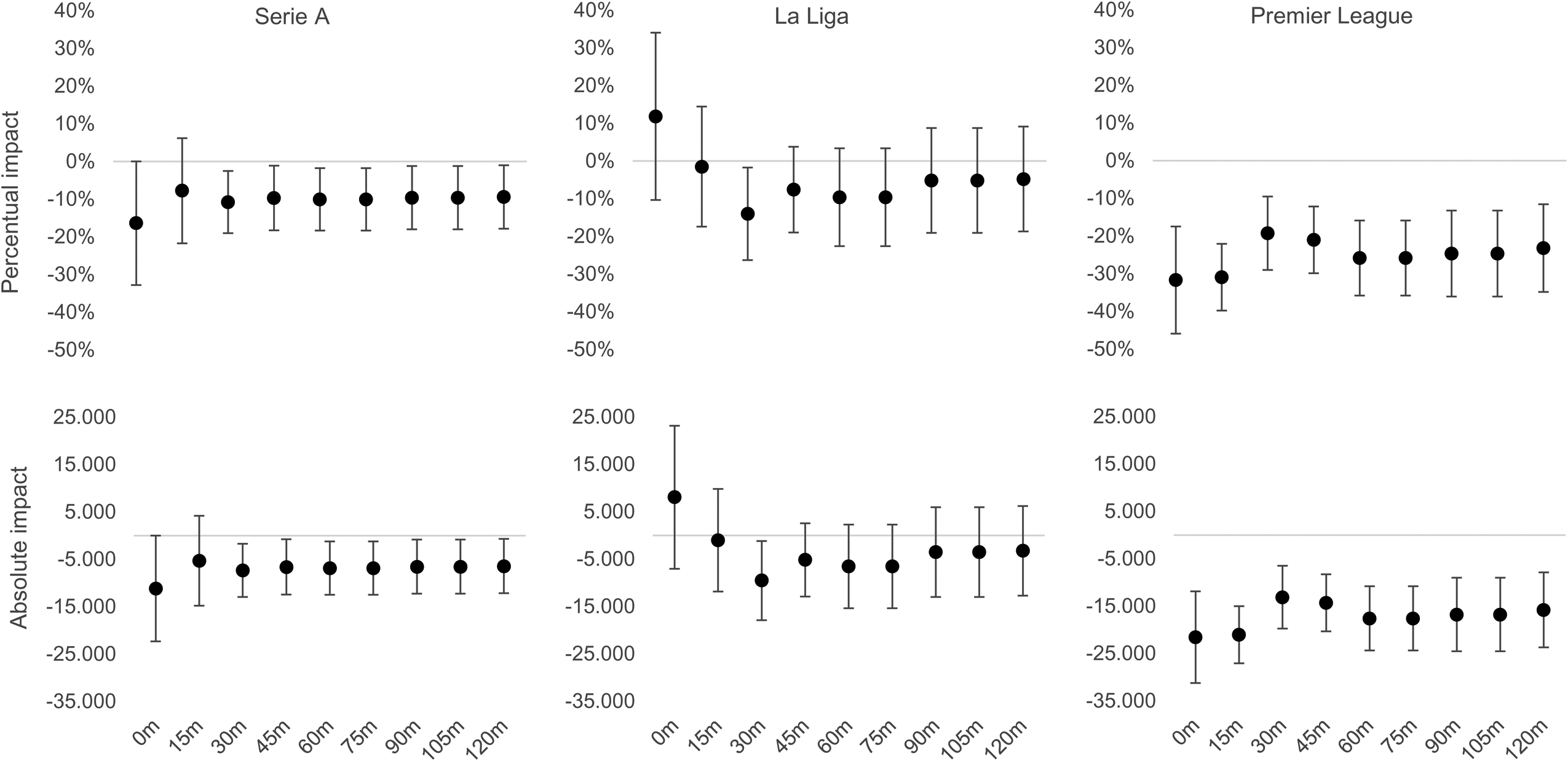
The effects of overlapping games on Bundesliga television audience.
Robustness Checks
To assess the robustness and sensitivity of our findings, we run several checks and test different estimators. A summary of the corresponding results can be found in the Online Appendix B, what follows is a discussion of these checks.
Unobserved team heterogeneity: In order to account for any unobserved or unobservable differences between the teams, we estimate all models including team fixed effects. The inclusion of team fixed effects affects neither the statistical significance nor the sign of the effects of interest. It should be noted, however, that the size of the coefficients in most models marginally increased (Tables B2-B4; Model 1 and 5).
Binary vs. metric specification: To test whether our results are equally valid and reliable, as a further robustness check, we estimate all models using the metric specification of the substitution variable (Tables B2-B4; Model 5 to 8). Overall, and in line with our findings on the binary specification of the substitution variable, negative effects seem to be primarily driven by Premier League games.
Selection issues: Only 399 out of a total of 612 of Bundesliga games were televised during our observation window. In general, a common way to approach selection is the use of classical Heckman models. Practically, however, it seems hard to imagine that any information available to the broadcaster is not available to the audience. Moreover, no data is available on the timing of the selection and the set of games subject to selection at each point of time. Taking all these issues together, it seems impossible to credibly select a variable satisfying the exclusion restriction in this setting. As such, we can only report estimates using the Heckman estimator without any instrument. This is somewhat unsatisfactory from an econometric point of view, because in the absence of an instrument, the covariance matrix of error terms is solely identified by the normality assumptions of the model and as such the estimates could be unstable and unreliable (Hamilton & Nickerson, 2003). Therefore, we extend our analysis by following a procedure which actually allows for identification in the absence of an instrument, i.e., the so-called DMZ model (c.f., D’Haultfoeuille et al., 2018). Overall, the DMZ model follows a semi-parametric methodology, uses an estimator based on a series of extremal quantile regressions (i.e., quantile regressions applied to the tails of the conditional distribution) and provides bootstrap inference for sample selection. While the DMZ model has recently started to gain some relevance as an alternative to Heckman estimators in labor economics (e.g., Yashiv, 2021), it has (to the best of our knowledge) not yet been employed in the sports economics literature. Compared to the Heckman estimator this model has three main features, i.e., the model (i) relies on the identifying assumption that the selection becomes independent of the covariates for large values of the outcome; (ii) does not require normality (linearity) of the (conditional expectation of the) error term in the selection (outcome) equation; and (iii) allows for heterogeneous distributional effects of other control variables (D’Haultfoeuille et al., 2018; 2020). Our main findings remain robust concerning the sign, while the effects reported both utilizing the Heckman estimator (Tables B2-B4; Model 3 and 7) and the DMZ models (Tables B2-B4; Model 4 and 8) are larger in magnitude suggesting that we rather observe lower bound estimates in our main specification (see Table 6).
As a further check, we run subsample estimations just considering Bundesliga games televised on Monday, Sunday and Friday. The intuition of this approach is as follows: since around 96% of all available Bundesliga games during these days / time slots were televised (N = 177), the impact of a (broadcaster) selection bias (if any) should be marginal (Tables B2-B4; Model 2 and 6). Again, our main findings remain.
Still, however, endogeneity concerns could remain if the Bundesliga games overlapping with games of other soccer leagues are systematically different in characteristics (e.g., with regard to team and/or game quality). This may happen, if either the league and / or the broadcaster have a special strategy in place to avoid overlaps with other leagues or to mitigate any substitution effects caused by them. To test this, we implement the inverse probability weighted regression adjustment (IPWRA) estimator. This estimator has a doubly robust property, i.e., it provides efficient estimates even when the treatment or outcome model are incorrectly specified (see Słoczyński & Wooldridge, 2018). The treatment models, which consider whether a Bundesliga game has a Premier League overlap (1 if “yes”), include all variables aiming to capture the patriotic bias, team and game quality. The outcome models are using the full set of covariates like in the main specifications. After successfully balancing out the differences between games with and without overlaps (see Figure B1), again, our main findings remain robust with regard to the adverse effect of Premier League telecasts on Bundesliga viewership (Table B5). Importantly, our main model estimates (see Table 6) lie within the 95% confidence intervals regarding the % change as documented by our treatment estimates
Omitted variable bias: Our regression equations include a rich set of covariates, however, we also check the sensitivity of our estimates to an omitted variable bias (see Table B6), by examining whether unmeasured confounding is large enough to materially affect our main conclusions. To this end, we apply a recently introduced approach proposed by Cinelli and Hazlett (2020). In all instances, the sensitivity tests report that our estimates are robust to a confounding variable fully explaining the left-out variance of the outcome and as strong as the strongest covariate in our setting (i.e., market value). In other words, even an omitted “worst-case confounder” would not overturn our conclusions with regard to the adverse effects of Premier League overlaps on the US demand for Bundesliga telecasts.
Conclusion
In this study, we investigate whether international soccer telecasts constitute substitutes in a between-country setting, an issue that is highly relevant both for practice and for theory yet has largely been neglected by the literature so far, mainly due to the limited availability of data. Taking advantage of a unique TV audience dataset, we determine whether scheduling clashes with the Premier League, La Liga, and Serie A affect the Bundesliga viewership in the US market.
The relevance of the chosen setting is threefold. Firstly, there are ongoing disputes about the degree of audience overlap between US networks broadcasting soccer. These disputes have the potential to bear severe consequences on the long-term viability of networks; to negatively affect consumer welfare; and may carry direct and indirect adverse effects on leagues and stakeholders (e.g., sponsors, advertisers). Secondly, the US is considered to be a key market for top European soccer leagues, making a significant contribution to their total international broadcast income. Thirdly, the Bundesliga—among the best soccer leagues worldwide in terms of playing quality and popularity—has recently started to capture American soccer fans’ attention and is currently competing for viewers with other European soccer leagues that have a longer presence in the country.
Our econometric models reveal that the Bundesliga viewership is adversely affected primarily by overlapping Premier League games and as such attest, for the first time empirically, to the substitution effects in a between-country setting. Based on these findings, we conclude that there seems to be significant competition between the networks for soccer viewers. This insight is highly relevant for regulatory bodies considering that market definition is the nucleus of the debates between stakeholders in the broadcasting industry. As such, the findings contribute towards a better understanding of the international sports media market, implying that international soccer leagues compete in the same relevant product market.
Managerial Implications
As to the managerial implications, arguably, our findings may reflect popularity differences between the leagues. In this respect, they may point towards the so-called double jeopardy phenomenon which is found to be particularly acute among directly competing televisions genres (Donthu, 1994). This phenomenon describes less popular brands being characterized not only by lower market shares but also by less brand loyal customers. Accordingly, the herein attested substitution effects may suggest that Bundesliga viewers in the US exhibit lower brand loyalty and thus are more likely to the shift their preferences towards timely adjacent telecasts of a far more popular league (e.g., Premier League). To address this double jeopardy, a remedy could be increased efforts towards boosting Bundesliga's brand awareness abroad. Rearranging league fixtures to avoid scheduling clashes seems to be impracticable, considering the scheduling constraints and the fact that substitution effects extend beyond just concurrent telecasts.
Limitations and Future Research
First, while our findings show that Bundesliga viewership decreases by overlapping games of other leagues, we are unable to test directly whether the concurrently scheduled games of these leagues benefit from this decrease. Second, we analyze audience data, which inevitably overlook out-of-home viewers (e.g., in bars, hotels, and airports) as well as non-linear viewing (e.g., over-the-top viewers). While we use the best data available, Nielsen recently announced plans to introduce an out-of-home measurement, which will be integrated with national TV measurements. Future research might take advantage of these more comprehensive data to validate our findings. Third, as noted, the vast majority of the Premier League, La Liga, and Serie A games are available linearly and/or non-linearly in the US. In this study, we do not explicitly discriminate between them; however, exploring whether the impact of substitution is mitigated by overlaps with games that are available only online may be relevant in future research. Fourth, our data contains program audiences. As shown by Buraimo et al. (2022) program audience figures tend to be lower than pure match audience figures (i.e., only for the 90 min plus extra time). Moreover, program audience data tends to be somewhat ‘noisier’. Given that typically networks market a game telecast as a whole (i.e., including pre-and post-game shows, the actual game, as well as halftime reports) and not just the 90 min played, we believe that this issue is less of concern in our setting. Furthermore, considering the scope of our research, we do not believe that using pure match audience figures would have overturned our conclusions. In the light of this discussion, however, it may be, that the herein reported substitution effects are lower-bound estimates only. Finally, in our study, we focus on Bundesliga telecasts and the US market, yet it would be interesting to test fan substitution both in the same setting, focusing on the demand for other leagues (e.g., La Liga or Serie A telecasts), and in other settings (e.g., in China), where viewing habits arguably differ.
Supplemental Material
sj-docx-1-jse-10.1177_15270025221132234 - Supplemental material for Substitution Effects and the Transnational Demand for European Soccer Telecasts
Supplemental material, sj-docx-1-jse-10.1177_15270025221132234 for Substitution Effects and the Transnational Demand for European Soccer Telecasts by Georgios Nalbantis, Tim Pawlowski, and Dominik Schreyer in Journal of Sports Economics
Footnotes
Acknowledgements
FOX audience data were provided by FOX in coordination with the DFL Deutsche Fußball Liga GmbH [German Football League]. The authors would like to thank Dominik Scholler (Head of Audiovisual Rights International) for providing data access. The content of this manuscript reflects only the authors’ views. The data provider is not liable for any use that may be made of the information contained therein.
Funding
The author(s) received no financial support for the research, authorship, and/or publication of this article

Notes
Author Biographies
Appendix
References
Supplementary Material
Please find the following supplemental material available below.
For Open Access articles published under a Creative Commons License, all supplemental material carries the same license as the article it is associated with.
For non-Open Access articles published, all supplemental material carries a non-exclusive license, and permission requests for re-use of supplemental material or any part of supplemental material shall be sent directly to the copyright owner as specified in the copyright notice associated with the article.
