



Abstract
I investigate the relationship between sports-based entertainment and crime using nine years of hourly data on robberies and thefts by police district in São Paulo linked to information on 430 football matches. Results report a citywide voluntary incapacitation impact and a local spatial concentration effect. Robberies significantly drop during matches, especially high-audience ones. Around the stadiums, this effect is outweighed by that of concentration. While I find no evidence of spatial displacement, temporal displacement is at play, with offenses being moved up to pre-game time. I show that the game-crime link is likely deployed through potential criminals rather than victims.
Introduction
The idea that entertainment may play a crime-preventing role is not a new one. As the old saying goes “idle hands are the devil's workshop”: the potential for criminal interaction drops as potential offenders and victims substitute time away from crime-conducive occupations to engage in alternative, less crime-conducive activities. This notion has even inspired a few policies (for instance the Midnight Basketball initiative in the US), typically designed to divert high-risk populations towards some subsidized recreational activity and away from crime.
Previous studies have empirically confirmed the relevance of this mechanism, which is known as the voluntary incapacitation effect (for instance, Copus & Laqueur, 2019; Dahl & Della Vigna, 2009). But this is not all. The entertainment-crime relationship is a complex one, that goes beyond the directness of the “idle hands” logic. Firstly, one must figure out whether voluntary incapacitation results in crimes being prevented or just shifted in time (temporal displacement). Secondly, to get a better grasp of the mechanism and its policy implications, it is crucial to identify which side of the criminal interaction (potential criminals or victims) channels the entertainment-crime link. In addition, the issue of spatial concentration must be considered: 1 a form of entertainment that is enjoyed in isolation (watching TV at home) is arguably different, as regards criminal outcomes, from one that entails a big crowd (a show).
This paper analyzes various aspects of the relationship between crime and sports-based entertainment using information on 430 important football matches linked to crime reports on robbery and theft for the city of São Paulo, Brazil, organized by hour and police districts (93 in total). The panel structure of this novel database, as well as the availability of information on different types of offenses, make it possible to address a wide range of research questions within one empirical exercise. Observations cover robberies and thefts for the period 2006 to 2014. The identifying assumption at the basis of my analysis of the entertainment-crime link is that, conditional on time fixed effects and further covariates, the scheduling of a game within a certain date and time is random with respect to crime (Copus & Laqueur, 2019).
Estimates indicate that the entertainment provided by football games leads to a 7.5% decrease in robberies, while thefts are not significantly affected. I find that the size and significance of crime drops are higher the closer the game is to the tournament's finals, which is in line with the voluntary incapacitation logic—later tournament rounds are likely to attract bigger audiences.
Examining individual hour-long units during and around game time, my results show that some crimes are being temporally displaced to the hours preceding the game. On the other hand, the negative impact of entertainment on crime extends to the game aftermath. This dynamic seems to reflect potential criminals planning their schedule and bringing some of their offenses forward to free up their agenda for the game and post-game time.
Exploiting the panel features of my dataset, I examine the impact on crime of game-related spatial concentration. Outcomes show that, when a match is played locally, the areas around the stadium register a positive and sizeable increase in both robberies (28.3%) and thefts (150%). In these regions, the impact of concentration more than outweighs that of voluntary incapacitation. On the other hand, I find no evidence of spatial displacement of offenses towards the stadiums’ areas from the surrounding neighborhoods when a game is played locally.
The data allow me to distinguish motor vehicle thefts within the overall theft category. I use this offense to test whether it is indeed criminals—rather than victims—who plausibly channel the game-crime link, and in particular the voluntary incapacitation effect. The logic underlying this test goes as follows. In contrast with robberies and other types of theft (e.g., pickpocketing), motor vehicle thefts typically happen in the absence of the victim. Then, as far as this offense is concerned, fewer victims (and witnesses) on the street likely result in better crime opportunities, whereas fewer criminals would lead to fewer crimes. Outcomes show that motor vehicle thefts drop during game time, which provides support to the hypothesis that the entertainment-crime link is driven by potential offenders.
This work contributes to the existing literature by investigating various aspects of the complex relationship linking entertainment and crime. The dataset I employ is to the best of my knowledge the most refined setup that has been used in this stream of literature so far. This represents a remarkable advantage with respect to previous related studies. My results speak to a policy-relevant debate by providing facts-based evidence on whether, and through which mechanism and channel, entertainment can aid crime prevention. In addition, this study offers novel insights by looking at the context of a lower-income country, such as Brazil.
The remainder of this paper is organized as follows. Section 2 introduces the conceptual framework that motivates the relationship between entertainment and crime and discusses previous literature. In Section 3, I present the data. Section 4 explains the empirical strategy. Section 5 describes my findings. Section 6 discusses the results and Section 7 concludes.
Conceptual Framework and Relevant Literature
Studying the connection between crime and various forms of entertainment, the literature has recognized the importance of the voluntary incapacitation mechanism. Dahl & Della Vigna (2009) estimate that violent movie attendance reduces violent crime in the short term by between 1% and 2% and interpret this finding along the lines of voluntary incapacitation. Cunningham et al. (2016) conclude that violent video games may reduce crime through the same mechanism. In addition, Chong & Yañez-Pagans (2017) show that television availability leads to significantly lower homicide rates in Brazil and mention incapacitation as an explanation. In a sports-crime study, Marie (2016) uses a panel of 6-hly data at the borough level to study the impact of football matches by nine teams on crime patterns in London. He calculates that voluntary incapacitation is responsible for a 3% drop in the incidence of property crimes in a team's home borough for every extra 10,000 fans attending an away match.
As mentioned, however, the entertainment-crime relationship is a complex one. To begin with, the concentration dimension may be relevant. Higher concentration is more crime conducive, as it increases the potential for interaction between potential victims and offenders and may reduce the chance of being caught (Kelly, 2000; Pyun, 2019). Thus, one may expect big (sporting) events to positively impact crime rates around the venues. Indeed, studies that focus on the effect of mass gatherings at sport stadiums typically find that large entertainment events increase crime in the local community, due to concentration. Kalist & Lee (2016) use three years of daily crime incidences in eight cities in the U.S. and show that home games of the American National Football League increase total crime by 2.6%. Thefts and motor vehicle thefts display the biggest hikes, with increases of 4.1% and 6.7% respectively. Interestingly, the authors observe that crime decreases by almost 10% on playoff game days. They acknowledge that their results reflect citywide crime increases, as their database (by city) does not allow them to examine the local patterns around the stadiums. Rees & Schnepel (2009) study the relationship between college American football games and some specific offenses such as vandalism and assault using a panel of daily crime data for 26 police agencies in the U.S.. On game days, they find substantial crime increases in the host community. Marie (2016) finds that home game attendance significantly increases property crime in the borough hosting the event. Pyun (2019) studies the move of a Major League Baseball team to Washington D.C. in 2005 as a natural experiment to examine the impact of games on crime in a host city. The author employs monthly city-level data and finds a significant rise in assaults as a result of the move. Mares & Blackburn (2019) also consider a Major League Baseball team and use 23 years of daily data for the city of St. Louis. They find that many crimes display substantial increases (around 14% to 16%) in the stadium area on game days. This is particularly the case for thefts, motor vehicle thefts, simple assaults, disorderly conduct, and destruction of property. The authors acknowledge the importance of spatial displacement recognizing that a crime rise around the stadium may not lift citywide crime levels if local offenders purposively travel to the stadium area to commit offenses. They find non-conclusive support for spatial displacement of robberies in their analysis.
On the other hand, if the event is also broadcast on television, and television viewership is sufficiently large with respect to stadium attendance, it may be that the overall effect of the sport events on crime is negative because voluntary incapacitation dominates the concentration effect. Copus & Laqueur (2019) focus on big sports events for which stadium attendance is negligible as compared to television viewership. They analyze criminal activity in Chicago using half-hourly data and find substantial reductions in offenses during game times. This lends support to the hypothesis of a dominant crime-preventive role of entertainment via voluntary incapacitation, as long as the activity is not experienced in a mass concentration. This result is consistent with outcomes from Dahl & Della Vigna (2009), Cunningham et al. (2016), and Chong & Yañez-Pagans (2017), all of which focus on entertainment activities that are typically experienced individually or in small groups. Even the finding in Kalist & Lee (2016) that crime decreases on playoff game days points to the same conclusion. Indeed, playoff games are likely to display the highest ratio of television viewership to stadium attendance.
When investigating the crime-preventive potential of entertainment, it is important to address the issue of temporal displacement: are offenses being avoided or simply shifted in time? The literature finds close to no evidence of short- or medium-term temporal displacement (Copus & Laqueur, 2019; Kalist & Lee, 2016; Marie, 2016; and Rees & Schnepel, 2009).
The quantity of crime is the equilibrium between the supply of offenses and the demand for criminal activity. Voluntary incapacitation may affect either side of the criminal interaction. There can be an effect on potential victims, whose choices could make criminal interaction more or less likely. However, the literature mostly emphasizes the role of voluntary incapacitation on potential criminals (Dahl & Della Vigna, 2009; Marie, 2016). In close relation with my study, Copus & Laqueur (2019) theorize that the game time crime drops they find are likely due to voluntary incapacitation on the side of potential offenders because consistent reductions are observed across all crime categories (violent, property, drug, and other). However, the data they employ are not sufficiently disaggregated at the offense type level to allow for testing. In fact, while it is reasonable that fewer people on the street may make some types of property (like motor vehicle theft) easier, this is not true for all property crimes. For instance, pickpocketing and robbery require the presence of a victim.
A conclusion that can be draw from the literature is that the structure, frequency of observations, level of aggregation, and offense coverage in the data are crucial to a thorough analysis of the complex games-crime relationship. A sufficiently refined panel setup is necessary to distinguish between the local and overall (i.e., citywide) effects of the games, as well as to investigate the issue of spatial displacement. In addition, temporal displacement concerns cannot be addressed without a high frequency in observations. Finally, a meaningful range of covered offenses can help determine the heterogeneous effects of sports-based entertainment on different crimes as well as disentangle the differential impact of games on potential criminals and victims. The panel dataset I employ, organized by hour and police district, offers a significant improvement with respect to prior research.
Data
I investigate the entertainment-crime relationship using information on important football games from three different championships combined with data from robberies and thefts reports for the city of São Paulo, Brazil, in the period 2006 to 2014.
Information on the Football Games
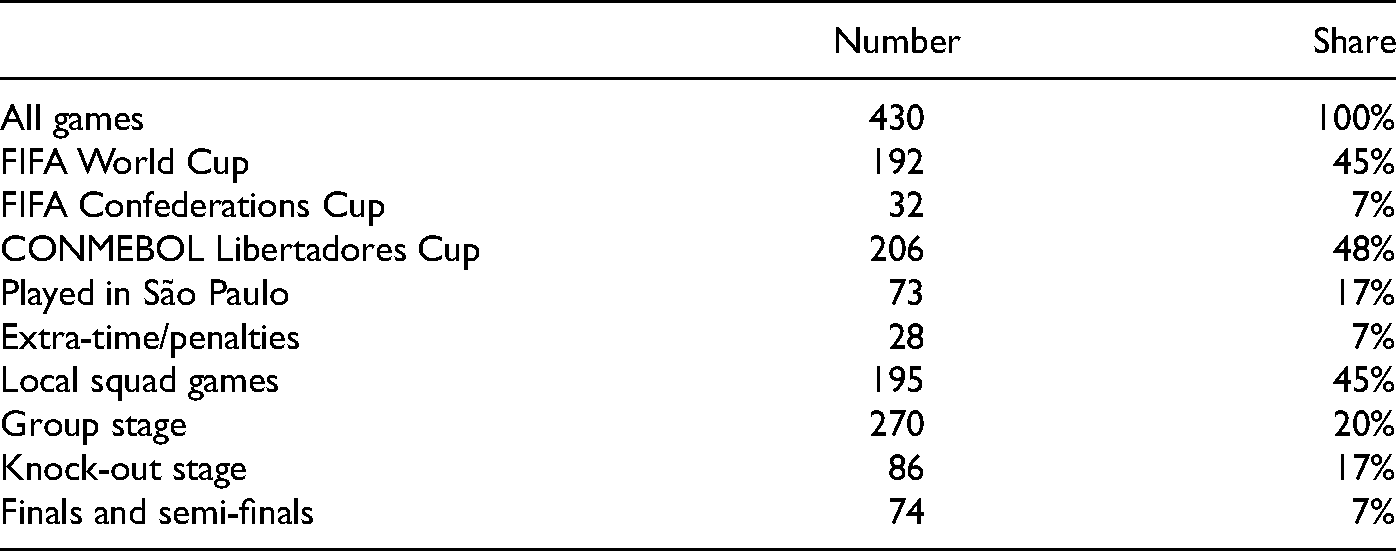
I consider 430 football matches from various editions of three international tournaments: the FIFA World Cup, the FIFA Confederations Cup, and the CONMEBOL Libertadores Cup. Data about these games are publicly available. I display some of them in Table 1.
Football Games.
The World Cup is a quadrennial world championship for men's national football teams organized by FIFA. It is the most prestigious football tournament worldwide. Over the 2006–2014 period, three editions of the FIFA World Cup took place: 2006 in Germany, 2010 in South Africa, and 2014 in Brazil.
The Confederations Cup also was a quadrennial world championship for men's national football teams organized by FIFA. It was cancelled after the 2017 edition. The Confederations Cup occurred the year before the World Cup, typically in the country that would host the main event the following year, and thus acting as a test for such event. Two editions of the Confederations Cup took place during the 2006–2014 period: 2009 in South Africa and 2013 in Brazil.
The Libertadores Cup is an annual international club football competition organized by CONMEBOL. It is the most important South American club championship (Gasparetto & Barajas, 2020). It took place every year during the 2006–2014 period, with matches being played at various venues throughout South America.
My dataset comprises all games of the World Cup and the Confederations Cup which were played in the considered timeframe. As regards the Libertadores Cup, I include all matches from the group stage onwards that either saw the participation of at least one of the four local teams from São Paulo (Corinthians, Palmeiras, Santos, and São Paulo 2 ) or belonged to the last stages of the championship (finals and semi-finals). The rationale of this selection is to include games that are likely to attract a large audience in São Paulo.
The regular duration of a match envisages two playing periods of 45 min each plus a half-time break of 15 min. Throughout the analysis, I employ the approximation that a regular game lasts 2 h. In some cases, if the score is level at the end of the regular playing time, extra-time (two additional 15-min periods) and, possibly, penalty shootouts are used to determine the winner. In these cases, I employ the approximation that a game lasts 3 h.
Data on Crime
I use data on robbery and theft (overall and motor vehicle theft only) incidents which occurred in the city of São Paulo in the period 1 January 2006 to 31 December 2014, and for which the police completed a case report.
Both theft (furto) and robbery (roubo) involve stealing. However, contrary to theft, robbery implies the use of (or the menace to use) force, which makes it more serious a crime. 3 In line with this, the Brazilian Penal Code envisages one to four years of imprisonment for theft as opposed to four to ten years of imprisonment for robbery.
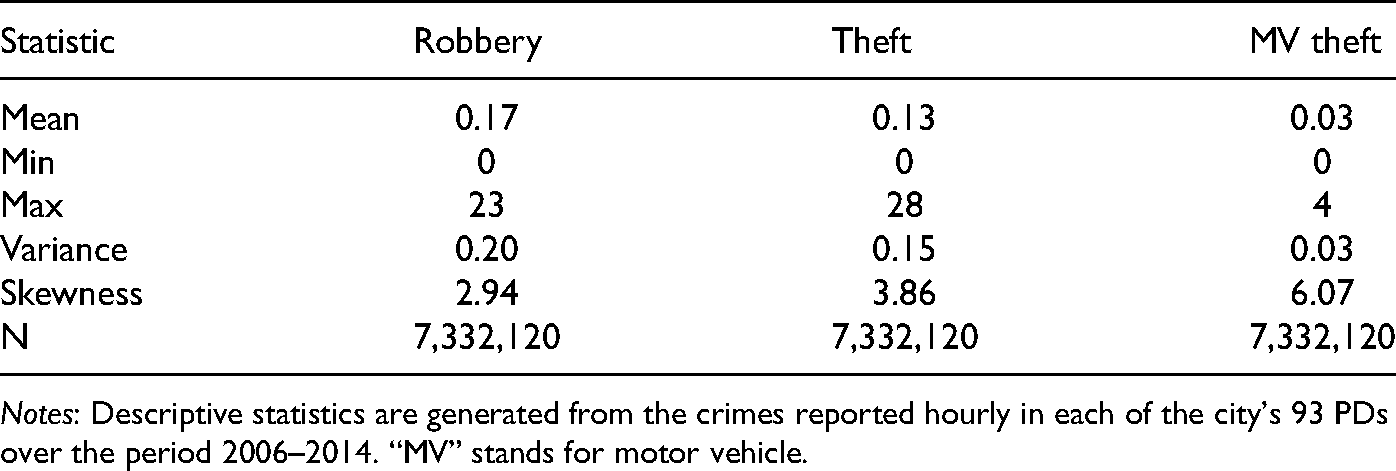
Crime data are not publicly available and were provided by the Public Safety Department of the State of São Paulo (Secretaria de Estado da Segurança Pública do Governo de São Paulo). All records contain information on the date of the occurrence as well as on the police district (“PD”) where it took place. I drop the instances that do not indicate the time of the occurrence (about 24% of thefts and 5% of robberies). There are 93 PDs in the city of São Paulo. I aggregate the crime reports in a panel setup by hour and PD. Summary statistics are reported in Table 2. For the distributions of robberies, thefts, and motor vehicle thefts the variance roughly coincides with the mean, indicating that over-dispersion is not an issue.
Crime Data Hourly by PD, 2006–2014.
Notes: Descriptive statistics are generated from the crimes reported hourly in each of the city's 93 PDs over the period 2006–2014. “MV” stands for motor vehicle.
Empirical Strategy
To investigate the entertainment-crime relationship, I use information on important football matches linked to crime data in a panel by hour and PD.
Robberies, thefts, and motor vehicle thefts are count variables that do not display over-dispersion (see Table 3). As a consequence, I assume that they follow a Poisson distribution (rather than a negative binomial one, which would be appropriate in case of over-dispersion), 
The Impact of Football Games on Crime.
Notes: An observation is an hour-long period for one of the 93 PDs in which São Paulo is divided over the period 2006–2014. The estimates come from Poisson regressions with PD-fixed effects; robust standard errors clustered at the PD level are in brackets. Time fixed effects include dummies for the year, month, day of the month, day of the week, and hour. Other controls (Z t ) comprise holiday indicators and a dummy which is equal to 1 starting from 1 December 2013, when it became possible to file reports for robbery online. ***, **, * denote statistical significance at 1%, 5%, and 10% respectively. “MV” stands for motor vehicle.
Throughout the analysis, I use the Poisson specification with PD-level fixed effects and robust standard errors clustered at the PD level (unless otherwise stated).
I estimate the impact of football matches on criminal activity using the model described below:
Being one of the venues of the 2014 World Cup, São Paulo may display changes in crime patterns due to increased tourist presence and policing (for a thorough discussion, see Masiero, 2020) over the concerned period. I control for this using the dummy
Vector Z comprises holiday indicators and a dummy which is equal to one starting from 1 December 2013, when it became possible to file reports for robbery online. Finally,
The simultaneous impact of football games on crime is captured by
I further investigate how the game-crime relationship varies depending on the match's tournament round. I modify Equation (2) by replacing variable
Then I investigate how crime behaves in the hours surrounding the sports events as well as in each game hour (first, second, or third—in case of extra time and/or penalties). I modify Equation (2) and substitute the variable
To study the effect of concentration, I check whether, during locally played games, criminal activity follows a different pattern around the stadium as compared to the rest of the city. Seventy-three out of the 430 games in the dataset were played in one of four stadiums located in three distinct PDs in the city of São Paulo. I perform a difference-in-differences (“DID”) type fixed-effect analysis of the impact of spatial concentration using the following model:
A concern with this setup is that standard inference methods used in DID models may not perform well because there are only 3 treated PDs. Conley & Taber (2011) show that if the number of treated units (N1) and the number of periods are fixed, the DID estimator is unbiased but inconsistent, as the estimated treatment coefficient tends in probability to the true parameter of interest plus a noise (
To alleviate concerns stemming from the small number of treatment units, I replicate the analysis using Conley & Taber's (“CT”) inference method to calculate the confidence intervals for the coefficient of interest (
Increased concentration in the stadium PDs may attract potential offenders from other areas (spatial displacement). Following Draca et al. (2011), I test for local spatial displacement by performing a variation of the analysis in Equation (2) where the control group is restricted to the PDs that are adjacent to the stadium ones.
Results
The Impact of Football Games on Crime
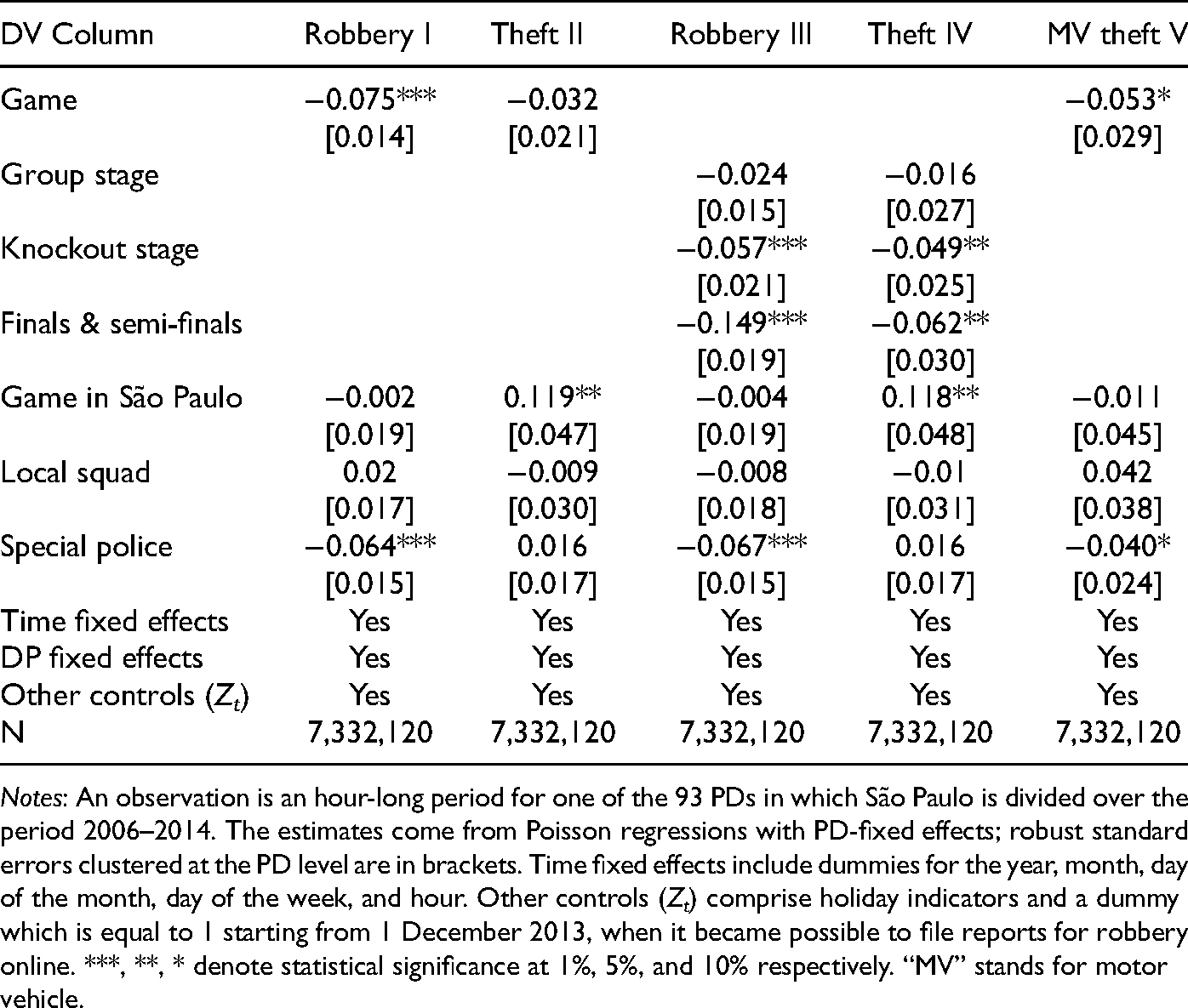
Columns I and II in Table 3 displays results from my baseline specification (described in Equation (2)). The simultaneous effect on crime is negative, in line with the voluntary incapacitation logic. Game time is associated with a highly significant (1% level) 7.5% decrease in robberies, while the impact on thefts is smaller in size (−3.2%) and not statistically significant. Having São Paulo as the match's venue results in significantly more thefts (11.9%), suggesting that a concentration effect may be at play. Whether or not the local team is one of the contestants does not seem to make a difference. Finally, outcomes show that robberies were significantly less frequent (−6.4%) during the deployment of the special police unit which overlooked the 2014 Brazil World Cup operations (in line with Masiero, 2020).
I further test whether the simultaneous relationship between games and crime can be reasonably interpreted as reflecting a (dominant) voluntary incapacitation effect. The logic underlying this notion implies that, the higher a game's audience, the bigger the crime drop. Since I do not have access to TV viewership data, I use the tournament rounds (specifically: group stage, knock-out stage, finals and semi-finals stage) as a proxy, based on the assumption that later stages attract more audience than earlier ones.
Results in columns III and IV in Table 3 confirm that the impact of games on crime depends on the championship stage. As compared to nongame time (i.e., hours in which
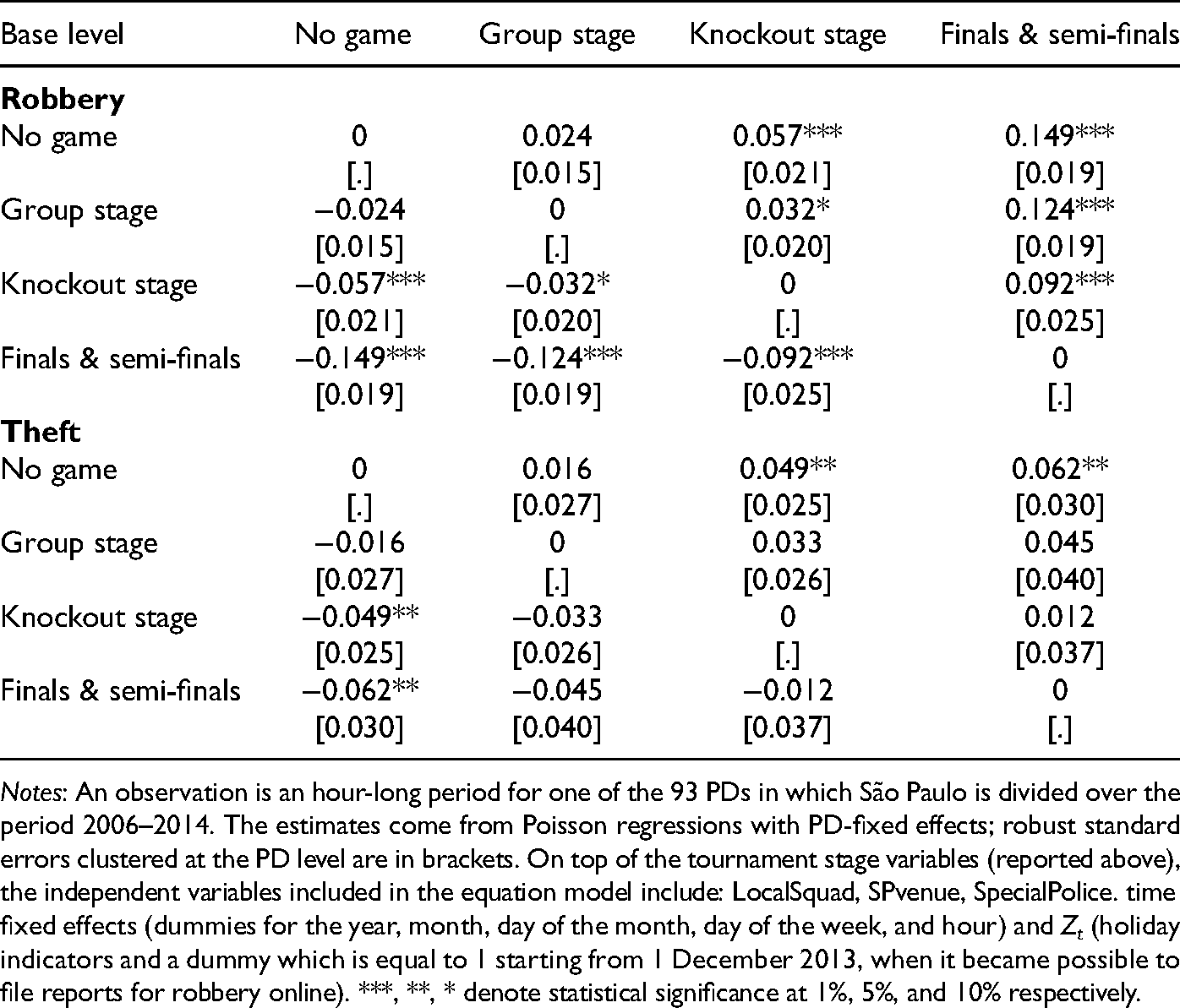
I examine more in detail how the impact on crime of game-related entertainment varies across championship rounds in Table 4. I sequentially take each tournament stage and nongame time as base level and present the estimated coefficients for each of the other rounds and nongame time (that is, their estimated differential impact on crime as compared to the specific base level). As far as robberies are concerned, almost all estimated coefficients are significant, implying that the effect of each round is statistically different relative to the other rounds (and to nongame time). Concerning thefts, instead, statistically significant relations can only be established relative to the nongame base level.
The Impact of Football Games on Crime: Difference Across Tournament Rounds.
Notes: An observation is an hour-long period for one of the 93 PDs in which São Paulo is divided over the period 2006–2014. The estimates come from Poisson regressions with PD-fixed effects; robust standard errors clustered at the PD level are in brackets. On top of the tournament stage variables (reported above), the independent variables included in the equation model include: LocalSquad, SPvenue, SpecialPolice. time fixed effects (dummies for the year, month, day of the month, day of the week, and hour) and Z t (holiday indicators and a dummy which is equal to 1 starting from 1 December 2013, when it became possible to file reports for robbery online). ***, **, * denote statistical significance at 1%, 5%, and 10% respectively.
Temporal Displacement
My baseline specification shows, at least concerning robberies, crime is significantly lower during game time as compared to nongame time, after controlling for time-fixed effects and further covariates. An important question is whether these offenses are prevented or just shifted to a more convenient time, when the ball is not rolling. To address the issue of short-run temporal displacement, I examine the crime patterns ± 2 h around game time.
Figure 1 shows that the impact of football games on crime exceeds their duration. For both robberies and thefts, offenses exceed (significantly for robberies) their nongame levels in the hours prior to the game. This trend switches to the opposite direction during (or right before) game time and persists, to some extent, after the game. This effect is not accounted for by time fixed effects (nor further covariates). A consistent explanation for this dynamic would be that potential offenders purposedly move up some of their criminal activity to be free for game and post-game time.
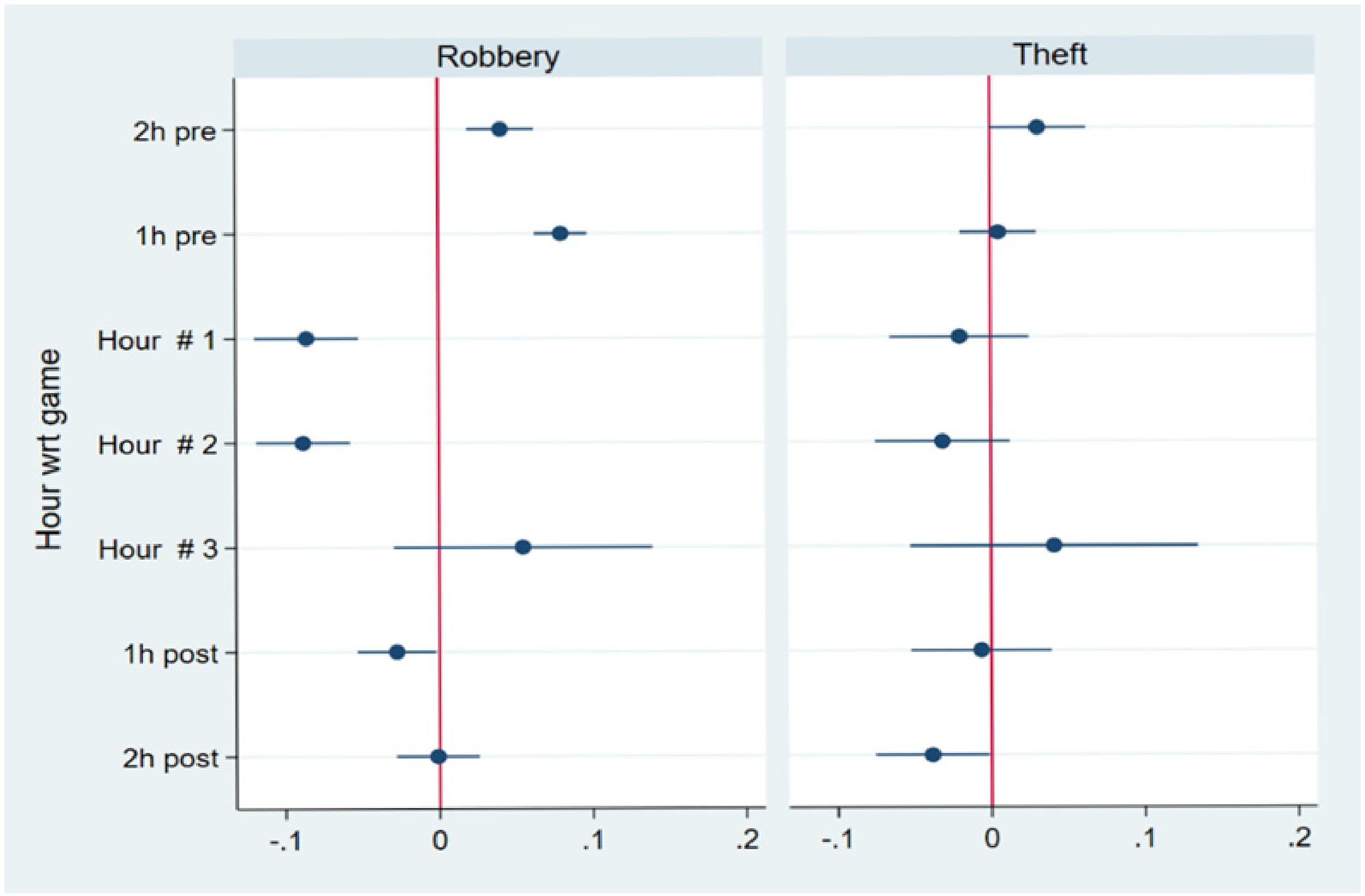
Temporal displacement. Notes: For each dependent variable (robbery and theft) and for each hour-long block (±2 h around a football game), the figures report the estimated coefficients and 95% confidence intervals.
A word of caution is in the order as regards these results. Sometimes more than one games in my sample are played on the same day. Then, a certain hour-long block may be, at the same time, a game hour, a pre-game hour, and a post-game hour. This represents a significant complication for the analysis and motivates why I chose to consider a short time widow (±2 h). I have tried several different models to fit the data. 6 Overall, I got to the conclusion that, while point estimates vary from model to model, the overall pattern and significance considerations remain unchanged.
The dynamic portrayed in Figure 1 is consistent with the hypothesis of time displacement, whereby a share of the criminal occurrences that do not take place during the match are shifted to pre-game time rather than foregone. This result is in contrast with previous literature, 7 in particular Copus & Laqueur (2019), who find close to no evidence of short-run temporal displacement (± 3 h in their study). The context of the analysis may help explain this discrepancy in results. Financially motivated crimes, like the ones I consider in this analysis, are associated with poverty (Foley, 2011). If criminals commit these types of crime for a living, they cannot put them off for long (Pyun, 2019). In a relatively poor country like Brazil, 8 some offenders may not put them off at all, and rather move them up a few hours to both “make their living” and enjoy the game night. On the other hand, in higher-income countries like the U.S. financially motivated criminals may have a wider horizon and choose not to displace crimes in the short run.
Supply and Demand of Criminal Activity
It is important to understand which side of the criminal interaction channels the game-crime link, and in particular the voluntary incapacitation effect.
Figure 1 is consistent with the hypothesis that offenders perpetrating financially motivated crimes—like the ones I analyze—plan to some extent their schedule and purposedly bring some of their criminal activity forward to free up their agenda for the game and post-game time (temporal displacement). Then, it would plausibly be potential criminals—rather than victims—who channel the game-crime link.
Alternative hypotheses would be that crime reporting (by the victims) or report filing (by the police) would be altered in the hours surrounding important games. Both explanations seem implausible because the data I employ indicate the time of the occurrence as reconstructed by the person reporting the crime, rather than the time of the filing. As a consequence, even in case victims do not report immediately (because they are watching the match) or police officers do not file a report right away (for the same reason), once the report is made and filed it will indicate the time of the occurrence.
Finally, it could be that this dynamic is driven by potential victims—rather than potential criminals. My database allows me to test for the plausibility of this hypothesis.
While both robbery and theft are financially motivated offenses, the former requires by definition the presence of at least a criminal and a victim, as it implies the use of (or the threat to use) force. On the other hand, some types of theft—for instance, motor vehicle thefts–typically happen in the absence of the victim. The data at my disposal allow me to separate motor vehicle thefts. The former account for 23% or about one in four theft occurrences. Looking at motor vehicle thefts allows me to further investigate through which side of the criminal interaction the game-crime link is deployed, as explained below.
Column V in Table 3 displays the results from my baseline analysis using motor vehicle thefts as the dependent variable. The simultaneous impact of entertainment on this offense is negative, significant, and bigger in size than that estimated for overall theft (see Column II). In theory, this effect could be driven by either a rise in victims’ (or witnesses’) presence or a reduction in activity on the side of offenders. The first explanation is implausible. The presence of potential victims on the streets during important matches would reasonably be lower than (or at least equal to) average. Then, these results strongly suggest that the crime drop during game time reflects a voluntary incapacitation effect on the side of potential offenders.
An exception may be represented by games played in São Paulo. In that case, one may expect bigger-than-average crowds to assemble around the stadium. This effect is captured by the coefficient for
All in all, planning by criminals plausibly explains why robberies go up before kickoff and then down after the game starts, after controlling for a plethora of time fixed effects including hour and day of the week (as well as further covariates).
Spatial Concentration
Previous literature finds that crime increases around the venues where big events are held (Kalist & Lee, 2016; Mares & Blackburn, 2019; Rees & Schnepel, 2009).
In my baseline analysis (see column II in Table 3) I find that thefts are significantly higher (11.9%) during locally played games, suggesting that a concentration effect may be at play. I further investigate this hypothesis exploiting the panel structure of my database.
About one-sixth of the matches I consider were played in one of four stadiums in the city of São Paulo which are situated in three distinct PDs. Using Equation (3) I analyze local game time crime patterns around the stadium PDs. Estimates in Table 5, columns I and II, show that the concentration effect dominates the voluntary incapacitation one in the areas that attract big match-driven crowds. While the baseline result is confirmed that game time is associated with a significant 7.5% decrease in robberies (and a non-statistically significant 3% decrease in thefts) on average in São Paulo's neighborhoods, in stadiums PDs this impact is more than outweighed by a positive concentration effect, which is substantial and highly significant for both robberies (28.3%) and thefts (150.5%). Concerning thefts, the estimated coefficient for a game being played in São Paulo is positive and significant (5.5%), implying that the higher-than-usual game time crime rates for locally played matches affect not only the stadium PDs, but also other areas in the city.
Spatial Concentration and Displacement.
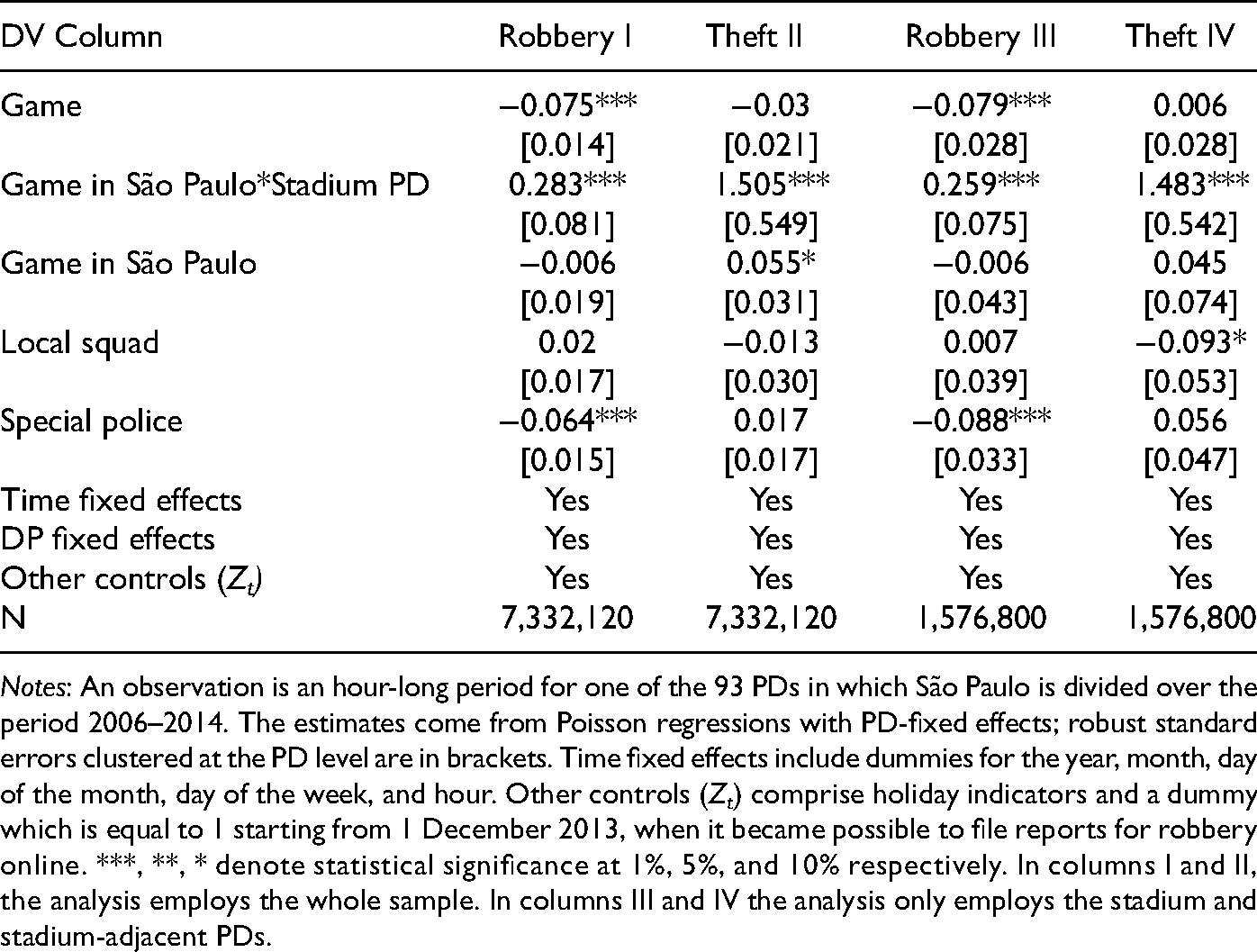
Notes: An observation is an hour-long period for one of the 93 PDs in which São Paulo is divided over the period 2006–2014. The estimates come from Poisson regressions with PD-fixed effects; robust standard errors clustered at the PD level are in brackets. Time fixed effects include dummies for the year, month, day of the month, day of the week, and hour. Other controls (Z t ) comprise holiday indicators and a dummy which is equal to 1 starting from 1 December 2013, when it became possible to file reports for robbery online. ***, **, * denote statistical significance at 1%, 5%, and 10% respectively. In columns I and II, the analysis employs the whole sample. In columns III and IV the analysis only employs the stadium and stadium-adjacent PDs.
A concern with this analysis is that there are only 3 treated PDs. As shown by Conley & Taber (2011), using standard inference methods could result in misleading standard errors. To address this concern, I replicate the analysis using the CT method to calculate the confidence intervals for the concentration effect's coefficient. Panel (A) in Table 6 presents the 95% confidence intervals from the CT approach for the coefficient of interest. Outcomes confirm that the impact of concentration on robberies and thefts is significant.
Spatial Concentration and Displacement: CT Inference Method.
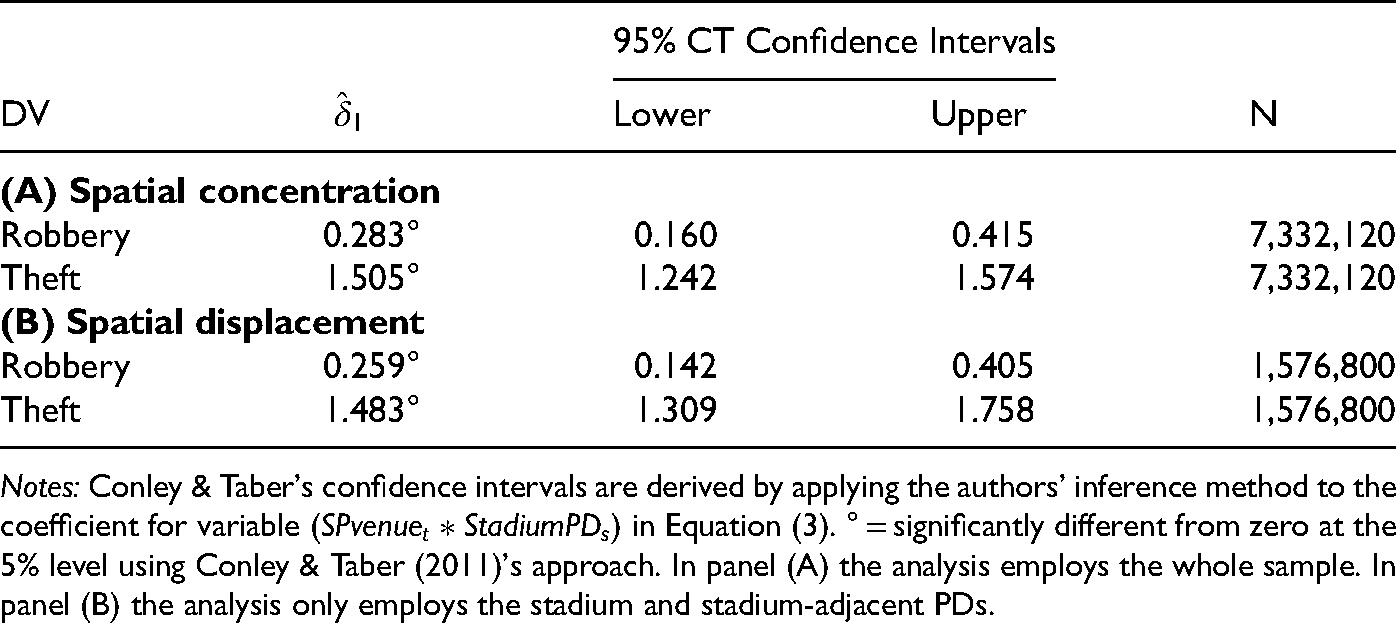
Notes: Conley & Taber's confidence intervals are derived by applying the authors’ inference method to the coefficient for variable
Spatial Displacement
The higher potential for criminal interactions afforded by increased concentration around the stadium PDs may prompt potential offenders in other neighborhoods to spatially displace their activities towards such areas when a game is played locally. I test whether the data support the existence of a local spatial displacement effect towards the stadium PDs from the surrounding areas. I follow Draca et al. (2011) and restrict the control group to the seventeen PDs that are adjacent to the three stadium ones. I then replicate the analysis in Equation (3). If crime were diverted to these areas, I would obtain bigger estimates for coefficient
Columns III and IV in Table 4 report the estimated coefficients for the analysis. Although I present results for both robbery and theft for completeness, I trust the former to be more reliable. In fact, in the spatial concentration analysis I found evidence that locally played games affect theft patterns citywide rather than only around the stadiums (see column II in Table 5), making the interpretation of theft results unclear.
Local spatial displacement does not seem to be an issue. In fact, the coefficients for variable
Discussion
My outcomes show that sports-related entertainment can play a crime-preventive role by means of the voluntary incapacitation effect. I estimate that during important football games, robberies in São Paulo decrease by a significant 7.5%. To put this result into perspective, it is useful to perform a back-of-the-envelope calculation. About 1.2 out of the sixteen robberies per hour recorded on average on nongame days would be avoided thanks to game-related voluntary incapacitation. This figure grows higher when one considers that incapacitation persists in the games’ aftermath, even though some of the offenses are shifted in time—rather than foregone. Continuing the back-of-the-envelope calculation, results imply that in the ± 2-h window surrounding a game, four out of 96 robberies would be prevented, while 0.7 would be brought forward to before kick-off. Outcomes strongly suggest that it is potential criminals—rather than victims—who channel the game-crime link. They appear to organize their schedule and bring some offenses forward to before kick-off time, thus freeing up their agenda for the game and its aftermath. The time displacement horizon may be especially short in relatively poorer countries such as Brazil.
While football matches generate a citywide crime reduction via voluntary incapacitation, this impact is more than offset in areas affected by game-related agglomeration. Again, it is useful to perform a back-of-the-envelope calculation to compare the relative importance of concentration and incapacitation. The latter mechanism accounts on average for a 7.5% decrease in robberies in each PD. On top of this, I estimate that concentration generates a 28.3% increase in crime in the stadium PDs during games played in São Paulo. Then, in these areas, the impact of spatial concentration outweighs that of voluntary incapacitation as an extra 0.04 robberies per hour and PD take place during locally played games. Still, for the city as a whole, the crime reducing effect dominates concentration, as about one fewer robbery than average is recorded during game time. As concerns theft, on the other hand, I detect no significant voluntary incapacitation effect. Then the crime-increasing impact of spatial concentration is dominant, with an extra 0.2 thefts per hour in each of the three stadium PDs.
Conclusions
Previous research on the sports-based entertainment-crime link provide two types of results. Studies that focus on crime patterns around the stadiums report a positive association between property crime and less-serious violent offenses and sporting events—in line with the expected effect of spatial concentration. On the other hand, a negative game-crime relationship is found by contributions that look at larger geographic areas—in line with the hypothesis of voluntary incapacitation.
My study shows that these seemingly contradictory results likely derive from data limitations. Prior research typically employs time series or panel data with a high level of aggregation. This makes the contextual evaluation of spatial concentration around the stadiums and citywide voluntary incapacitation unfeasible or imprecise. Using a refined dataset, I show that both spatial concentration and voluntary incapacitation are relevant, though at different levels of geographical aggregation (locally and citywide, respectively).
The data employed by previous research often made it hard to disentangle the main channel through which the game-crime link is deployed. Thanks to the different types of offenses covered by my dataset, I can more reliably conclude that potential criminals—rather than victims—are the likely channel, at least as far as financially-motivated crimes are concerned. Still, a study based on an even wider range of offenses would help consolidate this result. It would also allow investigating the heterogeneous impact of sports-based entertainment on different types of offenses.
Previous studies typically focus on the U.S. context and find close to no proof of temporal displacement. Conversely, this research looks at Brazil and finds evidence of temporal displacement of financially motivated crimes to the hours before the game. I theorize that the time displacement horizon may be especially short in relatively poorer countries. This is a novel insight that future research should investigate further.
Footnotes
Author's Note
This project has benefited from discussions with Rodrigo R. Soares, João Manoel Pinho de Mello, Leandro Piquet, Vladimir Ponczek, André Portela, Thadeu Gasparetto, and seminar participants at FGV – São Paulo School of Economics. All remaining errors are my own.
Declaration of Conflicting Interests
The author(s) declared no potential conflicts of interest with respect to the research, authorship, and/or publication of this article.
Funding
The author(s) received no financial support for the research, authorship, and/or publication of this article.
