



Abstract
This paper analyzes the risk-taking behavior of heterogeneous players in dynamic contests with intermediate information. Using data from the first German Handball league, we measure risk-taking by substituting the goalkeeper for an additional field player. By differentiating between ex-ante and in-game heterogeneity, we show that underdogs and trailing teams are willing to take more risks and that favourites and underdogs react differently to interim information. Trailing underdogs choose riskier strategies than trailing favorites during a match. The increased overall risk-taking is indeed beneficial for underdogs, whereas favourites lose significantly more games as a result of increased risk-taking.
Introduction
Be it bonus schemes in companies, political campaigns or even sporting competitions, the pay of participants frequently depends on their performance relative to other competitors, rather than on absolute performance. Above all, when monitoring productivity is costly or difficult, rank-order tournaments create a unique opportunity to assess the ability of workers, all while inducing incentives to elicit effort (see Lazear & Rosen, 1981; Green & Stokey, 1983; Nalebuff & Stiglitz, 1983; O'Keeffe et al., 1984). Nevertheless, as agents do not decide only how much effort to provide, but also how much risk they are willing to take, they can jeopardize the efficiency of the contest (Hvide & Kristiansen, 2003).
In fact, whenever agents are heterogeneous, and thus have different win probabilities—either caused by differences in ability (ex-ante heterogeneity) or by differences in score (in-game heterogeneity)—less able and trailing agents might feel compelled to partake in riskier choices in order to have an increased chance of winning the tournament (see Rosen, 1988, referring to Bronars, 1986; Knoeber & Thurman, 1994; Kräkel & Sliwka, 2004). This possibility to offset ability or score differences with risky strategies introduces considerable noise into the tournament, resulting in a growing interest in literature in the risk-taking behaviour of agents in tournaments and their associated efficiency.
The bulk of previous literature on risk-taking in tournaments concentrates on one type of heterogeneity—either ex-ante or in-game heterogeneity. The majority confirms that indeed, either less able (underdogs) or trailing agents seem to increase risk in order still to have a chance of winning the tournament, while more able (favourites) and leading agents prefer safer strategies to secure their lead, and rely on their surplus in ability or their lead (Rosen, 1988; Becker & Huselid, 1992; Knoeber & Thurman, 1994; Chevalier & Ellison, 1997; Brown et al., 1996; Nieken & Sliwka, 2010).
In the real world, however, agents are rarely homogeneous and with performance feedback over the course of the tournament, additional asymmetries are unavoidable. Thus, in most contests, agents are confronted with both types of heterogeneity—ex-ante and in-game. This poses the question of whether favourites and underdogs react differently to interim information. In particular when agents face a score deficit, the behaviour of agents could diverge substantially. On the one hand, as favourites surpass their competitor in ability, they might rely on their surplus in ability to win, even when facing a deficit, instead of opting for a risk gamble (Schneemann, 2017). On the other hand, as expectations about performance and loss aversion play a crucial role in individual risk decisions, favourites may increase risk-taking in order to avoid an unexpected loss (Kahneman & Tversky, 1979; Lehman & Hahn, 2013; Bartling et al., 2015). Therefore, the aim of this paper is to examine how risk-taking behaviour is affected when agents are confronted with both types of heterogeneity, and whether increased risk-taking is beneficial for heterogeneous agents.
In order to investigate the difference in risk-taking strategies of heterogeneous agents over the course of a contest, we use a data set from two seasons of the German Handball-Bundesliga. 1 Coaches in this sport have the unique opportunity to replace the goalkeeper with an additional field player at any time and as often as they like over the course of the match. This replacement option serves as an excellent proxy for risk-taking as an additional field player not only increases the number of field players, and thus the probability of a successful attack, but also leaves the attacking team vulnerable to a fastbreak and an easy goal for the opponent. As our data set includes all attacks during a match and the respective score during the attack, we are able to allocate risk decisions to a specific time during the game, and show that timing in the contest is pivotal for the agent’s risk decision. Additionally, by using the goal differential to control for leading and trailing teams and the rank differential to control for underdogs and favourites, we can observe whether or not risk-taking behaviour differs for the respective parties.
Our study contributes to existing literature in several respects. First, we confirm previous results that both underdogs and trailing teams indeed chose riskier strategies than underdogs or leading teams. Second, we expand previous literature by observing risk-taking behaviour of agents facing both types of heterogeneity. Compared to trailing favourites, we show that trailing underdogs increase risk-taking to a larger extent, as favourites seem to rely on their ability surplus. However, this behaviour changes towards the end of the match when the influence of in-game heterogeneity exceeds the influence of ex-ante heterogeneity on risk-taking. Contrary to earlier in the match, trailing favourites now opt for riskier strategies than trailing underdogs. Third, our investigation offers new insights into the effectiveness of increased risk-taking. Our data indicates that the increased overall risk-taking does indeed pay off, albeit only for underdogs. Towards the end of the match, however, the beneficiary of increased risk-taking switches and only trailing favourites benefit from increased risk-taking.
Our result regarding the payoff of risk-taking is surprising, as previous research has questioned the effectiveness of this behaviour, finding that neither trailing teams nor underdogs benefit from increased risk-taking (Bartling et al., 2015; Grund & Gürtler, 2005; Grund et al., 2013; Schneemann, 2017). Using substitutions as a proxy for risk-taking, Grund and Gürtler (2005) find that increased risk-taking for trailing teams impacts score and point advancement negatively. Schneemann (2017) arrives at a similar conclusion. In addition to substitution strategies, Bartling et al. (2015) extend their risk analysis to yellow and red cards, as this implies a more aggressive and thus riskier form of play. 2 If agents perform below their expectation, Bartling et al. (2015) find that both substitutions and cards affect match outcome negatively. Grund et al. (2013) check whether an increased fraction of three-point attempts in the last period of NBA matches compared to previous periods has a significant effect on win probability. They confirm that in close settings, trailing agents do not benefit from increased risk-taking. This holds for both trailing favourites and trailing underdogs. There is, however, some indication that teams with very high deficits might gain from an increase in three point attempts (Grund et al., 2013). Using professional handball penalty data, Bühren and Gabriel (2021) find that the overall tendency of players to take risks does not influence shot success during the game. There is, nevertheless, some evidence that higher risk-taking when leading has a detrimental effect on shot success during the last minutes of the match.
The remainder of this paper is structured as follows: Sections 2 and 3 derive hypothesis regarding the risk-taking behavior of heterogeneous agents in tournaments and examine risk-taking in handball. In Section 4, we present the data and descriptive statistics, before the empirical results are presented in Section 5. Section 6 then examines the effectiveness of risk-taking actions in handball. The paper concludes with Section 7.
Risk-taking of heterogeneous agents in tournaments
Previous research on ex-ante heterogeneity assumes that agents base their risk decisions on their opponent’s ability. Due to a higher win probability, the more able agent relies on its ability and chooses a less risky strategy. The less able agent, however, is compelled to decide on a riskier strategy to increase win-probability (see Rosen, 1988, referring to Bronars, 1986; Knoeber & Thurman, 1994; Kräkel & Sliwka, 2004). The respective behaviour has been confirmed by various empirical studies. For instance, Knoeber and Thurman (1994) investigate the performance variability of contracted producers of broiler chickens. They find that more able producers have a lower variance in performance, implying the use of a less risky strategy. The opposite holds for producers with a lower mean performance. Ozbeklik and Smith (2017) observe similar behaviour amongst golfers in match-play tournaments. Using the variation of relative-to-par scores and the percent of holes conceded as risk measurements, they also find that less able agents indeed opt for riskier strategies. Based on previous literature, we thus formulate the following hypothesis:
Nonetheless, asymmetry in tournaments does not arise solely due to ex-ante heterogeneity. In fact, feedback about previous performance in the tournament affects the risk decisions of individuals similarly, since it reveals in-game heterogeneity (Grund et al., 2013). While the trailing agents increase their risk to maintain a chance of winning the tournament, leading agents—having no desire to jeopardize their lead—choose less risky strategies (see Rosen, 1988, referring to Bronars, 1986; Chevalier & Ellison, 1997; Grund et al., 2013; Nieken & Sliwka, 2010). For instance, fund managers adjust their portfolio decisions when their fund performance is below average and increase their fund volatility (Brown et al., 1996; Chevalier & Ellison, 1997). Similarly, coaches substitute more offensively when trailing behind (see Grund & Gürtler, 2005). Hence, the literature suggests a negative relationship between performance feedback and risk-taking. Nevertheless, leading and trailing in itself are not the only factors influencing risk decisions. Similar to rank difference, the scale of the lead or deficit might have a substantial effect on risk choices. Indeed, Bothner et al. (2007) use NASCAR races to investigate how crowding effects risk-taking decisions in tournaments. Using car crashes as proxy for risk-taking, they find that agents are more concerned with losing their current standing in the ranking and increase risk to avoid a loss in position. Hence, agents are not incentivized only by their position in the ranking, but also by how close their opponents are located in the ranking. Genakos and Pagliero (2012) confirm this result when investigating the behaviour of agents, based on interim rank information in weightlifting competitions. Using the announcement of weight prior to the lift as a measure of risk, they find an inverted U-shaped relationship between rank and risk-taking. Thus, athletes decide on higher risk strategies when in immediate reach of the top. Nonetheless, with decreasing rank, riskier decisions decrease, as winning becomes unlikely. This argumentation leads to the following hypotheses:
To the best of our knowledge only two studies have tackled the effect of both heterogeneities on risk-taking behaviour. Schneemann (2017) stresses the importance of ability in risk-taking decisions when it comes to interim information. As favourites usually also have a higher level of ability, they do not require increased risk-taking when trailing behind. Instead they rely on their ability surplus to even out the score. The underdog, however, does not have the same privilege and continues to rely on riskier strategies. In order to investigate the risk strategies of soccer coaches over the course of a match, Schneemann (2017) uses the substitutions from the knockout stages of the UEFA Champions League. By measuring the offensive strength for different positions based on average goals and assists, she compares the offensive strength of incoming and outgoing players for each substitution. As the substitution of a more offensive player not only increases the probability of scoring, but also of conceding a goal, it indicates a riskier strategy. By investigating substitution strategies over the course of the match, she confirms that coaches of trailing underdogs substitute more offensively than those of trailing favourites when trailing by one goal. In cases of a larger deficit, however, risk strategies change and trailing favourites are more risk-friendly than trailing underdogs. Unfortunately, coaches in Champions League matches are limited to a certain amount of substitution, and thus somewhat restricted in their decision making.
Using shot data from NBA matches, Grund et al. (2013) offer an alternative and more continuous approach to assessing risk strategies. Depending on the distance, NBA players can score either two or three points for a successful shot, with shots from a larger distance earning more points. Although data shows that the expected points for both attempts are similar, three-point attempts have a significantly higher variance, thus indicating a riskier strategy. 3 Comparing the fraction of three point attempts in the last minutes of the match to its use in previous periods, they find that trailing favourites tend to be more risk-friendly in the last minutes of the match than trailing underdogs. They argue that this observation might be caused by different utility functions. While a loss by a small margin of an underdog might still be perceived as a win, this, is not the case for favourites. Thus, favourites benefit more from catching up than underdogs and tend to opt for riskier strategies. Increased risk-taking by trailing favourites, however, might additionally be explained by loss aversion and expectations. According to the theory, agents suffer a greater disutility from a loss than the utility from an equally high gain (see Kahneman & Tversky, 1979). Thus, individuals risk more to avoid a loss than to secure an equally large gain, leading individuals to be risk-friendly in losses and risk averse in gains. As gains and losses are defined not only with reference to the status quo, but also previous performance and expectations, changes in risk-taking might be more sensitive than otherwise if performance is below the aspiration level (Abeler, 2011; Ericson & Fuster, 2011; Kahneman & Tversky, 1979; Koszegi & Rabin, 2006, 2007; Samuelson & Zeckhauser, 1988). Indeed, using substitutions and betting odds in soccer games as reference points, Bartling et al. (2015) confirm that coaches substitute more offensively when lagging behind in expectations. Based on this observation, trailing favourites—performing below their expectation—increase risk-taking to avoid losing the match.
The seemingly contradictory results of Schneemann (2017) and Grund et al. (2013) of trailing favourites either decreasing or increasing risk-taking compared to underdogs are not necessarily at odds with one another. In fact, we are convinced that both attitudes towards risk-taking can be observed during a tournament, which, however, depends crucially on the timing of the decision in the contest. While Schneemann (2017) uses substitution data of the entire game, Grund et al. (2013) focus purely on the last minutes of the match. Nevertheless, since tournaments often consist of various stages, agents consistently obtain feedback about their relative position in the tournament and their productivity compared to their opponent (see Ederer, 2010). With constant feedback, agents can adjust their strategies more than once over the course of the tournament. This holds for the adjustment of effort (see e.g. Bach et al., 2009; Berger & Pope, 2011; Berger & Nieken, 2016; Iqbal & Krumer, 2019; Schneemann & Deutscher, 2017), as well as for the adjustment of risk-taking (see e.g. Bothner et al., 2007; Chevalier & Ellison, 1997; Grund & Gürtler, 2005; Genakos & Pagliero, 2012). At the beginning of the game, trailing favourites have the option to equalize the score with ability alone, and thus might revert to less risky strategies than trailing underdogs. Particularly in the last minutes of the game, however, expectations about relative performance might change the risk behaviour of agents, as the relationship between performance and risk-taking is stronger for performance below the aspiration level than for performance above it (see Bartling et al., 2015; Kahneman & Tversky, 1979; Lehman & Hahn, 2013). Thus, agents such as trailing favourites performing below their expectation, might eventually opt for riskier strategies to avoid an unexpected loss. As we expect a shift in risk strategies over the course of the tournament, we formulate the following hypotheses:
Risk-taking in handball
Handball is a team sport in which two teams of seven compete against one another. In a ‘standard’ play of handball, six attackers face six defenders of the opposing team, both teams having a goalkeeper. This situation is usually referred to as six versus six
Irrespective of the risk of leaving the goal empty, coaches mainly opt for the new substitution strategy to achieve two things: First, to offset the numerical imbalance caused by a two-minute suspension and second, to use the additional field player to outnumber the opponent and obtain a numerical advantage. In the first case, the attacking team is short-handed as at least one player has to leave the pitch for two minutes due to a rough foul. With the option of substituting the goalkeeper, the attacking team has the option of offsetting the imbalance caused by the suspension. Most frequently, the additional field player comes into play when the attacking team is one player down. In this case, the team can still maintain the ‘standard’ handball attack with six attackers and six defenders
In the second case, the substitution can be used to outnumber the defending team and give the attacking team a numerical advantage. Most commonly, this is the case when the attacking team does not face a suspension and the coach deliberately decides to use an additional field player to outnumber the opposing team and thus increase their probability of scoring a goal (
In both cases, the possibility to substitute the goalkeeper with an additional field player increases the team’s chances of scoring a goal, while leaving the team vulnerable to a fastbreak and a counterattack. Thus, we argue that the use of an additional field player serves as an excellent proxy for risk-taking behavior. Nevertheless, in order to analyze the effect of heterogeneity on risk-taking, we will focus in the remainder of the paper on the case of the attacking team substituting their goalkeeper when none of the team faces a time penalty
Regarding our previously stated hypotheses, we expect both less able and trailing teams to opt for riskier strategies. Thus, when facing an ability or score deficit, coaches increasingly opt for an additional field player. In contrast to soccer, handball is a high-scoring game and has—particularly in close games—many turnarounds. Thus, we expect the previously mentioned behaviour only occurs when the score is close. Regarding the combination of both asymmetries, we expect a shift in behaviour. While, over the course of the match, trailing favourites opt for less risk than trailing underdogs, they surpass trailing underdogs in their risk-taking towards the end of the match.
Data and Descriptive Statistics
In our study, we use data from the major handball league in Germany for the first two seasons after the rule change. Thus, our data entails 306 games of the 2016/17 season and 305 games of the 2017/18 season of the first handball league in Germany. 8 The first league consists of 18 teams competing for the title. The league is played as a round-robin tournament with each team playing one another twice (one home and one away game), resulting in 34 game days. The highest ranked teams have the chance to play internationally, whereas the three lowest ranked teams face relegation. 9 Teams obtain two points for each win and one point for a draw. At the end of the season the teams are ranked by points. In case of a tie, the difference in goals is decisive for the ranking in the table.
The data was recorded by the coaching software ‘XPS Sideline’ in order to collect data for a central database that can be used by coaches and teams to obtain information about game plays and their effectiveness. It contains detailed information about all plays by the teams (including the use of the 7th field player), the intermediate score and the result of the respective play. Not all plays result in an immediate change in possession, as a member of the defending team might commit a foul or deflect the ball out of play, leading either to a free throw or to a throw-in. Indeed, an attack may include many offensive plays. Hence, a possible result of a play may be a goal, a miss, a (standard) foul committed by the opponent (resulting in a free throw) or a technical fault. 10 A possession can also result in a penalty, if the opponent commits a hard foul or steps into the goal perimeter. The penalty throw itself, however, is considered a new play. Thus, similar to Bauer (2019), we limit our data to plays, which lead to a change in possession (goal, penalty, miss or technical fault) to avoid a doubling of observations. Furthermore, we classify a play as a success, if the result is either a goal or a penalty. In addition, we restrict the data set to set plays (no fastbreaks) and to possessions when neither team faces any time penalties, as being shorthanded might affect decision making. Additionally, we extended the data set with match results, the standing of both teams at the end of the season and the rank difference between the two teams. Similar to Thiem (2021) we have chosen standings at the end of the season instead of current positions in the league, as they reflect the strength of the team more accurately. In fact, the current standing might be severely biased due to the amount of matches and the strength of teams played before. Table 1 presents the descriptive statistics of the variables used in this paper.
Descriptive Statistics.
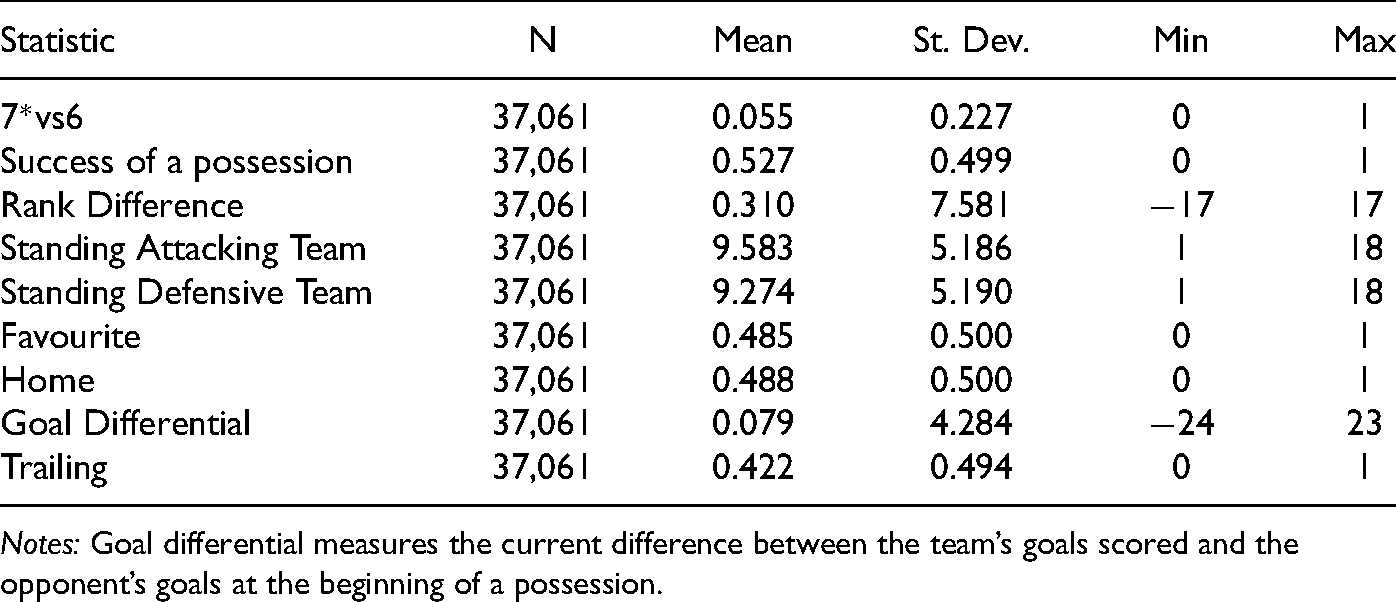
Notes: Goal differential measures the current difference between the team’s goals scored and the opponent’s goals at the beginning of a possession.
Empirical Investigation
7th field player as a risky-strategy
To analyze the risk-taking behaviour of teams in handball matches, we need to prove first and foremost that the use of an additional seventh field player indeed serves as an adequate proxy for risk-taking. For this assumption to hold, the strategy needs to be rewarded with a higher success rate. At the same time, an additional field player has to increase the risk of conceding a goal in case of a turnover.
The following Table 2 shows the success of a possession in a linear probability model, dependent on the use of the 7th player together with several variables controlling for the heterogeneity of the two competing teams. Similar to Haas and Nüesch 2012 and Schneemann (2017), we use a linear probability model instead of a non-linear model to avoid the incidental parameter problem in panel data sets or in regression models with fixed effects, and to include all data, since some teams or matches would be removed in a non-linear model, as some teams did not use the 7th field player in matches. 11 As control variables, we employ the location of the match, the rank difference between the two teams at the end of the season, the standing of the attacking teams (model (1)) as well as team-season (model (2)), and solely team-game fixed effects (model (3)).
Impact of the 7th field player on success of a possession.
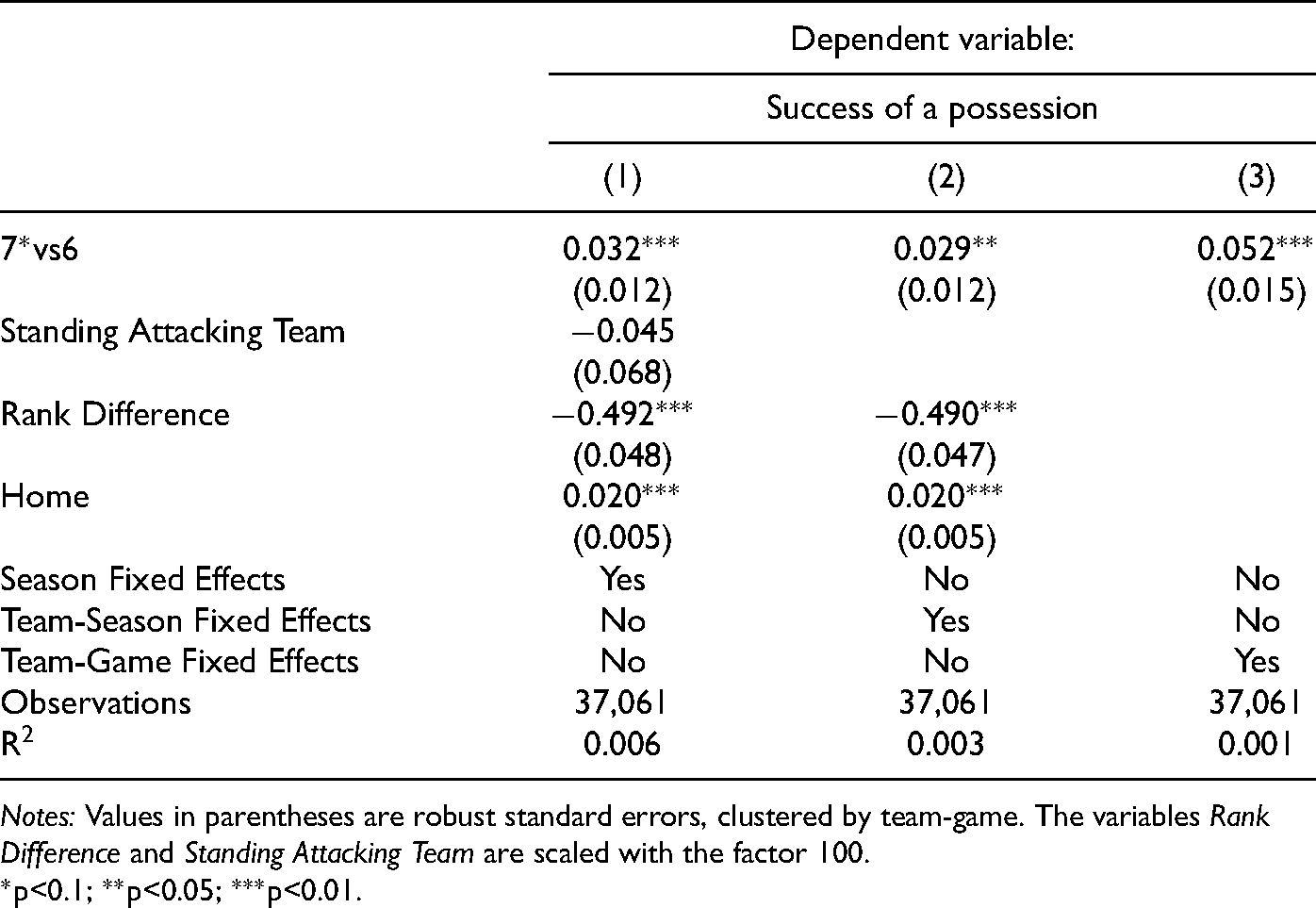
Notes: Values in parentheses are robust standard errors, clustered by team-game. The variables Rank Difference and Standing Attacking Team are scaled with the factor 100.
The results of an ordinary least squares (OLS) regression from Table 2 show that using the 7th field player undeniably increases the probability of a successful possession significantly. 12 This is not surprising, as the attacking team has the numerical advantage.
In the next regression, we measure the effect on the success of a possession, if the opponent had used the 7th field player in its last possession (measured by the variable Before
Impact of the 7th field player on the opponent’s next possession.
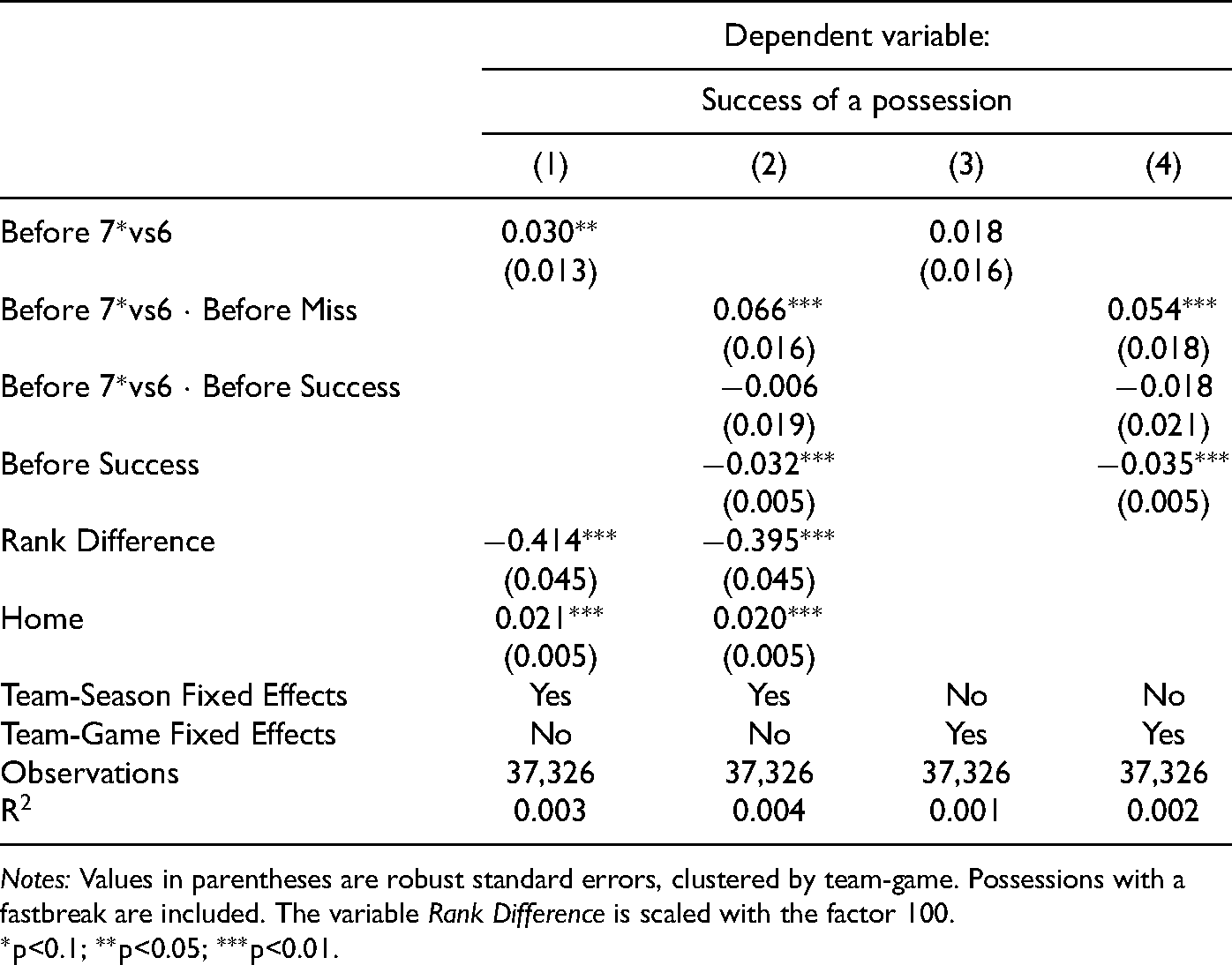
Notes: Values in parentheses are robust standard errors, clustered by team-game. Possessions with a fastbreak are included. The variable Rank Difference is scaled with the factor 100.
It can be noted that the positive effect of using the 7th player is almost the same as the negative effect in the next opponent’s possession. Thus, the expected net value of this strategy is almost identical to not using the 7th field player, which one would expect and is line with observations of Grund et al. (2013) on three-point attempts in the NBA. However, the larger variance of the expected net value of this strategy indicates that using the 7th player is indeed a risky strategy.
Risk-taking with ex-ante heterogeneous players
After confirming that replacing the goalkeeper indeed serves as a suitable proxy for risk-taking, we investigate whether ability differences between the two teams (ex-ante heterogeneity) has an effect on risk-taking decisions.
13
In particular, we consider whether lower ability handball teams use the strategy of the 7th player more often to increase their winning chances. At this point, we measure inequality by the rank difference of the two competing teams at the end of the season. To avoid any bias from using risky strategies towards the current score, we focus on possessions at the beginning of a match, when the score is usually still tied or very close. We therefore create two dummy variables
The results from Table 4 show that risk-taking does not depend only on a team’s own ability in general, as the estimators of the variable Standing Attacking Team in columns (1) and (3) of Table 4 are insignificant, but rather on the opposing team’s strength as well. Teams adjust their risk-taking behaviour to the relative strength of their opponent, because the estimator of the variable Rank Difference is significantly positive. Thus, underdogs are willing to take more risks in order to increase their winning chances. In addition, this effect becomes stronger with increasing heterogeneity between the two teams. As we only investigate possessions at the beginning of a match in this regression, one can assume that this strategy is part of the game plan developed by coaches of underdog teams prior to the match. These findings confirm Hypothesis 1. 14
Impact of ex-ante heterogeneity on risk-taking.
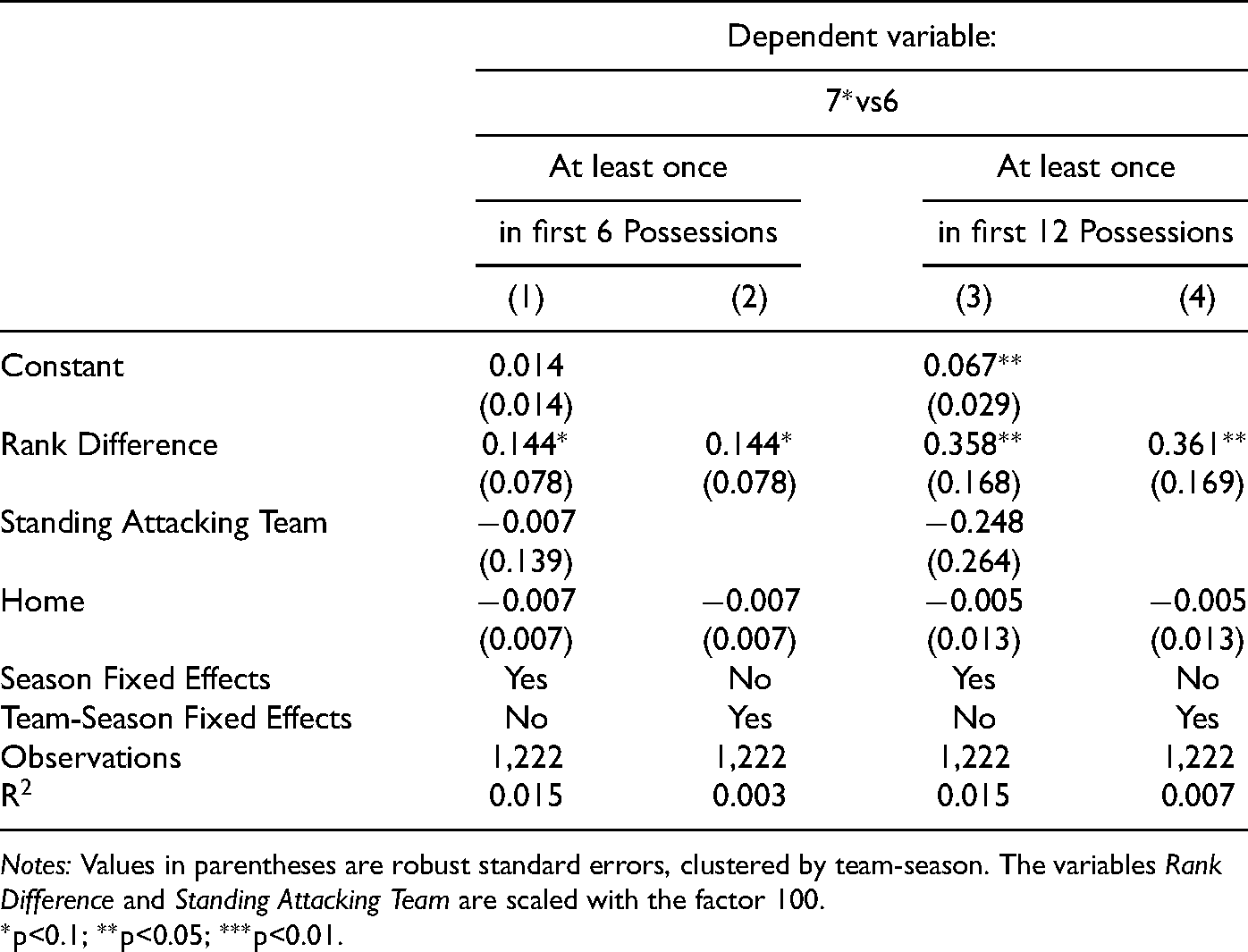
Notes: Values in parentheses are robust standard errors, clustered by team-season. The variables Rank Difference and Standing Attacking Team are scaled with the factor 100.
Risk-taking with in-game heterogeneity
Next, we investigate teams’ risk-taking choices on intermediate scores during a match. In particular, we study whether risk-taking behaviour changes if teams are trailing, and whether or not this potential reaction is additionally dependent on the current deficit. Therefore, we analyse team risk-taking choices in different circumstances (teams leading and tailing) in each possession, while controlling for heterogeneity in playing abilities of the two teams, home-field advantage, crowd-effects and general team risk-taking strategies with team-game fixed effects. Furthermore, we add the variables Goal Differential and
Impact of in-game heterogeneity on risk-taking.
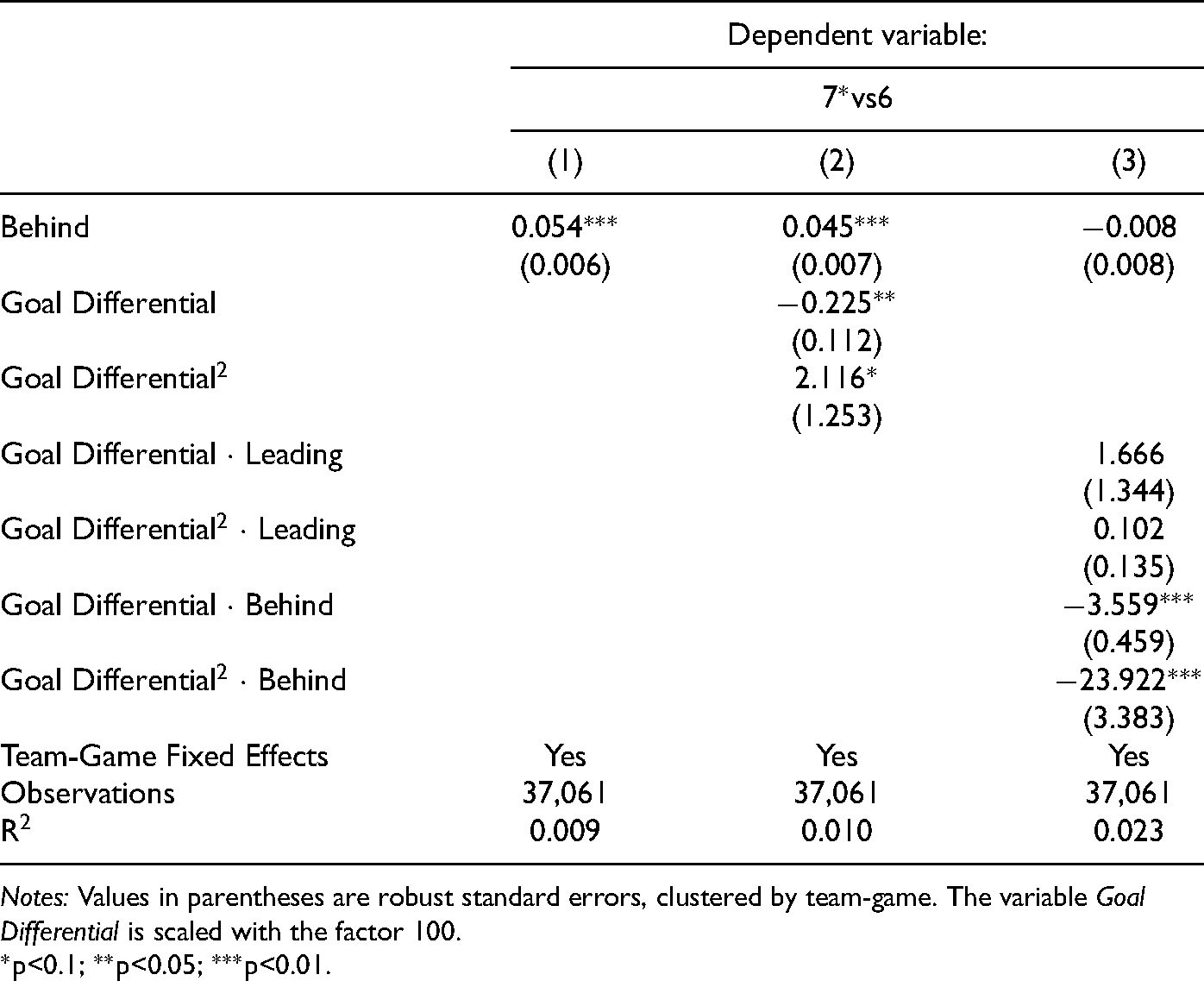
Notes: Values in parentheses are robust standard errors, clustered by team-game. The variable Goal Differential is scaled with the factor 100.
As can be seen in Column (1) of Table 5, teams choose to use the 7th field player more often, when they are trailing. Hence, teams indeed adjust their risk-taking strategy to the circumstance of leading or trailing. Following this result, we subsequently check whether the intermediate goal differential also influences the usage of risky strategies.
In addition, according to the results in Column (3) of Table 5, leading teams stick to their game plan and do not change their risk-strategies regarding the current score. However, as the estimators for the variables Goal Differential and
Risk-taking with in-game heterogeneity and heterogeneous teams
As the main focal point of our study, we investigate whether teams with heterogeneous playing abilities (namely favourites and underdogs) react differently in risk-taking to intermediate information. Following the results from Table 5, we only check whether there is an effect on trailing teams, as there seems to be no risk-taking effect on leading teams regarding the current score.
The results in Column (1) of Table 6 show that both underdogs and favourites increase their risk-taking behavior when trailing, and that this effect is larger for underdogs than for favorites, as favourite teams might believe they can still win the match without taking risky actions. 16
Impact of in-game heterogeneity on risk-taking with heterogeneous teams.
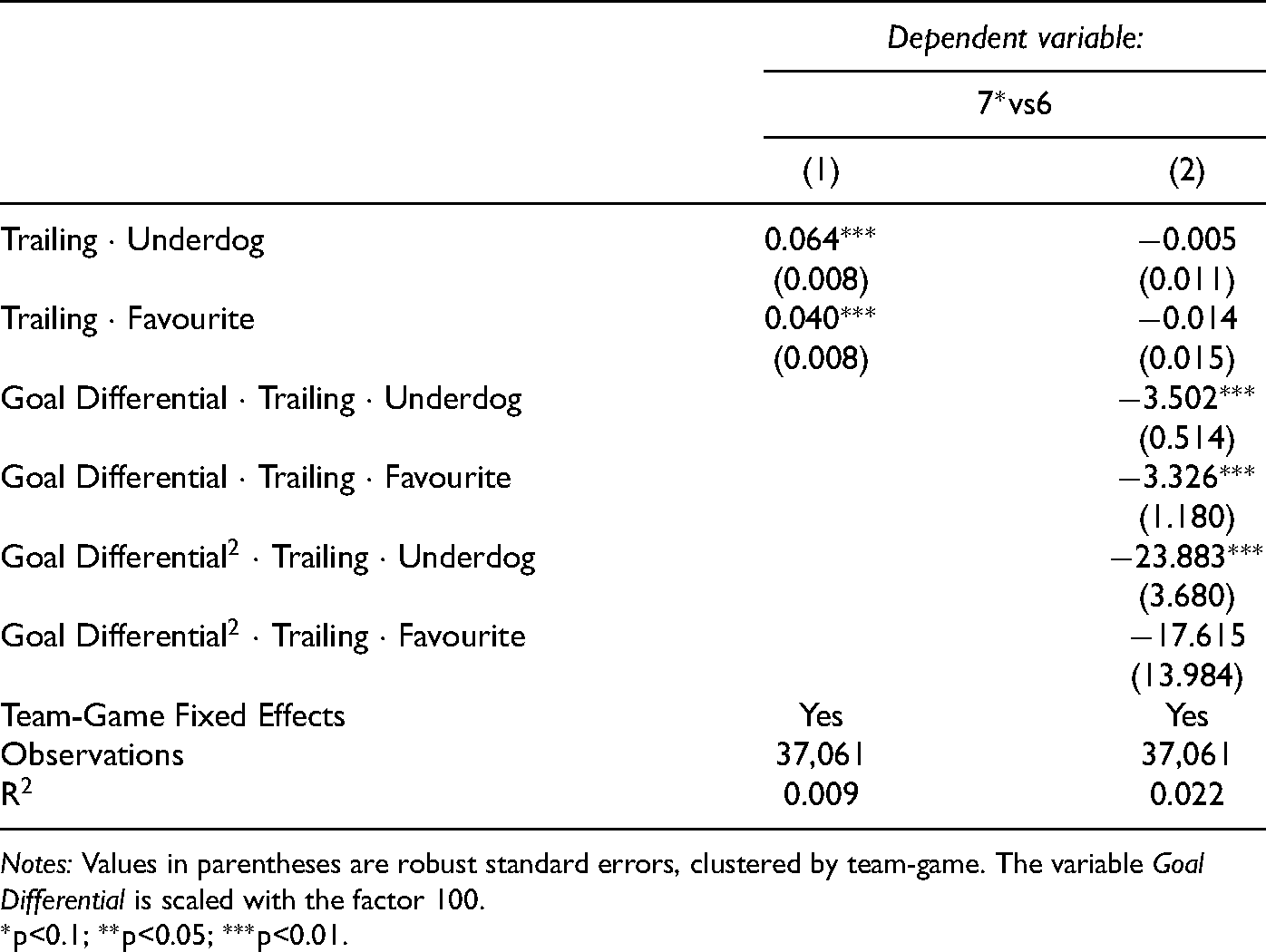
Notes: Values in parentheses are robust standard errors, clustered by team-game. The variable Goal Differential is scaled with the factor 100.
Furthermore, trailing underdogs and trailing favourites react differently to intermediate scores, since the estimator for the variable
Risk-taking with trailing and heterogeneous teams towards the end of matches.
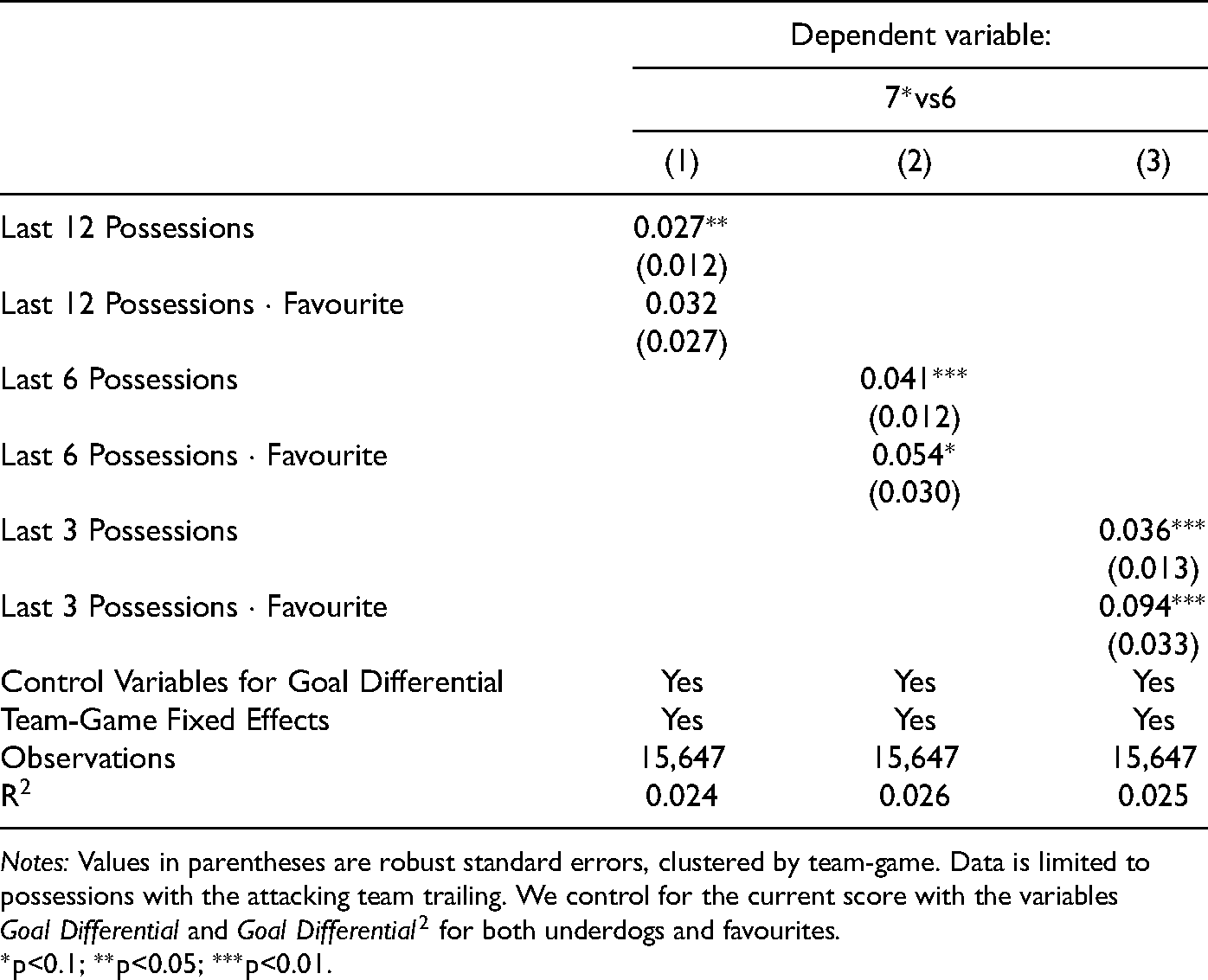
Notes: Values in parentheses are robust standard errors, clustered by team-game. Data is limited to possessions with the attacking team trailing. We control for the current score with the variables
Risk-taking behaviour of trailing favourites towards the end of a match.
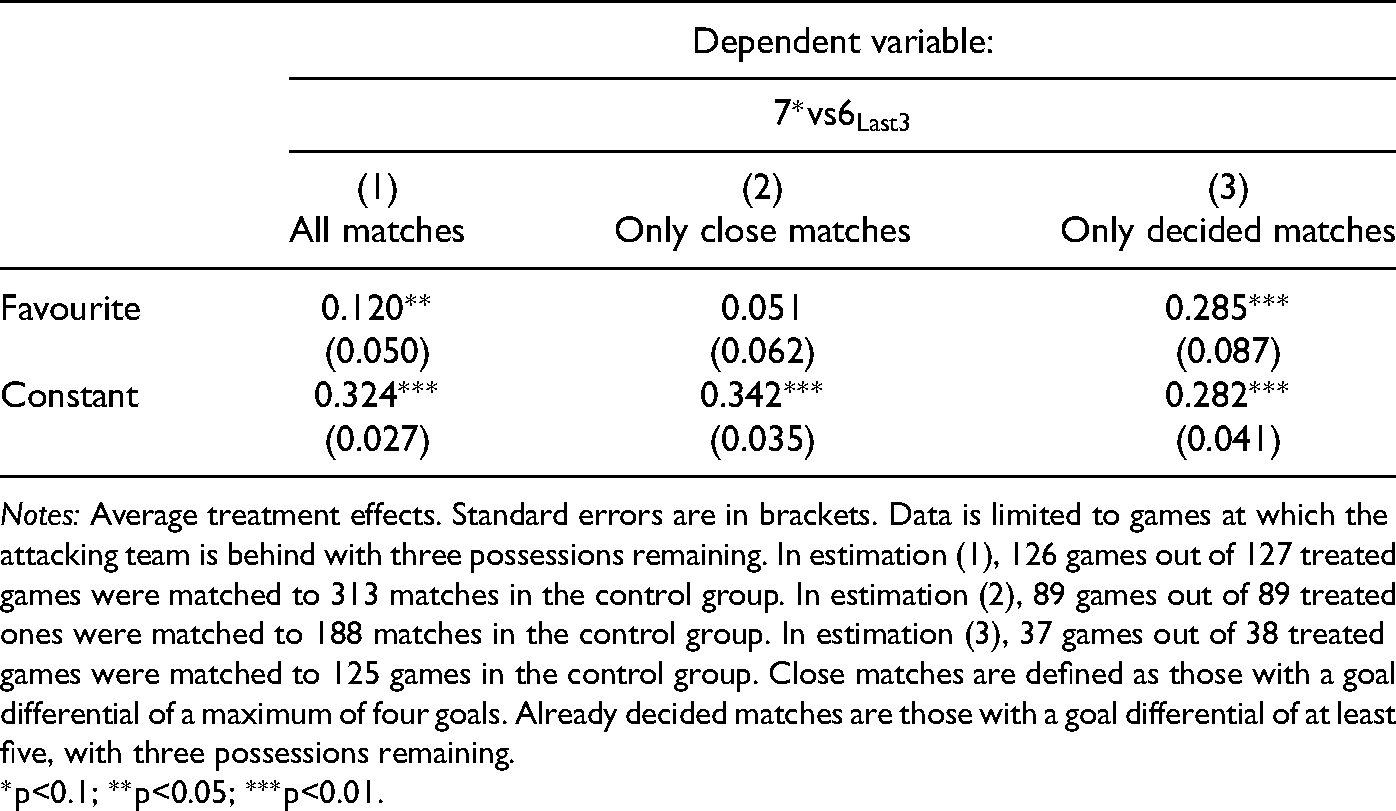
Notes: Average treatment effects. Standard errors are in brackets. Data is limited to games at which the attacking team is behind with three possessions remaining. In estimation (1), 126 games out of 127 treated games were matched to 313 matches in the control group. In estimation (2), 89 games out of 89 treated ones were matched to 188 matches in the control group. In estimation (3), 37 games out of 38 treated games were matched to 125 games in the control group. Close matches are defined as those with a goal differential of a maximum of four goals. Already decided matches are those with a goal differential of at least five, with three possessions remaining.
Next, we investigate the risk-taking behavior of favorites and uderdogs towards the end of matches, and determine whether trailing teams choose riskier actions close to the end, compared to during the match. To do so, we limit our data to possessions with teams trailing.
In contrast to previous regressions, the estimator of the interaction term Last 12 Possessions
To determine whether trailing favorites indeed choose riskier strategies towards the end of matches than trailing underdogs, as they are below their own expectations, we use an exact matching model with the favourites being in the treatment group and underdogs in the control group (Ho et al., 2007). As matching covariates, we utilize the current score, the location of the game and the season. Basically, we match a game of a trailing favourite to all games with a trailing underdog that have the exact goal differential played in the same season and location (home or away) as the trailing favourite. Subsequently, we determine whether the likelihood of using the 7th field player in the last three possessions is different between favourites and underdogs by comparing the weighted means in the treatment and control group (average treatment effect).
The results from Table 8 regarding the average treatment effect show that favorite teams indeed use riskier strategies more frequently when trailing towards the end of the match. However, this effect disappears if we only take a look at matches which are still close and not yet decided, as there is then no difference in risk-taking between underdogs and favourites (Column (2) in Table 8). Interestingly, the difference in risk-taking between favorites and underdogs is quite substantial in already decided matches (goal differential of at least five goals with only three possessions remaining). Furthermore, favourite teams even choose riskier strategies in already decided matches compared to close matches. In our estimation, 56.7% of the favourite teams used the 7th field player at least once when trailing by at least five goals, but only 39.3% favourite teams did so in matches which were not yet decided. We can think of several explanations for this peculiar observation. Although coaches of trailing favourites towards the end of a match might know that their risk-taking actions are of no avail for their teams, they might want to signal their players and their boss that they are not satisfied with the situation by choosing proactive behaviour. This behaviour is labeled “commission bias” in the literature and also studied empirically in several articles (e.g. Grund et al., 2013). Another possible explanation could be a training effect, as coaches might want to practice possessions with the 7th field player for upcoming matches. To test the training hypothesis, we ran another estimation similar to the one above, but this time investigating only leading teams. As the results of this estimation indicate no increased risk-taking behaviour for leading teams in already decided matches (see Table A3 in the appendix), the training hypothesis is not supported in the data and seems rather unlikely.
Average treatment effects of risk-taking on the success of trailing and heterogeneous teams.
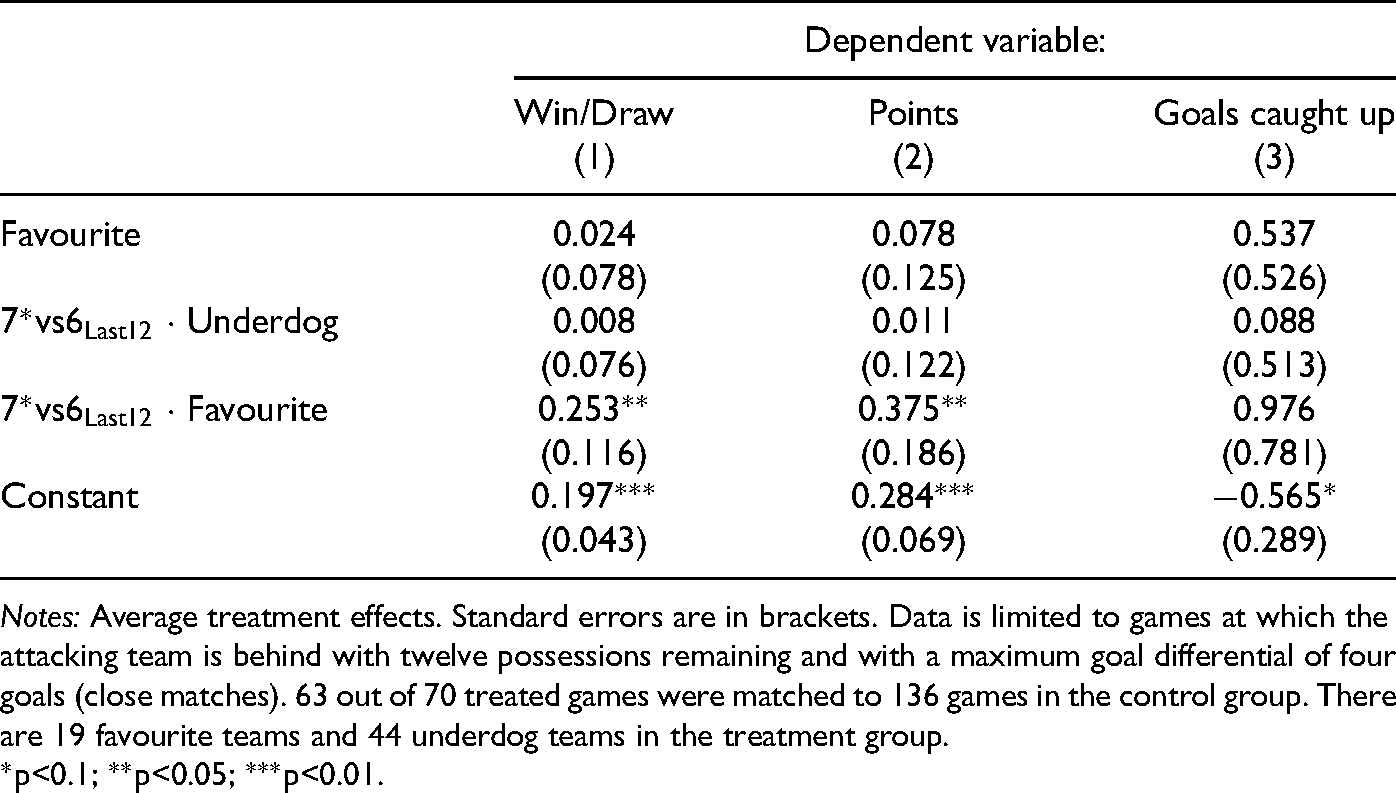
Notes: Average treatment effects. Standard errors are in brackets. Data is limited to games at which the attacking team is behind with twelve possessions remaining and with a maximum goal differential of four goals (close matches). 63 out of 70 treated games were matched to 136 games in the control group. There are 19 favourite teams and 44 underdog teams in the treatment group.
Impact of risk-taking on success
The primary goal of handball teams is winning matches and gaining points in order to secure a good classification in the round-robin tournament. The strategic use of the 7th field player might be a helpful method for increasing the winning probability during a match. This begs the question whether or not increased risk-taking behaviour is indeed beneficial for handball teams. Thus, we investigate whether teams that have used the 7th field player—especially towards the end of matches—have a higher chance of winning.
When stakes are high and teams face the last minutes of a match, the increased pressure might cause agent’s performance to deteriorate—often referred to as choking under pressure (see e.g. Ariely et al., 2009; Baumeister, 1984). 17 Thus, in our analysis of the effectiveness of risk-taking we control for a possible bias of choking under pressure by comparing the effectiveness of teams playing in the usual six field player formation with teams using an additional 7th field player.
First, we investigate whether or not trailing teams can overcome a possible loss by increasing their risk-taking towards the end of matches. For this purpose, we limit our data to matches at which the attacking team is trailing, with twelve possessions remaining. In addition, we restrict the data to close matches (maximum goal differential of four goals) to ensure that teams have a realistic chance of overcoming the deficit. Furthermore, we construct a binary variable
In order to identify any effect of increased risk-taking towards the end of a match on the outcome variables (treatment effect), we use a coarsened exact matching model to decrease ex-ante and in-game heterogeneity between teams in the treatment group (teams that used the 7th player in their last twelve possessions) and control group (no use of the 7th field player). This method allows us to coarsen the data of the covariates (e.g. clustering the data into groups) and to identify exact matches afterwards (see Iacus et al., 2012).
As covariates in this model, we utilise the rank difference towards the end of the season (to control for playing abilities), the goal differential with twelve possessions remaining (to control for in-game heterogeneity), the location and the season. We only coarsen the data for the variable Rank Difference, so that we only allow matches with the exact covariates for the other three variables. In Table A4 in the appendix, we present the summary of the balance of the matched games, which shows a good improvement after the matching.
Table 9 presents the average treatment effects of risk-taking on the three outcome variables (divided into underdogs and favourites) and it can be seen that only favourites significantly win or draw more games and gain more points after increasing risk-taking. However, there is no effect on the outcome variable Goals caught up. Risk-taking increases the probability of extreme results and hence, the variance of the goal differential (see Grund et al., 2013). This implies that there will be teams that benefit from risk-taking, but also those that increase their deficit or respectively worsen their goal differential. Therefore, it is not surprising that despite the fact that favourite teams gain more points due to the use of 7th field player, teams do not improve their goal differential on average, as teams that lose their game, suffer an even greater loss. 18
In addition to the previous estimation, we want to explore the effect of risk-taking on leading teams. Therefore, we take a look at teams that are ahead in score with twelve possessions remaining. We limit the data to games with a maximum goal differential of three goals, so that teams which are three goals ahead, need to have a deficit of at least four goals in the last twelve possessions to lose the match, which is similar to the previous estimation.
The results from Table 10 show that leading teams do not benefit from risk-taking, as it lowers the probability of winning or of drawing the game. This is true for both leading favourites and leading underdogs. Furthermore, the results are only significant for the variable Win/Draw, which indicates a relatively high fraction of draws in the treatment group. Following these results, coaches of leading teams should consider lowering their risky actions, as risk-taking seems to decrease the winning probability if a team is leading towards the end of a match. 19
Average treatment effects of risk-taking on the success of leading and heterogeneous teams.
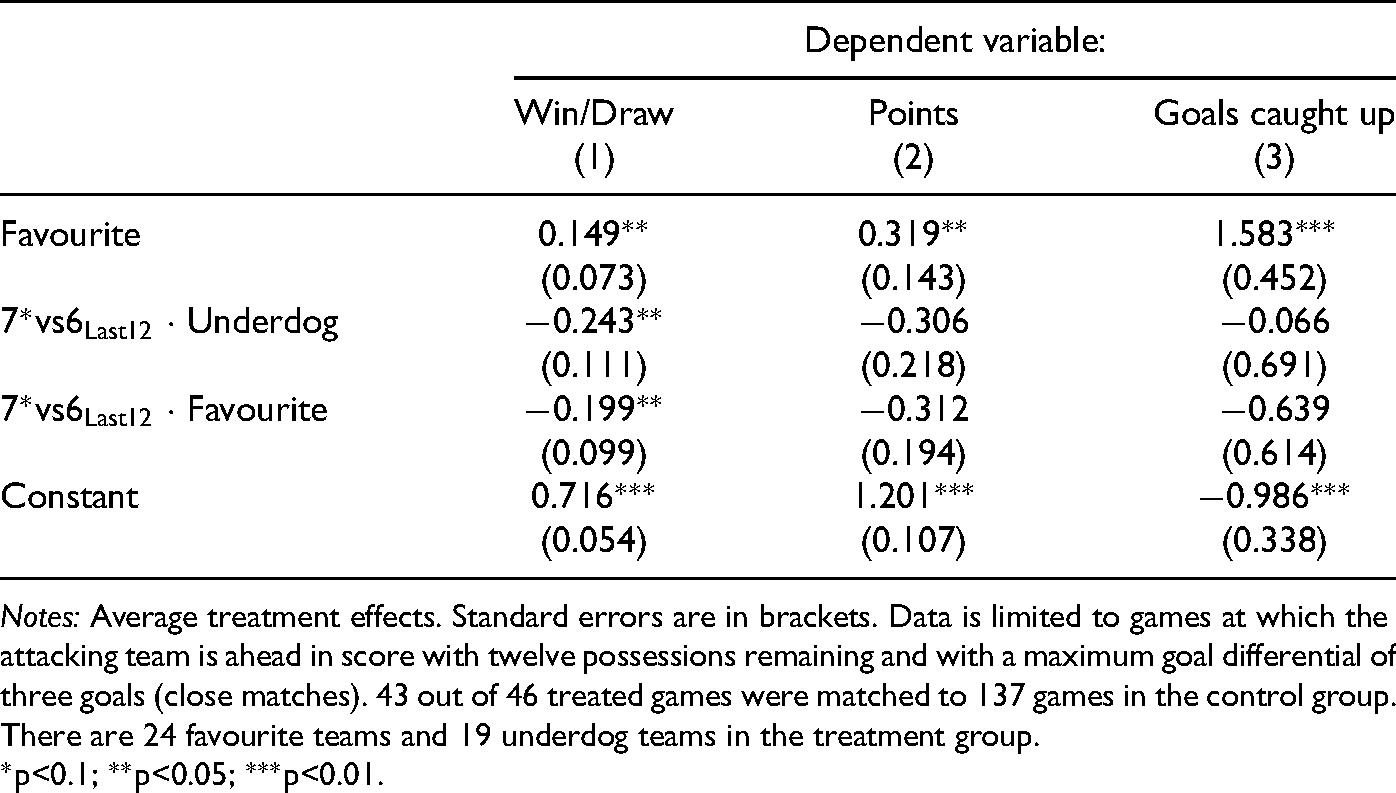
Notes: Average treatment effects. Standard errors are in brackets. Data is limited to games at which the attacking team is ahead in score with twelve possessions remaining and with a maximum goal differential of three goals (close matches). 43 out of 46 treated games were matched to 137 games in the control group. There are 24 favourite teams and 19 underdog teams in the treatment group.
Lastly, we want to estimate the overall effect of risk-taking on the outcome of a match. Therefore, we use the variable
Similar to the previous two estimations, we use an exact matching model with
Average treatment effects of risk-taking on success of heterogeneous teams.
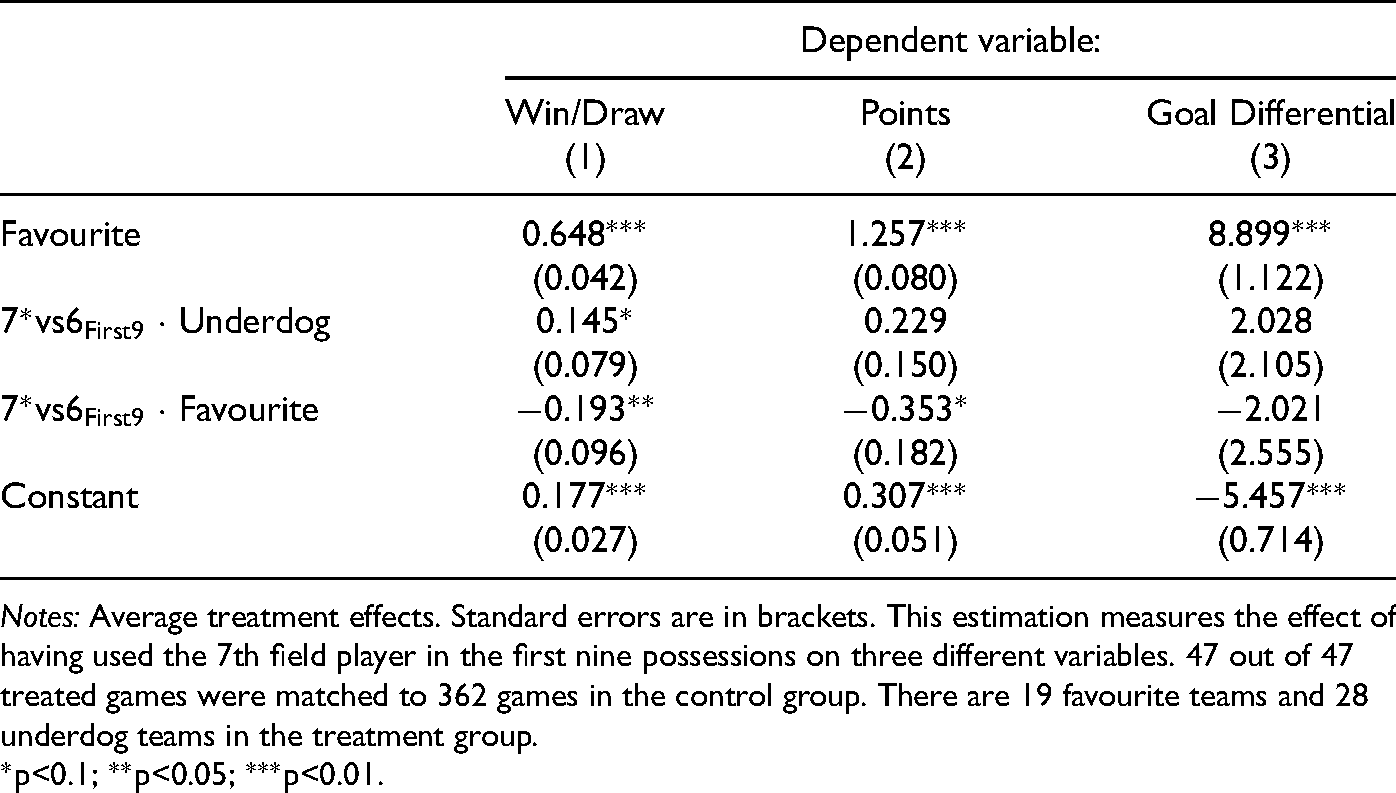
Notes: Average treatment effects. Standard errors are in brackets. This estimation measures the effect of having used the 7th field player in the first nine possessions on three different variables. 47 out of 47 treated games were matched to 362 games in the control group. There are 19 favourite teams and 28 underdog teams in the treatment group.
However, the results might be distorted by selection bias, if favourite teams which are currently on a losing streak increase their risk-taking ex-ante. Surprisingly though, more than 66% of the favourite teams that decided to use the 7th field player at the beginning of a match, had won their previous match. The high risk-taking might then reflect bad coaching strategies or a commission bias. Furthermore, players might have reduced their effort level due to an increased level of risk, as the input factors of talent and effort are substituted by luck to a certain extent in this case. They also might have not supported the coach’s decision of higher risk-taking in a match, in which they are the favourite, resulting in poorer performances.
The results of this section also show that timing and intermediate information is crucial for risk-taking and its success. According to the results of our estimations, favourite teams should rely on their superior playing ability and not increase risk-taking, unless they are trailing near the end of the match. Then these teams benefit from risk-taking, as it increases the probability of overcoming the deficit. Underdogs, on the other hand, should choose a moderate risk-taking strategy for the entire game. However, we did not find any evidence for trailing underdogs that higher risk-taking near the end of a game helps these teams to overcome a deficit.
Conclusion
The aim of this paper is to investigate risk-taking strategies used by handball teams in situations with ex-ante and in-game heterogeneity and to evaluate the success of this strategy. We show that teams are willing to take more risks when they have to overcome a deficit in ability (ex-ante heterogeneity) or in score (in-game heterogeneity). In addition, we provide evidence that heterogeneous teams react differently to current scores, as underdogs counter a current deficit by taking more risks than favourites, overall in the match. It seems that overall favourites rely more heavily on their superior ability than underdogs in order to overcome the current deficit. Interestingly, near the end of a match, this asymmetric behaviour changes, and trailing favourites choose riskier strategies, most notably if they no longer have any chance of winning the match. The commission bias may explain such behaviour, as coaches prefer to be proactive in hopeless situations, although this behaviour may not be effective.
Furthermore, we explore whether risk-taking is beneficial for teams. To do so, we investigate three different scenarios: teams with different (ex-ante) abilities at the beginning of a match, as well as teams trailing and leading near the end of a match. We show that underdogs who choose a riskier strategy overall, have a higher chance of winning the match. Favourites with overall increased risk-taking behaviour, on the other hand, have a significantly lower winning probability. Near the end of the match, however, the results indicate that trailing favourites benefit from increased risk-taking, whereas there is no such effect for underdogs adopting increased risk-taking. Leading teams on the other hand, both favourites and underdogs, suffer from riskier strategies close to the end of a match, as it decreases the probability of wining or drawing. Our results imply that the efficiency of using an additional field player depends crucially on timing and ability. Thus, particularly coaches of favourites need to be careful in their use of the 7th field player, as it may be counterproductive. The limited success of using an additional field player has not gone unnoticed by coaches. In fact, the share of attacks that use a 7th field player has decreased from 6.5% in the first year after the introduction of the new rule to 4.5% in the second year.
Our analysis has two clear advantages compared to what can be found in literature. First, the use of the 7th field player as a proxy for risk-taking is a very good reflection of a coach’s strategy implemented before and during the match. Second, the detailed data on every possession in a handball match provides an excellent opportunity to study the team’s changes in risk-taking in the context of the current score and whether this behaviour may depend on ex-ante heterogeneity as well. Unfortunately, our data set only contains two seasons with 607 matches, and the fraction of possessions in which the 7th player has been used, is also comparatively low (about 5%), which makes it difficult to empirically evaluate the effectiveness of this risk-taking strategy, as the number of teams in the treatment group (teams which used the 7th field player) is small. Future research might delve deeper into this issue. In addition, it could be interesting to test whether risk-taking is dependent on the tournament format (league tournaments vs cup tournaments), and whether teams are willing to take more risks in cup tournaments, because they face elimination in this format.
Supplemental Material
sj-pdf-1-jse-10.1177_15270025211071028 - Supplemental material for Risk-taking in contests with heterogeneous players and intermediate Information—Evidence from handball
Supplemental material, sj-pdf-1-jse-10.1177_15270025211071028 for Risk-taking in contests with heterogeneous players and intermediate Information—Evidence from handball by Lena Neuberg and Stefan Thiem in Journal of Sports Economics
Footnotes
Acknowledgements
We thank Aloys Prinz for his helpful comments, Susan Wagner and Julian Bauer for providing the data and Brian Bloch for the English editing. The usual disclaimer applies. This research did not receive any specific grant from funding agencies in the public, commercial, or not-for-profit sectors.
Declaration of Conflicting Interests
The authors declared no potential conflicts of interest with respect to the research, authorship, and/or publication of this article.

Supplemental Material
Supplemental material for this article is available online.
Notes
Appendix
References
Supplementary Material
Please find the following supplemental material available below.
For Open Access articles published under a Creative Commons License, all supplemental material carries the same license as the article it is associated with.
For non-Open Access articles published, all supplemental material carries a non-exclusive license, and permission requests for re-use of supplemental material or any part of supplemental material shall be sent directly to the copyright owner as specified in the copyright notice associated with the article.
