



Abstract
Using a large dataset with over 4,000 game-level observations from Major League Soccer over the period 2006 to 2019 we investigate the determinants of attendance demand. Focusing on franchise expansion and location effects, we find that some decisions made by the organization had positive impacts on league revenues. While going to cities with a large population and already hosting nearby NFL or NBA teams is positively associated with game attendance, the presence of geographically close MLB and NHL teams is detrimental to MLS revenues. Our results suggest a need for a more nuanced and selective approach to MLS expansion policy.
Introduction
The purpose of our study is to examine the influences of franchise expansion and location on game-level attendance in Major League Soccer (MLS). The results of our study should provide useful information for MLS officials to support decision making around the strategic placement of franchises in order to increase spectator attendance.
In recent years, MLS has enjoyed an influx of veteran players rendering the league to be a more viable, competitive, yet still developing major league sport in North America. While team values in MLS are on average substantially lower than in other major leagues in North America 1 , MLS has experienced an impressive recent expansion (MLS, 2019). When MLS began operating in 1996, 10 teams were playing in the league across the USA. In the subsequent years, MLS heavily invested in expansion activities to grow in popularity, to increase overall media rights value and to become an important professional sports league. By 2020, league size has more than doubled, with 26 teams - located in the US and in Canada - playing in MLS. After Austin was awarded the next MLS franchise in 2021, Charlotte will follow in 2022. In 2023, the league will reach 30 teams with the addition of St. Louis and Sacramento. Table 1 provides an overview of MLS expansion activities over time.
Expansion Activities in MLS, 1996–2023.
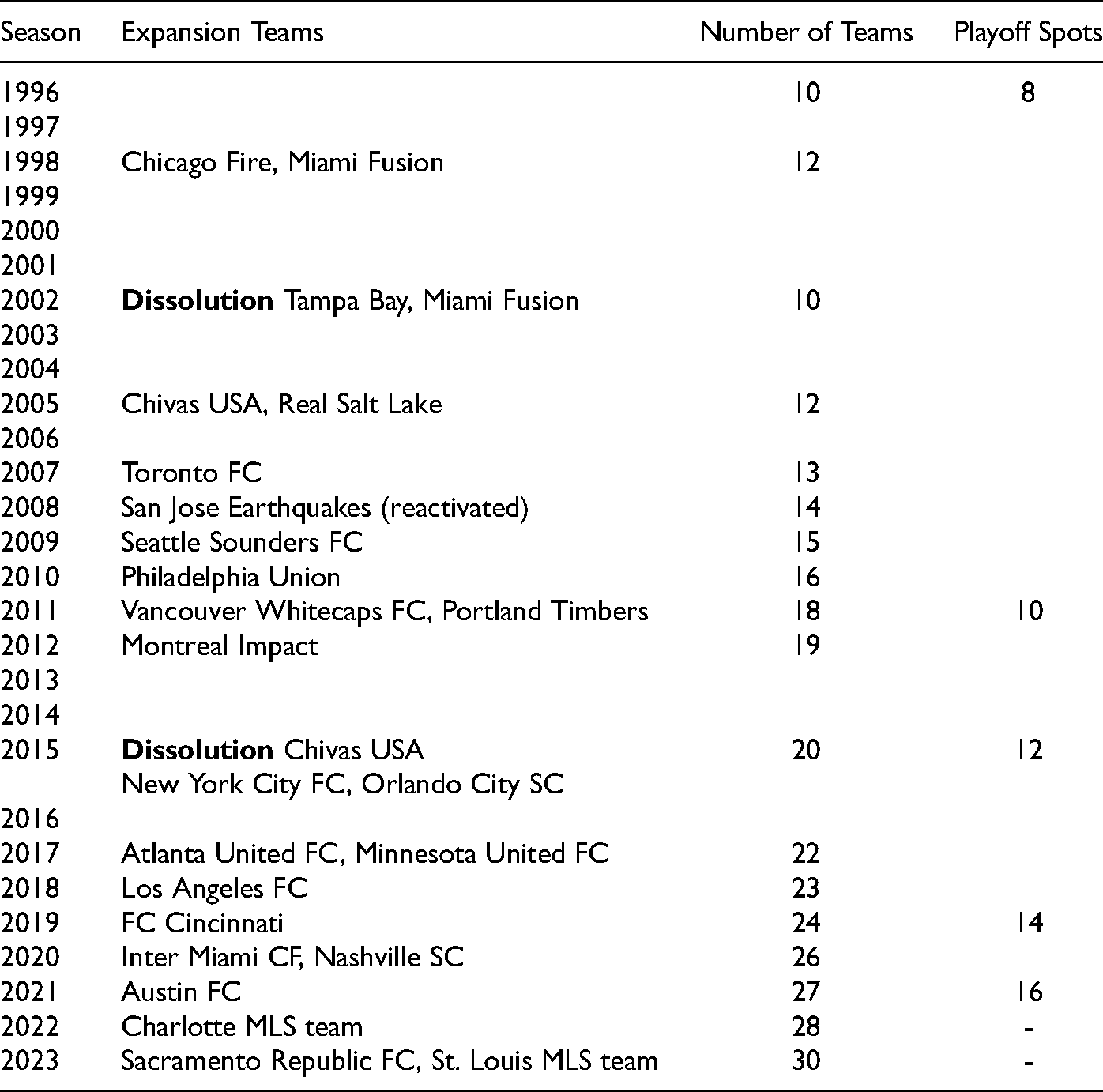
However, MLS expansion is not completed. In February 2020, Commissioner Don Garber announced that more cities aim to join the league and at some point MLS will expand further (Williams, 2020).
With respect to revenues, the 23 teams that played in MLS in 2018 generated more than $800 million (Smith, 2019). In contrast to other North American professional sports leagues, the percentage of revenues coming from in-stadium sources are a substantial part of the overall revenues. While television and apparel contracts reduced the revenues stemming from in-stadium sources to approximately 80 percent of the in-stadium revenue contribution in 2016, revenues from stadium attendance remain the major source of income for MLS teams (Smith, 2017). Therefore, a better understanding of the determinants of consumer demand is crucial for both the league and academia.
The following figure displays game-level attendance in MLS since the league's inaugural season 1996, distinguishing between founding and expansion teams 2 . It appears from Figure 1 that nearly the entire observation period 2004–2019 is characterized by a constant growth of MLS attendance while in the first years MLS had substantial problems to increase spectator interest.
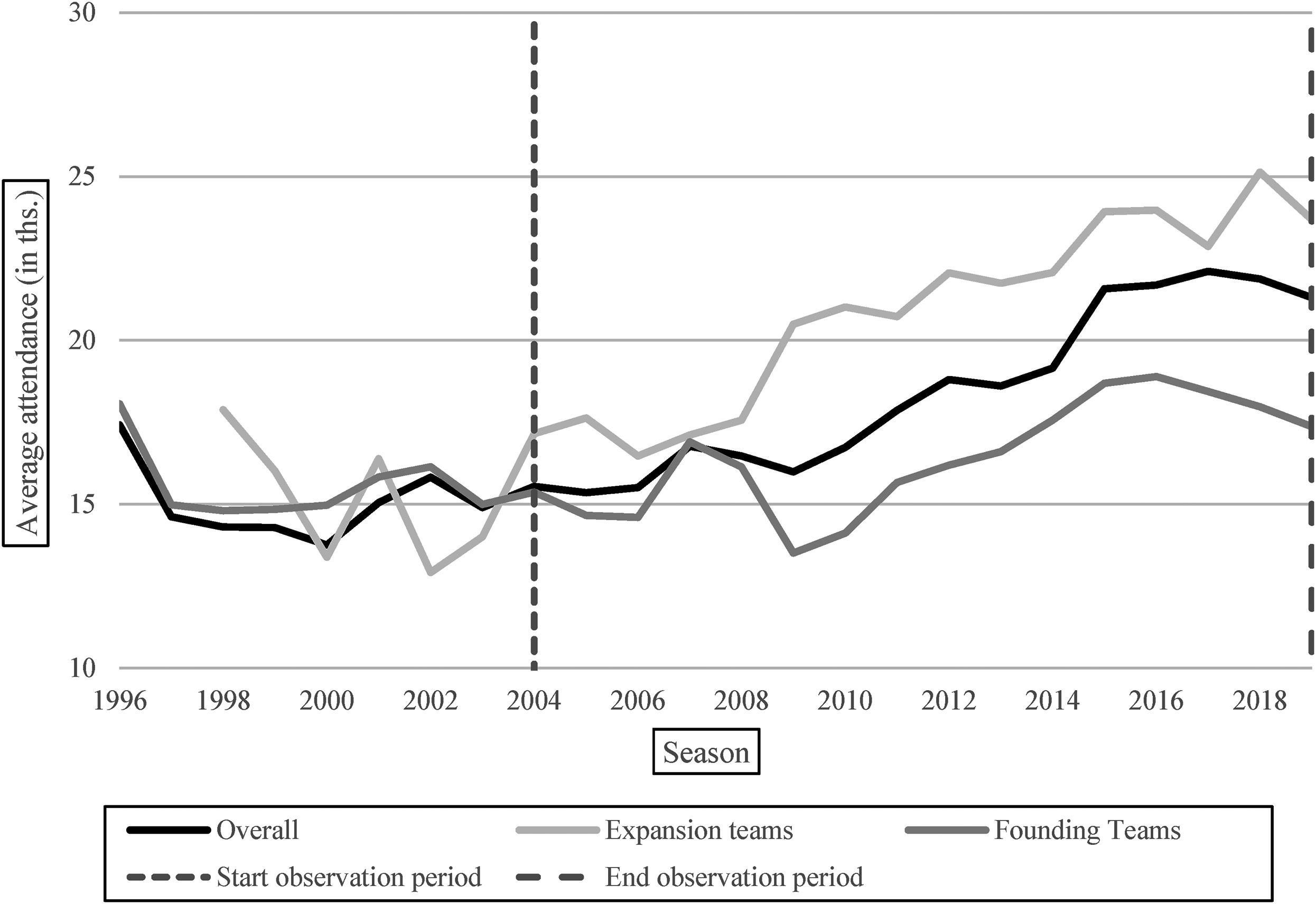
MLS attendance per game, 1996–2019.
So far, researchers have studied several (potential) determinants of attendance demand in MLS, but the dynamics and the rapid growth of the league require further investigation. One primary growth strategy for MLS has been the strategic placement of expansion teams in promising markets. When determining where to award expansion franchises, MLS considers several criteria such as an MLS-committed ownership group, support from the corporate community or a detailed stadium plan. The main criteria when deciding to award a new franchise are the characteristics of the metropolitan market due to their potential to determine success or failure of the expansion franchise. Previous studies examining the determinants of attendance in MLS control for only a few characteristics of the metropolitan market such as income, population or the competition from other major league teams. We aim to fill this gap.
Literature Review and Hypotheses
Location
A basic assumption in sports economics is that each team's revenue and profitability are dependent on the drawing potential of the local market (El-Hodiri & Quirk, 1971; Fort & Quirk, 1995). That is, teams located in largely populated areas will enjoy higher demand compared to those in less populated areas. Empirically, Jones and Ferguson (1988) investigated location factors in the National Hockey League (NHL) and found that teams located in cities with large population or regions with high interest in NHL (e.g., Canada) enjoyed higher demand. The quality of the local market may also be a significant factor as economic conditions (i.e., the unemployment rate) may also affect attendance (Jones et al., 2000). Our analysis focuses on local population as this is a standard measure of market size and as such may influence MLS decisions about the award of MLS franchises as part of its expansion program.
In addition to the economic conditions in a particular location, the distance between two competing teams has also been discussed in the previous literature. In general, the Hotelling model assumes that consumers will, other things equal, prefer goods and services that are offered at close proximity to their place of residence. This plausibly also applies to professional sports. As the distance increases, travel costs will also increase. Thus, if there are professional sports teams of similar quality, sports fans will prefer a team that is located close to where they live.
In this context, much of the work on demand for sport utilizes a distance measure to estimate the effects of proximity on ticket demand. Specifically, using Hotelling's travel cost model, Winfree et al. (2004) found that as the distance between the two teams decreases, the home team will enjoy additional fan interest. In other words, appearance of a new team in close proximity is likely to decrease the fan base of the incumbent team. Hence, even if a market is large enough to host multiple teams, it could also result in cannibalization of the incumbent teams. Other studies have found that an increase in distance between two teams has a significantly negative effect on attendance (Forrest & Simmons, 2002; Lemke et al., 2010). This is most likely due to the fact that an increase in distance attracts fewer fans of the visiting team. While this behavior was not observed early in the season, it becomes more and more important as the season progresses (Lemke et al., 2010). In addition, Wooten (2018) found that MLS games between teams located within a 250 miles radius attracted more fans. Attendance further increases by approximately 5% when the visiting team is in closer proximity. Teams that are located in close proximity typically have a particular rivalry, which has been found to be one of the most important determinants of ticket demand (Sung et al., 2017).
Winfree et al. (2004) as well as Mills and Rosentraub (2014) found that the introduction of a new team in a region where incumbents already exist, leads to a reduction in gate attendance, suggesting that substitution effects play an important role. Coates and Humphreys (2005) even found evidence of cross-league substitution in Major League Baseball (MLB) and in the National Basketball Association (NBA) due to the presence of other professional teams in the region. In this context, only the ticket price turned out to be statistically significant in the fans’ decision to substitute with other professional league teams while no evidence of quality substitution across sports was found (Mills et al., 2015). These findings suggest that within league substitution is likely to be affected by both, price and quality, while cross league substitution is likely to be based mainly on price considerations. With regard to MLS, Bradbury (2019) found that the existence of different sports league teams in cities hosting a MLS team did not explain the observable variation in game to game attendance.
In terms of demand for sport in shared markets, Mills and Winfree (2016) investigated cross quality effects on viewership demand in shared markets where two MLB teams reside. They found a complementary relationship when both teams demonstrated an equallygood performance. However, whenever either team falls behind, this effect disappeared for the poorly performing team. Additionally, free-riding benefits from residing next to a high quality team is expected to be taken away whenever the quality gap between these teams increases, resulting in indirect substitution. Yet, this effect was not found to be in play for shared market viewership demand in the National Football League (NFL) (Mondello, Mills, & Tainsky, 2017).
Cross-league substitution between major league teams and MLS attendance is likely for Major League Baseball. This is because these two leagues occupy very similar season schedules running from April until October. Also, MLB games can be accessed very cheaply, depending on fan preferences for seat location. The other major leagues have schedules with little or no overlap with MLS and it is possible for at least some of these leagues that complementary effects could occur. Complementarity will be observed if the presence of major league teams (NBA, NFL, and NHL) raises audience interest in MLS via an agglomeration externality. Fan interest in major league sports might generally spill over into MLS attendance especially as the MLS season does not overlap with these leagues so opportunity cost of leisure time is less of a concern. We term this complementarity effect ‘sporting intensity’ where fans are more likely to attend MLS games because of a strong professional sports presence in a given area, not necessarily confined to a local city hosting an MLS team.
Two previous papers examined the effects of neighboring major league teams on MLS attendances, with some contrasting results. Using a matchday analysis of the 2007 season, Lawson, Sheehan, and Stephenson (2008) found positive effects of same-city NBA, NFL and NHL teams on MLS home team attendances but a negative effect of a same-city MLB team. Using seasonal data from 1996 to 2001, Jewell and Molina (2005) found a positive effect of an NBA team, a negative effect of an NFL team and insignificant effects of MLB and NHL teams. The inconsistencies of these results suggest a need to revisit the effects of major league franchises on MLS attendances and we are able to do so with a large number of seasons (14) and observations (over 4,000 games).
Moreover, we offer a richer matchday analysis that extends the treatment of distance beyond local city boundaries so as to incorporate potential agglomeration effects of sporting intensity. These effects have been studied within-league in English soccer by Buraimo et al. (2007) and Doran and Jordan (2018), in terms of effects of closeness of rival teams on team performances (negative in the former case and positive in the latter study) and by Buraimo et al. (2009) on the impact of the number of local soccer teams on attendances in the English second tier league (the Championship). Defining market overlap as the proportion of local population absorbed by rival teams, the authors found a significant negative impact of rival soccer teams on home team attendance. We would not expect similarity of agglomeration effects between MLS and European soccer leagues due to the relatively large distances between team locations in MLS as opposed to the positioning of soccer teams in dense conurbations in England and Germany (London and North-West for England and Ruhr area for Germany). Indeed, sports leagues in North America appear to prefer tough limits on league size (30 to 32 teams as opposed to 92 in English soccer) with geographically distant locations yet with many large cities left unserved by a franchise in a given major league.
We take the analysis of fan substitution and local agglomeration effects in two different directions. First, we relax the standard assumption that rivalry and agglomeration effects are confined to the same city as a given MLS team and explore alternative possibilities for distances containing catchment areas of MLS teams. Second, we use our attendance demand estimates below to perform a simulation analysis to evaluate the relative attractiveness, in terms of stadium visitors, of currently enacted and planned MLS expansion teams and also those teams nominated for consideration as part of future MLS expansion.
Novelty Effects
Both the introduction of a new team as well as the creation of a new stadium are generally expected to increase the interest of sports fans, implying that a new franchise or the relocation of an existing one causes substitution effects among fans (Mills & Winfree, 2016). Yet, not much work has been done on the effect of new teams and their impact on incumbent teams which is probably due to major leagues in the U.S. limiting the number of relocations as well as expansions. The existing literature finds that new or relocated teams enjoy large crowds in their first years only (Clapp & Hakes, 2005; DeSchriver et al., 2016). This effect is likely to persist if the new team becomes a contender soon thereafter (Winfree, 2009).
With respect to new stadiums, Clapp and Hakes (2005) found a 30% increase in attendance for MLB teams in the first year regardless of on-field performance. Coates and Humphreys (2005) found a quantitatively similar effect in NBA, NFL, and MLB and a similar novelty effect was found for teams in the German “Bundesliga” (Feddersen et al., 2006).
In MLS, new as well as already existing teams are encouraged to build soccer-specific stadia as their main growth strategy. Previously, researchers indeed found increased attendance at newly built stadiums and soccer-specific stadiums. This effect, however, was not league-wide nor long-term (DeSchriver et al., 2016; Wooten, 2018). Others found diminishing returns to stadium age and no statistically significant effect of soccer-specific stadiums (Bradbury, 2019; Sung & Mills, 2018).
Other Determinants
Previous work has found that while “superstars”, i.e. Designated Players (DP) create additional fan interest in both attendance and TV viewership (DeSchriver, 2007; Lawson et al., 2008; Jewell, 2017; Sung & Mills, 2018; Sung et al., 2019), this additional interest decreases over time (Jewell, 2017). This has been mostly attributed to the high salaries of the DPs (Sung & Mills, 2018). Apart from the positive impact of DPs on attendance, others found the existence of these highly paid players to have a negative effect on team performance (Coates et al., 2016). More recently, it was also found that the introduction of the DP rule negatively affected the level of competitive balance (Gomez-Gonzalez et al., 2019).
Another consideration that may affect the behavior of sports fans are the market values of the teams, that are used both as reputation (or brand) measures and as proxies for their financial power. Previously, Czarnitzki and Stadtmann (2002) found that German soccer fans have strong preferences for teams with greater reputation instead of uncertainty of outcome. These findings have recently been confirmed by Serrano et al. (2015) who found that the market value of a team's roster was a major and statistically significant determinant among European soccer fans while outcome uncertainty was not at all favored, thus again providing no evidence to support Rottenberg's uncertainty of outcome hypothesis.
Hypotheses
We formulate the following four hypotheses according to franchise expansion and location:
Hypothesis 3 refers to the population of the metropolitan market where the MLS stadium is located. Theoretically, a larger population in the metropolitan market represents a higher number of consumers or potential fans to attend MLS games. Thus, most studies investigating the determinants of attendance in professional team sports consider population to account for the size of the local market and find a positive relationship between population and attendance (Bradbury, 2019).
Hypothesis 4 relates to the number of MLB teams located within 100 travel miles around the MLS team. While the regular season in MLB overlaps with the regular season in MLS, we test the effect of nearby MLB teams on the home attendance of the incumbent MLS team. Based on previous findings (e.g., Lawson et al., 2008), we expect that local MLB games serve as substitutes for MLS games, where MLB is seen as a rival, competitor league to MLS. Thus, the presence of nearby MLB teams is predicted to impact home attendance of MLS teams negatively. Our hypothesis stipulates 100 miles as the relevant distance between teams but this is arbitrary of course so in our empirical analysis we consider alternative distances.
In addition to testing Hypothesis 4 on the potential adverse effects of a neighboring baseball team on MLS home team attendances, we further consider the effects of presence of other major league teams on MLS attendances. Here, we offer no precise hypothesis. Instead, we propose two offsetting conjectures. On the one hand, presence of an NBA, NFL, or NHL franchise within the neighborhood of an MLS team can reduce MLS attendances due to a competition effect as fans of other major league teams or sports decline to attend MLS games due to strength of preference for their favored major league sport(s). This can occur despite lack of any strong overlap of seasons between NBA, NFL, and NHL and MLS. On the other hand, presence of major league franchises in a given area can generate an agglomeration externality upon MLS attendances since fans of major league sports may take an additional interest in MLS as a newer and growing league. As noted above, we view this as a ‘sporting intensity’ argument and note that it is customary in North America for fans to take active interests in more than one sports league. The presence of a strong sporting culture with fan intensity in a given city or local area could raise interest in an MLS team based in that area. Taking account of opposing competition rivalry and sporting intensity effects, we cannot sign the predicted impact of presence of NBA, NFL, or NHL franchises on MLS attendances a priori. Thus far, the evidence on the impacts of major league franchises on MLS attendances is mixed. For example, using seasonal data, Jewell and Molina (2005) found negative effects of local (same city) NFL teams on MLS attendances while Lawson et al. (2008) found positive effects of NFL teams using single season matchday data.
Data and Empirical Specification
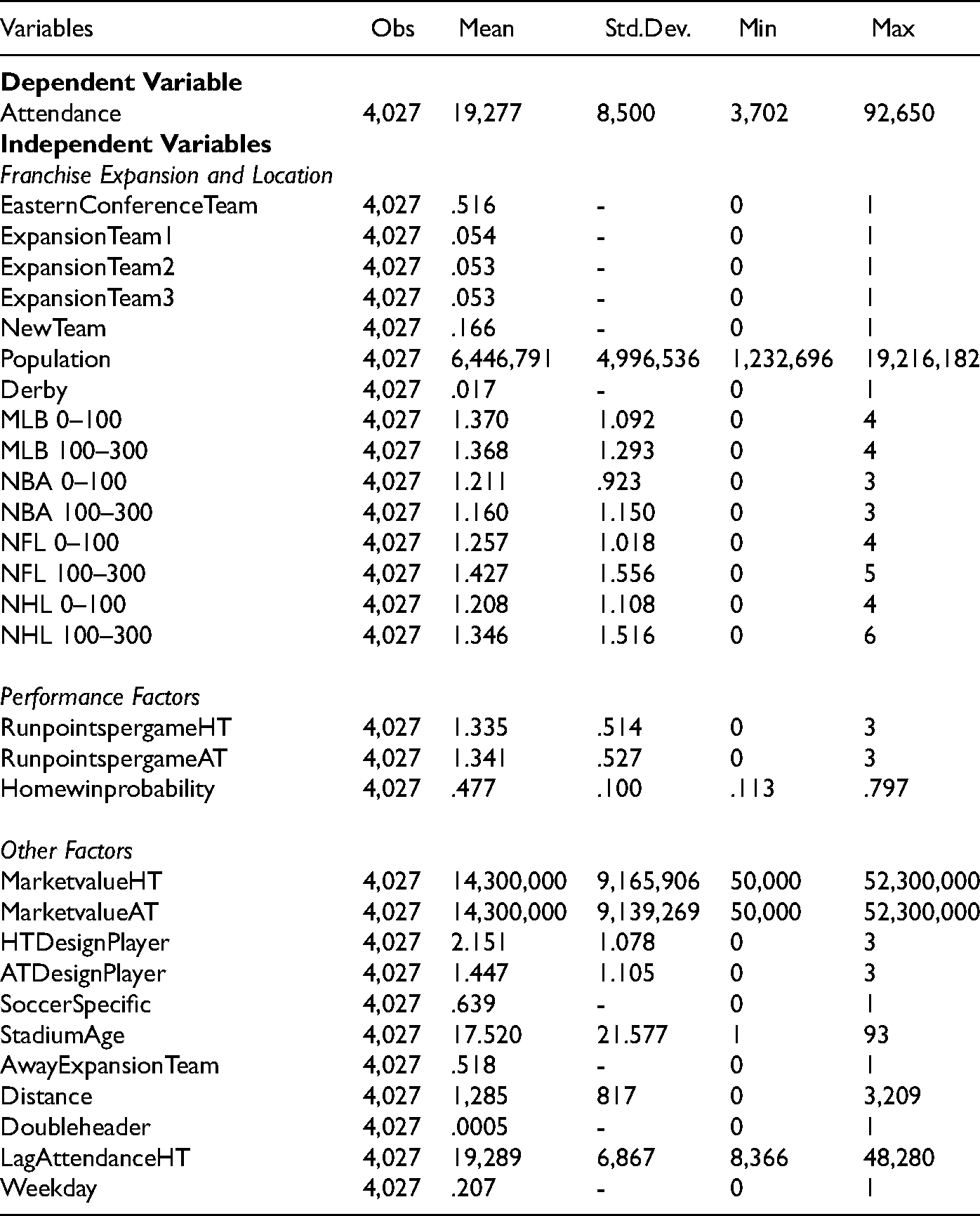
We start with an unbalanced panel dataset including all 2004–2019 MLS regular season games, resulting in 4,532 individual game-level observations. However, the data were not available for every variable for all games. For instance, the market values of the teams are only available since 2006. Hence, we dropped the 2004 and 2005 seasons, resulting in 4,027 observations over 2006 to 2019 seasons for our regression analysis.
Data on per-game attendance, game results, the number of designated players per team, team points, and the date of the game were collected from the official MLS website (www.mlssoccer.com). The league and the individual websites of the teams provided facility information such as stadium age or soccer-specific designation. The population of the metropolitan market standard metropolitan statistical area (SMSA) (as is conventional in attendance demand studies of North American sports) were derived from US Census Bureau and for the Canadian MLS teams from Statistics Canada. The official websites of the four major leagues in the U.S. as well as Google Maps were used to determine the travel distance between MLS stadiums. Also, the website trippy.com was used to determine travel distances between MLS teams and other major league teams in the local area. Betting odds data were retrieved from Odds Portal (www.oddsportal.com) and information on the market values of the teams comes from transfermarkt (www.transfermarkt.de).
The regular season usually runs from April to October each year. The teams played unbalanced schedules with 30 regular season games between 2007 and 2010, 32 regular season games in 2006, and 34 regular season games from 2011 to 2019. Since 2011, MLS teams play 24 intra-conference and 10 inter-conference games each regular season.
To analyze the determinants of attendance at MLS games, we include several explanatory variables in our models. Table 2 provides a description of the variables used.
Description of Variables.
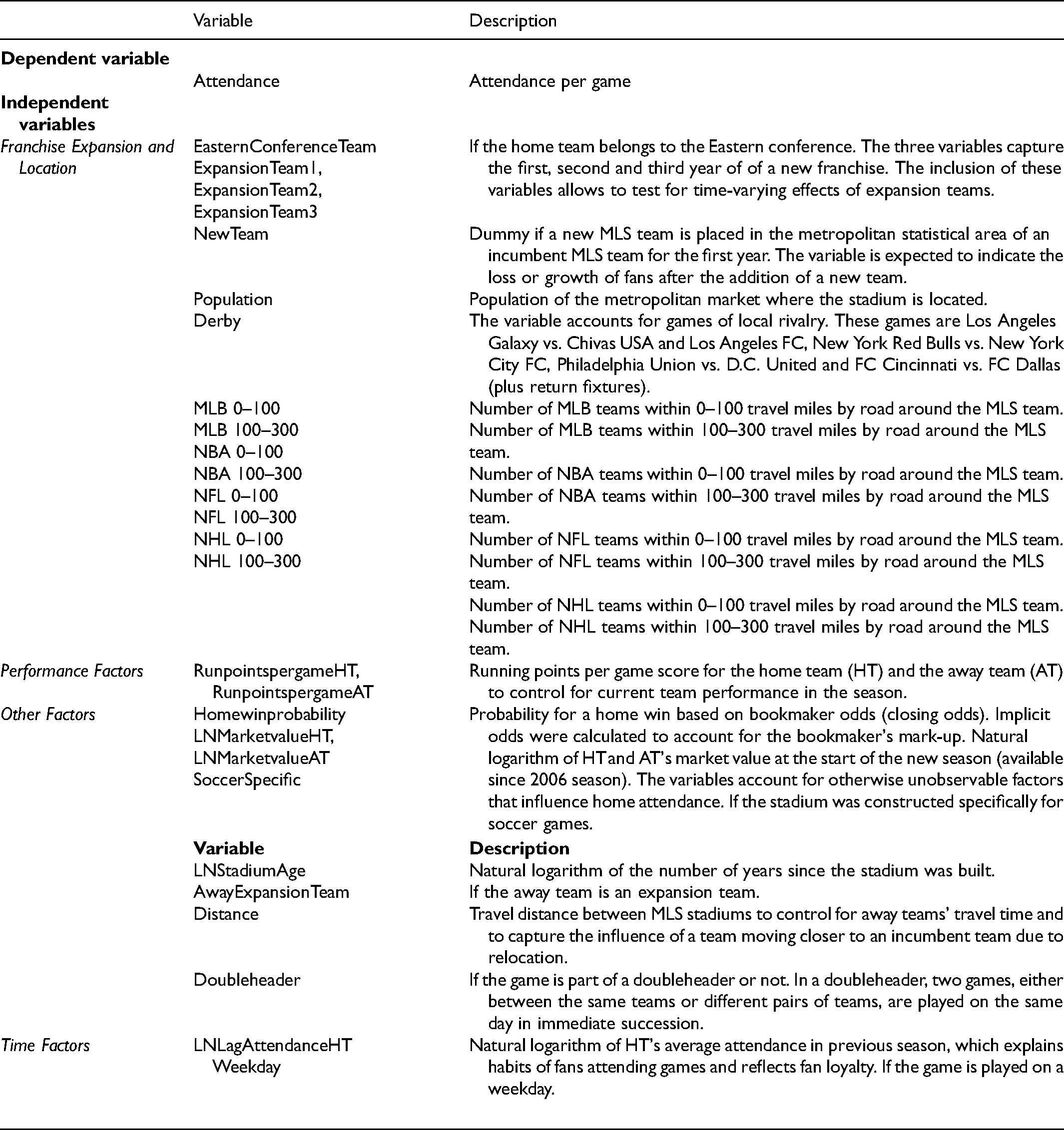
The most general specification reported in our empirical results is of the following form: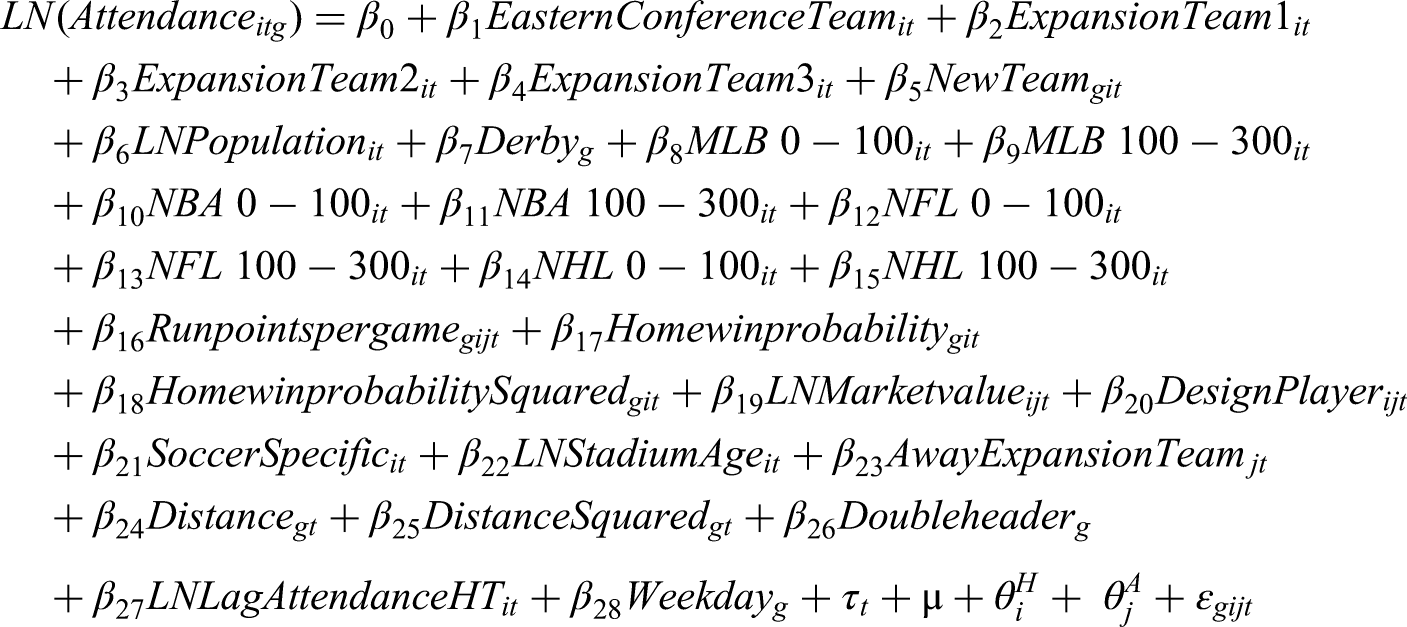
Summary Statistics.
Results and Discussion
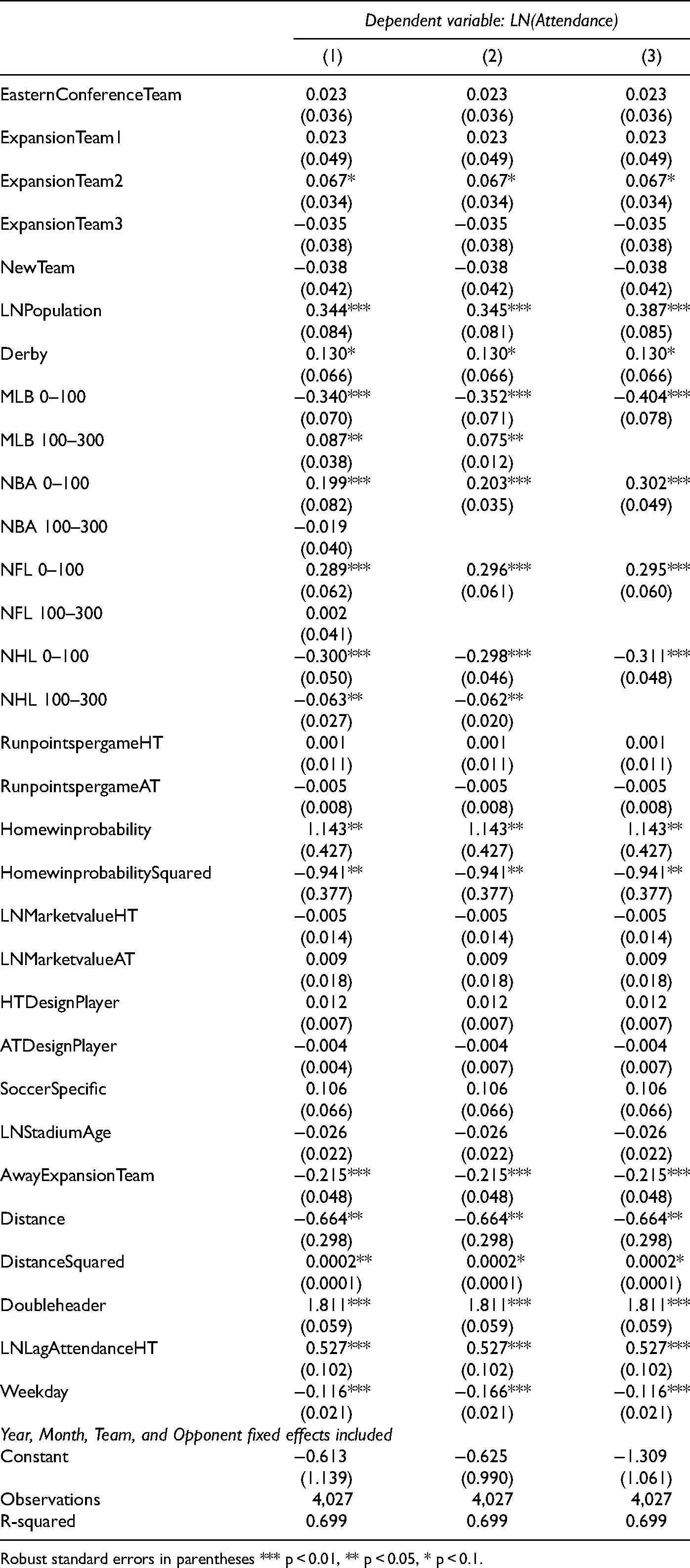
Our observation period covers 14 consecutive seasons and thus provides considerable variation in attendance between and within teams. To investigate the effect of franchise expansion and location on attendance, we estimate various fixed effects models. Table 4 presents the results of the ordinary least squares (OLS) regression estimations. The dependent variable is the natural logarithm of attendance ( In addition to Distance, we control for specific games involving local rivalry, termed Derby. These games are noted in Table 2. We expect these games to have positive effects on home attendances in line with attendance demand studies of European soccer leagues.
OLS Regression Results.
Robust standard errors in parentheses *** p < 0.01, ** p < 0.05, * p < 0.1.
Table 4 reports three sets of regression estimates. Column (1) features a full set of major league variables by distance. In these estimates we find insignificant coefficients on NBA 100–300 and NFL 100–300. Column (2) drops these two rival league variables and this is our preferred model. Column (3) restricts distance of alternative major league teams to within 100 miles. We regard this as unwarranted given the significant coefficients on MLB 100–300 and NHL 100–300. Nevertheless, stakeholders might perceive inter-league externality effects between 0 and 100 miles as a closer definition of ‘neighboring’. We therefore use the estimates in column (3) as a robustness check on our simulation analysis to follow. This simulation is designed to show the relative attractiveness of currently planned and potential future MLS franchises assessed by predicted scores derived from our estimates of attendance demand in Table 4. The following sub-sections present the findings of our regressions, focusing on column (2) of Table 4.
Franchise Expansion and Location
For new franchises, we find that expansion teams in their second year experience significantly higher attendances than incumbent teams but find insignificant effects on attendance for expansion teams in the first or third year. This finding is in contrast with DeSchriver et al. (2016), who find a significantly positive effect for the first three years of an expansion team. However, DeSchriver et al. (2016) only used game level data for five consecutive seasons from 2007 to 2011. Since our data covers a much longer period as well as the most recent seasons, results can differ. Since the results in Table 4 do not support the assumption of a (potential) novelty effect that might raise attendance, we have to reject Hypothesis 1.
Concerning our second hypothesis, we do not find a significant effect of adding new MLS teams that are geographically close to incumbent teams on game-level attendance. Therefore, creating clusters of MLS teams in particular city areas, such as Los Angeles or New York, does not seem to affect attendance. Therefore, Hypothesis 2 must be rejected.
Consistent with our third hypothesis, we find that population in the metropolitan market is positively associated with MLS game attendance, confirming Hypothesis 3. This finding is in line with many studies examining attendance in different professional sports leagues (e.g., Tainsky and Winfree, 2010). Thus, the population of the metropolitan market should be considered by MLS officials when awarding MLS franchises. Concerning our last hypothesis, we find a significant negative association between MLB teams located in the “inner zone” (0–100 travel miles around the MLS team) and game attendance. However, for MLB teams located in the “outer zone” (100–300 travel miles around the MLS team), the effect on MLS attendance is the opposite. Noting that the league rivalry and sporting intensity effects are opposite to each other, we find for the inner zone that the rivalry effect of MLB teams is dominant. This is as expected given that the MLS and MLB seasons run concurrently. The negative coefficient on MLB 0–100 is consistent with previous findings by Lawson et al. (2008) for matchday attendances in an early, single season (2007). However, Lawson et al. (2008) restricted attention of league rivalry to location within the same city whereas we take a broader interpretation of location extending beyond city boundaries and we have a more granular analysis covering 14 seasons. For the outer zone, we find that the sporting intensity effect of baseball teams dominates the league rivalry effect with a positive coefficient on MLB 100–300. Hence, Hypothesis 4 is supported but only for the inner zone of 0 to 100 miles containing rival MLB teams.
Turning to those major leagues that have seasons which do not overlap with MLS, we find that a greater number of NBA teams located within 100 miles of an MLS team has a positive effect on MLS attendances. This result supports and extends the earlier finding of Lawson et al. (2008) using matchday data and Jewell and Molina (2005) using seasonal data where these authors restricted attention to within-city effects.
A larger number of NFL teams within 100 miles is also associated with higher MLS attendances. For both NBA and NFL, we found insignificant effects of number of teams in the outer zone of 100 to 300 miles on MLS attendances (column (1)). Hence, the positive sporting intensity effects of NBA and NFL are confined to within a 100 miles radius of an MLS team.
In contrast, and differing from Lawson et al. (2008) and Jewell and Molina (2005), a higher number of NHL teams within 100 miles radius lowers MLS attendances. This suggests that attendance preferences of hockey fans differ from preferences of basketball and football fans. The negative effect of number of NHL teams remains negative and significant for the 100 to 300 mile outer zone although with smaller magnitude.
Other Independent Variables
Concerning further explanatory varables, most coefficients have the expected sign but are not always statistically significant. While a derby or a doubleheader game affect attendance at MLS games positively, weekday games draw smaller audiences. If the away team is an expansion team, home teams’ attendance is affected negatively. One explanation for this results might be that expansion teams are often perceived by fans as weaker than incumbent teams and, therefore, have a lower drawing power as do, for example, some promoted teams in the German Bundesliga or the English Premier League. Also, as expected and in line with studies of European soccer leagues (Buraimo et al., 2009; Buraimo et al., 2021), longer distance between MLS stadiums is associated with a decrease in MLS game attendance, with a quadratic form in which the turning point is at 1,919 miles. The coefficient on Derby is positive, as predicted, but only significant at 10 percent. This is perhaps due to the relatively small number of Derby fixtures compared to European soccer leagues.
Interestingly, for the home win probability and its squared term, we find an inverted U-shaped relationship supporting the conventional uncertainty of outcome hypothesis. Thus, our results show that MLS fans seem to enjoy outcome uncertainty in sharp contrast to evidence to the contrary from studies examing game-level attendance in US major leagues (e.g., Coates and Humphreys, 2010), European football (e.g., Buraimo and Simmons, 2008) and MLS itself (Sung & Mills, 2018). In our case, we note the lack of significance of both home and away team points per game (Runpointspergame) and suspect that home win probability is capturing home team strength and a preference for home team wins. However, we do not attempt a formal separation of home win preference from outcome uncertainty which is beyond the scope of the present paper (Humphreys & Zhou, 2015). Home win probability and its square are simply used here as control variables.
Another important control variable is the impact of the fans’ attendance in the previous season as a possible indicator of fan habit or persistence, used in several soccer attendance papers (Buraimo et al., 2021). A small (large) audience in the last season is associated with a small (large) audience in the current season 3 .
Simulation Analysis
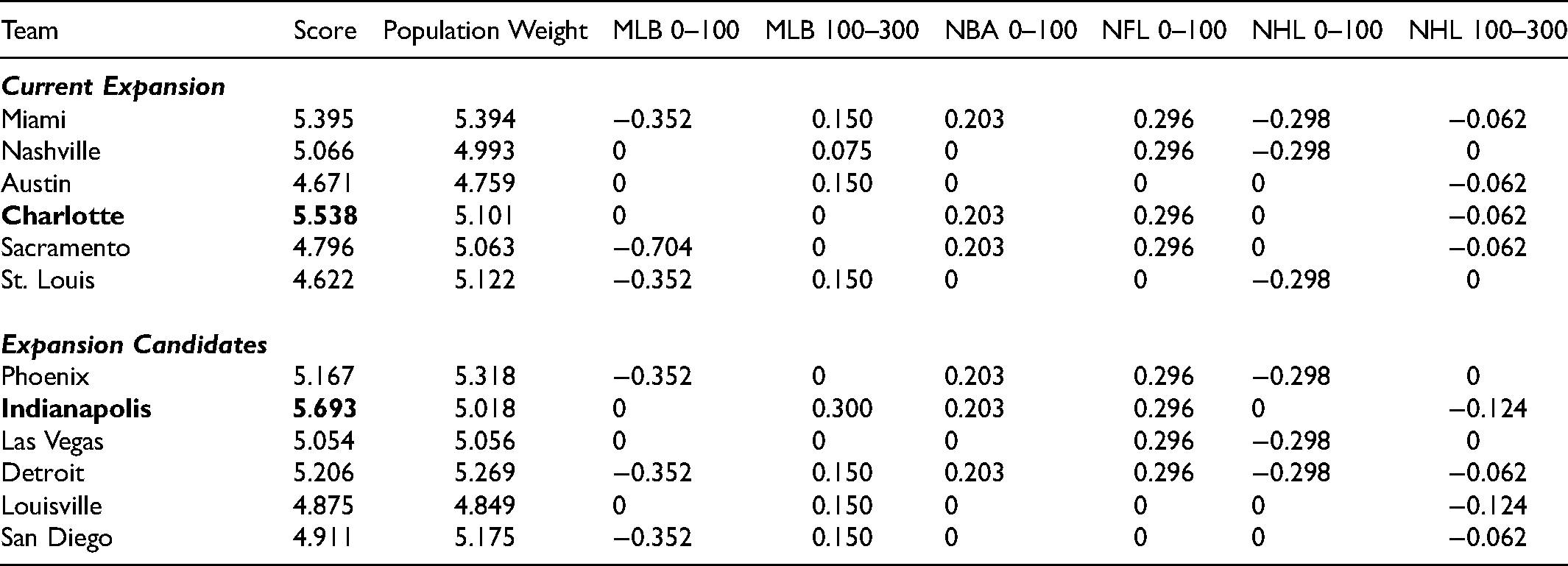
In the next step, we provide simulations of current and candidate expansion teams. Using the estimates in column (2) of Table 4, we define a variable Score as:
Simulation Study of Current and Candidate Expansion Teams.
If an MLS team locates in an area with presence of one team of each major league within 100 miles but no major league team in the 100 to 300 mile outer zone then the Score value will be
From the set of franchises already awarded expansion status, we find the highest Score for Charlotte, even though it does not have the highest SMSA population of the six cities shown. This highest rank score comes about because of absence of an MLB team and presence of NBA and NFL teams (Hornets and Panthers) generating sporting intensity. The nearest NHL team (Carolina Hurricanes) is in Raleigh, 170 miles away.
The next highest Score to Charlotte on already planned expansion teams is for Miami. Of course, Miami's entry into MLS was largely stimulated by the role of part-owner David Beckham as sporting celebrity and former MLS player but there is also a locational advantage for this franchise with the largest SMSA population among the six expansion cities. For Miami, the sporting rivalry and positive sporting intensity components are almost exactly offset.
The lowest Score values for cities hosting planned expansion MLS teams are for Austin and St. Louis. These each have relatively low SMSA population. Austin has the lowest SMSA population of the six cities shown while the relatively low population effect for St. Louis is compounded by adverse sporting rivalry effects with the presence of baseball (Cardinals) and hockey (Blues) within the city.
Turning to candidate cities for future expansion, we note six of these that are prominent in media coverage. Of these, our attendance-based Score measure favors Indianapolis and Detroit, even though neither has the largest population of the nominated cities. That award goes to Phoenix. The population contribution to Phoenix's Score is unaffected by the presence of major league teams. Indianapolis, however, benefits from lack of an MLB team within 100 miles and presence of NBA and NFL teams in the city (Pacers and Colts) together with four MLB teams in the outer zone (Cubs, White Sox, Tigers, Reds) which dominates the adverse effect of outlying NHL teams (Blue Jackets, Red Wings, Blackhawks).
The second highest Score for the candidate expansion cities belongs to Detroit. This is driven by large SMSA population weight which actually suffers a small net reduction when substitute or complementary major league teams are considered. The lowest Score values go to Louisville, with smallest population of the six cities, and San Diego which suffers from the adverse sporting rivalry effect of an MLB team in the city (Padres). Interestingly, according to our estimates, the relocation of the Chargers to Los Angeles reduces the attractiveness of San Diego as a host of an MLS team. Such externalities merit consideration when assessing overall effects of team relocations in North American major leagues.
We note that the lowest Score value for nominated expansion teams is still greater than the fourth highest Score value for expansion teams that are already approved (Sacramento). In that sense, the expansion candidates each have a good case. We note also that favorable attendance characteristics represent just a part of the case for MLS approval of an expansion team. Clearly, stadium facility construction or renovation, ability to recruit high quality players and support for the expansion team by local authority and local community are also important considerations, as noted above. Nevertheless, our regresssion estimates and simulation give some guidance of potential attendance effects for the competing expansion teams and hopefully provide some input to consideration of merits of each city as hosts of future MLS teams. Our results point to the superiority of Indianapolis and Detroit over the other nominated cities as MLS expansion candidates in terms of greatest attendance potential.
Concluding Remarks
In a profit-maximizing single-entity league like MLS with no promotion and relegation, strategic placement of new teams is decisive for the entire organization's economic performance. In this paper we seek to identify the success factors that maximize fan interest, overall attendance and league revenues. Using a large data set with some 4,000 game-level-observations covering the 2006 to 2019 seasons we find, unsurprisingly, that MLS teams situated in larger population centers draw larger home attendance so market size does matter. Probing more deeply into the effects of rival major leagues on MLS attendances, we find evidence of substitution and cannibalization on the one hand, from baseball and hockey, but also evidence of positive sporting agglomeration effects from basketball and football, on the other hand. Moreover, these fan substitution and sporting agglomeration or ‘sporting intensity’ effects vary by distance from the location of an MLS team, specifically for placement of MLB and NHL teams.
Our matchday attendance demand estimates were used to form a scorecard of locations of recently approved and possible future MLS expansion cities. This revealed highest scores for locations of approved MLS expansion teams in Charlotte and Miami. Based on attendance demand considerations only, our results support MLS expansion into Indianapolis and Detroit over other candidate cities proposed in media discussion.
Footnotes
Acknowledgments
This research did not receive any specific grant from funding agencies in the public, commercial, or not-for-profit sectors.
Declaration of Conflicting Interests
The author(s) declared no potential conflicts of interest with respect to the research, authorship, and/or publication of this article.
Funding
The author(s) received no financial support for the research, authorship and/or publication of this article.
