



Abstract
This article summarises the research findings of papers published in Journal of Sports Economics on the workings of professional sports labor markets. The article covers three main themes: pay and performance, discrimination, and player mobility. The review shows what scholars have found so far and point out various gaps that researchers can fill in future work.
Introduction
The purpose of this article is to summarise the research findings of papers published in Journal of Sports Economics (JSE) on the workings of professional sports labor markets. The review shows what scholars have found so far and will point out various gaps that researchers can fill in future work.
The journal's initial mission statement invited papers on “labor market research, labor-management relations, collective bargaining (and) wage determination.” Without doubt, researchers have taken up this invitation with enthusiasm. A search through the JSE archive revealed 94 papers on professional sports labor markets; 38 of these were on Major League Baseball (MLB), 18 were on soccer leagues, and 13 each on National Basketball Association (NBA) and National Hockey League (NHL). The lead author by contribution, singly or jointly, is Tony Krautmann with 10 papers, all on MLB. The most-cited paper on sports labor markets in JSE is Lucifora and Simmons (2003) with 353 citations according to Google Scholar. This very high number perhaps shows that academics have the same fascination with sporting celebrities as fans.
Not every paper published in JSE on professional sports labor markets will be reviewed here. Space constraints dictate some selectivity but the omission of a particular paper does not imply irrelevance. Deliberately excluded are papers on individual sports as this is an area that deserves its own review. Papers on college sports are also excluded unless they have a bearing on professional sports labor markets, primarily through draft selections by Major League teams. Incentive effects of player contracts are also passed over (see Maxcy, 2018 for a review).
The remainder of the article is organized around three core themes in research on professional sports labor markets. The section Pay and Performance in JSE reviews papers that estimate salary models and salary returns to performance. The section “Discrimination” assesses JSE papers on pay, hiring, and exit discrimination in professional sports leagues. The section Player Mobility and Player Draft reviews JSE papers on patterns of player movement and the draft process as an obstacle to player mobility. A final section, Concluding Remarks: What Next? offers some thoughts on what the next generation of papers on sports labor markets in JSE is likely to offer.
Pay and Performance in JSE
Kahn (2000) emphasized the strengths of sports labor market data to inform research questions surrounding worker pay and performance. In North American sports especially, firm (team) performance, worker (player) productivity, and salary are all observed in precise detail and, even better, are publicly available for free from online sources.
The theory behind pay and performance models has two components. First, players with scarce ability form job matches with teams under imperfect information (Farber, 1999). Rents from scarce ability are shared between players and teams and there are matching frictions. In North American leagues, the limited numbers of teams (e.g., 32 in National Football League (NFL)s, 30 in MLB), together with restrictions on mobility, confer monopsony power on teams. Leeds & Kowalewski (2001) outline how this matching theory can be applied to the NFL.
The second theoretical strand shows how players (via agents) and teams bargain over pay outcomes. Solow and Krautmann (2020a) show a solution to a Nash bargaining model where teams and free-agent players strive to maximize a joint surplus. For the team, the surplus is the excess of player's marginal revenue product over that of the next best alternative player. The player's surplus is the difference between bargained salary and salary obtainable on the free-agent market. If a bargain is successful, the negotiated pay is positively related to salary of replacement player, salary on the free-agent market, and difference in marginal revenue product between player and next best alternative. Although this theoretical solution was designed with MLB free agents in mind, it can be generalized to free agents in any sports league.
The workhorse model for empirical analysis of pay and performance in sports leagues is Mincer (1974) wage equation expressed generically as:
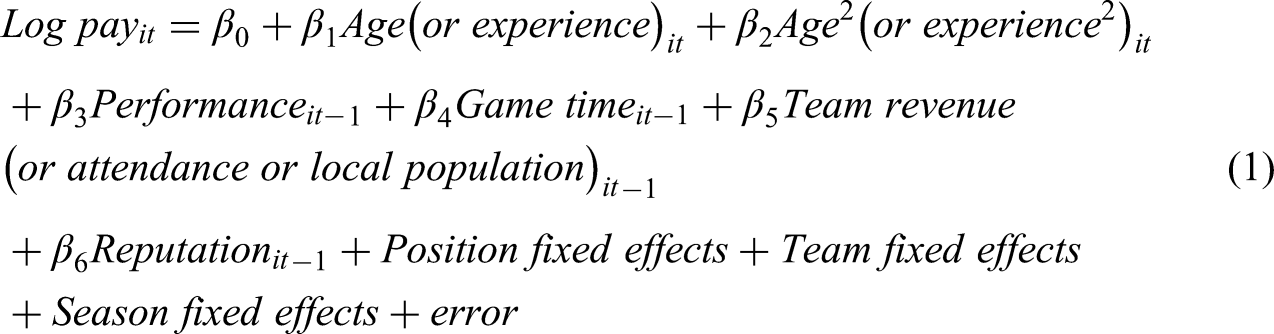
A common theme of papers published in JSE on pay and performance of players in sports leagues is the estimation of equation (1) with various refinements to address specific research questions. The two sports in JSE with the most coverage of salary models are MLB (eight papers) and European soccer leagues (seven).
The salary measures used in papers covering North American sports are fairly straightforward. MLB and NBA salaries are guaranteed, and data can be garnered from various sources. For NHL, Vincent and Eastman (2009) used data from the players’ union (NHLPA) website but recent data showing “cap hit” values can be found on www.spotrac.com. The cap hit comprises base pay plus prorated signing bonus.
NFL salaries are not guaranteed and papers that model NFL pay use the cap values that are the NFL's official measurement of player salary values set against a team's salary cap. Although data sources for North American sports salaries have changed over time, the principle of open access to publicly available sources has not.
When we turn to European soccer leagues, we find that salary data are severely limited. The only publicly available and reliable source of European soccer salary data is from Gazzetta dello Sport for Italy's Serie A, published each September since 2008 by enterprising journalists with access to players’ employment records. Within JSE, it is surprising that only one paper has been published on individual pay and performance using these data (Drut & Duhautois, 2017). Outside of JSE, papers that model player pay from Italy include Bryson et al. (2014), Carrieri et al. (2018), Carrieri et al. (2020), and Fumarco and Rossi (2018).
Lack of actual salary data has led European researchers to use proxy measures for player pay. Prominent proxies are Kicker magazine player valuations published at beginning of each season for German Bundesliga and Transfermarkt valuations for European football (Bryson et al., 2013; Deutscher & Büschemann, 2016). In defense of the validity of these proxy measures, Deutscher and Büschemann note that total player Kicker valuations match total Bundesliga team payrolls to a proportion of 1.5. Prockl and Frick (2018) find correlation coefficients between Transfermarkt market values and actual player salaries of between 0.7 and 0.75 for Major League Soccer, where the correlation rises with greater coverage by the Transfermarkt expert community since 2010. Prockl and Frick conclude that Transfermarkt estimates represent a good proxy for player salaries in soccer leagues.
In contrast, using a cross-sectional sample of players in Norwegian football, Thrane (2019) finds the correlation between Transfermarkt values actual salaries to be just 0.6. Thrane's salary estimates show quite different effects from career games, season dummies, club affiliation, age and age squared (where the peak age is three years apart), and player nationality dummies (insignificant for Transfermarkt but significant for actual pay). It appears, though, that Thrane excluded young players and players who mostly sit on the bench from his sample (173 out of a population of 413 contracted players). This makes the correlation between market values and salaries weaker. Since market values peak much earlier than salaries, the correlation gets weaker as particular subgroups of players are excluded. Also, market value estimates are likely to be less precise for soccer leagues, such as Norway, outside of the top five, due to reduced coverage among Transfermarkt contributors.
In JSE, the dominant estimation method for equation (1) is Ordinary Least Squares (OLS). Strangely, only one paper has playerfixed effects (Drut & Duhautois, 2017) although team and seasonfixed effects are typically included. Where panel data are used, the groups are often too small for meaningful estimates to be obtained via playerfixed effects. Only two papers offer instrumental variables estimation to deal with endogeneity of explanatory variables due to the correlation of omitted variables with the error term. Such practice is prevalent in the broader labor economics literature (Angrist & Pischke, 2009). Outside of JSE, Carrieri et al. (2020) use team numbers of yellow cards (cautions) as an instrument for incidence of player injuries as an endogenous variable in their salary model.
Six papers in JSE have applied quantile regression to treat the skewed and non-normal distribution of log player pay, beginning with Leeds and Kowalewski (2001) on NFL. This estimation method is especially relevant for the detection of superstar effects (Kuethe & Motamed, 2010; Lucifora & Simmons, 2003). Quantile regression estimates broadly show increased sensitivity of pay to performance and experience when moving up the salary distribution (Lucifora & Simmons, 2003; Vincent & Eastman, 2009).
Salary models on North American sports typically deploy age or experience but not both due to collinearity. Age of entry into leagues is most often by draft at the early 20s. Player pay typically has a predicted concave shape in a player experience that reflects diminishing marginal productivity due to physical wear and tear and difficulties in recovery from injury. In Brown et al. (2017), for example, veteran baseball pay peaks at eight years of experience, where six years is the qualifying period for free agency, and the sample mean is 10 years. An interesting behavioral question is whether team executives properly recognize the upcoming downturn in productivity for a new baseballfree agent (Solow & Krautmann, 2020b). In soccer, Lucifora and Simmons (2003) and Thrane (2019) find a turning point for actual pay at age of 28 that does conform to industry expectations of peak player productivity. More generally, the correlations between age and, respectively, expected salary and player performance merit greater attention across various sports leagues.
Measuring player performance is at the heart of player salary estimation. For North American sports, research on baseball has moved on from slugging average for hitters and earned run average for pitchers. On base percentage plus slugging average is now widely applied and is an economically significant predictor of pay. For pitchers, Scully (1974) and Bradbury (2007) emphasize the importance of measures that are independent of fielding, which earned run average is not. As such, Bradbury shows that strikeouts have consistently significant effects on pitcher salary over 1986-2004. Bradbury also suggests that a good metric should feature between season consistency, otherwise it is too noisy to be useful. Again, strikeouts serve this purpose better than earned run average for pitchers.
Several papers modeling NBA salaries have used Wins Produced as a superior measure of player productivity over the NBA's own efficiency measure (Simmons & Berri, 2011). In NFL, yards gained appear to be a good metric for skill position players (Berri & Simmons, 2009). New measures have been developed for offensive linemen including pass and run blocking efficiency by Pro Football Focus. Approximate value is an algorithm-generated single metric available on Pro Football Reference for all NFL positions (Gregory-Smith, 2021).
Soccer is a fluid, interactive sport. Even recent papers on soccer salary models have used very basic indicators such as goals and assists (Carrieri et al., 2018), which are heavily loaded in favor of forward and against defensive players. One alternative to these measures would be journalist ratings such as those from Kicker in Germany (Deutscher & Büschemann, 2016). More recently, player ratings for several European leagues have been produced by www.whoscored.com. However, ratings may well contain biases in favor of particular players or teams and, in the case of who scored, the range of seasonal averages from 6.5 to 8.2 looks suspiciously small on a 1–10 scale.
For each sport, it is possible to find a performance metric that predicts salary. The interesting behavioral questions are whether players are paid according to marginal revenue product, whether anomalies occur in pay setting, whether performance expectations are realized in player contracts, and whether the player labor markets in these sports are efficient. On these broader questions, evidence is mixed. For example, Healy (2008) finds that recent season baseball hitter performances predict player pay far better than previous performances, two to three years back. Healy attributes this result to “memory bias” where team executives take note of most recent performances as salient and reject information from earlier periods. But this result could simply mean that previous performance is not relevant to expectations of future performance imbedded in player contracts. Performances three years back were probably with different players, possibly a different team and in a different context, for example, contention for playoffs. The connection between expected and realized performance merits further research (Krautmann, 2017, 2018).
As a further anomaly, Ashworth and Heyndels (2007) find that young German soccer players born soon after a selection cutoff point for year groups are more likely to be selected for training by Bundesliga teams than later-born players, a relative age effect. Yet, later-born players get a salary premium over early-born players. This could be due to selection on ability (the later-born players are better) or peer effects (the younger players learn from peers in training). This highlights a broader area of neglect in the pay–performance literature. Peer effects and productivity spillovers have received little attention. Arcidiacono et al. (2017) are a notable exception delving into play-by-play NBA data to assess productivity spillovers with the interesting result that spillovers affect team production positively but have little impact on individual salary. Further work to assess productivity spillovers and teammate interactions using high-frequency data in other sports is desirable.
Two papers in JSE reflect the influence of Moneyball and the subsequent growth of sports analytics on the pay–performance relationship. According to Hakes and Sauer (2006), the Oakland A's franchise encouraged hitters to check their swings to induce a “ball” with four balls leading to a “walk” to first base. If practiced widely, this would raise demand and salary returns to the skill of plate discipline reflected in higher values of On Base Percentage. Using different sample periods, Brown et al. (2017) and Congdon-Hohman and Lanning (2018) offer empirical support for this conjecture although it is rejected by Holmes et al. (2018) for their sample of free agents in first year of new contract.
Baseball has undergone several small but significant changes since Moneyball was published in 2003. These include the introduction of retrospective video replays to review umpire decision-making and a change in umpire behavior where strikes toward the bottom of the zone were called more frequently (Mills, 2017). Subtle changes in game technology can affect player productivity and player salaries. Impacts of technical progress in sports on player careers are worth pursuing in future research.
Some JSE papers analyze the relationship between contract length and pay, again specific to MLB. Krautmann and Oppenheimer (2002) estimate

Link and Yosifov (2012) estimate a similar model to Krautmann and Oppenheimer (2002) but with different sample periods (1984-1989, 1990-1994, 2003-2006). They use the Win Shares measure, essentially a player's contribution to team wins, as an alternative to slugging. Contract length is again treated as endogenous, this time with the number of disability days in past two years as the instrument. Link and Yosifov broadly confirm the findings of Krautmann and Oppenheimer. For the whole sample over 2003-2006, the interaction coefficient is −0.024 and significant. Restricting the sample to players with at least 10 years of service and using Win Shares, returns to performance are reduced by 2% in exchange for one extra contract year. The trade-off between returns to performance and contract length exists even though pay is positively related to both performance and contract length.
In MLB, many players accept contract extensions while in the final year of their existing contract. The contract extension buys out the remaining contract and adds extra years, potentially with a greater annual salary. If a player still with a rookie contract takes this offer, he will necessarily defer entry into free-agent status. The extension guarantees the team control of player services through the contract extension, while a risk-averse player might see an advantage in avoiding the uncertainty of the free-agent market. Krautmann (2018) argues first that a contract extension typically raises a player's annual salary and second, more contentiously, aligns an MLB player's pay with his marginal revenue product.
In Krautmann (2018), a player's marginal revenue product is assessed relative to the value of output of a replacement player using the Wins Above Replacement (WAR) measure as reported in www.baseball-reference.com. The WAR player is an average AAA player who might appear in MLB as a replacement for an injured player. It is important to stress that Krautmann (2018) is estimating relative marginal revenue product of a player and not an absolute marginal product. The replacement player need not be the average AAA player and may instead be a veteran free agent. If the replacement player is called up from AAA minor league then it is important to consider the productivity distribution of this type of player and not just the mean.
The connection between pay and marginal revenue product is investigated by Solow and Krautmann (2020b). Starting with the notion of long-term contracts as a mechanism for players and teams to share risks, they estimate present values of marginal revenues and future salaries. The estimates reveal a negative surplus, with marginal cost above team marginal benefits for the majority of long-term contracts that they observe. As with Krautmann (2018), the present value estimates are net of pay and productivity contributions of replacement player as captured by WAR. Further work is needed to assess the results of Krautmann (2018) and Solow and Krautmann (2020b) using metrics for the productivity of replacement player other than WAR. More generally, the effects of different contract types on the relationship between pay and marginal revenue product merit further analysis, not just for MLB.
Gregory-Smith (2021) offers an alternative approach for NFL players based on lost cap value to teams from injured players. Gregory-Smith finds that, on average, NFL players have pay equal to marginal revenue product but this conceals heterogeneity. As is well-known, rookie players are subject to monopsony exploitation and receive pay below marginal revenue product. Therefore, Gregory-Smith's results imply that some veterans have pay above marginal revenue product. This should be investigated further.
Discrimination
The presence of various racial and ethnic groups in sports teams leads naturally to the consideration of possible discrimination. This is broadly defined as unequal treatment of groups of players of similar characteristics, including productivity. Unequal treatment covers pay, hiring, and career length (exit discrimination). Sources of taste-based pay discrimination are employer, customer/fan, and coworker (teammates). Statistical discrimination in pay via stereotyping of particular groups of players is another possibility. Unlike papers on bargaining and contracts, papers are spread widely across North American leagues with five on NFL, four on NBA, and three on NHL. MLB is featured in just two papers and soccer also has two.
Following Becker (1957), taste-based discrimination should not persist in competitive product and labor markets as firms that avoid discrimination should gain a competitive advantage. This forces discriminating firms to either exit their industry or abandon pay discrimination. Goff et al. (2002) draw upon this principle to explain the process of integration of Black players into MLB in the 1940s and 1950s, starting with the famous example of Jackie Robinson. According to Goff et al., a small group of “entrepreneurial” teams led the process of Black player integration that was then followed by all teams. This argument is challenged empirically by Hanssen and Meehan (2009).
Early papers on pay discrimination in JSE focused on possible discrimination against French Canadian players on Canadian teams outside of French-speaking Quebec (Curme & Dougherty, 2004; Lavoie, 2000). These papers have cross-sectional data applied to an extension of wage equation (1) with dummy variables added to denote ethnic groups. In their fullest model, Curme and Dougherty estimate a large 31% wage penalty for French Canadians on Canadian teams outside Quebec. But this penalty does not imply discrimination unless one is convinced that sufficient productivity measures have been included in the model.
Standard empirical labor economics treatment of pay discrimination offers wage equations estimated separately for groups of players. This is typically followed by an Oaxaca–Blinder decomposition that breaks down the mean pay gap between worker types into endowments (quantities of characteristics) and returns to characteristics. Differences in returns to characteristics indicate pay discrimination, again assuming sufficient productivity measures.
The basic Oaxaca–Blinder approach has not generally been followed in papers published in JSE. One reason for this omission is insufficient observations on the minority group. For example, Berri and Simmons (2009) only have 95 observations of Black NFL quarterbacks in a total sample size of 530. Rather than estimate separate Black and White salary models, Berri and Simmons include a dummy variable for Black together with interaction terms for Black with performance metrics. Here, the details of the estimated pooled salary model become interesting. The Black dummy has an insignificant coefficient but Black interacted with pass yards has significant, negative coefficients in quantiles 0.5 and above. Moreover, Black quarterbacks are observed to make more rushing yards than White quarterbacks yet are not rewarded for this additional performance. These results suggest that the examination of the details of salary models is needed as these will not be revealed by a general Oaxaca–Blinder decomposition.
The basic Oaxaca–Blinder decomposition is applied to mean pay gaps. But in sports leagues especially, with a skewed distribution of log salary, it is important to investigate pay disparities away from the mean. The Melly (2006) decomposition generalizes the Oaxaca–Blinder procedure to quantile regressions, and this approach has been applied in two papers in JSE on NFL players. Keefer (2013) models of pay of linebackers over 2001-2009 finding evidence of significant differences in coefficients of returns to characteristics between Black and White players throughout the distribution. These differences are greater at 0.1 and 0.9 quantiles.
Burnett and Van Scyoc (2015) model pay of linebackers and offensive linemen also over 2001-2009 but with a different sample to Keefer. Using both a Black dummy and quantile treatment effects in quantile regressions, they find no evidence of pay discrimination against Black players. The authors’ rationale for the difference in results from Keefer (2013) is that their sample was based on a later period of entry into the NFL in which awareness of discrimination had increased. This echoes Goff et al. (2002) and presents an intriguing problem for further work. If it is indeed the case that pays discrimination against Black linebackers was present in the 1990s but not later on, then how did discrimination get removed? The numbers of Black and White offensive linemen and linebackers should be sufficient to estimate Melly quantile treatment effects.
Following the seminal work of Szymanski (2000) on discrimination in English football in the 1970s and 1980s, Mongeon (2015) performs a “market test” on NHL. This involves regressing team performance on team (relative) payrolls and shares of ethnic groups on NHL team rosters. Mongeon finds significant coefficients on ethnic group shares in both OLS and IV estimations where team payrolls are endogenous. Of course, this exercise depends on team relative payroll being a good proxy for team quality which Mongeon argues does hold for NHL despite the presence of a hard salary cap.
Instead of using a Black dummy variable, Robst et al. (2011) adopt a continuous measure of skin color derived from skin pigmentation and assessed by software. Applying this measure to NBA salaries, they find an insignificant coefficient on their “skin tone” measure, and this indicates the absence of pay discrimination in this league.
The only paper in JSE on discrimination against player types in MLB is an early contribution by Bellemore (2001). This uses probit estimation to show that promotion from AAA Minor League to Major League was less likely for Black players in the 1960s, 1970s, and 1990s. Contrary to the hypothesis of integration, this result persists into the 1990s with a Black player having an 8.7% lower probability of promotion relative to a White player with similar performance. Interestingly, Bellemore finds that hiring discrimination falls as the league expands its number of teams (and therefore the total pool of players).
Groothuis and Hill (2018) model career durations using hazard functions estimated overall NBA players between 1990 and 2013. Foreign-born players who did not play college basketball in United States have shorter careers than US-born players. This could reflect exit discrimination. However, foreign-born players who did play college basketball in United States do not have shorter careers than US-born players. The results need not imply discrimination per se but are consistent with the primacy of the college draft in player hires and, conversely, a downgrading of experience and backgrounds of foreign-born players who did not attend a US college. In addition, as Groothuis and Hill point out, the greater attractiveness of basketball leagues outside North America could represent a significant “pull” factor for foreign-born players. This merits further analysis.
Focusing on the effects of race on NFL quarterback survival rates with a variety of hazard function estimations, Volz (2017) finds that Black players have a greater probability of exit from NFL relative to Whites. Volz argues that Black quarterbacks are shown “less patience” than observationally equivalent White quarterbacks. Black players are less likely to be starters and more likely to exit the league. Moreover, there is some tentative evidence that Black quarterbacks suffer less exit discrimination in areas with a greater proportion of Black residents in the population.
Two papers offer evidence on hiring discrimination outside of North America. For Australian Rules football, Mitchell et al. (2011) find that performance evaluations of indigenous Australians are higher than for nonindigenous players. The player ratings here represent expected performance; indigenous Australians deliver performances that on average exceed expectations. For Uruguayan soccer, Gandelman (2009) models player performance with a race dummy included and finds that non-White players deliver better performances than White players. If the two groups share the same talent distribution then this would imply discriminatory treatment of non-White players in hiring. However, the crucial assumption of similar talent distributions is not tested.
Overall, the evidence of hiring and exit discrimination in various leagues looks stronger than the evidence for salary discrimination. Results vary by league and the sources of hiring and exit discrimination need further analysis. In particular, the processes of integration of particular ethnic groups need closer attention. Another important consideration worth pursuing is the impact of player survival on career earnings and whether Black (or other ethnic group) players suffer on this measure relative to White players.
Player Mobility and Player Draft
Twenty-two papers in JSE can be identified as covering player mobility and player drafts as barriers to entry into sports leagues. Eight papers are on MLB, with NBA and soccer leagues featuring four each.
Sports economists have long been fascinated by the Coasian Invariance Proposition, first stated by Rottenberg (1956). Processes governing the movement of players, such as the reserve clause in North American sports leagues, should not affect the allocation of player talent across teams. In an invited contribution in the first issue of JSE, Rottenberg (2000) suggests that players “find themselves” in teams that value them most highly and for which they are most productive. Directions and quantities of player movements should be the same in both freely competitive and constrained player labor markets. Player annual pay should be reduced to reflect any risk attached to player contracts.
Krautmann (2008) offers an alternative perspective on the Invariance Proposition with recognition of several obstacles to Rottenberg's assumptions. These assumptions include a lack of externalities that might affect team owners’ hiring choices. Without a reserve clause, team owners in large markets would bid for elite talent and, assuming a fixed talent supply, this puts small market teams at a competitive disadvantage. If fans respond adversely to the resulting lack of competitive balance, then league-wide revenues and profits are reduced. Supported by a reserve clause policy, team owners can discipline themselves to mitigate the external effects of their hiring choices. Other assumptions that might not hold are negligible transactions costs and players not considering nonpecuniary net benefits such as preferences for choice of location. Krautmann (2008) questions the assumptions behind the Invariance Proposition and suggests that players do not necessarily end up with teams that value their talent the most.
Depken (2002) shows that MLB free agency in 1976 had limited effects on the concentration of player talent. Using Herfindahl–Hirschman concentration indices over 1920-2000, Depken finds a reduced concentration of home runs but not strikeouts or runs scored in the period after free agency.
A further questionable assumption behind the Rottenberg Invariance Proposition is a fixed supply of talent. Using a similar data set to Depken and deploying unit root tests, Schmidt and Berri (2005) find that dispersion in player performances fell after free agency and they attribute this to an expansion of the baseball talent pool as teams widened their player search geographically. The effects of the entry of baseball players from Caribbean, Latin American, South American, and Asian countries on the player labor market have surprisingly not been considered so far in JSE papers.
Restrictions on player movement in soccer were fully loosened with the Bosman ruling of 1995. In line with the free movement of labor throughout the European Union, footballers could move freely within and between European soccer leagues after the expiry of their contracts, whereas previously clubs could demand a transfer fee as compensation even if a player was out of contract. After the Bosman ruling, player pay accelerated in a similar pattern to MLB free agency (Dobson & Goddard, 2011).
In soccer, player mobility increased, both between and within leagues. Two JSE papers examine the process of assortative matching where better players move to better teams. For the Uruguayan league, Gandelman (2008) estimates probit models for moves to better or worse teams in the 2000 season. Gandelman finds that players with strong performances, as assessed by journalists’ rankings, are rewarded by move to better teams. Players with weaker performances tend to move to poorer teams. This suggests positive assortative matching.
An analysis of assortative matching that conforms to standard labor market applications, such as Abowd et al. (1999), is offered by Drut and Duhautois (2017) for Italy Serie A. From player wage equations with panel data over 2009-2014, the authors extract player and team fixed effects. The significant positive correlation between the two sets of fixed effects indicates positive assortative matching. Moreover, player fixed effects show a greater correlation with log wage than team fixed effects. This indicates the presence of superstar effects in Italian football. Outside of soccer, Peeters et al. (2020) find evidence of assortative matching in the market for field managers and general managers in MLB.
The standard theory of labor migration proposes that net of monetary and psychic costs, workers move between locations dependent on wage differentials between host and sending regions or countries (Borjas, 2020, ch. 8). Within North America, States and Provinces have different average and marginal rates of income tax. This variation is exploited in two papers in JSE. For NBA free agents over 2001-2008, Kopkin (2012) shows that an increase in marginal income tax rate reduces the average skill level of free agents who switch teams. Skill is proxied by predicted salary from a wage equation similar to (1) with a variety of performance measures as regressors. Similarly, Alm et al. (2012) find that MLB free-agent salaries over 1995-2001 were raised by around $22,000 per annum for each percentage point increase in the local income tax rate. Tax differences are reflected in pretax salary offers. Teams in low-tax states, such as Florida, Texas, and Washington, then gain a competitive advantage. Both papers offer support for the standard theory of labor migration.
Lack of mobility for drafted players and relatively small sizes of major leagues in North America jointly result in monopsony exploitation of young players with pay below marginal revenue product. Following Scully (1974), the standard approach to the estimation of marginal rates of exploitation entails first, regressing team wins on player performance inputs to determine marginal productivity and second, regressing team revenues on team wins to convert marginal physical product into marginal revenue product.
In a rare analysis of a female sports league in a JSE paper, Giddings and Haupert (2019) compare marginal rates of exploitation for the short-lived All American Girls Professional Baseball League (AAGPL) with MLB over 1947-1952. Female baseball players were paid much less than their male counterparts with women pitchers earning a 0.1 fraction of male pitcher pay. But across all players, the MLB marginal rate of exploitation was estimated at 0.92, while for women it was somewhat lower at 0.79–0.82. The authors attribute the lower exploitation rates for women to a not-for-profit ownership structure in AAGPL and a growth in female reservation wages over the immediate postwar reconstruction period.
In a refinement of the Scully model, Fort et al. (2019) estimate marginal rates of exploitation in MLB through the team revenue distribution using quantile regression. Applications of the Scully model to team monopsony power typically take total revenues as determined by team wins at the revenue means, using OLS. Quantile regression estimates show lower marginal revenue product and marginal rates of exploitation for smaller revenue teams. Conversely, marginal rates of exploitation are higher for larger revenue teams. At median revenues, pitcher and hitter marginal rates of exploitation are estimated at 0.78 and 0.83, respectively, in line with earlier estimates, but there is considerable variation in numbers both between teams and through the revenue distribution.
Several papers in JSE have evaluated the economic effects on teams and players of the draft process in North American sports leagues. For teams, draft pick numbers have been shown to be imperfect predictors of future player performance in NBA (Berri et al., 2011) and NFL (Berri & Simmons, 2011). Motomura (2016) extends this argument to consider the drafting of international players by NBA teams. Examining 580 players drafted over 1996-2005, Motomura shows that, up to 2001, drafted international players outperformed expectations when controlling for draft position. After 2001, teams reacted by drafting more international players, International players picked in first round then underperformed relative to expectations suggesting overreaction and suboptimal evaluation of players by teams.
The college sports system provides future professional players with both a human capital element via college experience and a signal of future potential, based on the sports program reputation of the college. For NBA draftees, Groothuis et al. (2007) find some support for both human capital and signaling components. In their wage equation for NBA rookies for 1997 and 2002, college experience variables are significant predictors of rookie salary. By drafting players early in college, teams can lengthen rookie contracts to help them pay for general human capital. If a team captures a star player early, it can exploit economic rent for more years if the player is a college junior. However, identifying a future star player is of course very difficult.
Especially in MLB and NBA, players can choose whether to enter after high school or during college. This raises the question of whether expected career earnings in the chosen sport exceed opportunity costs for the draftee. Pifer et al. (2020) use a novel machine learning method to evaluate the expected career earnings of MLB draftees. Their procedure follows three steps. First, the software delivers probabilities of a player appearing in seven different classifications over his early career, ranging from MLB to permanently out of professional baseball. Next, financial data and predicted probabilities are used to estimate the expected salary over a player's first six seasons. Finally, the player's expected income is compared to those initial players who did not sign professional contracts. On this basis, Pifer et al. compute the threshold draft pick number at which a player is indifferent between signing a professional contract and staying out of the sport. Earnings outside of baseball are total six-year incomes for 18- to 24-year-olds according to educational attainment.
For picks below the threshold, a signing bonus or high expected performance is needed to offset the opportunity costs of playing baseball. For example, the threshold for pitchers with some college experience is pick number 171. For college graduates, the threshold rises to 32. Pifer et al. (2020) suggest that young baseball players may be unrealistically optimistic about their chances of success. The prospects look especially gloomy for players who are stuck in Minor Leagues as pay there is very low, and players are exploited even more than in MLB. This raises a concern for MLB. The draft selection process leads to the development of general human capital in Minor League teams supported by monopsony exploitation of rookies (Krautmann et al., 2000). However, pay at Minor League teams may not cover a player's reservation wage especially if the player is a college graduate. Moreover, star players are often multitalented and have choices over which sport to enter. Then, the relative severity of rookie employment contracts in different sports may play a role in player choices. This point has not been explored in research so far.
Concluding Remarks: What Next?
Papers on sports labor markets published in JSE offer valuable insights. But there is considerable scope for further work. Empirical labor market papers in JSE are typically on single leagues so it is not clear if or how results generalize beyond the specific applications. Establishing “external validity” is a challenge for future papers in JSE to address. Soccer leagues remain underrepresented in studies, largely due to inadequate data on player pay, performances, and contracts. This is already changing as new websites emerge such as https://fbref.com with very detailed performance indicators.
It is clear that player pay responds to lagged player performance in most leagues studied in JSE. Whether particular player positions and types are “properly rewarded,” as Bradbury (2007) suggests occurs for MLB pitchers, is a more difficult question to assess but deserves further scrutiny. Are some veteran free agents paid above marginal revenue product and if so why? What do superstars really bring to team revenues? Do deferred compensation explanations of player career earnings dominate market power explanations (Gregory-Smith, 2021)?
An important line of inquiry to follow here is the connection between broadcast rights deals for sports leagues and their impacts on player pay and contracts. In soccer and NBA especially, overseas sales of broadcast rights have grown in value over time, partly driven by the appeal of particular star players. If superstars capture much of the rents from overseas broadcast rights, how does this affect other players? Do they respond positively with the expectation that high-earning teammates will help them achieve team performance objectives such as playoff appearances and Champions’ League success? Alternatively, do envy and lack of team cohesiveness appears with damage to team morale and team performances? In soccer leagues, it is often alleged that “arms races” develop where teams overbid for player talent in an unconstrained quest for team success. Can this be ascertained at the player, rather than the team, level?
The emergence of documented high-frequency play-by-play data should facilitate the study of productivity spillovers between teammates. The finding of Arcidiacono et al. (2017) that productivity spillovers affect team output but not individual pay is specific to NBA. Does this result generalize to other leagues where player roles are more specialized, such as NFL or MLB?
Research in JSE shows that the best players get the longest contracts but there is a trade-off between contract length and returns to performance. The latter result is specific to MLB (Link & Yosifov, 2012) and needs to be generalized. The impacts of particular CBAs on player contracts and pay distribution also merit further inquiry. Behavioral biases in pay and contract setting, such as endowment effects in player trades, outcome bias in performance evaluation, and memory bias in pay determination (Healy, 2008) can also be investigated.
Research in JSE has found little evidence of pay discrimination but some evidence of hiring and exit discrimination (Volz, 2017). Studies of exit discrimination that use duration analysis could consider competing risks models for multiple exit states, not just staying at current team or leaving the league.
It is difficult to apply difference-in-difference analysis to sports labor markets. This is because changes in rules and regulations in sports labor markets typically affect all teams at the same time. A future study on player movement in European soccer leagues could draw upon the recent exit of Britain from the European Union and associated variations in work permit rules for players across Europe. Although free movement of players within the European Union, minus Britain, remains a core principle there are various work permit restrictions applied to immigration of players from outside the European Union.
Papers in JSE have come a long way, econometrically, from single-season, cross-sectional studies of the 2000s. Econometric methods have advanced considerably over 20 years, and longitudinal data sets are now routinely used in sports economics. We should therefore expect to see sports labor market applications in JSE that feature the following:
Machine learning methods such as Lasso and Random Forest to identify relevant player productivity effects from multiple measures; Searches for instrumental variables in pay–performance and pay–performance–contract length relationships; Propensity score matching methods to identify effects of ownership and head coach changes and other endogenous impacts on player careers; Application of player fixed effects in pay–performance models; Estimation of unconditional as well as conditional quantile regression models of player pay (Carrieri et al., 2018); Estimation of staggered difference-in-difference models of player pay and performance where events such as Covid-19 infections occur at different times; Competing risk models of player career duration.
Armed with these contemporary techniques, the future for scholars working on professional sports labor markets looks very bright. JSE will continue to be an important outlet for these future studies.
Footnotes
Acknowledgments
The author thanks Bernd Frick and Brian Mills for helpful comments on an earlier draft.
Declaration of Conflicting Interests
The author declared no potential conflicts of interest with respect to the research, authorship, and/or publication of this article.
Funding
The author received no financial support for the research, authorship and/or publication of this article.
