



Abstract
Objective:
The objective of this study was to compare the perioperative performance of the novel large-diameter composite polycarbonate polyurethane graft and the polyester graft.
Methods:
In this study, we retrospectively analyzed 14 patients with thoracic aortic prosthesis replacement from 2016 to 2021. The preoperative, intraoperative, and postoperative data of the 2 groups were assessed in detail.
Results:
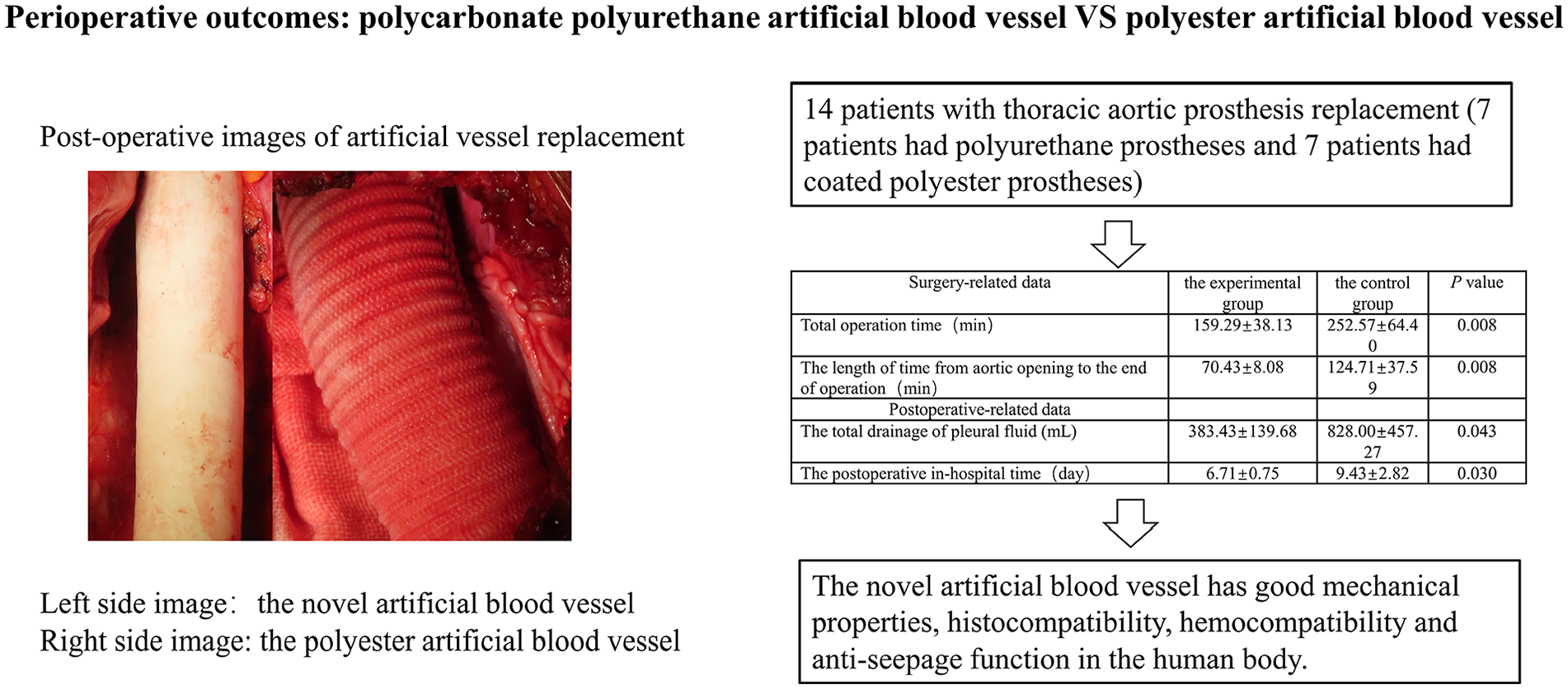
We defined the patients with polyester grafts as the control group and the patients with polycarbonate polyurethane grafts as the experimental group. The total operation time of the experimental group was significantly shorter than that of the control group, which were 159.29±38.13 minutes and 252.57±64.40 minutes, respectively (p<0.001). The length of time from aortic opening to the end of operation in the experimental group was significantly shorter than that in the control group, which were 70.43±8.08 minutes and 124.71±37.59 minutes, respectively (p<0.001). The mean total drainage of pleural fluid was lower in the experimental group than in the control group (383.43±139.68 mL vs. 828.00±457.27 mL; p<0.05). The mean postoperative in-hospital time was shorter in the experimental group than in the control group (6.71±0.75 days vs. 9.43±2.82 days; p<0.05).
Conclusions:
This study provides preliminary evidence that the novel artificial blood vessel has good mechanical properties, histocompatibility, hemocompatibility, and anti-seepage function in the human body. A multicenter randomized controlled trial is needed for further validation.
Clinical Impact
The novel hybrid polycarbonate polyurethane (PCU)/polyester three-layered large-diameter artificial blood vessel simulates the internal, middle, and external layers of the human blood vessels. The inner and outer layer are made of PCU, and the middle reinforcing layer is woven by polyester. Because of the three-layered structure, this artificial blood vessel has excellent anti-seepage and anti-infection functions. the inner and outer layers of the blood vessel made of PCU let this artificial blood vessel has excellent blood compatibility, outstanding biocompatibility, high endothelialization rate, and 100% patency. By comparing the perioperative outcomes with the polyester artificial blood vessel, we find it has good mechanical properties, histocompatibility, hemocompatibility and anti-seepage function in the human body.
Get full access to this article
View all access options for this article.
References
Supplementary Material
Please find the following supplemental material available below.
For Open Access articles published under a Creative Commons License, all supplemental material carries the same license as the article it is associated with.
For non-Open Access articles published, all supplemental material carries a non-exclusive license, and permission requests for re-use of supplemental material or any part of supplemental material shall be sent directly to the copyright owner as specified in the copyright notice associated with the article.
