



Abstract
Research with families and friends of homicide victims (FFHV) requires researchers to consider how to best protect participants. Due to the nature of this type of research, researchers need to be aware of concerns such as sensitivity due to the emotional weight of sharing about their loved one, mental health, and trauma. Although there has been an increase in research focused on FFHV, no known research has provided guidance on considerations for holding focus groups (FG) with FFHV. Based on several years of holding focus groups with FFHV, this short take provides suggestions that include the following: selecting a research team; confidentiality; victim-informed questions; the research environment; research time and location; mental health concerns; participant burden; support information; concluding the groups; and researcher transparency and accountability.
Introduction
Research on families and friends of homicide victims (FFHV) include studies employing qualitative or mixed methods research (see Connolly and Gordon 2015; Costa et al. 2017), with a growing number of these studies utilizing focus groups (FG) (see Armour and Umbreit 2012; Englebrecht et al. 2014; Hartwell et al. 2018; Mastrocinque et al. 2015; Mastrocinque et al. 2023; Reed and Caraballo 2022; Reed et al. 2020). FGs are beneficial because they could be more comfortable for discussing difficult topics (Kitzinger 1994), identify group norms (Kitzinger 1994:116), capture dimensions of understanding not feasible through conventional data collection (Kitzinger 1995), allow exploration of one’s experiences “in their own vocabulary, generating their own questions and pursuing their own priorities” (Kitzinger 1995:299), and be “an important tool for accessing the experiences and attitudes of marginalized and minority groups” (Hesse-Biber 2017:151).
Such sensitive research requires considerations such as the emotional weight of FFHV sharing about their loved one, mental health, and trauma; however, no known research provides guidance for holding FFHV FG. Existing guidance focuses on FFHV interviews (Goodrum 2019) or trauma-related research in general with attention to these aspects: IRB requirements and ethics (Parkes 1995; Rosenblatt 1995); categorical assumptions regarding perceived vulnerabilities of participants in trauma-focused studies (Griffin et al. 2003; Newman and Kaloupek 2004; Newman et al. 1999); and participants’ views of their research participation (Dyregrov 2004; Griffin et al. 2003; Legerski and Bunnell 2010; Ruzek and Zatzick 2000; Walker et al. 1997).
Background
The recommendations presented are based on my FFHV FG experiences (in collaboration with a research team) with seven FG of 23 participants across three states (see Table 1) (Mastrocinque et al. 2015; Mastrocinque et al. 2020; Mastrocinque et al. 2023; Metzger et al. 2015). Four groups were from one site of a multisite, multistate study (Mastrocinque et al. 2015), and while I did not hold the other sites’ FG, the larger collaboration allowed across site discussions regarding research preparation and experiences.
Information on Focus Groups.
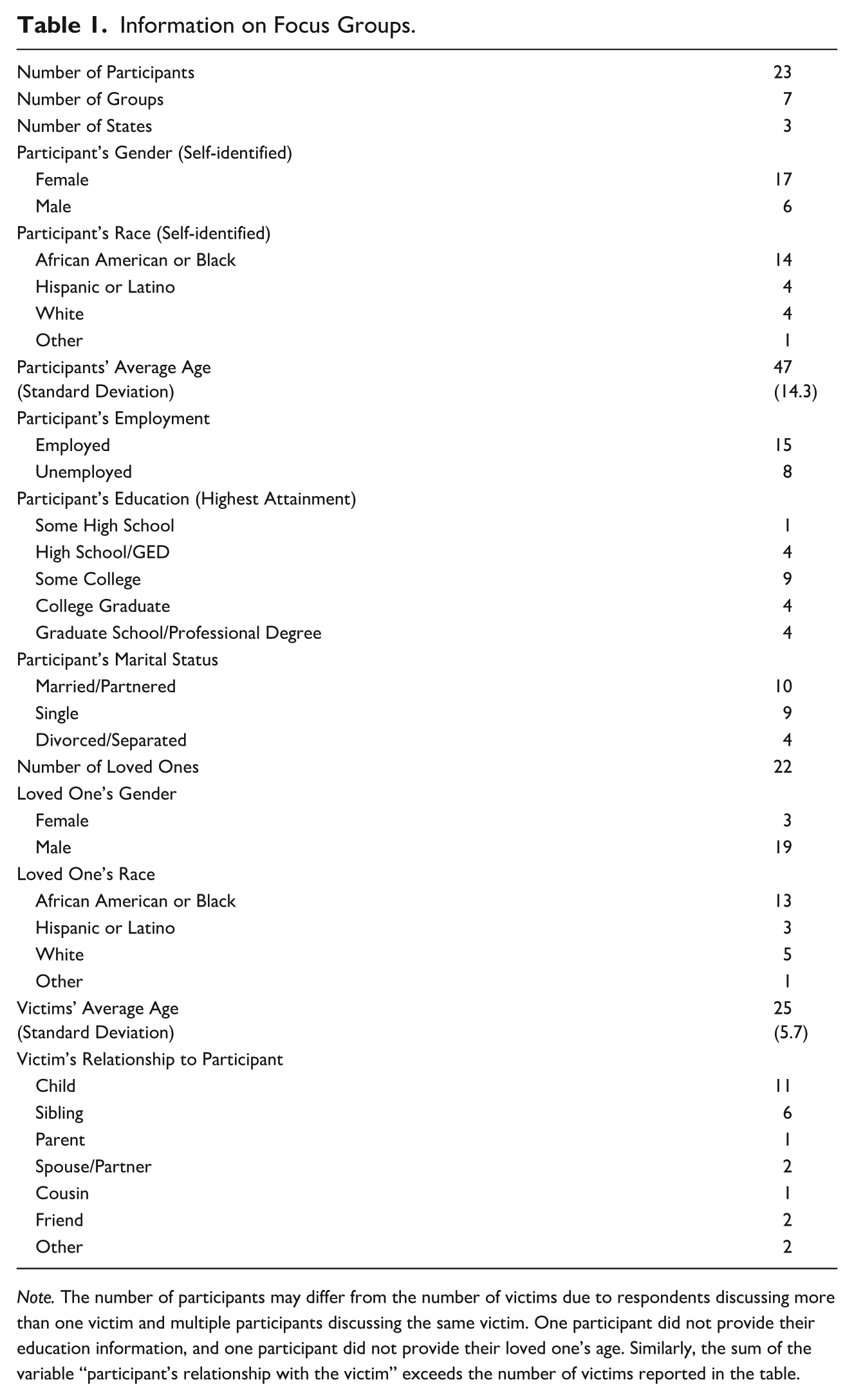
Note. The number of participants may differ from the number of victims due to respondents discussing more than one victim and multiple participants discussing the same victim. One participant did not provide their education information, and one participant did not provide their loved one’s age. Similarly, the sum of the variable “participant’s relationship with the victim” exceeds the number of victims reported in the table.
Participants were also provided individual surveys with an open-ended question regarding their FG participation experience. Participants’ responses in our most recent study (Mastrocinque et al. 2023) included the following quotes: “very engaging,” “very enlightening because of the interest they have in helping or interest in finding other significant ways to help families of homicide,” being able “to express myself without interruptions,” and “Sometimes I want to scream and cry but just hold it in. Today I was able to talk about it” (Research participant, survey responses 2018).
Additionally, I have held three suicide-loss survivor FG (N=15). Although these are two unique populations with unique experiences, some concerns regarding FG with people who have experienced an unexpected traumatic death of a loved one warrant similar considerations for both populations.
Considerations
Selecting a Research Team
Our studies utilize interdisciplinary teams (e.g., FFHV, physicians, mental health providers, victim researchers) which establishes many benefits. Team members can create questions specific to their discipline and analyze data from various perspectives (e.g., theories; frameworks). This approach can result in multifaceted victim-informed recommendations ultimately impacting multiple disciplines’ and systems’ responses.
Protecting Confidentiality
Participant confidentiality is a priority, especially because experiences may be specific enough to identify participants. During recruitment, we collect the first name and email or phone number for a reminder (if requested) or FG cancellation notification. We ask if messages can be left at the provided number to avoid others learning about study participation. After the group, we destroy participant contact information, and delete phone logs, phone messages, and sent/received emails. When scheduling FG, researchers should not confirm or provide any information about participants to other participants (e.g., who is attending which group). During the group, participants are not asked to provide their names and an information letter, provided before the FG with time to review, states that researchers cannot prevent research participants from sharing information discussed in the group. Other FFHV research has used confidentiality agreements (Reed and Caraballo 2022). We audio record, transcribe, and review the transcripts. We redact identifying information.
Creating Victim-informed Questions
Awareness of sensitive language (e.g., “closure” and “loss” are not always well received) and topics is important when creating questions (Goodrum 2019). Researchers can consider working with a FFHV or a FFHV organization, researching existing related surveys, consulting with other researchers, and exploring related literature. Existing FFHV interview research has used pretest interviews (Goodrum 2019).
Creating a Comfortable Environment
FG should be held in safe, secure locations. Locations near public transportation and parking are ideal with costs covered if possible (e.g., grant funded parking). Given the length of time of FG, restrooms and refreshments are important. Other considerations include a location away from public viewing and listening (e.g., avoiding a first-floor room surrounded by windows), having research team members spread out around the table, and providing tissues.
Participants should be informed that they can leave or take a break at any time, that service provision is not contingent on FG participation, and that anyone distressed can meet with the available counselor. The group should be asked for voluntary responses as opposed to requiring responses for each question from every participant. Some participants may be more outspoken or take longer to participate than others. It is important to understand that every person has their own process, timeline, and experiences navigating their life after a loved one’s homicide. Given the discussion, it is important to debrief both with the group and team members as noted in the subsequent section.
Selecting a Time and Location
When scheduling groups, consider when the groups would conclude. While beginning a group in the evening hours may seem most convenient for working participants, a three-hour focus group starting at 7 pm would conclude at 10 pm. The time of year should also be considered regarding early nightfall. Options can include earlier evenings, afternoons, or weekend afternoons. If researchers plan to utilize a standing support group’s meeting time, attendees should be notified in advance, and an alternative support option should be available for attendees not interested in FG participation.
Mental Health Concerns
It is critical to have a trained and licensed mental health care provider (MHCP) at the groups who is comfortable addressing potential mental health concerns or emergencies. Team members need to be aware of questions in surveys (e.g., suicidality assessments) requiring a MHCP to respond. Before the groups meet, the team should discuss the logistics of reviewing the questions, what responses to flag, how to subtly indicate to the MHCP they need to meet with the participant, and where the MHCP can meet with participants privately. It is best to have more than one MHCP in the event more than one participant needs to meet with the MHCP. Researchers should know nearby emergency medical and psychiatric intake locations and have a contact person, if possible, in the event of an emergency. As noted in the subsequent section, it is important to debrief when concluding the groups.
Participant Burden
Participants who signed up for a FG might attend late or not attend. If only one person attends, it is important to ask that person if they are comfortable discussing their loved one if no other participants attend. This precaution is to avoid participant burden (i.e., someone prepared to discuss a loved one’s homicide is turned away due to being the only person in attendance). The effort it takes to attend a group to share such an experience should be respected and appreciated.
Providing Support Information
Support information (e.g., handouts of local support groups, organizations, and online resources) should be available when screening for study eligibility and at the FG. In our research, cases could not be under active investigation; therefore, a FFHV impacted by a recent homicide would not be eligible. Support information should be readily accessible via phone or email.
Concluding the Groups
The MHCP can do a short debriefing exercise with participants at the conclusion of the groups and can provide individual debriefing opportunities. Research leaders should be aware of vicarious trauma team members may experience (see Office for Victims of Crime n.d.), have a debriefing plan with the team, and create a safe and comfortable environment for team members to discuss experiences honestly and openly. Creating this environment (e.g., the Principal Investigator being open to discussing concerns; checking in) is especially important when researchers (e.g., students) are on teams with supervisors and may be reluctant to discuss difficulties.
Researcher Transparency and Accountability
In recent studies, I prioritized transparency and accountability. This approach includes explaining that team members are unable to contact participants due to both confidentiality concerns and not keeping participant contact information; however, I encourage participants to contact me about the state of the work if interested. It is helpful to explain how long the research process takes, including publishing timelines and translating research into practice. Researchers can schedule a day to publicly share findings, even if preliminary, at a community venue. Presentation information can be announced at the groups and/or publicized through the same avenues used to recruit (e.g., flyers, social media, listservs). Researchers can discuss what has been done and what is planned with the research at the FG without overpromising deliverables.
Conclusion
FFHV research provides a voice to the experiences of a unique group of people. Often FFHV will participate interested in advocating for change, and researchers can communicate their stories to service providers and practitioners to better inform responses. Given the great privilege researchers are provided to have access to these stories and experiences, it is important that researchers take great care to create a comfortable, safe, and trusting environment.
Footnotes
Acknowledgements
An earlier version of this article was presented at the Homicide Research Working Group’s Annual Meeting in 2019. The author thanks Dr. Catherine Cerulli, Dr. Jed Metzger, Mr. Peter K. Navratil, and Mrs. Corey Nichols-Hadeed for their comments on earlier drafts of this paper and all research team members. We sincerely thank all of the participants for being willing to share their stories of their loved ones with us.

Funding
The author disclosed receipt of the following financial support for the research, authorship, and/or publication of this article: The families and friends of homicide victims focus groups reported in the table were from studies funded from three different sources. The Rochester site was founded through the National Research Service Award NIMH T32 MH18911 and the Innovations in Community Scholarship Award. The New Jersey and Pennsylvania sites were funded through the Researcher-Practitioner Fellowship from the Center for Victim Research (CVR) under grant number 2016-XV-GX-K006, awarded by the Office for Victims of Crime, Office of Justice Programs, U.S. Department of Justice. The opinions, findings, and conclusions or recommendations expressed in this short take are those of the contributors and do not necessarily represent the official position or policies of the U.S. Department of Justice.
Declaration of Conflicting Interests
The author declared no potential conflicts of interest with respect to the research, authorship, and/or publication of this article.