



Abstract
This study examined the feasibility of conducting a follow-up survey of panel attriters as a panel maintenance measure to investigate respondents’ reasons for attrition, assessing their willingness to rejoin, and updating their addresses. We surveyed FReDA panelists who had not participated in two consecutive subwaves and were excluded from the panel. The response rate for the follow-up survey was 7.1%. The most common reasons for non-participation in previous FReDA subwaves were time-related. Of the follow-up survey participants, 84.1% agreed to be re-contacted for the upcoming subwave. These respondents had promising participation rates of 67.4% and 53.8% in the two subsequent FReDA subwaves. Given the ease of conducting a follow-up survey online and its benefits in gaining valuable insights into the reasons for (temporary) attrition, re-engaging attriters, and updating their addresses, we consider it a valuable panel maintenance measure.
Introduction
Probability-based panel surveys offer numerous advantages, such as tracking individual changes and developments over time. However, they also face challenges, the most important being panel attrition—the loss of panel members over time—which can bias the data obtained if those who remain in the study differ systematically from those who drop out. In addition, the panel becomes progressively smaller over time, which reduces its statistical power (Lynn 2018).
Panel attrition may result from various factors such as participant fatigue, lack of interest, education and literacy, health problems or death, life changes such as the beginning or end of a relationship, moving in together, marriage, or birth of a child, or difficulty in maintaining contact (e.g., Beller et al. 2022; Lugtig 2014; Martin et al. 2021; Müller and Castiglioni 2020; Voorpostel and Lipps 2011). Questionnaire characteristics such as length, difficulty, and variety also influence respondents’ decisions about whether to participate again (Gummer and Daikeler 2020; Kleinert et al. 2021; Yu et al. 2022). Typically, some respondents—such as younger and older people, men, people with a migration background, and people with health issues—are more prone to panel attrition than others (Yu et al. 2022).
Panel attrition is primarily caused by two processes that involve various factors and present different challenges for researchers seeking to address them. First, non-location or non-contact (i.e., failure to locate or contact participants because they have moved or are otherwise unavailable). Second, non-cooperation, where panelists who no longer wish to participate either formally withdraw their consent or drop out without explicitly withdrawing it (Rübsamen et al. 2017). Understanding the factors contributing to panel attrition is paramount, as it allows researchers to address and mitigate its impact on survey outcomes. One way to discover these factors could be to conduct a follow-up survey of panel attriters.
Follow-up surveys are commonly conducted in the context of cross-sectional surveys. Nonrespondents are asked key questions about the survey topic, their sociodemographics, and their reasons for not participating in the main survey. This information can then be used for nonresponse analysis and adjustment (e.g., Busse et al. 2015; Couper et al. 2007; Lynn 2003; Olson et al. 2011; Vandenplas et al. 2015). As follow-up surveys are designed for the specific needs of each study, their content, target population, design, and mode of data collection may vary widely. This may limit the generalizability of results from previous follow-up surveys. Additionally, panel studies differ not only in terms of topic, length, frequency, and mode but also in terms of why participants drop out. Furthermore, we are not aware of any follow-up surveys designed to bring attriters back into the panel.
In this study, we investigated the use of a follow-up survey to address panel attrition. For this purpose, we conducted a follow-up survey of former members of FReDA—The German Family Demography Panel Study. FReDA covers various family-related topics, such as partnership, fertility behavior, parenting, work-family balance, and intergenerational relations (Schneider et al. 2021). FReDA surveys are mixed-mode, self-administered surveys using web-based (CAWI) and paper-based (PAPI) questionnaires. The FReDA panel was recruited in 2021 using a probability-based sample from German municipal population registers. In the 10-minute recruitment survey (W1R), respondents aged 18–49 years living in private households in Germany were invited by mail to participate in the panel (i.e., FReDA-GGS sample; Hank et al. 2025). The W1R response rate (RR2; AAPOR 2023) was 34.9%, calculated by dividing the number of respondents who completed or partially completed the questionnaire (n = 37,756) by the total number of people invited to participate. Respondents who agreed to be contacted again were invited by mail to participate in the subsequent subwaves (W1A, W1B), each lasting about 25–30 minutes. From wave 2 onwards panelists are surveyed twice a year using a 20-minute questionnaire, respectively, receiving the invitation by mail and, if available, by email. Up to two reminders per subwave are sent (for details, see Hank et al. 2025).
In addition to examining the feasibility of conducting a follow-up survey as a panel maintenance measure, we pursued three methodological research objectives. First, we aimed to investigate the reasons for panel attrition. Understanding the factors that led participants to discontinue their participation in previous waves could inform targeted improvements to survey design and questionnaire features, thereby reducing panel attrition in the future. Our second objective was to explore the possibility of re-engaging attriters by soliciting their consent to be contacted again and assessing their willingness to participate in an upcoming panel wave. Third, we aimed to investigate the possibility of updating addresses that were no longer valid so that respondents could be contacted in the next panel wave.
Data and Methods
The follow-up survey was conducted between April 13 and May 2, 2023, as a web survey accessible via a personalized link or QR code. The invitation—a postcard in an envelope—was sent by mail; no incentives were offered, and no reminder letters were sent. The invitations were sent through PREMIUMADRESS, a service provided by Deutsche Post, Germany’s primary postal service provider. PREMIUMADRESS is a digital address maintenance service with an on-site deliverability check. It records incorrect addresses, compares them with current databases, and provides updated addresses.
The invitees to the follow-up survey comprised former panelists from the FReDA-GGS sample who had not participated in two consecutive subwaves without formally opting out. We invited a total of 5,230 cases, of which 45.4% were considered attriters after W1B (last participation in W1R), 32.6% after W2A (last participation in W1A), and 22.0% after W2B (last participation in W1B; for the FReDA panel timeline and wave schedule, see Figure A1 in the Supplementary Material). The follow-up survey took an average of 3.3 minutes to complete; 90.9% of respondents answered it on their smartphones.
The follow-up survey comprised three questions (see Table A1 in the Supplementary Material): one closed 6-item battery, one open-ended question (in randomized order to control for question order effects) asking for the respondent’s reasons for non-participation in previous FReDA subwaves, and one question requesting the respondent’s consent to be re-contacted for the upcoming FReDA subwave, W3A.
To better understand the respondents’ willingness to participate in a follow-up survey and their reasons for non-participation in previous subwaves, we examined differences depending on the time of last participation before dropout (i.e., in subwaves W1R, W1A, or W1B) and survey mode (i.e., CAWI or PAPI). We analyzed data from FReDA wave 3 to investigate participation rates of the follow-up survey respondents compared with our regular panelists in subwaves W3A and W3B. Furthermore, we analyzed the sample composition of the regular FReDA panel respondents, the follow-up survey (non)respondents, and the re-engaged FReDA panel respondents concerning sociodemographic variables (i.e., information on gender, age, education, and nationality collected in the W1R recruitment survey, with the first three variables updated for panel respondents in each wave).
Results
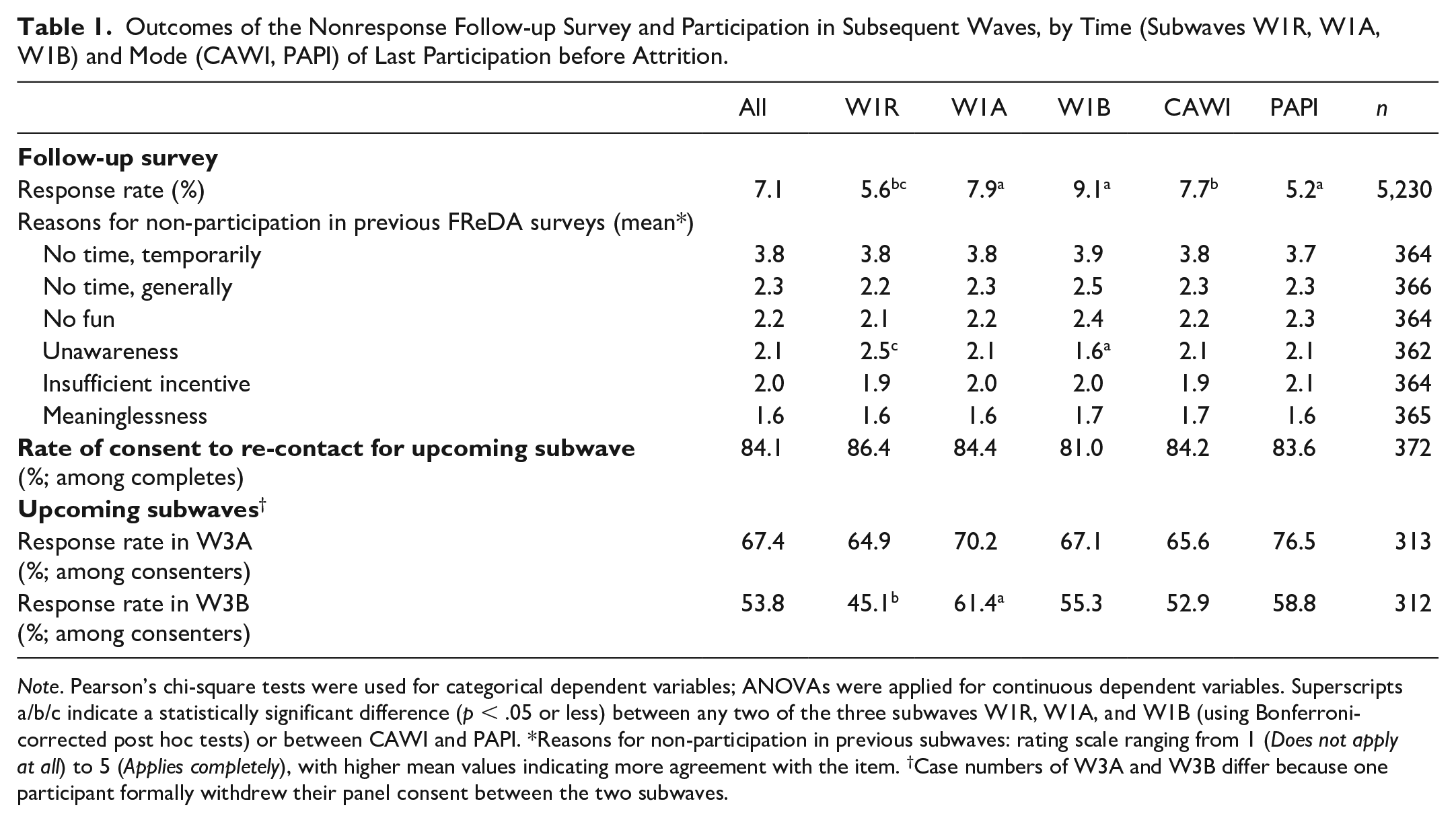
Table 1 summarizes our findings regarding participation in the follow-up survey, respondents’ reasons for non-participation in previous FReDA subwaves, their consent to be re-contacted for the upcoming subwave, and their willingness to rejoin the panel by the time and mode of their last participation before dropout.
Outcomes of the Nonresponse Follow-up Survey and Participation in Subsequent Waves, by Time (Subwaves W1R, W1A, W1B) and Mode (CAWI, PAPI) of Last Participation before Attrition.
Note. Pearson’s chi-square tests were used for categorical dependent variables; ANOVAs were applied for continuous dependent variables. Superscripts a/b/c indicate a statistically significant difference (p < .05 or less) between any two of the three subwaves W1R, W1A, and W1B (using Bonferroni-corrected post hoc tests) or between CAWI and PAPI. *Reasons for non-participation in previous subwaves: rating scale ranging from 1 (Does not apply at all) to 5 (Applies completely), with higher mean values indicating more agreement with the item. †Case numbers of W3A and W3B differ because one participant formally withdrew their panel consent between the two subwaves.
Participation in the Follow-up Survey
A total of 402 invitees started the follow-up survey, and 372 completed it, yielding a response rate (RR5, AAPOR 2023) of 7.1% (calculated by dividing the number of respondents who completed the questionnaire by the total number of invitees). Thus, the overall response rate for the follow-up survey was low. Response rates differed by time and mode of last participation before dropout. The proportion of complete cases was significantly higher when the last participation was more recent (i.e., W1A and W1B compared with W1R) and when respondents last participated in FReDA in the CAWI rather than the PAPI mode (see Table 1).
Reasons for Non-participation in Previous Subwaves
We asked respondents why they had not participated in previous FReDA surveys. Based on the closed question (see Table 1 and Figure A2 in the Supplementary Material), the most common reason was that respondents did not have time for the last survey but would generally be willing to participate (no time, temporarily). This was followed by the reasons that they generally did not have time (no time, generally) or did not enjoy answering the questions (no fun). The reasons for non-participation did not vary greatly by the time and mode of the last participation before dropout. The only exception was “unawareness,” with respondents whose last participation was longer ago (i.e., in W1R compared with W1B) more frequently stating that they did not know about the survey.
The ranking of the reasons for non-participation given in response to the closed question corresponded largely to that of the reasons given in the open-ended question (not shown in Table 1). The main reason for non-participation was lack of time (42.6%), with responses summarized as “generally and temporarily no time” (due to vague open-ended responses, a clear distinction was not always possible when coding). Among the open-ended responses, “forgot to respond” (25.4%) and “personal circumstances” (16.7%) were mentioned as additional reasons, both of which related primarily to time constraints (including health reasons, maternity, stay abroad, and relocation). The ranking of other reasons given in response to the closed question was also similar to that of the reasons given in the open-ended question, with “no fun” (17.3%), “unawareness” (10.8%), “insufficient incentive” (1.8%), and “meaninglessness” (1.2%).
In summary, irrespective of question format, time-related factors, whether temporary or general, were the predominant reasons for non-participation in previous FReDA surveys cited by attriters.
Consent to Re-contact for Upcoming Subwave
We asked respondents for their consent to be re-contacted for the upcoming FReDA subwave, W3A. The consent rate was generally high: 84.1% of respondents who completed the follow-up survey agreed to be contacted again (n = 313; see Table 1). The consent rate did not vary depending on the time and mode of the last participation before dropout. However, it did differ depending on the reasons for non-participation reported in response to the closed question (see Figure 1). Those with above-mean values on “no time, temporarily” and “unawareness” were significantly more likely to consent to re-contact. Conversely, those with above-mean values on “no time, generally,” “no fun,” and “meaninglessness” were significantly less likely to provide their consent.
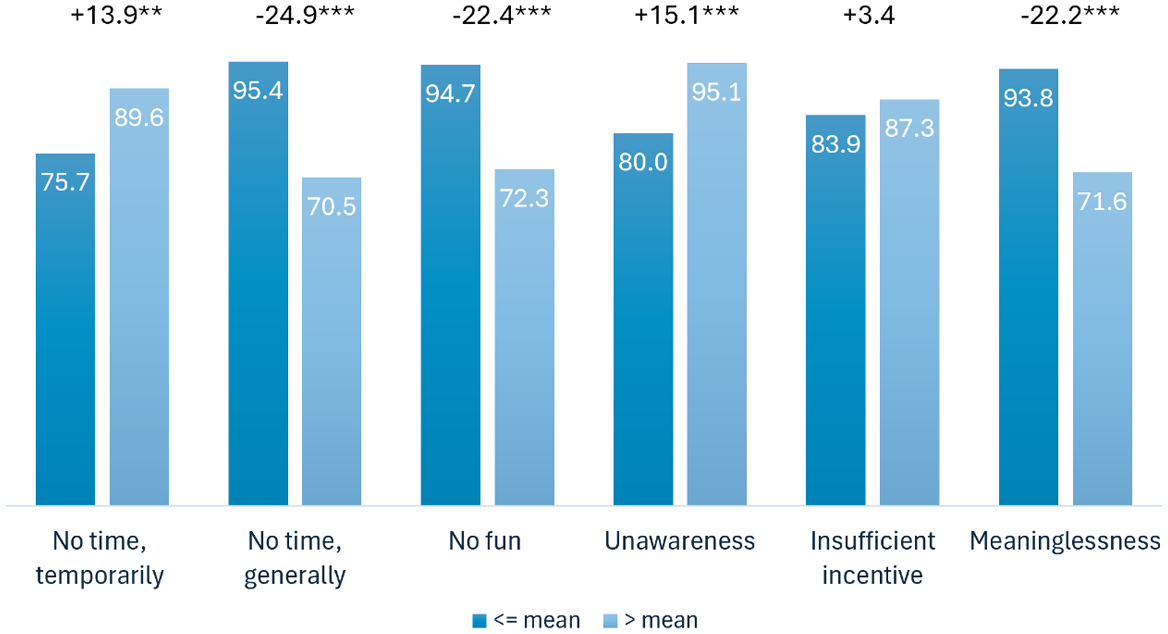
Rates of consent to re-contact for upcoming subwave (%) by reasons for non-participation. Note. Results of Pearson’s chi-square tests with statistically significant differences at ***p < .001, **p < .01, *p < .05.
Willingness to Rejoin the FReDA Panel
Looking at the actual participation of respondents who gave their consent in the follow-up survey to be re-contacted for W3A, the response rates (RR5, AAPOR 2023) in W3A and W3B were 67.4% and 53.8%, respectively (see Table 1). In principle, participation can be considered good. However, compared with the response rates of 84.4% and 82.3%, respectively, in W3A and W3B among our regular FReDA panelists (Bujard et al. 2025), participation among the follow-up survey respondents was comparably lower. In addition, the willingness to participate decreased after the first re-participation, as evidenced by the 13.6 percentage point lower response rate in W3B compared with W3A among the follow-up survey respondents. Differences depending on the time and mode of last participation before dropout were largely non-significant, with response rates tending to be higher for those who had participated in the FReDA panel more recently (i.e., W1A and W1B compared with W1R).
Analysis of the sociodemographic characteristics of the regular FReDA panel respondents, follow-up survey (non)respondents, and re-engaged FReDA panel respondents depicted in Table A2 in the Supplementary Material revealed that those who participated in the follow-up survey and could be re-engaged in later subwaves were more likely to be from subgroups that had dropped out more frequently in earlier subwaves (i.e., men, younger respondents aged 18–29, respondents with low education, and respondents with foreign nationality). Although this suggests that follow-up surveys can help offset differential attrition by attracting underrepresented groups, the number of follow-up survey respondents and re-engaged panel respondents was too small to significantly impact the overall sample composition.
Address Tracing
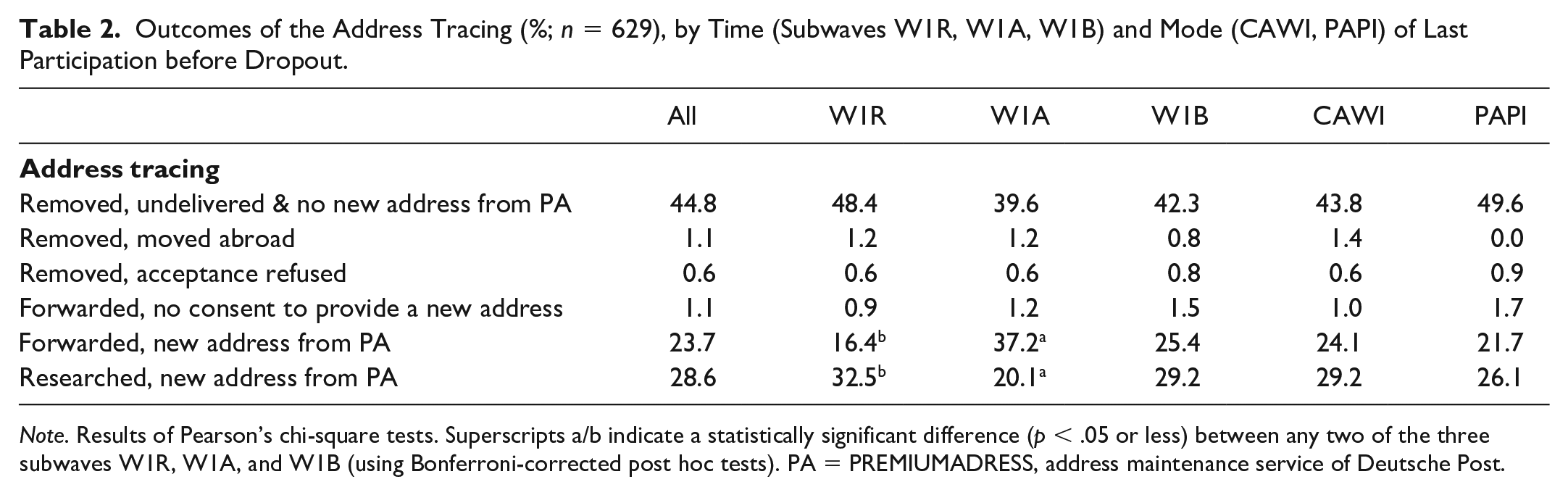
Table 2 shows the outcomes of the address maintenance service PREMIUMADRESS, which we used to check for on-site deliverability and updated addresses. The address tracing comprises several steps. First, if there is a forwarding order, the items are forwarded to the new address, and researchers are informed of the new address (if the recipient consented). Second, if the item is undeliverable and there is no forwarding order, a database check is conducted by the service provider, and, if positive, researchers are informed of the new address. Third, if the database check is negative, research is carried out by Deutsche Post, and if positive, researchers are informed of the new address.
Outcomes of the Address Tracing (%; n = 629), by Time (Subwaves W1R, W1A, W1B) and Mode (CAWI, PAPI) of Last Participation before Dropout.
Note. Results of Pearson’s chi-square tests. Superscripts a/b indicate a statistically significant difference (p < .05 or less) between any two of the three subwaves W1R, W1A, and W1B (using Bonferroni-corrected post hoc tests). PA = PREMIUMADRESS, address maintenance service of Deutsche Post.
In 88% of cases, we received no information from PREMIUMADRESS about deliverability, which is why we assume that these addresses were up-to-date and that the invitation letter for the follow-up survey could be successfully delivered; for 12% of the cases (629 of 5,230), we received information from PREMIUMADRESS. Ultimately, 46.5% of these 629 addresses were removed from our panel because the known address was no longer valid and PREMIUMADRESS could not determine a new address, or the person had moved abroad or did not accept our invitation letter. In 24.8% of cases, our invitation letter could be forwarded to the new address due to a forwarding order. For most of those cases (23.7%), we received a new address from PREMIUMADRESS (in only 1.1% of cases, Deutsche Post was not allowed to pass on the new address and PREMIUMADRESS remained without an address update). The result of a forwarding order with a new address from PREMIUMADRESS was more likely when the last participation was not so long ago (i.e., significantly higher for W1A than for W1R). In 28.6% of cases without a forwarding order, new addresses were researched by PREMIUMADRESS and passed on to us. This result was more likely if the last participation was longer ago (i.e., significantly higher for W1R compared with W1A). Thus, over 50% of the addresses were successfully updated by PREMIUMADRESS.
Conclusions
This study aimed to examine the feasibility of conducting a follow-up survey as a panel maintenance measure. We investigated the benefits of a follow-up survey in terms of better understanding why respondents drop out and the possibility of retargeting respondents who had previously left the panel by asking for their consent to be re-contacted and updating their addresses before inviting them to the upcoming panel wave. For this purpose, we conducted a follow-up survey among FReDA panelists who had not participated in two consecutive subwaves (i.e., attriters). We asked them three questions, one closed and one open-ended question about their reasons for non-participation in previous subwaves and one binary (yes/no) question about their willingness to be re-contacted for the upcoming subwave. We also used an address maintenance service to check deliverability and correct or update the attriters’ addresses if necessary.
The follow-up survey had a relatively low response rate of 7.1% (RR5, AAPOR 2023). This means that it collected data from only a small group of attriters, who may differ in some ways from other attriters. This is important to keep in mind because the subjective reasons for non-participation in previous subwaves may also differ between our follow-up survey respondents and nonrespondents. The fact that they participated in our follow-up survey shows their high motivation. Therefore, it is not surprising that the willingness of our follow-up survey respondents to re-engage in the panel was also high. Although the follow-up survey brought some subgroups back into the panel more than others, it did not significantly impact the overall sample composition. This lack of impact is due to the very small number of follow-up survey respondents and re-engaged panel respondents in W3A and W3B compared to the regular panel sample (N >16,500 in W3A and W3B).
Nevertheless, given the ease of conducting a follow-up survey as a web survey and the potential benefits in terms of gaining valuable insights into the reasons for (temporary) attrition, re-engaging attriters in the panel, and updating their addresses, we consider a follow-up survey to be a valuable panel maintenance measure. Over 50% of the outdated addresses were successfully updated using the address maintenance service. Given the relatively low cost, this service can be considered an additional worthwhile measure for panel address maintenance. Thus, based on our experience, we recommend routinely conducting follow-up surveys among attriters in long-running panel surveys to obtain information to improve the survey design and questionnaire features and, above all, to win back lost panelists and take another opportunity to update their addresses.
The results of our follow-up survey suggest several practical implications for improving the survey and questionnaire design. First, we found that time-related reasons, whether temporary or general, were the most common reasons for non-participation in previous FReDA surveys. At the same time, 84.1% of the follow-up survey respondents consented to be re-contacted for the upcoming subwave (W3A). Of these, 67.4% and 53.8%, respectively, participated in W3A and W3B, which is considerable, although lower than the response rates of regular FReDA panelists. Therefore, excluding panelists after non-participation in two consecutive subwaves may be premature, as the high willingness of follow-up survey respondents to re-engage indicates that their unavailability was mostly temporary.
Temporary circumstances often prevent participation, or panelists may simply forget to participate. Extending the permissible inactivity period, varying the timing of repeat contacts, and sending additional reminders may help to ensure that panelists do not forget to participate and may increase the likelihood of a positive response from at least one of the contacts (Maineri and Van Mol 2022; Sauermann and Roach 2013). In addition, the lack of time reported by the follow-up survey respondents suggests that shorter surveys should be conducted so that panelists can participate even when pressed for time. Vercruyssen et al. (2014:357) found that “the subjective experience of busyness—feeling too busy—has a significant effect on participation, whereas more objective measures of busyness do not.” Thus, researchers could also give panelists more flexibility about when and how they answer the questionnaires. Shorter, more frequent surveys may be more feasible for some panelists than lengthy bi-annual surveys.
Second, another common reason for non-participation in previous subwaves was that the surveys were not considered to be fun. In response to the open-ended question, follow-up survey respondents stated that previous FReDA surveys were too lengthy or asked too personal questions, or they indicated that they disliked them for other reasons. This may be due to the design of FReDA, which has 25–30-minute questionnaires in subwaves W1A and W1B (and, from wave 2 onwards, 20-minute questionnaires) and includes sensitive questions such as those related to fertility (Schmid et al. 2023). The fact that some respondents did not enjoy previous FReDA surveys also suggests the need for shorter surveys and a more balanced selection of questions. In other words, if the survey program cannot avoid sensitive or complicated questions (e.g., household grids and other loop questions), survey researchers should at least ensure that most questions create a positive survey experience for respondents.
Third, although the address maintenance service can be considered an effective measure for panel address maintenance overall, a non-negligible proportion of outdated addresses could not be updated using this service. This highlights the importance of using email as an additional contact mode to improve response rates in follow-up surveys and regular panel waves. In the FReDA panel, we did not collect respondents’ email addresses until subwave W1B. Therefore, we could not send email invitations to our follow-up survey, as we lacked email addresses for most attriters. In our regular panel waves, we began using email addresses as an additional contact method from wave 2 onwards, sending the initial invitation letter by email to panelists for whom we have an email address. Contacting attriters by email as well can increase the chances of reaching those who have moved—especially in countries without an address management service like the one in Germany—or who cannot be reached at their postal address for other reasons.
The present study has several limitations, which present opportunities for future research. First, our analyses focused on the FReDA panel as a case study, which afforded a sufficiently large sample size to conduct a follow-up survey among attriters. We welcome similar follow-up surveys in panel studies addressing different topics or target populations. Second, the follow-up survey was conducted only once, and no incentives or reminder letters were offered. Although relatively few attriters responded to our follow-up survey, their willingness to re-engage in the panel was high. It therefore seems promising to conduct follow-up surveys at regular intervals to increase response rates across waves. Incentives and other measures to encourage participation in follow-up surveys should also be systematically investigated. Third, our follow-up survey was conducted exclusively in CAWI mode, thus enabling cost-effective implementation. However, it also seems valuable to offer a PAPI mode, as this could attract a broader and more diverse group of attriters, especially as FReDA is a mixed-mode panel.
Supplemental Material
sj-docx-1-fmx-10.1177_1525822X251343721 – Supplemental material for Follow-up Survey of Panel Attriters Investigating Reasons for Attrition and Willingness to Rejoin: The Case of the FReDA Panel
Supplemental material, sj-docx-1-fmx-10.1177_1525822X251343721 for Follow-up Survey of Panel Attriters Investigating Reasons for Attrition and Willingness to Rejoin: The Case of the FReDA Panel by Tanja Kunz, Simon Börlin and Tobias Gummer in Field Methods
Footnotes

Funding
The author(s) disclosed receipt of the following financial support for the research, authorship, and/or publication of this article: This work was supported by the German Federal Ministry of Education and Research [grant number 01UW2001B].
Declaration of Conflicting Interests
The author(s) declared no potential conflicts of interest with respect to the research, authorship, and/or publication of this article.
Supplemental Material
Supplemental material for this article is available online.
References
Supplementary Material
Please find the following supplemental material available below.
For Open Access articles published under a Creative Commons License, all supplemental material carries the same license as the article it is associated with.
For non-Open Access articles published, all supplemental material carries a non-exclusive license, and permission requests for re-use of supplemental material or any part of supplemental material shall be sent directly to the copyright owner as specified in the copyright notice associated with the article.
