




Abstract
This article examines how positionality and various researcher–respondent combinations enhance our ability to gain holistic representations of the ethnically diverse Qatari society. While there has been a substantial growth in the use of qualitative research methods in the Arab World since the 1990s, methodological analyses of this qualitative shift remain scarce. Our two years of extensive research on the National Museum of Qatar involving 135 semi-structured interviews and six focus groups conducted by a diverse research team with a diverse population enabled us to identify practical guidance on the employment of qualitative research methods in Qatar, and by extension to the socially, culturally, and politically similar wider Arab Gulf region.
Introduction
The issue of developing and employing regionally appropriate methodologies, including in the context of decolonizing research, has received growing attention in recent years. Various post-colonial regions have been analyzed including Africa (Rodriguez 2019) and South-East Asia (Kreps 2003). The results, however, are not generalizable as each of these regions is unique and the relevance of the findings for other postcolonial contexts is not always applicable. The reflection on the appropriateness of specific methods and the role of researchers and their positionalities in the process of employing them should therefore be embedded in the specific local conditions.
This article examines how employing qualitative methods of semi-structured interviews and focus groups by researchers of diverse positionalities played out in the context of the Arab Gulf country of Qatar. The observations concerning social research methods were made while conducting the National Museums and the Public Imagination: A Longitudinal Study of the National Museum of Qatar from 2016 to 2019 and based at University College London in Qatar (UCL Qatar). With Qatar being a relatively young state, the research project captured a unique period of a national museum in the making and directly post-opening. The core question of the project centered on exploring the public’s imaginations of what may be, and what they would like to be, included in or excluded from the National Museum of Qatar (NMoQ). One of the project’s sub-objectives was developing regionally appropriate social science methodologies. Therefore, methodological issues received careful attention at every step of the project, from forming the research team, through data collection to data analysis. The project was the widest scale museum audience research conducted in the Arab Gulf at the time, involving 135 semi-structured interviews and six focus groups.
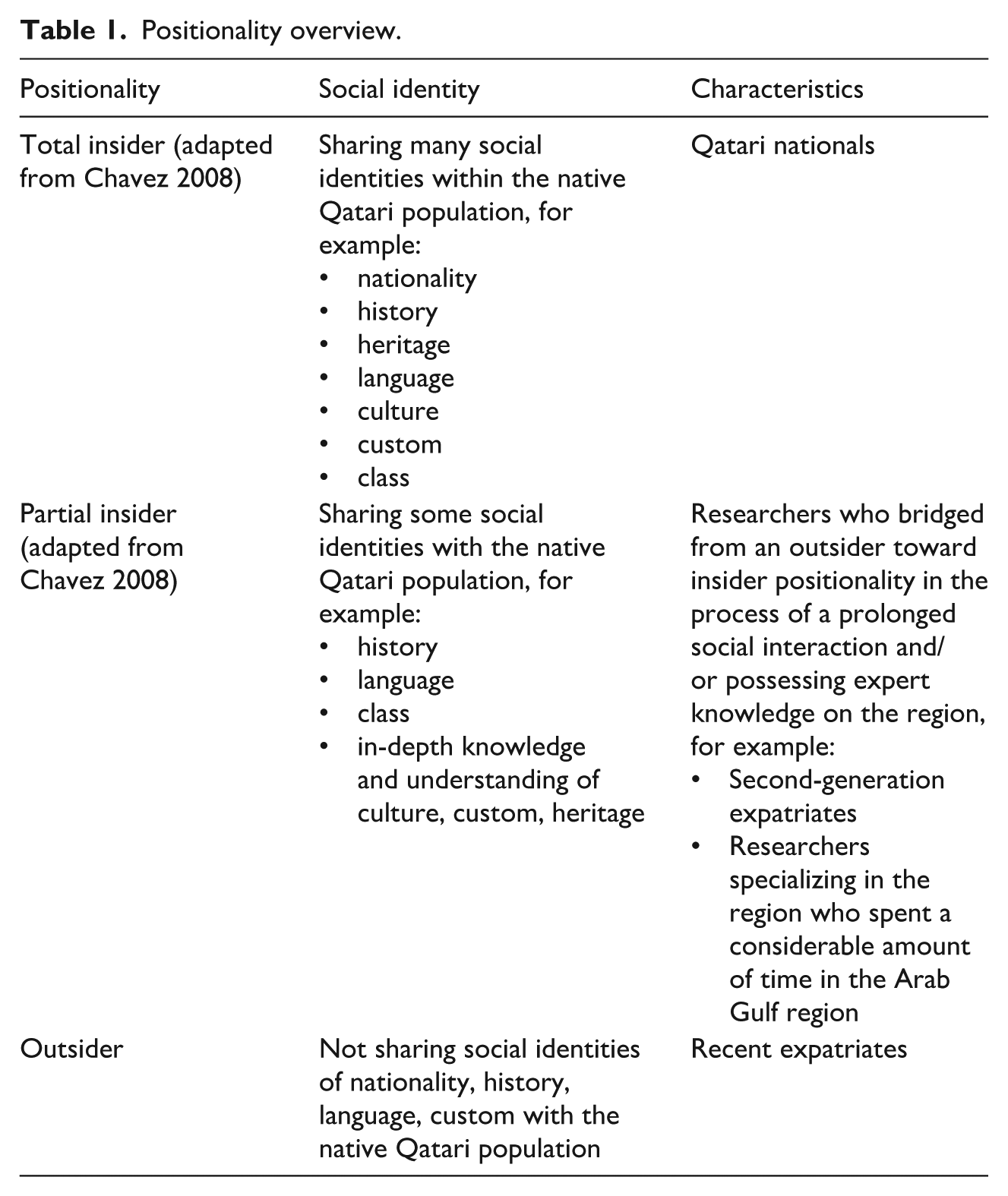
Employing qualitative methodology allowed us to examine in-depth how certain matters were expressed differently in conversations with researchers of different positionalities (Table 1) who were perceived as either insiders or outsiders by the interviewees. While important work has been done on researcher positionality with a primary focus on survey research in Qatar and the Arab region (Shockley 2021), our extensive fieldwork offers an opportunity to explore the under-researched yet growing employment of qualitative research methods in Qatar, and by extension in the culturally, socially, politically, and economically similar, although with variations, Arab Gulf region (Kamrava 2013; Serhan 2021). The research team consisted of both expatriate and native researchers, which, in turn, opened up the space for conducting interviews with a diverse range of communities native to and resident in Qatar. The composition of the research team loosely resembled the composition of the Qatari society and consisted of Qatari researchers as well as European, American, non-Gulf Arabs, and South Asian researchers in the roles of principal investigators, research associates and research assistants (Table 2, supplementary materials).
Positionality overview.
The diversity of the Arab Gulf region has been influenced by the substantial demand for foreign labor in Arab Gulf states since the discovery of vast oil and gas resources, which in recent decades has considerably altered the composition of Gulf societies. In fact, Qataris constitute only 12% of the 2.7 million population (Koch 2019), making them a minority, albeit a dominant one, within their own country. The almost 90% immigrant and expatriate population is predominantly from South and East Asia, the Arab World, Africa, and a minority of Westerners from Europe, North America, and Australia (Al Ghanem 2014; Al Najjar 2013).
Research in the Arab Region: Its History and Development
Social Research Methods in the Arab Region
Currently, Gross Domestic Expenditure on Research and Development (GERD) remains at a relatively low 0.6% of GDP in all Arab countries, including the oil-rich Gulf countries (UNESCO 2021). Despite this minimal governmental spending, this translates into large finances for a relatively small number of researchers in the Arab Gulf case (Waast 2010). As oil and gas will eventually become depleted or limited, the development of knowledge economies that are less reliant on hydrocarbons has become a key objective of Arab Gulf states (Kamrava 2013; Waast 2010; Wilkins 2011). They have therefore been bringing in international branch campuses of world-class universities from the West, and the current study has been based in one such university. In fact, the Gulf states have become the largest recipients of translational higher education globally, with the United States and United Kingdom as the main providers and to a lesser extent Australia and France (Wilkins 2011).
Through mega projects like the Education City in Qatar and the Dubai International Academic City, which account for a quarter of branch campuses worldwide (Waast 2010), Gulf political leaders seek not just to close the development gap, but also aim to transform the Arab academic landscape from a site of knowledge reception to a site of knowledge production (Romani 2009). Bahrain, Kuwait, Oman, and Saudi Arabia have a smaller number of branch campuses (Wilkins 2011). All branch campuses employ Arab and non-Arab scholars, many of whom are North Americans and Europeans, and most of whom have a Western education regardless of national origin. In addition to the branch campuses, there are local universities where teaching and research is conducted in Arabic. To obtain funding, Western branch campuses and local universities are encouraged to collaborate with each other by local funding agencies.
In relation to research methods in the Arab region, survey research was most employed from the 1960s until the 1990s. Early 20th-century Arab social scientists were educated first in France and then in Britain. This led to a divide between the first and second generation of Arab social scientists around research methods. The French-educated generation were more focused on theory, while the British-educated generation were more focused on survey research, primarily centered on socioeconomic development in the de-colonization and post-colonial periods (Hanafi et al. 2014).
While survey research was dominant until the 1990s, the use of qualitative methods has been on the rise, even though there are restrictions by the state on social, cultural, and political research in most Arab countries to varying degrees (Benstead 2018; Serhan 2017; Shockley 2021). For example, studying religion, gender and sexuality, and/or the political system may be banned altogether in some countries (Serhan 2017).
The shortcoming of survey research as the primary research method did not go unnoticed by some Arab social scientists. In a conference on research methods held at Kuwait University in the 1980s, there were already calls for a greater employment of qualitative methods such as semi-structured interviews and focus groups to gain a deeper understanding of social phenomena and structures. In that conference at which Arab sociologists participated, the issue of positivism and positionality was raised and discussed. Similar to earlier discussions in the West, it was noted that researchers ought to be aware of the biases of their discipline, and their sociocultural and personal biases, as well as shared standpoints with the research participants, when embarking on research to ensure the highest levels of objectivity (Serhan 1987).
A recent study titled National Identity in Qatar: A Systematic Literature Review (Cochrane et al. 2024) elucidates the extent to which qualitative methods are increasingly employed by researchers in Qatar. While the topic of national identity is more likely to attract qualitative researchers, and while the publications were in English and Arabic-language publications were not examined, this review is still indicative. Of the 404 studies resulting from the systematic research, 75 met the inclusion criteria and were analyzed, of which 81% were qualitative studies and 9% were quantitative. In terms of institutional affiliation, 64% of first authors had affiliation to a Qatar-based institution, about 9% had a U.S.-based affiliation, and almost 7% were affiliated to a U.K. institution. While qualitative research based on Western research methods has become somewhat mainstream in the Arab region, it also brings up some challenges discussed in the results section below.
Multi-ethnic Research and the Concept of Positionality
Adapting research methods to linguistically, ethnically, or religiously diverse societies has been a concern among social scientists everywhere to varying degrees, and the Arab Gulf region is no exception. While context is one of the buzzwords in social science, understanding the social, cultural, political, and possibly the economic context is not enough to undertake multi-ethnic or cross-national research. There are also practical components that researchers ought to keep in mind at the design stage of the research project and moving onward. The choice of team members and the social or ethnic groups to be incorporated in the study are, however, significant not only for how the research process unfolds but also the findings (Hantrais 1999).
When considering the composition of a research team, the concept of positionality comes invaluable. The concept gained recognition in the 1970s as a corrective (Robertson 2002) to a positivist approach to social research. Influenced heavily by feminist scholars (Hill-Collins 1986; McDowell 1999), it contested the view that social reality could be investigated and analyzed in objective terms where an outsider position is perceived as advantageous, providing “objective” results. Rather, authors such as Patricia Hill-Collins (1986) proposed that all knowledge is situated, and it is precisely its subjectivity that allows an insight into a certain social reality. For this to be achieved, the researcher and the researched should share a standpoint (Smith 2005) based on social categories such as class, ethnicity, gender, and/or sexuality. Sharing a standpoint decreases the need for translating social experiences. Even when things are incompletely expressed, the researcher can still draw from a mutual experience (De Vault 1990).
This approach clearly distinguished between an insider and outsider position perceiving each of them as fixed. As the discussion on the concept progressed, scholars started to point out the complexity of each status, which can be based not on one but on multiple identities creating a position of a total insider or partial insider depending on the extent of shared identities (Chavez 2008). The status of an outsider is also not without its complexities. For example, Banks (1998) distinguishes between indigenous–outsider and external–outsider. Both insider and outsider positions are not free of bias. An outsider is at risk of an imposition of their own values, beliefs, and perceptions, while an insider risks an overly positive perception or not noticing the mundane (Chavez 2008)—“the insider’s strengths become the outsider’s weaknesses and vice-versa” (Merriam et al. 2011:411). Therefore, what seems to be of the main importance is the awareness of one’s position and how it impacts the research process (Sultana 2007).
Reflection on positionality can also facilitate building awareness and navigating power relations that enter a research interaction, especially if standpoints differ (Boveda and Annamma 2023; Jacobson and Mustafa 2019; Merriam et al. 2011). This involves reflecting about privilege or oppression, how they play out in the field to determine levels of openness and trust, and how they impact research interpretation. A deeper reflection on the complexities of power and privilege in knowledge production is possible if researchers go beyond simply identifying and listing their identities. While demographic characteristics like race, gender, class, and ability are important, positionality also encompasses one's epistemological and ontological assumptions, theoretical frameworks, and professional experiences (Boveda and Annamma 2023; Holmes 2020). Recent studies by Jacobson and Mustafa (2019) and Boveda and Annamma (2023) offered some guidelines for navigating these issues in research practice and not just as a theoretical concept. If navigated skillfully, positionality can shift from simply occupying insider/outsider positions toward recognizing and correcting power imbalances in a research interaction (Milner 2007) and investigating knowledge production from the onto-epistemic, sociohistorical, and sociocultural perspectives.
Methods
This article is based on 135 semi-structured interviews and six focus groups. The interviews, lasting between half an hour and one hour, included 63 Qataris and 72 expatriates, among them 62 men and 73 women. The interviews and focus groups were conducted in English, Arabic, Urdu, and Hindi, and were transcribed and translated to English by the respective researchers. All respondents had been anonymized and verbal consent was obtained. Transcripts were coded separately by the two researchers from the authorial team using NVivo software.
For sampling, interview and focus group participants were recruited through personal contacts followed by a snowball effect (Bryman 2012). Participants were also recruited by contacting expatriate groups and associations present on social media and through student services of several universities in Qatar. Here, too, the ethnicity of recruiters or recruited had a potential impact on the recruitment process. This allowed for a reflection on positionality in the early stages of research that is not just theoretical but considered against an actual fieldwork experience, which is often unanticipated and subtle (Merriam et al. 2011). The researchers were from the Arab region including Qatar, South Asia, Europe, and North America. The interviewees and focus group participants included ethnicities from all regions of the world. In terms of positionalities the researcher-respondent combinations included insider–insider (total and partial in different combinations) and outsider–outsider.
Results
Combining Positionalities in a Research Team
The research team combined both insider and outsider positionalities. Yet, positionalities are not fixed whereby partial insiders can bridge from being an outsider toward the positionality of an insider in the process of a prolonged social interaction and/or possessing expert knowledge on the region. Details of each positionality are summarized in Table 1. The authors’ team consisted of a partial insider and an outsider. We are two sociologists, a man and a woman, middle class with doctoral qualifications obtained at a Western university in the Anglo-Saxon tradition. We both have experience of long-term migration. Researcher WS is Palestinian–Irish, familiar with both the Arab World and Europe, having lived for prolonged periods in several countries in both regions, including in Qatar. Researcher KW is Polish, lived and was educated to the master's degree level in the country of origin before moving to Ireland as well as to Qatar for a period. Reflecting on the onto-epistemic positionality (Boveda and Annamma 2023), we were both educated according to the Enlightenment principles of rationality and knowledge being generated in the process of rigorous research conducted by trained scholars, but in a less rigid social constructivist rather than positivist tradition. We are both interested in critical sociological approaches. Researcher WS specializes in migration, critical race theory, and conflict. Researcher KW studies organizations, with a particular interest in grassroots self-organization, co-production, and local knowledge.
From the sociohistorical and sociocultural perspectives (Boveda and Annamma 2023), we experienced both privilege and oppression derived from the intersection of identity categories (Jacobson and Mustafa 2019). Privilege manifested through, for example, access to elite education and being middle-class. Oppression presented through some aspects of being migrants and the precarity of our profession, as well as conflict in the case of WS. These sensitized us to the issues of intersectionality and positionality during data analysis. While analyzing data separately, we were both struck by how different the results were depending on the positionality combinations. We embraced the advantage of access to data from a large-scale project where such comparison was available.
The Total Insiders (Qatari to Qatari)—Collective Memory and Nostalgia
In the interviews where interviewers and interviewees shared total insider positionalities, the results were particularly rich in the historical and cultural details as well as certain emotional load. Both the interviewers and respondents possessed a historical and cultural awareness that first-generation expatriates who we consider outsiders lacked.
Employing Qatari researchers on the research project was particularly valuable for gaining rich data around the topics related to the native Qatari identity in terms of history and heritage. While this may be obvious in most contexts, in the Gulf countries the workforce is predominantly foreign and comprises over 90% of workers in Qatar, thereby having native staff on projects is not always a given. Moreover, as Longva (2005) vividly captures the dichotomy of native–expatriate in Gulf societies by describing them as “ethnocracies,” where there are thick boundaries between natives and even well-to-do immigrants, or even Arab or Muslim immigrants, in the Arab Gulf states, including Qatar.
There were two topics where this became especially visible. The first one was the issue of the ancestors’ suffering that allowed for current prosperity. The data collected on this topic had the strongest emotional content. The testimonies were colorful and nostalgic and based on shared memory as exemplified in the following excerpt, in which the researcher and the interviewer were both Qatari nationals: My 1980s generation have some experience of how our parents lived in the past, but the current generation doesn’t know the extent of suffering that the grandparents endured. They see everyone in fast, air-conditioned cars these days, but they don’t know how cars were in the past. . . . The current generation doesn’t know that people sewed their clothes in the past using a needle and thread, and when matters developed there was a primitive sewing machine to help them with this task. [34-year-old Qatari man]
While ancestors’ suffering appears to be integral to Qatari identity, the majority of expatriates who arrived in Qatar relatively recently were unaware of its importance. Even though the vast majority of expatriates, who comprise nearly 90% of Qatar’s population, did not recognize the significance of suffering for Qatari identity and to their collective memories, the issue of suffering is actually exhibited in the NMoQ.
The second topic was the distinctions in the identity of Qatari people. The interview question concerned whether there should be sections in the museum that were dedicated separately to people of coastal heritage (Hadar) and desert (Bedu) heritage. In the Qatari-to-Qatari interviews, the answers demonstrated a shared understanding of the topic, which allowed the conversations to immediately move to a deeper level (e.g., discussing the important historical differences or the evolution of identities where the distinctions that were once significant in time diminished as explained by this respondent): When it was cold in the winter the Hadhar used to temporarily live in the North [the desert], and in the summer the Bedu used to move to the coast to live with the Hadhar. Therefore, it was possible for them to intermingle and merge, but only in certain aspects. [59-year-old Qatari man]
In comparison, when non-Qatari researchers asked Qataris (outsider–total insider combination) the same question about Bedu and Hadhar, the data obtained were less rich and detailed. Hardly surprisingly, in the outsider–outsider interviews the issue was practically absent as neither the researchers nor interviewers possessed the insight to explore it. Tables 4 and 5 (supplementary materials) provide further examples of quotes on these issues.
Partial Insider-to-Total Insider—Political and Critical Views
The dynamics of the interviews conducted in the partial insider-to-total insider combination was different to those discussed in the previous section. Even though the results were also rich and detailed, they were of a different character. They seemed to have lacked the emotional content derived from the collective memory and heritage that was present in the interviews where the insider positionality of an interviewer and an interviewee was shared more extensively. Instead, they contained political analysis as well as a critical assessment of the narratives that were expected to be created for the purposes of NMoQ.
Bedu or Hadhar belonging was one issue where this became particularly visible. When a Western professor (partial insider) who spent a significant amount of time in Qatar and was considered an expert in the field of the Arab Gulf asked his Qatari interviewee about the perception of Qatari distinctions, the topic was immediately connected to their recognition in the current politics as in the below quote: Contribution-wise, members of Bedouin families have a lot of very powerful political positions. And a lot of well-known, prominent Qatari families are Bedouin. [25-year-old Qatari woman]
Gender was another issue that was discussed openly and critically in the partial insider-total-insider interviews but not in the total insider-total insider combination. Even though not addressed directly, it emerged in interviews in the context of inclusion or exclusion of various groups’ contributions to Qatari society, including women. Young Qatari women spoke about how they expected the museum to be masculine in its character, with women’s contributions largely absent as expressed in the below quote: I think it’s going to be very masculine; I think it’s going to erase all women and their contributions. . . . I do expect there to be a lot of these masculine stories of war against the Portuguese, against the Turks, and freedom [sarcasm] . . . that narrative—taking off the yoke of colonialism. [25-year-old Qatari female]
The same sentiment was shared by the recent expatriates in the outsider-to-outsider interviews. In contrast, in the total insider-to-total insider, or Qatari to Qatari interviews, the gender issue either did not come up or was perceived as a neutral topic that was not associated with any controversy. All the comments regarding women’s contributions were expressed by women. Tables 3, 4 and 5 (supplementary materials) provide further examples of quotes on these issues.
The Outsiders—Out of Radar Issues and Critical Views
As discussed previously, expatriates comprise around 90% of the population of Qatar. The majority of them arrived in Qatar in the last 15 years, and a minority had lived there for several decades. We consider that minority group to be partial insiders as discussed in the previous section. In the current section, the focus is shifted to the most recent expatriates who we categorize as outsiders and to the interviews and focus groups where this positionality was shared by both a researcher and a responder.
Again, it was possible to point to topics where the responses differed significantly from those in other combinations. Foreign contributions to Qatari society was one such topic. Almost all expatriates expressed an opinion that their contributions should be acknowledged in the museum, although the views were split on whether this would actually happen. In contrast, in the insider–insider interviews, when Qataris were asked by Qataris about the inclusion of expatriate contributions, some referred in their answers to a segment of Qatari nationals originating from India, Iran, Yemen, Africa, and so on, disregarding the current contribution of non-Qatari expatriates who are perceived as being in the country temporarily as workers and employees by a segment of Qatari society. In Qatari-to-Qatari interviews where the question was actually understood for what it was, respondents were split between those for and against the inclusion of expatriate contributions.
Outsider-to-outsider interviews had an additional layer when it came to expatriate labor, namely the interest in and a critique of the conditions unskilled or semi-skilled migrant labor, which is not mentioned by any Qatari interviewee, except for one. The single Qatari mention of migrant labor, while unique, had a softer tone.
Outsider-to-outsider interviews and focus groups also brought out topics that were completely off the radar of the insiders. An outsider focus group facilitated by an expatriate researcher with recent Western, Arab, and African expatriates revealed some of the narratives solely common among the outsiders such as their sense of the Qataris being an insulated community that expatriates did not have access to, as expressed in the quote below: I’ve been here a couple of years, and I don’t know anything about Qataris. For the vast majority of expats, they’re never going to get into a Qatari house. This might be the only way [the museum] for Qataris to show who they are, otherwise, they’ll just be like the man behind the curtain . . . we don’t see, it’s just the things we hear about . . . they have a lot of money and they do a lot of shopping. The only way I’ll ever get to see who they are and the humanity behind them . . . who they are as humans and what they’re like as persons. [Education City Expatriate Students Focus Groups 2017]
So far, the recent expatriates have been positioned in this article as outsiders. However, if we change the lens and see this group not just vis-à-vis the native Qatari population but a community in their own right, it was possible to see how it also comprised of different positionalities based on identities that were not only ethnic but also based on class. Expatriates in higher profile positions were more willing to be critical of some aspects of Qatari society, for example, in relation to migrant labor or women’s rights. Interrelatedly, the language used to conduct the interview also had an impact on the responses. When the researcher and the researched spoke the same language, those interviewed felt more confident and it built rapport; however, this did not always translate into respondents openly expressing their opinions.
When a South Asian researcher asked South Asians about the blockade imposed on Qatar by Saudi Arabia, the UAE, Bahrain, and Egypt from 2017 to 2021 (Serhan, 2021), they did not wish to speak about it, especially when they were in semi-skilled professions. Their differing positionalities seemed to have created a gap too challenging to cross. The researcher and the participants shared a standpoint in terms of ethnicity but not in terms of class. The power dynamic entered these research interactions and limited the extent of openness and trust. On the other hand, another South Asian researcher who shared most basic socioeconomic characteristics with his respondents, and hence shared the positionality more extensively, was able to receive more open and critical responses. Table 5 (supplementary materials) provide further examples of quotes on these issues.
Discussion
The positionalities discussed throughout the article offered practical guidance on how to obtain a holistic picture of an ethnically diverse Qatar, and, by extension, the wider Arab Gulf region. In conclusion, and as concrete examples from the research team of this study, WS and KW reflect on how their positionalities played out in the data collection and data analysis stages.
As a partial insider, WS held a focus group with six Arab women professionals living and working in Qatar. Some of these women were also partial insiders and some were outsiders as recently arrived expatriates. The strength and importance of these shared identities emerged when sensitive topics were being discussed, and WS sensed the occurrence of self-censoring on the part of participants. WS’s positionality enabled him to read the cues, know when to probe further, and know what to stop probing to avoid making the participants anxious. Similarly, on the participants’ side, there was trust toward and rapport with WS that led to richer data as there was a sense that we are all on the same boat.
The crucialness of having Qatari researchers, or total insiders, on the research team for the purpose of this and similar studies relates to the difficulty of gaining access to native Gulf societies. In Qatar, the immigrant population has more than tripled since 1997 (Al Ghanem 2014). Some Gulf scholars, such as Al Najjar (2008), have argued that there is a fear among the native population of sameness with immigrants and a loss of distinctiveness. This constitutes one of the main reasons behind the limited sociable interaction between Gulf nationals and immigrants and expatriates. Longva (2005) captures this dynamic by describing Gulf societies as “ethnocracies,” whereby Gulf nationals strive to remain ethnically “pure” by maintaining thick boundaries.
While Longva’s notion of ethnocracy remains to be relevant in today’s Arab Gulf societies, Vora and Koch (2015) argue for stretching beyond this notion and the citizen/noncitizen dichotomy to explore how the differential inclusion of both citizens and immigrants configures prevailing power structures in the Gulf region. Arab Gulf societies are transforming as Vora and Koch suggest, but our outsider, or expatriate-to-expatriate, interviews and focus groups revealed that this transformation is not as far-reaching as they imply.
An expatriate focus group facilitated by an expatriate researcher offered a trusted and comfortable space, and a shared lived experience, for participants to express that they knew very little about Qataris social lives, had limited meaningful interaction with them, and had to go by stereotypes to form an image of Qataris. The researcher, being equally curious about the same issue, grasped this as an opportunity to delve into how the NMoQ can bridge this gap between natives and expatriates and create greater understanding between the two groups.
At the analysis and interpretation stage, coding individually and from diverse standpoints, we identified different themes that stretched beyond the project’s main aims. Researcher WS focused on migration, ethnic identity, and the political dimension consisting in the 2017 blockade against Qatar. Researcher KW noticed recurrent gender mentions, despite no questions concerning gender included in the interview schedule. Research participants discussed this issue critically in the partial-insider–total-insider interviews and the outsider–outsider ones. While the latter might not be surprising, Qatari women opening up about the experience of their gender-based positionality, a topic seldomly discussed in public in Qatar, without even being asked, seemed significant. Interviewing from the position that was not a total but partial insider turned out to be advantageous in terms of trust and rapport. The intersection of researcher KW’s identities was at play in the process of data analysis and interpretation. Socioculturally, it was the experience of being a woman with some of its oppressive manifestations (Boveda and Annamma, 2023); onto-epistemically (Jacobson and Mustafa, 2019), the exposure to and engagement with the feminist discourse as well as the positionality of a scientist trained in the constructivist/interpretivist tradition of embracing emergent data.
To collect rich data in qualitative research, it is key to gain the trust of research participants, build rapport with them, and possess the ability to read their cues and understand the wider context they are situated in. The Qatari qualitative research context is no exception to this, however it does have its specificities as this article revealed.
Supplemental Material
sj-docx-1-fmx-10.1177_1525822X251315045 – Supplemental material for Positionality in an Ethnically Diverse Qatar
Supplemental material, sj-docx-1-fmx-10.1177_1525822X251315045 for Positionality in an Ethnically Diverse Qatar by Katarzyna Wodniak and Waleed Serhan in Field Methods
Footnotes
Declaration of Conflicting Interests
The authors declared no potential conflicts of interest with respect to the research, authorship, and/or publication of this article.
Funding
The authors disclosed receipt of the following financial support for the research, authorship, and/or publication of this article: The project “National Museums and the Public Imagination” upon which this article is based was funded by the Qatar National Research Fund, grant number: NPRP 8-389-5-051.

Supplemental Material
Supplemental material for this article is available online.
References
Supplementary Material
Please find the following supplemental material available below.
For Open Access articles published under a Creative Commons License, all supplemental material carries the same license as the article it is associated with.
For non-Open Access articles published, all supplemental material carries a non-exclusive license, and permission requests for re-use of supplemental material or any part of supplemental material shall be sent directly to the copyright owner as specified in the copyright notice associated with the article.
