



Abstract
Single and multiple sense stimuli create sensescapes, which combine to be perceived as multisensory integrated products. Such encounters may be experienced across multiple spaces and have importance due to esthetic sensuality, cultural value, economic benefit, or religious significance. This article presents a methodological protocol for the identification and documentation of on-site sensory and multisensory experiences. It outlines currently accepted methodologies for the key senses, followed by an inventory of method benefits and limitations. Externalities affecting sensory surveys are discussed, and a decision tree is presented to plan for and execute a sensory survey.
Introduction and Background
The human world is experienced through the five principal senses (aural, visual, olfactory, gustatory, and tactile). While each of these can be defined and described anatomically and physiologically, it is the perception of the senses, either individually or in combination that creates a sensory experience (Barth et al. 2012). Stimuli derived from single senses in a spatially stratified setting create sensescapes (soundscapes, smellscapes), or can combine to be perceived by neural process as a multisensory integrated product—being significantly different from responses evoked from individual stimuli (Stein et al. 2010).
Preliminary Suggestions for Places/Sites/Events That Exhibit a Collective of Experienced Multisensory Elements (Components Augmented by the Authors).
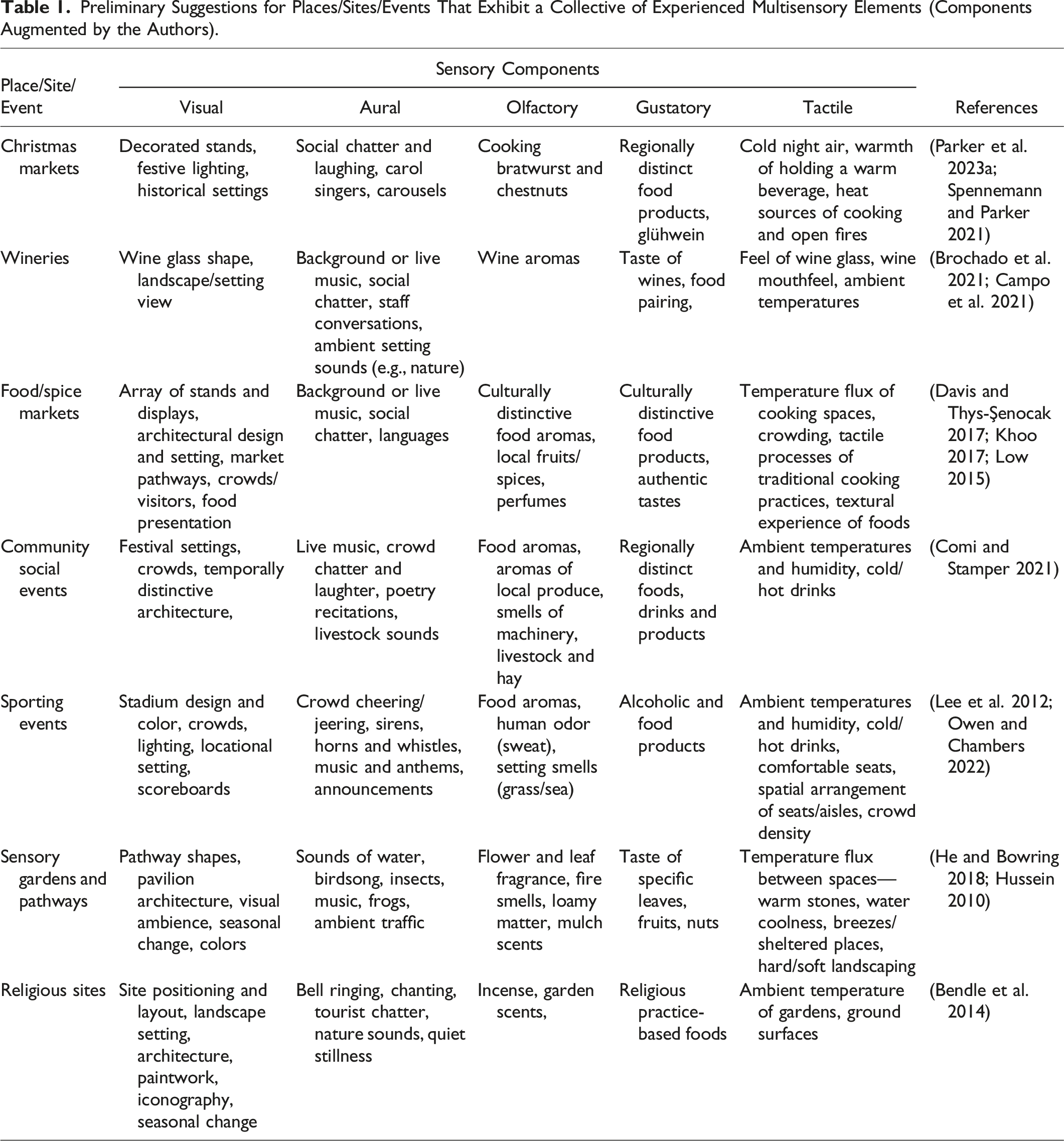
Researchers have investigated individual sensorial experience, including sight (Abuarkub 2018), sound (Huang and Kang 2015), smell (Davis and Thys-Şenocak 2017), taste (Mercado 2021), and touch (Woods and Donaldson 2021), with aural and olfactory elements being heavily discussed. Multisensory engagement is typically limited to few senses (e.g., sight/smell), or is generally descriptive or theoretical, with limited identification/documentation methodologies when engaging multiple senses (Parker et al. 2023b). Some multisensory research addresses distinct spaces, but not to the level of detail required to provide sufficient grounding across multiple cases (Kartal 2021). As the following sections are essentially literature based, a detailed review need not be repeated here.
This protocol was developed through researching on-site sensory experiences across multiple heritage sites as intangible heritage. While value perceptions of (multi)sensory experiences were addressed through on-site interviews/surveys, sensory datasets and representative records of existing experiences were necessary to ground perceptual interrogative data. Acquiring valuable comparative data through identification and documentation enabled understanding of critical sensory features to appropriately research a case (in conjunction with other parameters such as local histories, geopolitics, and cultural alignments). The methodology and subsequent decision tree were therefore advanced through: (1) literature reviews for each sensory survey processes; (2) engagement/testing of combined processes in a sensorial-rich heritage site pilot study (in conjunction with interrogative data processes); and (3) refinement based on preliminary pilot data analysis, aiming to collect the richest practical (multi)sensorial dataset possible.
There were numerous ways to document individual sense experiences, but an overall integrated multisensory approach was lacking. This article presents a methodological protocol for identifying and documenting on-site sensory and multisensory experiences. It outlines currently accepted methodologies for each of the key senses, followed by an inventory of benefits and limitations of methods at various spatial scales. Externalities affecting sensory surveys are discussed, and we present a decision tree to plan for, and execute a sensory survey. The article concludes with a methodological protocol for transparent data collection procedures and subsequent project revalidation.
Accepted Methodologies for the Identification and Documentation of Individual Senses
Benefits and Limitations for Identification and/or Recording Methods for Each Sensory Component.
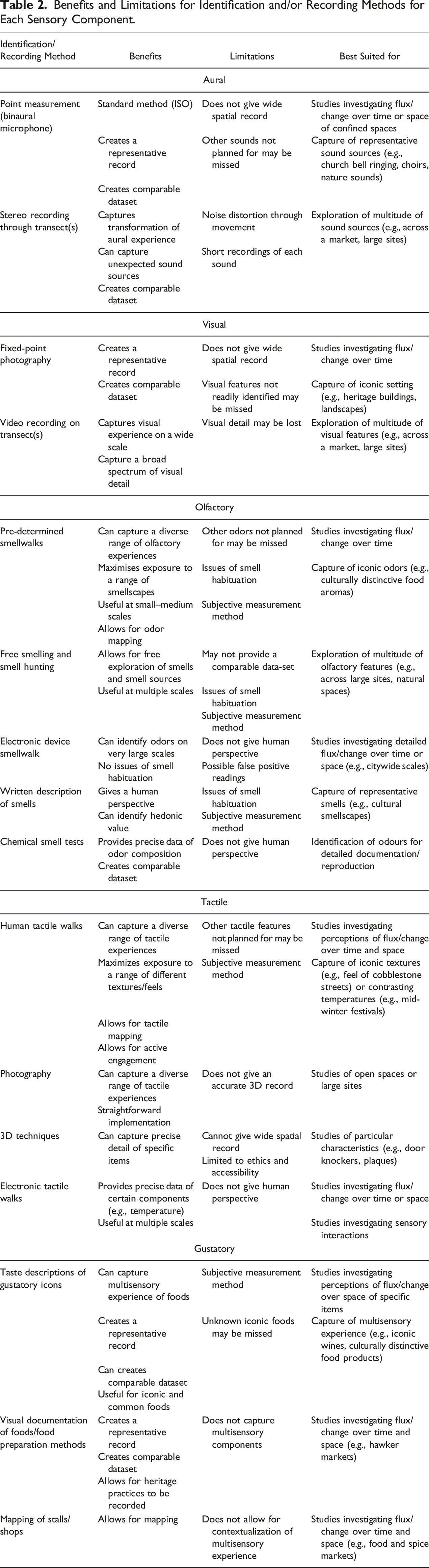
Aural
Formal standards for documenting aural components has been developed and methods should follow ISO TS12913–2 (ISO 2018), noting that this specifically concerns soundscapes. Thus, ISO requirements are to be followed diligently, while recognizing the equality of other senses within research contexts.
Acoustic environments may be recorded using binaural measurements, with locations determined to capture the broadest range of acoustic experience. As per ISO, microphone positions are 1.6 m ± 0.1 m above ground, >1 m distant from reflecting structures, with recordings undertaken while stationary for noise reduction. A wind-sock is imperative outdoors. Measurements can cover significant and typical sound sources/events to create a representative record of the on-site auditorial experience. Multiple recordings may be undertaken periodically, each entailing a minimum 3-minute duration.
Per ISO, supplementary data should record time/date and interval of recording, height and orientation, location descriptions (neighboring structural features), equipment details, atmospheric conditions (lux, humidity, temperature), influence of local topography, local shielding effects, and sound sources identified. Measurements include A- and C-weighted equivalent continuous sound pressure levels.
Acoustic environments may also be recorded along transects (spatially contained explorations across a given space), capturing aural experience spatial transformation. Transects may be pre-determined based on site design/layout, and audio recordings synchronized with video recordings (if used) for later analysis. Sound sources may be identified in-situ and/or post-visit using file recordings. Narrative reports for measurement techniques can be utilized to give the researcher’s perspective with videography assisting sound source and structural feature determination. Alternatively, a sound walk may be used with a group of participants, giving subjective perception assessments including sound feature impression, preference, loudness, and value, with walks limited to one hour and employed over differing temporal periods (Jeon et al. 2013).
Visual
Visual components of a place include proportion/orientation of architectural fabrics, alongside light/shadow, reflection, and color of spaces and materials (Kartal 2021). Sensewalks may include visitors or locals, using discussion, description, or graphic documentation. Following similar processes as above, photographic and/or video documentation is common, at specific locations to identify significant sources/events, and across transects to capture visual experience spatial variation.
Visual documentation practice records iconic settings (e.g., market settings) and site-specific visual icons/features (merry-go-rounds, etc.). Documentation can also include fixed-point photography, enabling ocular variation comparison (e.g., diurnal visitation flux) (Kammerhofer-Aggermann et al. 2003). Session times and aspects should be documented, and it is essential that photography be done identically as previous sessions, including location, focus length, and aspect. Fixed-point photography can capture visual ambience flux, such as temporal visual experience (daytime/dusk/night-time), and subsequent contrast difference between night-time lighting and evening/dusk/night darkness. Visual experience baselines may be recorded when sites are closed. Observations should not target specific individuals unless ethically defensible.
Olfactory
Despite no formal standard being developed, olfactory components identification should be guided by smellwalk methods of Henshaw (2013) and McLean (2019)—for methodological review see Parker et al. (2024). Smellwalks can be pre-determined to capture a diverse range of olfactory perceptions and to maximize exposure to different smellscapes (Henshaw 2013). Alternatively, smellwalking may include smell catching (focused perception on isolated smells), smell hunting (seeking smell sources) and free smelling (free exploration) (Henshaw et al. 2017; McLean 2019).
Smellwalks may be augmented by video and/or audio recordings, enabling the researcher to more accurately focus on olfactory elements (Allen 2021). It is important to be cognizant of visual/olfactory interplay; some visually identified foods trigger smell detection, whereas some odors are detected before food observation.
Olfactory transects may be undertaken over similar timepoints, with times determined when olfactory experience is most rich. Narrative reports can give a human perspective, including smell detection, preference, intensity, and emotional experience. Common and strongest/pervasive odors should be noted. Physical environmental aspects should be documented (openness and function of space, barriers, and ventilation) along with temporary conditions (time, weather, and approximate number of people).
Research can utilize two researchers to overcome limitations of “one point of nose” (Balez 2021), either in silence for immersive familiarization (McLean 2019), or with live discussion for temporal and spatial contextualisation (Low 2015). Local participants may yield a greater awareness of olfactory cultural process, whereas nonlocals may overcome smell habituation (Balez 2021). The team could use a combination of local and nonlocal researchers as required. Alternatively, for non-contextual expert odor evaluation, trained noses could be employed, with training methodologies (detection and description) and odor assessment being comparable to the level of detail required.
Smellwalks may include stopping points to focus on site-specific odors or be continuous to explore olfactory spatial variance. Duration should be limited to 45 minutes, however the team should remain open to spontaneous route variation and be willing to extend time limitations when suitably engaged (McLean 2019). Electronic devices may record specific chemical olfactory notes. However, as e-nose smell detection rate is currently subordinate compared to humans (including false positive readings), it is recommended that the use of electronic devices be used if essential (to scale-up data or over extensive temporal periods) (Parker et al. 2024).
Limitations of subjective olfactory measurements are ultimately inherent. Physiological parameters can influence olfactory assessor capabilities (Gary et al. 2023), and it is recommended that researchers undergo independent olfactory testing, such as basic olfactory screening prior to smellwalking. Environmental parameters can affect odor dispersion in outdoor settings, but the influence of urban canyons and micro-topography can largely be ignored in smaller outdoor spaces (Spennemann et al. 2023). Wind speed and direction may be recorded to consider macro-environmental odor attenuation.
Tactile
To date, there has been little discussion of identification and documentation of tactile-based urban environmental components. Where discussed, haptic sensewalk methods target specific data (visual texture recognition, temperature), utilizing physical sensory enquiry for embodied experiences (Springgay and Truman 2017).
Sensewalks may utilize active engagement as per Anemogiannis and Theocharis (2021), touching site-specific iconic objects, alongside cognizance of ground textures, “feel” of ambient spaces and crowds, as well as temperatures, humidity, and temperature fluxes. Transects should be identical to sensory routes if data consistency is required, with routes chosen to encounter iconic markers and interest points. Impressions and mental associations may be documented verbally, visually, or descriptively, detailing haptic experience and sources of expression. Hands-free videography allows for haptic exploration, whereas handheld recorders can better facilitate video direction. Tactile experience mapping can take place retrospectively with this second approach, providing opportunity for the researcher to be more creatively/actively engaged. Transcriptions and descriptive reflections are best taken immediately after the transects.
Other tactile-based experience documentation methods include preferencing photography over physically touching surfaces (Kartal 2021), charcoal rubbings (Savić 2017) (and by extrapolation, brass-plate rubbing, casting, or 3D scanning), and using post-processing techniques to re-present collected data (Rubidge and Stones 2009). Implemented methodologies should ultimately be guided by research questions.
Two researchers can undertake sensewalks to overcome biases. Duo walks can be silent, or with discussion to allow temporal and spatial contextualization of perceived haptics. Incorporating locational familiarity may prove fruitful in realizing the totality of haptic sensory experience, with choices dependent on study purposes. To consider physiological parameters that may influence an assessor’s tactile capabilities, each researcher may undergo independent touch-centered testing, such as basic hot/cold or sharp/blunt test, prior to any sensewalks.
Objective thermal environment measurements (air temperature, relative humidity, and lux measurements) may also be recorded, either at fixed position locations or in conjunction with a sensewalk as per Berkouk et al. (2022). Sensors should be employed at similar heights as per ISO TS12913–2. Research may utilize purpose-built portable weather stations if research questions require specific thermal dimensional microclimatic data (Vasilikou 2018).
Gustatory
There has been little discussion of identification and documentation of gustatory sensory components with respect to in-situ taste and flavor experiences. Often research sites have iconic foods strongly associated with cultural heritages, being recognized as representative (Parker et al. 2023a), and such foods could be the focus of on-site gustatory documentation. Conversely, in sites without iconic foods, research could document the breadth of available gustatory elements.
Descriptions should include taste perceptions (sweet, sour, salty, bitter, umami), with chemical analysis employed as required. Food color and shape, smell, texture, temperature, and presentation techniques should also be recorded, supplemented with photographic imagery (external/internal features). Such an approach recognizes that gustatory flavor components are inherently multisensory; olfactorily (food odors), and by ocular and tactile expression through visual and textural appeal of food (Kartal 2021). A taste description template may be conceived for comparable gustatory documentation.
If social contextualization of gustatory icons is required, documentation could include tasting similar foods inter- and intra-place, using descriptive processes and visual documentation as per Kamaruzaman et al. (2020), alongside documentation of food preparation methods (Mercado 2021). Non-regionally distinct (yet iconic) products can be similarly documented, both intra- and inter-place for comparison of (multi)sensory experience. Mapping of stalls/shops providing foodstuffs may be undertaken at each research site/place to document foodways, linking to other multisensory relationships and for further contextualization.
Incorporating local familiarity may be paramount when realizing the totality of sensory experience of iconic foods. To reduce bias, the team could utilize two researchers when undertaking subjective gustatory documentation. It is recommended that participants undergo independent gustatory testing (basic taste test) prior to any on-site activities to account for physiological parameters that influence the assessor’s gustatory capabilities.
Nota Bene
Methods employed should reflect research questions and desired outcomes, with subjective- or objective-focused approaches providing distinctive options depending on research motivation—whether the central objective of sensory documentation is for analysis or reproduction.
This protocol proposes a combination of sensory probes for each of the five senses. Mixed methods—incorporating digital/electronic/chemical tools alongside human sensors—have benefits and limitations (as per research objectives) linked to inherent subjectivity/objectivity, with determinations balancing level of robustness with degrees of human subjectivity required. While tools may provide more robust data, human engagement allows for multisensory integration realization and social/place contextualization (e.g., for eating or tactile experiences).
Translation of sensory information into other forms of data may occur. An analysis of critical sensory encounters for cultural studies could entail extrapolation of all data into textual/graphical formats, whereas reproduction applications would best focus on more robust sonographic or chemo-centered procedures.
As this protocol deals specifically with on-site experiences, all sensory parameters are contextual, and multisensory integration occurs between all senses to varying degrees, notably more so in gustatory realms. Documentation of human experience of multisensory integration may be realized through descriptive formats (personal response) or through interrogative means (public response).
Sensory Survey Designs on Various Spatial Scales
Research sites may include confined indoor (e.g., winery) or outdoor locations (e.g., fountain), and open indoor (e.g., market bazaar) or outdoor locations (e.g., garden/park). The spatial scale and research focus ultimately determine data collection procedures, being centrally point measurements, transect surveys, or a combination of the two. Point locations and transects may capture as many sensory experience parameters as possible, determined through previous research or reconnaissance days (McLean 2019), or stratified across a site/place.
Sensewalk Transects
Sensory transect methods (e.g., smellwalk, soundwalk) typically involve a researcher/participant physically walking set routes, reporting presence/change of sensory experiences. Transect shapes can be linear (including reversed or with specified points), U-shaped, circular, or in combination (Buckland 2006; McLean 2019), with each design having benefits and limitations (Supplemental Table 1). Transect length should be determined by research questions, being feasible and practical, and multiple transects may be employed over different temporal periods (daily, seasonally, yearly).
Fixed Position Measurements
Fixed position measurement locations may cover a healthy sample of significant and iconic sources/events, determined through site reconnaissance or previous research. Fixed position measurement gives comparative data, and locations can be varied as circumstances arise, such as cognisance of more appropriate target locations (e.g., site specific sensory encounters).
Externalities to Consider
Research Timing
Fieldwork must recognize inherent temporal variation of experiential sensory elements. Diurnal factors affect sensory expression through differences in lighting, temperatures, time-dependent activities, crowd flux, meal-specific cooking practices, and socially determined drinking practices (e.g., alcohol) (ISO 2018; Kammerhofer-Aggermann et al. 2003). Seasonal factors affect sensory experience through temperature variation, foliage colour and coverage, tourist flux, seasonally distinct foods and produce, and other annual patterns (He and Bowring 2018; Ling et al. 2022), and intra-period variations of special events (e.g., midweek/weekend) affect sensory elements experience through crowd/tourist flux and behavior, and visitor excitement flux (Al-Ahmadi et al. 2018).
Timing should be guided by research questions. To explore temporal changes of sensory experiences within one season, data should be collected over multiple days in repeated blocks using a wide temporal scale as possible, subject to logistical and financial limitations. For exploratory overviews, data should be collected from areas considered “hot spots” of sensory and multisensory activity, with specific timings not of concern. Subsequent day(s) in each location are allocated to collect sensory data as required, while being cognizant that data collection processes may need to be repeated (unfamiliar temporal factors).
Site Choice
Dependent on research question specifics, sensory research may be undertaken at single site or across multiple locations, with selection based on researchers’ previous work or other relevant literature and locations validated through research questions (Yin 2014).
Type of Observers
The issue of perception versus sense-making must also be addressed. Sensory experience is a complex process, involving the detection of sensory stimulation and perceptive processing (physically/mentally). Physical/physiological parameters (proximity to stimuli, blocked nose) affect degree of sensory contact, and mental parameters (cultural background, localness, attention given) affect degree of detection and identification, both across and within individuals (Anemogiannis and Theocharis 2021; Balez 2021; Gary et al. 2023; McLean 2019). Surveys involving human detectors must recognize these perception issues when planning a survey and minimize biases as required.
Identification and documentation of sensory elements can be undertaken solo, in pairs or groups, and can incorporate both researchers and participants. To minimize potential individual biases when observing and recording subjective experiences, data collection may include two or more individuals. A local observer may have a greater sense of cultural process and activity (conscious or implied) of sensory elements than a nonlocal. The research team should be cognizant of these biases and decisions of protocol execution of “local” versus “nonlocal” researchers being made dependent on both research question focus and the interactivity of the identified research site(s)—e.g., an active (significant stallholder/visitor interaction) or passive (limited interaction) market. To account for physiological biases when undertaking subjective measurements (olfactory, tactile, gustatory), calibration tools, such as smell/taste tests, and neurological sensory exams, can be used as highlighted above.
Planning a Sensory Survey
Pilot Study
A pilot study can test and refine methodological decisions and could be considered of paramount importance where considerable distances or expenses present data collection limitations, or where repeated data collection periods are unfeasible.
Specific testing of methodologies can allow for refining sensewalk sequence (individual/combined sensewalks) to develop the most efficient/effective approach; trialling of twin researcher-based sensewalks techniques (silent sensewalks/live discussion); testing of individual documentation methods (aural, visual, or descriptive documentation), and to improve fixed-point positions. Multiple pilot study visits may be undertaken, being carried out in similar temporal dynamics (diurnally, seasonally) as the central study, to refine the best practice methodological approach.
While actual sensory experiences and perceptions of these experiences should not be expected (or intended) to be identical as those in the central research project, pilot study location(s) should be justified through the similarity of site setting and extent of sensory experiences.
Research Sequence
The choice of research sequence (sensory identification order) should be determined by data category preference, acknowledging temporal experience lags during subsequent sensewalks. Research questions should guide decisions. It may be appropriate to undertake five separate sensewalks, with benefits including exceptionally focused identification transects, and limitations including extensive time commitments and time lags between multisensory experiences (identified cooking scents may offer no subsequent comparative multisensorial information).
However, focusing on individual sensory elements raises questions of authenticity, perception, and consciousness, and encapsulating one multimodal aspect gives only a partial record of a multisensory experience (Rubidge and Stones 2009). For complex multisensory identification/documentation exercises, it may be more appropriate to undertake multisensory transects, with benefits including a more rapid transect turnover enabling greater site coverage. This method may be more suitable for research exploring multisensory experience or involving multiple participants. It should be recognized that unique sensory components may be realized through the exploration of separate components (e.g., detecting timber smells through physically touching products), counteracted by concentration limitations through constantly switching between detection techniques.
Preliminary subjective sensory testing results (olfactory, gustatory, tactile) might provide impetus to preference individual methodological techniques in the research design to offset personal physiological sensory biases.
Decision Tree
Figure 1 sets out a procedural decision summary for the methodological process as outlined. All decisions should be informed by prior research or knowledge/insight by the research team, with the protocol being adapted in pilot study phases as required. Decision tree for on-site identification and documentation of sensory and multisensory experiences.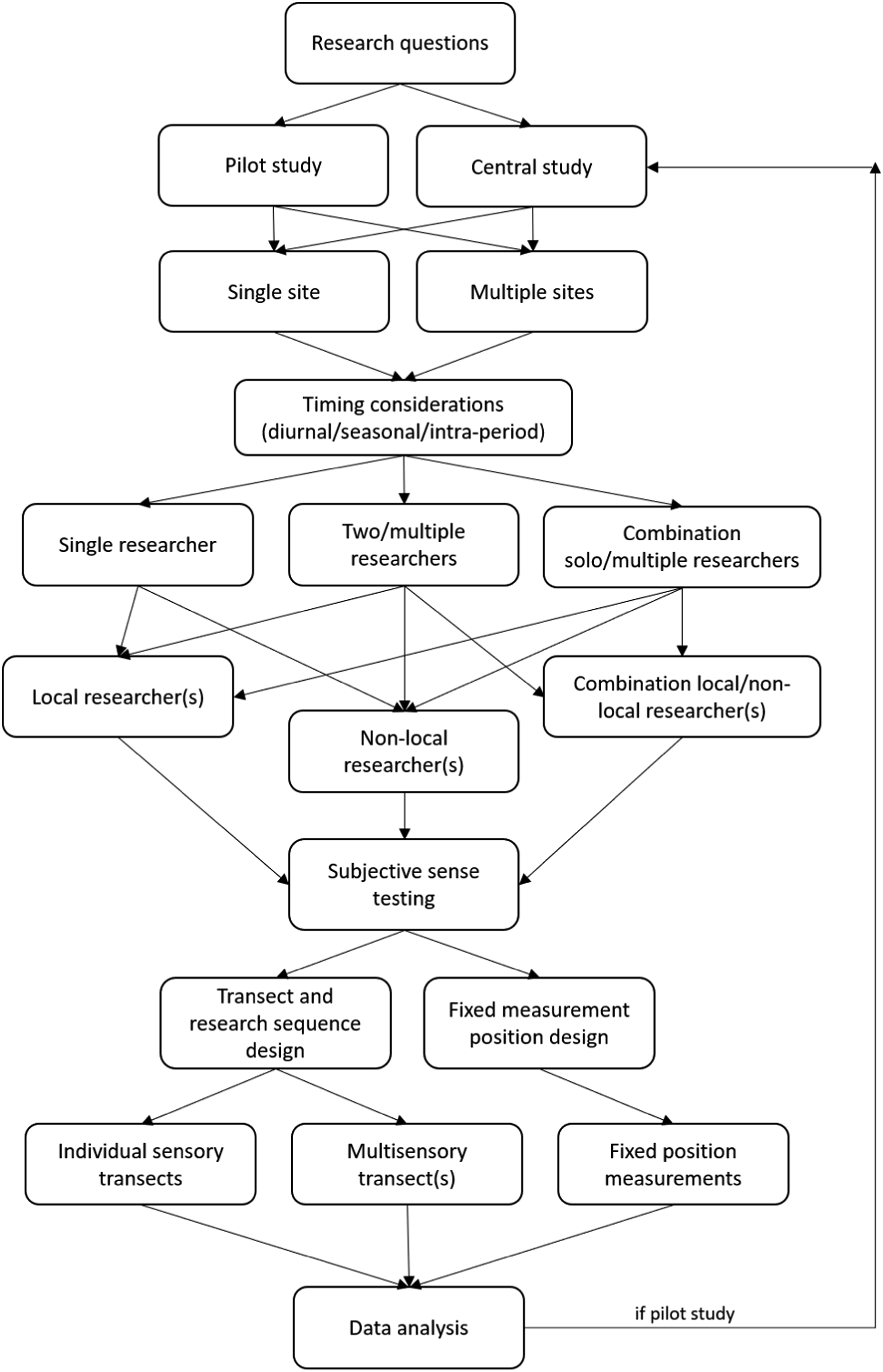
Protocol
The following framework is offered as a checklist for a comprehensive study design. To allow for transparent data collection procedures and subsequent project revalidation, the following particulars of methodological approach should be acknowledged: • Locational information of each research space (and pilot study) should be detailed, including a scaled map indicating position of key or iconic sensory/structural features, access points, and itemising backdrops and/or settings. • The number of sites should be stated alongside selection justification. • The number of included sensory components should be stated and justified, alongside reasons for omission of excluded senses. • Timing and duration for data collection should be recorded, including transect times and point measurements. Recording duration and frequency, interval determination and data collection research periods should be justified. • Detailed data collection methods should be provided and justified. Transect choice and locations of fixed points measurement should be documented and justified. Specifics of utilized equipment should be provided, including detailed implementation procedures. • Research sequence should be explained, and justifications made for choice of sensory identification order, and/or combined multisensory decisions. • Researchers/participant particulars should be stated, including participant numbers, demographic data, proportion of local to nonlocal individuals, and visitation frequency. Potential observer biases should be acknowledged, alongside implemented mitigation procedures.
In addition, detailed descriptions should be provided for: • Limiting factors for each criterion • Difficulties encountered during method execution
Conclusion
This article presents a methodological protocol for the identification and documentation of on-site sensory and multisensory experiences, for the components of aural, visual, olfactory, tactile, and gustatory sensations. It allows for a valuable comparative record for integrated multisensory experiences of sites/places, enabling understanding of critical sensory features to appropriately research single or multiple cases, and as a grounding for interrogative data. It serves to perform in the heritage domain as designed, but allows for implementation across several multisensory research fields, including those of tourism, religion, marketing, and social science domains.
The article highlights currently accepted identification and documentation methodologies for each of these senses and discusses the benefits and limitations of each of these methods at various spatial scales. Considering externalities such as research timing, site choice and determination of participants, alongside choice of research implementation, a decision tree is given to plan for, and execute a sensory survey. Finally, a recording framework protocol is given to allow for transparent data collection procedures and subsequent project revalidation.
Supplemental Material
Supplemental Material - The Identification and Documentation of On-Site Sensory and Multisensory Experience–A Methodological Protocol
Supplemental Material for The Identification and Documentation of On-Site Sensory and Multisensory Experience–A Methodological Protocol by Murray Parker, Dirk H. R. Spennemann, and Jennifer Bond in Field Methods.
Footnotes
Declaration of Conflicting Interests
The author(s) declared no potential conflicts of interest with respect to the research, authorship, and/or publication of this article.
Funding
The author(s) disclosed receipt of the following financial support for the research, authorship, and/or publication of this article: This work was supported by an Australian Government Research Training Program Scholarship.

Supplemental Material
Supplemental material for this article is available online.
References
Supplementary Material
Please find the following supplemental material available below.
For Open Access articles published under a Creative Commons License, all supplemental material carries the same license as the article it is associated with.
For non-Open Access articles published, all supplemental material carries a non-exclusive license, and permission requests for re-use of supplemental material or any part of supplemental material shall be sent directly to the copyright owner as specified in the copyright notice associated with the article.
