




Abstract
Is it possible to measure wealth and poverty across settings while being faithful to local understandings? The stages of progress method (SoP) attempts to do this by building ladders of wealth in locally relevant terms and using these in comparisons across groups. This approach is potentially useful among pastoralist populations where monetary income and standard asset inventories may be misleading, and where people are discriminated against by the state and neglected by formal systems of accounting. On the basis of fieldwork among Nyangatom agro–pastoralists in Ethiopia, we expose some problematic assumptions of the SoP method. Participants did not endorse ladder-like stages from poverty to wealth distinguished by material assets, nor did they reach consensus on the definition of a poverty line. We caution that the SoP method carries risks of facipulation, and instead we advocate for multidimensional measures of prosperity based on locally relevant forms of wealth.
Introduction
How might one measure wealth and poverty in societies without monetary income and wage labour? Is it possible to measure these constructs in the same way across all types of economic system, or does each setting require its own measures? Social scientists have long pondered these questions (for surveys, see Widlok and Tadesse 2005; Wilk and Cliggett 2007). In the 1980s, a set of techniques was developed that offered potential for combining the virtues of local validity with the utility of cross-site comparison, namely methods of wealth ranking and participatory rural appraisal (Chambers 1997). One offshoot of this tradition, the stages of progress (SoP) method, has been widely used in recent years; it combines participatory research on local understandings of wealth and poverty with retrospective interviews to reconstruct household profiles of change over time (Krishna 2011). While the geographical range of sites in which SoP has been used is wide, the settings to date have largely been urban and agrarian farming communities. In this article, we consider the SoP’s usefulness in a setting where pastoralism is a dominant form of livelihood.
As an economic system, pastoralism is based on the herding of livestock, often accompanied by other activities such as agriculture and trade. 1 In the world’s drylands, including parts of the Sahel and Central Asia, it constitutes the dominant form of land use. Pastoralists vary tremendously in degree of reliance on livestock for their diets, in the extent to which they are integrated in markets, and in the pace of social and economic change that they are experiencing. One thing they share is that they are difficult to survey: They are often marginalized from state governments, have relatively low access to schooling, and move often. With few exceptions, they are therefore systematically underrepresented in censuses and national accounting systems (Randall 2015). They also often experience discrimination and social exclusion. A deficit model of pastoralist lifeways—the idea that they are essentially backward or poor—is sometimes used to justify misguided interventions to alleviate their supposed poverty (e.g., the seizure of communal resources such as grazing land for state projects) (see, e.g., Fratkin 2014).
In such contexts, how poverty is measured (and whether the measures reflect insiders' or outsiders' views, i.e., whether measures are emic or etic) may have important political implications. As Biruk (2018:200) has observed, measurement approaches “reflect and cohere the social worlds from which they emerge.” In the Ethiopian case we focus on here, assessment of the wealth or poverty of communities is politically charged, as the region in question has been a site of massive environmental engineering (dam and plantation projects) that have led to a redistribution of resources between locals and outsiders (Hodbod et al. 2019). Here and elsewhere, a vital question in poverty measurement is: Whose views does measurement reflect?
Livestock, Money, and Other Etic Measures of Wealth
One seemingly straightforward way for outsiders to measure wealth among pastoralists would be simply to count livestock, as this constitutes their primary form of wealth. One way of representing this is tropical livestock units, which is expressed in both aggregate small and large stock (e.g., a combination of goats and cattle) (see Rothman-Ostrow et al. 2020). However, the task of counting is complicated by the fact that owners rarely keep their animals all in one place; rather they distribute them across networks of kin and associates. This means is hard for outsiders to verify ownership: The animals in any given herd or enclosure may be a mixture of those belonging to different individuals and families, some of whom may live a considerable distance from one another.
Monetary income or expenditure, which are the most common ways of measuring wealth and poverty internationally, rarely constitute valid measures of wealth among pastoralists. In Borana, Ethiopia, for example, where levels of livestock ownership are high, some 95% of pastoralist households fall below a $1/day poverty line (a threshold for extreme poverty used by the Tache and Sjaastad 2010; United Nations 2000). In other cases, monetary income may overrepresent the wealth that derives from pastoral activities (e.g., in the Arab emirates, where pastoralism is a side-line for people whose income derives principally from oil and trade). Nor do asset inventories provide an easy solution, since the inventories that are most widely used in low-income countries (e.g., Rutstein and Johnson 2004; Smits and Steendijk 2015) are ill-suited for assessing degrees of wealth and poverty in settings that are off-grid and where consumer goods such as bicycles and refrigerators are all but absent. As Little and colleagues (2008:596) note: “because pastoralists rely on mobility as a key production strategy, their motivation to expend cash on durable consumer goods is minimal.”
Distinct from both monetary and asset-based measures, multi-dimensional measures of prosperity include indicators that may be extrinsic to material wealth, but are commonly associated with it, such as education or life expectancy. While it is theoretically sound, this approach may not always be feasible in practice. Vital registration systems are often lacking in pastoralist settings, and estimating life expectancy may therefore be difficult. Further, the components of standard multi-dimensional measures may not always be relevant to the local context. Although number of years in education is closely associated with social status and economic mobility in contexts where success in formal education is key to realizing normative life goals (Sen 1999), it does not hold the same cachet or afford the same opportunities everywhere. Watete and colleagues (2016), for example, found that in two pastoralist populations in northern Kenya, primary schooling for children was considered an important component of social status in one population (Somalis in Mandera County), but it was not salient even for those considered wealthy in another (in Turkana County).
Emic Measures of Wealth: Ethnographic and Participatory Approaches
To some, the problems of conceptualization and measurement of wealth reviewed above may simply make pastoralists appear eccentric or anomalous. Until such time as they conform to more widely shared ideas of what wealth and poverty look like, it might be argued, it is enough to categorize them as “poor.” This, however, would ignore the views of many pastoralists, who do not consider themselves poor (Anderson and Broch-Due 1999). Taking seriously local understandings of wealth, anthropologists often argue in favor of ethnographic approaches that treat each case on its own terms and prioritize insiders' ideas of status markers, which might include livestock or family size (Ferguson 1992; Guyer 1995). Unfortunately this makes it difficult, if not impossible, to compare wealth and poverty systematically across populations.
One potential way around this impasse is to focus not on discrete characteristics of individuals or households (income, livestock ownership, etc.) but on their position within local hierarchies of wealth and poverty. Through focus group discussions, for example, one might identify salient characteristics of the rich and poor in local terms, and use them to build a ladder of wealth. This is an approach that emerged from participatory rural appraisal in the 1980s and is known as participatory wealth ranking (Grandin 1988). There is evidence that this may hold among pastoralists. In Borana, Ethiopia, Tache and Sjastaad (2010) reported an indigenous typology of seven wealth classes based primarily on cattle ownership. Among Maasai in Kenya, BurnSilver (2016) identified three classes (rich, intermediate, and poor), and showed that these corresponded to livestock ownership and secondly to amount of agricultural land owned.
The Stages of Progress Method
In the past 15 years, economist Anirudh Krishna has developed a method that builds on the participatory wealth ranking tradition, which he calls the stages of progress (Krishna 2011). The method involves three steps. First, community members identify the assets and capabilities that are typically acquired as households progress out of poverty, which may be represented as a ladder of stages from poverty to wealth. (Figure 1). Second, experiences of movement up or down the ladder are traced through interviews in which participants are asked to narrate their households’ experiences over the previous decade or two. Third, reasons for ascent or descent are explored—including both household-level events such as family illness and wider events such as regime changes or epidemics. Stages from poverty (bottom of the stairway) to prosperity (top) as described in 20 rural communities in Western Kenya (adapted from Krishna 2011; compare Kristjanson et al. 2010).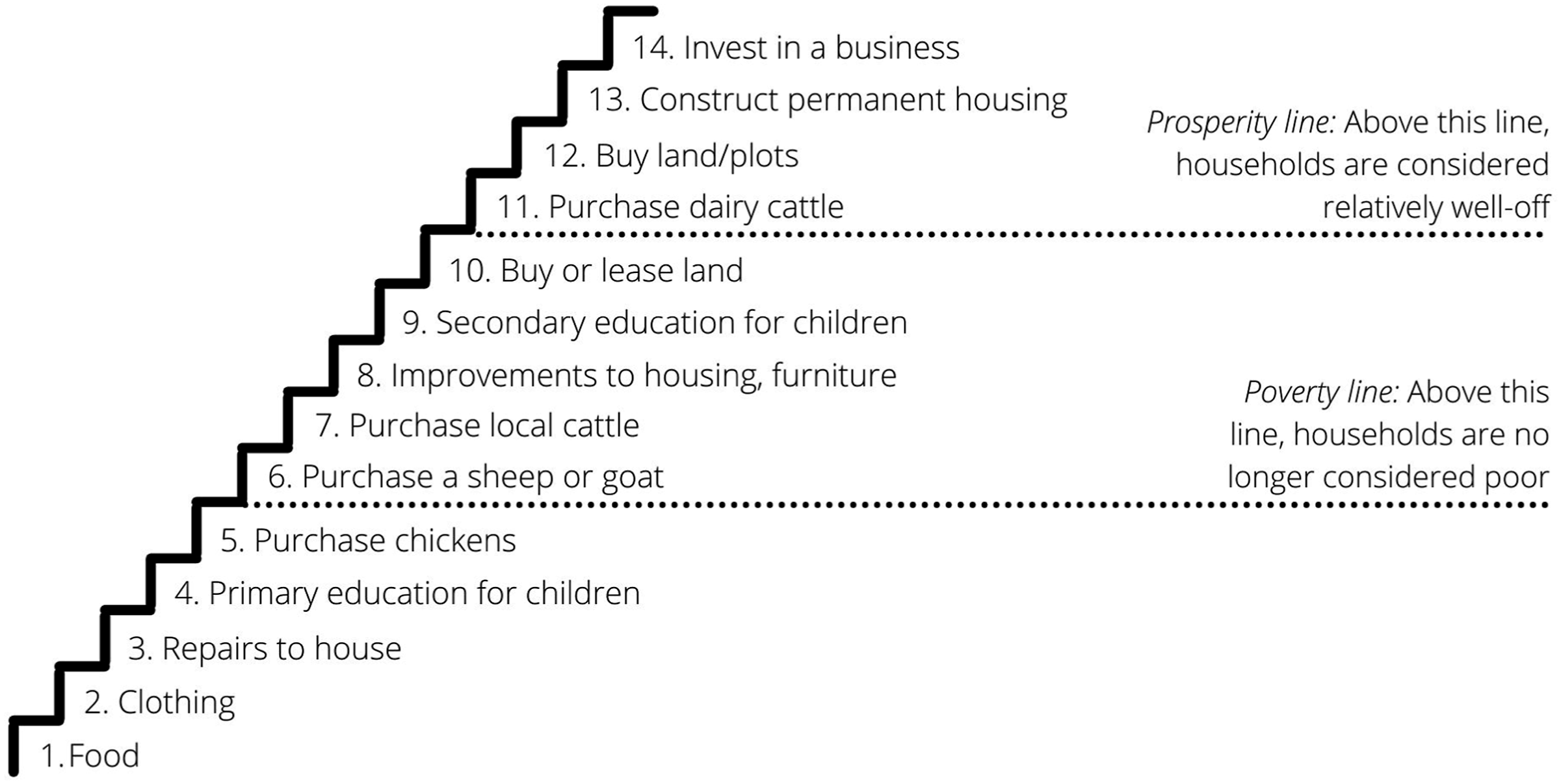
In theory, this method—involving (1) locally relevant definitions of wealth/poverty, (2) trajectories of change at the household level, and (3) forces that push or pull people in or out of poverty—makes it possible to represent the dynamics of wealth and poverty over time in ways that are both locally specific and comparable across sites. It therefore holds promise as a way of combining the virtues of an emic approach while also making it possible to compare groups across space and time.
So far, only one study has attempted to apply the SoP method in a pastoralist context, among Somali and Turkana in northern Kenya. Watete and colleagues (2016) reported that, in both groups, approximately one-quarter of households had fallen into poverty over the previous 20 years. Approximately 15% of the Turkana and 18% of the Somali had escaped poverty in the same period. The most important cause of poverty was a prolonged drought in 2005/06.
We aimed to apply the SoP approach among a pastoralist group neighboring the Turkana: the Nyangatom of southwest Ethiopia. The Nyangatom are one of several groups who inhabit Ethiopia’s Lower Omo valley, and depend on a combination of mobile pastoralism and flood-recession and rain-fed farming, supplemented by fishing, gathering of wild plants and hunting of game (Turton 1988). They neighbor the Turkana in the south and west, and speak a closely related language. According to projections from the most recent census, the Nyangatom numbered 21,000 in 2017 (Gebeyehu and Abbink 2022).
Over the past decade, the Nyangatom and other people of the Lower Omo have experienced rapid change as a result of the construction of hydropower dams upstream and the establishment of sugar plantations on what was formerly communally held grazing and farming land (Hodbod et al. 2019; Kamski 2019). These circumstances have led some to declare that pastoralism in the Lower Omo is in crisis (Glowacki 2013). In recent years, distress sales of cattle have occurred with increasing frequency (Gebresenbet 2021; Tebbs et al. 2019). These events, which have grave implications for human welfare, motivated our attempt to track changes in wealth and poverty over time in this setting. We focused on the first two steps of the SoP methodology—i.e. (1) ascertaining the features that might differentiate households at different rungs of a ladder from poverty to wealth; and (2) identifying historical markers that could be used to chart ascents and descents into and out of poverty. We carried out focus group discussions, key informant interviews, and ethnographic work over a period of approximately three months in 2018 and 2019.
Methods
The first step of the SoP method begins with “assembl[ing] a diverse and representative community group.” The group should include 20–25 people “knowledgeable about the community,” with an equal number of men and women, at least half of whom are 40 years or older (Krishna 2005:16). A facilitator should guide this group to do the following: (1) “Elicit a common understanding of concepts of poverty, … [probing] until the community supplies the term they are most comfortable with” (Krishna 2005:17); (2) “Define the Stages of Progress,” by asking “What does a household do when it climbs upward gradually from a stage of acute poverty? … What does this household do in the second stage, in the third stage, and so on?” (Krishna 2005:18); (3) “Bring the community to consensus on where the poverty and prosperity cut-off lines are” (Krishna 2005:20); (4) Identify “well-known signifying events” 10 or 25 years ago (Krishna 2005:22).
Although we intended to replicate this method, we deviated from the protocol in three ways: First, we convened multiple, separate focus group discussions (FGDs) for men and women, instead of a single mixed-gender group. This decision was based on advice from co-author DT, a native of the region, that women would feel uncomfortable speaking openly in the company of men (a view shared by a researcher who worked in Turkana, Ivy Pike, personal communication). It also reflected our expectation that women and men hold knowledge about distinct but overlapping areas of social and economic life. Second, rather than attempting to assemble groups of men and women who were representative of the entirety of Nyangatom, we stratified the sample across a set of focal communities to explore potential variation in understandings of wealth. On advice from key informants, we chose three communities (kebeles in the Ethiopian system of jurisdiction) with varying dependence on pastoralism and farming. We also included the district town of Kangaten, a local hub for trade and wage labor (see Figure 2). Third, rather than covering all of the steps of the SoP protocol in a single session, we allowed FGDs to focus more or less exclusively on either the conceptualisation of poverty and wealth or identification of “signifying events” in the past. This decision was driven by necessity, as it proved impossible to resolve more than one of these questions in a single discussion. The study location (map designed by Emma Tebbs).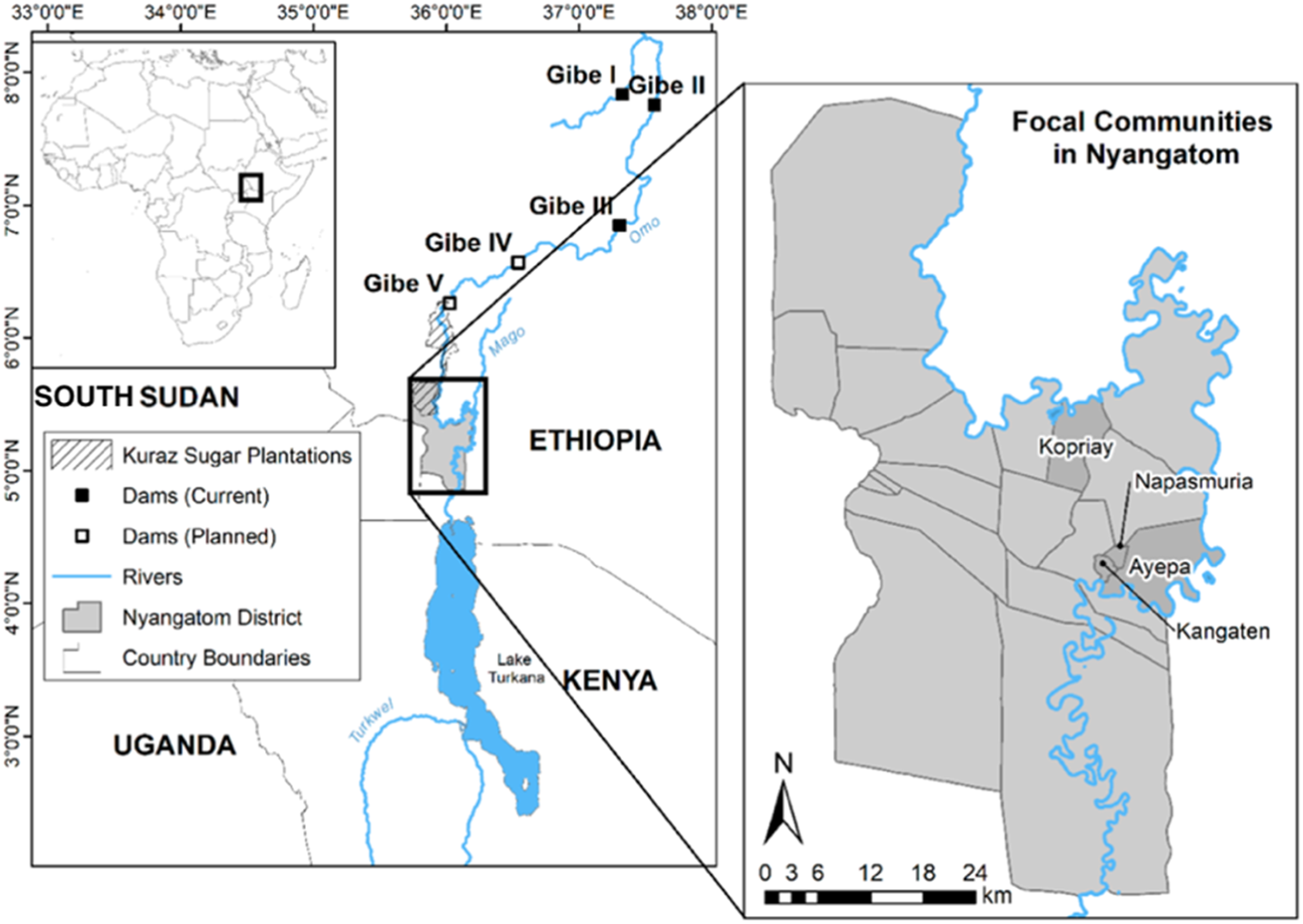
In total we held seven FGDs with women, eight FGDs with men, and one FGD with mixed genders. FGDs ranged in size from three to 20 members. We also carried out interviews with 29 people to explore variation across axes of age, gender, and placement within local status hierarchies (including offices of government). Facilitation and interpretation between English and Nyangatom was carried out by DT and Soya Kurupa, in collaboration with DP and EGJS. We carried out a thematic analysis of interview transcripts and field notes using the qualitative data analysis software package NVivo 11.4, coding the texts by labeling phrases, sentences, or paragraphs in terms of common themes (Boyatzis 1998). Below we present results using excerpts from the SoP method guidelines as subheadings.
Results
(1) “Elicit a common understanding of concepts of poverty.”
The closest equivalent of the English word “poor” in Nyangatom, ekulaket (ngikulaz in plural), was used almost exclusively of people who lack livestock, particularly cattle. As one man put it, “In Nyangatom, if a man has no animals, it doesn’t matter what crops he has, he’s still ekulaket” (July 20, 2018, discussion in Kopriay). Ekulaket also has an important moral dimension. If someone of reputable character in Nyangatom did not have resources, relatives and friends would provide support by lending or gifting animals or organizing labor opportunities. The label ekulaket implies a judgment from the community that the person in question does not deserve access to this network of mutual aid, which may be because of behavior including neglect, laziness, or disgracing their family.
An elder recalled that when a government safety net program was introduced some years ago, few signed up because the program was advertised as “relief for the poor.” DP: Why did they not think they were poor? X: They didn’t understand the question. Some people had a lot of animals and they thought, “Why would I say I’m poor? I have a lot of animals of my own!” They didn’t want to be called ekulaket. (August 7, 2018)
Ekulaket was contrasted not so much with wealth but with the concept of resourcefulness (ekabaran). A resourceful person, it was said, would secure livestock and cultivate social connections both through kin and wider networks. Ekabaran was also linked to agogong, which connoted strength, endurance, and courage. People recognized that other kinds of wealth and poverty existed (e.g., the wealth of salaried government employees and merchants, and the poverty of the urban poor) but these forms of wealth and poverty were not indexed by the ordinary terms of Nyangatom language. In Ayepa, some people were receiving cash stipends of 1200 Ethiopian Birr (approx. 45 US dollars) per month from a government cooperative scheme, growing grass intended for distribution to destitute pastoralists. Notably, this income did not qualify them as well-off by local standards. (2) “What does a household do when it climbs upward gradually from a stage of acute poverty?”
Given the absence of concepts of wealth or poverty that related exclusively to money or property, it was difficult to get people to think in terms of stages of progress that were marked simply by differing sets of material assets. Discussions about the circumstances in which someone might amass wealth tended instead to revolve around the normative development cycle of a family: a man building up a herd, marrying, and gaining livestock through akuta when his daughters were married. The term akuta refers to the obligation of the family of the groom to transfer cattle to the family of the bride over a number of years to formalize the marriage. (In English, this is usually termed “bridewealth,” although that term obscures the importance of the convention for building and reinforcing networks of kinship.) While the poor could be distinguished by a lack of livestock, land, and family connections, there was no widely agreed order for acquiring these things. The following exchange with a member of local government illustrates the sense in which these assets and capabilities were thought of as interconnected. X: He [the ekulaket] is helpless and has no married sister, so he gets no cattle from that. He has no relatives. He is a person with no hope at all; he doesn’t have land. DP: What makes the poor different from the very poor, helpless guys? X: [The person who is not helpless] may have a farm, he can cultivate sorghum or maize, and he can sell that to get goats and sheep. The source of what he gets is his land. But if he doesn’t have any female relatives and is badly connected, there is no way for him to get animals from any other source—no akuta. (July 21, 2018)
On the significance of education as an asset, respondents were divided. Historically, education was a risky investment, as it had been challenging to convert education into job opportunities. Schooling remained relatively inaccessible in parts of Nyangatom territory, and the standard model of stationary school provision is ill-suited to pastoral modes of production, which require mobility. A student reflected: A more-educated daughter brings no more to the family than a less-educated one, and the benefit tends to go to the husband [rather than the direct family]. An educated son will go far away and forget the family. My mother is concerned that if her sons are all educated, she will have no one to rely on when she gets old. (July 27, 2018)
Particularly if a household had a large herd, most parents preferred to keep their children at home, so they could help with herding, rather than send them to school. Therefore, while there was no consensus on the significance of children’s education for a household’s passage from poverty to wealth, having a large family—many children—was often regarded as a sign of wealth. (3) “Bring the group to consensus on poverty line.”
Because of the difficulty of defining poverty in a morally neutral way, and of conceiving of wealth and poverty in terms of discrete stages defined by material assets, it was not possible to reach consensus on the idea of a poverty line. One respondent suggested that 30 cattle, held in a single enclosure, might be a threshold for a viable household. This idea was not widely endorsed, however, and in justifying it, the man who volunteered the idea stressed its social dimensions: This would be a group of cattle kept in “one place,” implying an inability to mobilize associates. (4) “Identify significant events at 25 and 10 years ago”
Episodes in the past tended to be remembered in terms of periods of hunger, conflict, and changes in the landscape. In 1994 (25 years before our study), there was a transboundary conflict known as Atom-Ka’Esokon, and in 2009 (10 years before our study), there was a time when the rate of exchange for a goat reached equality with a can of maize, an extraordinary low value for livestock. The most widely known event in recent history, however, was the last annual flood of the Omo in 2014 (five years before our study). After this, the completion of the Gilgel-Gibe III dam upstream meant that the annual flood ceased to be predictable, undermining the possibility of flood recession farming. In the same year, a Chinese contractor built a permanent bridge across the river. The year 2014 was therefore commonly referred to as “the year the Chinese stole the flood” or simply “[the year of] China.”
In sum, our interlocutors in Nyangatom could not supply a term for “poverty” that did not have a morally judgmental quality, did not endorse a ladder-like model of progress from poverty to wealth via particular assets, and did not express a consensus opinion on the definition of a poverty line. Instead, they emphasized the importance of wealth in livestock, in crops or farmland, and in networks of kinship, each of which was mutually reinforcing. There were broadly shared social memories of episodes of hardship in the past associated with conflict and hunger.
Discussion
There has long been debate between those who favor universal measures of wealth and those who argue that each social and historical setting requires its own measures. The SoP method has been proffered as a middle way between these two extremes, allowing for local specificity while also allowing cross-site comparison (Krishna 2011). We began our work in Nyangatom in hopes of being able to bear out this prediction, and it came as a surprise to us that the method was so difficult to apply in this context. Most of the people we spoke with in Nyangatom rejected the idea of a distinct set or quantity of assets that distinguished individuals or households at different levels of poverty or wealth, and insisted on people’s social networks and the content of their characters as the decisive factors in whether or not they would succeed in building a family and managing a herd.
Given the apparent success of other researchers in applying the SoP method to nearby Turkana and Somali populations (Watete et al. 2016), and other reports of categorical wealth classification among East African pastoralists (e.g., BurnSilver 2016; Tache and Sjaastad 2008), these findings may seem puzzling. One possible explanation is that there is something particular to the local culture that conflicts with a classification of rich and poor. We might think of this as the “pastoralist dream,” akin to the American dream. As in the American case, attention to the possibility of anyone with social skills becoming wealthy serves as a distraction from the fact of marked inequality within society. Many of the people we spoke with upheld a principle of social mobility and objected to speaking of poverty and wealth as morally neutral concepts.
Another possible explanation for the discordance between our findings and those of other researchers who have used wealth ranking methods among pastoralists is that they have forced a potentially false consensus on definitions of wealth and poverty. One piece of evidence for this is that close equivalents of the word ekulaket (which we found problematic as a translation for “poor” in Nyangatom) were used by Watete and colleagues as glosses for poor among the Turkana, who speak a closely related language. 2 They also took the Turkana word ekabaran (which has the sense of “resourceful” in Nyangatom) to mean “rich.” Either these terms have substantially different meanings in Turkana than Nyangatom, or Watete and colleagues were rash in assuming that they mapped clearly onto rich and poor.
It is a virtue of the SoP method that it begins with open-ended discussion about the terms of enquiry. In principle, this increases the validity of the data that are subsequently collected, as they are more likely to represent the realities of the people concerned. However, if participants in the discussion are not representative of the population as a whole, or if discussion is rushed, the resulting data may be no more valid than those deriving from a questionnaire designed by outsiders. Since the SoP protocol instructs facilitators to simply identify local terms for a predetermined schematization of wealth and poverty, it carries risks of facipulation (i.e., manipulation of focus-group participants by a facilitator, whether conscious or unconscious) (Stirling et al. 2003). This risk is heightened by a set of unexamined assumptions built into the SoP protocol, namely that (1) a non-pejorative term for poor exists in the vernacular language; (2) a ladder-like relationship between poverty and wealth exists in the minds of community members; (3) one set of material assets unambiguously distinguishes the poor from the better-off; and (4) progression from poverty to wealth is indexed primarily by successful competition within a cash economy. 3
As Ferguson (1992) has noted, these assumptions are part of a Western folk model of wealth and poverty in which wealth is conceived as a single, measurable substance that different people have more or less of, and people are assorted into different grades of social status according to how much of it they have. International survey researchers impose this model when they assume that ladders of social status map unambiguously onto local understandings (Biruk 2018:53). But this model ignores the possibility that people may be simultaneously rich and poor in different ways: for example, “having ‘long legs’ or many associates and patrons” but little regular income (Biruk 2018:54, citing Barnes 1986 on social status in Lagos).
Another assumption of international survey research that is shared by the SoP method is that the most important local social unit is the household, defined by commensality (for review and critique, see Randall et al. 2011). Our conversations in Nyangatom revealed that different types of wealth accrue to different social units. While cattle may formally belong to a senior person of high status, they are shared with networks of kin and herding associates. Farm produce is conventionally controlled by wives; in the case of polygynous families, which are common among East African pastoralists including the Nyangatom, each wife may have her own farm plot and granary and have influence over the distribution of grain. Income from wage labor may be held by individuals; when kin make claims on it, it would be a matter for negotiation on a case-by-case basis. An approach to measuring wealth that better reflects the local reality would inquire separately about livestock ownership, farm produce, income from wage labour, and “wealth in people”—the latter indexing the social and economic benefits related to a large family and the networks of kinship that they afford (Guyer 1995). This would constitute a kind of multidimensional measure of wealth, albeit one that recognizes distinctive, locally relevant dimensions. As we came to recognize the shortcomings of a wealth-ranking method in Nyangatom, we pivoted to this formulation of wealth, which we will report on elsewhere.
There is a clear rationale for seeking comparable data on wealth and poverty across settings, both within and between states. But the imperative of generating such data should not blind us to the risks of misrepresentation that the enterprise may entail. Inaccurate representation of wealth and poverty has real consequences, such as exclusion from poverty relief projects; and the judgment that a particular group of people is poor may be used to justify misguided interventions to alleviate their supposed poverty. Some of the concerns we have raised here in relation to Nyangatom are distinctive and may not be shared in other settings. But however exceptional such cases may be, they can shed light on general problems in the conceptualiszation and measurement of poverty and wealth.
Footnotes
Acknowledgments
We thank our colleagues Mercy Fekadu Mulugeta, Fana Gebresenbet, Jenny Hodbod, Emma Tebbs, Kris Chan, and Immo Eulenberger for their support. In Nyangatom, in addition to the people who took part in interviews and discussions, we especially thank Soya Kurupa, Abraham Bongosso, Moi Topo, and Gashaw George. We thank Kay G. Stevenson and three anonymous reviewers for comments that clarified our thinking. EGJS was supported during writing of the manuscript by the FORMAS (Swedish Research Council) project: Conflict Prevention and Low Carbon Development (Locacons), grant 2017-01941 (2017-20).
Declaration of Conflicting Interests
The author(s) declared no potential conflicts of interest with respect to the research, authorship, and/or publication of this article.
Funding
The author(s) disclosed receipt of the following financial support for the research, authorship, and/or publication of this article: Our research was part of the Shifting In/equality Dynamics in Ethiopia: from Research to Application (SIDERA) project, supported by the United Kingdom’s Economic and Social Research Council and Department for International Development (grant ES/R002460/1, 2018-2019) and Svenska Formas (2017-01941).
