




Abstract
To date, research on elite interviews has primarily focused on political or business settings in European and Anglo-American contexts. In this study, we examine the procedures involved in conducting elite interviews in academic settings, drawing on fieldwork with 53 senior scholars at 10 universities across five regions of northern China. We provide a detailed, critically reflective account of strategies to gain access, develop trust, and manage the power imbalance. Our account reveals the importance of the researcher’s professional identity in gaining participants’ trust and determining adequate forms of reciprocity.
Introduction
Over the past decade, a growing number of studies have investigated methodological issues concerning interview-based research with elites in political (e.g., Ergun and Erdemir 2010; Mikecz 2012; Morse 2019) and business contexts (e.g., Dicce and Ewers 2020; Harvey 2010, 2011; Palme 2020). These studies have acknowledged domain-specific conventions related to, for instance, forms of approach, channel of communication and the negotiation of identities, which, in turn, are sensitive to the broader sociocultural context in which the fieldwork was conducted. These studies have primarily emanated from European and Middle Eastern contexts (e.g., Dicce and Ewers 2020; Ergun and Erdemir 2010; Mikecz 2012; Palme 2020), and research on East Asian contexts is lacking. In this study, we build on the still limited research on elites in academia (see Perera 2021; Savvides et al. 2014) by focusing on China.
Academics are viewed as professional elites in many Asian contexts, especially those influenced by Confucian thought, such as China, South Korea, and Japan (Li and Gong 2008). In China, the academic profession has been traditionally associated with the symbolic meanings of nobleness, sacredness, and self-sacrifice, and continues to be endowed with a high level of social prestige (Li and Du 2013). In contemporary China, academic positions are also coveted due to their tenured nature and the associated social welfare benefits (Li and Jiang 2017).
Previous studies on elite interviews in political and business domains have shown the importance of the researcher’s insider–outsider positionality in the process of gaining access, acquiring trust, and establishing rapport with elites (Lancaster 2017; Morse 2019; Palme 2020), managing subjectivity (Ergun and Erdemir 2010; Mikecz 2012), and the complexity of power negotiations between the researcher and the researched (Belur 2014). The researcher’s positionality, subjectivity, and the power negotiation are informed and shaped by intersecting facets of the researcher’s identity such as gender, political or religious affiliation, ethnicity, language, and professional status (Neumann 2011; Perera 2021), in a dynamic and context-sensitive manner (Belur 2014; Palme 2020).
While previous studies yielded important insights on strategies to navigate methodological challenges during elite interviews in political and business settings, guidance is lacking on how researchers reach, initially engage with, and secure as participants, academic elites with whom the researcher has had no previous contact, and where no intermediary to facilitate contact exists. The perception of the researcher as an outsider weakens the legitimacy of an interview request and the power imbalance is more salient (Bourdieu 2020; Liu 2018). Lancaster (2017) and Smith (2006) liken the use of strategies for in-person initial contact with elites to those used when interviewing nonelite participants. The strategies they describe assume the existence of a shared public space or communication channel for the preliminary acquaintance-building or networking stage, which is not always feasible. In research with elites, it is usual for the interviewers to initiate the interview from a position of lesser power, and little guidance is available on how the researchers can mobilize skills, knowledge, and experience to position themselves strategically in relation to situation or topic-specific segments of the interview event, as guidance from research with nonelites recommends (Vähäsantanen and Saarinen 2013). Such management of the interview event hinges on the researchers being attentive to and confronting their subjective perception of their disempowered status relative to the elite participants.
Inadequate management of the researcher’s positionality, subjectivity, and power status can have far-reaching methodological consequences, resulting in, for instance, insufficient or biased data (Savvides et al. 2014). This is a particular imperative in Confucian-influenced settings such as the Chinese educational context (Li and Du 2013), as the traditional power imbalance between established and early-career academics (including students) is underpinned by strong cultural beliefs.
In this study, we critically reflect on our multi-sited, interview-based fieldwork in China with 53 Chinese scholars of one of the following languages: Russian, Japanese, or Korean and, informed by this, we formulate guidance on the management of the researcher’s positionality, subjectivity, and power imbalance.
Elites as Research Participants
The term elite refers to influential individuals who possess considerable power (e.g., political, economic, symbolic), authority, and prestige in the social or professional positions they occupy (Denord et al. 2020). Academics, such as those in this study, fall into the category of professional elites (McDowell 1998), and possess symbolic power on account of their professional expertise, achievements, and rank (Bourdieu 2020; Denord et al. 2020). Due to their status, the elite interviewee is more powerfully positioned vis-à-vis the researcher and is able to exercise greater control over the interview event than nonelite participants (Bourdieu 2020).
Power, understood as the capacity to exert influence on other people (Wrong 1995), is the result of a continually negotiated intersection of factors such as gender, professional status, ethnicity, age, and language (Belur 2014; Neumann 2011; Perera 2021), and the relative importance of each factor is context dependent. For instance, Belur (2014) and Perera (2021) reported the importance of professional rank and participation in professional networks for the power negotiation between the interviewer and the interviewee in their respective research with the police and academics. This situationally sensitive negotiation of power acknowledges the possibility of the researcher assuming a more directive role in the exchange, particularly on issues where they possess pertinent experience (Savvides et al. 2014).
Accessing Elites and Building Rapport
Recognizing the amply reported difficulties in gaining access to elites, previous research on strategies to navigate this challenge has emphasized the importance of a cumulative series of acts that begin with pre-engagement preparatory work (e.g., Ergun and Erdemir 2010; Harvey 2010, 2011; Morse 2019). The researcher’s goal at this stage is to attain confident familiarity with the anticipated participants’ profile, to communicate the goals of the project concisely and convincingly, and to identify possible routes for establishing contact (e.g., emails or telephone calls) that are both culturally and professionally appropriate (Dicce and Ewers 2020; Liu 2018; Mikecz 2012; Morse 2019; Richardson 2014).
Snowball sampling has been found to be an effective strategy to access and secure elite-status participants (e.g., Harvey 2010; Liu 2018; Morse 2019) and, in the context of China, the convention of Guanxi can contribute to this, as both practices are underpinned by networking. Guanxi refers to “the concept of drawing on connections in order to secure favors in personal relations ... [it] contains implicit mutual obligation, assurance and understanding, and governs Chinese people’s attitudes toward long-term social and business relationships”
The power imbalance, combined with the importance of discretion and confidentiality for elite participants, heightens the obstacles to building trust and rapport (Harvey 2010, 2011). In their endeavor to build rapport, researchers should demonstrate an understanding of the elites’ professional culture (and the likely constraints this has on the interview event), and anticipate the possible sensitivity of particular interview questions (Liu 2018; Mikecz 2012).
Researcher Positionality and Power Relations
Systematic reflections on the evolution of insider/outsider positionality during fieldwork have shown it to be a complex, dynamic continuum (e.g., Palme 2020; Pustulka et al. 2019), and the interviewer’s positioning is closely related to the negotiation of power between the researcher and the researched (Belur 2014; Ergun and Erdemir 2010; Mikecz 2012; Neumann 2011; Palme 2020; Perera 2021).
Insider status refers to the researcher’s identity-related commonalities with the participants such as gender, political or religious affiliation, ethnicity, language, and profession (Belur 2014; Ergun and Erdemir 2010; Neumann 2011; Savvides et al. 2014; Perera 2021). By focusing on commonalities at the recruitment stage, researchers may gain access to individuals more readily, and the ensuing temporary sense of proximity and trust may facilitate a more open exchange during interviews (Liu 2018; Savvides et al. 2014). Nevertheless, the assumption of shared knowledge may result in the researcher taking certain information for granted (Wolf 2018), or prioritizing their own perspectives over the participant’s (Chavez 2008).
In contrast, outsider status is viewed as bringing greater objectivity to the researcher's explorations of the research topic, due to their lack of personal identification with either the participants or the topic (Simmel 2002). Nonetheless, this distance between the researcher and the researched negatively impacts on the status of the researcher during fieldwork, who may struggle to be perceived as a legitimate interlocutor (Ergun and Erdemir 2010; Savvides et al. 2014).
Subjectivity Management during Elite Interviews
Systematic monitoring of subjectivity can contribute to greater transparency with respect to the researcher’s interpretations of the research context and the interview exchange, and decisions taken during research activities (Riazi 2016). For instance, during his 11-month fieldwork with nonelite participants in an educational context, Peshkin (1988) systematically documented his subjectivity from six dimensions (the Ethnic-Maintenance I, the Community-Maintenance I, the E-Pluribus-Unum I, the Justice-Seeking I, the Pedagogical-Meliorist I, and the Nonresearch-Human I), and then critically examined the influence of each of these dimensions on his interpretations.
Earlier studies have yielded important insights on the management of specific dimensions of the researcher’s subjectivity (e.g., gender, region, political stance) with the purpose of developing appropriate strategies for accessing elites and rapport building (e.g., Ergun and Erdemir 2010; Harvey 2011; Liu 2018; Mikecz 2012; Morse 2019). Nevertheless, guidance is lacking on the management of the researcher’s subjectivity in research involving multiple culturally distinct contexts.
Multi-Sited Fieldwork in China
Our analysis of strategies to manage interview fieldwork with elite participants in academia draws on fieldwork from a broader project that sought to identify the factors that multilingual academic elites consider when selecting a particular language for research and publication purposes (see Liu and Buckingham 2022).
As we did not possess connections to pertinent academics at universities in China who might have facilitated access to potential participants, we heeded guidance from our university’s Ethics Committee and initially emailed heads of department, but this elicited few responses. Two circumstances help explain this: First, at the time of fieldwork, phishing and fraud emails were widely reported problems in China; second, reliance on the official university email address for work-related communication is less widespread in China than in Western countries.
Participant Information (n = 53).
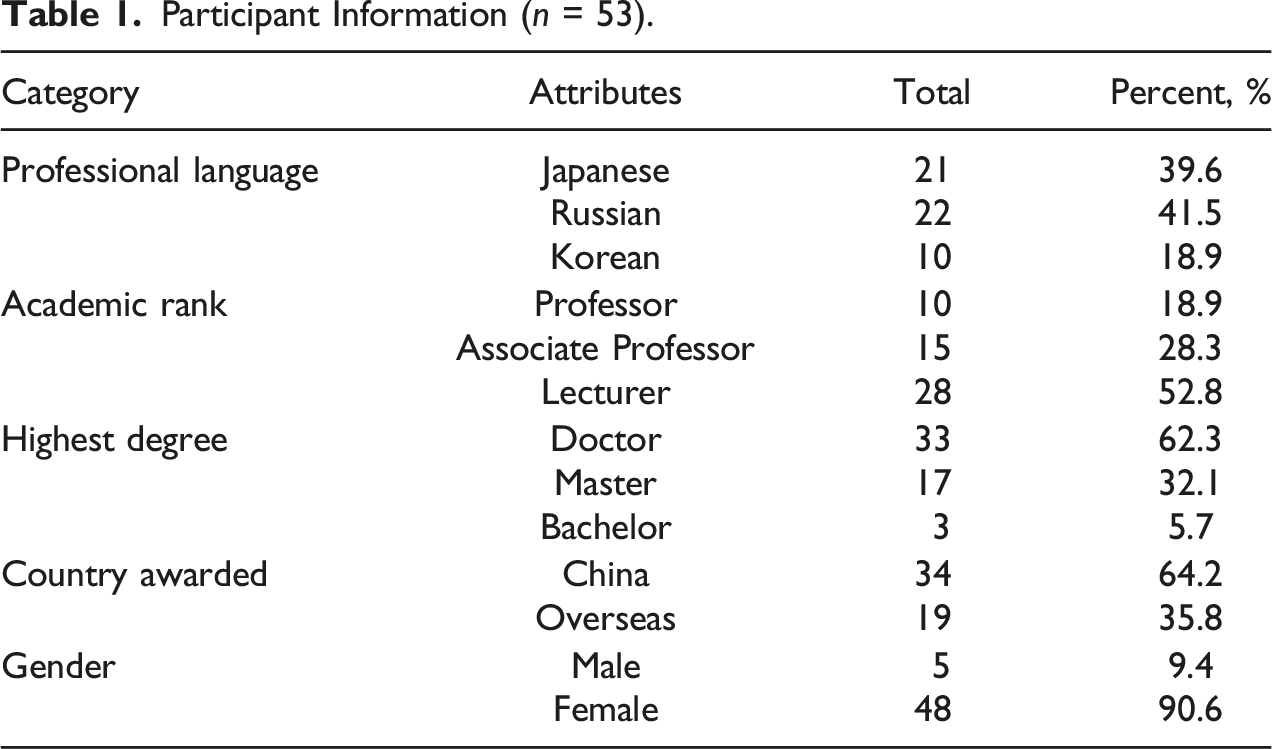
The fieldwork locations involved the foreign language departments of 10 universities across five regions of northern China (Hebei, Tianjin, Jilin, Gansu, Xinjiang), and all fieldwork was conducted in Mandarin. The final two sections are concerned with managing the dynamic and context-sensitive power relations between the researcher and the researched. The fieldwork was undertaken by the first author, who is henceforth referred to as “the researcher,” “she,” or “her.” 1
Fieldwork Preparation
We undertook two main steps to prepare for contacting potential participants: identifying institutions where scholars of the three targeted languages worked; and in-depth familiarization with each local fieldwork context. For the first step, we employed primarily the national academic database, China National Knowledge Infrastructure, which enabled filtered searches for individuals, disciplines, and institutions. As described in Liu and Buckingham (2022), our final choice of institutions was guided by the need to have representation from regions with different levels of socioeconomic development to understand how the availability of research-relevant resources affected the academics’ ability or preference to research and publish in particular languages.
Regarding the second step, the researcher created a personal knowledge base that covered cultural and socio–political aspects of the respective city and region, as cultural and geographic distances between locations were considerable. As a result, on her arrival she was already familiar with the city layout and logistical considerations such as local transport routes and had attained a general understanding of local concerns and the particularities of the local dialect or accent.
On location, the researcher undertook a week-long systematic familiarization visit of the research site and the surroundings and identified the location of particular offices or departments. She sought opportunities to talk to local people and, where appropriate, accommodated her speech (accent and idiomatic language) toward the local respective dialect (Tianjin, Jilin, Gansu, and Hebei dialects). This preparation allowed her to introduce, alongside her etic researcher perspective, the beginnings of an emic viewpoint through her growing understanding of local perspectives and customs.
Although these measures helped her adapt to each environment, the researcher nevertheless had to rely on intuition, due to the lack of in-depth personal experience in these cultural contexts and her linguistic limitations. Despite her ability to shift from her native accent 2 and partially imitate the regional pronunciation typically used at each location, she could not sustain the shift during lengthy exchanges, and her outsider identity was evident in her speech. Her partial linguistic accommodation was not possible in the regions Yanbian (in Jilin province) and Xinjiang, where the use of minority languages (i.e., Korean and Uyghur among others) was common.
Modes of Approach
We developed three strategies to navigate the initial stages of fieldwork: (1) choosing an appropriate approach to make initial contact; (2) gaining access and developing trust: and (3) managing the power relationship. We discuss each of these in turn.
Our original participant recruitment strategy, which relied on administrative heads of department to disseminate introductory information to staff, proved unviable as, in most cases, our initial email was unanswered or the administrative head instructed us to contact staff directly without guidance on how this might occur. (The two exceptions to this are described below.) We thus developed an alternative strategy to attract the attention of our target group and disseminate information.
Drawing on recommendations from interviews with elites in political or business settings (e.g., Harvey 2010, 2011; Morse 2019) to position oneself as a salesperson with the task of promoting the product (i.e., the research project) to the target customers (i.e., academic elites), the researcher took on the role of public informant and developed a one-minute promotional speech on the topic of language proficiency and academic publishing. As part of her salesperson role enactment, she positioned herself next to a folding table that displayed a promotional poster, documents that attested to her professional identity (including her university business card and copies of her degree diplomas), and leaflets with brief information about the project to distribute. She gave her sales-pitch type presentation to passersby at strategic positions between lecture theaters and meeting rooms and academic staff offices, routes she had previously observed to be well traversed. Over a one-week period, this time-consuming strategy resulted in securing several participants at each location. Most initial participants facilitated contact to others through snowballing, either in person or by forwarding information about the project with a recommendation on their phones.
In two instances (in Tianjin and Xinjiang), administrative heads gave active support. Academic staff immediately responded to the introduction by a high-status insider, and opportunities for initial relationship building between these and the researcher followed, with only minimal trust-building measures needed (e.g., a brief introduction to the research and the researcher) before individuals committed to an interview.
In the absence of an insider introduction, additional trust-building measures were needed to mitigate initial suspicions and secure the collaboration of individuals as participants. The researcher’s outsider status (evident, for instance, in her affiliation to a foreign university and the absence of a trusted third-party introduction) was explicitly referred to by some individuals at the initial stage of contact (e.g., “I haven’t met you before,” “Who introduced you to us?” or “Do you know any of our colleagues here?”).
The researcher took three trust-building measures in these instances. First, and as previously recommended (e.g., Harvey 2010, 2011; Mikecz 2012; Morse 2019), the researcher exercised maximum transparency in her responses and offered evidence of her identity and justification for her presence by drawing on previously prepared official documents (accompanied by Chinese-language translations where necessary). With those who chose to engage further, the researcher progressed to the second trust-building stage.
The second measure entailed an attempt to engage in informal interactions. For instance, the researcher invited individuals to have coffee and, where individuals were receptive, she encouraged small talk about personal and professional lives in person or through WeChat, using her knowledge of the local context to find topics that prompted engagement. At times, this outsider status proved beneficial as individuals requested information about the researcher’s study abroad experience and were interested in seeing photos that illustrated her life abroad. By displaying these on her phone, the researcher catered to the dual objectives of fostering conversation and strengthening her identity claims.
The third trust-building measure concerned the gesture of reciprocity through which we had intended to account for the social debt that we had incurred through the participants’ contribution to our fieldwork. The researcher’s description of the intended benefit (the option of a voucher, as recommended by our university’s Ethics Committee) invariably met with indifference. Rather, most individuals requested an information exchange with a focus on issues relevant to academic careers abroad (scholarship applications, education systems, and the practicalities of living abroad), and developing academic English proficiency. Around 10% of the participants (n = 6) requested proof-reading assistance. That is, their goal was to benefit from the knowledge specific to the researcher’s outsider academic status. This led to our adaptation of the gesture of reciprocity to include the option of “interviewing the researcher” in a separately scheduled meeting after the participant’s interview. In this manner, we responded to the need for reciprocity that was defined in terms meaningful to the participants.
The third measure entailed managing the imbalance of power between the researcher and academic elites. The difficulties experienced in this regard were prompted by the requisite senior status that participants possessed, and primarily concerned the fact that the researcher was undertaking fieldwork on the topic of research itself, which was an intrinsic component of the participants’ professional identity and status. The study design, and the researcher’s (assumed) more junior academic status became points of contention in some cases during the recruitment stage, and the researcher was challenged with questions such as: “Have you published articles?” or “How would you be capable of investigating our publishing experience if you yourself haven’t published in different languages?” Other academics questioned the qualitative paradigm, the lack of extensive funding, and the absence of affiliation to local institutions.
The more common (and less confrontational) approach involved individual academic elites adopting a supervisory role and advising the researcher on the research design, procedures, and the worthiness of the topic. In both situations, despite the embarrassment that the researcher sometimes experienced, she endeavored to balance the cultural imperative of showing respect to academics, with the need to justify the research design in an objective and professional manner. This experience prompted her to develop alternative ways of articulating the justification for the topic and research procedures that highlighted the benefits of an outsider’s perspective.
The relative power status of the researcher at any point in the fieldwork was the result of an intersection of factors and dynamic. Higher levels of power were experienced when the researcher was able to position herself as an international scholar and qualified applied linguist, while low levels of power were experienced when she took the roles of early-career researcher or younger “sister.” The redesign of the post-fieldwork reciprocity stage into an opportunity for the participants to interview the researcher reaffirmed her professional status and alleviated the power imbalance.
Researcher Positionality
The researcher experienced the challenge of appropriately positioning herself during interviews as a continual and dynamic negotiation of her insider and outsider identity (Chavez 2008; Cunliffe and Karunanayake 2013; Merton 1972). The natural attributes (e.g., age, gender, language, ethnicity, and somatic characteristics such as skin tone, hair, or eyes) and acquired attributes (e.g., career, education, political affiliation) contributed differentially to her insider and outsider identity depending on the particular geographic and cultural context.
The sense of insiderness or outsiderness was never absolute, but always relative and negotiated (Merton 1972), and her awareness of the multi-faceted dimensions of her identity strengthened her agency in positioning herself flexibly and contextually (Chavez 2008). She experienced the tensions in the insider and outsider divide during her interview with each participant as an edge-walking researcher, who embraced (and to varying degrees internalized) both the Chinese local identity and an international identity affiliated to a Western university (Beals et al. 2020).
The researcher experienced greater insiderness in the central-northern regions compared to the northwestern and northeastern regions because of her natural attributes and the ease with which she could conduct herself in a culturally appropriate manner. For example, during the initial stages of in-person contact with a head of department, she mentioned the location of her home (a town in the region) and the local university she had graduated from. In response, the head of the department responded with culturally appropriate hospitality by offering a seat and a cup of tea. By establishing a local personal history and identity, the researcher met with easier initial, if only temporary, acceptance into the community.
The privilege of (negotiated) insiderness was absent once she traveled to the northwestern and northeastern regions, such as Jilin, Gansu, and Xinjiang, primarily on account of differences in natural attributes (particularly language and ethnicity), but also acquired attributes. For example, when the researcher attempted to access potential participants in Yanbian, the participants she approached used Korean to introduce her to other academics. The researcher experienced a sense of powerlessness on not understanding the language used in the ensuing discussion during this initial contact.
Similarities in acquired attributes (particularly education) frequently contributed to her perception of insiderness with participants and encouraged gestures of empathy and trust from the participants (Cunliffe and Karunanayake 2013). The participants in the central-northern regions were more likely to have studied internationally, but this was the exception among participants in the northwestern and northeastern regions. During informal interactions at the relationship-building stage, academics with a similar educational background displayed confidence and trust more rapidly, and this translated into multiple hospitable gestures such as invitations to a meal, on-campus accompaniment, office space, and invitations to department meetings to introduce the study. Where this insider element was activated, participants independently initiated snowballing by introducing the researcher to other potential participants.
A dynamic interplay of insiderness and outsiderness also occurred with each participant, as the researcher might need to reposition herself several times during the interview in a context-sensitive manner (Beals et al. 2020). For instance, she positioned herself as an insider while talking about issues relating to publishing in international journals, but her outsiderness was dominant if the discussion turned to publishing in Chinese in domestic journals.
Researcher Subjectivity
The researcher’s awareness of her context, topic, and location-dependent insider and outsider positionality during fieldwork contributed to her ability to monitor her subjectivity during interactions with academic elites in an attempt to minimize bias (Riazi 2016). She kept memos of feelings and reflections that arose during interactions (during initial contact and interviews) and used these as prompts for critical reflections on her practice and as a trail of evidence of researcher accountability (Mullings 1999).
Following Peshkin (1988), these reflections led to the discovery of four “Is” that encapsulated the researcher’s identity in the context of this project: the Professional English I, the Emerging-researcher I, the Ethnicity-Han I, and the Young female I. These Is derived from a wide range of natural and acquired attributes (Merton 1972), and constituted subjectivities that affected the researcher’s engagement and the interpretations she drew from the communicative exchange. Some dimensions of subjectivity emerged due to a sense of powerlessness in particular contexts (e.g., the Emerging-researcher I, the Young female I); while other dimensions embodied the researcher’s agentive response to minimizing the unequal power status (e.g., the Professional English I). We report here on each of these dimensions in turn.
The most commonly experienced subjectivity concerned the Professional English I. The researcher had a strong professional background in teaching and researching English academic writing. While transcribing the first interview, she noticed that her interview questions probed more deeply into the participant’s experiences in writing in English rather than their language specialization (Japanese, Russian, or Korean) or Chinese. The researcher recognized this as evidence of her subjectivity, which could bias her data collection. She consequently revised the follow-up questions related to the participants’ publishing experiences in Chinese and their language specialization on the interview guide to ensure their prominence during future interviews, and monitored her response when participants questioned her professional or academic expertise, as this seemed to trigger this subjectivity dimension. Nevertheless, this subjectivity had a positive influence at the post-interview reciprocity stage. Most participants chose to determine their preferred form of reciprocity, and an instructional session on English academic writing was commonly requested. The participants’ interest in these sessions also contributed to further participant recruitment through personal recommendation (or snowballing).
Conscious of the researcher’s lower-status relative to her participants, we had anticipated the emergence of the Emerging-researcher I at the fieldwork planning stage. We had hoped to mitigate it through the extensive preparation stage that entailed document-based evidence of potential participants’ academic trajectories (described in the section Fieldwork). The Emerging-researcher I negatively influenced the researcher’s confidence in probing responses or exploring sensitive issues during interviews with particularly senior participants. For example, when interviewing a department head, she refrained from querying the apparent mismatch between his publications and his academic rank as an associate professor, although this point was pertinent to the research.
In her post-interview critical reflection, the researcher realized that her subjective Emerging-researcher I had hindered her. This monitoring compelled the researcher to revise her professional profile on the documents presented to potential participants and furnish additional details about her publications and international teaching experience to enhance her researcher identity. In addition, she rehearsed certain sensitive interview questions several times by varying their formulation and the delivery before future interviews. The confidence-enhancing effect of these combined measures reduced the interference of the Emerging-researcher I.
The Ethnicity-Han I emerged during the fieldwork in Yanbian and Xinjiang, two regions with large ethnolinguistic minority groups. The experience began upon arriving at Yanbian train station, where all signage and advertising boards were in two languages, Chinese and Korean. The researcher realized that her Ethnicity-Han I contributed to her sense of alienation and a heightened alertness toward her surroundings. Similarly, this unease arose on arrival in Xinjiang. The researcher became conscious of her very different appearance and the absence of individuals recognizable as Han-Chinese at her accommodation in Tianshan district, Urumqi city in Xinjiang. Consequently, she lacked confidence in approaching people, and was initially unable to develop a confident familiarity with local affairs and conversance with the dominant minority languages (Korean and Uyghur in Yanbian and Xinjiang respectively). Realizing that this subjective perception of unease would hinder her ability to engage with potential participants, the researcher extended her stay at each location, dedicating one week solely to deepening her familiarization with the city and local culture. This acclimatization period enabled the researcher to acquire firsthand knowledge of local customs, artifacts, and community concerns, which she could weave into her interactions with academics.
The Young female I emerged in response to unsolicited advice received during encounters with individuals while traveling. For example, a taxi driver in Tianjin expressed surprise at the researcher’s extensive travel, commenting on her profile as “a young female alone,” and a male academic in Tianjin advised her to give up her travel plans as they were “unsafe for a young female.” These voices contributed to lowering the researcher’s sense of confidence in her ability to undertake the fieldwork as envisaged. To keep in check the influence of the Young female I, the researcher objectively examined the relative security concerns of each stage of the fieldwork plan, and strategically used her inner voice to critically counter the outside voices.
Discussion and Conclusion
In this article, we provided a methodological and reflexive account of how a researcher can critically negotiate power relations within the context of research with established academics, individuals who are recognized as elites within their professional and broader social context. In her deconstruction of power in the interview event, Smith (2006:651) adduces that elites’ power status is not monolithic and is not necessarily transferrable across contexts “into the space of the interview.” Consequently, power status should not a priori be a factor that differentiates research with elites. In our view, the extent to which power derived from the participants’ elite status is transferrable depends on the focus of the research project and the physical setting. In our exploration of researcher power negotiation, the researcher engaged with elites in their own workplace and on a topic central to their professional identity and status (language choice for research and publication purposes). That is, power and status were imbued in the physical institutional setting, materially through artifacts that referenced the participants’ professional identity and status, and cognitively, through the interview focus and purpose. The professional academic hierarchy requires the existence of status differentials, and an academic’s seniority is constructed to contrast with the absence of seniority in others. We demonstrated how the lower professional status researcher can recur to intersecting attributed and acquired features of her identity to position herself differentially, and to monitor and manage the subjectivities triggered by the power imbalance as the interview progresses.
While other studies have underscored the importance of factors such as researcher status with respect to research with elites in political settings (Belur 2014; Ergun and Erdemir 2010), social networks in business-related settings (Liu 2018; Palme 2020), and ethnicity, religion, and/or gender in nonelite interview settings (Pustulka et al. 2019), professional experience and skills were the features of the researcher’s identity that most strongly facilitated access to, engagement with, and securing the participation of, academic elites. The perception of the researcher as a professional within of shared domain (academia) contributed to the legitimacy of the interview request and prompted the participants to identify a form of reciprocity to ensure the exchange was beneficial to them. A possible explanation for the dominant role of professional experience is that academics’ elite status is defined in terms of their profession-related expertise and achievements (Bourdieu 2020; Denord et al. 2020; McDowell 1998).
Although insider institutional status, as portrayed in Perera (2021), can assist in recruitment and trust building during fieldwork with academics, the researcher’s outsiderness (institutional and disciplinary) was not always experienced as disadvantageous. This may be explained by the highly competitive nature of academic careers and that an outsider, lower-status researcher was not perceived as a potential rival, an insight also alluded to in Bruno and Salle (2020). Additionally, the researcher’s preparatory groundwork brought a measure of familiarity with the social and physical fieldwork environment, which contributed to her confidence in engaging as an outsider, and to the openness with which she was often received. Although attempts to attract participants could also fail, this context-informed confidence and her persistent in-situ presence gradually led to insider introductions, which lessened the impact of the researcher’s outsider identity.
This reflective account supports the tenet that both subjectivity and positionality management are powered social practice (Vähäsantanen and Saarinen 2013). Researcher agency plays an important role in responding to the sense of outsiderness and the specific subjectivity dimensions triggered by lower power status, and this includes the cultivation of insider-like qualities that can mitigate the power imbalance (Belur 2014; Ergun and Erdemir 2010; Mikecz 2012; Neumann 2011; Perera 2021).
While this approach may be questioned as being manipulative (Smith 2006), we believe that these strategies that are aimed at accommodating toward interlocutors are not unlike the forms of convergence that are commonly employed (often unconsciously) in our everyday lives, as explicated by communication accommodation theory (see Coupland 1996). Future research might explore the subtle distinction between accommodation and manipulation, with consideration to the intersecting natural and attributed features of the researcher, such as age, gender and social status, and the specifics of the fieldwork context.
Footnotes
Declaration of Conflicting Interests
The author(s) declared no potential conflicts of interest with respect to the research, authorship, and/or publication of this article.
Funding
The author(s) received no financial support for the research, authorship, and/or publication of this article.
