




Abstract
This article concerns online data capture using survey methods when the target population(s) comprise not just of several different language-using groups, but additionally populations who may be multilingual and whose total language repertoires are commonly employed in meaning-making practices—commonly referred to as translanguaging. It addresses whether current online data capture survey methods adequately respond to such population characteristics and demonstrates a worked example of how we adapted one electronic data capture software platform (REDCap) to present participants with not just multilingual but translanguaging engagement routes that also encompassed multimodal linguistic access in auditory, orthographic, and visual media. The study population comprised deaf young people. We share the technical (coding) adaptations made and discuss the relevance of our work for other linguistic populations.
Introduction
Translanguaging is a practical theory of language that focuses attention on the everyday linguistic and semiotic social practices of plurilinguals: “A practice that involves dynamic and functionally integrated use of different languages and language varieties, but more importantly a process of knowledge construction that goes beyond language(s)” (Li 2018:15). The implications of translanguaging practices are that individuals may draw on multiple and overlapping linguistic knowledge (and its performance) both to make sense of and engage in everyday communication as well as to construct and reflect fluid identity(ies) (Li and Zhu 2013). Translanguaging thus is a social semiotic practice, not just a linguistic one.
Although survey methodologies are increasingly interested in questions associated with multilingual design including translation process and equivalence, and response characteristics of multilinguals depending on language of participation (Harkness 2008), translanguaging in survey design has not been addressed. By this we mean the potential for a participant to engage with and respond to a survey that simultaneously presents questions in more than one language and more than one modality (written, spoken, visual). Online digital survey platforms such as REDCap (https://projectREDCap.org/; Harris et al. 2009) in theory have such potential. Indeed, access to surveys in multiple languages are now afforded through REDCap’s “multilingual hook,” with a single data output if desired permitting comparable surveys across different language populations (Mattingly et al. 2019). Yet within multinational and cross-cultural studies, it remains common for a participant to be offered and to choose a single language with which to access and complete a survey. Furthermore, different language versions of the same survey usually remain distinct from the purview of the participant, in effect negating the possibility of using their multilingual repertoire to make sense of a question if required. This is surprising given the growth of language contact, fluidity, and flux (Creese and Blackledge 2015), whether in migrant and/or culturally diverse populations, that is shaping the language repertoires of generations growing up in the age of superdiversity (Phillimore et al. 2018).
Outstanding questions include whether it is possible and/or desirable to construct a survey that actively exploits an individual’s plurilinguistic repertoire in how they engage with the online interface, how a multimodal language approach might be accommodated that is not tied just to the orthographic form of a language, and what the advantages may be of enabling the participant to interact with the interface translinguistically, i.e., in interaction with more than one language simultaneously and/or more than one language presentation (modality).
In this article, we address the methodological and practical issues pertaining to building an online survey that permits participants to navigate according to different language pathways AND to draw on their translanguaging repertoires within a single survey. The ability to construct surveys in such a way to respond to multiple modalities of language engagement online (auditory, orthographic, and visual) is also explored and demonstrated as a significant aspect of translanguaging within survey construction to maximize survey participation and equality of access.
Background to the Specific Example
Our interest in translanguaging survey construction arose through the design of a prospective longitudinal study involving a large number of deaf young people in the United Kingdom: The READY Study (Recording Emerging Adulthood in Deaf Youth 2020) (http://sites.manchester.ac.uk/thereadystudy). An annual survey was required to set both baseline factual and attitudinal data at first point of entry into the study and repeated once a year for five years by the cohort of up to 500 deaf young people (aged 16–19 at point of entry). The cohort was designed to be representative of the many differences within the population(s) of deaf young people at this point in the early 21st century (Leigh 2009). Deaf young people are highly diverse, not just in terms of degrees of deafness, age of onset, and cultural and socioeconomic background, but also in terms of their exposure to and use of different languages and modalities of language; typically, spoken languages and signed languages as well as written, spoken, and visual modalities (Swanwick et al. 2016).
Although professional practice and educational media with respect to deaf young people and their families are often delivered according to monolingual language trajectories (bilingual spoken/signed approaches remain rare) (Knoors and Marschark 2012), the lived reality for many deaf people is more complex (Crowe et al. 2013; Kusters 2019). Dependent on context and interlocutor, deaf young people may modify their productive language use and vary in their receptive language abilities (Swanwick 2017). For example, a young person who uses spoken language at home and in school may nonetheless sign with peers and at deaf community events; or a young person whose first language is a signed language such as BSL (British Sign Language) may nonetheless have good access to spoken language in the right acoustic environments; other deaf young people may be firmly monolingual whether in a spoken or signed language (Crowe et al. 2013; Swanwick et al. 2016). However, a good spoken language user is not necessarily a good reader, demonstrating how modality not just language has implications for knowledge acquisition and production. In fact, across the diversity of deaf young people, age-appropriate literacy in the written word remains a significant barrier to the acquisition of knowledge and progress in education and employment (Mayer 2007; Young et al. 2015).
Therefore, multiple language access and translanguaging were considerations in our construction of an online survey, as well as modality. Without the provision to hear/lipread a question for a young person who was an English user, the survey in their preferred language could become little more than a test of reading comprehension. Without the possibility of accessing a survey in BSL visually, even if the response to closed questions was given in written English, those whose language strengths were not auditory/written would be severely disadvantaged. In reality, many deaf young people use multiple language resources, albeit in different and highly diverse ways within their own translanguaging communication and semiotic practices (Kusters et al. 2017; Swanwick et al. 2016). Prior online survey research for use with deaf populations had addressed to some extent the importance of access to survey material in a signed language and also the choice of language options within a single survey (e.g., American Sign Language, Manually Coded English, and written English) (Gerich and Lehner 2006; Graybill et al. 2010). But none to date had attempted the simultaneity of access to multiple and simultaneously presented forms (including the auditory) and languages (including the visual) on a question by question basis that we were envisaging.
In what follows, we address research design and technical build questions associated with building an online survey in REDCap with the ability to promote translanguaging engagement through multiple linguistic and modality resources to promote and scaffold participant engagement. Although our specific example is deaf young people, we discuss the relevance of our work for other populations where researchers may wish to reach users of multiple languages, where translanguaging is pertinent to everyday life (including migrant and minority language populations) and those with poor written literacy skills or whose preferred language(s) do not have a written form.
Methods
A baseline requirement of this study was that deaf participants would be given access to the survey instrument in five different languages/modalities. The orthographic forms were written English and written Welsh. Within the United Kingdom, Welsh has an equivalent legal linguistic status to English within Wales (Welsh Language Act 1993), and formal public material should be offered in Welsh also as a matter of course. There were three signed formats. British Sign Language (BSL) is a fully grammatical visual gestural language distinct from spoken/written English and with no written form (Sutton-Spence and Woll 2000). Questions in BSL therefore had to be presented in a video format. Sign Supported Spoken English (SSSE) is a visual representation of spoken English. It incorporates clear lip patterns and high-quality sound recording to facilitate access through speech reading and listening as well as signs borrowed from BSL to clarify some of the spoken English. We use SSSE rather than the more usual SSE (Sign Supported English) to emphasize the high-quality access to sound/speech that this version encompassed. The video presentation follows the English word order of the written version. This option was designed to ensure that deaf young people who were users of cochlear implants, digital hearing aids and/or with minimal signing would be able access the survey without relying on their written English literacy, which may have been poor in comparison with their spoken language comprehension. The same considerations underpinned the presentation of the survey in Sign Supported Spoken Welsh, with some additional features. The spoken component was in Welsh with signs borrowed from BSL and some additional signed components that were not identical to those in BSL, such as additional letters/letter combinations in fingerspelling in Welsh that are not present in fingerspelled English words and other vocabulary items that have a Welsh signed variation.
All signed formats were presented in videos without any subtitles. This decision was taken to ensure that the linguistic specificity of the videos was as clean as possible (e.g., the BSL version was not bilingual with English subtitles; the sign-supported versions to enable hearing/spoken access were not presented with written words that would require looking in an additional way [speech reading, listening, and reading simultaneously]). However, all videos were presented on the screen below a written English or a written Welsh version that could be viewed if required.
Results
The presentation of the results takes the form of addressing key problems identified and their resolution within the technical build.
Multimodal Question Presentation
Learning from previous research (Rogers et al. 2013), we took care to ensure the on-screen BSL presenter reversed the directional pronoun “I” to “you.” When written I statements are read by a reader using their internal voice (e.g., “I use hearing aids” or “I have a cochlear implant”), it is cognitively clear that I refers to the reader themselves. When viewing a signer on screen, however, utterances are perceived cognitively as a two-person interaction, and I, indicated in BSL by an index finger pointing to the signer, is likely to be misunderstood as referring to the signer, not the watcher. Reversing the direction of this pronoun, and asking the signer to indicate you, pointing toward the camera and therefore the viewer, reduces confusion and presents an equivalent cognitive load. This adjustment was not necessary in the sign-supported spoken versions, which are processed by the viewer in a similar way to written input. Additionally, steps were taken to reduce the cognitive load of responding to multiple questions that shared a single response scale by ensuring the scale descriptors (in a signed version) were repeated sequentially after each question, meaning respondents were not required to hold the response scale in mind across several questions. This produces a cognitively equivalent task to the written version, where scale descriptors can be viewed on the same page as the questions.
There were also issues around the need to maintain the internal consistency of a dual presentation that had to be resolved. Since respondents viewing video pathways were also being presented with written response options below the videos, we needed to ensure the visual positioning of the response options within the onscreen videos meshed with the textual presentation of the same information below the video. Signed languages make use of space as a linguistic feature to convey meaning (Sutton-Spence and Woll 2000). If the presenter describes a response scale in visual signing space, running from left to right, with the extreme left position indicating strong agreement and the extreme right position indicating strong disagreement, the text-based scale below must also run in the same order; where a textual list of response options is presented from top to bottom, the on-screen presentation of the list of options must also run top to bottom. Pilot testing of the signed versions revealed several instances when this had not occurred because the on-screen signer at the time of filming had been unaware of the visual textual placement of the question and response scale in the final online version. This necessitated some refilming.
Translingual Rather than Multilingual Functionality
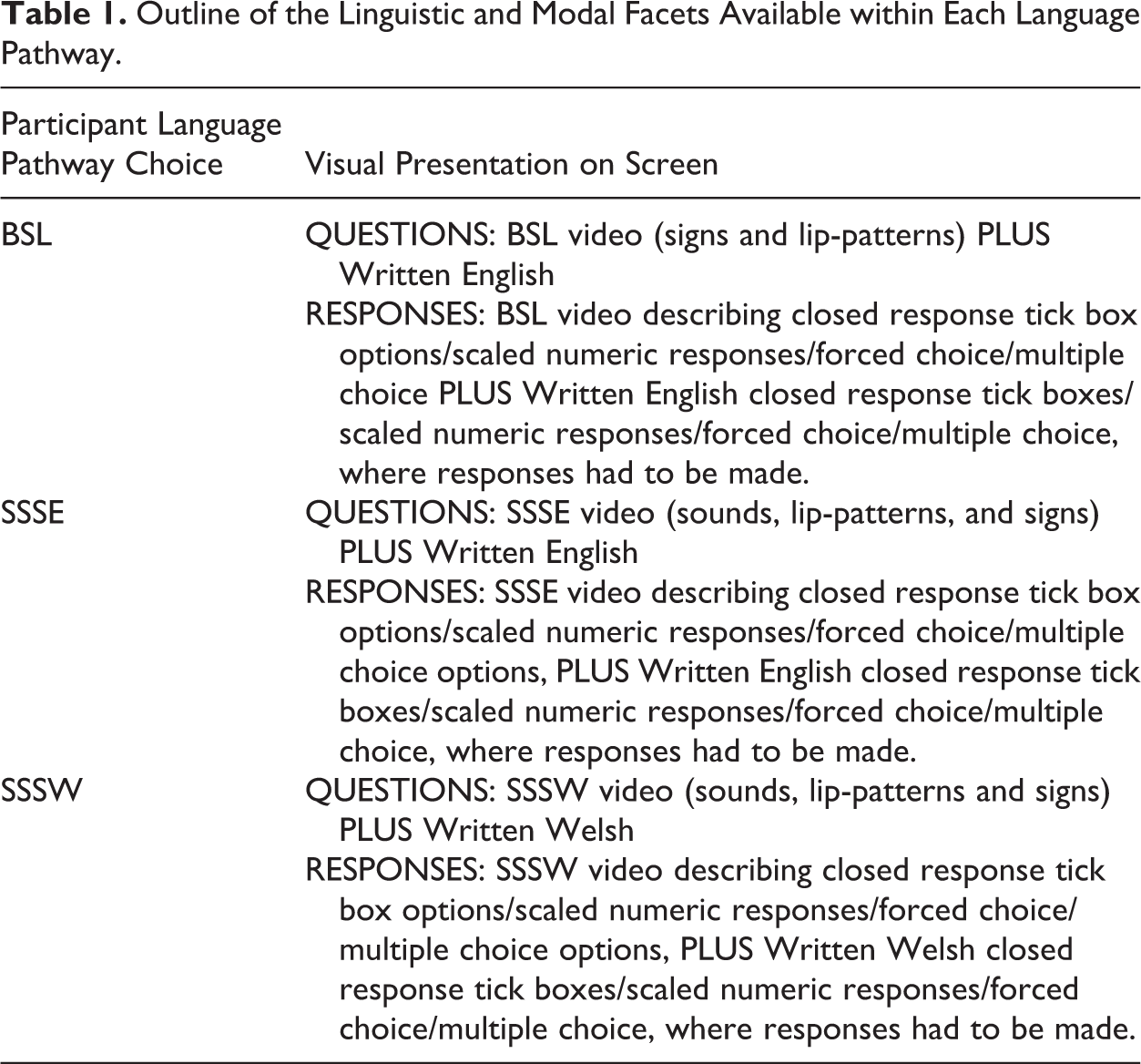
From a user interface perspective, we puzzled initially how to enable respondents to view the questions asked in multiple languages, while at the same time as ensuring a response in a single language. Our solution was two-fold. Respondents were initially asked to choose a single language pathway. These were offered as: Written English (WE), Written Welsh (WW), British Sign Language (BSL), Sign Supported Spoken English (SSSE), Sign Supported Spoken Welsh (SSSW). Those opting for a video pathway were able to see both video (signs and lip-patterns) and text, and in the case of the spoken versions, audio too (see Table 1).
Outline of the Linguistic and Modal Facets Available within Each Language Pathway.
Second, participants were told they could step out of their chosen pathway on a question-by-question basis if they wished and switch to a different pathway. The means for doing so was by a simple icon button to the top right of each screen that could be clicked by the respondent. Any responses already made on a page remained stable and carried through to the new pathway.
Our thinking was that these adaptations may be helpful for three reasons: (1) semantic checking (e.g., it would be possible to look at the same question in a different language if unsure of its meaning or of a vocabulary item within it); (2) expediency (e.g., watching a survey in signed presentation such as in BSL takes far more time than scanning a question in a written language, whether English or Welsh. By presenting both signed and written versions simultaneously (in the case of BSL, SSSE, and SSSW), participants could answer straightforward questions (e.g., date of birth, gender, etc.) more quickly using just written English, while retaining the option to view the signed/spoken presentations for more complex questions; (3) fit with individual language practices (e.g., as a young deaf person in 21st-century United Kingdom, it might be much more comfortable and recognizable to be able to switch between language sources to scaffold understanding and response because that is more in line with everyday life.
To achieve this complexity of translingual opportunity, some key technical challenges within REDCap had to be overcome. One centered on those instances when certain automated functions did not work in the same way when the multilingual hook was in use. For example, REDCap permits the researcher to specify some questions as compulsory, and the participant is unable to progress until the question has been answered. In those instances, REDCap displays the text “*must provide value*.” However, when the multilingual hook is in use, that message does not display automatically because the text in the translation field overwrites that message. Therefore, we had to create a HTML code manually and apply it to each instance where a compulsory answer was required when the multilingual hook was in use. For example:
English (no multilingual hook plugin): Where do you live? [REDCap automatically displays “must provide value” in red font]
English (but multilingual hook plugin is in use to permit the question being seen in other languages as well as in English): Where do you live? <p><span class=“multilingual” style=“color: red;”>*must provide value</span>
The code contains the question plus an HTML code to ensure that the compulsory conditions surrounding answering the question are met. Furthermore, this must be written separately for every question that is considered compulsory. The structure is further complicated when a visual modality is used (e.g., BSL). The field for translations provided by the multilingual hook does not permit the possibility of copying and pasting into a video link. For example in the following code: ENTER TRANSLATION HERE span class=“multilingual” style=“color: red;”>*must provide a value </span> Where do you live?<br><iframe src=“https://video.manchester.ac.uk/embedded/ffffffff-c327-dc22-0000-016b6b8e5b20”width=“660”height=“380”frameborder=“0”webkitallowfullscreenmozallowfullscreenallowfullscreen></iframe><p><span class=“multilingual” style=“color: red;”>*must provide value</span>
Limitations in Our Solutions
Our approach (and the technical solutions innovated) to allow participants to switch language pathways repeatedly throughout the survey was not entirely satisfactory. First, once an initial language choice had been made, the software displayed only a single switching button, at the top right of each page, rather than next to each question. If participants were somewhere down an online page, this button was no longer visible, and participants would have to scroll back to the top of the page to switch pathways, then back down to the question they were answering.
Second, although the five language pathway options were always available to participants, a pathway change was only possible in a linear fashion, by clicking a single button, rather than the five options all being presented simultaneously (as they were at the start). This meant that participants had to scroll through the five options (WE → WW → BSL → SSSE → SSSW then back to WE) to reach their intended pathway choice. Although change happens almost instantaneously, this linear structure is not without burden, and it may be disconcerting, at least initially, for non-Welsh users, for example, to be presented with written Welsh.
Third, for the small number of free field text answers, we would ideally have liked respondents to have had the option of responding in BSL/SSSE/SSSW if they wanted to, rather than having to default to a written response. Indeed, REDCap permits users to upload any document they might wish to send to the survey, and theoretically that could also include video files. However, there were restrictions making this impractical in our case: (1) Files uploaded by respondents to the REDCap system cannot be larger than 32mb. As a reference, 1 minute of film using an iPhone 6 at 720p at 30FPS is about 60mb (https://www.videoproc.com/iphone-video-processing/iphone-video-size-per-minute.htm); (2) the General Data Protection Regulations (GDPR 2018) under European Union law treat the face/images and films of the face, as personally identifying data that cannot be stored without specific consent. Although this barrier could have been overcome in the research consent process, the internal university security protections around the upload and storage of personally identifying information created significant barriers (i.e., regulations specify that video files would need to be encrypted by the respondent prior to upload, rather than encrypted by research team prior to storage). For the limited number of free text answers these two issues led us to decide it was not worth seeking additional solutions.
Data Output in the Face of Multilingual Completion and Translingual Access
The multilingual hook from REDCap enables input in different languages to be outputted in a single form enabling analysis and manipulation of variables and question responses to be treated as a single data set. Participants’ answers are stored in the same column in the data set regardless of varied language use. However, we were also interested in potential differences in response dependent on language(s) used to complete the survey. We wanted to know, for example, who chose to use the translanguaging facility we had built in, how often, whether only with regard to some questions, in which language combinations, and to relate such choices to features of their background. We were also interested prospectively in observing how an individual’s language choices and translanguaging strategies might change over time, given the repeat annual data collection.
One feature of REDCap was potentially problematic for these ends. The multilingual hook creates a “Languages” variable within the dataset. This is a single variable assigned for each “respondent user” and observation event—i.e., each iteration of a survey, which in our case was each year within the longitudinal study. Although the variable provides information on the languages used by each respondent, it stores only the last choice made. Furthermore, it is updated every time a new language is chosen by the user. Therefore, it would not be possible to discern patterns within different language choices across questions in a single observation event such as the completion of the annual survey.
However, within REDCap, a log record exists containing all changes made during a project within the “MySQL data base.” The actions recorded in this file include changes made by members of the research team such as adding a field but also changes made by respondents (e.g., answering a question). In its raw version, each row on the log file describes an event (i.e., an action made by a specific user at a specific time. Thus, columns record a timestamp, the user associated with the action, a category describing the action made, and a list showing all modified fields in the dataset for that specific event. From this log file it is possible to trace every time a respondent opted to view a different language/format than the language pathway they initially started on within the annual survey and to specify precisely on which questions this happened. To streamline this process, we wrote a STATA syntax (Do file) (see Table 2) containing commands to: Look for rows containing actions related to the multilingual hook “Languages” variable. Flag if they correspond to participants’ initial selection or to switches throughout the survey. Identify participants who make language choice changes using their ID number and create a variable for storing that information. Identify the language options chosen by participant for each event. Convert the timestamp variable stored as string into Day/Month/Year/hour/minute (DMYhm) format. Identify which other questions were answered during the same event (i.e., between language switches).
Description of Log File after Syntax.
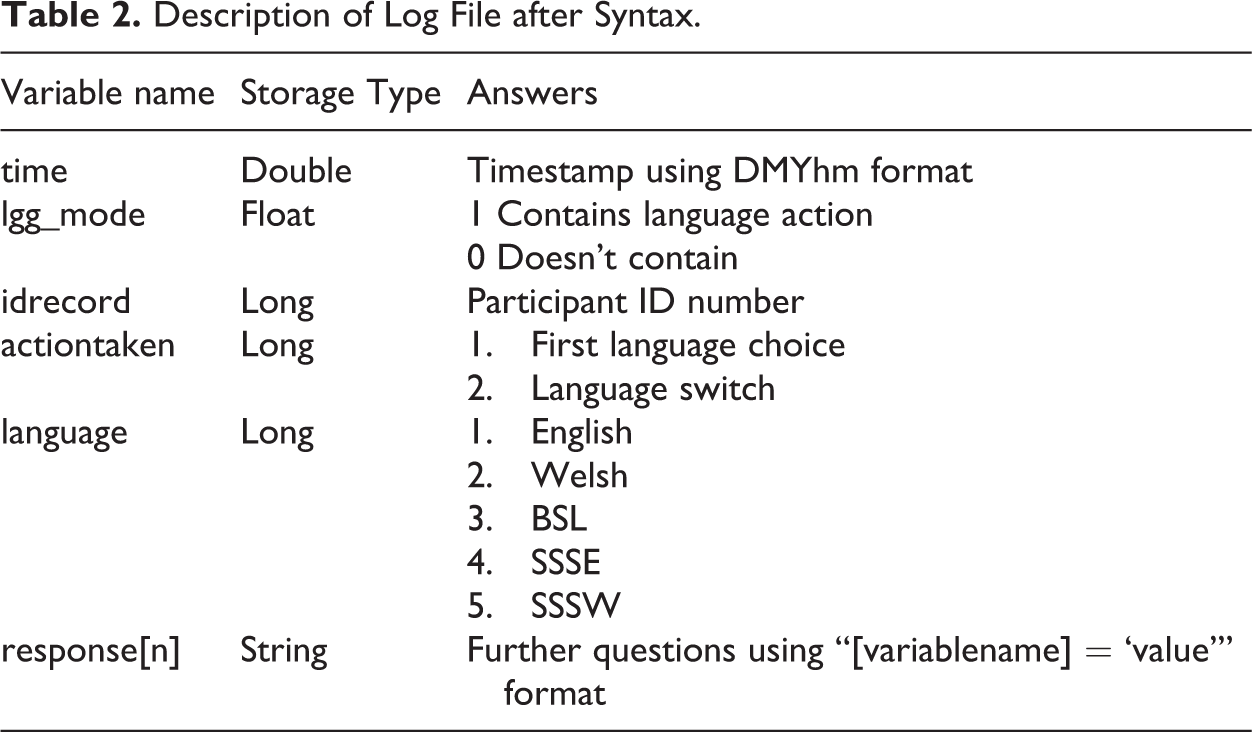
After this syntax is used, the resulting log file still retains the original structure by which every row describes an event, but the cleaned data are now analyzable for our purposes—to describe the nature and frequency of use of the translanguaging facility we have built into the survey.
Is the Instrument Working in the Field?
At time of writing, we can report that of the 242 participants who have answered the initial screening questions to enter the study 90.8% (n = 242) did so with reference to one language only, but 24 (9.91%) switched between one or more languages. Wave One of our data collection remains open for a further three months and the opportunity for observing in detail the characteristics of those who access multiple languages/formats and at what points in the survey will grow, with results to be reported separately.
Discussion
As Im et al. (2017) remark: “practical issues in the use of multiple languages, especially in technology-based intervention studies, have rarely been reported and/or discussed in the literature” (p. 147). We have shared openly some of the technical challenges we have faced and our initial solutions, alongside consideration of their theoretical significance for the quality of the data collected. Multilanguage survey research conventionally assumes that participant engagement remains bound to monolingual and unimodal structures and responses. Consequently, methodological focus is predominantly on issues of translation processes, potential differences in language group responses, and cultural adaptation of questions to ensure comparability between different language versions (Angel 2013; Harkness 2008; Harkness et al. 2010). Evidence also suggest that the way in which bilingual/multilinguals respond to a survey varies depending on which language they are questioned in and whether they acquired their languages simultaneously or at different times/in different contexts (Richard and Toffoli 2009). Although this insight points to cultural and semiotic processes that borrow from and between an individual’s language competencies, the form of survey research usually still assumes a single language model of engagement within a data collection instrument. By contrast, the question we set out to explore and demonstrate was what would happen if the everyday translanguaging potential and practices of participants was the starting point for how a survey instrument should be built. Furthermore, the test example of the highly diverse population of deaf young people also permitted us to consider this question from a modality, not just a language point of view, extending translanguaging online survey design to encompass the visual, orthographic, and auditory.
We believe there is potential to use this translanguaging online data collection facility with many populations who might be considered hard to reach or complex, such as those with poor levels of literacy or those whose preferred language does not have a written form. The possibility of embedded, filmed, and clearly heard questions is pertinent with respect to modality-diverse presentation of monolingual surveys, too. However, the extent to which modality of survey engagement might affect participant response within an online environment has not been rigorously explored. Modality effects of survey administration are more usually considered in terms of different environmental conditions affecting participant response and data quality (e.g., telephone, online, face to face, self-administered, and so forth) (Bowyer and Rogowski 2017; Christensen et al. 2013; de Leeuw et al. 2008). In our case, we conflated the multilingual and multimodal for the translanguaging rationale stated, but the relative influences of each aspect of possible mode of engagement on participant response behavior has not been investigated. In the process of developing our approach, we also started to wonder whether some of the issues of congruence between the visual and the orthographic that is required when presenting questions in BSL to show the direction or order of a response scale could also be applied in spoken questions that are filmed whereby an actor/researcher in speaking a question can also indicate where on the screen the answer can be found and the correct direction of a scale (e.g., left or right). This might provide further cognitive scaffolding for correct interpretations of what is expected in completing a response and an avenue of future exploration.
There are some limitations to what we have achieved. The building of an online translanguaging survey assumes that those to whom it is directed will be comfortable with digital and virtual interfaces. This is not true for all target populations. Also, the visual experience of online users is moderated to some extent by such factors as Internet connection speed and stability, or limits on data traffic that may be pertinent in some countries. Operating systems and browsers that use different video players can also affect the end user visual experience despite content (HTML code) remaining the same. Furthermore, the online platform we used, REDCap, was originally intended for biomedical research and most of the configurations related to visualization were intended for researchers inputting data rather than participants doing so. Consequently, not all the layout items are customizable, which restricts the final presentation.
Conclusion
It has been remarked that “Conducting research in a [participant’s] preferred language offers the best opportunity to truly capture reliable and valid results representative of their experiences. A preferred language is the person’s ‘language of the heart,’ the one that they want to speak when they feel at their most vulnerable” (Squires et al. 2019:707). However, in a world increasingly characterized by mobility, migration, multilingualism, and fluid language use, it is perhaps naive for researchers to continue to assume that the language of the heart is a single language defined by its associated structures, forms and lexicon (Li and Zhu 2013). We have raised the possibility of online survey design that starts to support the translanguaging semiotic and social reality of many people today. Technologically, this is possible. Its implications in terms of survey recruitment, response patterns, and data quality remain questions to be further explored.
Footnotes
Acknowledgments
We acknowledge the wider READY study team: Rachel O’Neill, Chris Mackintosh, John Ravenscroft, Helen Chilton, and Garry Squires.
Declaration of Conflicting Interests
The author(s) declared no potential conflicts of interest with respect to the research, authorship, and/or publication of this article.
Funding
The author(s) disclosed receipt of the following financial support for the research, authorship, and/or publication of this article: The READY study is funded by the National Deaf Children’s Society (UK). Views expressed in the article are those of the study team and not necessarily those of the funder.