




Abstract
Temporal aspects of child and adolescent time allocation in diverse cultural settings have been difficult to model using conventional statistical techniques. A new statistical approach, Egocentric Relational Event Modelling (EREM), allows for the simultaneous modelling of activity frequency, duration, and sequencing. Here, EREM is applied to a focal follow dataset of Congolese BaYaka forager child and adolescent play and work activities. Results show that, as children age, they engage in less frequent and extended play bouts and more frequent and extended work bouts. Bout frequency and duration were a more sensitive measure for early sex differences than overall time allocation. Sequential patterns of work and play suggest that these activities have short-term energetic trade-offs. This article demonstrates that EREM can reveal stable and variable patterns in child development.
Observational studies of children’s time allocation demonstrate that age, sex, family circumstance, and culture influence activity budgets (Blurton Jones 1972; Bock and Johnson 2004; Gosso 2010; Munroe et al. 1984; Whiting and Whiting 1975). However, temporal aspects of behavior have been difficult to model using conventional statistical techniques. Here, we demonstrate the applicability of the Egocentric Relational Event Model (EREM) using a focal follow dataset of BaYaka child and adolescent play and work activities (Butts 2008; Marcum and Butts 2015). While EREM is not the only statistical framework to accommodate sequential data, it is unique in the flexibility with which it can simultaneously model the probability and duration of multiple events.
Modeling Play and Work in Small-scale Societies
The role of play in preparing children for work has been debated. According to practice theory (Bock 2002; Bock and Johnson 2004), play allows children to practice social and subsistence skills necessary for adulthood. In support of this theory, children in small-scale societies allocate more time to work and less time to play as they age, suggesting that some skill acquisition has occurred (Bock and Johnson 2004; Boyette 2016; Lew-Levy and Boyette 2018). The surplus energy theory views play as a short-term mechanism for energy expenditure (Pellegrini 1987). In support of the surplus energy theory, preschoolers who spent longer periods of time indoors in non-play activities played more vigorously when released to the playground than preschoolers who had been indoors for shorter periods (Smith and Hagan 1980). While the surplus energy theory does not adequately explain many aspects of children’s playground activities (Evans and Pellegrini 1997), it considers energy expenditure as a factor in children’s time allocation. Thus, the practice and surplus energy theories likely capture long- and short-term trade-offs in time allocation to play and work.
Conventional statistical approaches make it difficult to simultaneously model these short- and long-term trade-offs. Models that rely on aggregation, such as Poisson or negative binomial regression, can explore the effect of independent variables, such as age, on children’s time allocation to various activities (e.g., Bock and Johnson 2004; Boyette 2016), but trade-offs in specific activities are not formally assessed. Multilevel models can employ correlated random effects to capture trade-offs in behavior, alongside fixed effects (e.g., Koster and McElreath 2017). However, specific hypothesis-derived sequences of events are not usually incorporated. Here, we demonstrate how fixed effects and sequence forms can be simultaneously applied in EREM to model trade-offs in child and adolescent time allocation.
Further, children often participate in sex-typed play that emulates adult sexual division of labor (Gosso 2010; Montgomery 2009). By adolescence, children’s work activities also reflect the sexual division of labor inherent to their cultural milieu (e.g., Froehle et al. 2019; Gallois et al. 2015). Previous work with BaYaka foragers has demonstrated that girls allocate more overall time to household work and pretense play than boys, while boys allocated more overall time to hunting play (Lew-Levy and Boyette 2018; Lew-Levy et al. 2020; Lew-Levy et al. 2019). However, these aggregate measures do not capture the dynamic and developmentally variable nature of children’s time allocation. Younger children may be incapable of attending to certain play or work activities for long periods of time (Ruff and Lawson 1990), even if they frequently revisit preferred activities throughout the day. While bout frequency, activity duration, and overall time allocation can be modeled independently using standard regression, EREM accounts for the non-independence of these measures by modeling them simultaneously. Here, using EREM, we examine sex differences in BaYaka children’s activity bout frequency and duration.
The Dataset
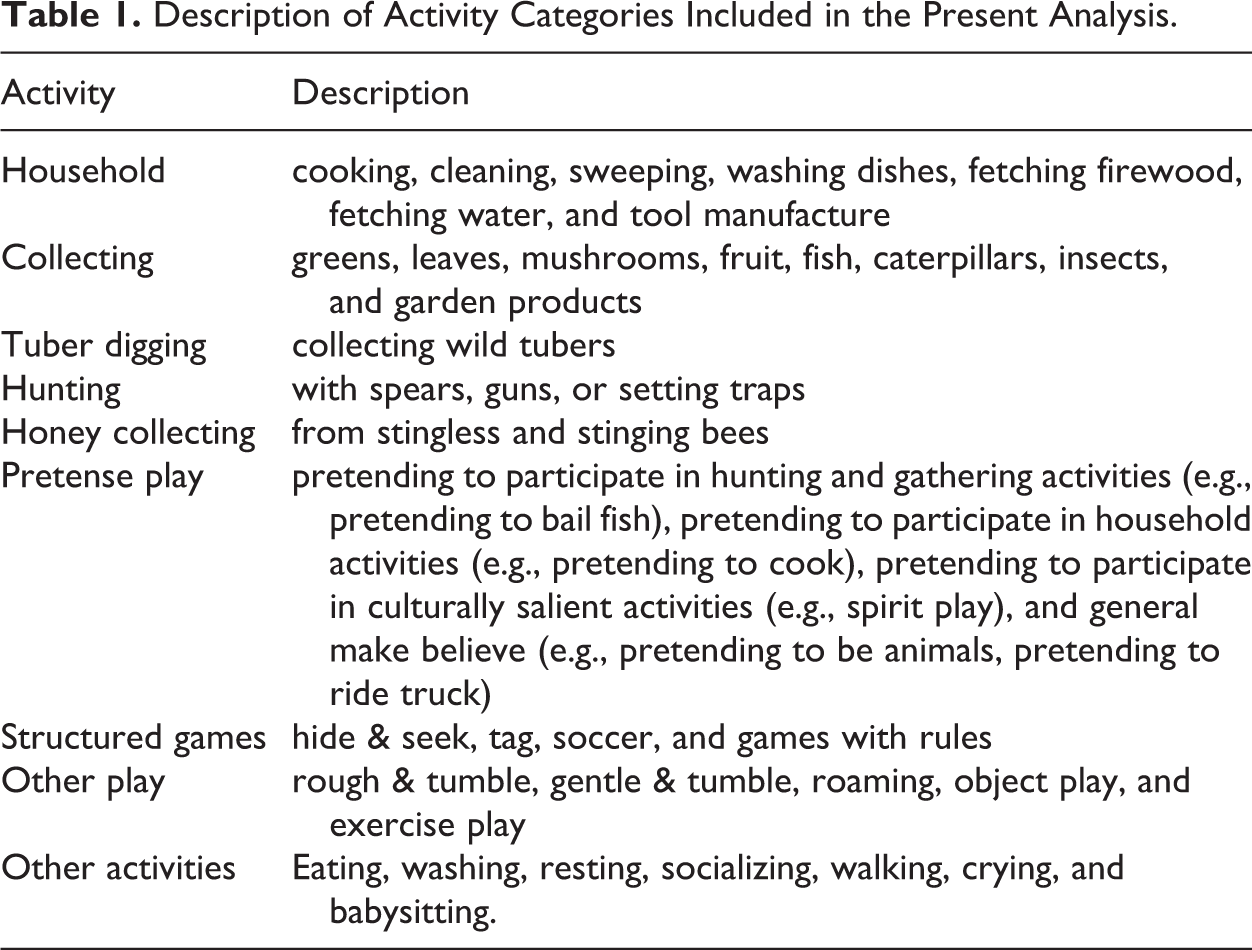
BaYaka foragers subsistence includes fishing, hunting, trapping, collecting, and gardening (Lewis 2002). BaYaka trade with farming populations for domesticated staples and market goods. The BaYaka are egalitarian, value individual autonomy, and maintain strong sharing norms. Data for this study were collected by SLL between August and September 2016, 2017, and 2018 in the Likouala province of the Republic of Congo. Sixty-five 3- to 18-year-olds were sampled from seven forest camps during bail fishing and caterpillar seasons. Using instantaneous focal follows (Altmann 1974), work and play activities (Table 1) were recorded at one-minute intervals over the span of two, two-hour sampling blocks, usually between 8 and 10 am and 12 to 2 pm over one or two days. Each child was observed, on average, for 286.4 minutes (SD = 151.1), totaling 18,617 observations. Reliability was high across all codes (K
Description of Activity Categories Included in the Present Analysis.
The Relational Event Model
Data Preparation
The focal follow data have the following structure in their raw form:
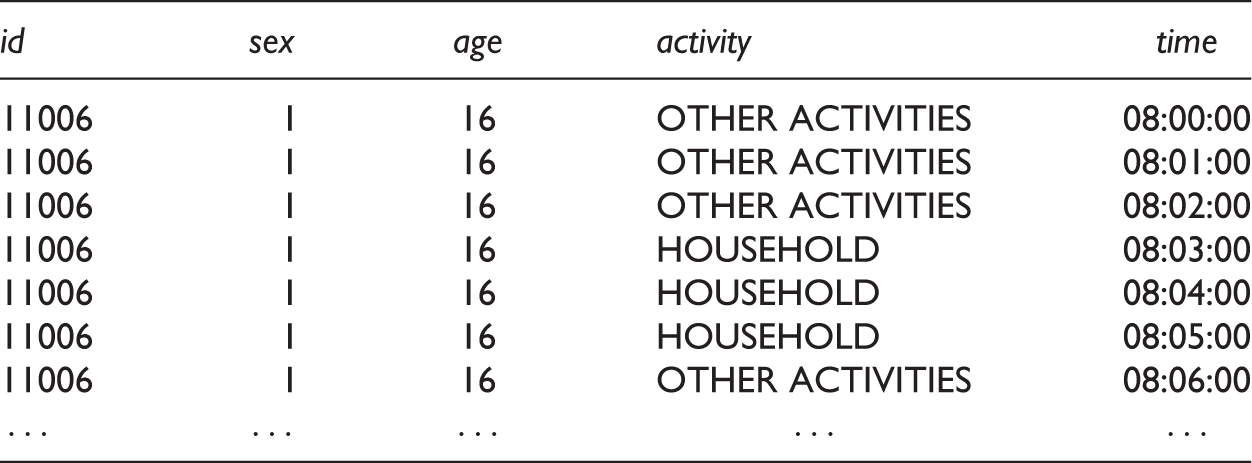
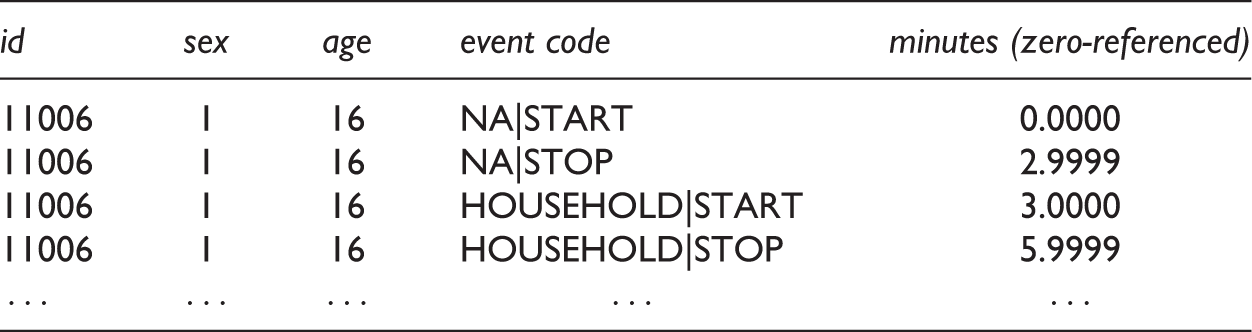
The time variable indicates that observation began at 8:00 am and activity was coded every minute. Because EREMs require each activity to be coded so that no events overlap in time, we subtracted 1/1,000 of a minute from the end of each activity (see Marcum and Butts 2015). Because each activity requires an onset and termination time, the first and last event in each block, and missing observations longer than 10 minutes, were coded as unknown because the start or end time of those specific activities fell outside the observation period. These missing data are modeled as a discrete category in each analysis to account for children’s time allocation to activities we did not directly observe, though we report relative frequency of events as a proportion of non-missing events. For children sampled in more than one year, we only used data from their first observation year, because the packages used for the present analyses cannot straight-forwardly model repeated observations (but see Dubois et al. 2013).
For EREM, data are structured with variables in columns such that each row represents a single event, with separate rows for STOP and START events in models with interval timing. Each row must contain an identifier for the actor, the event type, the time (zero-referenced for each actor), and covariates:
All analyses were conducted in R 3.4.4 (R Core Team 2013). The models were estimated in relevent (Butts 2008). Event list and a statistics list (statslist)—the former containing event histories for each actor and the latter containing contrast matrices specifying statistics to be estimated—were created using the informR package (Marcum and Butts 2015).
Model Formulation
The basis for the EREM is a relational event a defined as a finite list of elements consisting of the event type and time of each event. The relational event is defined by the list of elements (i, c, t) denoting the actor (i), event (c), and time (t). Thus, A
t = (a
1, a
2,…, a
m) is the set of events that have occurred by time t, termed an event history. The likelihood function for this event history is specified in terms of its hazard and survival functions. Butts (2008) proposes a piecewise constant model with the hazard function h(t) =

where
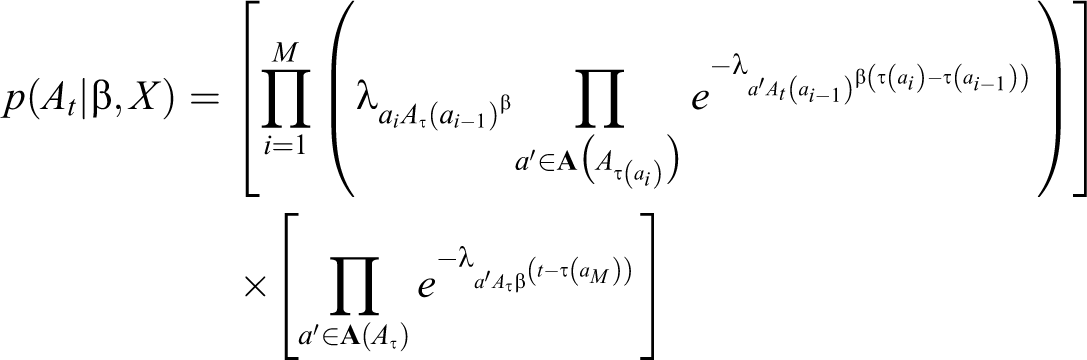
The hazard function gives the instantaneous rate of an event occurring and a hazard (short for hazard ratio) is the relative rate of one event to another. The parameter estimates are log hazards and are proportional to the log probability that any event in a series of events is of a particular event type. The probability of an event a is thus given by
The piecewise constant hazard assumption treats the time from the onset to the termination of an activity as an exponential waiting time distribution. Factors influencing the probability of an event are assumed to be constant over time. The onset and termination for each activity performed by an actor are constrained such that each onset is paired with a termination, and the onset of a new event must follow the termination of a preceding event. The probability of an event type is obtained from the onset parameter, and the duration of an event is obtained from the inverse exponent of the parameter estimate for the termination of that event type (ba
) as
Modeling Approach
We began by fitting a baseline model to estimate bout frequency and duration for events of interest for the sample as a whole. For individual effects, one can use the posterior probability associated with each effect summarized by 95% posterior probability intervals, intervals in which there is a 95% probability that the true parameter falls assuming the model is correct. A Bayesian analog of the frequentist p value can also be obtained, based on the relationship between p and the posterior probability that the effect is in the opposite direction to that observed (Casella and Berger 1987). High probabilities indicate uncertainty about the presence or direction of effect. If the posterior probability interval is also relatively narrow, the size of any effect is likely negligible.
We considered two extensions to this baseline model. The first extension explores the impact of covariates, in this case, age (mean centered) and sex, on bout frequency and duration of work or play events. The second extension models complex event sequences using sequence forms (s-forms) that measure how previous activities predict future ones. The s-forms enter the model as statistics within
We report estimates from the models fitted with Bayesian Simulated Importance Sampling (BSIR), which has the advantage that our estimates are posterior means rather than posterior modes, which may be more intuitive in terms of interpretation. We used weakly informative priors (scaled t distributions with scale = 10 and df = 9) to obtain estimates of the posterior mean because these can help efficiency of estimation and rule out unreasonable parameter values (McElreath 2015). Model comparison information, the dataset used in this analysis, and associated annotated R script, are provided in the supplementary materials.
Results
The Baseline Model: Examining Children’s Overall Participation in Work and Play
The baseline model (Table S2) allows us to derive point and interval estimates for the frequency and duration of events. The point estimates can be interpreted similarly to beta coefficients in conventional regression modeling. The START coefficients have a probabilistic interpretation as the likelihood of occurrence, while the STOP coefficients have a bout-duration waiting time interpretation. Intercepts for bout frequency are log hazards that can be transformed into estimates for the probability of an event a. For bout frequency, household activities have a log hazard of ba
= 7.13 and
As seen in Figure 1, other activity events represent 43.0% of the total (excluding unknown events). Other play (24.0%) is the next most likely to occur, followed by pretense play (8.3%), and games (3.0%): 35.3% of events are some form of play: 21.6% of events are work events, with household work (13.1%) most frequent, followed by food collection (5.4%), tubers (2.1%), hunting (0.54%), and honey collecting (0.44%). Other activity events average 5.6 minutes in length, with tuber digging and hunting longer at 8.8 and 8.0 minutes. Collecting (5.5 minutes) and honey collecting (6.4 minutes) are typically shorter. Household work tends to be brief in duration, averaging 3.2 minutes. Other play events are also short (2.7 minutes). Pretense play tends to be longer at 4.9 minutes, and structured games longer still at 5.4 minutes.
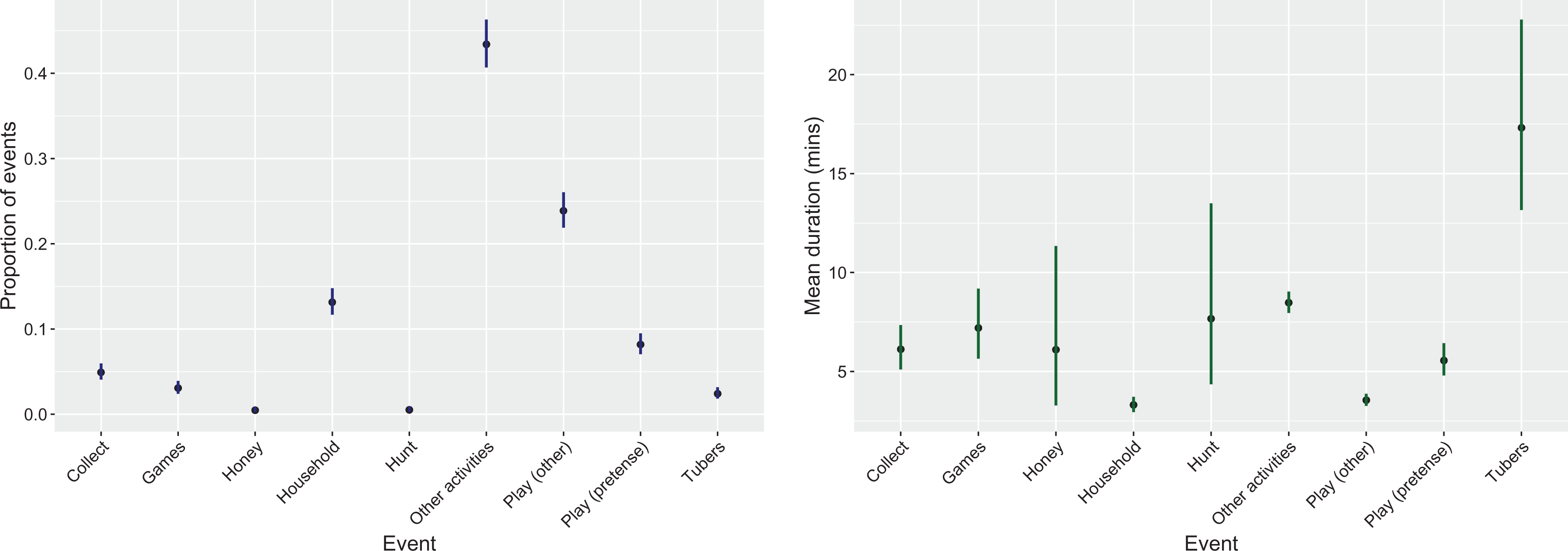
Mean probability and duration of known event type with 95% posterior probability intervals for the baseline (intercept-only model).
Modeling Covariates: Sex Differences in Bout Frequency and Duration
With the inclusion of sex as a fixed effect in the model, the point estimates for the intercept now represent the baseline for girls, and the male coefficients represent differences in log hazards between boys and girls (Table S3). Household work was less common for boys than girls by a factor of e−0.326 = 0.72. Boys spent 1/(e0.804) = 0.45—less than half as long—in household work than girls. Hunting is more frequent for boys by a factor of e2.242 = 9.4. Boys spent longer hunting by 1/(e−1.283) = 3.6. Household work, collecting, and tuber digging are less frequent, and hunting and honey collection more frequent for boys than girls (Figure 2). Pretense and other play are more common for boys. Girls may be more likely to play structured games than boys. Girls spend longer on household work, while boys spend longer than girls hunting and collecting tubers. Boys spend longer on structured games and other play, but girls spent longer in pretense play than boys.
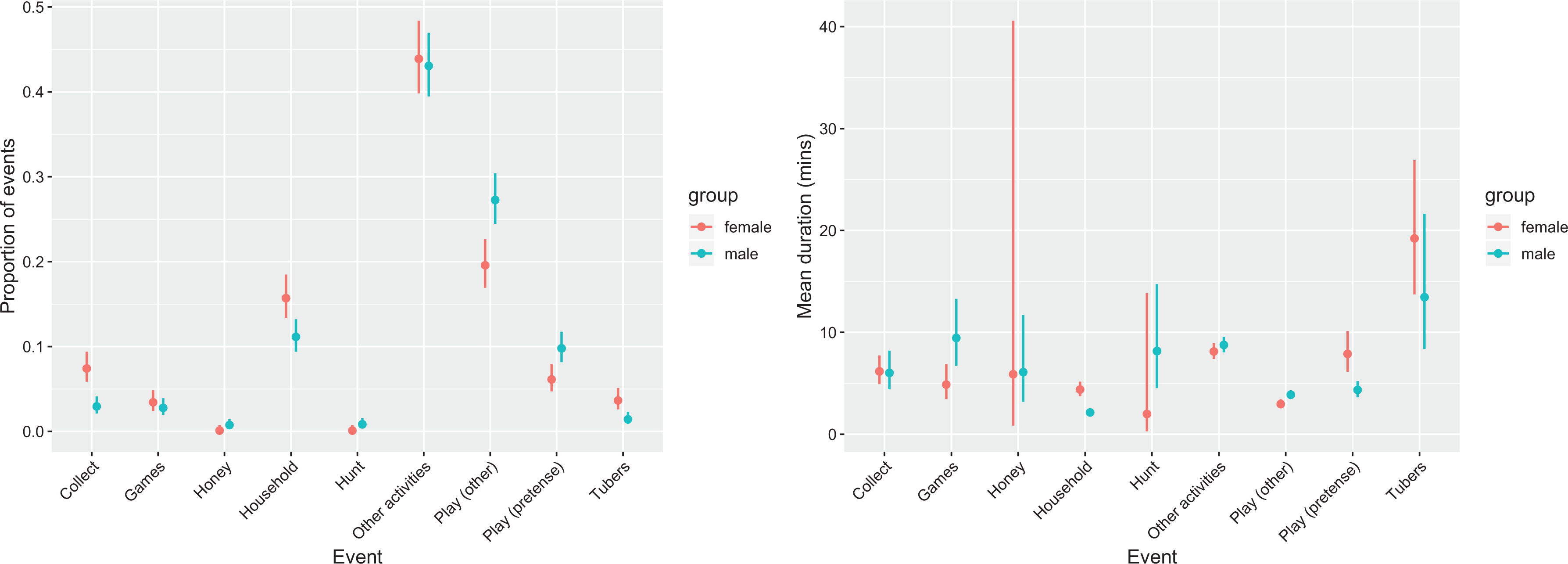
The mean probability (upper panel) and duration (lower panel) of different events by gender. Error bars are 95% posterior probability intervals.
Modeling Covariates: Replicating the Practice Theory of Play
By adding age as a covariate, it is also possible to explore changes in patterns of work and play for younger and older children (Table S4). The intercepts represent the parameter estimates for the frequency and duration of each event for a child with mean age of 10.6 years, and coefficients represent the change in log hazard from the intercept for a one-year increase in age.
All work events increased in frequency for older children. For example, with each one-year increase in age, household work events become more common by a factor of e0.085 = 1.09. Pretense play becomes less common by a factor of e−0.089 = 0.91. Other activities and playing games remain relatively stable in occurrence from younger to older children. All work activities except hunting have longer durations for older children. For household work, for every year older a child is, the typical duration increases by a factor of 1/(e−0.035) = 1.04; about 4% longer per year. Each year increases the duration of games by 1/(e−0.126) = 1.13 (13% per year). Pretense play tends to be shorter in duration by a factor of 1/(e−0.053) = 1.05 (or 5% per year). Other play was relatively unchanged with age. Hunting decreases in duration by 1/(e0.644) = 0.53; almost halving in duration each year.
Modeling Sequence Forms: Testing the Surplus Energy Theory for Play
By using s-forms, it is possible to test hypotheses about the relationship between different event types. The present example focuses on the probability and duration of play following household or foraging work, and vice versa. We separated household work from foraging work because the former is less energy intensive than the latter (e.g., Froehle et al. 2019). We expanded the s-form to include subsequences where “other activities” interrupted work to play or play to work transitions. This increases the number of subsequences that match the s-form and accounts for the logical relation of “other work” to the work or play events being modeled (e.g., eating between cooking and playing). Our s-forms take the following form: play|START→play|STOP→foraging|START→foraging|STOP play|START→play|STOP→other|START →other|STOP →foraging|START→foraging|STOP foraging|START→foraging|STOP→play|START→play|STOP foraging|START→foraging|STOP→other|START→other|STOP→play|START→play|STOP play|START→play|STOP→household|START→household|STOP play|START→play|STOP→other|START →other|STOP→household|START→household|STOP household|START→household|STOP→play|START→play|STOP household|START→household|STOP→other|START→other|STOP→play|START→play|STOP
The s-forms can be interpreted like additional variables in the model (Table S5). The bout frequency coefficients represent conditional log hazards of the first event relative to the second event. For example, the household → play s-form codes all event sequences in which a play event (whether pretense, games, or other play) follows a household work event type (with or without an interruption for the other activities event type). The household → play coefficients (−0.567 and −0.040 respectively) are relative log hazards and therefore indicate to what extent the frequency and duration of play events changes after household work activity. There is a reduction in play frequency following household work: play changes by a factor of e−0.567 = 0.57 (around 43% lower). There is little evidence that mean duration of these play events change. The foraging → play s-form shows a similar pattern, with the probability of a play event decreasing by a factor of e−1.108 = 0.34, but little indication of a change in play duration. Thus, a play event is far less likely following food collection. Household work decreases in frequency by 54%, e−0.780 = 0.46 following play. The duration also decreases by around 40%, 1/(e0.545) = 0.58. Foraging is on average over 75% less likely to occur after play, e−1.39 = 0.25.
Discussion and Conclusion
This article demonstrates the application of egocentric relational event modeling to studies of child and adolescent activity patterns in a small-scale society. There is a long history of observational research on childhood among the BaYaka of the Congo Basin, showing that play and work are integrated into children’s social, cultural, and economic development (see Hewlett 2014; Hewlett et al. 2011 for review). Here, we have added to this body of research by applying EREM to investigate the temporal aspects of children’s autonomous activities.
In support of practice theory, our findings show that work bouts were more frequent, while pretense and other play bouts were less frequent with age. Game play is an exception, being no less probable among older than younger children, likely because games increase in complexity as children age (Lew-Levy et al. 2020) and because games make up the leisure activity repertoire of both adults and children in this society (Lewis 2016). The duration of household work, collecting, honey collecting, and tuber digging increased with age. These findings may demonstrate increased skill acquisition and engagement in work, in line with findings by Bock and Johnson (2004). Hunting decreased in bout duration as children aged, despite being more frequent among older children. While hunting requires extensive time and skill for success (Gurven et al. 2006; Koster et al. 2020; Walker et al. 2002), children must also reach baseline competencies before they can practice hunting (Bock and Johnson 2004). Thus, there may be a delay in children’s learning-through-participation for this difficult activity.
Using sequence forms, we were further able to account for short-term trade-offs in play and work by modeling the probability of a play event following a work event and vice versa. Children were less likely to play after foraging. Play was also less frequent after household work. Household work was half as frequent and shorter in duration after play and collecting was three-fourths as frequent when play preceded it. Consistent with the surplus energy theory, these results suggest that both work and play involve short-term energetic costs for BaYaka children. Taken together, energy expenditure may explain immediate time allocation trade-offs, but learning may better explain trade-offs in activities across childhood. Learning more complex skills, such as hunting and trapping, may begin later. Sequence forms, implemented in EREM, offer another dimension along which variation in trade-offs in behavior can be formally modeled.
Previous research conducted among the BaYaka showed that overall time allocation to work activities minimally varied by sex, with only household work showing strong sex differences, in favor of girls (Lew-Levy et al. 2019). Similarly, the present analysis shows that boys participated in fewer bouts of household tasks and spent less than half as much time as girls on household tasks. Unlike our previous research, we found that boys were more likely to engage in hunting and honey collecting and had longer bouts of hunting. While girls were more likely than boys to participate in tuber digging and collecting, boys had longer bouts of tuber digging than girls. These findings are consistent with the BaYaka sexual division of labor, where men primarily hunt and collect honey, and women do a majority, though not all, of the gathering (Marlowe 2007). Compared to overall time allocation, bout frequency and duration, simultaneously modeled in EREM, are more sensitive to early sex differences and thus can shed light on the ontogeny of the sexual division of labor.
While we’ve focused on simple examples to demonstrate the applicability of EREM to observational data, more complex models can be set up using the informR package. S-forms can model different kinds of complex behaviors, such as the transition between specific types of work and play, and disjunctions within these. For example, it would be possible to examine whether pretense play is more or less likely after tuber digging, and whether a third event is more or less likely to occur between these. We might also be able to examine the relative temporal association between work or play activities with low or high energy expenditure. Studies can theoretically include multiple covariates within the same model, interactions between covariates, and interactions between external and endogenous effects (e.g., sex or age differences in s-forms). For example, in sequences of children’s work, we could observe the age-based allocation of time to skill- versus strength-based work activities, which might shed light on current debates regarding children’s early contribution to subsistence throughout human evolution, despite being highly productive in certain ecological contexts (Bird and Bliege Bird 2002; Bliege Bird and Bird 2002; Bock and Johnson 2004). EREM can also be applied to sequences where start and end times are unknown, such as during scan sampling, by modeling activities as ordinal. Where multiple individuals are observed and data about the sender and receiver of an action are available, EREM can be extended to model dyadic events (e.g., Pilny et al. 2016). Areas of application might include studies of childcare, dyadic play, or resource sharing.
Supplemental Material
Supplemental Material, sj-pdf-1-fmx-10.1177_1525822X20987073 - Demonstrating the Utility of Egocentric Relational Event Modeling Using Focal Follow Data from Congolese BaYaka Children and Adolescents Engaging in Work and Play
Supplemental Material, sj-pdf-1-fmx-10.1177_1525822X20987073 for Demonstrating the Utility of Egocentric Relational Event Modeling Using Focal Follow Data from Congolese BaYaka Children and Adolescents Engaging in Work and Play by Kate Ellis-Davies, Sheina Lew-Levy, Eleanor Fleming, Adam H. Boyette and Thom Baguley in Field Methods
Footnotes
Acknowledgments
We thank the BaYaka families who agreed to participate in this research. Thanks as well to Prof. Clobite Bouka-Biona from IRSEN, who facilitated the acquisition of research permits and infrastructure, DZABATOU Moise, who served as a community liaison, and our field assistants, MEKOUNO Paul and KOUTAIN Mindoula.
Author Contributions
KED and SLL contributed equally to the manuscript. KED and SLL conceived of the article and oversaw its development. SLL collected and categorized the data. TB conducted the statistical analyses. All authors wrote, reviewed, and approved the manuscript.
Declaration of Conflicting Interests
The author(s) declared no potential conflicts of interest with respect to the research, authorship, and/or publication of this article.
Funding
The author(s) disclosed receipt of the following financial support for the research, authorship, and/or publication of this article: Funding for data collection and writing was provided to SLL by the Cambridge International Trust, the Social Sciences and Humanities Research Council of Canada Doctoral Scholarship (Award Number 752-2016-0555), the Ruggles-Gates Fund for Anthropological Scholarship of the Royal Anthropological Institute of Great Britain and Ireland, the Smuts Memorial Fund, the Worts Travelling Grant, and the Cambridge School of Biological Sciences Fieldwork Fund.
Supplemental Material
Supplemental material for this article is available online.
References
Supplementary Material
Please find the following supplemental material available below.
For Open Access articles published under a Creative Commons License, all supplemental material carries the same license as the article it is associated with.
For non-Open Access articles published, all supplemental material carries a non-exclusive license, and permission requests for re-use of supplemental material or any part of supplemental material shall be sent directly to the copyright owner as specified in the copyright notice associated with the article.
