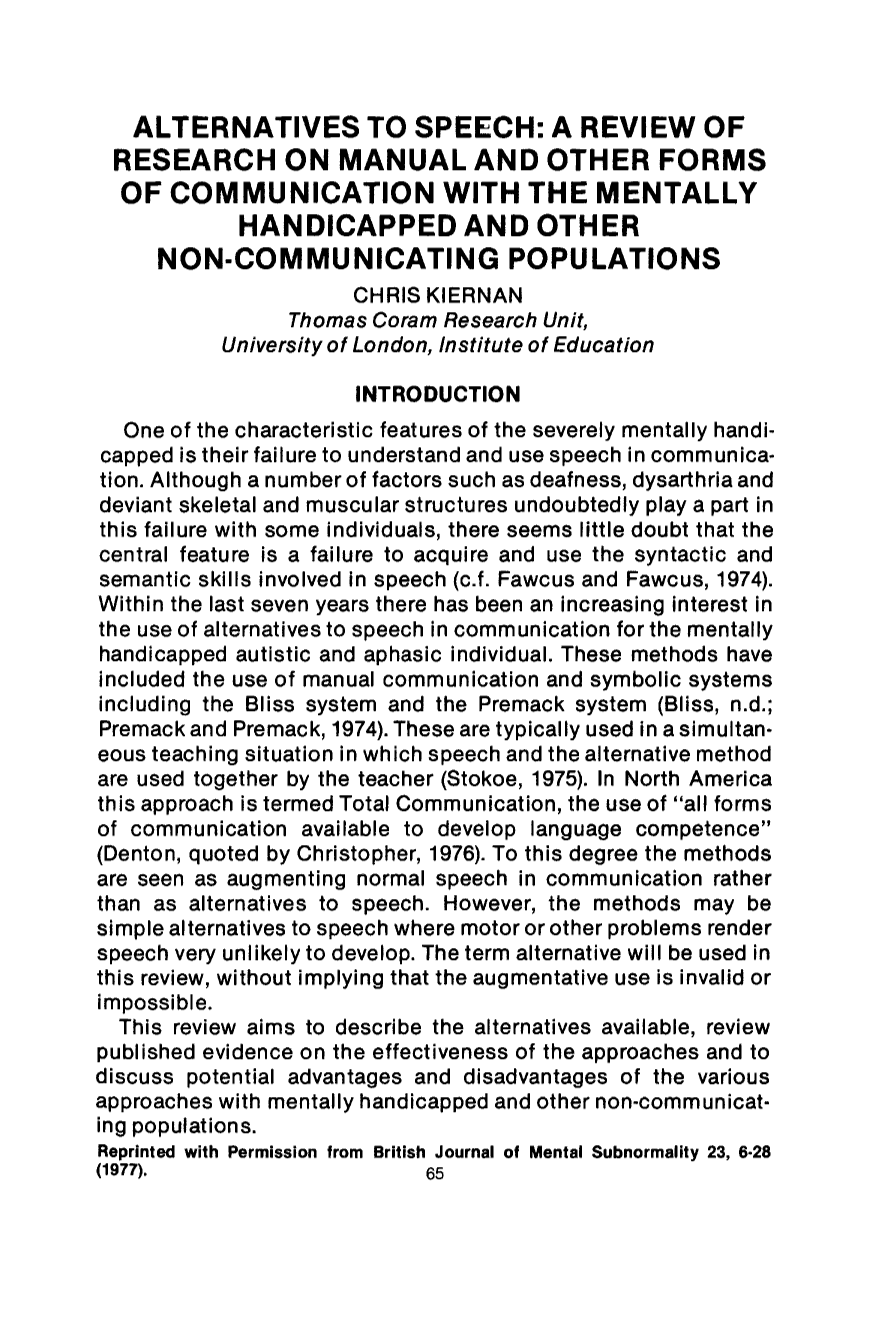
Alternatives To Speech: A Review of Research On Manual and Other Forms of Communication With the Mentally Handicapped and Other Non-Communicating Populations
Restricted accessReview articleFirst published online December, 1979
Alternatives To Speech: A Review of Research On Manual and Other Forms of Communication With the Mentally Handicapped and Other Non-Communicating Populations
Adler, E.P. (1971). Severely handicapped and multiply disabled deaf adults. Journal of Rehabilitation of the Deaf, 1971,4 (3), 96-100.
2.
Anthony, D. A. and Associates (Eds.) (1971 ). Seeing Essential English, Anaheim, Calif. : Educational Services Division, Anaheim Union High School District.
3.
Babbini, B.E. (1974). Manual Communication: Fingerspelling and the Language of Signs. Urbana: University of Illinois Press.
4.
Bellugi, U. and Fischer, S. (1972). A comparison of sign language and spoken language . Cognition, 1972, 1, 173-200.
5.
Bellugi, U. and Klima, E.S. (1975). Aspects of sign language and its structure. In Kavanagh, J.F. and Cutting, J.E.The Role of Speech in Language. Cambridge: MIT Press, pp. 171-203.
6.
Berger, S. (1972). A clinical program for developing multimedia responses with atypical deaf children. In McLean, J.,Yoder, D. and Schiefelbusch, R. (Eds.). Language Intervention with the Retarded. Baltimore: University Park Press.
7.
Berges, J. and Lezier, I. (1965). The Imitation of Gestures. London: Spastics Society.
8.
Bliss, C. (19--). Semantography. Sydney, Australia: Semantography Publications.
9.
Bonvillian, J.D. and Nelson, K.E. (1976). Sign language acquisition in a mute autistic boy . Journal of Speech and Hearing Disorders, 1976, 339-347.
10.
Bornstein, H. (1973). A description of some current sign systems designed to represent English. American Annals of the Deaf, 1973,118, 454-463.
11.
Bornstein, H., Kannapell, B.M., Saulnier, K.L., Hamilton, L.B. and Roy, H.L. (1972-74). Signed English Series: The Basic Pre-school Signed English Dictionary. Washington, D.C.: Galluadet College, 1972-1974.
12.
Bricker, D.D. (1972). Imitative sign training as a facilitator of word-association with low functioning children. American Journal of Mental Deficiency, 1972, 76 (5). 509-516.
13.
British Deaf and Dumb Association (1960). The Language of the Silent World. Oxford.
14.
Brown, A.L. (1974). The role of strategic behaviour in retardate memory . In Ellis, N. R. (Ed.). International Review of Research in Mental Retardation. Vol. 7. N.Y.: Academic Press.
15.
Brown, R. (1973). A First Language. London: Allen & Unwin.
16.
Butler, G.A., Griffing, B.L. and Huffman, J. (1969). Training Programme for the Retarded Blind and the Retarded Deaf Children. Grant No. 2 R20M R02075-04, Sonoma State Hospital, Eldridge, California (December 14, 1969).
17.
Carrier, J.K. (1974). Application of functional analysis and a non-speech response mode to language teaching. In McReynolds, L. V. (Ed.). Developing Systematic Procedures for Training Children's Language. A.S.H.A, Monograph No. 18.
18.
Carrier, J.K. (1976). Application of a non-speech language system with the severely language handicapped. In Lloyd, L. L. (Ed.). Communication Assessment and Intervention Strategies . Baltimore: University Park Press .
19.
Carrier, J.K. and Peak, T. (1975). Non-Speech Language Initiation Programme. Lawrence, Kansas: H. & H. Enterprises .
20.
Chafe, W.L. (1973). Meaning and the Structure of Language. Chicago: University of Chicago Press.
21.
Christopher, D.A. (1976). Manual Communication. Baltimore : University Park Press.
22.
Clark, C.R., Davies, C.O. and Woodcock, R.W. (1974). Standard Rebus Glossary. Circle Pines, Minnesota: American Guidance Service.
23.
Clark, C.R. and Greco, J.A. (1973). MELDS Glossary of Rebuses and Signs. Research, Development and Demonstration Centre in Education of Handicapped Children , University of Minnesota, Minneapolis .
24.
Clark, C.R., Moores, D.F. and Woodcock, R.W. (1975). The Minnesota Early Language Development Sequence (MELDS). Research, Development and Demonstration Centre in Education of Handicapped Children, University of Minnesota, Minneapolis.
25.
Clark, C.R. and Woodcock, R.W. (1976). Graphic systems of communication. In Lloyd, L. L. (Ed.). Communication Assessment and Intervention Strategies. Baltimore: University Park Press.
26.
Clarke, A.M. and Clarke, A.D.B. (1974). Experimental studies: An overview. In Clarke, A. M. and Clarke, A. D. B. (Eds.). Mental Deficiency: The Changing Outlook (3rd Edition), London: Methuen.
27.
Cornforth, A.R.T., Johnson, K. and Walker, M. (1974). Teaching sign language to the deaf mentally handicapped . Apex, 1974. 2 (1), -.
28.
Craig, E. (1970). The systematic sign language. Hearing, 1970, 25, 342.
29.
Critchley, M. (1970). Silent Language. London: Butterworths.
30.
Crystal, D. and Craig, E. (197 ). In Schlesinger and Namir. Current Trends in the Study of Sign Languages of the Deaf.
31.
Dale, D.M.C. (1975). Language Development in Deaf and Partially Hearing Children. Springfield, Illinois: C. C. Thomas.
32.
Fawcus, M. and Fawcus, R. (1974). Disorders of communication. In Clarke, A. M. and Clarke, A. D. B.Mental Deficiency. London: Methuen.
33.
Fenn, G. and Rowe, J.A. (1975). An experiment in manual communication. British Journal of Disorders of Communication, 1975 ,10, 3-16.
34.
Fillmore, C.J. (1968). The case for case. In Bach, E. and Harms, R. T. (Eds.). Universals in Linguistic Theory, N.Y.: Holt, Rinehart & Winston, 1-88.
35.
Gustason, G., Pfetzing, D. and Zawolkow, E. (1972). Signing Exact English. Modern Signs Press, 3434 Walker Lee Drive, Rossmore, Calif . 94720.
36.
Hall, S.M. and Talkington, L.W. (1970). Evaluation of a manual approach to programming for deaf retarded. American Journal of Mental Deficiency, 1970, 75, 378-380.
37.
Harris-Vanderheiden, D.J., Brown, W.P., MacKensie, P., Reined, S. and Scheibel, C. (1975). Symbol communication for the mentally handicapped . Mental Retardation, 1975, 13 (1), 34-37.
38.
Heber, R. (1959). A manual of terminology and classification in mental retardation. American Journal of Mental Deficiency Monograph Supplement, No. 64, 1959 .
39.
Hermelin, B.M. and O'Connor, N. (1975). Seeing, speaking and ordering. In O'Connor, N. (Ed.). Language, Cognitive Deficits and Retardation. London: Butterworths, 129-138.
40.
Hobsbaum, A. and Mittler, P. (1971). Sentence Comprehension Test (Experimental Edition) . Hester Adrian Research Centre, University of Manchester .
41.
Hockett, C.F. (1958). Course in Modern Linguistics. New York.
42.
Hoffmeister, R.J. and Farmer, A. (1972). The development of manual sign language in mentally retarded deaf individuals. Journal of Rehabilitation of the Deaf, 1972, 6, 19-26.
43.
Hughes, J. (1974/5). Acquisition of a non-verbal "language" by aphasic children. Cognition. 197415, 3, 41-55.
44.
Ingram, D. (1976). Phonological Disability in Children. London: Arnold.
45.
Jones, H. (1972). Talking Hands. London: StanleylPaul.
46.
Kiernan, C.C. (1974). Behaviour Modification. In Clarke, A. M. and Clarke, A. D. B.Mental Deficiency: The Changing Outlook. London : Methuen.
47.
Kiernan, C.C. and Saunders, C.A. (1976). Generalisation of Generalised Imitation Submitted for Publication.
48.
Klima, E.S. (1975). Sound and its absence in the linguistic symbol . In Kavanagh, J. F. and Cutting, J. E.The Role of Speech in Language . MIT Press: Cambridge, Mass.
49.
Klima, E.S. and Bellugi, U. (1972). The signs of language in child and chimpanzee . In Alloway, T., Krames, L. and Pliner, P.Communication and Affect. N. Y.: Academic Press.
50.
Kopchick, G.A. and Lloyd, L.L. (1976). Total communication programming for the severely language impaired: A 24-hour approach. In Lloyd, L.L. (Ed.). Communication Assessment and Intervention Strategies . Baltimore : University Park Press .
51.
Kopchick, G.A., Rombach, D.W. and Smilovitz, R. (1975). A total communication environment in an institution . Mental Retardation, 1975, 13 (3), 22-23.
52.
Levett, L.M. (1969). A method of communication for non-speaking severely subnormal children. British Journal of Disorders of Communication , 1969, 4, 64-66.
53.
Levett, L.M. (1971). A method of communication for non-speaking severely subnormal children-Trial results. British Journal of Disorders of Communication, 1971, 6, 125-128.
54.
Levett, L.M. (1971). Discovering how mime can help. Special Education, 1971, 60, 17-19.
55.
Lynch, L. and Tobin, A. (1973). The development of language training programmes for post-rubella hearing-impaired children. Journal of Speech and Hearing Disorders, 1973, 38, 15-24.
56.
McDonald, E.T. (1976). Design and Application of Communication Boards . In Vanderheiden, G. C. and Grilley, K. (Eds.). Non-Vocal Communication Techniques and Aids of the Severely Physically Handicapped. Baltimore: University Park Press.
57.
McLean, L.P. and McLean, J.E. (1974). A language training programme for non-verbal autistic children. Journal of Speech and Hearing Disorders. 1974, 39, 186-193.
58.
Mecham, M. (1968). Verbal Language Development Scale. Circle Pines, Minnesota: American Guidance Service .
59.
Miller, A. (1968). Symbol Accentuation-A New Approach toReading. N.Y.: Doubleday Multimedia.
60.
Miller, A. and Miller, E.E. (1973). Cognitive-developmental training with elevated boards and sign language. Journal of Autism and Childhood Schizophrenia, 1973, 3, 65-85.
61.
Miller, E.E. (1968). Symbol accentuation: A new approach to language development with retardates. In Richards, B. W. (Ed.). Montpelier, France: Proceedings of the First International Congress for the Scientific Study of Mental Deficiency.
62.
Moores, D.F. (1974). Non-vocal systems of verbal behaviour. In Schiefelbusch, R. L. and Lloyd, L. L. (Eds.). Language Perspectives-Acquisition, Retardation and Intervention. London: MacMillan .
63.
Morris, G.P. (1975). Language and memory in the severely retarded. In O'Connor, N.Language, Cognitive Deficits and Retardation. London: Butterworths, 143-150.
64.
Nelson, R.O. and Evans, I.M. (1968). The combination of learning principles and speech therapy techniques in the treatment of non-communicating children. Journal of Child Psychology and Psychiatry, 1968, 9, 111-124.
65.
Nelson, R. 0., Peoples, A., Hay, L.R., Johnson, T. and Hay, W. (1976). The effectiveness of speech training techniques based on operant conditioning : A comparison of two methods. Mental Retardation, 1976, 14, (3), 34-38.
66.
O'Connor, N. (1975). Language, Cognitive Deficits and Retardation. London : Butterworths.
67.
Ontario Crippled Children's Centre (1974). Teaching Guide. Toronto, Ontario: Symbol Communication Research Project.
68.
Ontario Crippled Children's Centre (1974). Symbol Communication Programme. Year End Report.
69.
Paget, R. (1951). The New Sign Language. London : The Wellcome Foundation.
70.
Paget, R., Gorman, P. and Paget, G. (1972). A Systematic Sign Language. London: Mimeographed.
71.
Paivio, A. (1971). Imagery and Verbal Processes. N.Y.: Holt, Rinehart & Winston.
72.
Piaget, J. (1962). Play, Dreams and Imitation in Childhood. N.Y.: Norton.
73.
Premack, D. (1970). A functional analysis of language. Journal for the Experimental Analysis of Behaviour, 1974, 14, 107-125.
74.
Premack, D. and Premack, A.J. (1974). Teaching visual language to apes and language-deficient persons. In Schiefelbusch, R. L. and Lloyd, L. L. (Eds.). Language Perspectives-Acquisition, Retardation and Intervention. London: MacMillan.
75.
Pylyshyn, Z.W. (1973). What the mind's eye tells the mind's brain: A critique of mental imagery. Psychological Bulletin, 1973, 80, 1-27.
76.
Richardson, T. (1975). Sign language for the SMR and PMR. Mental Retardation, 1975, 13 (3), 17.
77.
Riekehoff, L.L. (1963). Talk to the Deaf. Springfield Mo.: Gospel Publishing House.
78.
Rutter, M., Graham, P. and Yule, W. (1970). A Neuropsychiatric Study in Childhood. London: Spastics Society.
79.
Spidal, D.A. and Pfau, G.S. (1972). The potential for language acquisition of illiterate deaf adolescents and adults. Journal of Rehabilitation of the Deaf, 1972, 6 (1), 27-41.
80.
Sutcliffe, T.H. (1971). Conversation with the Deaf. London: Royal National Institute for the Deaf.
81.
Sutherland, G.F. and Beckett, J.W. (1969). Teaching the mentally retarded sign language. Journal of Rehabilitation of the Deaf, 1969, 2 (4), 56-60.
82.
Stokoe, W.D. (1975). The use of sign language in teaching English. American Annals of the Deaf, 1975, 120 (4), 417-421.
83.
Stokoe, W.C., Casterline, D.C. and Croneberg, C.G. (1965). Dictionary of American Sign Language on Linguistic Principles. Washington, D.C.Gallaudet College.
84.
Topper, S.T. (1975). Gesture language for a non-verbal severely retarded male. Mental Retardation, 1975, 13 (1), 30-31.
85.
Vanderheiden, G.C. and Grilley, K. (1976). Non-Vocal Communication Techniques and Aids for the Severely Physically Handicapped. Baltimore: University Park Press.
86.
Vanderheiden, G.C. and Harris-Vanderheiden, D. (1976). Communication techniques and aids for the bon-vocal severely handicapped. In Lloyd, L. L. (Ed.). Communication Assessemnt and Intervention Strategies . Baltimore: University Park Press .
87.
Van Mierlo, J.M.A. (1975). Communicatology. A New Technical Approach to Communicational Problem-solving. Mimeographed.
88.
Velletri-Glass, G.A., Gazzaniga, M.S. and Premack, D. (1973). Artificial language training in global aphasics . Neuropsychologia, 1973, 11, 95-103.
89.
Walker, M. (1973). An experimental evaluation of the success of a system of communication for Deaf Mentally Handicapped. Unpublished M.Sc. Thesis Human Communication Studies. University of London.
90.
Walker, M. (1976). The Makaton Vocabulary: A progress report. Apex, 1976, 3 (4), 27-28.
91.
Wilbur, R.B. (1976). The Linguistics of manual systems. In Lloyd, L. L. (Ed.). Communication Assessment and Intervention Strategies. Baltimore: University Park Press.
92.
Woodcock, R. W. (Ed) (1965). The Rebus Reading Series. Institute on Mental Retardation and Intellectual Development, George Peabody College, Nashville.
93.
Woodcock, R.W., Clark, C.R. and Davies, C.O. (1968). Peabody Rebus Reading Programme. Circle Pines, Minnesota: American Guidance Service .