



Abstract
Adolescent mothers (AMs) often experience limited academic and financial attainment and higher rates of mental health disorders, which may affect their relationships with their children. Although children of AMs are at higher risk for developmental delays, there is no clear evidence of the relationships between mother characteristics and child outcomes. This descriptive study explored AMs’ and their children’s sociodemographic characteristics and language skills, home literacy environment, and the quality of mother–child interactions. Eight AM–child dyads were recruited from local school districts. Data were collected through questionnaires, standardized measures of language, and mother–child interactions. Most AMs demonstrated below-average language skills and most children had language scores that fell within the average range. AMs demonstrated strong affectionate behaviors, and emerging responsive, encouraging, and teaching behaviors when interacting with their children. This study provides unique data on AMs’ language characteristics that have not been clearly published in the literature.
Prevalence and Cost of Adolescent Motherhood
The average birth rate for adolescents in the United States is one of the highest out of all industrial countries, estimated at 17.4 births per 1,000 females ages 15 to 19 years in 2018 (Martin et al., 2019), despite decreasing trends since 1991 (Planned Parenthood, 2014). During 2018, the birth rates for Hispanic and non-Hispanic Black adolescents were more than twice the rate for non-Hispanic White adolescents (Martin et al., 2019). These rates contextualize the heavy burden of adolescent pregnancy and parenting, which cost society an average US$9.4 billion yearly due to adolescent mothers’ (AMs) limited spending and earning, dependence on welfare programs, and criminal justice spending (The National Campaign, 2017).
Several risk factors put young women at risk for giving birth during the teenage years, including being reared by an AM, early-onset menstruation, being born into a single-parent family, exposure to major parental changes (e.g., parental divorce, remarriage), educational underachievement, conduct issues, engaging in high rates of sexual activity, and involvement with deviant peers (Woodward et al., 2001). Furthermore, adolescent pregnancy and parenting negatively affect AMs’ academic achievement (Shuger, 2012), financial attainment (Planned Parenthood, 2014), and mental health (Huang et al., 2014), setting a multigenerational cycle of academic, financial, and health limitations. In fact, only 45% of pregnant and parenting adolescents graduate from high school, with fewer than 2% receiving a college degree by age 30 (Shuger, 2012). In turn, these limitations negatively affect AMs’ offspring’s development (Huang et al., 2014). Mothers living in poverty, with little education, and experiencing depression display fewer positive parenting behaviors, such as general verbalness, maternal warmth, and contingent responsivity (Lanzi et al., 2009).
A Parent’s Role in Their Child’s Language Development
The influence of parents on their child’s language development is often the most important factor in learning new skills (Adamson et al., 2020). Three aspects of parenting have been highlighted as integral to children’s language development (Tamis-LeMonda & Rodriguez, 2008): the frequency of children’s participation in learning activities, the provision of age-appropriate learning materials, and the quality of caregiver-child engagements, which may be determined by a parent’s responsiveness.
The home literacy environment (HLE) is made up of three aspects (Burgess et al., 2002): (a) demographic characteristics of parents, (b) parental literacy habits that expose children to models of literacy, and (c) parental efforts that directly engage children in literacy-centered activities. Routine learning activities (e.g., shared book reading and trips to the library) expose children to a foundation for early language, learning, and literacy development (Payne et al., 1994; Tamis-LeMonda & Rodriguez, 2008). There is a strong correlation between receptive and expressive vocabulary development and the child’s access to literacy in the home environment (Payne et al., 1994). AMs have been reported to provide fewer children’s books, score lower on measures of print exposure, allow more access to television and less access to the library, and play less with magnetic letters with their children (Burgess, 2005). AMs also scored lower on adult print exposure measures, reported reading for pleasure less often, watched television more often, and exhibited lower vocabulary scores (Burgess, 2005). These results indicate that home literacy practices must be measured and interpreted in combination with the broader language environment and cultural practices and traditions that affect language and literacy development in children (Burgess, 2005).
Another predictor of children’s language development is the quality of caregiver–child interactions. Growth of a child’s communicative skills are partially dependent on their parents’ ability to demonstrate facilitative strategies during shared play interactions such as contingent responsivity and providing directives related to a child’s focus (Adamson et al., 2020). Because most AMs come from diverse racial and ethnic minority backgrounds (Martin et al., 2019) and live in low-income households (Planned Parenthood, 2014), it is critical to understand the mothering patterns across ethnic and cultural groups. Across European American (EA), African American (AA), and Latin American (LA) ethnic groups, the majority of mothers demonstrate consistent supportive mothering patterns over time (Fuligni & Brooks-Gunn, 2013), while other patterns included directive and detached characteristics (Brady-Smith et al., 2013). AA and LA mothers were found to be more likely to demonstrate decreasing levels of supportiveness over time (Fuligni & Brooks-Gunn, 2013). In terms of supporting children’s outcomes, a supportive (Brady-Smith et al., 2013) and consistent (Fuligni & Brooks-Gunn, 2013) mothering pattern has the most beneficial relationship with children’s cognitive, emotional, relational, and language development (Brady-Smith et al., 2013; Fuligni & Brooks-Gunn, 2013), while a harsh pattern has the most pervasive negative correlations with later child outcomes (Brady-Smith et al., 2013) across all ethnicities. However, the associations between stable high levels of support and later child language outcomes are weaker in AA children—suggesting that factors other than patterns of parenting styles, such as neighborhood characteristics and social capital, account for the variation in AA children’s outcomes (Fuligni & Brooks-Gunn, 2013).
Berlin and colleagues (2002) found that AMs are significantly less supportive, more detached, and more directive (although no more negative) than adult mothers when all related demographic characteristics are controlled for. This association is mediated by the level of risk the mother is experiencing; that is, among mothers who completed high school, were married/cohabitating, or were not living in deep poverty, a relationship between childrearing age and less supportive and more directive parenting behaviors was evident. No correlations between the AMs’ school grade, race/ethnicity, depression, or maternal family background and use of language facilitation strategies have been found (Towson et al., 2020).
When directly coached, AMs have demonstrated their ability in using language facilitation strategies. In response to coaching AMs to use interactive cues during interactions with their children, mothers increased the use of the cues and the children’s participation and receptive language increased (Neuman & Gallagher, 1994). Similarly, AMs who participated in an emergent literacy intervention demonstrated significantly greater frequency of reading behaviors focused on vocabulary, questioning, and book/print features (Scott et al., 2016).
Impact of Adolescent Mothers on Children’s Language Development
Increased maternal intrusiveness and lack of verbal stimulation, low maternal ability, and a lacking HLE have been linked to delays in expressive and receptive language for children of AMs (Keown et al., 2001; Oxford & Spieker, 2006). Children of AMs perform lower than children born to adult parents on emerging literacy and language measures as toddlers (Keown et al., 2001; Oxford & Spieker, 2006), putting them at risk for developing a language delay and being retained a grade in elementary school (Keown et al., 2001; Luster et al., 2000). The most successful children who were born to AMs are those that experience more supportive care and higher levels of parenting, were read to frequently, and had mothers who progressed further in their schooling (Luster et al., 2000).
Purpose of the Present Study
It is evident that AMs are at an elevated risk for a myriad of challenges. These risk factors place their children at risk for language delays and ultimately less academic success compared with peers born to adult mothers (Keown et al., 2001; Luster et al., 2000), creating a multigenerational cycle of environmental, developmental, and academic factors that hinders the success of adolescent families. To disrupt the multigenerational cycle, we must first understand which factors influence each other. However, there is limited foundational research to inform best practices for adolescent families. The purpose of this study was to explore AMs’ and their children’s demographic characteristics and language and literacy skills, the HLE provided by AMs, and the quality of linguistic interactions between AMs and their children.
Method
An exploratory case series was analyzed to better understand AM–child dyad’s demographic and linguistics characteristics, the HLE provided by AMs, and the quality of linguistic interactions between AMs and their children. The study was reviewed, approved, and overseen by [University’s] Institutional Review Board (STUDY00000987, approved October 23, 2019). There are no conflicts of interest to report.
Data Sources and Participants
Data were obtained from two separate sources. Dataset A was collected for the purposes of the current study, starting in 2019, and Dataset B originated from a retrospective analysis of the pretest phase of a 2018 study (Abarca et al., 2023). The aim of said study was to assess the impact of a parent-implemented intervention on AMs’ use of language facilitation strategies. Datasets A and B included four AM–child dyads each (i.e., 8 AMs and 8 child participants total), recruited from two public district schools in a metropolitan city in the Southeastern region of the United States. Both recruitment sites offer specialized services for AMs ages 12 to 19 years.
AMs for Dataset A (AMs A1–A4) were included in the study if they (1) were the primary caregiver of the child, (2) spoke English as their primary language, and (3) had at least one child (3a) between the ages of 0 to 60 months old, (3b) with normal vision (with corrective lenses if applicable) and not diagnosed as deaf or hard of hearing, and (3c) not identified with a diagnosed impairment per state eligibility requirements (e.g., autism spectrum disorder, Down syndrome, or developmental delay) determined per parent report. For Dataset B, AMs (AMs B5–B8) were included if they (1) were currently enrolled in one of the recruitment sites and (2) had a child (2a) between the ages of 6 and 60 months old (2b) who attended the recruitment site.
Eligible adult participants (i.e., 18 years or older) received an explanation of the research study from each study’s primary investigator and signed consent for themselves and their children. Eligible participants who were younger than 18 years received a consent form to be completed by their parent or legal guardian providing permission for their participation in the study. For Dataset A, AMs who were younger than 18 years had to sign consent for their children in addition to having a consent form completed by their parent or legal guardian.
Measures
AM Questionnaire
The AM Questionnaire (see Supplementary Material) comprised three modules. The demographic module included the following questions: program attended, date of birth, age at recruitment, race/ethnicity, age when first child was born, highest grade completed or current grade, household income, spoken languages, and with whom she lived. The HLE module was adapted from Lonigan and Farver’s (2002) HLE Questionnaire and consisted of six multiple-choice questions regarding literacy practices and eight questions regarding shared reading strategies on a 6-point Likert-type scale.
Comprehensive Evaluation of Language Fundamentals (Wiig et al., 2013)
The Comprehensive Evaluation of Language Fundamentals (CELF-5) is a comprehensive battery of 16 subtests assessing an individual’s reading comprehension, structured writing, oral language, and social language skills. The assessment is designed for individuals 5 to 21 years old and was standardized across a representative sample of the U.S. population of 2,380 English-speaking individuals (7.6% between 17 and 21 years old). The Core Language Score (CLS) was calculated by adding the scaled scores of the Formulated Sentences, Recalling Sentences, Understanding Spoken Paragraphs, and Semantic Relationships subtests into a standard score (M = 100; SD = 15).
Child Questionnaire
The Child Questionnaire (see Supplementary Material) was completed by the AMs and collected the following demographic information: date of birth, chronological age, gender, race, home language(s), special education services child receives, and any medical diagnoses.
Preschool Language Scales, 5th Edition (Zimmerman et al., 2011)
The Preschool Language Scales, 5th Edition (PLS-5) is a play-based assessment of global language abilities that include items ranging from preverbal, interaction-based skills to preliteracy skills. The assessment is designed for children 0 to 7 years. It is composed of an Auditory Comprehension (AC) subtest and an Expressive Communication (EC) subtest that are compiled for a Total Language scaled score (TLS, M = 100; standard deviation, SD = 15). The test was standardized across more than 1,800 children, representative of the U.S. population in terms of gender, geographic region, race/ethnicity, and parent’s education level.
Parenting Interactions With Children: Checklist of Observations Linked to Outcomes (Roggman et al., 2013a)
Linguistic interactions between the AM and child participants were assessed with the use of the Parenting Interactions With Children: Checklist of Observations Linked to Outcomes (PICCOLO)—a research-based observational tool that consists of seven to eight items within four domains: Affection, Responsiveness, Encouragement, and Teaching. The Affection domain contains items that measure demonstrations of physical or verbal acts through positive emotion, regard, and evaluation. The Responsiveness domain measures how the caregiver reacts sensitively and positively to their child’s needs, interests, and behaviors. In the Encouragement domain, items measure how caregivers encourage children’s efforts, exploration, play, independence, creativity, and initiative. The Teaching domain focuses on measuring conversations, explanations, stimulation that caregivers provide to promote cognitive stimulation. For further detail on the PICCOLO, see Roggman et al. (2013a). Each item is scored on a 3-point frequency scale, ranging from “never” to “frequently” observed. Domains are scored out of a total of 14 points, with the exception of the Teaching domain which is out of 16 points. There is a total of 58 possible points across the four domains. Because of its purpose as a clinical tool, there is no standardized way to interpret PICCOLO scores. The PICCOLO has IRR correlations between two observers at .77 and internal consistency indicated by Cronbach’s α averaged .78 (Roggman et al., 2013a).
Data Collection
Following recruitment and consent, AMs completed the AM and Child Questionnaires. Then, standardized assessments as mentioned above (see Measures) were administered to each individual participant. Testing sessions were completed in a quiet location at the dyad’s school or at home. For adult participants assessed in their school (n = 7), testing was completed across no more than four 30-min testing sessions during their regularly scheduled group counseling sessions during the school day. Children at the site were assessed during one 30- to 60-min session during the school day. Participants assessed in the home (n = 2) were assessed across one (child) or two (AM) 60-min testing sessions.
In Dataset B, dyads B5 to B8 were then videotaped by an unobtrusive observer with a handheld video camera while they interacted through play and a book-reading after being instructed to “play/read as you normally would.” Across the four participants, average playtime lasted 7:53 min. Interactions during book-reading were recorded for only three participants because a recording of one parent–child dyad was terminated early due to challenging child behaviors. The book-reading portion of the interactions lasted an average of 4:23 min and the average total interaction lasted 13:21 min.
Data Analyses
Descriptive statistics were used to provide information about the sociodemographic characteristics of the adult and child participants. Median scores on language measures for both adult and child participants and the measure of mother–child interactions were reported to provide information about the typical language skills of AMs and their children.
The CELF-5 and PLS-5 assessments were scored by the first author. Linguistic interactions were coded using the PICCOLO tool. The first author and a graduate research assistant completed the PICCOLO training DVD (Roggman et al., 2013b) and practiced utilizing it across a set of videos of parent–child dyads which were provided by the publisher. Once trained, both observers independently coded sample parent–child interactions. Domain scores and total scores were then calculated by first totaling the scores per domain, and then across domains. IRR was calculated by dividing the number of agreements by the sum of disagreements and agreements (Mitchell, 1979). Videos were coded until 80% reliability was reached across two videos, for a total of nine videos coded. The same process was utilized to establish reliability between observers when coding the four videos for the present study. Mean (range) IRR across the four videos was 80% (76%, 83%) overall, 90% (86%, 100%) for Affection, 82% (71%, 86%) for Responsiveness, 75% (71%, 86%) for Encouragement, and 81% for Teaching (75%, 88%). Although some of the domain-specific IRR percentages fell below the 80% threshold, they were comparable to the IRR correlations published in the Roggman et al. (2013) study. Disagreements were resolved by the two observers.
Results
Due to the small sample size of our study, results are presented for each individual AM–child dyad, instead of data summarized across the whole group. Results for AM–child dyads are depicted in Table 1.
Child and Adolescent Mother Results on the PLS-5, CELF-5, HLE, and PICCOLO.
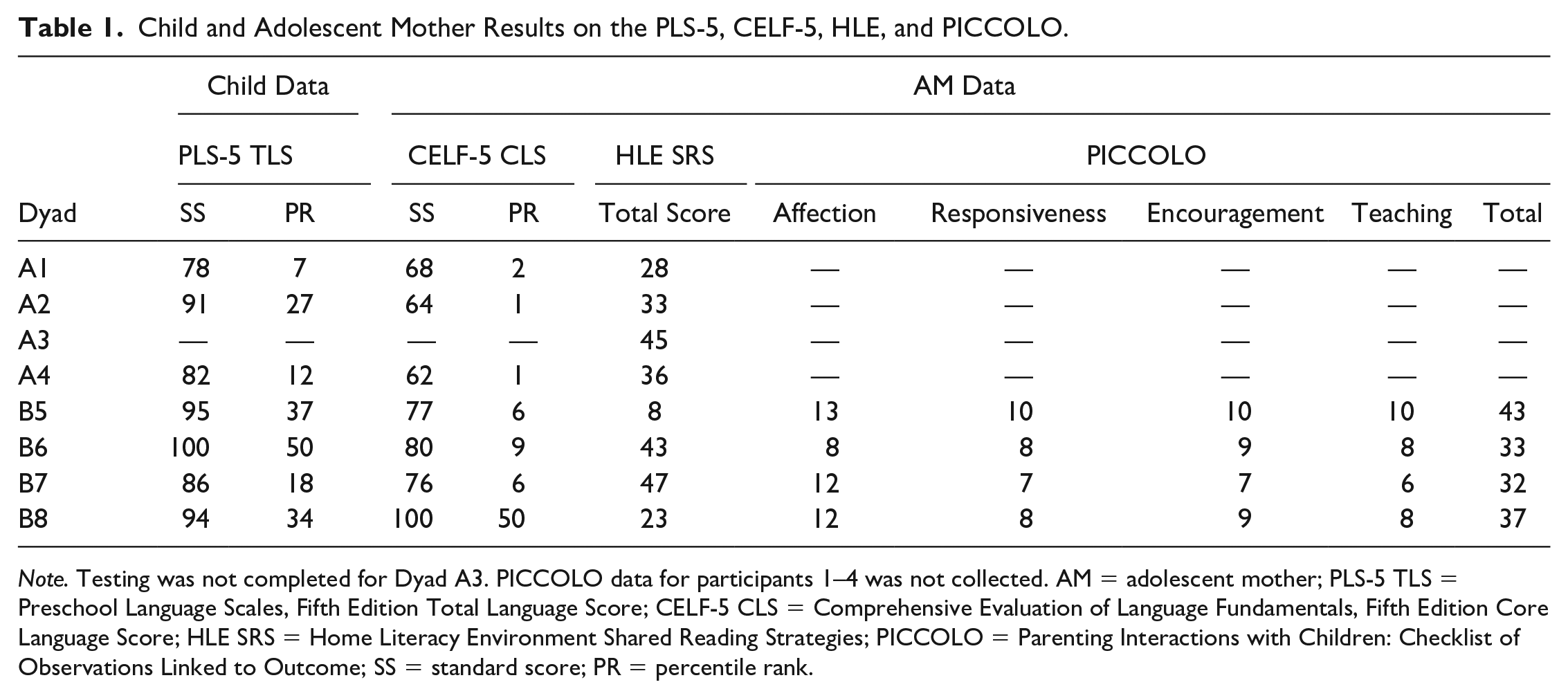
Note. Testing was not completed for Dyad A3. PICCOLO data for participants 1–4 was not collected. AM = adolescent mother; PLS-5 TLS = Preschool Language Scales, Fifth Edition Total Language Score; CELF-5 CLS = Comprehensive Evaluation of Language Fundamentals, Fifth Edition Core Language Score; HLE SRS = Home Literacy Environment Shared Reading Strategies; PICCOLO = Parenting Interactions with Children: Checklist of Observations Linked to Outcome; SS = standard score; PR = percentile rank.
Dyad A1
AM A1 was a White, English-speaking 18-year-old enrolled in 10th grade. She was 16 when she had her baby, lived with her aunt and grandparents, and reported an annual household income of US$100,000. Her son (Child A1) was 20 months old and biracial. She reported that he spoke his first word at 7 months and took his first steps at 12 months. He had been diagnosed with a collapsed airway and had an upcoming speech and language evaluation. AM A1’s score on the CELF-5 fell two SDs below the mean. She scored a median score of 4 on the shared reading strategies HLE portion of AM Questionnaire, indicating that the strategies were “fairly descriptive” of her. She reported that she: reads 4 times per week to her child; reads 15 min to her child the day before; has 21 to 50 books at home; will typically read to her child for 15 to 19 min; rarely goes to library; and started sharing books with her child before he was 6 months. Child A1’s TLS on the PLS-5 indicated that he performed approximately 1.5 SDs below the average score.
Dyad A2
AM A2 was a Hispanic, bilingual Spanish and English-speaking 17-year-old enrolled in 11th grade. She was 13 when she had her baby, lived with her sibling, and did not report an annual household income. Her daughter (Child A2) was 20 months old and Hispanic. She reported that Child A2 spoke her first word at 9 months, took her first steps at 12 months, and had been diagnosed with cystic fibrosis. AM A2’s score on the CELF-5 fell 2.5 SDs below the mean. She received a median score of 4 on the shared reading strategies portion of the HLE module on the AM Questionnaire, indicating that the strategies were “fairly descriptive” of her. She reported that she: reads 3 times per week to her child; read 5 min to her child the day before; has 21 to 50 books at home; will typically read to her child for 10 to 14 min; never goes to library; and started sharing books with her child before she was 6 months. Child A2’s TLS on the PLS-5 indicated that she performed within the average range.
Dyad A3
AM A3 was a Hispanic, bilingual Spanish- and English-speaking 19-year-old enrolled in 12th grade. She was 17 when she had her baby, lived with her boyfriend, and reported an annual household income of <US$25,000. Her daughter (Child A3) was 8 months old and White. She reported that Child A3 spoke her first word at 6 months and did not have a medical diagnosis. She received a median score of 6 on the shared reading strategies portion of the HLE module on the AM Questionnaire, indicating that the strategies were “highly descriptive” of her. She reported that she: reads 2 times per week to her child; read 10 min to her child the day before; has 0 to 10 books at home; will typically read to her child for 5 to 9 min; never goes to library; and started sharing books with her child at birth. Standardized language assessments were not completed for this dyad due to high absenteeism.
Dyad A4
AM A4 was a White, English-speaking 21-year-old who had graduated from high school. She was 18 when she had her baby, lived with her sibling, and reported an annual household income of <US$25,000. Her daughter (Child A4) was 43 months old and White. Child A4 spoke her first word at 6 months, took her first steps at 9 months, and had no medical diagnosis. AM A4’s score on the CELF-5 fell 2.5 SDs below the mean. She received a median score of 4 on the shared reading strategies portion of the HLE module on the AM Questionnaire, indicating that the strategies were “quite descriptive” of her. She reported that she: reads 2 times per week to her child; read 5 min to her child the day before; has 11 to 20 books at home; will typically read to her child for 0 to 4 min; rarely goes to library; and started sharing books with her child at 1 year. Child A4’s TLS on the PLS-5 indicated that she performed 0.5 SD below average.
Dyad B5
AM B5 was a Black, English-speaking 17-year-old in ninth grade. She was 15 when she had her baby, lived with her parents, and did not report an annual household income. Her son (Child B5) was 20 months old and Black and had no medical diagnosis. AM B5’s CELF-5 score fell approximately 1.5 SDs below the mean. She received a median score of 1 on the shared reading strategies portion of the HLE module on the AM Questionnaire, indicating that the strategies were “not at all descriptive” of her. She reported that she: reads 6 times per week to her child; read 10 min to her child the day before; has 0 to 10 books at home; will typically read to her child for 10 to 14 min; sometimes goes to library; and started sharing books with her child at birth. On the PICCOLO, AM B5 scored a total score of 43 points out of 68, with the highest score in the Affection domain and a score of 10 points on the remaining domains. Child B5 TLS on the PLS-5 indicated that he performed within the average range.
Dyad B6
AM B6 was a Black, English-speaking 19-year-old in 12th grade. She was 17 when she had her baby, lived with her parents, and did not report an annual household income. Her daughter (Child B6) was 22 months old, Black, and had no medical diagnosis. AM B6’s CELF-5 score fell within the average range. She received a median score of 5 on the shared reading strategies portion of the HLE module on the AM Questionnaire, indicating that the strategies were “quite descriptive” of her. She reported that she: reads 6 times per week to her child; read 15 min to her child the day before; has 11 to 20 books at home; will typically read to her child for 5 to 9 min; sometimes goes to library; and started sharing books with her child before six months. On the PICCOLO, AM B6 scored a total score of 33 points out of 68, with the highest score in the Encouragement domain and a score of 8 points on the remaining domains. Child B6’s TLS on the PLS-5 indicated that she performed within the average range.
Dyad B7
AM B7 was a biracial, Spanish and English-speaking 18-year-old in 12th grade. She was 17 when she had her baby, lived with her parents and siblings, and reported an annual household income of <US$25,000. Her daughter (Child B7) was 15 months old, biracial, and had no medical diagnosis. AM B6’s score on the CELF-5 fell approximately 1.5 SDs below the mean. She received a median score of 6 on the shared reading strategies portion of the HLE module on the AM Questionnaire, indicating that the strategies were “highly descriptive” of her. She reported that she: reads 3 times per week to her child; read 5 min to her child the day before; has 11 to 20 books at home; will typically read to her child for 5 to 9 min; never goes to library; and started sharing books with her child before 6 months. On the PICCOLO, AM B7 scored a total score of 32 points out of 68, with the highest score in the Affection domain and the lowest score in the Teaching domain. Child B7’s TLS on the PLS-5 indicated that she performed within the average range.
Dyad B8
AM B8 was a Black, Spanish and English-speaking 18-year-old in 12th grade. She was 17 when she had her baby, lived with her parents and siblings, and reported an annual household income between US$25,000 and US$50,000. Her son (Child B8) was 17 months old, Black, and had no medical diagnosis. AM B8’s score on the CELF-5 fell within the average range. She received a median score of 4 on the shared reading strategies portion of the HLE module, indicating that the strategies were “fairly descriptive” of her. She reported that she: reads 6 times per week to her child; read 10 min to her child the day before; has 11 to 20 books at home; will typically read to her child for 5 to 9 min; rarely goes to library; and started sharing books with her child at 6 months. On the PICCOLO, AM B8 scored a total score of 37 points out of 68, with the highest score in the Affection domain and the lowest scores in the Responsiveness and Teaching domains. Child B8 TLS on the PLS-5 indicated that she performed within the average range.
Discussion
Researchers have found that families comprising AMs and their children experience different levels of success in the provision of language-facilitative practices and later child outcomes (Brady-Smith et al., 2013; Fuligini & Brooks-Gun 2013). The interactions between AMs’ characteristics and their children’s later language and academic outcomes have been evaluated across several different studies (e.g., Berlin et al., 2002; Towson et al., 2020), but findings have been limited in the number of variables that were considered, specifically AMs’ language and literacy abilities. This descriptive pilot study explored the socio-demographic and linguistic characteristics of adolescent family units as a start to understanding the complex relationships between these characteristics and the ultimate outcomes for these young families. In summary, we found that while AMs demonstrated below-average skills on a language measure, provided HLEs of variable quality, and demonstrated strong affectionate strategies and emerging responsive, encouraging, and teaching strategies while interacting with their children, the majority of their children scored within the average range of a language measure.
We described the language skills of both AMs and their children as represented by norm-referenced, standardized assessment data. Median language scores of AMs on a standardized language measure fell more than one and a half SDs below the nationally representative sample, indicating that they are eligible to receive speech and language services within the public school system. However, the AMs did not report to be diagnosed with a speech or language disability. Furthermore, the range of standard scores across mothers (SS = 62–100) varied widely, making it difficult to make a strong conclusion about the AMs’ language skills. However, some research has shown that AMs struggle more in reading than in mathematics (Rauch-Elnekave, 1994), indicating that potential language disorders in AMs may be present. Median language scores of children of AMs on a standardized language measure fell within the average range of the national sample. It is unclear if these findings are comparable to the literature reporting language characteristics of AMs children (Keown et al., 2001; Oxford & Spieker, 2006) as child participants in previous studies were older (typically preschool age) than those included in the present study, and it is typical for certain delays to become evident as children age. In these previous studies, the child participants were found to have lower language scores than those of children born to adult mothers (Keown et al., 2001; Oxford & Spieker, 2006).
Next, we found that the participating mothers reported reading to their children frequently throughout the week using a variety of shared reading strategies during the reading interactions. However, the AMs in this sample were living with other family members, so the HLE they reported to provide may not be truly representative of the literacy experiences the AMs themselves were providing in the home. The language models provided by other caregivers in the home may help to explain the children’s average language scores and the frequent book reading. All mothers reported having some books in the home, although the number of books provided was limited. Similarly to a previous study, AMs did not frequently visit the library with their children (Burgess, 2005). The importance of a “strong” HLE and specifically which practices make up the HLE within an adolescent family unit must be further investigated as results have been mixed, especially when considering racial and ethnic background as a variable (Burgess, 2005).
Mother–child interactions were described in terms of Affection, Responsiveness, Encouragement, and Teaching as measured by the PICCOLO. The highest scoring domain across the four AMs was Affection, a surprising finding, as in previous studies, African American and Latina mothers displayed less maternal warmth and physical affection than EA mothers. The findings also indicated that mothering behaviors that fell under the Responsiveness, Encouragement, and Teaching domains were more often “emerging” than “clearly” displayed, which are similar to the “supportiveness” and “directiveness” behaviors described in previous studies (cf. Brady-Smith et al., 2013; Fuligini & Brooks-Gun, 2013). This may indicate that explicit teaching behaviors such as asking questions, labeling and describing, and explaining processes, may not be as natural for these AMs, or that they may not prioritize these practices with their infant children. Many studies have shown that the presence of these mothering patterns are complex and variable across mothers of different racial and ethnic backgrounds and maternal age (Brady-Smith et al., 2013; Fuligini & Brooks-Gunn, 2013). Therefore, researchers and interventionists must be aware and sensitive of the way maternal behaviors are measured and described, especially when working with diverse populations.
Limitations and Future Directions
There are several limitations to the current study. The small sample size and the fact that most participants came from the same school for AMs limits the generalizability of the findings. The sample size also limited the design of the study to a descriptive analysis of data, rather than the use of statistical analyses. In addition, no patterns or trends were seen amongst the relationships between AMs’ social-linguistic characteristics and their children’s language skills due to the small sample and high variability across dyads. This is a common problem in studies that involve AMs (Berlin et al., 2002), perhaps due to difficulties in recruiting and the frequency of attrition. In addition, the PLS-5 may have not been a sensitive enough measure to detect linguistic difficulties when utilized with the younger children included in the sample. Another major limitation of our study was that we did not assess the Spanish language development or skills in AMs and children who spoke both English and Spanish, limiting our understanding of their entire linguistic repertoire.
Future studies should focus on recruiting a larger sample size, perhaps through multi-site research projects across time to collect data across a variety of AM populations. Large sample sizes will be conducive for conducting the statistical analyses needed to understand the linguistic relationships between AMs and their children. As standardized formal language measures for infants that lend themselves well to statistical analyses are limited, methods of measuring children’s language skills, such as observations of communication skills and language sampling, must be adopted when including infants in the research sample. Future researchers may benefit from utilizing mixed method approaches by beginning with qualitative investigations of AMs’ perceptions of parenting and experiences as students to inform quantitative regressive analyses of the correlations between AMs’ linguistic and literacy characteristics and their parenting behaviors.
Clinical Implications
Information on the complex linguistic and literacy relationships between AMs and their children is needed to inform appropriate interventions for working with adolescent family units. As one of the major findings of the study was that AMs may experience language deficits as measured by one standardized assessment, an important clinical implication is that first contact practitioners (e.g., obstetrics and gynecology physicians, nurses, and pediatricians) consider referring AMs for language evaluations for identification of deficits. First contact personnel could also provide AMs with the educational resources and access to support programs specifically designed for AMs. Furthermore, by understanding how an AM’s language and literacy abilities affect their mothering behaviors, interventionists can provide the necessary support when working with these young families, whether that be through referrals to academic specialists or inclusion of readable educational materials in intervention services. Finally, this study furthers the evidence base that parent–child interactions vary based on many socio-demographic characteristics, including race/ethnicity, socioeconomic status, and HLE. Therefore, interventionists working with adolescent family units should consider the family as a whole and encourage variability in how parents interact with their children that may differ then what is expected per the current evidence base.
Conclusion
This study is an important first step in investigating the complex relationships between AMs and their children and provides descriptive information that has not been clearly reported in previous studies, including linguistic characteristics of young mothers. One important premise of parent–child interactions is that “a parent contributes to language-facilitating interactions using finely tuned acts that are responsive to the child’s ongoing actions and developmental course” (Adamson et al., 2020, p. 64). However, AMs may not clearly demonstrate those “responsive” behaviors, as seen in the current study, and that may be because they do not have the knowledge that their actions can benefit their children’s language development (Neuman & Gallagher, 1994). Furthermore, other variables, such as their confidence and ease in reading and understanding language presented in educational material, interventions, or other systems of support, may limit their ability to change their parenting behaviors, despite their motivation to do so. Therefore, we must continue with larger, multisite studies that utilize mixed methods to investigate linguistic and literacy characteristics of adolescent family units to inform the interventions and support programs that are developed for adolescent family units.
Supplemental Material
sj-docx-1-cdq-10.1177_15257401231190056 – Supplemental material for Breaking Cyclic Intergenerational Literacy Deficits: Describing Linguistic Interactions Between Adolescent Mothers and Their Young Children
Supplemental material, sj-docx-1-cdq-10.1177_15257401231190056 for Breaking Cyclic Intergenerational Literacy Deficits: Describing Linguistic Interactions Between Adolescent Mothers and Their Young Children by Diana L. Abarca, Jacqueline Towson and Humberto López Castillo in Communication Disorders Quarterly
Supplemental Material
sj-docx-2-cdq-10.1177_15257401231190056 – Supplemental material for Breaking Cyclic Intergenerational Literacy Deficits: Describing Linguistic Interactions Between Adolescent Mothers and Their Young Children
Supplemental material, sj-docx-2-cdq-10.1177_15257401231190056 for Breaking Cyclic Intergenerational Literacy Deficits: Describing Linguistic Interactions Between Adolescent Mothers and Their Young Children by Diana L. Abarca, Jacqueline Towson and Humberto López Castillo in Communication Disorders Quarterly
Footnotes
Declaration of Conflicting Interests
The author(s) declared no potential conflicts of interest with respect to the research, authorship, and/or publication of this article.
Funding
The author(s) received no financial support for the research, authorship, and/or publication of this article.

Supplemental Material
Supplemental material for this article is available on the Communication Disorders Quarterly website with the online version of this article.
References
Supplementary Material
Please find the following supplemental material available below.
For Open Access articles published under a Creative Commons License, all supplemental material carries the same license as the article it is associated with.
For non-Open Access articles published, all supplemental material carries a non-exclusive license, and permission requests for re-use of supplemental material or any part of supplemental material shall be sent directly to the copyright owner as specified in the copyright notice associated with the article.
