



Abstract
A 3-year follow-up survey was sent to speech-language pathologists who completed a mindfulness program as part of their graduate studies. Findings indicated that 53% of the speech-language pathologists who responded continued to practice learned mindfulness skills in their personal lives as well as incorporating them in their therapy plans.
Mindfulness is a nonjudgmental awareness that arises from paying attention in the present moment that can be accomplished in a variety of ways (e.g., breathing exercises, meditation, yoga poses, and focused attention) (Kabat-Zinn, 2009). The literature describes the teaching of mindfulness to college students enrolled in a variety of health sciences programs including speech-language pathology (SLP), occupational therapy, physical therapy, and nursing (Beck & Verticchio, 2014; Brown et al., 2016; Chambers et al., 2016; Myers et al., 2012; Nelson et al., 2001; Yusoff et al., 2010). Positive outcomes for these students include stress and anxiety reduction (Beck et al., 2015, 2017; Beck & Verticchio, 2014; Kindel & Rafoth, 2020; Song & Lindquist, 2015), improved focus on classwork (Stew, 2011), reduction of negative thought patterns (Gura, 2010; Hawley et al., 2014; Martín-Asuero & García- Banda, 2010; Mead & Medina, 2021; Michalak et al., 2011; Raes & Williams, 2010; Svendsen et al., 2017), gaining sense of meaning of one’s life (Akyurek et al., 2018; Gura, 2010), managing and accepting oneself (Akyurek et al., 2018), and positively changing overall attitudes (Akyurek et al., 2018). Similar findings such as improved quality of life and emotional well-being have been reported as a result of embedding mindfulness in the therapeutic setting (Medina & Mead, 2021). To date, there have been no follow-up studies that investigate SLP students’ use of learned mindfulness strategies after graduation. This information is necessary to support and foster incorporating mindfulness in the SLP curriculum as a mental health resource for students as well as a therapeutic tool to be used with clients. The purpose of this exploratory study is to describe the personal and professional use of mindfulness strategies of speech-language pathologists who participated in a mindfulness training as part of their academic program.
Method
In 2018, a mindfulness program was embedded into the MS-SLP curriculum as part of clinic seminar meetings. The program consisted of weekly, 45-minute sessions hosted over 8 weeks and included the conversations about mindfulness topics, yoga postures, guided meditations, 432 Hz music, and breathwork (Mead & Medina, 2021). In 2021, the 40 participants were sent a 12-item anonymous survey hosted by Qualtrics, which was designed to explore their use of mindfulness strategies 3 years after participation in the program. The survey included 11 multiple choice questions covering topics such as demographics, contexts of mindfulness use in personal life, and application of mindfulness techniques in the clinical setting (Appendix A). The final item was open-ended and prompted survey respondents to elaborate on their experiences using mindfulness personally and professionally. Descriptive statistics were generated by Qualtrics for items 1 to 11, and narrative responses to item 12 were analyzed for content.
Results
Respondents
A total of 37.5% (N = 15) licensed and certified speech-language pathologists responded to the 3-year follow-up survey, 14 of whom were female. Respondents ranged in age from 26 to 47 years old with 93% being 26 to 29. The majority of respondents (73%) identified as “Hispanic/Latino,” while 20% identified as “White,” and 7% as “Other: Middle Eastern.” All respondents graduated from the same accredited MS-SLP program in South Florida 3 years prior to receiving the survey.
Mindfulness Practice in Personal Life
When asked whether they practiced mindfulness in their personal lives, 67% (n = 10) of respondents indicated “yes.” Follow-up questions sought more details in terms of when they practiced and what their practice entailed. For the check-all-that-apply question regarding when respondents practiced, the two most frequently selected responses were “While exercising (i.e., running, biking, and yoga)” with seven responses and “As part of your bedtime routine” with five responses. In response to the check-all-that-apply question, “What does your personal practice of mindfulness consist of?,” eight respondents indicated they practiced breathwork with the majority (60%) practicing weekly. The option “Mindfulness during activities (i.e., while tying your shoes or washing your hands, etc.)” was also selected by eight respondents with 44% indicating they practiced this technique daily. Techniques used for personal practice included breathing exercises, centering, relaxing, and slowing down. Of the five respondents who indicated that they did not practice mindfulness in their personal lives, two included narrative responses explaining why (Appendix B).
Incorporating Mindfulness in Clinical Practice
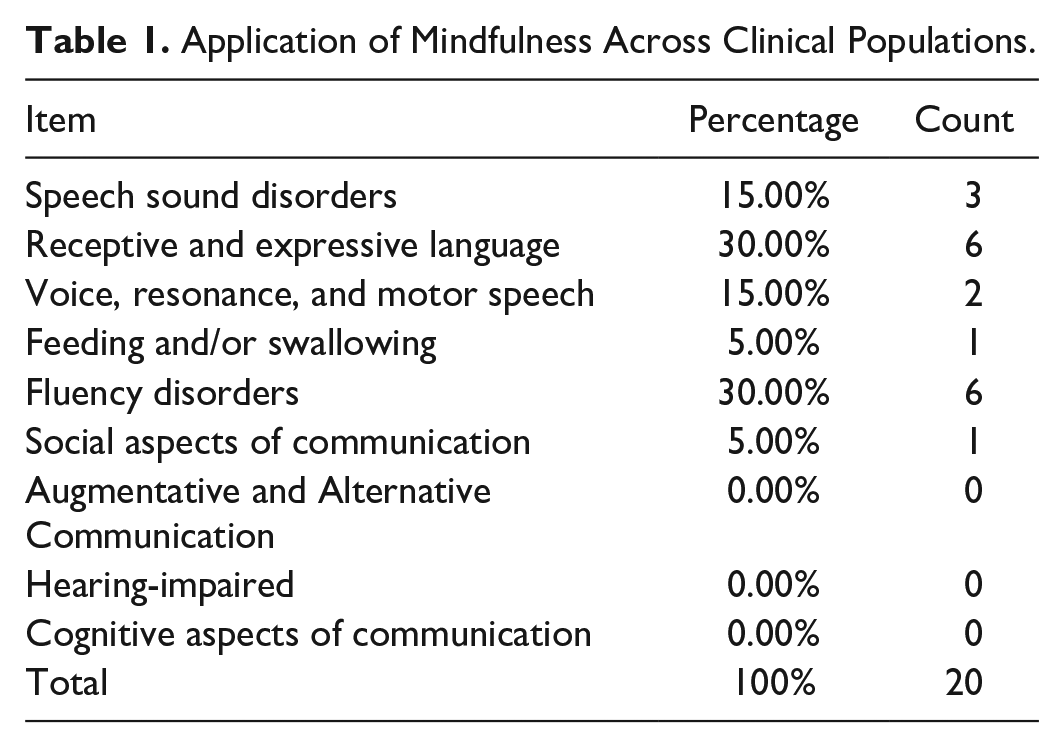
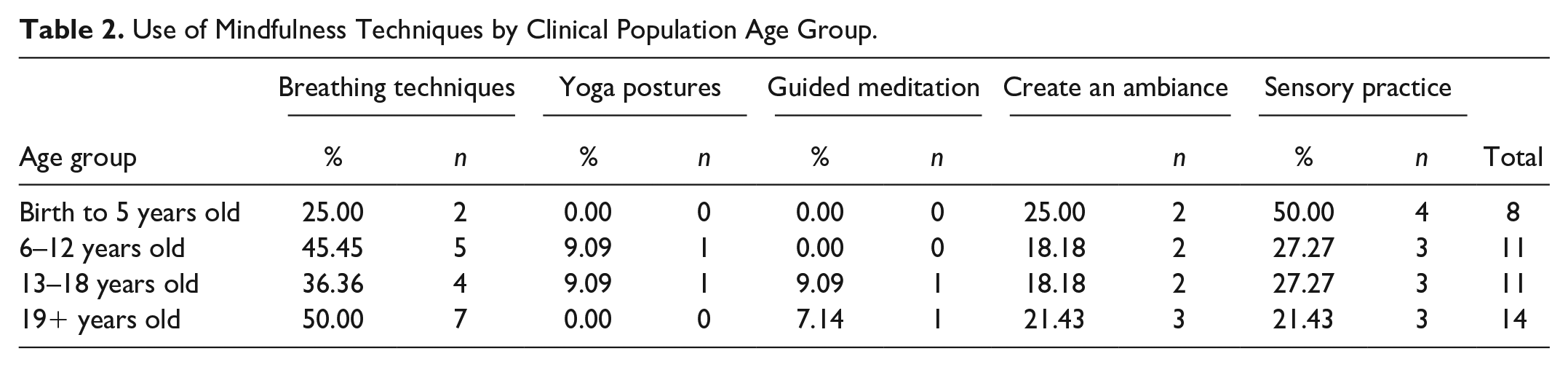
When asked if they incorporated mindfulness in their clinical practice with patients, clients, and/or students, 53% (n = 8) responded “yes.” Check-all-that-apply follow-up questions generated details about the client population in terms of diagnosis as well as the types of mindfulness techniques used with particular age groups. The two most frequently identified client populations were fluency disorders and receptive/expressive language disorders with six responses each (see Table 1). Breathing techniques were selected the most frequently across all age groups, except for birth to age 5, with seven respondents indicating that they use breathing techniques with clients who are 19 years of age and older and five with their clients ages 6 to 12 years old (see Table 2). The most frequently cited technique for the “birth to 5 years” age group was sensory perception (n = 4). In response to the optional, open-ended prompt, “Please elaborate on your experience using mindfulness personally and professionally over the past three years,” two respondents shared feedback about their professional applications of mindfulness, one discussed applications in their personal life, and one described how they have applied mindfulness in both contexts (Appendix B). In clinical practice, mindfulness techniques were reportedly used for voice, fluency, and pragmatic disorders.
Application of Mindfulness Across Clinical Populations.
Use of Mindfulness Techniques by Clinical Population Age Group.
Of the seven respondents who indicated that they did not use mindfulness in their clinical practice, three elaborated by responding to the open-ended prompt “Please explain why not” (Appendix B). One respondent indicated that they felt their clients were too young, while another referred to their response about not practicing in their personal lives. The third respondent provided details about a technique they use with their autistic clients, which has tenets of mindfulness; however, given that the respondent answered “no,” they may not have understood the connection between the technique and mindfulness.
Discussion
Even though the students were not specifically taught how to use mindfulness in clinical practice, many of those who responded intuitively realized it could be included in therapy plans for people who stutter as well as those who present with language disorders. The use of mindfulness techniques as part of fluency treatment is well-established in the literature (Medina & Mead, 2021); however, the application of mindfulness with the language population is a novel finding that has not been described in previous literature. Breathwork was the most frequently reported strategy across the adult, teenage, and school-age clinical populations, while sensory perception was selected most frequently with the birth to age 5 group. Data for this study were only collected 3 years post-program with a low response rate (37%), which are methodological limitations. Future mindfulness training should explicitly teach students how to use mindfulness strategies with a variety of clinical populations across the lifespan. Similarly, future studies can investigate students’ use of mindfulness strategies and the impact this use has on their clients’ clinical outcomes.
Conclusion
These findings indicate that with exposure to mindfulness training in the context of their academic program, half of the SLPs in this study have shown to apply learned mindfulness strategies in their personal lives and in clinical practice. Although not explicitly trained on how to use mindfulness with different clinical populations, the respondents were able to generalize their personal practice to enhance their clients’ therapeutic experience. These preliminary data revealed that mindfulness can be infused in therapy plans for clients across the lifespan.
Footnotes
Appendix A
Appendix B
Declaration of Conflicting Interests
The author(s) declared no potential conflicts of interest with respect to the research, authorship, and/or publication of this article.
Funding
The author(s) received no financial support for the research, authorship, and/or publication of this article.
