



Abstract
This study investigated whether teachers’ observations of pragmatic language competence predict literacy skills (and the reverse) in students referred for reading disabilities in Oman. A sample of 574 at-risk children between 7 and 12 years old participated. Teachers rated students’ pragmatic language, reading, and written expression. Results showed (a) teachers rated female students significantly higher in all three areas, while ratings were not different across grades; (b) relationships between pragmatics and literacy skills were significantly stronger for girls than for boys; (c) after controlling for gender and grade, pragmatic language competence accounted for significant unique variance in both reading and written expression; and (d) after controlling for gender and grade, reading and writing both contributed significant unique variance to pragmatic skills, and the standardized regression coefficients suggested stronger effects of literacy skills on pragmatics than pragmatics on literacy skills. Implications for school professionals and future research directions are discussed.
The acquisition, development, and maintenance of literacy have been the subject of a large body of research in Western and non-Western contexts for groups with typical and atypical development. There is research evidence indicating that children with specific language impairment (SLI) and specific learning disabilities (SLD) are not homogeneous groups. Research shows that children with SLI have other associated difficulties in pragmatic language and reading, particularly as they grow older (Botting et al., 2006; Conti-Ramsden & Botting, 2004). Likewise, students with reading disability (one kind of SLD) display atypical patterns in using pragmatic language that may have an impact on their academic success (Kearns et al., 2019). Empirical reports show that teachers and other school professionals in Oman are not often able to clearly differentiate between students with SLD and those with other disabilities (Al-Mamari et al., 2015; Emam & Kazem, 2015). Omani teachers remain, however, an important source of information that assists with screening and referral procedures in schools, particularly due to the absence of standardized norm-referenced tests available in Arabic (Emam et al., 2021).
Over the past two decades, the field of school psychology and the deployment of school-wide support systems have shifted to new service delivery models, such as data-based decision-making and problem-solving approaches. Within such models, educators, school psychologists, and other school professionals like speech-language pathologists are encouraged to build professional collaborative practices to provide enriched instructional consultation to support struggling learners (Powers et al., 2008). The problem-solving model involves a detailed description of a student’s problem, generation and implementation of early intervention strategies, monitoring of student progress and evaluation of intervention effectiveness using high-quality data, and finally the continuation of this cycle until the problem is resolved. The data-based decision-making model requires that no decision within the problem-solving model or any other approach to service delivery can be taken unless it is grounded in sufficient and reliable data that are gathered on the student’s behavioral, socio-emotional, and academic learning outcomes.
In Oman, which is a vast country in the Arabic Gulf region, the alarm has been raised for literacy proficiency using analyses of national and international literacy assessment data (AlHashmi, 2020; Al Shabibi & Silvennoinen, 2018). International assessment data from the Progress in International Reading Literacy Results (PIRLS) have shown that all Arabic-speaking countries are near the bottom of global achievement levels. More specifically, fourth-grade Arabic-speaking students in both wealthy and poor Arab countries are achieving below the international benchmark in reading. Oman is among the countries that showed no improvement in the PIRLS assessment between 2011 and 2016 (AlHashmi, 2020), and the country has a large gender gap of 11 percentage points in reading achievement favoring males—99.1% of males between the ages of 15 and 24 years are considered literate (Oman Ministry of Education, 2006; World Bank, 2012). There is research indicating that as many as one in eight students in Oman are at risk of reading disability, with very few of these students receiving instructional supports or interventions for reading and/or behavioral concerns (Emam, 2018; Emam et al., 2021; Oman Ministry of Education, 2008). Research has also indicated a lack of a visible reading culture in Oman (Mahrooqi & Denman, 2016) and limited instruction on foundational reading skills such as phonological awareness in early school years (Emam et al., 2021). It is reported that, compared with an average European child who reads for 12,000 min per year, the average Arabic-speaking child reads only 6 min per year (see Mahrooqi & Denman, 2016). Moreover, the absence of sufficiently sensitive and specific diagnostic assessment tools has resulted in over-identification of students with SLD (Emam et al., 2021).
Language Difficulties and Literacy: A Synopsis
Language difficulties in general and pragmatic language difficulties, in particular, are characteristic of students with SLD and/or SLI (e.g., Laws et al., 2012; Mackie & Law, 2014; Siegel & Mazabel, 2013; Troia, 2011, 2021). Pragmatic language refers to the effective and appropriate use of language in social contexts and is fundamentally important for children’s ability to perform well at home, school, and in society (Newcomer & Hammill, 2009). Specific language impairment (SLI) refers to a child’s receptive and/or expressive language difficulties, most—but not exclusively all of which—are related to morphology and syntax that cannot be accounted for by general delay in development, hearing loss, physical abnormality of the speech apparatus, autism spectrum disorder (ASD), apraxia, or acquired brain injury (Graham et al., 2020). Narrowly defined, specific learning disabilities (SLD) refers to a disorder within a constellation of skills involved in understanding or using spoken or written language that is displayed in the student’s imperfect ability to listen, think, speak, read, write, spell, or do mathematical calculations. SLD does not include learning problems that are primarily the result of visual, hearing, or motor disabilities; intellectual disability; serious emotional disability; cultural factors; environmental or economic disadvantage; or limited language proficiency (Kavale et al., 2009). More specifically, dyslexia is a term that implies a reading difficulty and is a type of SLD. It is a complex disorder that is characterized by difficulty recognizing familiar and unfamiliar printed words with accuracy and speed, resulting in difficulty with comprehending written text (Kearns et al., 2019).
Research has shown that poor language skills, including pragmatics, are correlated with social, emotional, and behavioral difficulties and poor literacy skills (e.g., Eadie et al., 2021; Graham et al., 2020). Both children with SLI and SLD differ from their typically developing peers in mastering reading quickly (Cardillo et al., 2018; Helland et al., 2016). More specific to pragmatic skills, research evidence suggests that students with SLD perform poorly on aspects of pragmatic language such as the use of figurative language, awareness of words’ multiple meanings and uses, and employing appropriate language in specific social contexts (Bryan et al., 2004; Elias, 2004; Stothers & Cardy, 2012). Bryan and colleagues (1981) examined conversation skills in children with and without reading disabilities in Grades 2 and 4 by videotaping students role-playing as a talk-show host. They concluded that students with reading disability were less assertive and had some deficits in communicative initiation and conversation maintenance. More recently, Kasirer and Mashal (2017) reported that young children with purported dyslexia displayed deficits in comprehending conversational metaphors. In another study (Lam & Ho, 2014), the pragmatic skills of 22 Chinese students ages 8 to 12 years with purported dyslexia were rated and compared with 24 children in an age-matched non-dyslexic sample. Results showed the children with dyslexia were rated lower in initiating communication and using communication in social contexts. Likewise, research has shown pragmatic difficulties in children with SLI, including (a) difficulty joining social interactions (Farnsworth, 2018), (b) difficulty collaborating with other children on activities (Morocco et al., 2001), (c) difficulty with conflict resolution (Timler, 2008), and (d) limited motivation to learn (O’Neill, 2014; Troia, 2011).
Pragmatic Language, Literacy, and SLI
Children with pragmatic language difficulties, regardless of their diagnostic label, may fail to use language appropriately for social interaction purposes even if they code language correctly (i.e., they exhibit problems in language use although their language form is relatively intact). Pragmatic language competence is grounded in social behavior, cognitive processes, and the semantic as well as syntactic aspects of linguistic functioning, and is a core feature of competence in any language (Lightbown & Spada, 2013) as it deals with using language in varied contexts with different people and understanding the implicit and explicit meaning of communication (Green et al., 2014; O’Neill, 2014). Pragmatic language is an integrative skill that students use to accommodate direct and indirect requests; initiate, maintain (through turn-taking), shift, terminate, and repair conversations with others; and understand and use nonliteral and figurative language (including humor) and discourse structures to participate successfully in daily classroom interactions (Demchick & Day, 2016; Farnsworth, 2018; Lightbown & Spada, 2013; Mackie & Law, 2014; O’Neill, 2014; Wiener & Schneider, 2002). Moreover, Law et al. (2014) found that pragmatic skills substantially mediated the association between language and behavior in a group of primary school disadvantaged children, meaning that pragmatic skills serve an important role in children’s classroom behaviors.
Deficits in pragmatic language may result in difficulty in understanding and generating a variety of texts, taking others’ perspectives, using adequate vocabulary and figurative expressions to convey ideas, understanding and marking nuances in meaning, and expressing ideas and views using imagery, metaphor, and other devices in writing (Morocco et al., 2001). There is longitudinal research evidence that indicates children with SLI or pragmatic language impairment continue to show deficient structural language (e.g., morphology and syntax) and limited literacy ability into adulthood (Magiati et al., 2014; Whitehouse et al., 2009). Unfortunately, much of the research in pragmatics has not thoroughly examined the literacy skills of students who appear to show weaknesses in pragmatics (Morocco et al., 2001; Troia, 2011, 2021), although the study by Whitehouse and colleagues (2009) is an exception. In their study, they examined the structural language, pragmatics, and literacy skills of adults who had participated as children in research studies that examined these same skill areas. There were four groups of individuals based on childhood diagnosis—specific language impairment, pragmatic language impairment, ASD, and typical. The literacy measures included tasks that evaluated spelling, text proofreading, word and nonword reading accuracy and speed, and passage reading accuracy and speed; no reading comprehension tasks were administered. The authors found that the group with language impairment demonstrated the weakest structural language and literacy skills and often developed pragmatic difficulties over time. The group with pragmatic language impairment continued to experience these difficulties in adulthood, but their structural language and literacy skills were better than those with specific language impairment (although below those of typically developing students).
Understanding the literacy skills among students with and without pragmatic difficulties is important because there is apparent reciprocity that exists between literacy and pragmatic language skills (Baron-Cohen et al., 2013; Diehl et al., 2006). For instance, socio-cognitive abilities related to pragmatics, such as perspective taking and understanding communicative intentions, also play a role in drawing inferences during reading comprehension and relating information in comprehensible ways through written expression. Thus, reading and writing activities that place demands on these underlying socio-cognitive abilities may help support (or limit) their development in spoken discourse and vice versa. Moreover, children who struggle using these skills in one domain likely struggle in other domains for which they also are used (e.g., Cain et al., 2004; Kidd & Castano, 2013).
The Current Study
Recently, proficiency in literacy skills has been given considerable attention in Arab countries. More specifically, in the last decade in Oman emphasis has been placed on the assessment of literacy proficiency for various reasons: (a) it provides evidence of the occurrence of learning in school (Al Shabibi & Silvennoinen, 2018); (b) there has been dissatisfaction among Omani society due to unsatisfactory performance of students on international assessments such as PIRLS and Trends in International Mathematics and Science Study (TIMSS) in the last decade (Mullis et al., 2012); (c) the majority of Omani students in cycle one schools (Grades 1–4) do not demonstrate grade-level mastery of reading and writing skills, which has resulted in a large number of student referrals to the national Learning Disability Program (LDP; Emam et al., 2021); and (d) the Oman 2040 vision statement, which asserts that literacy proficiency is essential for participation in a global information technology society and the gateway for employment and promotion in future careers (Al Shabibi & Silvennoinen, 2018).
Screening for and monitoring of learning for children with disabilities requires teachers and other educators to conduct observations of their students’ classroom performance, emotional and social development, and on-task behaviors. Teachers’ judgments are valued as a rich source of information about students’ actual capabilities (Dockrell & Lindsay, 2000; García & Tyler, 2010). Gilmore and Vance (2007), for example, reported that teachers’ ratings of verbal comprehension and attentive listening in pupils ages 4 to 5 correlated significantly with the pupils’ actual language comprehension test scores. Dockrell and Lindsay (2000) found various school professionals (e.g., teachers, school psychologists, and speech-language pathologists) in general could accurately report 82% and 86% of students’ difficulties in reading and spelling, respectively. There is evidence, however, that teachers’ judgments may differ from other school professionals’ understanding of students’ behaviors and needs (Dockrell & Lindsay, 2000; Gilmore & Vance, 2007; Williams, 2006). Speech-language pathologists, school psychologists, social workers, and school counselors may differ in their conceptualization of the challenges experienced by and the specific needs of students (Dockrell & Lindsay, 2000; Williams, 2006) and the accuracy of professionals’ judgments is contingent upon their length of service, preservice training, and professional learning opportunities and experiences (Gilmore & Vance, 2007; Wiener & Schneider, 2002). At any rate, teachers’ ratings of language and literacy skills and the connections between their judgments in these areas are important to examine because teachers are typically the professionals who make referrals for special education services, which is true both in the United States and in Oman. With the above in mind, one goal of the current study was to collect data on classroom teachers’ observations of language and literacy skills and to determine the extent to which competence in pragmatics predicts reading comprehension and writing-related skills (and the reverse) in students referred for reading disabilities in Grades 2 through 6 in Oman. An additional goal of the study was to determine whether gender or grade differences in teacher’s ratings exist and to see whether the associations between observed pragmatic language skills and observed written language skills are influenced by gender and grade level, given the evidence that (a) boys in many English-speaking countries often exhibit poorer word reading skills (e.g., Wackerle-Hollman et al., 2020) and oral language comprehension (Helland et al., 2016) than girls and (b) the shifting gender makeup of classrooms across grades in Oman (see below). Our study was guided by the following research questions:
Method
Participants
Students
A total of 850 students in Grades 1 to 5 were selected for potential inclusion in the study. Basic education in Oman includes two cycles. Cycle 1 schools include Grades 1 through 4 and are based on mixed-sex enrollment, while Cycle 2 schools include Grades 5 through 10 and are based on single-sex education (i.e., boys and girls are educated in separate schools). Students were indigenous Omani children, spoke Arabic as a first and typically only language, and were selected from all geographical regions represented in the 11 governorates of Oman. A stratified sampling technique was employed. The population was divided into these 11 regions, and students referred to the school learning disabilities program (LDP) in each region were selected to be rated by their Arabic teachers for this study. Based on educational policy from the Ministry of Education (MOE) in Oman, all participants in the study were referred to the LDP, where they received academic interventions. The referral is based on psychoeducational evaluations that yield a risk status of having a reading disability. The criteria for referral include (a) normal intellectual functioning based on a general ability test such as the Raven’s Colored Progressive Matrices (Kazem et al., 2007), (b) teachers’ ratings on the Learning Disabilities Diagnostic Inventories (Emam et al., 2021), and (c) below average performance on school diagnostic tests in reading and writing (Oman Ministry of Education, 2008). All participants displayed normal intellectual functioning based on a cut score of 1.5 SD below the age-group mean; therefore, the raw cut score ranged between 17 and 25, with a mean of 24.49 (SD = 4.97) for Grades 1 through 5 on the Raven’s Colored Progressive Matrices (see Kazem et al., 2007). The participants’ academic performance was generally two standard deviations below their classroom peers’ performance. A centralized psychoeducational team is responsible for ensuring that these criteria are met before a referral decision is made. Teachers were requested to rate the selected students using the study rating scales and return them either by hand or electronically. Students included both genders (45.1% male, 54.9% female) and represented both school cycles (Cycle 1 schools, i.e., Grades 1–4, and Cycle 2 schools, i.e., Grade 5). Preschool and kindergarten are not part of the formal educational system in Oman and students are normally enrolled in school at the age of 6. Participants in the study ranged in age from 6 to 12 years with a mean age of 8.4 years (SD = 1.2 years). There were 14 students in Grade 1 (2.4%), 213 in Grade 2 (37.1%), 204 in Grade 3 (35.5%), 101 in Grade 4 (17.6%), and 42 in Grade 5 (7.3%). The response rate was relatively high as the MOE formally supported teacher recruitment for the study.
Teachers
Of the total selected sample, 574 (67.5%) of the students were rated by their teachers, while 276 (32.5%) of the students were not rated for reasons related to teachers’ workload. Teachers who rated students were general educators who taught Arabic to students in inclusive settings. We chose Arabic language teachers rather than other school personnel because we thought they were the most likely to have first-hand knowledge about and the opportunity to regularly observe the communication and literacy skills of their students in school contexts. All teachers who rated students were full-time teachers with a minimum of 5 years of teaching experience and had taught the participants for at least 1 complete year when they completed the rating scales based on their accumulated student familiarity.
Instruments
Pragmatic Language Observation Scale–Arabic Version
The Pragmatic Language Observation Scale–Arabic Version (PLOS-Ar) is intended as a screener for students who exhibit pragmatic deficits in the classroom and is used to evaluate the communication of students with specific language impairment in natural settings. Originally, the PLOS was developed by Newcomer and Hammill (2009). It uses teachers’ ratings to assess students’ everyday classroom oral language behaviors. It includes 30 items that evaluate students on a variety of communication skills, the majority of which are considered pragmatic skills (e.g., shares information, sticks to the topic when speaking, and adjusts language to different social situations), although items also assess phonological (e.g., has intelligible speech), semantic (e.g., retrieves words quickly), and syntactic skills (e.g., uses acceptable grammar). The PLOS is designed for students ages 8 years, 0 months through 17 years, 11 months, and is completed in 5 to 10 min. Teachers or professionals knowledgeable of the student rate the 30 communication behaviors on a five-point Likert-type scale (1 and 2 = below average, 3 = average, 4 and 5 = above average). PLOS scores between 90 and 110 are considered average. For this study, we desired a measure focused solely on the construct of pragmatics; thus, we closely examined the items to determine if they matched the four areas related to pragmatic language functioning—communicative intentions, presuppositional abilities, discourse regulation skills, and figurative/nonliteral language comprehension and use (see Troia, 2021). Four items were considered indicative of communicative intentions (5, 14, 15, and 28; e.g., “shares information,” “voices needs and wants”); five items were considered representative of presupposition (9, 17, 19, 20, and 24; e.g., “gives accurate directions to others,” “adjusts language to different social situations”); three items were associated with discourse regulation (4, 8, and 25; e.g., “sticks to the topic when speaking”); and, finally, three items were indicative of figurative language (11, 26, and 29; e.g., “understand and laughs at jokes”). Thus, we used 15 of the original 30 items to develop an abbreviated and focused version of the PLOS. All analyses reported in this article are based on this abbreviated version.
Reading Observation Scale–Arabic Version
The Reading Observation Scale–Arabic Version (ROS-Ar) is a 25-item rating scale that can be used to assess daily classroom reading behaviors of students ages 8 years, 0 months through 17 years, 11 months, and is completed by teachers in 5 to 10 min. Originally, the ROS was developed by Weiderholt et al. (2006). The scale statements describe specific reading behaviors readily seen in instructional settings (e.g., enjoys reading, retells read material correctly), with emphasis on reading comprehension as opposed to printed word recognition and related skills; each statement is rated by teachers on the same 5-point scale as the PLOS.
Written Language Observation Scale–Arabic Version
The Written Language Observation Scale–Arabic Version (WLOS-Ar) is a 25-item rating scale that is used to assess daily classroom written language behaviors displayed by students ages 9-0 to 17-11. Originally, the WLOS was developed by Hammill and Larson (2009). Its items are completed in 5 to 10 min and describe specific writing behaviors exhibited in instructional settings (e.g., enjoys writing, uses acceptable grammar) with a focus on both transcription and text generation; each statement is rated by teachers on the same five-point scale as the PLOS and ROS.
Procedures and Data Analysis
The data were collected as part of a research project on students with learning disabilities in basic education in Oman. The project was approved by the University Humanities Research Ethics Committee (HREC) and The Ministry of Education Technical Office (MOETO) and, therefore, access to schools was granted to the research team. Participating teachers were informed of the general purposes of the research project (i.e., to evaluate the literacy and language skills of students who had been referred for LD and to determine if variability in these skills was evident), but they were not asked to compare referred students to those who were not referred. Rather, they were asked to use the rating scales to judge each child’s performance on each item as accurately as possible. The study instruments were all purchased from Pearson Assessment Corporation and were translated from English into Arabic using the committee translation method (Brislin, 1970; Cha et al., 2007). This method employs a group of bilingual experts (three at minimum) to translate the content to the target language from the first language. Mistakes can easily be monitored by the committee members. Three of the authors completed the translation. Overall, the three scales showed high internal consistency reliability. Cronbach’s alpha coefficients of the PLOS-Ar, ROS-Ar, and WLOS-Ar were 0.985, 0.980, and 0.985, respectively. Cronbach’s αs for males were 0.982, 0.987, and 0.982, respectively, whereas for females they were 0.986, 0.981, and 0.985, respectively. Interobserver reliability data were not available from the publisher and were not collected for this study.
For data analysis, descriptive statistics were computed for students’ pragmatic use of language, reading, and written language from the respective scales for each gender and each grade. The summed total of ratings from each instrument was used in all analyses. It should be noted that some students in the study sample who were rated by their teachers using the PLOS-Ar, ROS-Ar, and WLOS-Ar fell below the normative base age of 8 or 9 years for deriving standard scores (166 students were below age 8 and additional 196 were below age 9). Excluding these cases yielded similar patterns of results, except that significant gender differences were no longer observed for outcome variables and the regression coefficients for gender were no longer significant when predicting reading performance or pragmatics (see below). We used a two-way (2 × 5) factorial analysis of variance to determine whether there were significant differences based on gender and grade, respectively, for the teacher-assigned ratings. Pearson correlation matrices for the rating scales also were computed, separated by gender and grade (lower vs. upper elementary), and z tests were conducted to determine if the strength of associations varied based on gender and grade. Finally, multiple regression analyses were conducted to examine the degree to which scores on the PLOS-Ar predicted those on the ROS-Ar and WLOS-Ar, and vice versa.
Results
Gender and Grade Differences in Language and Literacy Skills
Table 1 presents the descriptive statistics for teachers’ ratings of students’ pragmatic language (PLOS-Ar), reading (ROS-Ar), and written expression (WLOS-Ar) by gender and grade. The data presented represent the mean sum of ratings across items on each scale. For the PLOS-Ar, there were significant differences between female and male students, F(1, 564) = 8.36, MSE = 206.71, p = .004, η2 = .015 (small effect), but no significant differences attributable to grade, F(4, 564) = 1.10, MSE = 206.71, p = .36, η2 = .008 (negligible effect). Additionally, the interaction between gender and grade was not significant, F(4, 564) = 0.68, MSE = 206.71, p = .61, η2 = .005 (negligible effect). For the ROS-Ar, similar results were obtained. Female students performed significantly better than male students, F(1, 564) = 8.03, MSE = 772.60, p = .005, η2 = .014 (small effect), but grade had little effect on teachers’ ratings of students’ reading performance, F(4, 564) = 1.14, MSE = 772.60, p = .34, η2 = .008 (negligible effect), and the interaction between the two variables was not significant, F(4, 564) = 0.39, MSE = 772.60, p = .82, η2 = .003 (negligible effect). Finally, for the WLOS-Ar, there were significant differences between female and male students, F(1, 564) = 14.53, MSE = 654.85, p < .001, η2 = .025 (small effect), but no significant differences attributable to grade, F(4, 564) = 1.52, MSE = 654.85, p = .20, η2 = .011 (small effect), or their interaction, F(4, 564) = 0.25, MSE = 654.85, p = .91, η2 = .002 (negligible effect).
Descriptive Statistics for Pragmatic Language, Reading, and Written Expression Sum Ratings by Gender, Grade, and Overall.
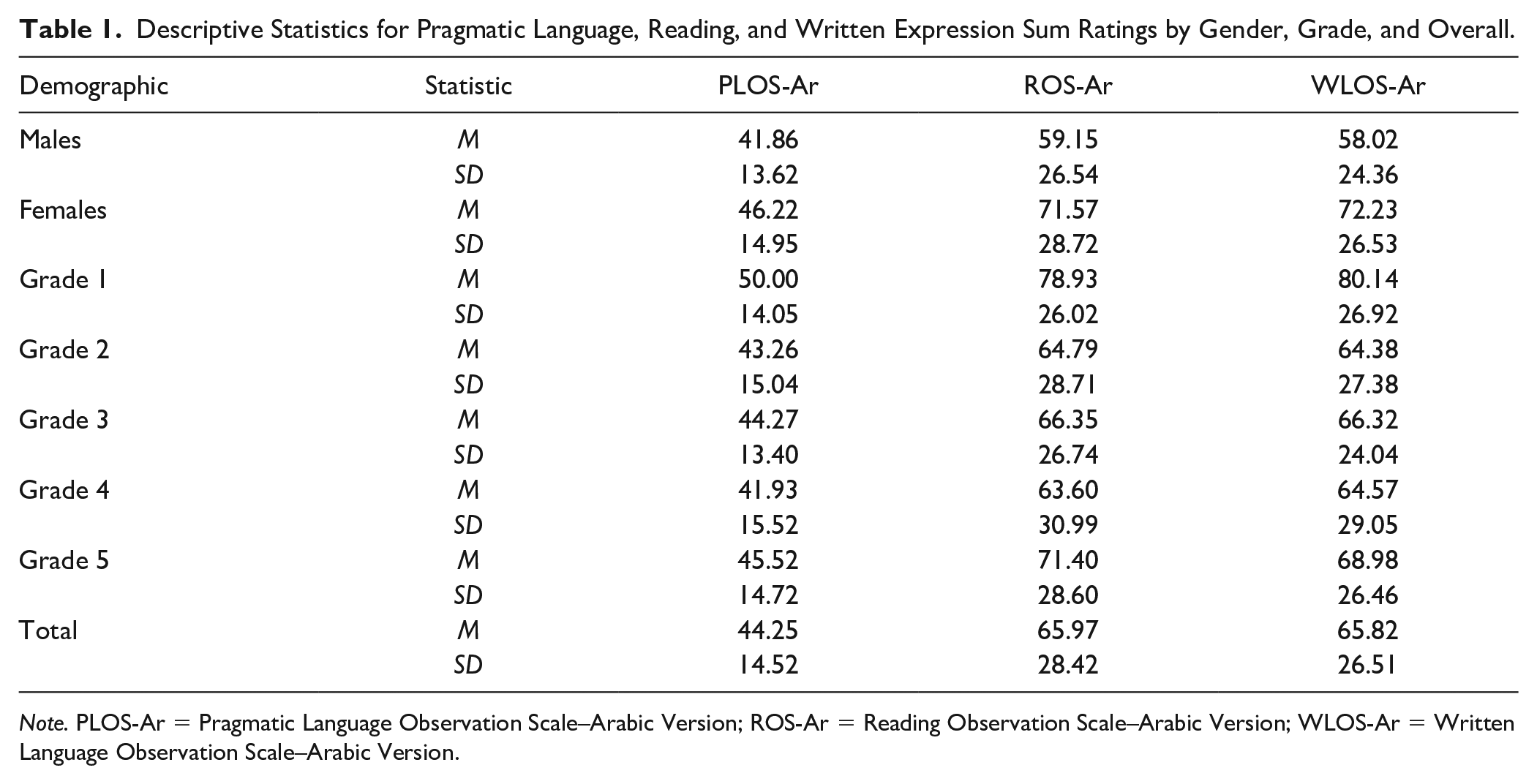
Note. PLOS-Ar = Pragmatic Language Observation Scale–Arabic Version; ROS-Ar = Reading Observation Scale–Arabic Version; WLOS-Ar = Written Language Observation Scale–Arabic Version.
Correlations Between Variables
Table 2 presents Pearson’s correlations among the three variables for both genders, with data for males below the diagonal and for females above it. For both genders, the three measures were highly intercorrelated. Female students showed significantly larger correlations than males for pragmatics and reading, z = 3.16, p = .002, and pragmatics and written expression, z = 2.96, p = .003. However, correlations between the reading and writing scales were similar for male and female students, z = 1.61, p = .107.
Intercorrelations Among Study Measures for Males (Below Diagonal) and Females (Above Diagonal).
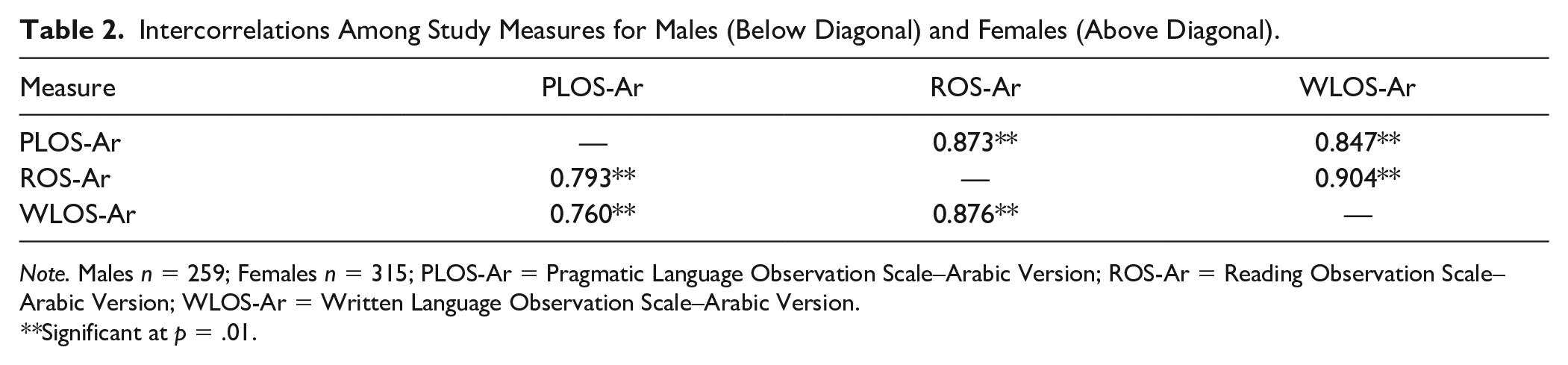
Note. Males n = 259; Females n = 315; PLOS-Ar = Pragmatic Language Observation Scale–Arabic Version; ROS-Ar = Reading Observation Scale–Arabic Version; WLOS-Ar = Written Language Observation Scale–Arabic Version.
**Significant at p = .01.
In Table 3, Pearson’s correlations for scores on the three rating scales are presented using grade bands for early elementary (Grades 1–3) below the diagonal and late elementary (Grades 4 and 5) above the diagonal. The magnitude of the correlation between pragmatics and reading was similar across these grade bands, z = 1.64, p = .101, as it was for the correlation between pragmatics and written expression, z = 0.75, p = .453. However, there was a significant difference attributable to grade in the correlations between reading and writing, with a stronger association between the ROS-Ar and WLOS-Ar scores in older students, z = 3.46, p = .001.
Intercorrelations Among Study Measures for Lower Elementary (Below Diagonal) and Upper Elementary (Above Diagonal).
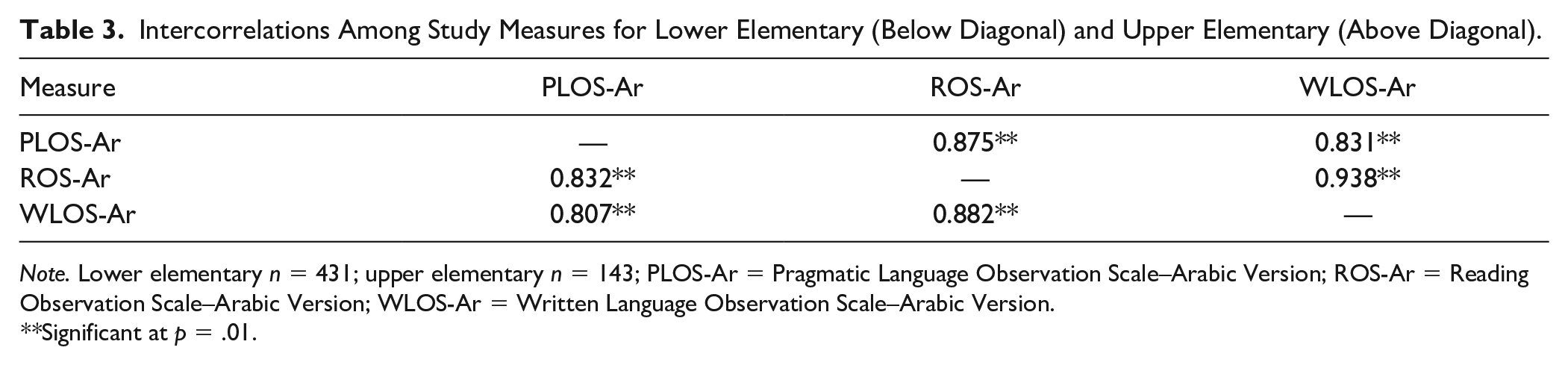
Note. Lower elementary n = 431; upper elementary n = 143; PLOS-Ar = Pragmatic Language Observation Scale–Arabic Version; ROS-Ar = Reading Observation Scale–Arabic Version; WLOS-Ar = Written Language Observation Scale–Arabic Version.
**Significant at p = .01.
Contribution of Pragmatics to Literacy Skills and Vice Versa
One of the primary objectives of this study was to examine the extent to which pragmatics explains variance in literacy skills. To do this, we used blocked multiple regression in which gender and grade were entered in the first block to control for these variables (see above regarding gender differences) and PLOS-Ar was entered in the second block. Of course, one would anticipate that there is some degree of reciprocity in the relationship between pragmatic skills and literacy skills, so we performed the same regression analysis but reversed the criterion and key predictor variables. In all regression analyses, collinearity diagnostics (i.e., variance inflation factors and tolerances) were within acceptable limits and suggested multicollinearity was negligible, although scores on the literacy and pragmatic rating scales were clearly strongly positively related as indicated in Tables 2 and 3. When examining the contributions of gender, grade, and pragmatics to reading, gender and grade contributed 4.7% of the variance, which was significant, F(2, 571) = 14.213, p < .001, and pragmatics contributed an additional 67.3% of variance, which also was significant, F(1, 570) = 1374.306, p < .001. The regression coefficients for the final model are presented in Table 4, along with t-test outcomes for significance of the coefficients; only gender and PLOS-Ar ratings made significant contributions to ROS-Ar scores. When examining the contributions of gender, grade, and reading to pragmatics, although gender and grade together explained a significant 2.3% of variance, F(2, 571) = 6.678, p < .001, neither of these variables were significant contributors to pragmatics in the final model. On the contrary, reading explained an additional 69.1% of variance in pragmatics, F(1,570) = 1,374.306, p < .001. Overall, gender, grade, and pragmatics explained a total of 72.1% of variance in reading, whereas gender, grade, and reading explained slightly less total variance in pragmatics (71.4%), although the standardized regression coefficient associated with reading as a predictor was greater than that associated with pragmatics as a predictor. Thus, there is indeed reciprocity in the relationship between pragmatic language skills and reading, with the impact of reading on pragmatics potentially being slightly more powerful than the reverse.
Regression Coefficients for Reading Comprehension as Criterion Variable (Top Half) and Pragmatics as Criterion Variable (Bottom Half).
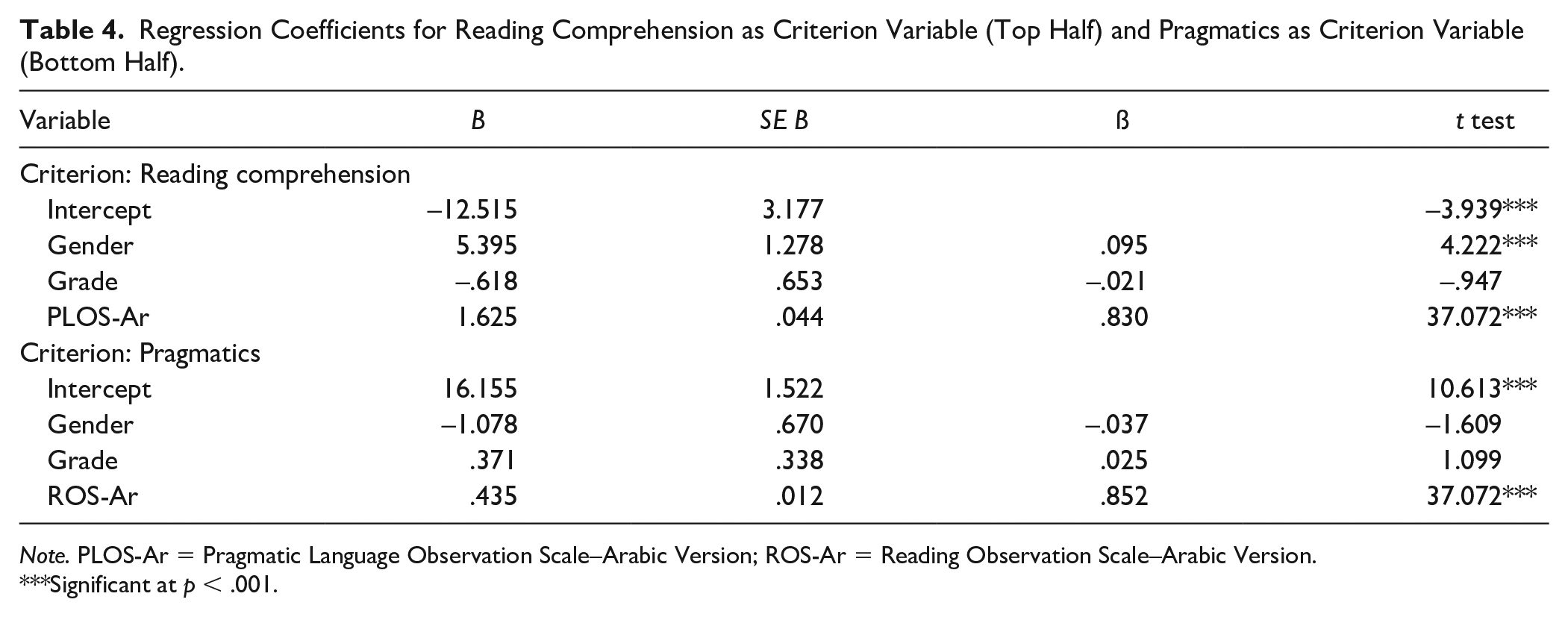
Note. PLOS-Ar = Pragmatic Language Observation Scale–Arabic Version; ROS-Ar = Reading Observation Scale–Arabic Version.
Significant at p < .001.
When we evaluated the contributions of gender, grade, and pragmatics to written expression, gender and grade contributed 7.1% of variance, which was significant, F(2, 571) = 21.932, p < .001, and pragmatics contributed an additional 61.3% of variance, which also was significant, F(1, 570) = 1,104.462, p < .001. The regression coefficients for the final model are presented in Table 5, along with t test outcomes for significance of the coefficients; only gender and PLOS-Ar ratings made significant contributions to WLOS-Ar scores. When examining the contributions of gender, grade, and written expression to pragmatics, although gender and grade together explained a significant 2.3% of variance, F(2, 571) = 6.678, p < .001, only gender was a significant contributor to pragmatics in the final model along with written expression. WLOS-Ar scores explained an additional 64.5% of variance in pragmatics, F(1, 570) = 1,104.462, p < .001. Overall, gender, grade, and pragmatics explained a total of 68.4% of variance in writing, whereas gender, grade and writing explained slightly less total variance in pragmatics (66.7%), but the standardized regression coefficient associated with writing as a predictor was greater than that associated with pragmatics as a predictor. Once again, there is evidence of reciprocity in the relationship between pragmatic language skills and writing, with the impact of writing on pragmatics potentially being slightly more powerful than the reverse.
Regression Coefficients for Writing as Criterion Variable (Top Half) and Pragmatics as Criterion Variable (Bottom Half).
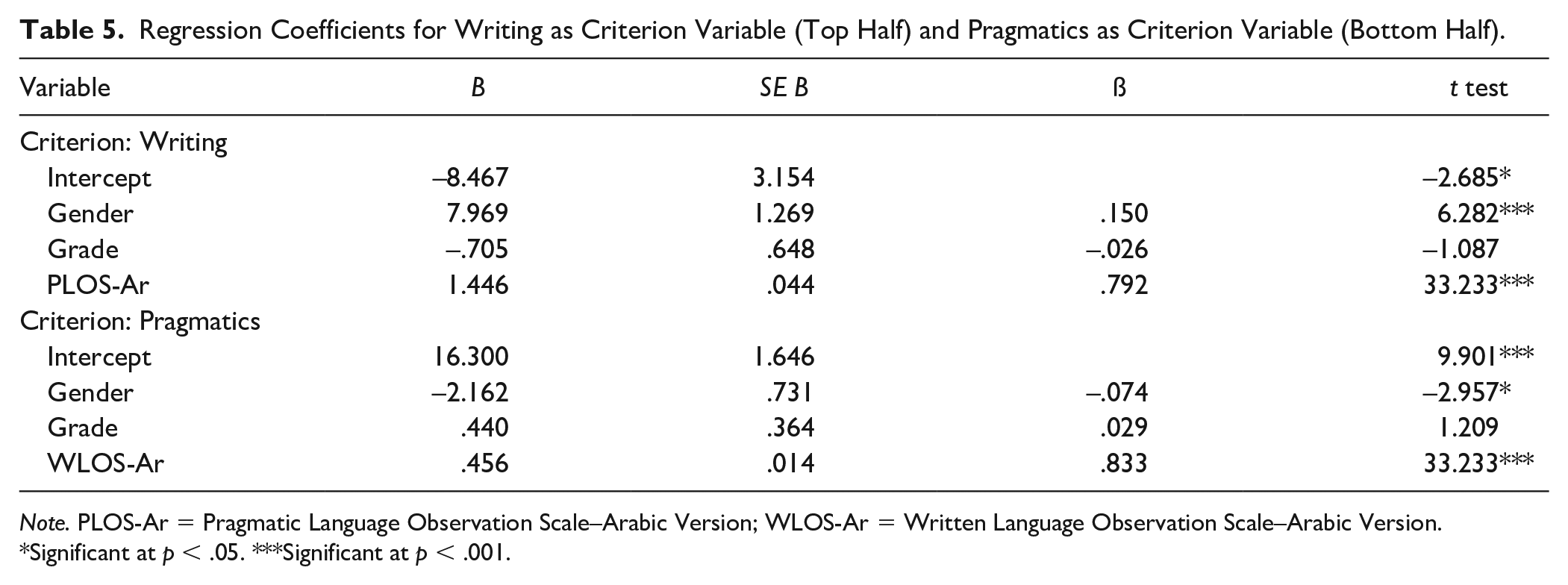
Note. PLOS-Ar = Pragmatic Language Observation Scale–Arabic Version; WLOS-Ar = Written Language Observation Scale–Arabic Version.
Significant at p < .05. ***Significant at p < .001.
Discussion
The current study was based on the notion that teachers should know well about students’ language and literacy skills. Language demands in the classroom require students to be able to monitor conversations and to successfully play the roles of speaker and listener as well as to meaningfully engage with text comprehension and production activities. Teachers have first-hand knowledge of their students’ manifest abilities in classroom-based language and literacy. Pragmatic language in particular—the use of language in social contexts to address communicative needs and regulate social interactions—has been of interest in connection with students having SLD who have difficulties in reading and/or writing. The primary goal of the current study was to examine whether teachers’ observations of their students’ literacy and pragmatic language skills would demonstrate expected relationships, based on the limited available research, among these skills in a group of students in Grades 1 through 5 referred for reading disability in Oman. We also sought to determine whether gender or grade level affected any of these relationships. Our study produced four substantive findings:
gender and pragmatic language skills each explained significant variance in both children’s reading comprehension and written expression, although pragmatics accounted for the majority of variance (between 61% and 67%);
reading comprehension and writing skills (both transcription and text production) explained a significant portion of variance in pragmatic language skills (between 65% and 69%; gender also made a significant contribution in the case of writing);
although gender, grade, and pragmatic skills explained slightly more total variance in reading and writing than the reverse, regression coefficients were larger for literacy skills when each served as a predictor of pragmatic language; and
girls outperformed boys in literacy and pragmatic language, although with small effect sizes, based on teacher report (and correlations between literacy and pragmatics were stronger among female students) and these differences were consistent across the grades examined in the study, but grade level itself had no significant bearing on the outcomes assessed.
Additionally, we found that the teachers rated their students average in pragmatic skills: The PLOS-Ar has 15 items focused just on pragmatics and a score of “3” or average on each item would produce a total sum of 45 points; the mean for the sample was 44.25. On the contrary, teachers rated their students overall below average on the ROS-Ar and WLOS-Ar (both have 25 items that would yield a total of 75 points for average performance) for reading comprehension (sample mean of 65.97) and written expression (sample mean of 65.82), respectively. We expected students’ performance would be below average on all three variables, but it may be that the teachers focused more on academic learning outcomes in reading and written language than on their students’ use of pragmatic language skills in the classroom. It should be noted that we did not obtain teachers’ ratings of students’ social, emotional, or behavioral difficulties, which may contribute to poor academic literacy skills and have been shown to be related to pragmatic deficits (Eadie et al., 2021). These would be an important set of factors to examine in future work. We caution that our findings might be affected by strong correlations observed between the literacy and pragmatics measures, although multicollinearity diagnostics did not flag this as a serious problem, in that the different rating scales might be tapping into some similar underlying language-related skills. Additionally, because some of the instruments used in this study were developed for students 8 or 9 years of age and older, when we excluded students younger than this, significant differences attributable to gender and the predictive significance of gender in regression analyses were mostly eliminated; this likely means that gender was a much more important variable for first and second graders than older students.
The perceived gender differences observed on the three key variables using the full sample of students were in line with prior research, although the differences we observed were small in magnitude. We believe that the observed differences were mainly the result of teachers’ judgments about students’ performance in their class. In general, gender disparities have been recorded in the literature, showing that girls do better on general and specialized language development tests (Bornstein et al., 2004; David & Wei, 2008; Eriksson et al., 2012). Moreover, gender differences have been observed in everyday communication. For instance, Thompson and Moore (2000) provided evidence of gender differences in problem-solving discourse among preschoolers. They analyzed the frequency of collaborative speech acts in the task-related spontaneous speech of 103 preschoolers (53 boys and 50 girls). Findings showed greater help-eliciting and self-disclosing communicative acts among girls, greater initiation of verbal turns by girls, and more collaborative speech by girls. Helland et al. (2017) evaluated and compared the outcomes of evidence-based screening instruments used to identify preschoolers at risk of language impairment and dyslexia. Three assessment tools were used: one to evaluate early language development, one to determine the risk of developmental dyslexia, and one to evaluate children’s early communicative competence. The instruments were completed by 79 children’s caregivers. Using recommended cut scores for these three screening instruments, a typical group (n = 51) and an at-risk group (n = 28) were established. The normal and at-risk groups differed significantly from one another, as was predicted, and there was a moderate association between scores on the instruments. Within the at-risk group, there was a gender difference in that the boys scored much lower than the girls. Bouchard et al. (2020) examined the moderating role of pragmatic language skills in the relationship between perceived prosociality and gender among children in two different educational contexts and age groups (n = 108 children in childcare centers, ages 4–5; n = 113 children in kindergarten, ages 5–6). They found that boys were seen as less prosocial than girls by all educators as a result of differences in perceived pragmatic language skills. Girls also appear to possess a greater variety of reading strategies supported by use of metacognitive reflection (Alami, 2016) and have been found rather consistently to outperform boys on writing tasks (e.g., Troia et al., 2019). However, there is some contradictory evidence on gender differences in pragmatic language skills. Longobardi et al. (2017) found no gender differences in the pragmatic development of Italian children ages 18 to 47 months. However, a gender by age interaction was found for some components of pragmatics that were evaluated such as storytelling, adapting conversation, and questioning and commenting about people and things. The observed trend was for girls’ performance to be significantly higher in the younger age groups (24–29 and 30–35 months) compared with that of the boys, but the opposite was observed among the oldest age group (42–47 months), where boys’ performance was significantly higher than that of girls. Even so, Loukusa et al. (2007) found no gender differences in pragmatic skills in Finnish children ages 3 through 9 years. Our findings highlight the importance of exploring gender differences in pragmatic language of other clinical groups (children at risk for SLD in reading).
For both genders, pragmatic language, reading comprehension, and written expression were highly intercorrelated, although females had significantly larger correlations than males, demonstrating an even stronger connection between perceived language and literacy competence. The interconnected relationships among the three variables for girls and boys imply that reading and writing are potentially good predictors of students’ use of pragmatic language and vice versa (O’Neill, 2014; Troia, 2011). It could be argued that teachers should target the teaching of pragmatics through reading and writing activities, which occupy a large swath of time in elementary classrooms. This is reinforced by our finding of larger coefficients associated with pragmatic language regressed onto literacy skills than those associated with literacy regressed onto pragmatic language. Remedial instruction and tutorial interventions for students with purported reading disabilities could employ embedded and explicit activities to increase the appropriate social use of language (Demchick & Day, 2016; Lightbown & Spada, 2013). For instance, Nathanson and colleagues (2007) reported that using reading and written language-related cognitive strategies helped improve students’ oral narration. The type of intervention a student receives will depend on how much the various educational stakeholders take oral language development into account. For instance, speech-language pathologists are trained to assess and monitor oral language skills and have knowledge of language disorders and developmental progressions in areas of language (phonology, morphology, vocabulary, syntax, and pragmatics). A greater emphasis may be placed on evaluating children’s literacy skills over time by special education teachers and regular classroom teachers (such as reading fluency, spelling, and comprehension). The abilities that are chosen to be emphasized in literacy education, evaluation, and intervention can be affected in a cascading manner by differences in how language is understood (Goodrich et al., 2023).
As expected, we found that teacher-judged pragmatic language skills explained a substantial portion of variance in rated literacy skills. This reinforces the contention that pragmatic language serves an important role in success with reading and written expression. Simultaneously, our findings showed that observed reading comprehension and writing skills could explain a large proportion of variance in pragmatic language use in the classroom. Students with SLD may (a) perceive themselves as socially less adept than their typically developing peers (Timler, 2008) and (b) behave less sociably in the classroom due to difficulties in perceiving social cues, both of which affect peer relationships (Laws et al., 2012). Moreover, difficulties in reading and written expression may result from students’ disinterest in using language within the context of social literacy practices in the classroom, thereby reducing the development of reading and writing skills (Laws et al., 2012). Additionally, these difficulties with forming peer friendships and participation in shared literacy practices can influence the use of language forms and functions, particularly in relation to three main components of pragmatics: (a) presupposition abilities, which are related to social cognition and theory of mind and affect reading comprehension and written expression (Farnsworth, 2018; Troia, 2011, 2021), (b) discourse regulation such as topic maintenance and organization, paraphrasing, and grammatical cohesion, all of which are key contributors to good writing (Norbury & Bishop, 2003), and (c) figurative language (e.g., idioms, proverbs, metaphors, and similes) comprehension and use that would impact both areas of literacy (Stothers & Cardy, 2012).
Reading comprehension, compared with writing, was a somewhat stronger predictor of pragmatic language in our study participants. This finding could be of interest to teachers because reading activities offer fewer opportunities for students to mask their pragmatic difficulties, whereas in writing students may purposefully avoid using figurative language or conveying narratives that involve a theory of mind or more complex syntactical and grammatical structures. However, previous research has shown theory of mind is more strongly associated with writing than with reading (Cardillo et al., 2018; Farnsworth, 2018). We did find that written expression also was a good predictor of pragmatic language, and, therefore, our work supports previous evidence of a strong connection between written expression and pragmatic language. Furthermore, reading disability and SLI are argued to be on a continuum and not categorically distinctive (Spanoudis et al., 2019); children with SLI and/or reading disability are often less proficient at processing phonological information, building a mental lexicon, using morphosyntactic information, using pragmatics effectively, understanding and retrieving text, and comprehending sentence structure and sentential semantics (Leonard, 2014). Thus, connections between pragmatics and literacy are anticipated for all students, those with and without related disabilities.
Limitations and Future Directions
Our investigation has some limitations that warrant discussion. First, our study was based on teacher judgment of students’ observed behaviors and skills in the classroom. Although using teacher report for identifying students as at risk is likely to be valid, relying on one single method of assessment probably has low sensitivity and could exclude many children. Therefore, adding objective testing of the observed skills (i.e., pragmatic language, reading, and writing) and/or conducting teacher interviews may enhance screening and assessment procedures and yield more valid data. Additionally, we have no information regarding the interobserver reliability of the ratings assigned by teachers due to data collection limitations imposed via conducting this research across the entire country of Oman. Although there is some research suggesting that teachers’ ratings can be indicative of students’ performance (e.g., Dockrell & Lindsay, 2000; Gilmore & Vance, 2007), it should not be assumed that the ratings data used in this study are perfectly accurate. Second, the ROS-Ar only evaluated reading comprehension and not lower-level reading skills (e.g., phonological awareness, symbol-sound associations, word identification), so it is possible that relations between PLOS-Ar scores and ROS-Ar scores would be different if more fundamental reading skills had been included as items to be rated by teachers, especially given the age group of children in this study. This reflects the need to employ well-aligned measures of constructs under investigation. Third, the referrals of the study participants were based on diagnostic academic assessments in reading and writing that are largely designed by expert teachers because there is a lack of standardized norm-referenced achievement tests and criterion-referenced tests in Oman. Fourth, there were 276 students who were initially included in the study sample but were later dropped due to their teachers’ inability to complete the rating scales due to workload. We believe this did not drastically affect our findings because (a) those students who were dropped did not differ from those who were rated in their sociodemographic traits and (b) they too were referred to the learning disability program. Fifth, findings that (a) observed reading comprehension behaviors, as compared with writing behaviors, are more indicative of pragmatic language skills and (b) literacy skills are somewhat more strongly predictive of pragmatic language than vice versa need to be replicated and validated via objective testing.
Implications and Future Research
The current study has several implications for school psychologists, other school professionals, and teachers in Oman. It is important to mention that, in Oman, there are few speech-language pathologists who provide primary care and intervention services to children with language disorders in academic or clinical settings, and the number of qualified school psychologists is very limited. Schools, instead, may have a school professional (e.g., special educator, learning disability teacher, school counselor, and social worker) who received in-service professional development in the areas of school psychology or speech-language pathology with a focus on assessment of students’ academic and non-academic skills. Of course, this is hardly ideal as any in-service training would be woefully inadequate compared with coursework and other preparatory activities that fulfill professional credentialing requirements in these disciplines. We recommend employing teachers’ observations in screening for students with salient language difficulties including the pragmatic use of language particularly for students with a risk status for SLD. In this study, we relied solely on teachers’ judgments and knowledge of students’ performance in reading comprehension, writing, and pragmatic language. Although this could be seen as a limitation, it is equally relevant to decision makers and to teachers themselves. Investment in training teachers (and other professionals) about how to accurately identify typical and atypical student performance could help enhance prevention, intervention, and referral procedures in Oman’s schools. Additionally, teachers’ professional development activities in schools could be a platform for enhancing their roles in supporting clinical populations and addressing the needs experienced by these students. School psychologists, speech-language pathologists, or professionals working in a related field and serving in a school or providing outreach services to several schools may help provide training professional development on how to conduct accurate and reliable observations of children’s language and literacy skills and behaviors in the classroom.
Footnotes
Declaration of Conflicting Interests
The author(s) declared no potential conflicts of interest with respect to the research, authorship, and/or publication of this article.
Funding
This research was supported by a grant from The Deanship of Research at Sultan Qaboos University, The Sultanate of Oman, under grant number RF/EDU/PSYC/23/02
