



Abstract
The study reported herein sought to explore the effect of self-disclosure about stuttering on listener perceptions of persons who stutter (PWS). Sixty young adults who do not stutter were divided into three groups. Each group was assigned to one of three conditions: no disclosure (ND), apologetic self-disclosure (ApD), and assertive self-disclosure (AsD), followed by a narrative by a PWS presented auditorily. Participants then rated the PWS on a semantic differential scale. Results revealed no significant difference between listener ratings for ApD and ND conditions. The PWS in the AsD condition was perceived as “less sociable” than the PWS in the ND condition. The PWS disclosing assertively appeared to be rated more positively by female listeners. Being well acquainted with a PWS appeared to result in more positive perceptions indicating a need to educate the general public about stuttering.
Stuttering is a multifactorial and a complex communication disorder. Bloodstein (1995) defined stuttering as a disorder of fluency where speech is interrupted abnormally by repetitions or prolongations of a sound, syllable or posture, and/or by avoidance or struggle reactions. Stipdonk et al. (2014) found that persons who stutter (PWS) who held more negative communication attitudes because of stuttering possessed a more introverted personality. Persons who stutter have also been subjected to negative stereotypes and attitudes across cultures such as Asian Indian (Tellis & Tellis, 2003); Middle Eastern (Nabieh El-Adawy et al., 2020; Üstün-Yavuz et al., 2021); Japanese (Iimura et al., 2018); Chinese (Bebout & Arthur, 1992, 1997; Ip et al., 2012; Üstün-Yavuz et al., 2021); as well as American Indian (Beste-Guldborg et al., 2012) culture. Persons who stutter may be perceived as nervous, anxious, or less confident by listeners (Mac Kinnon et al. 2007; White & Collins, 1984). These stereotypical beliefs may vary across cultures. In a study done by Daniels et al. (2006), African American males who stuttered reported experiencing negative attitudes from their listeners which affected their racial and communicative identity as well as their professional and social lives. Prevalence of stereotypes is stronger in some cultures than others, probably due to limited knowledge of the disorder. This has been seen in Middle Eastern countries such as Kuwait and Sudan where stuttering was believed to be caused by “an act of God” (Abrahams et al., 2016).
Negative stereotypes about stuttering may be formed due to inadequate knowledge and/or lack of interaction between the PWS and people who do not stutter (MacKinnon et al., 2007; White & Collins, 1984). Disfluent speech and the stigma attached to it might induce feelings of self-consciousness, embarrassment in a PWS, subsequently adding to their communicative stress (Starkweather, 2001). One of the effective ways of reducing these feelings in a PWS is self-disclosure about stuttering (Montgomery, 2006). Self-disclosure is the act of disclosing personal information about himself/herself (such as a disability or a disorder) to a communication partner (Hastorf et al., 1979). It involves the PWS actively disclosing or advertising their stuttering to their listener or communicative partner (Breitenfeldt & Lorenz, 1989; Montgomery, 2006).
According to MacKinnon et al. (2007), stereotypes related to stuttering are formed when listeners anchor their perceptions in their own experiences of disfluency. However, these perceptions are then adjusted to become less negative when the listener knows that the speaker has a chronic speech difficulty. It follows then that self-disclosing about one’s stuttering might aid this adjustment process, thus minimizing listener biases and stigma (Murphy et al., 2007). Consequently, it works toward inducing feelings of relief in the PWS (Montgomery, 2006). In other words, self-disclosure helps in enhancing social interaction between the PWS and their communication partners (Collins & Blood, 1990) and consequently reduces the impact of stuttering (Byrd, McGill, et al., 2017).
Effects of Different Types of Self-Disclosure
Some studies compared the effects of using different types of disclosure. Byrd, Croft, et al. (2017) explored the utility of self-disclosure and what types of disclosure would be beneficial to adults who stutter (AWS). A sample of 388 adult listeners had volunteered to participate in the study. The participants were then randomly assigned to six groups. Each group was exposed to one of the six disclosure conditions that were: adult male (informative; apologetic; and no disclosure [ND]), adult female (informative; apologetic; and ND). The findings revealed that listeners favor informative disclosure to apologetic disclosure. McGill et al. (2018) explored the various verbatim wordings used during self-disclosure in stuttering, and various contexts in which AWS used self-disclosure. A sample of 42 adults who stuttered and 33 speech-language pathologists (SLPs) participated in the study. The majority of AWS reported with verbatim self-disclosure statements that were coded as educational. The major context in which AWS reported the use of self-disclosure while stuttering was for a job interview.
Position of Self-Disclosure Statements Within a Narration
Healey et al. (2007) studied the effect of self-disclosure at the beginning of a monologue; self-disclosure at the end of monologue and no self-disclosure in 90 adults in the age range of 18 to 54 years. The results revealed that more than half of the listeners’ perceptions did not change with or without self-disclosure. In a study by Lincoln & Bricker-Katz, (2008), listeners reported that PWS who disclosed at the end of the interaction were more friendly as compared to PWS in the other two conditions. Potts (2013) conducted an online survey to study the effects of position of self-disclosure (beginning, end, or ND) on a sample of 82 adults in the age range of 18 to 64 years. The participants viewed a video of a 30-year-old adult who stuttered, narrating a scripted monologue of the Grandfather Passage. The results indicated that a majority of listeners preferred self-disclosure at the end of the narration. Female respondents gave more positive ratings as compared to males. Healey et al. (2007), however, found self-disclosure at the end of a conversation to cause no changes in listener perceptions. However, some studies where the PWS self-disclosed about stuttering at the beginning of a narrative or a conversation revealed significant positive effects of self-disclosure on listeners (Byrd, Croft, et al., 2017; Lincoln & Bricker-Katz, 2008).
Effect of Self-Disclosure on Male and Female Listeners
The results of studies comparing perceptions of male and female listeners toward self-disclosure of stuttering have been equivocal. Potts (2013) found that female listeners tended to rate PWS more positively than male listeners. Along similar lines, Byrd, Croft, et al. (2017) reported that male listeners had a lower opinion of speakers than females. Jain et al. (2020), in contrast did not find significant differences in the way male and female listeners perceived PWS who disclosed their stuttering.
Culture and Self-Disclosure
Just as the nature and strength of stereotypes might vary across cultures, the reactions of listeners to self-disclosure of stuttering might vary as well. For instance, in contrast to European American listeners, Chinese listeners (Zhang, 2010) or African American listeners (Mayo et al., 2004) blame AWS for their disfluencies. Self-disclosure in these populations might, perhaps, worsen listener perceptions.
It would certainly be interesting to know about these differences. Unfortunately, there is a dearth of studies exploring the effect of self-disclosure about stuttering across various cultures. Croft and Byrd (2021) examined the effect of self-disclosure in the Hebrew speaking population in Israel. The study included simulated stuttering samples of adults under three conditions of disclosure viz. informative; apologetic and ND replicating the methods of the study by Byrd, Croft, et al. (2017). Results indicated that Hebrew listeners preferred disclosing in an informative manner and male speakers were rated more friendly and outgoing than the female speakers. However, the positive effects of self-disclosure were smaller among Israeli listeners as compared to listeners from the United States. The researchers attributed this to cultural differences in the two populations.
A qualitative study done in Australia (Nang et al., 2018) focused on studying the experiences of women who stuttered. Nine women who stutter ages 35 to 80 years were recruited from Speak Easy Association of Western Australia and were interviewed. Their interviews were transcribed verbatim and coded. In the management section of the interview, the women gave personal accounts of self-disclosure and other practices. It was found that self-acceptance is related to self-disclosure in stuttering. One of the participants said that she used self-disclosure to teach others about stuttering. Another participant said that she used self-disclosure publicly at work. A small number of participants were apprehensive about using self-disclosure and reportedly used self-disclosure only with a select few people. One participant said that when she acknowledged stuttering in front of a manager, she got a negative response which made her avoid the use of self-disclosure in subsequent conversations. In her own words, “If I know that somebody knows (I stutter), I don’t want to talk to them anymore” (p. 1251).
There is limited literature reporting the effects of self-disclosure in the Indian population. Bajaj et al. (2017) assessed the effect of self-disclosure and gender of speakers on the perception of simulated stuttering of 100 adult listeners ages 18 to 25 years. The participants were divided into four groups consisting of anyone of the four disclosure conditions namely, adult male with disclosure; adult male without disclosure; adult female with disclosure; adult female without disclosure. The findings indicated that in the personality, social communication efficiency domains, females received a more favorable rating than males irrespective of the disclosure conditions. Jain et al. (2020) studied the effect of self-disclosure on 60 typical speakers in the age range of 18 to 40 years. Participants were randomly assigned to one of three groups. Each group of 20 participants was exposed to one of three disclosure conditions, no self-disclosure, self-disclosure about stuttering, self-disclosure about intervention for stuttering. The stimulus was an audio-simulated narration sample on “My Hobbies”. Listeners rated the speaker on a semantic differential scale (Burley & Rinaldi, 1986; Collins & Blood, 1990; Irani & Gabel, 2008; Woods & Williams, 1971) and the quality-of-life subscale of the Impact Scale for Assessment of Cluttering and Stuttering (Kelkar & Mukundan, 2015). Results revealed that there was no significant difference in listener perceptions across the three conditions of disclosure. Exploring the effect of variations in the type of self-disclosure could have important implications in therapy and in verifying the viability of self-disclosure of stuttering in India.
The above literature indicates that an informative tone of self-disclosure is preferred by listeners. However, this preference was seen in populations limited to American and Israeli cultures. Studies on self-disclosure reported from India, on the other hand, have used an apologetic tone of disclosure. Exploring the use of an informative or assertive tone while disclosing about one’s stuttering in the Indian sociocultural scenario could certainly add to the present body of research in this realm. Results related to reactions of male and female listeners to self-disclosure have been highly equivocal in literature. This variable has not been explored in many studies till date in India. Similarly, results related to the position of self-disclosure are mixed, with some studies reporting positive effects of disclosure at the beginning of a narrative, while some reporting improved listener perceptions when disclosure was used at the end. However, multiple studies that investigated the effects of disclosure versus ND (Lincoln & Bricker-Katz, 2008), different types of disclosure (Byrd, Croft, et al., 2017), disclosure across cultures (Croft & Byrd, 2021), as well as the two studies reported from India (Bajaj et al., 2017; Jain et al., 2020) used self-disclosure at the beginning of the narrative or conversational sample. Self-disclosure at the beginning was therefore chosen for the present study as well, to explore the effects of disclosure as well as effects of the tone of disclosure used. The present study was thus a preliminary investigation of the effect of self-disclosure about stuttering on listener perceptions of PWS in India. Listener perceptions were compared across three conditions of disclosure: apologetic disclosure, assertive disclosure, and ND. A comparison was also made across perceptions of male and female listeners for each of the disclosure conditions. Effects of some additional variables, such as education, occupation, and prior exposure to PWS on listeners’ perceptions of self-disclosure by the PWS were also examined.
Method
The study was approved by the ethics committee of the institute to which the first and second authors are affiliated.
Stimuli
A 21-year-old male with a diagnosis of moderate developmental stuttering on the Stuttering Severity Instrument-4 (SSI-4; Riley, 2009) consented to participate in the study. He was conversant in English and had no concomitant speech, language, and auditory problems. The PWS spontaneously narrated on the topic “My Hobbies.” A duration of approximately three minutes was considered appropriate for the narration (Roberts et al., 2009). The topic was selected after consultation with three SLPs with over 10 years of experience in the field of speech-language pathology. It was selected based on factors such as universality, simplicity, relevance, and neutrality. The participant first verbalized an apologetic self-disclosure (ApD) statement previously used by Byrd, Croft, et al. (2017) which read, “Before we get started, I should let you know that I stutter, so this might be hard in spots, so please bear with me.” The apologetic statement was followed, after a short pause, by an assertive self-disclosure (AsD) statement which read, “Before we get started, I should let you know that I am a person who stutters. So, this narration might take a bit longer than expected.” This statement was created based on inputs from a clinical psychologist (PhD) with over 20 years of experience and an SLP (PhD) with over 10 years of experience in the clinical as well as research realm. This was then followed by the narration task. SSI-4 was administered. A percentile score of 61 to 77 was obtained on SSI-4 (Frequency: 14; Duration: 6; Physical concomitants: 8; Total Score: 28), which indicated moderate stuttering. The speech of the PWS consisted of blocks, repetitions as well as prolongations. The recording was carried out using a Hi-Q MP3 voice recorder on a video call. This was done in view of the COVID-19 pandemic which made remote recording imperative. Hi-Q MP3 Voice Recorder (a freely available audio recording application; on android platforms) was used to create an auditory stimulus sample. Hi-Q settings had been validated by cross-checking them against the Audacity software. A sampling rate of 44 kHz, a bit rate of 320 kbps, and a gain of 10 dB was used while recording.
The researcher and the PWS had the same application so that the researcher could specify application settings before recording. The auditory sample was then shared with the researcher by the PWS. Using Audacity (a freely available editing software), the first author added either the apologetic or assertive disclosure statement to a copy of each of the narratives, at the beginning of the sample. The third copy of the narrative did not consist of any disclosure statement. This yielded three audio recorded stimulus samples, beginning with each of the three self-disclosure conditions, ND; ApD; and AsD which were 2.07 minutes (ND), 2,15 minutes (ApD) and 2.17 minutes (AsD) long respectively.
Participants
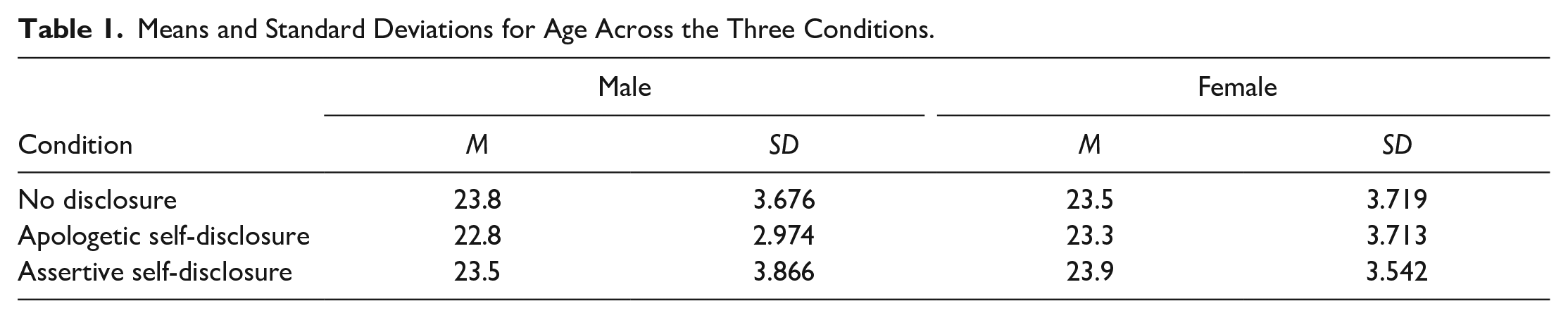
Sixty typically speaking adults in the age range of 18 to 30 years (Mean age = 23.62; SD = 3.499) participated as listeners in the study. Informed consent was taken from the participants before beginning with the procedure. Each participant was informed that the researcher is studying perceptions toward PWS (the specifics of the study were revealed after data collection so as to reduce the chances of bias). Participants could read, understand and speak English without assistance. Individuals who had a significant speech and language history, a history of stuttering, SLPs or professionals working toward the rehabilitation of PWS were excluded. The 60 participants were assigned into one of the three groups to be exposed to one of the three conditions of self-disclosure such that they were age matched across groups. Each group thus had 20 listening participants (10 males, 10 females). The means and SDs for age across groups are displayed in Table 1.
Means and Standard Deviations for Age Across the Three Conditions.
All participants were from urban areas of Maharashtra, India. The distribution of participants within each group in terms of their education, occupation, and close acquaintance with a PWS (operational definition of close acquaintance: immediate family, close friends, colleagues whom they interact with every day) is shown in Table 2.
Frequency Distribution of Participants Across Education Level, Occupation, and Acquaintance With Person Who Stutters.
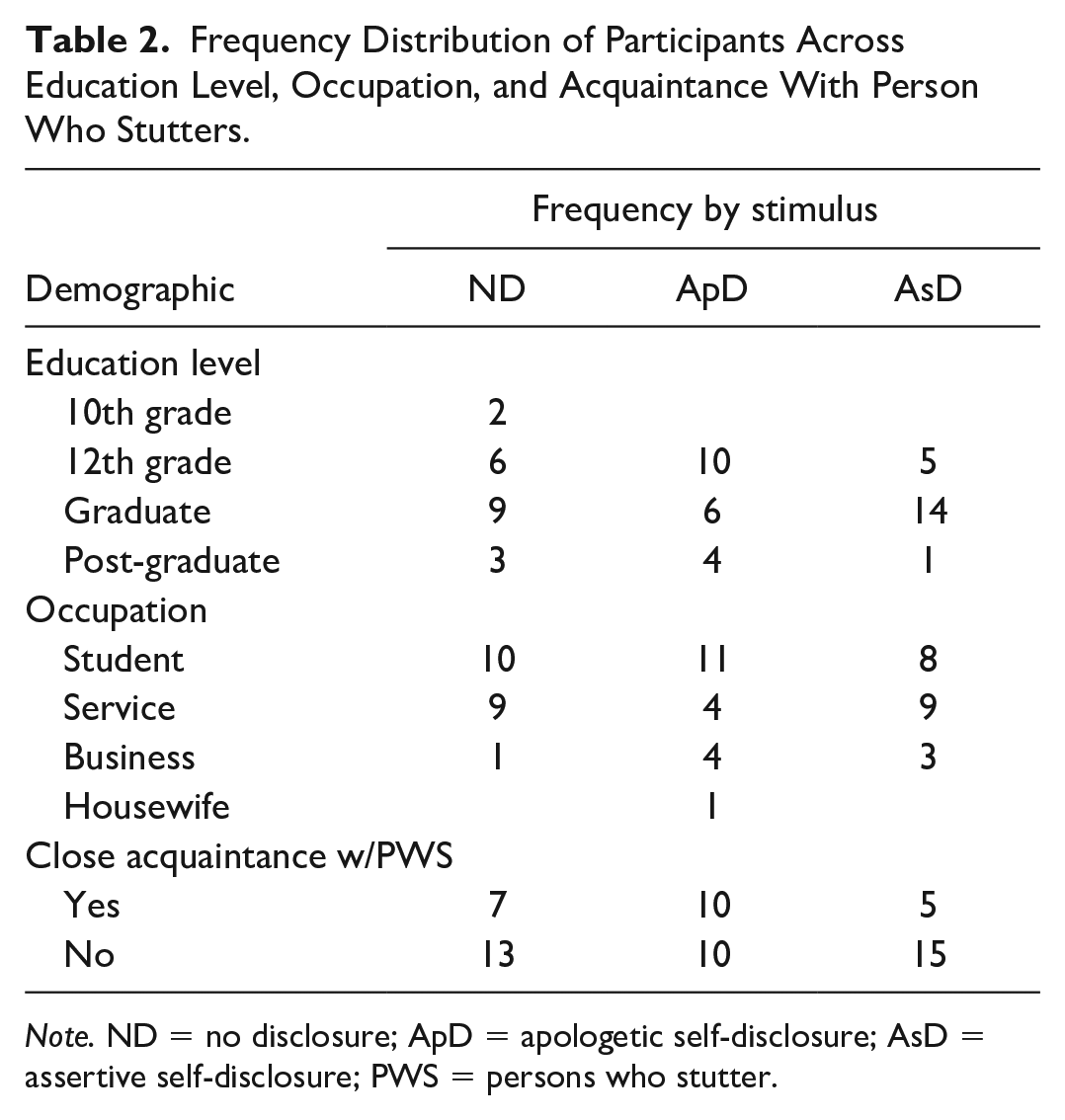
Note. ND = no disclosure; ApD = apologetic self-disclosure; AsD = assertive self-disclosure; PWS = persons who stutter.
Procedure
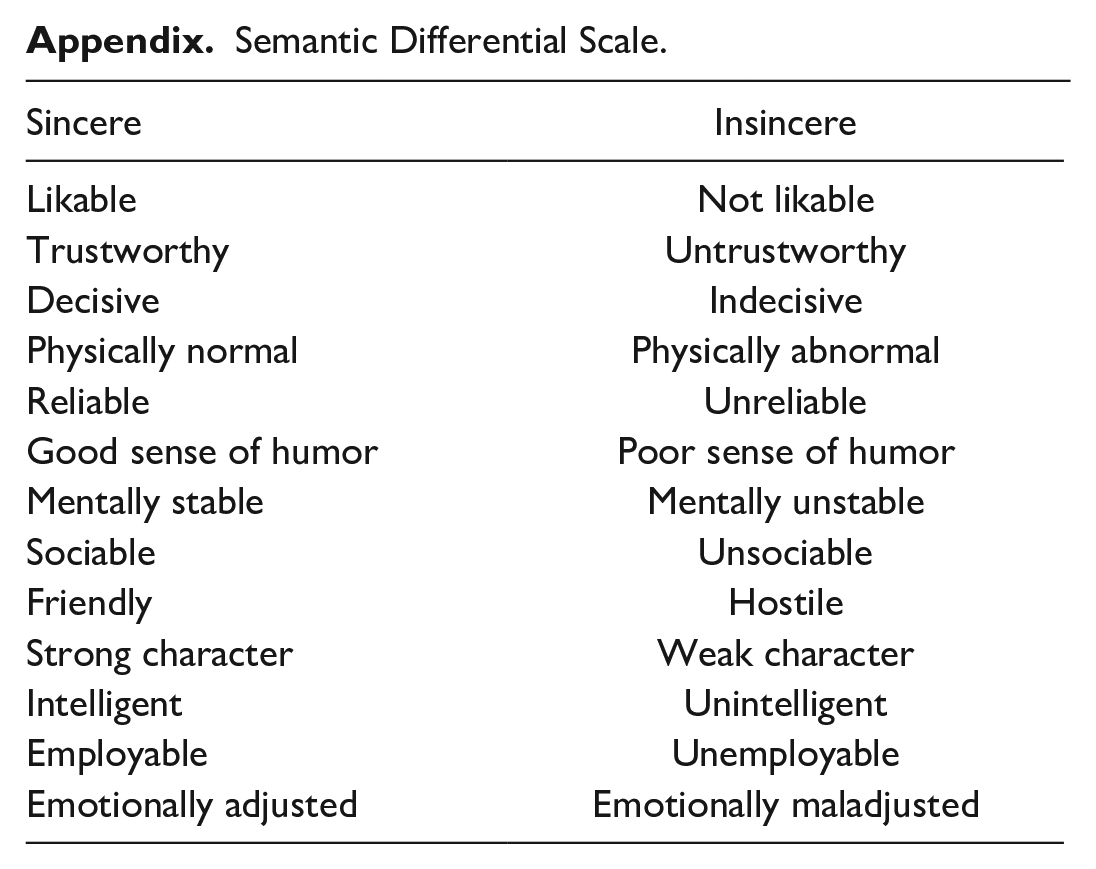
Demographic information of the participants was elicited along with a question about whether they knew a PWS in their immediate family, close friends, or colleagues who they interacted with every day. Each participant was then exposed to the audio sample with one of the three conditions of disclosure. They were then asked to fill a 14-item semantic differential scale (Burley & Rinaldi, 1986; Collins & Blood, 1990; Irani & Gabel, 2008; Woods & Williams, 1971). This is a balanced 7-point Likert-type scale consisting of 14 adjectives paired with their antonyms. A rating of 1 or 7 on either side meant an extreme value and 4 meant a neutral value. The tool with items can be referred to in the Appendix.
In case, of online data collection in view of the COVID-19 pandemic; the Likert-type scale and the recording were emailed to the participant just before commencing the video call. The demographic data sheet was with the researcher and was filled in using an interview method. The researcher and the participant stayed connected on a video call till the participant filled in the Likert-type scale. The filled sheet was then immediately sent back to the researcher through an email.
Statistical Analyses
The semantic differential scale consisted of 14 adjectival pairs. These pairs were arranged randomly, so that a positive adjective appeared on the right extreme for some pairs and left extreme for the others. However, while scoring, a score of 7 was given for the positive attributes and a score of 1 was given for the negative attributes. E.g., a rating toward “sincere” end received a score of 7, while a rating toward the “insincere” end received a score of 1. All the other interim ratings were given scores accordingly in this manner.
The results were statistically analyzed using the IBM SPSS Statistics version 20.0. Normality testing using the Shapiro Wilk coefficient revealed a non-normal distribution, necessitating the use of non-parametric statistical tests. The Kruskal–Wallis Test was used to compare the listener perceptions obtained by the semantic differential scale across the three conditions of self-disclosure. The level of significance was set at .05. Paired comparisons were then carried out using Mann–Whitney U tests. Listener perceptions of males and females within each of the three conditions were compared using the Mann–Whitney U test. The effects of demographic variables such as education and occupation on listener ratings were analyzed using the Kruskal–Wallis test. The effect of close acquaintance with a PWS on listener ratings was analyzed using a Mann–Whitney U test.
Results
Differences in Semantic Ratings Among ND, ApD, and AsD
Kruskal–Wallis tests for each of the 14 adjectival pairs revealed statistically significant differences among ND, ApD, and AsD for the attributes “physically normal” (χ2 = 0.01; df = 2; p = .01), “reliable” (χ2 = 8.53; df = 2; p = .03), and “sociable” (χ2 = 0.63; df = 2; p = .02). Three Mann–Whitney U tests to obtain pairwise comparisons were carried out. A Bonferroni correction was applied to yield a new p value of 0.016 (dividing 0.05 by 3).
A Mann–Whitney U test across ND and ApD conditions revealed that the items “reliable” (Z = 0.80; p = .421), “sociable” (Z = 1.65; p = .100), and “physically normal” (Z = 1.98; p = .048) were not significantly different across the ND and ApD conditions.
A Mann–Whitney U test across ApD and AsD conditions revealed that the scores of the items “physically normal” (Z = 2.85; p = .004), and “reliable” (Z = 2.50; p = .012) were significantly different for the two conditions. The median and interquartile range values for each of the 14 attributes across each of the three stimulus conditions are displayed in Table 3. Median values shown in Table 3 imply that individuals in the ApD condition rated the PWS more favorably than individuals in the AsD condition it may be recalled that higher scores indicate positive ratings.
Descriptive Statistics of Scores Elicited for No Disclosure (ND), Apologetic Disclosure (ApD), and Assertive Disclosure (AsD) Conditions.
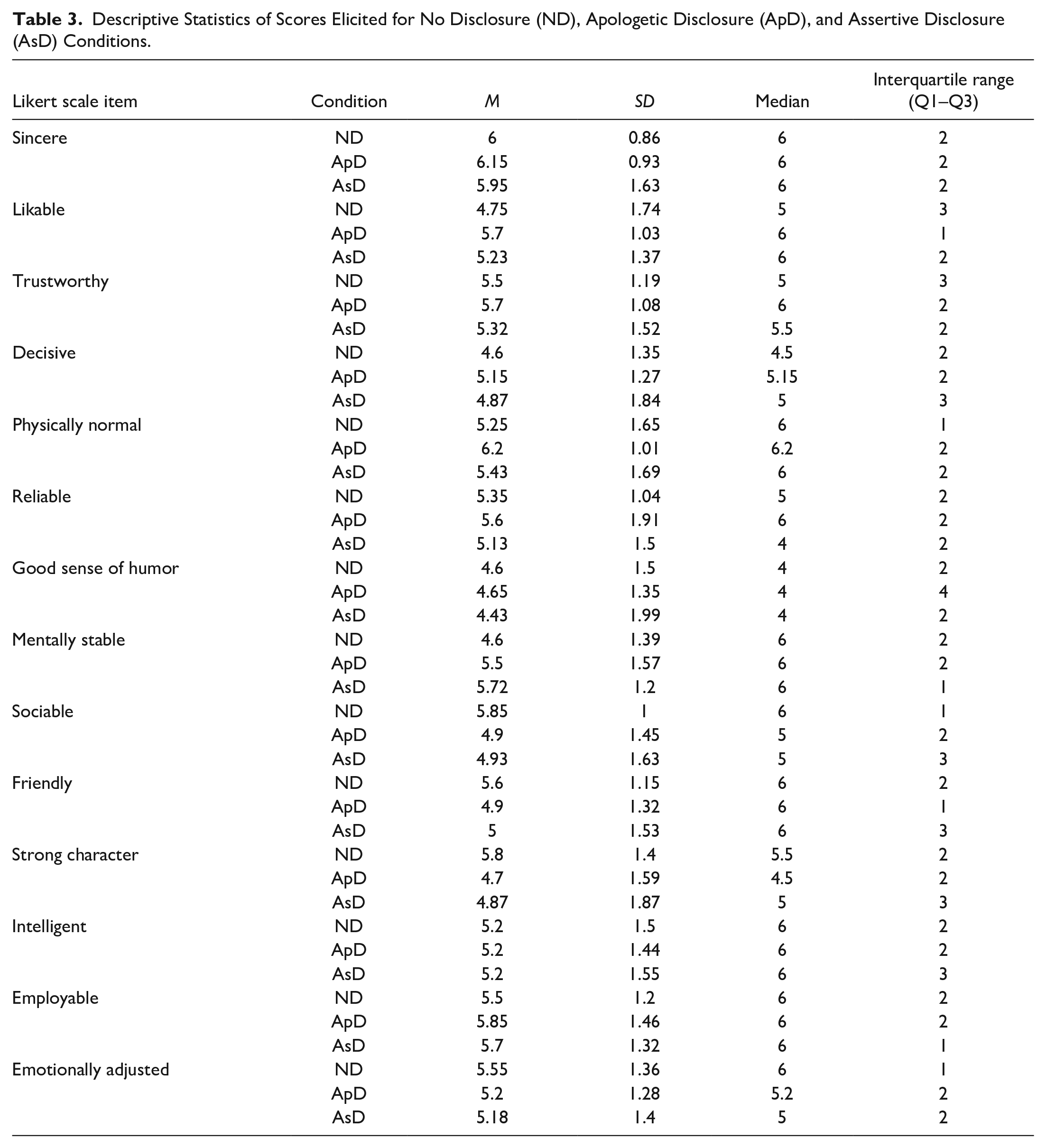
A Mann–Whitney U test across the ND and AsD conditions revealed a significant difference between groups for the attribute “sociable” (Z = 2.66; p = .008). Median values in Table 3 imply that individuals in the ND condition rated the PWS more favorably for the “sociable” item than individuals in the AsD condition.
Differences in Semantic Ratings Between Males and Females
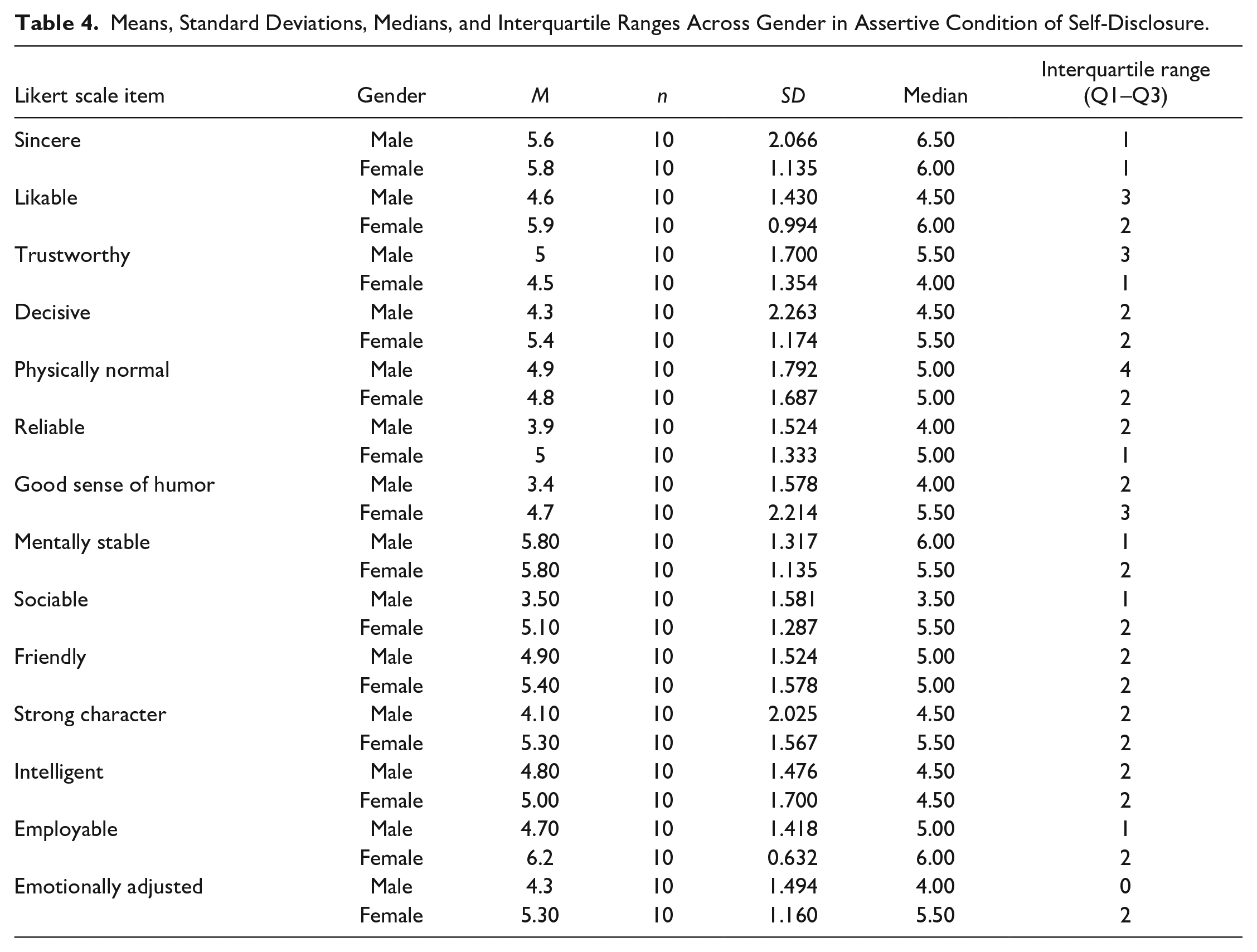
Mann–Whitney U tests were done to compare listener ratings given by males and females in each of the three groups, ND, AsD, and ApD. For the ND and ApD groups, there was no significant difference between the perceptions of male and female listeners. For the AsD group, females rated the PWS as significantly more likable (Z = 2.08; p = .04), sociable (Z = 2.16; p = .03) and employable (Z = 2.52; p = .01). Table 4 displays median and interquartile range values for scores given by male and female listeners in each of the three stimulus conditions to each of the attributes.
Means, Standard Deviations, Medians, and Interquartile Ranges Across Gender in Assertive Condition of Self-Disclosure.
Differences in Semantic Ratings Depending on Education Levels, Occupation, and Exposure to Stuttering
It must be noted that during statistical analysis, the 10th and 12th grade participants were analyzed as one group of “undergraduates” owing to the small sample size in the 10th grade category (n = 2; Table 2); similarly, the only housewife among the participants was included in the “student” category during statistical analysis, the other two occupational categories being “service” and “business” (see Table 2). On the Kruskal–Wallis test, there was no significant difference obtained across perceptions of listeners belonging to different categories of education and occupation in each of the three groups. However, in the ND group, the Mann–Whitney U test revealed a significant difference across close acquaintance with PWS for the attribute “mentally stable” (Z = 2.64; p = .04). Listeners who were well acquainted with a PWS gave better scores (median = 7; interquartile range = 2; M = 6.09; SD = 1.019) for this attribute as compared with those who did not (median = 6; interquartile range = 2; M = 6.09; SD = 1.52).
Discussion
The present study aimed to explore the utility of self-disclosure as a strategy for PWS in India. This was done by randomly assigning listeners from urban areas from the state of Maharashtra, India in the age range of 18 to 30 years to either ND, ApD, or AsD conditions.
Differences in Semantic Ratings Among ND, ApD, and AsD
The results indicated that overall, the AsD condition seemed to elicit poorer listener perceptions as compared with ApD and ND conditions. There was no significant difference between ND and ApD conditions, indicating that apologetic disclosure does not seem to have damaging or detrimental effects on listener perceptions. However, assertive disclosure might have a detrimental effect on listener perceptions, albeit only for a few traits.
Between the statements of self-disclosure, the apologetic statement seemed to elicit more positive listener perceptions than the assertive statement. Disclosure has been established as a strategy for reducing communicative stress in PWS (McGill et al., 2018). The findings of the present study as an adjunct to these findings from literature suggest that apologetic disclosure can be used by PWS without fear of being negatively evaluated by listeners. Persons who stutter might also choose to use assertive disclosure with the knowledge that it might elicit relatively unfavorable listener perceptions along traits of sociability, physical normalcy, and reliability.
Byrd, McGill, et al. (2017) found that listeners preferred apologetic disclosure over ND. However, studies that compared assertive to apologetic disclosure found that assertive disclosure elicited more favorable responses from listeners. Byrd, Croft, et al. (2017) examined the effect of the informative and apologetic conditions on 388 adult listeners and found that listeners preferred disclosing in an informative manner. Using identical methods as Byrd, Croft, et al. (2017), Croft and Byrd (2021) found that assertive self-disclosure was preferred over ApD in Israel. Along similar lines, Mcgill et al. (2018) reported that AWS preferred disclosing in an educational as well as direct or in an assertive manner. The findings of the present study do not agree with the above findings in two ways. Firstly, disclosure did not result in more positive listener perceptions. Secondly, assertive disclosure resulted in more negative listener perceptions of a few traits. The findings, however, do reiterate the findings of both the studies reported from India (Bajaj et al., 2017; Jain et al., 2020) that reported no significant differences in perception across disclosure and ND conditions when the speakers used an apologetic statement.
There were methodical differences in the study by Byrd, Croft, et al. (2017) and others including the present study. Byrd, Croft, et al. (2017) used a conversational sample; while Byrd, McGill, et al. (2017), Healey et al. (2007) and Bajaj et al. (2017) used narration samples. Listeners in the study by Byrd, Croft, et al. (2017) ranged in age from 18 to 90 years; while those in the other three studies were young adults. Comparing the three studies that used a narrative sample and had young adult listeners, then, only the study by Bajaj et al. (2017) did not show a significant effect of disclosure. Given that the findings of the present study are in agreement with Bajaj et al. (2017), the lack of change in listener perceptions seen in the two Indian studies might be attributed to the Indian sociocultural milieu. India has a predominantly collectivistic culture that is more community-oriented and people might therefore tend to be less accepting of differences or deviations from the norm. This could be a possible explanation why disclosure did not result in favorable listener perceptions. It might also be one of the reasons why apologetic disclosure did not worsen listener perceptions, but assertive disclosure did. Specifically, assertive disclosure elicited poorer ratings for sociability, reliability, and physical normalcy. In a culture that values conforming to social norms, talking about a difference in an assertive tone might have resulted in the speaker being perceived as someone who is socially aloof or deviates from the conformist social fabric.
Differences in Semantic Ratings Between Males and Females
In the context of listener perceptions across gender, in particular, literature reports more studies that reveal better female listener responses than males (Burley & Rinaldi, 1986; Byrd, Croft, et al., 2017; Potts, 2013). In line with previous research, the present study found ratings of female listeners to be better, especially toward the speaker who disclosed stuttering assertively. A possible reason for such a finding, according to Potts (2013) could be that the act of disclosure might be viewed by male listeners as sympathy or attention seeking, qualities which may not typically be appreciated in a stereotypical male culture. Females, in contrast, appreciate such qualities in both, males and females and might consider them as signs of vulnerability and sociability. Likeability and sociability were, in fact, two of the traits on which females rated the speaker as higher. Disclosure also appears to increase the chances of PWS being perceived as more employable by females. In addition, it may be noted that higher ratings from females were elicited by the male who disclosed assertively. Assertiveness is known to be another stereotypical male trait. As the present study involved only a male speaker, replicating the study with a female speaker could shed more light on whether this contrast in perception of male and female listeners is specific to the gender of the speaker. Assertive disclosure by a male could, nonetheless, be noted by PWS as a behavior that makes female listeners perceive them more positively on the above traits.
Differences in Semantic Ratings Depending on Education Level and Exposure to Stuttering
There have been studies which demonstrate that having interpersonal contact with the PWS helps in reducing the stuttering stereotype amongst the public (Boyle et al., 2016; Schlagheck et al., 2009). Close contact with PWS is possibly the strongest factor in eradicating negative stereotypes and stigma associated with stuttering amongst the general public (Boyle et al., 2016). The findings of the present study revealed a similar trend. When stuttering was not disclosed by the PWS, those who were not acquainted with a PWS rated the speaker as mentally less stable. These results reiterate the importance of dispensing information about stuttering among the general public.
Looking at all the findings together, speakers who stutter can use apologetic disclosure without any doubts about being perceived negatively by listeners. Although there are chances of listeners perceiving PWS who disclose assertively as less sociable, reliable, or physically normal, listener perceptions of other traits such as trustworthiness, employability, sense of humor, decisiveness, or likeability are unaffected irrespective of the type of disclosure statement. Assertive disclosure is received positively in communication dyads with a male PWS and a female listener. Persons who stutter can use this information to strike a tradeoff between the need to sound assertive rather than apologetic, and the need to be perceived positively along certain traits, and make an informed decision on the type of self-disclosure they would want to use based on the situation and the communicative partner.
Limitations and Suggestions for Future Research
It must be noted that the present study used audio samples unlike most other studies on self-disclosure. This, in the researchers’ opinion, could be considered a strength as well as a limitation. The use of an audio sample ensured that the reactions of listeners were based purely on the presence or absence of disclosure and were not biased because of the appearance of the speaker. However, an audio sample does not give a complete picture of stuttering because the respondent is unable to view the struggle and secondary behaviors that might accompany the moments of stuttering. One of the strengths of the present study was the presence of the researcher (online) despite the COVID-19 pandemic. In addition to reducing the chances of sample attrition (Lau et al., 2019), the presence of the researcher also ensured that the respondents filled the response form immediately after listening to the sample. A limitation of the study was that it included a sample from the urban areas of a single state in India. Replicating the study in other parts of India, as well as in native Indian languages in rural areas could shed more light on the clinical utility of self-disclosure across India. An interesting addition to the present study could have been the inclusion of an open-ended question after every rating on the bipolar adjectival scale to elicit reasons for the ratings given. The response so obtained might give valuable insights into the mental set of listeners in India toward those who stutter. It might go a step further towards helping PWS make well-informed decisions about whether to use self-disclosure and which type of self-disclosure would benefit them the most with different people and in different communicative situations. Another limitation of the present study was that there might have been individual variability in the perception of self-disclosure. However, the nature of the study does not lend itself to a repeated measures design. A larger sample size, could, however, help overcome this limitation in future attempts to study the effect of self-disclosure on listener perceptions of those who stutter.
Conclusion
It can be concluded from the present study that if PWS in Maharashtra, India, wish to use disclosure during communicative situations, apologetic disclosure could be used without any fear of being stereotyped or negatively judged by listeners. One positive outcome of assertive disclosure could be that when disclosing assertively, the PWS was perceived as more “likable,” “sociable,” and “employable” by female listeners. As being acquainted with a PWS resulted in relatively favorable listener perceptions, public education about stuttering is indicated.
Footnotes
Appendix
Semantic Differential Scale.
| Sincere | Insincere |
|---|---|
| Likable | Not likable |
| Trustworthy | Untrustworthy |
| Decisive | Indecisive |
| Physically normal | Physically abnormal |
| Reliable | Unreliable |
| Good sense of humor | Poor sense of humor |
| Mentally stable | Mentally unstable |
| Sociable | Unsociable |
| Friendly | Hostile |
| Strong character | Weak character |
| Intelligent | Unintelligent |
| Employable | Unemployable |
| Emotionally adjusted | Emotionally maladjusted |
Acknowledgements
We would like to acknowledge the staff of BV(DU) SASLP for supporting our study.
Declaration of Conflicting Interests
The author(s) declared no potential conflicts of interest with respect to the research, authorship, and/or publication of this article.
Funding
The author(s) received no financial support for the research, authorship, and/or publication of this article.
