



Abstract
The MYTH (Misinformation-identifying Youth in Tobacco and Health) Youth Collaborative engages adolescents (ages 13–17) as partners in addressing nicotine and tobacco product (NTP) misinformation on social media through a Youth Participatory Action Research (YPAR) approach. Recognizing youth’s unique social media expertise and the growing influence of online NTP marketing, MYTH aims to build critical media literacy skills and empower youth as health advocates. This practice note evaluates participants’ experience in MYTH using a mixed-methods approach, combining surveys and a focus group discussion (FGD). Surveys assessed experiences, challenges, and suggestions, analyzed descriptively; the FGD explored in-depth perspectives thematically. Lessons learned highlight the power of participatory learning to shift youth perceptions on NTP misinformation, the importance of an inclusive program environment and consistent logistics for engagement, and opportunities to integrate broader youth development. In conclusion, YPAR initiatives like MYTH offer a promising strategy to empower youth in countering health misinformation and shaping youth-centered public health interventions.
Keywords
In 2024, 2.25 million youth reported current tobacco use, with e-cigarettes as the most common product; 26.3% of users reported daily use (U.S. Food and Drug Administration [FDA], 2025). Online nicotine and tobacco product (NTP)-related content influences youth perceptions of nicotine risks, potentially encouraging use (Sidani et al., 2022) and frequent exposure to tobacco-related content on social media may contribute to susceptibility to these products among youth (Lim et al., 2024; Vassey et al., 2022). Given the strong influence of social media on youth tobacco use behaviors, supporting youth in critically evaluating and countering online NTP-related misinformation is essential for reducing initiation.
Youth participatory action research (YPAR) actively engages youth, allowing them to collaborate on structured research projects with guidance from adult mentors (Huerta et al., 2024). By equipping youth with the tools to analyze and counteract misleading content, YPAR can play a pivotal role in fostering digital health literacy and promoting informed decision-making about NTPs. However, to our knowledge, YPAR initiatives that focus on addressing NTP-related misinformation are limited. This practice note describes an evaluation on participants’ experience in the MYTH (Misinformation-identifying Youth in Tobacco and Health) Youth Collaborative by employing a mixed-methods approach using surveys and a focus group discussion (FGD).
Program Contextualization
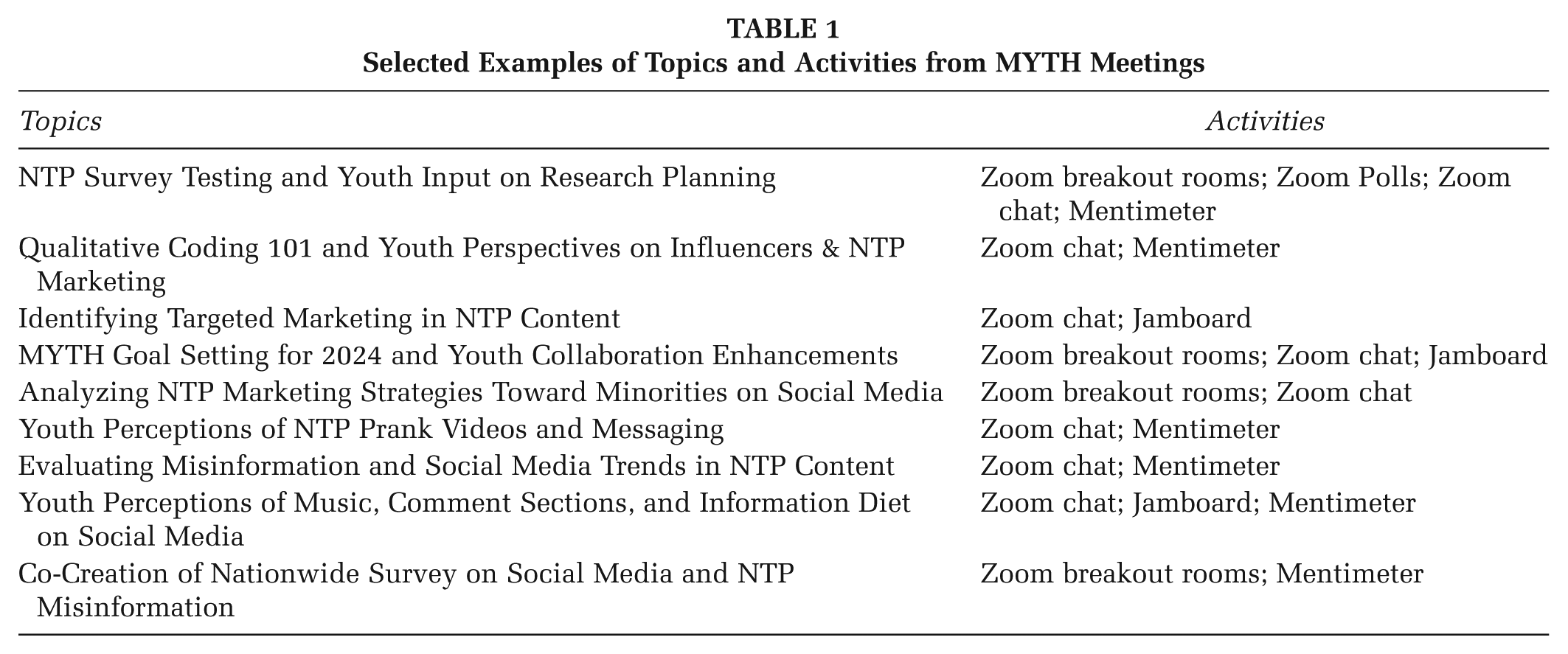
MYTH, a YPAR initiative of a 5-year research study, was developed to address NTP misinformation on youth-oriented social media platforms. Initiated in July 2023, MYTH now includes 13 active participants ages 13 to 17 who meet with study team members monthly via Zoom for 1-hour sessions. MYTH members share their perspectives on NTP and social media trends and terminology and co-create study materials, including codebooks for analyzing social media content, surveys to be distributed to other youth, and health communication messages to counteract misinformation. Examples of meeting topics and activities are described in Table 1.
Selected Examples of Topics and Activities from MYTH Meetings
Evaluation
The evaluation was conducted in July 2024. Most (n = 9; 69.2%) MYTH members completed an anonymous survey via Qualtrics. Survey items asked about members’ experiences, challenges, and suggestions for improvement. Most identified as Black or African American (55.6%) and female (55.6%), with the remainder identifying as White (44.4%) and male (44.4%). The majority (88.9%) reported being straight/heterosexual. Three individuals participated in an hour-long focus group via Zoom. The full list of survey items is provided in the supplemental material. This study was reviewed by the University of Pittsburgh Human Research Protection Office and determined as an activity not under the jurisdiction of the institutional review board (IRB) due to being a program evaluation.
Lessons Learned
The Power of Participatory Learning on Addressing NTP-Related Misinformation
A strength of MYTH is its participatory and interactive learning. Most participants (88.9%) reported MYTH activities highly useful, particularly participatory activities about addressing NTP-related misinformation and media portrayals of NTPs. One participant shared, “They showed us videos in MYTH meetings, and we then learned knowledge relating to tobacco and drug use and how it affects us or how it affects how we view them (NTPs) later in life.” Another noted, “We watched short videos, like Instagram Reels, TikToks, or YouTube clips, and then talked about what we saw—how the videos made people feel or whether they might influence someone to try or avoid NTPs.” The content covered messages that portrayed NTP use as youth-appealing and minimized or misrepresented the potential harm of using NTPs. This hands-on approach may be more impactful to promote health education than passive information delivery.
Changes in Perspectives on NTPs and Addressing NTP-Related Misinformation
Discussions on nicotine risks and social media misinformation resonated with participants’ real-world experiences. Participants emphasized their increased awareness of marketing tactics: “It made me more aware of how tobacco products are subtly promoted on social media.” Cultivating media literacy empowers participants to critically evaluate information independently, turning them into agents who can influence peers. One participant mentioned, “It’s a good study for teens and how they view smoking and those things (NTPs) on social media—how it influences them and how they can influence their peers.” This emphasizes that relating information directly to youth’s lives makes learning more meaningful.
Experiences Participating in MYTH and Opportunities for Improvement
All nine participants (100%) felt their voices were heard and valued. They appreciated the inclusive environment, with one noting, “I always felt like my voice mattered and that I could share without fear of judgment.” Increasing meeting frequency and consistency were provided as constructive feedback for improving the program. One participant shared, “Sometimes it’s easy to forget about the meetings because the dates aren’t consistent.” Another suggested, “Maybe doing a couple of meetings per month would be more beneficial.”
While the survey didn’t include questions about professional development, participants organically expressed interest in incorporating activities to better prepare for their futures. One suggested, “I also think the youth collaborative could have (college) student guest speakers sharing their college life and career goals. I always thought that could be very interesting and beneficial.” As a core component of YPAR, such mentorship equips participants with the necessary skills and confidence to engage more effectively in the research process.
Implications for Practice
This evaluation highlights how MYTH supports youth in developing critical media literacy skills and identifies opportunities to expand its impact. One promising direction is building in structured mentorship opportunities within MYTH. Peer-to-peer mentorship, where returning MYTH members support newer participants, can reinforce leadership skills and cultivate a greater sense of belonging among new members. In addition, incorporating senior mentors, such as college students, can further enhance youth development by offering additional guidance. Pairing MYTH participants with college mentors can create space for aspirational conversations about academic pathways and research engagement. These mentorship opportunities can strengthen community bonds and make the college experience more transparent, increasing intent to achieve higher education and pursuing research aligned with their interests. Together, these layered mentorship structures can amplify MYTH’s long-term impact by fostering both personal growth and academic ambition. Future studies should build on this evaluation to explore youth reactions to NTP misinformation on social media.
Supplemental Material
sj-docx-1-hpp-10.1177_15248399251415427 – Supplemental material for An Evaluation of a Youth Collaborative Approach to Addressing Nicotine and Tobacco Misinformation on Social Media
Supplemental material, sj-docx-1-hpp-10.1177_15248399251415427 for An Evaluation of a Youth Collaborative Approach to Addressing Nicotine and Tobacco Misinformation on Social Media by Julia (Pengyue) Dou, Jaime E. Sidani, Christine Larkin, Melina B. Martin and Maya I. Ragavan in Health Promotion Practice
Footnotes
Author’s Note:
The authors declared no potential conflicts of interest with respect to the research, authorship, and/or publication of this article. The authors disclosed receipt of the following financial support for the research, authorship, and/or publication of this article: This study was supported by the National Institutes of Health under Award Number R01MD018543 (Principal Investigator: Dr. Jaime E. Sidani).

References
Supplementary Material
Please find the following supplemental material available below.
For Open Access articles published under a Creative Commons License, all supplemental material carries the same license as the article it is associated with.
For non-Open Access articles published, all supplemental material carries a non-exclusive license, and permission requests for re-use of supplemental material or any part of supplemental material shall be sent directly to the copyright owner as specified in the copyright notice associated with the article.
