



Abstract
The use of Photovoice methods to identify and address public health challenges has evolved since this participatory action research method’s inception in the 1990s. However, there is a notable lack of research on the dissemination of Photovoice findings to promote community action and change. This study evaluates audience and Photovoice participants’ experiences of dissemination events presenting the results of 21 Photovoice projects that supplemented the HEALing Communities Study (HCS), a multistate community-based study of strategies to reduce opioid overdose deaths. The Photovoice projects captured the perspectives of people with lived experience of substance use disorder and front-line providers regarding their communities’ responses to the opioid epidemic. This article describes the multiple artifact types and dissemination formats co-created by HEALing Communities Study researchers and Photovoice project participants to share photographs, captions, and insights. In addition, the study reports the evaluation results from attendees of more than 24 local, state, and national events that exhibited and presented on the Photovoice projects. These evaluations assessed whether attendees’ experiences at the events influenced their critical consciousness of and intention to act to address their communities’ concerns with substance use disorder. Respondents encouraged continued efforts to educate community members, especially policymakers, from the perspective of those most impacted by substance use disorder. Findings from the study suggest Photovoice dissemination events may encourage attendees to engage more deeply in public health topics such as the opioid addiction crisis, which supports the critical consciousness model for assessing community health change initiatives.
Keywords
Background
Photovoice is a participatory action research method with the goals of (1) capturing community health assets and challenges, (2) promoting critical consciousness of the causes of problems, and (3) encouraging action and policy change (Wang & Burris, 1997). Researchers and practitioners have applied Photovoice methods to various health issues, although projects often have strayed from the participatory action research imperative of including participants in all research steps (Evans-Agnew & Rosemberg, 2016; Seitz & Orsini, 2022). Participatory analysis is an essential Photovoice element to facilitate identification of the key themes and priorities needed to guide dissemination activities (Liebenberg, 2022; Seitz & Orsini, 2022).
In addition, Photovoice participants as part of their project involvement should ideally co-design dissemination activities to share their photographs and findings with others, especially policymakers (Golden, 2020; Seitz & Orsini, 2022; Strack et al., 2022). Gallery-style displays of photography with captions are a traditional Photovoice dissemination method (Switzer, 2019). With digital technology, participants have almost infinite options for being involved in strategically defining target audiences they want to reach with Photovoice and developing multimedia dissemination tools, including but not limited to websites, digital stories, and social media (Teti & Myroniuk, 2022). Yet, evaluations of whether and how Photovoice projects achieve their goal of promoting action and policy change through exhibiting events that engage and influence intended audiences and decision-makers are lacking (Liebenberg, 2018, 2022; Mitchell, 2015; Seitz & Orsini, 2022). Fortunately, measurement tools are now available to empirically validate Carlson and colleagues’ critical consciousness framework for understanding how experiences with Photovoice move audiences from passive adaptation to their communities’ conditions to emotional and cognitive engagement with these issues, leading to change-making action (Carlson et al., 2006; Orsini et al., 2022).
In this study, we aim to evaluate how attendees engaged with Photovoice events and experienced multimedia dissemination strategies in terms of their alignment with the critical consciousness framework as well as the three original Photovoice goals. As part of the supplemental Photovoice protocol for the HEALing Communities Study (HCS), a randomized controlled trial designed to address the opioid epidemic (Balvanz et al., 2024), researchers convened Photovoice projects with participants including people with lived experience of substance use disorder (SUD) and front-line providers, facilitated photography and group discussion about the impact of the opioid epidemic on their communities, and worked with participants to co-design dissemination activities. This study describes the artifacts co-created by Photovoice participants and researchers for dissemination events and the evaluation of event attendees’ engagement with the multimedia Photovoice dissemination strategies. We present findings from analysis of survey data to assess how attendees’ experiences with Photovoice influenced their critical consciousness of concerns related to opioid overdose and recovery.
Method
Study Context and Participants
The HCS engaged 67 communities across four research sites, Kentucky (KY), Massachusetts (MA), New York (NY), and Ohio (OH), in the Communities That HEAL intervention from January 2020 to June 2023. The details of the HCS, including final outcomes, are reported elsewhere (The HEALing Communities Study Consortium, 2024). The intervention entailed multisectoral coalitions in each community selecting and measuring the impact of evidence-based practice strategies aimed at reducing opioid overdose deaths in selected communities. A state-level community advisory board comprising representatives from each HCS community coalition and staff from state agencies supported the research process (Sprague Martinez et al., 2020). In addition, a cross-site Intervention Working Group, including coalition members, researchers, local and state policymakers, and national-level advisors (National Institute on Drug Abuse/Substance Abuse and Mental Health Services Administration), provided study oversight.
In December 2021, three HCS researchers in KY, MA, and OH with Photovoice or qualitative research experience proposed the addition of an optional supplement using Photovoice to reach people with lived experience of SUD and front-line providers to obtain their perspectives on local barriers to and facilitators of addressing the opioid epidemic. The NY site declined to participate. Participating sites developed a shared protocol that allowed flexibility in completing Photovoice projects based on local contexts and intervention priorities while also supporting cross-site analysis to understand cross-cutting themes.
From January 2022 to December 2023, the HCS Photovoice research team—HCS researchers and HCS staff trained as facilitators—approached interested HCS-associated community coalitions and recovery centers to recruit participants based on similarities in roles and experiences. Project groups included Photovoice participants who were either primarily people with lived experience of SUD or front-line providers, although some (e.g., peer support specialists) identified with both roles (McGladrey et al., 2025). Each Photovoice project involved multiple sessions guided by a HCS facilitator to produce photography and captions, group photo discussion transcripts, and thematic analysis. Each project concluded with sharing analysis results and planning for dissemination events. This final session also involved participants’ consideration of which photographs best captured themes from photograph discussions and what captions should accompany selected photographs. The complete common HCS Photovoice protocol has been detailed elsewhere (Balvanz et al., 2024). The study was approved by Advarra Inc., the HCS single Institutional Review Board (Pro00038088).
Dissemination Materials and Events
During the final session, facilitators encouraged participants to present their project results to the community’s HCS coalition and the HCS state-level Community Advisory Board. The projects brainstormed other dissemination activities to share results using the protocol’s dissemination toolkit, including various artifact templates such as Microsoft PowerPoint presentation slides, printed posters for gallery displays, and postcards to distribute (Balvanz et al., 2024). In addition, facilitators helped projects creatively tailor templates or co-create artifacts based on their dissemination goals. A dissemination event refers to any activity, presentation, or gallery exhibit where the HCS Photovoice research team and/or Photovoice participants shared project(s) results with an audience. Audience is defined as those in attendance at events who had not contributed to the HCS Photovoice projects.
Dissemination Event Evaluations and Analysis
The HCS Photovoice research team designed an evaluation instrument for dissemination events (Supplement 1). The evaluation included multiple-choice and open-ended questions and prompts to capture demographic information (age, gender, race/ethnicity, education, role in the community, or connection to the opioid epidemic). Three prompts representing the foundational goals of Photovoice presented statements with Likert-type-scale responses from “strongly agree” to “strongly disagree.” This evaluation tool was designed to assess Photovoice method fidelity; data collection took place before the four-factor critical consciousness scale was published (Balvanz et al., 2024; Orsini et al., 2022). Additional questions qualitatively captured respondents’ experiences of events. Each site administered the anonymous evaluation as a paper survey or digitally (Qualtrics.com) during or immediately following dissemination events to audience members and Photovoice participant attendees. Each site compiled anonymized results before combining data across sites for analysis.
The HCS Photovoice research team conducted descriptive analysis of the data in Microsoft Excel and collapsed the Likert-type-scale responses into three categories: “agree” (from responses “somewhat agree,” “agree,” and “strongly agree”), “neither agree nor disagree,” and “disagree” (from responses “somewhat disagree,” “disagree,” and “strongly disagree”). The first author, with coauthors’ review, deductively coded the open-ended responses using the conceptual definitions from the four-factor critical consciousness scale for passive adaptation, emotional engagement, cognitive awareness, and intention to act (Orsini et al., 2022). For analysis of two-word responses describing attendees’ experiences, the research team used NVivo14 to capture the frequency of words to create a word cloud.
Results
There were 21 HCS Photovoice projects ranging from four to eight participants per group. Results include descriptions of the co-designed dissemination events, artifacts used, and analysis of evaluation data.
Dissemination Events Descriptions
From May 2022 to February 2024, the HCS Photovoice research team, often along with self-selected Photovoice participants, presented and exhibited projects at more than 24 in-person and virtual formal dissemination events that varied in format across communities (Table 1). Some events included presentations that ranged from 5-minute PowerPoint presentations of project topics, photographs, and captions during local HCS community coalition meetings to an hour-long interactive presentation of the Photovoice process and results. Some events involved more typical gallery exhibits where Photovoice participants presented their captioned photographs as posters. In others, such as the community art show, project participants exhibited the Photovoice project’s artifacts at tables or on stage.
Information on Photovoice dissemination events.
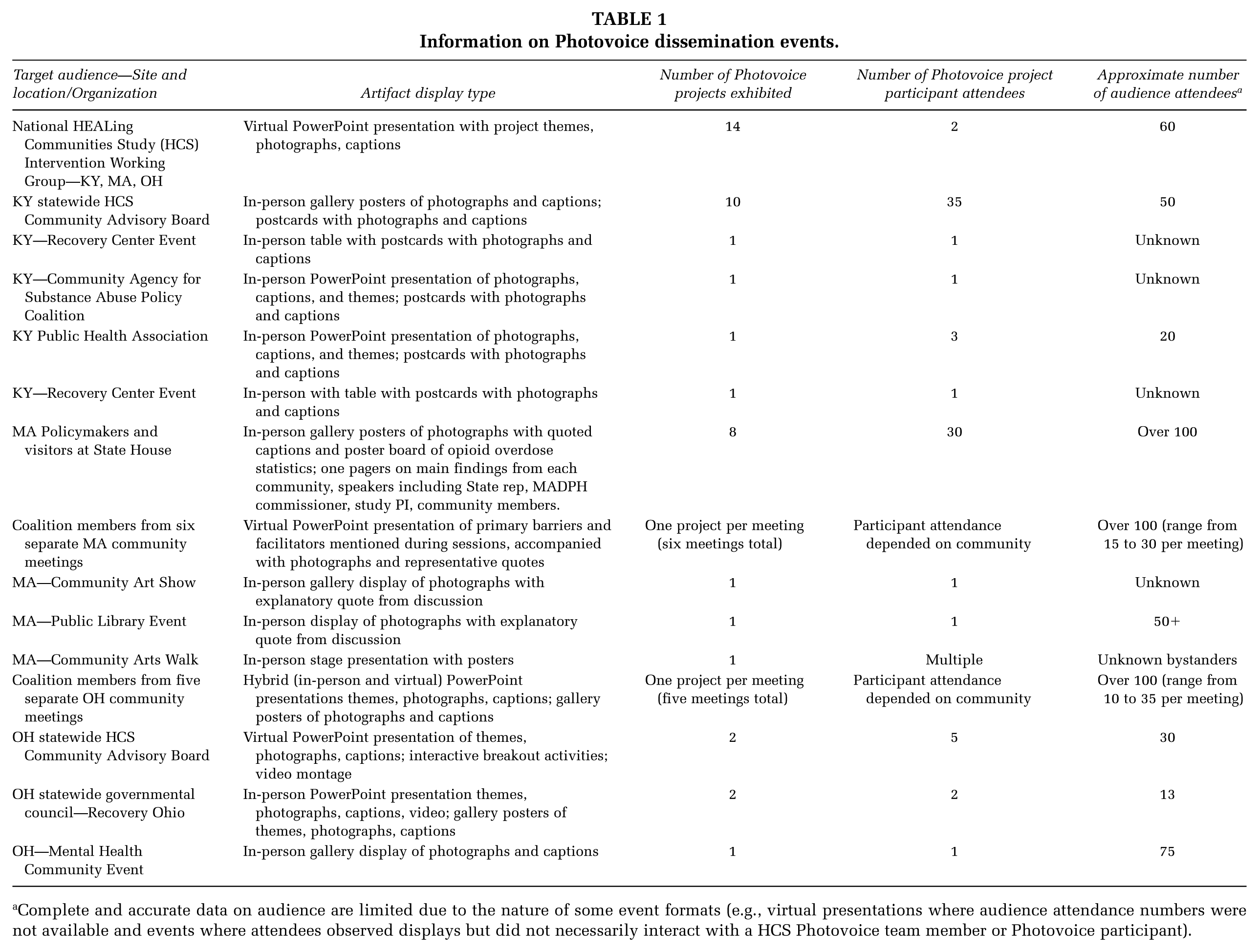
Complete and accurate data on audience are limited due to the nature of some event formats (e.g., virtual presentations where audience attendance numbers were not available and events where attendees observed displays but did not necessarily interact with a HCS Photovoice team member or Photovoice participant).
We conducted initial dissemination events virtually due to the COVID-19 pandemic, although later presentations were hybrid or in-person. Most events were locally focused, where a single community-based Photovoice project shared results within their community or with their community’s HCS-affiliated coalition. Each site’s HCS Photovoice research team and some project participants presented results from multiple projects with broader, statewide audiences, such as the site’s Community Advisory Board. In addition, the research team and self-selected project participants presented early cross-site results to the HCS Intervention Working Group spanning all four HCS sites. In Table 1, we report the target audience, description of artifacts displayed, number of projects, number of project participant attendees, and approximate number of audience members at each formal event. We estimate more than 500 people attended HCS Photovoice dissemination events.
Dissemination Event Artifacts
Each dissemination event entailed at least one co-designed artifact type (Figure 1). All artifacts featured a combination of project photographs with associated captions and representation of broader themes or quotes transcribed from photograph discussions. Project participants and facilitators co-created artifacts as stand-alone, unattended gallery displays or to accompany informal or formal oral presentations and exhibits where the HCS research team and project participants interacted with the audience alongside the photographs.
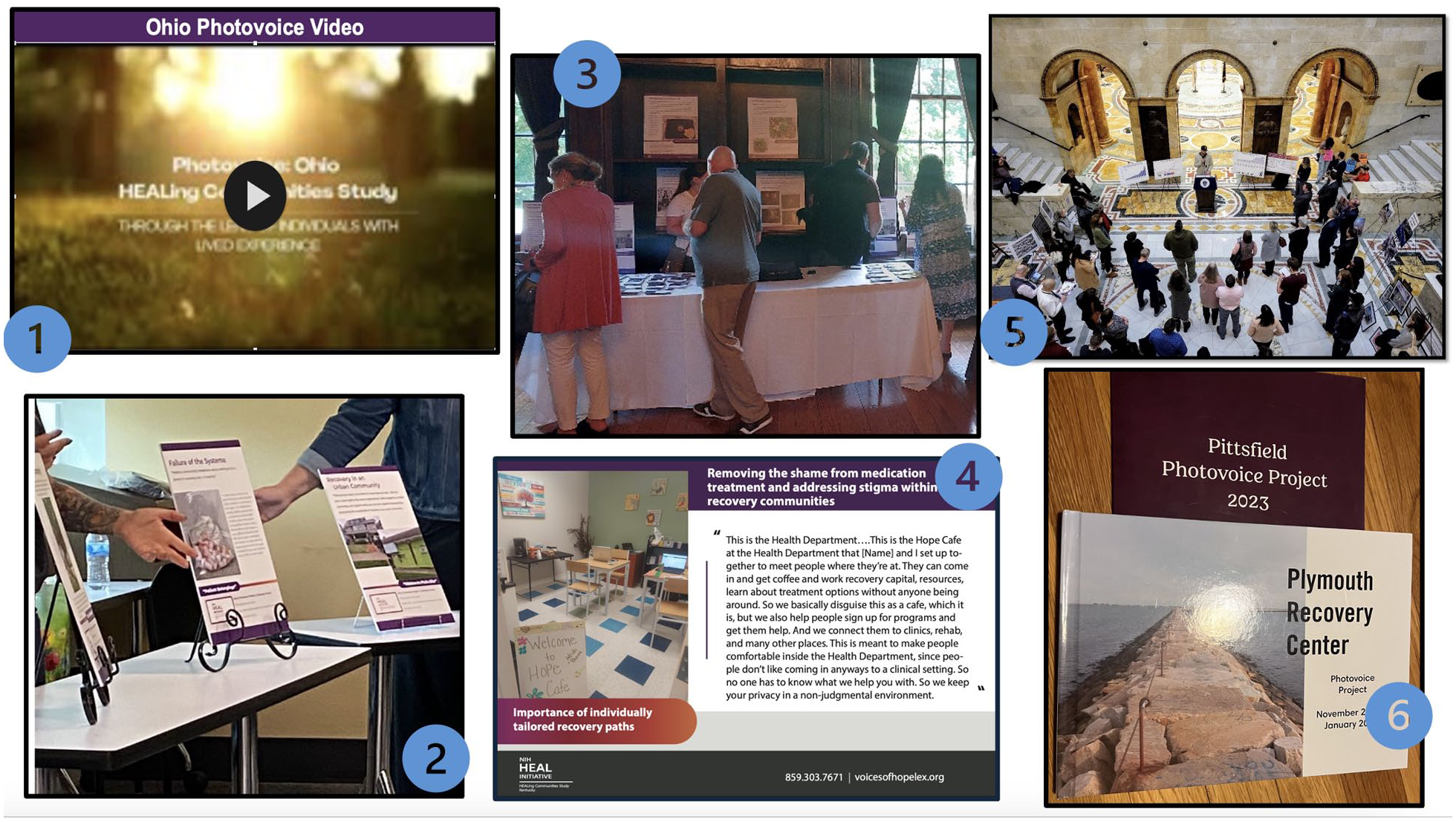
Photovoice Project Artifacts and Dissemination Events
All three sites produced printed photographs with captions as gallery posters. In addition, each site used PowerPoint slides for presentation of results, photographs, and captions with virtual and in-person audiences. The KY Photovoice projects designed printed postcards to distribute at the statewide dissemination event and later circulated the postcards at local events. In MA, the Photovoice projects created a handout with general Photovoice information and findings, and each project designed a one-page brief describing their results and suggested action items. At the MA statewide dissemination event, audience members, including lawmakers, received these briefs. Individual MA projects displayed posters at community recovery centers, and five projects created books, with one distributing their book to more than 200 community members. The OH HCS Photovoice research team created videos of projects’ co-created themes, photographs, and captions. Videos were available on YouTube (youtube.com) for viewing during meetings or for distribution to those unable to attend.
Evaluation Results
From the 24 formal Photovoice dissemination events, 99 attendees, including project participants and audience members, responded to the evaluation by answering at least one question (Table 2). There were 78 attendees who reported their demographic information, most of whom were white (88.5%), women (70.5%), and had professional occupations (80.8%). Nearly 20% of respondents had at least one family member or friend who experienced SUD, and 16.7% of respondents self-identified as a person with lived experiences of SUD. More than half of the respondents were members of HCS-affiliated community coalitions. When answering questions about whether their experience at the dissemination event aligned with the original three goals of Photovoice, nearly 86% of respondents agreed that the Photovoice projects helped them understand the community’s concerns and strengths related to the opioid epidemic, and more than 91% agreed that the project made them think more critically about the opioid epidemic. Almost 90% of respondents agreed that the Photovoice projects increased their intention to act (Table 3). The most common words reported by the 86 respondents who shared at least one word describing their experience were “powerful,” “inspiring,” “impactful,” and “eye-opening” (Figure 2).
Characteristics of attendees of Photovoice dissemination event who completed evaluation (N = 78) a .
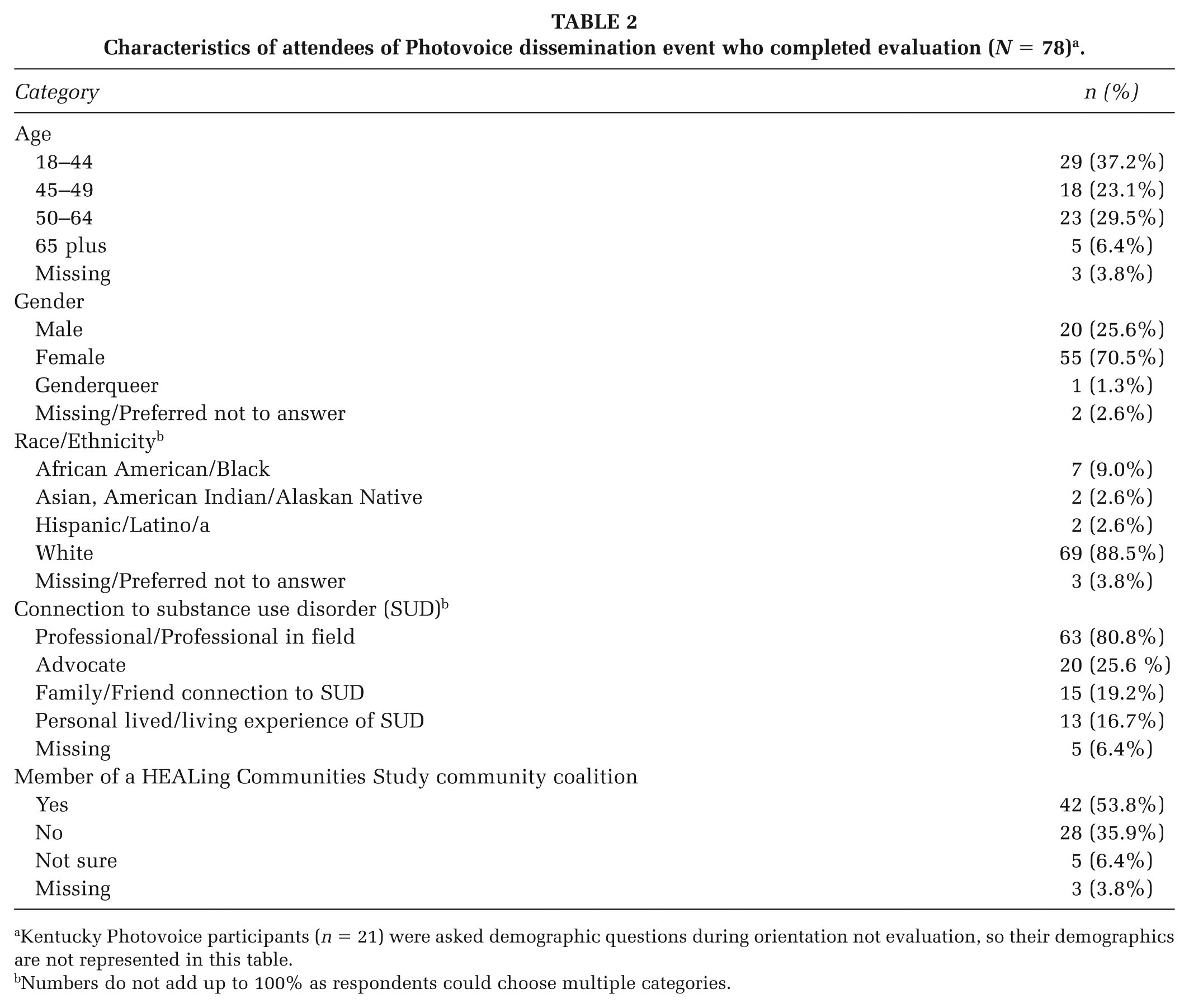
Kentucky Photovoice participants (n = 21) were asked demographic questions during orientation not evaluation, so their demographics are not represented in this table.
Numbers do not add up to 100% as respondents could choose multiple categories.
Responses to statements by Photovoice dissemination event attendees (Photovoice participants and audience) (N = 99).
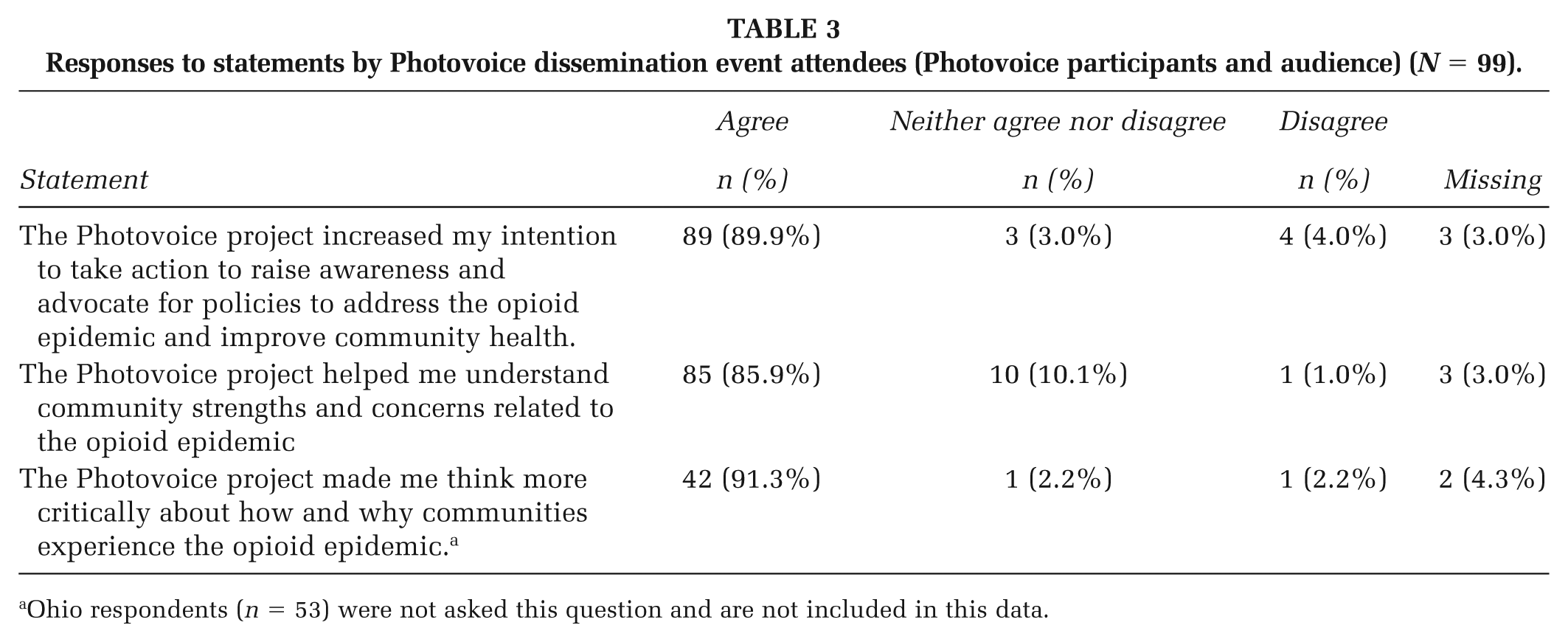
Ohio respondents (n = 53) were not asked this question and are not included in this data.
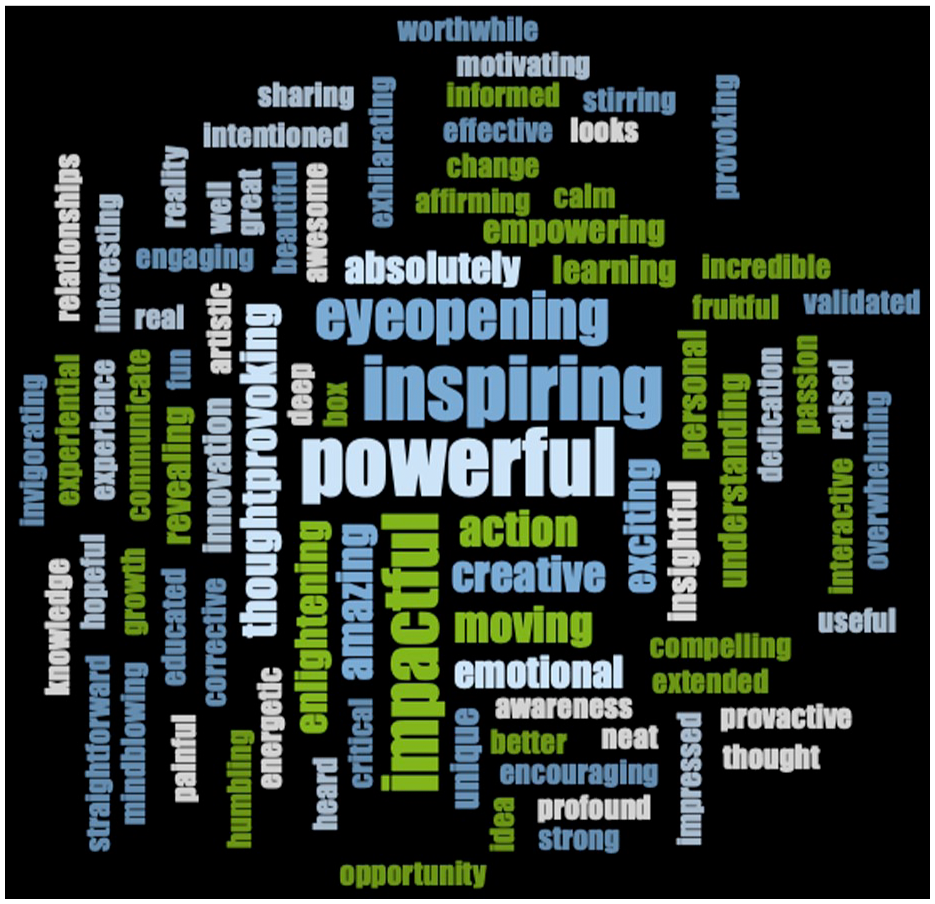
Word Cloud Visualization of Frequency of Words Reported by Photovoice Event Attendees Created in NVivo 14 (Lumivero.com)
Consistent with an evaluation of Photovoice project dissemination using the validated critical consciousness scale (Li et al., 2025), the 82 open-ended responses about the biggest takeaway from the events did not indicate passive adaptation among audience members, likely because attendees self-selected to participate in these events focused on community health. However, the other three domains of the critical consciousness framework—emotional engagement, cognitive awareness, and intention to act—were evident in attendees’ responses to the experience.
Emotional Engagement
Many attendees reported feeling emotionally moved by events. Some attendees focused on the “creativity,” “artistic” aspects, and “[p]assion of participants.” One respondent questioned, “A picture is worth 1,000 words?” and another that the event “[g]ives a voice that sometimes outweighs statistics.” Other responses focused on the emotions from seeing drug misuse and recovery from participants’ perspectives. For example, one respondent explained that “you could feel . . . all the emotions in the photos, and it really helps you to see a slice of their life through their eyes. helps to bring compassion and awarness [sic]. which I think and hope was the goal.” For some, the main emotion was captured in the word “hope.”
Cognitive Awareness
The responses from some attendees moved beyond emotional engagement to intellectual understanding of root causes of SUD that the Photovoice projects exposed, including the “complexity” of the problem at the community-level. A respondent shared, “Different communities are affected by the same thing, but in different ways.” Furthermore, respondents emphasized the systemic causes of the epidemic, as one noted, “The system is flawed in all aspects” and another recognized the “many ‘angles’ there are to the opioid epidemic and its impact/responses.” Some respondents understood that the complexity of SUD requires multilevel responses: “The interconnectedness of all parts of life—investment in communities, opportunities to enjoy life (through family, play, or work), and pathways toward regaining health—are all needed to combat addiction, of any substance.”
Intention to Act
Event experiences for some participants sparked desire for additional Photovoice dissemination, calls for community action, and individual intentions to act. Some of the respondents put the onus for action on the HCS to conduct additional Photovoice projects and events. For example, one respondent wrote, “Very impactful, how else can this be shared? Important to get this in front of others.” Some respondents wanted more dissemination to decision-makers, as in this comment: “Policy makers [sic] need to see this.” For others, they made a collective call to action, such as, “We must reduce stigma.” Finally, for some, they reported their own motivation to act, as this respondent shared: “That someone must step up and do something. It might as well be me, the/a person who lived the lifestyle.”
When asked what they might do because of attending the event, not all respondents had a concrete answer. Those that did said that they planned to share their experience with family, friends, or others within their organizations. A few respondents described specific actions, with one reporting, “I’m going to emphasize dental care in the MAT [medication for addiction treatment] center we just opened!”
Following the Photovoice dissemination events, we received anecdotal evidence that some policy and programmatic changes occurred. Transportation issues highlighted in one Photovoice project informed purchase of a vehicle driven by a recovery coach for appointments and gas cards for people during the reentry process. Dental issues displayed from another project led to the provision of toothbrushes to people on buprenorphine while incarcerated. Finally, a Photovoice participant leveraged a project’s photographs and quotes emphasizing a community’s dilapidated public basketball court to fund recreational infrastructure improvements.
Discussion
This study describes and evaluates dissemination events co-designed by project participants and researchers sharing artifacts from HCS Photovoice projects. The artifacts and dissemination event formats varied based on local contexts and project participants’ priorities. Results from dissemination event evaluations indicated that the Photovoice projects reached attendees working with and/or having prior personal experience of the opioid epidemic. Furthermore, responses suggested that attendees found dissemination efforts effective in increasing understanding and emotional engagement with SUD stigmatization by experiencing the viewpoints of those most impacted by it. This is similar to other studies that found social-contact-based education effective in reducing prejudice and stigma (Livingston et al., 2012). Findings qualitatively validate the interconnection of emotional engagement and cognitive awareness in inspiring intention to act in the critical consciousness framework (Orsini et al., 2022).
From the project’s inception, the HCS Photovoice research team aimed to fully realize the Photovoice goals of engaging participants in policy or practice change as Wang and Burris (1997) envisioned. Following recommendations for arranging dissemination strategies early in the process (Wang et al., 2000), the research team leveraged built-in connections to community and decision-makers through the HCS community coalitions, statewide Community Advisory Boards, and national policymakers, which may have limited full participant-guided dissemination decisions (Creighton et al., 2018; Smith et al., 2024; Sutton-Brown, 2014). However, participants determine how, where, to whom, and what to highlight in dissemination events. This participant-guided approach was a response to criticism that Photovoice projects often fail to achieve this level of participation beyond data collection (Evans-Agnew & Rosemberg, 2016; Golden, 2020) while being mindful of the ways Photovoice participation and disclosure may trigger vulnerability for people with lived experience of SUD (Smith et al., 2024; Teti & Myroniuk, 2022). As such, we attempted to balance encouraging dissemination within HCS, facilitating project participants’ creativity around virtual and more long-lasting dissemination ideas, and supporting the autonomy of participants to determine their involvement in every step of the Photovoice process, including options not to use their photographs or participate in dissemination events (Creighton et al., 2018; Smith et al., 2022).
This study also responded to critiques of the lack of participant engagement in dissemination (Gabrielsson et al., 2022) with the researcher–participant co-design of various artifacts and types of dissemination events. Although some have discussed the use and potential limitations of virtual platforms to collect Photovoice data (Breny & McMorrow, 2022; Call-Cummings & Hauber-Özer, 2021), little is known about the effects of virtual Photovoice dissemination events. Photovoice project participants attended virtual meetings where multimedia videos and PowerPoint slides enabled them to communicate results to a broader audience, such as during the national-level HCS meeting. In addition, the distribution and circulation of postcards, flyers, videos, and books allowed Photovoice participants to keep and share project artifacts with others beyond event audiences, increasing the likelihood of further dissemination (Mitchell, 2015).
Limitations
Our study attempted to use Photovoice projects to initiate policy and practice change and evaluate the impact of these projects on exhibit audiences (Liebenberg, 2018; Lofton & Grant, 2021; Mitchell, 2015; Seitz & Orsini, 2022). However, our evaluation was limited because Orsini and colleague’s (2022) four-factor critical consciousness scale was published after our data collection began so it could only inform qualitative coding definitions. In addition, despite anecdotal evidence of policy changes made because of event attendance, any actions inspired by the Photovoice experience happened after the evaluation; therefore, a linear dose–response relationship between Photovoice “exposures” and policy changes cannot be assumed. Further in-depth interviews or longitudinal study of decision-maker motivations and behavior is needed to understand how intentions to act inspired by experiences with constituents such as during Photovoice events translate into actual policy and programming proposals considering the complex political determinants of health that influence policymaking (Dawes et al., 2022).
We were unable to collect information on all dissemination activities that may have occurred, particularly informal sharing. In addition, we are unable to report evaluation response rates because of missing data on accurate attendance and lack of survey distribution at some events, so the results may be affected by selection bias. Unfortunately, because evaluations were anonymous, we are unable to identify which events the 99 respondents attended. Respondents who reported demographics were mainly homogeneous; thus, the sample does not represent the diversity of the communities where dissemination events took place. The timing of dissemination events and budgets for compensation for attending events did not allow every Photovoice project participant to attend events, particularly those who had child care or work responsibilities during daytime events that involved decision-makers. These constraints also limited the involvement of Photovoice participants in analysis of the data for the study.
Implications for Practice
Disseminating information to audiences who can act on it remains a major barrier in public health research attributed to inappropriate dissemination approaches (Brownson et al., 2018). The results of our study suggest that effective dissemination is possible with a participatory multimedia approach to engaging communities and decision-makers. However, the time, design expertise, and travel expenses for participants and practitioners to co-develop and co-deliver strategies to disseminate their Photovoice results to audiences, especially influential decision-makers, may be an additional burden for many Photovoice projects. For larger, well-resourced projects, we suggest the inclusion of health promotion specialists to support Photovoice dissemination. We imagine these dissemination support specialists with expertise in graphic design, health education, strategic communication, and campaign evaluation could function as the champions needed to proactively diffuse innovative Photovoice ideas and priorities to relevant decision-makers at local, state, and national levels (Rogers et al., 2009).
Conclusion
This study demonstrates how HCS Photovoice dissemination events co-designed by researchers and participants inspired community members and decision-makers to understand and address the root causes the opioid epidemic. Our findings suggest Photovoice events and artifacts, as health promotion tools, can evoke measurable changes in audiences’ critical consciousness and intentions to act to improve stigmatized issues like SUD. In future projects, researchers and their funders should consider including dissemination event evaluations to continue building the evidence for how Photovoice promotes consciousness-raising among audiences as the basis for policy and program change.
Supplemental Material
sj-docx-1-hpp-10.1177_15248399251411295 – Supplemental material for “Policymakers Need to See This!”: Dissemination and Evaluation of a Multisite Photovoice Project on the Opioid Epidemic
Supplemental material, sj-docx-1-hpp-10.1177_15248399251411295 for “Policymakers Need to See This!”: Dissemination and Evaluation of a Multisite Photovoice Project on the Opioid Epidemic by Ramona G. Olvera, Peter Balvanz, Owusua Yamoah, Kesla Klingler, Marisa D. Booty, Sylvia A. Ellison, Amy Farmer, Amy K. Kuntz, Hilary L. Surratt, Carrie B. Oser and Margaret L. McGladrey in Health Promotion Practice
Footnotes
Authors’ Note:
The authors are grateful for the National Institute on Drug Abuse and the HEALing Communities Study Steering Committee and the Massachusetts, Kentucky, and Ohio community advisory committees (CABs) for considering and approving the use of Photovoice in the HCS. We would like to acknowledge the contributions of the HCS community coalitions, Photovoice participants, and attendees at our Photovoice events whose involvement made this project possible. In addition, we want to thank Hakimo Abdikadir for her assistance in this article development. This work was supported by the National Institutes of Health (NIH) and the Substance Abuse and Mental Health Services Administration (SAMHSA) through the NIH HEAL (Helping to End Addiction Long-term®) Initiative under award numbers UM1DA049406, UM1DA049412, UM1DA049417 (ClinicalTrials.gov Identifier: NCT04111939). Marisa Booty’s effort on this article was supported by the National Institute on Drug Abuse (NIDA) under award number R36DA061317. This study protocol (Pro00038088) was approved by Advarra Inc., the HEALing Communities Study single Institutional Review Board. The content is solely the responsibility of the authors and does not necessarily represent the official views of the National Institutes of Health, the Substance Abuse and Mental Health Services Administration, or the NIH HEAL Initiative®.
ORCID iDs

References
Supplementary Material
Please find the following supplemental material available below.
For Open Access articles published under a Creative Commons License, all supplemental material carries the same license as the article it is associated with.
For non-Open Access articles published, all supplemental material carries a non-exclusive license, and permission requests for re-use of supplemental material or any part of supplemental material shall be sent directly to the copyright owner as specified in the copyright notice associated with the article.
