



Abstract
Modifications to evidence-based health-promotion programs are often required to enhance “real-world” sustainability. User-centered design (UCD) methodologies can support these re-design efforts. We describe how UCD methodologies were used to optimize an online, champion-delivered workplace health-promotion sit less/move more initiative (BeUpstanding) to promote sustainability. Three participant groups (core expert group, workplace end users, commercialization partners; n = 16 total) participated in three discovery cycles with data used to develop a working prototype. This prototype was tested in a 3-month beta-testing validation phase, involving four workplaces and 20 champion end users, with qualitative feedback collected. Optimizations were mapped to the RE-AIM (Reach, Effectiveness, Adoption, Implementation, Maintenance) framework, with desirability, viability, and feasibility parameters considered. The discovery cycles highlighted the need for a new user type—an “overseer”—to manage and help engage champions delivering the program. An enhanced user-experience to support implementation across users (i.e., overseers and champions) as well as additional engagement features were other identified requirements. Prototype testing found revised features to be both desirable and useful. Employing UCD methodologies to re-design BeUpstanding helped focus efforts on usability and effectiveness to promote sustainability. Iterative cycles of discovery and validation guided by the RE-AIM framework may provide a comprehensive approach to addressing the evolving needs of workplace health and wellbeing programs.
Contribution to Health Promotion
Champion-led workplace behavior change programs require iterative re-design for sustainability. To sustain engagement, programs need flexibility to fit diverse workplace contexts and strategies to prevent champion burnout.
UCD methodologies can help develop workplace health-promotion programs. Applying user-centered design enables co-creation with end users, helping to ensure the program is relevant, usable, and responsive to evolving needs in dynamic work environments.
The RE-AIM framework can help organize and prioritize re-design efforts. Using RE-AIM provides a structured way to prioritize which aspects of a program need refinement (e.g., improving adoption vs. enhancing implementation fidelity) and supports data-driven decision making for sustaining interventions.
Background
Program modifications are often required for health-promotion interventions to be successfully delivered in applied contexts in the long term (Escoffery et al., 2018; Shelton et al., 2019; Stirman et al., 2013). There is increasing acknowledgment that ongoing changes may be required to enhance sustainability (Sun et al., 2024; World Health Organization, 2011) and that understanding how and why such changes occur is important (Koorts et al., 2018). User-centered design (UCD) is recognized as a promising approach to support health promotion program planning and delivery in “real-world” contexts, including guiding iterative program re-design (Banos et al., 2015; Kokol et al., 2022). UCD brings together research in human-computer interaction, user experience design, service design, behavioral science and cognitive psychology (IDEO, 2015; Martin, 2003). It has a unique advantage over many established implementation and adaptation frameworks due to its inherently collaborative and iterative nature. UCD can readily be used to understand the needs of multiple end users and their context and is agile enough to account for changes in these needs and contexts over time (De Vito Dabbs et al., 2009; Martin, 2003). Specifically, UCD helps focus on continuous exploration of end-user needs, the development of program features as new information is discovered, and the validation of these features in a timely manner (Chokshi & Mann, 2018). Thereby, it may offer a methodology that is particularly well suited to understanding and guiding continuous program improvements needed to enhance sustainability.
In the case of BeUpstanding—an online, workplace health-promotion initiative—an iterative, phased approach to development and testing was applied throughout the planned research-to-practice translation process (Goode et al., 2022; Healy et al., 2016, 2018, 2020, 2021, 2024). As described previously (Healy et al., 2020), the BeUpstanding program is a sit less / move more intervention that aims to create sustainable change through raising staff awareness of the benefits of sitting less and moving more and fostering a supportive culture for change. UCD has been central across all planned phases of the research-to-practice translation of BeUpstanding, including informing optimization of the program to ensure it was fit-for-purpose for a national implementation trial (Goode et al., 2022). From inception, development and testing of the program phases has been grounded in the well-established RE-AIM (Reach, Effectiveness, Adoption, Implementation, Maintenance) framework (Glasgow et al., 1999, 2019). RE-AIM has been used widely to guide the design and evaluation of programs in applied contexts (Glasgow et al., 2020). It can also help to identify common elements that will require attention from researchers and program designers to promote success of programs in these contexts (Goode & Eakin, 2013).
Details of the phased approach to research translation according to RE-AIM have been reported elsewhere (Healy et al., 2016, 2021, 2024). In brief, Phase 1 focused on the adaptation of the Stand Up Australia program of workplace intervention research (Healy et al., 2016; Neuhaus et al., 2014). Collaborative research-government/industry partnerships guided the development of an online “BeUpstanding Champion Toolkit” designed to enable the delivery and evaluation of the program at scale by workplace champions (Healy et al., 2018). Phase 2 tested the feasibility and acceptability of a workplace champion-led model of delivery using a beta (test) version of the program (Goode et al., 2019; Healy et al., 2018). Having proven the champion-led model was feasible and acceptable to end users (i.e., workplaces, champions, and staff), Phase 3 involved the further development and testing of a minimal viable product (MVP) via a national soft launch (Healy et al., 2021). With promising indicators of adoption, reach, and effectiveness, changes were made to optimize the program to enhance implementation and evaluation prior to a planned national implementation trial (Phase 4) (Goode et al., 2022). Phase 4 included wide-scale promotion of the program through the policy and practice partners and collection of implementation data across a range of organizations (Healy et al., 2024). This enabled comprehensive understanding of how the program worked for a range of different users.
At the completion of Phase 4, which showed that the program was effective at achieving the primary aims of supporting desk workers to sit less and move more and enhancing workplace culture around these behaviors (Healy et al., 2024), questions regarding how to best support the longer-term sustainability of the program came into focus (Phase 5—dissemination and sustainability). Feedback from a variety of participants and end users (including expert health coaches supporting the delivery of the program as part of the national implementation trial, and workplace champions) involved in Phase 4 identified a primary barrier to wider uptake and sustainability within organizations; namely, it was difficult to conduct the program within more than one work team at a time. The version of BeUpstanding used in the implementation trial (BeUpstanding 1.0) was not readily designed for running multiple teams within an organization, and it lacked functionality for end users to readily report or aggregate results from staff survey data across multiple teams within the one organization.
The aim of this study is to describe the UCD process employed to develop a product (i.e., BeUpstanding 2.0) to (a) improve the user experience for multiple user types (e.g., overseers/leaders, champions, staff) and (b) better support these users to enhance the sustainability of the program. To ensure the product was viable, the potential features were mapped against the RE-AIM framework. Our description is intended to provide guidance for others interested in employing UCD methodologies to support the sustainability of workplace health-promotion programs in practice.
Methods
How the BeUpstanding Intervention Is Delivered
BeUpstanding employs a “train-the champion” approach, where a workplace champion is guided to deliver and evaluate the 8-week program in their work team via the online champion toolkit and associated multi-media resources and downloads (Healy et al., 2020). Champions interact with a toolkit dashboard that guides them through three phases of the program (plan, do, and review) and associated activities. Champions self-nominate and can be any staff member within a team. BeUpstanding is hosted via a bespoke implementation and evaluation learning, management and research platform called Wildfyre™. The toolkit provides information and training to support implementation via interactive dashboards with the Wildfyre platform enabling online data collection and reporting. Further details of the intervention and platform have been previously published (Healy et al., 2021, 2020).
Methodological Approach
A UCD approach was employed (Hanington & Martin, 2019) to inform the re-design of the BeUpstanding program for sustainability (BeUpstanding 2.0). UCD, informed by IDEO’s (2015) human-centered design methodology emphasizes iterative co-design with participants across four phases: identify, ideate, test, and validate. Three sequential discovery cycles (A-C) involving the four phases were undertaken, followed by a beta testing phase (validation only) of the optimized program. This approach allowed for iterative integration of participant input and progressive refinement of the prototype. To ensure the design was both implementable and scalable, the emerging features were considered against two conceptual frameworks: The RE-AIM framework(Glasgow et al., 1999), and IDEO’s (2008) Desirability, Feasibility, Viability (DFV) framework. RE-AIM and the DFV frameworks offer complementary strengths by integrating human-centered design with implementation science, enabling a comprehensive approach from intervention development to sustainable real-world impact. While DVF ensures interventions are contextually relevant, desirable, and practical, RE-AIM adds evaluative rigor by assessing reach, effectiveness, implementation fidelity, and long-term maintenance across diverse settings.
Research Team and Reflexivity
The research team included a female sedentary behavior expert (GH), a female implementation scientist (AG), a female behavior change coach (LU), and a mix of male and female external experts in interaction design, software development and product development. All team members who facilitated the focus groups and interviews were experienced (10+ years) in either qualitative and/or participatory methods. Facilitators introduced themselves as members of a research and development team. Data were discussed within the multidisciplinary team and the team engaged in reflexive discussions throughout to reduce potential bias and to interpret findings in light of each member’s positionality.
Participants
Participants included a core expert team (n = 9); workplace end users (n = 36); and commercialization partners (n = 4) (See Table 1).
Participants Involved in the Re-design of the BeUpstanding Program
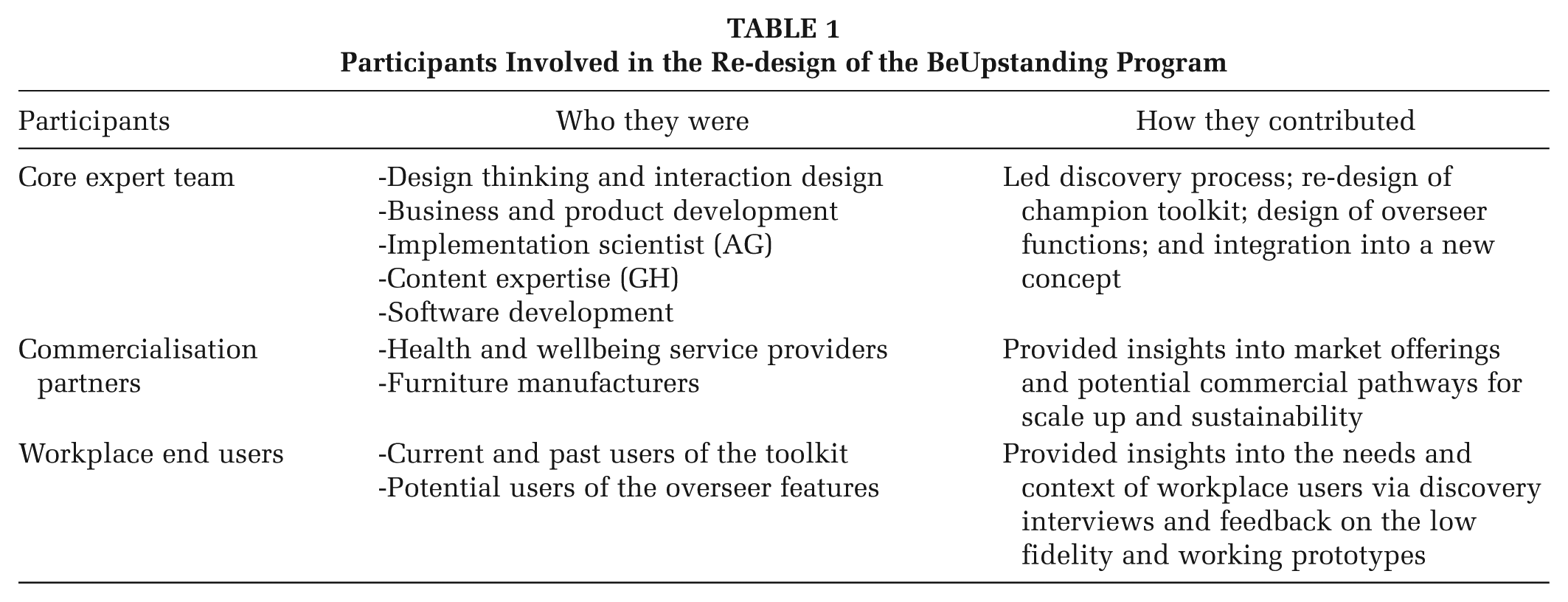
Core expert team: experts in sedentary behavior (GH), implementation science (AG), behavior change (LU), product development, interaction design, and software development.
Workplace end users: champions, managers, and staff who had implemented or were potential users of BeUpstanding.
Commercialization partners: representatives from larger organizations with interest in co-design and scaling health-promotion programs.
Recruitment
The lead researchers (GH, AG) employed external experts in product development and commercialization, interaction design, and software development to form the core expert team. Initially, workplace end users and commercialization partners were recruited to test conceptual prototypes and engage in co-design of features that best met their needs and requirements (Discovery cycles A to C). Once the software had been developed, a further group of workplaces were recruited to beta test the completed prototypes during the 3-month validation trial. The BeUpstanding toolkit’s online registration form provided details for user organizations to be recruited via email. Non-user organizations were recruited through core expert partner channels via email and telephone. Organizations invited to take part in the beta test had previously expressed interest in further testing and development of the program or in delivering BeUpstanding to multiple teams within their organization. Purposive and snowball sampling was used. Ethics approval was granted by the Human Ethics Committee of The University of Queensland (#2016001743), and all participants provided written informed consent. No participants were obligated to participate.
Setting
Data collection occurred between November 2021 and September 2022 through a combination of in-person workshops and virtual platforms (Zoom, Microsoft Teams). Interviews and focus groups were held in private settings and recorded with permission. Only participants and facilitators were present during data collection.
Data Collection and Measures
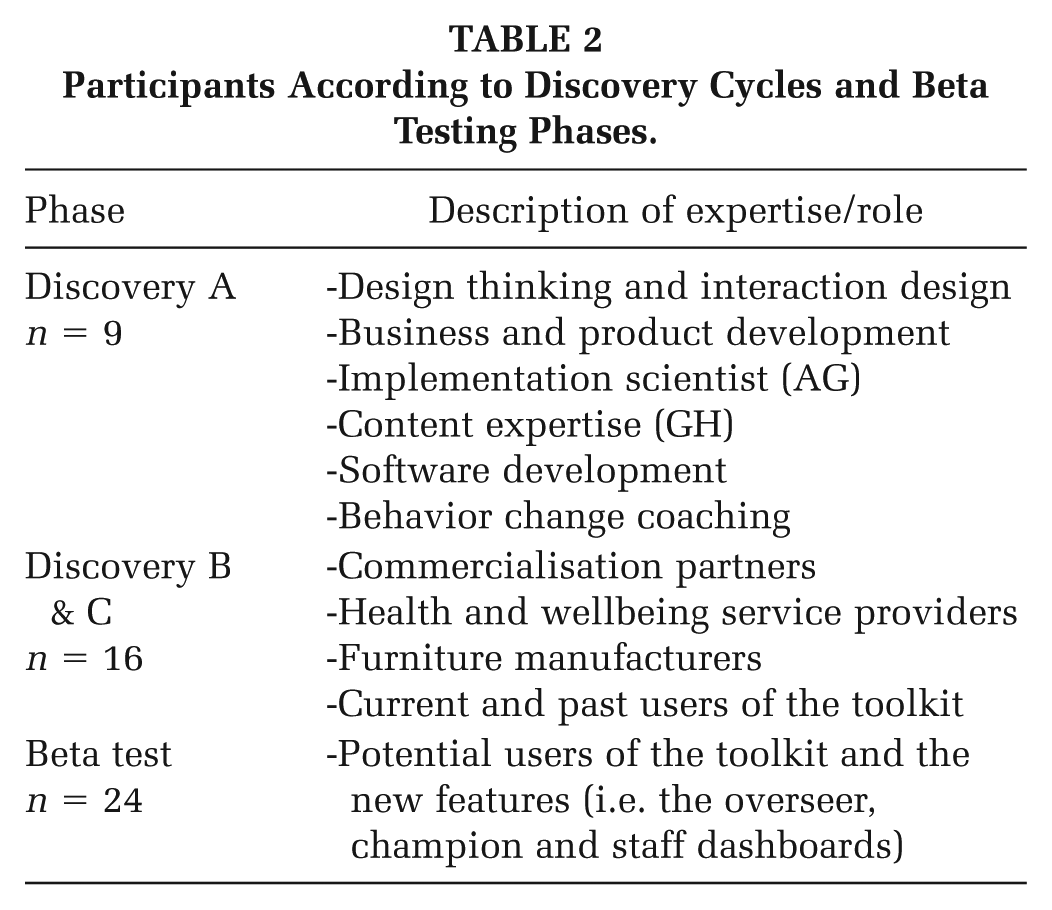
A summary of the discovery and validation activities is provided below. Activities by participant group are presented in Table 2.
Participants According to Discovery Cycles and Beta Testing Phases.
Discovery Cycle A: Expert-Led Scoping
This phase involved the core expert team (n = 9). Following a 1-day in-person planning workshop to confirm objectives, a series of 2- to 3-hour online workshops and 1-hour meetings were held over 3 months. These sessions focused on pre-development research and analysis. Sessions were guided by prior trial findings, with a focus on identifying problems or barriers to sustainability. The team used collaborative tools (e.g., online screen sharing, Miro, InVision) to brainstorm enhancements, develop value-added features and value proposition concepts and map customer journeys based on a “jobs-to-be-done” framework (Osterwalder et al., 2015). Wireframes were iteratively developed by the interaction designer and reviewed by all members of the core expert team, with input from the software developer regarding feasibility of proposed features.
Discovery Cycle B: Early Prototype Testing and Context Exploration
Interviews and focus groups (60–90 minutes) were conducted with workplace champions, staff, and partners (n = 12; focus groups ranged in size from 2 to 5 participants). These sessions were led by product-development experts and guided by a semi-structured interview guide (See Supplemental file A) developed for the purpose of this work by the expert team. Interview topics included motivations for engagement with workplace health program and perceived challenges to implementation and engagement. If participants were current or past users of BeUpstanding, interviewees were asked about the strengths and challenges of the BeUpstanding program. Participants were then shown mock-ups of key features of the re-designed program dashboards and associated features via video sharing (e.g., Zoom or Microsoft Teams) and asked to reflect on their usability and relevance. In line with common involvement practice (i.e., user testing and iterative feedback loops which are evidence-based strategies for user engagement in co-deign; Sanders & Stappers, 2008; Tuk et al., 2021), participant feedback was collected as written field notes by the facilitators. Notes (including direct quotes) were collated and compared across the two core team members attending the interviews. Key points were identified and fed back to the core expert team. Revised wireframes incorporating the feedback were then developed with the interaction designer.
Discovery Cycle C: Feature Refinement
This phase involved 60- to 90-minute follow-up sessions with both eight returning and four new users, using the same semi-structured format as Discovery Cycle B. Participants evaluated refined prototypes, focusing on usability, acceptability, and alignment with daily practice. Interview topics included whether this version of the program felt intuitive and whether re-designed dashboards were credible, engaging, and useful (Supplemental file A). Feedback informed final design modifications and supported the transition to full software development.
Validation Phase: Beta Testing
A 3-month beta trial was then conducted in four selected workplaces. Informal user feedback was collected via ongoing correspondence (email, phone, virtual meetings). In addition, semi-structured interviews (see Supplemental file B) were conducted at 4 and 12 weeks post implementation with both program champions and organizational overseers. Interview topics included platform usability and navigation, implementation feasibility and perceived program value and sustainability. Interviews were recorded, transcribed verbatim, and de-identified prior to analysis.
Analysis
The meeting and field notes gathered during discovery cycles and beta testing were thematically coded, while formal interviews conducted during the beta testing phase were transcribed verbatim for analysis. Coding and exploratory thematic analysis was guided by Braun and Clark’s six-step process (Boyatzis, 1998). Analysis of the insights was conducted by two researchers (AG and LU) independently with regular peer debriefing and team consensus meetings to review and refine themes. Reflexivity was maintained through documentation of analytic decisions and discussion of researcher perspectives during consensus meetings. Insights from multiple data sources including interviews, field notes, and market analysis were triangulated to enhance the credibility and depth of the analysis. Identified themes and potential solutions were then retrospectively mapped to the RE-AIM framework, taking into consideration usability and IDEO’s (2008) Desirability, Feasibility, and Viability framework.
Results
Participants
A total of 49 people participated. Nine people participated in discovery a, including all members of the core expert team which included three behavior change coaches who had helped deliver the program. A total of 16 people from 11 organizations from a variety of sectors including private and non-government took part in discovery b and c interviews and focus groups. The beta test of the prototype was conducted with four organizations (two public; one regional and three metropolitan across three Australian states) with four overseers and 20 champions.
Findings From the Discovery Cycles
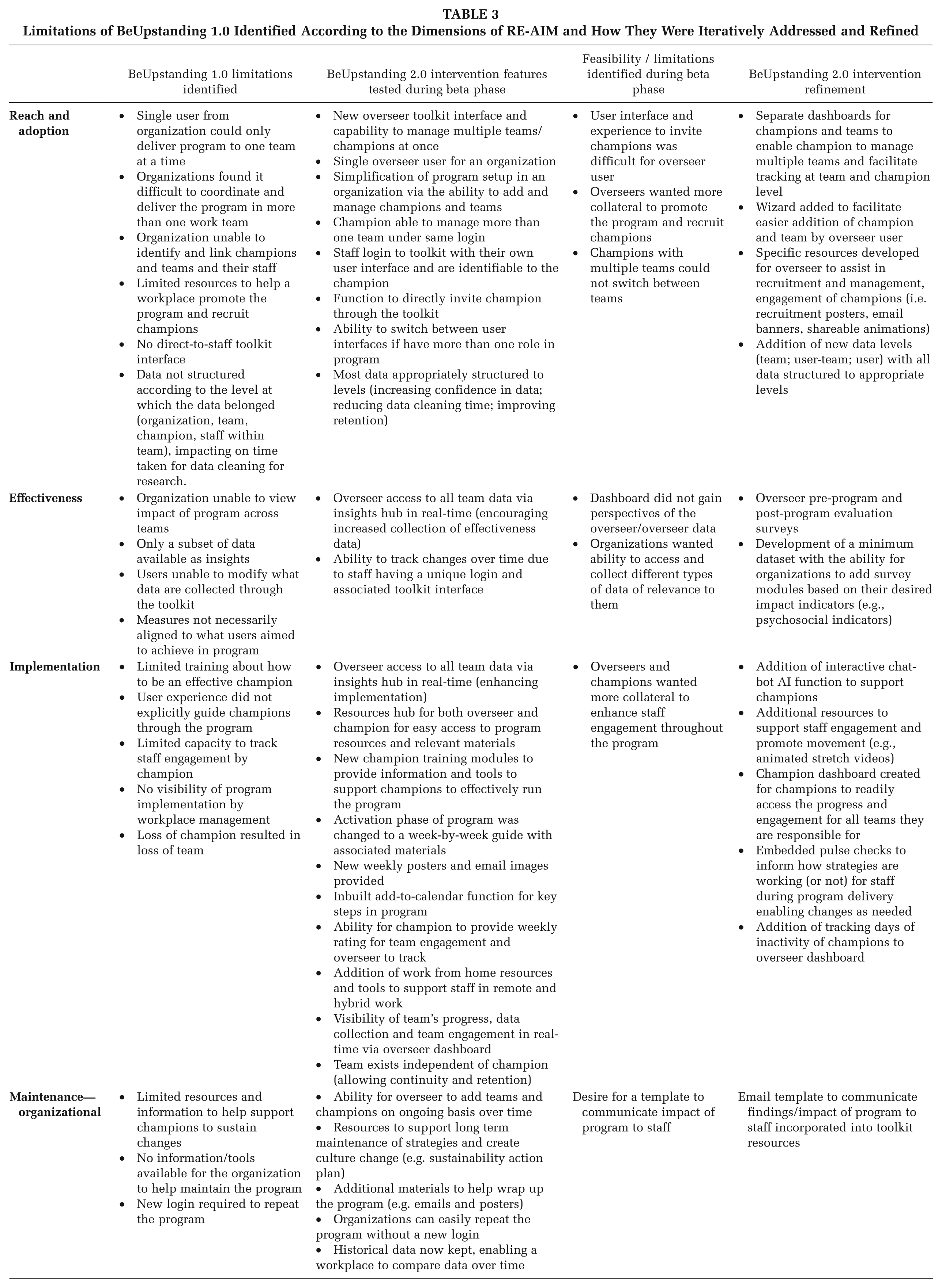
Collectively, the discovery work highlighted key problems and design challenges related to both the program itself as well as the way it was delivered via the online toolkit and dashboard/s. Table 3 summarizes these insights organized according to the RE-AIM (Glasgow et al., 1999) framework. Three major insights emerged across the discovery cycles.
The program needed to expand to include an “overseer” user. Most organizations found it difficult to run and coordinate multiple teams and champions. Given the appropriate support, an “overseer” user could facilitate organization-wide uptake of BeUpstanding, correspondingly increasing impact and the wider dissemination and sustainability of BeUpstanding, particularly in large organizations. To facilitate this, it was identified that a dedicated overseer dashboard and associated features were needed.
Significant restructure of the underlying implementation platform (Wildfyre) and the champion toolkit was required. To improve the experience for both program users and the research team, it was identified that all users needed to have an identifiable user profile (staff were anonymous in BeUpstanding 1.0). This would enhance the user experience (e.g., staff did not need to repeat survey questions relating to non-modifiable demographic characteristics) and provide the functionality to provide tailored content to staff. The addition of a “team” level of user also served to reduce data duplication and associated data cleaning. Significant changes were also made to the toolkit structure in response to feedback from participants across all cycles on the importance of making the process of program delivery as easy as possible for time poor champions and enhancing the champion journey. Specifically, all recommended that the champion toolkit be revised to be more prescriptive, with a week-by-week program guide and associated revised downloadable materials.
Features to enhance and maintain engagement were highly desired. It was noted by many that improving engagement of individual participants and champions taking part in BeUpstanding was fundamental to the success and sustainability of the program. Most organizations forecasted that hybrid work would become the “new normal” thus, flexible ways to deliver and engage staff in remote and hybrid work environments were often raised. Some organizational end users suggested potential gamification and competition elements, as well as real-time visibility progress and leader boards as key features that could assist with this. This opportunity to play and compete among teams and staff members was suggested by some workplace participants to build “local support” and enthusiasm for using the program. Many workplace participants noted that real-time visibility of program progress and team engagement were key functions to include in the overseer and champion dashboards. An evidence hub where users could gain easy access to the latest research evidence was also requested. It was noted that automation was needed to ensure additional features did not add more time to running and administering the program.
Limitations of BeUpstanding 1.0 Identified According to the Dimensions of RE-AIM and How They Were Iteratively Addressed and Refined
Findings From the Beta Testing (Validation Phase)
Table 3 shows the insights from the beta testing of the optimized product (BeUpstanding 2.0) according to the RE-AIM framework (Glasgow et al., 1999). In addition, aspects around usability, desirability, feasibility, and viability (i.e., sustainability) according to IDEO (2008) were considered and summarized below.
Usability
User interviews revealed that the new overseer dashboard layout was visually appealing, engaging, and straightforward to use. The new functionality of having an overseer log in, and a dashboard to add and track multiple teams and champions running the program concurrently, was well received and enabled greater reach to staff within the organization. The restructuring of the champion toolkit to include weekly email templates, posters, and other resources helped drive program engagement.
It was all really good that it was all there and ready to roll out, so I appreciated having all those tools ready-made. (Champion A)
Most participants noted the need to simplify initial program setup (including adding and managing teams and champions) and overall navigation, as well as streamlining survey access. From a research perspective, the application of the different user levels (overseer, team, champion, staff) to the data collection was considered to significantly simplify data cleaning and reporting processes.
Desirability
Interviews reaffirmed that the ability for an overseer to view insights from individual team data as well as aggregate data across teams was highly valued. All users reported that this enabled them to track participation and monitor the effectiveness of the program. All respondents considered data reports to be a highly desirable tool for reporting progress to higher level managers. Making the insights reporting easier to filter and showing progress over time was noted as a potential improvement. Many felt additional resources, tools and communications were needed to maintain momentum, such as prompts to keep momentum going, and having more targeted resources for “working from home.”
I think definitely having some resources like little mini challenges within the weekly challenge particularly for those later weeks would be really helpful I think to keep people engaged. (Champion B)
Feasibility and Sustainability
Overseers indicated that it would be simple for any individual within any organization to run the program regardless of experience with health and wellbeing programs. To enhance the feasibility and sustainability of running the program without expert researcher support, interactive champion training modules were developed to help educate and guide workplace champions to effectively deliver the program in a work team, with this feature included in the beta testing. Interviewees described the training as comprehensive, detailed, and self-explanatory with content and videos “well put together and helpful” for understanding and getting started with the program, making it more feasible to implement without expert support. Suggested improvements included an enhanced insights portal where team progress regarding survey completion and weekly engagement as well as summary data of participant baseline and follow-up surveys could be displayed.
Discussion
This study describes and reflects on the design discovery process of a champion-led workplace behavior change program to make it more sustainable. Multiple end users were involved across discovery cycles with the RE-AIM and IDEO desirability, viability, feasibility frameworks used to guide design and implementation decisions throughout the development process. Beta testing of the optimized product (BeUpstanding 2.0) showed it to be acceptable and feasible, albeit with further modification needs identified. Collectively, this study showcases the process of utilizing UCD methodologies to iteratively develop a product to be fit-for-purpose to meet the needs of multiple end users in the evolving workplace health-promotion context.
Throughout the three discovery cycles, it was clearly identified that there was a need for managers responsible for coordinating the delivery of BeUpstanding in the workplace to have a more engaged experience with the online toolkit. Such “coordination of the intervention” has been identified as a key contextual factor influencing the success of workplace health promotion efforts (Rojatz et al., 2017). BeUpstanding 2.0 addressed this through the addition of an “overseer” user and an associated overseer user experience, including a distinct sign-up process, dashboard, insights, and resources. These features enabled the individual overseer user to add and manage teams as well as track progress of their teams throughout the program implementation, supporting them to have more of an involved role in program implementation. Continuous support for workplaces to both encourage leadership engagement and increase the knowledge and self-efficacy of health managers to promote evidence-based workplace health-promotion efforts is needed (Saito et al., 2022). Our work highlights the importance of features to foster initial and ongoing organizational buy-in, as well as sustained program engagement across multiple types of end users (e.g., staff, champions, and overseers).
A core strength of the UCD approach is that it allows for tailoring of programs to meet the unique needs of users, which may not be fully known or understood at the onset (Davis, 2012). The process can also result in fostering meaningful participant engagement to deliver creative solutions that may not otherwise result from traditional quality improvement approaches (Levander et al., 2024). This was evident in our process utilized in modifying the BeUpstanding program. Here, our continuous exploration of workplace needs, validation of proposed solutions, and refinement of requirements as new information was discovered resulted in multiple software design alterations, which, without consultation, would not have been anticipated by the core research team (e.g., the need for more prescriptive program guidance and associated resources). Furthermore, it allowed us to readily respond to the shifting needs and requirements of organizations due to the COVID-19 pandemic.
Others have noted the need for novel approaches to maximize the adoption and maintenance of evidence-based programs in practice, including the potential for integrating UCD into implementation science (Dopp et al., 2019a, 2019b). Description of how end users were involved in the development and testing of interactive health technologies is important, with reports highlighting the usefulness of UCD for customizing interventions to client needs (De Vito Dabbs et al., 2009). For example, UCD methodologies helped develop an evidence-based training guide on the optimal use of sit-stand workstations that met the needs and was appropriate and relevant for multi-level end users within an organization (e.g., staff and health and safety managers) (Zerguine et al., 2024). More broadly, the value of a UCD to address diverse global health issues has been identified (Bazzano et al., 2017). Our description further highlights how the UCD process to help understand user needs, behaviors, motivators, and test assumptions quickly to more rapidly enhance research-to-practice translation. Importantly, we also showcased how a framework widely used to evaluate public health interventions (RE-AIM) can also be used to guide design and development decisions, alongside more typical product development considerations (i.e., usability, desirability, feasibility, viability). Despite these strengths, UCD is inherently an ambiguous process, often involving multiple pivots and repeated prototyping (Bazzano et al., 2017). Due to the constraints of the project’s timeline and resources, not all participant insights were able to be incorporated or tested.
Implications for Practice
This study provides a comprehensive example for how to move forward within resource constrained environments that are typical of research contexts to identify new features and ideas to be tested with low-fidelity prototypes in smaller groups for feedback before expensive development and roll out. Champion-led workplace behavior change programs will very likely require iterative re-design for sustainability. UCD methodologies can help develop sustainable workplace health promotion programs and the RE-AIM framework can help organize and prioritize re-design efforts.
Implications for Research
Iterative data collection from a wide variety of end users using multiple collection approaches (e.g., interviews, field notes, and market analysis) is important. By triangulating insights from multiple sources, analyses can captured diverse perspectives and potential areas for further enhancement to addressing the evolving needs of workplace health and wellbeing programs. The planned next step for BeUpstanding 2.0 is to implement and evaluate these enhancements. Future directions for research include focusing on how iterative continuous feedback loops may help to ensure emerging challenges to engagement are promptly addressed.
Supplemental Material
sj-docx-1-hpp-10.1177_15248399251398555 – Supplemental material for A User-Centered Design Approach to Enhance Sustainability of a Sit Less, Move More Program for Desk-Based Workers
Supplemental material, sj-docx-1-hpp-10.1177_15248399251398555 for A User-Centered Design Approach to Enhance Sustainability of a Sit Less, Move More Program for Desk-Based Workers by Ana D. Goode, Lisa Ulyate and Genevieve N. Healy in Health Promotion Practice
Supplemental Material
sj-docx-2-hpp-10.1177_15248399251398555 – Supplemental material for A User-Centered Design Approach to Enhance Sustainability of a Sit Less, Move More Program for Desk-Based Workers
Supplemental material, sj-docx-2-hpp-10.1177_15248399251398555 for A User-Centered Design Approach to Enhance Sustainability of a Sit Less, Move More Program for Desk-Based Workers by Ana D. Goode, Lisa Ulyate and Genevieve N. Healy in Health Promotion Practice
Footnotes
Authors’ Note:
In addition to the authors listed, the authors would like to acknowledge and thank Steve Goodwin, Sarah Hyne, and Matthew Frith, as well as the champions and overseers who took part in this study. This work was supported by funding from the Queensland Government “Healthier. Happier. Workplaces” program, Safe Work Australia, Comcare, and the National Health and Medical Research Council of Australia through a Partnership Project Grant (#1149936) conducted in partnership with Comcare, Safe Work Australia, the Queensland Office of Industrial Relations, VicHealth, and Healthier Workplace WA. NHMRC had no role in the study in terms of the design, data collection, management, analysis, and/or interpretation. This work was also supported by funding from the Queensland Government Department of Tourism, Innovation and Sport ActiveKIT Grant (#AKO1-2021-0147). GNH was supported by an MRFF-NHMRC Emerging Leadership Investigator Grant (#1193815).
Author Contributions
AG, LU, and GH all made substantial contributions to the analysis, interpretation, and write up for this work. AG led the design and write up. LU co-led data collection and interpretation and reviewed the write up. GH oversaw the project and critically reviewed all data, analysis and write up.
Ethics Information
Ethics approval was granted by the Human Ethics Committee of The University of Queensland (#2016001743), and all participants provided written informed consent.
Data Availability
The data underlying this article will be shared on reasonable request to the corresponding author.

References
Supplementary Material
Please find the following supplemental material available below.
For Open Access articles published under a Creative Commons License, all supplemental material carries the same license as the article it is associated with.
For non-Open Access articles published, all supplemental material carries a non-exclusive license, and permission requests for re-use of supplemental material or any part of supplemental material shall be sent directly to the copyright owner as specified in the copyright notice associated with the article.
