



Abstract
In March 2022, as the world was still reeling from the ongoing COVID-19 pandemic and its lingering effects, frontline health workers were yearning for a way to share their stories and for the public to acknowledge the devastating effects of COVID-19. With the understanding that the art of storytelling can provoke empathy, the University of Pennsylvania School of Nursing and Elevate Theatre Company created the Frontline Health Workers Digital Theater Project. Through our project, we aimed to engage frontline health workers in storytelling and give audience members the opportunity to see how their individual choices impact our frontline workforce. Storytelling workshops were conducted with frontline health workers to further explore and understand their experiences. After the workshops, incorporating the frontline health workers’ stories, two original plays were written, and performed virtually, highlighting the personal and institutional toll the pandemic had on these frontline health workers. The two plays were: “A Soft Landing” by Ang Bey and “Silos” by Nikki Brake-Sillá. After the performances, a panel of health care experts and frontline workers discussed multiple themes in the theater productions, including how the public health issues highlighted in the plays manifested in real life and what the public can do to decrease the burden of our frontline health workers. The Frontline Health Workers Digital Theater Project can be viewed on Elevate’s website: https://elevatetheatrecompany.com/frontline-health-workers.
Keywords
“But when we rest, we heal.” (A Soft Landing by Ange Bey)
Characters
Prologue: Opening Monologue
FRONTLINE HEALTH WORKER / PERFORMING ARTIST
Tonight will be great. Arriving in the parking lot for work, I am excited but nervous; there are a lot of people here. A lot of people to engage with. People to help. Dusk falls as I walk toward the building. I have a thought of gratitude as I know I’m doing exactly what I was meant to do.
I walk through the doors, nod at security, sign in, and head toward the changing area. I don my work clothes, greeting my coworkers as they arrive. I look in the mirror; I adjust my hair, makeup, and clothes until I’m satisfied with my appearance and feel ready. Before beginning my shift, I check all of my various tools and props, sometimes I stretch a little and ensure that I have everything I need to seamlessly work alongside my colleagues and serve our patrons. I pass through the common area and fill my water bottle. I greet more of the team and exchange pleasantries about our hope for a good night ahead. The opportunity we have to make a difference in people’s lives. A night of healing. There is an energy, and everyone is ready to begin. As I turn to move forward through the threshold and into my role, I acknowledge all the training and care that has led me to moments like this. The beginning of another story.
Act 1: The Process
Asserting that the arts can enhance the work of nurses and other frontline health workers, two seemingly disparate groups, Elevate and Penn Nursing, began a collaboration to use theater as a way to allow frontline health workers to process and explain what they were experiencing during the COVID-19 pandemic. Over the first 2 years of the pandemic, the frontline health workers felt that the public did not understand their struggles and sacrifices (Patel & Kimmel, 2021; Smith & Spector, 2023). The pandemic was extremely detrimental to the mental health of frontline health workers, and in turn, they began experiencing burnout at unprecedented rates (Alhouri et al., 2023; Gambaro et al., 2023; Gupta et al., 2021). Yearning for a way to be heard and for the public to acknowledge the devastating effects of COVID-19—and with the understanding that the art of storytelling can provoke empathy, Penn Nursing and Elevate created the Frontline Health Workers Digital Theater Project (Ahmad et al., 2023; Fancourt & Finn, 2019). Through the project, we aimed to provide frontline health workers from Penn Nursing and Penn Medicine an opportunity to share their experiences in a safe space, and to have their stories heard by the public.
The Frontline Health Workers Digital Theater Project was supported by a grant through the Sachs Program for Arts Innovation at the University of Pennsylvania and had three agreed-upon goals:
to engage frontline health workers in storytelling to ensure that they could reflect on their experiences around COVID-19 and express their sentiments.
to give audience members the opportunity to see how their individual choices impact health care systems and, thus, our frontline workforce.
to leverage artistic storytelling, bring together the broader community, and ensure the public can engage with and understand the frontline experience.
In collaboration with Penn Nursing, Elevate conducted two 90-min storytelling workshops at various times to accommodate schedules, with self-selected frontline health workers to further explore and understand their stories. The workshops leveraged theater techniques to engage frontline workers in theater games, beginning with gestures and gradually evolving into written and verbal storytelling activities to promote reflection, play, and participant collaboration. The workshops were facilitated by professional teaching artists and observed by local Philadelphia playwrights, pulling from Elevate’s extensive network of professional partners.
After the workshops and using the frontline health workers’ stories, the professional playwrights and teaching artists then collaborated with Penn Nursing to construct two original plays. These plays were then written to highlight the personal toll the pandemic had on these frontline health workers. The plays were performed as part of the Frontline Health Workers Digital Theater Project on March 31, 2022: “A Soft Landing” by Ang Bey and “Silos” by Nikki Brake-Sillá.
Due to the pandemic, the event was on Zoom and live-streamed. It was free and open to the public. Elevate provided the virtual event production and co-hosted the event with Penn Nursing. There were two 30-min performances of the plays, followed by a panel discussion focused on the main themes of each theater piece. The Frontline Health Worker Digital Theater Project is available to view on Elevate’s website: https://elevatetheatrecompany.com/frontline-health-workers.
The post-performance panel discussion included frontline health workers who participated in the workshops, other health care experts, and the two playwrights. The audience was allowed time to digest the stories they heard and then witnessed the discussions rooted in accurate health information and action. The panelists discussed multiple themes, including how the public health issues highlighted in the plays manifested in real life (see Table 1). In addition, the playwrights discussed their process of taking what they heard during the workshops and turning those into the two plays. One of the playwrights emphasized wanting to highlight the experiences of health care providers of color. Finally, the audience was guided to action steps for engaging in their own health post-performance by participating in the arts to fortify well-being and how to support frontline health workers moving forward by supporting the next generation of frontline health workers.
Major Themes From the Frontline Health Worker Digital Theater Project
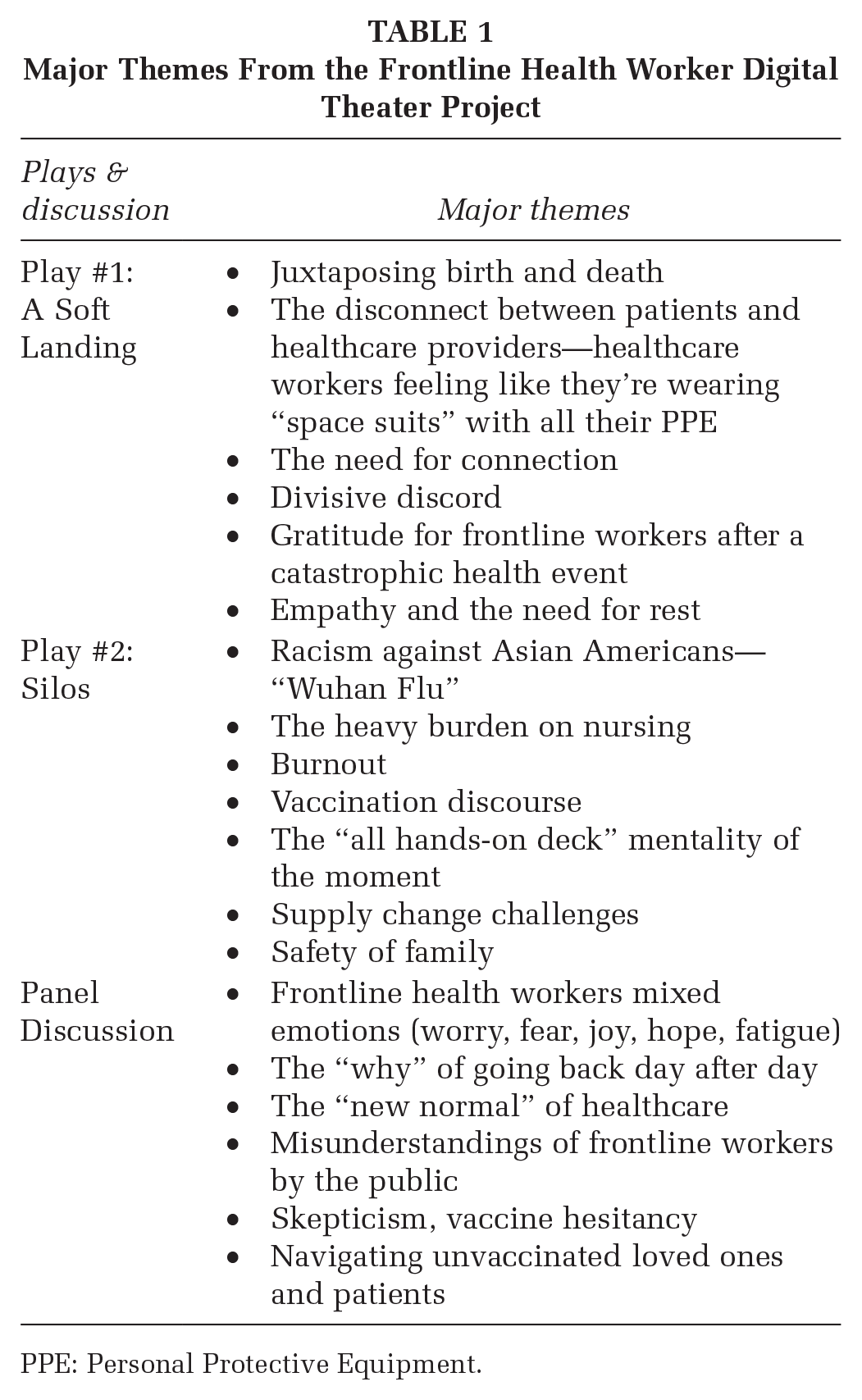
PPE: Personal Protective Equipment.
Act II: Outcomes
Nurses and other frontline health workers, as well as those working within the health care system and in public health, are uniquely equipped to tell compelling stories about the pandemic and the multitude of other issues they see in health and health care. As noted by Sonke et al. (2021), “The arts provide means for engaging dialogue, influencing behaviors, disrupting paradigms and fueling social movements.” Therefore, it was not only important that we show the public what these individuals confronted during the pandemic but to highlight what our health care workforce faces every day, and how that impacts themselves, their families, their patients, and the community at large. The collaboration between health care and theater gave these individuals a space to process and share experiences in a unique and innovative way and provided the public with a relatable storytelling performance that reflected the human condition and made the themes easier to understand and digest.
Storytelling is an emerging area in nursing (Leary, 2022; Pomilo, 2022). Too often, there are misconceptions about what nurses do, based mainly on how nurses are portrayed in the media. Penn Nursing uses storytelling to highlight the breadth and depth of nurses’ expertise. This embrace of storytelling and understanding of its value sparked the connection between Penn Nursing and Elevate. At Penn Nursing, innovation is more than a product or solution that is created, it is a mind-set and way of thinking. Intentional collaborations between health and the arts are rare, and this project showed how valuable this integration can be.
Act III: Implications for Future Practice
The Frontline Health Workers Digital Theater Project was a poignant opportunity for both frontline health workers and audiences alike to reflect on the events of 2020 and move forward with advice and a call to action from health experts. The performances created from the workshops, using the firsthand stories of the frontline health workers, allowed audience members to see unique perspectives of health and wellness. By leveraging theater performance to portray in real-time the impacts of the COVID-19 pandemic, the audience was engaged emotionally and intellectually. The addition of panel discussions, guided by health experts, allowed for exploration, challenging of assumptions and space to learn from these themes to further identify actions for health promotion, allowing for the arts and health collaboration to be meaningful and relevant to the historic moment (Sonke et al., 2021).
The Frontline Health Worker Digital Theater pieces “A Soft Landing” and “Silos” are still available on YouTube for viewing because Penn Nursing and Elevate have agreed that free and easy access to this content is essential for continued educational use, both in the classroom and for further viewing by the public. We wish to continue to highlight the frontline health workers’ experiences during and post-pandemic, and the power of storytelling to provide audience members with a new perspective.
Today, innovation and collective action are required to move public health forward. In this “call for a fifth wave in public health” we argue this unique and effective model of collaboration between an arts organization (Elevate) and an academic health institution (Penn Nursing), can and should be replicated (Davies et al., 2014). Any cross-sector collaboration is worth exploring, given the exponential expertise available when multiple entities work together. Moreover, it is worth exploring how to leverage the resources available at these academic institutions. Many schools of medicine and nursing are indeed a part of an institution that also has a school of performing arts and other art forms. Developing cross-departmental collaboration and involving community-based organizations allows for this type of work to be fortified in the training of future generations of frontline health workers. By engaging them in play and creativity in their training, we expand the tools and likely players at the table for problem-solving and start to address the current state of frontline health worker burnout and mental health challenges (Alhouri et al., 2023; Gambaro et al., 2023; Gupta et al., 2021). These bonds between the arts and health have been fortified over millennia and are inextricably linked, now is the time to reengage that connection (Dissanayake, 1988).
A Note From the Playwrights
The opening scene above is a simple open experience intended to mirror the beginning of work for either a nurse or a performing artist. This story grounds us in the similarities and parallels of these roles, their service, and their quest to help. We understand that healing comes in many forms, and we intend to show how health care and the arts can work together toward health and wellness.
The partnership between Penn Nursing and Elevate was an unlikely yet necessary and intuitive collaboration. During the creation and execution of the Frontline Health Workers Digital Theater Project, interesting similarities between health care and the theater emerged, as highlighted in our opening scene. In both settings—the hospital and the theater—there are individuals dedicated to supporting those who come to see us, the training and tools that are required, the spaces, and the people needed to make each theatrical production, or the hospital unit run smoothly. Individuals who keep the lights on, attend to the environmental needs, and ensure the bills are paid. Both have workers in the spotlight waiting to serve and care for those who come to see them. It was important to show those similarities and how to uniquely share those stories by working together. We may not go to the hospital for the same reason we go to the theater, but storytelling can be a healing tool and the theater a healing space. Let’s remember to leverage all our tools and collaborate to further our health and wellness.
Footnotes
Authors’ Note:
We would like to thank and acknowledge all of the frontline health workers who showed up to work every day during the COVID-19 pandemic and continue to do so. We would also like to thank the Penn Medicine and Penn Nursing frontline workers and clinicians who participated in the Frontline Health Workers Digital Theater Project for sharing their time and experiences. Finally, a big thank you to the Elevate playwrights who captured the stories of the frontline health workers and the performers who brought their stories to life. Funding for the Frontline Health Workers Digital Theater Project was provided by a grant from the Sachs Program for Arts Innovation at the University of Pennsylvania.
