



Abstract
This study describes the recruitment strategies for a 6-week telephone-delivered walking program for adults with arthritis, enrollment yields per strategy, and differences in participant sociodemographic characteristics (e.g., age, income, and race) across strategies. Adults with arthritis were recruited to participate in a clinical trial examining the effects of a telephone-delivered Walk With Ease (WWE) program. Enrollment yield was calculated as the ratio of participants randomized by recruitment strategy. Enrollment yields by each recruitment method were compared between age (<65 years and ≥65 years), income (<$66,990 and ≥$66,990), and race (Black and Non-Black). Participants (n = 267) were primarily female (92%) and Black (60%) with an average age of 64.1 ± 9.4 years and an average BMI of 34.2 ± 7.7kg/m2. The most successful recruitment strategies were Facebook (32%), radio advertisements (24%), word of mouth (13%), and community events or organizations (10%). There was no difference in recruitment strategies by age group; however, for Black and lower income participants, the top recruitment strategy was radio advertisements (39% and 28%, respectively). Facebook was the most effective recruitment strategy among the sample population, followed by radio advertisements and word of mouth. Radio advertisements were more effective at recruiting Black and lower income participants, and Facebook remained the most effective recruitment strategy among non-Black and higher-income participants. The approach to recruitment and strategies used may differ depending on the population of interest. Public health practitioners can use these results to tailor their recruitment strategies based on the priority population.
Keywords
Arthritis is the leading cause of disability in the United States (Barbour, 2017). Over 50 million adults have arthritis and the prevalence is expected to continue rising (Fallon, 2023; Theis et al., 2021). Physical activity is recommended by several rheumatology and professional organizations as a non-pharmacological treatment approach for people with arthritis (Bidonde et al., 2014; Katz et al., 2020; Kolasinski et al., 2020). Among adults with arthritis, participation in regular aerobic physical activity is an effective strategy for improving health-related outcomes and arthritis-related symptoms such as pain (Verhoeven et al., 2016), physical function (Björk et al., 2022), quality of life (Björk et al., 2022), and fatigue (Kelley et al., 2018).
Given the known benefits of physical activity for those with arthritis, the Osteoarthritis Action Alliance (OAAA, 2024) recognizes and recommends several arthritis-appropriate evidence programs. One of these programs is the Walk With Ease (WWE) Program, which is a 6-week evidence-based physical activity program developed by the Arthritis Foundation for people with arthritis (Bruno et al., 2006; Callahan et al., 2011). WWE consists of three in-person group sessions each week (18 sessions total) with each session lasting approximately 60 minutes. WWE has led to improvements in arthritis symptoms (Bruno et al., 2006; Callahan et al., 2011; Conte et al., 2016; Wyatt, 2014) and function (Callahan et al., 2011), and participants report high satisfaction (Conte et al., 2016; Nyrop et al., 2014), including African American participants (Wyatt, 2014).
Although effective, participation in community programs is typically lower in underrepresented populations (Wieland et al., 2021) and most participants of WWE programs have been white (Callahan et al., 2011; Lamoureux et al., 2023; Nyrop et al., 2011) and highly educated (Lamoureux et al., 2023; Murphy, Brady, et al., 2017). Given the high prevalence of arthritis in underrepresented populations (e.g., lower income, Black, lower education; Fallon, 2023), it is necessary to identify effective recruitment strategies to increase the representation of these populations in arthritis-appropriate evidence-based programs. Numerous studies have focused on recruitment of underrepresented populations to health promotion programs (Graham et al., 2018; Wilbur et al., 2013), but few have focused on underrepresented populations with arthritis (Carthron et al., 2018; Reid et al., 2014). Adults with arthritis face additional barriers to participation (Theis et al., 2013; Vaughan et al., 2017); thus, the most effective recruitment strategies may differ in underrepresented populations with arthritis. Understanding the recruitment strategies that lead to successful enrollment among underrepresentation populations with arthritis can help future community-based programs reach those who may be in the greatest need of those programs Therefore, the purpose of this study is to describe the recruitment strategies used and the enrollment yields per strategy and to examine whether yield differed by participant sociodemographic characteristics (e.g., age, income, race). The recruitment strategies used for this study were informed by a previous review on recruitment and retention strategies for underrepresented populations (Pellegrini et al., 2023).
Materials and Methods
Study Design
The current study focused on the recruitment strategies and baseline characteristics of participants who were enrolled in a clinical trial examining the effects of a telephone-delivered Walk With Ease Program (WWE-T) in Columbia, South Carolina (Pellegrini et al., 2025). WWE is an evidence-based physical activity program (Callahan et al., 2011). As implemented in the current study, WWE-T is based on the Social Cognitive Theory (Bandura, 1986) and incorporates evidence-based strategies such as self-monitoring and goal setting. In addition, a Methods-Motivational Interviewing approach was used to aid with recruitment and retention (Jake-Schoffman et al., 2021). Participants were recruited between March 2022 and August 2023. All study procedures were approved by the University of South Carolina Institutional Review Board. Participants provided written informed consent prior to participation.
Participants
To be eligible for the clinical trial, adults (≥18 years old) had to be told by a doctor or other health professional that they have some form of arthritis, rheumatoid arthritis, gout, lupus, or fibromyalgia (Murphy, Cisternas, et al., 2017). Participants also had to speak English, plan to live in the Columbia, SC region for the next year, and be willing to be randomized to the intervention (WWE-T) or a wait-list control who received the WWE-T after completing the 12-month assessment. Participants were excluded from participation if they had any contraindications to exercise, a serious cognitive impairment, or were pregnant, breastfeeding, or planning to become pregnant.
Recruitment Methods
Participants were recruited from a variety of methods that were informed by a previous scoping review conducted in preparation for this study (Pellegrini et al., 2023). All recruitment materials provided details of the study along with a study phone number and website. Recruitment material included images of individuals of different ages and races walking. Across the community, flyers were posted in locations such as local libraries, storefronts (e.g., barbershops, nail salons), and wellness centers. Across the university, recruitment materials were sent to all faculty and staff and flyers were posted throughout campus. Research staff attended community and senior events throughout the community and at several senior centers. Paid advertisements were also used on local radio stations (e.g., gospel, sports), in community magazines, on city buses, and on Facebook. The PI appeared and promoted the study on a local TV station. Finally, at study visits, all participants were encouraged to tell their friends and family members about the study and were provided recruitment postcards and study-branded materials (e.g., t-shirts, water bottles, cell phone holders, and reusable bags).
Participants completed an initial online screener to assess study eligibility. All interested candidates were contacted by telephone to describe the study in detail, review study eligibility criteria, and answer any questions. If eligible and interested, participants were scheduled for a study visit based on their availability to complete the informed consent process and baseline assessment.
Intervention
Following completion of informed consent and the baseline assessment, participants were randomized to either the intervention (WWE-T) or a wait-list control group. The WWE-T program was adapted from the Arthritis Foundation’s WWE program for adults with arthritis and focused on helping participants work toward walking at least 30 minutes/day for at least 3 days/week. All participants received the Arthritis Foundation’s WWE Guidebook and WWE-T handouts. During the 6-week program, participants received two telephone calls each week from a WWE-certified trained leader. The first telephone call each week was a group call that included five to 17 other participants and the second call each week was an individual call with the WWE-T leader.
Baseline Assessment
Participants completed the baseline assessment in-person after informed consent which consisted of a series of surveys and objective measures. Participants received a US$25 gift-card for completing the baseline assessment.
Demographic and Anthropometric Measures
The demographic variables assessed by self-report included date of birth, sex, race, ethnicity, education, employment status, and income. The race and ethnicity questions included a fixed set of category options based on NIH terminology. Participants also self-reported type of arthritis diagnosis.
Height to the nearest 0.1 cm and weight to the nearest 0.1 kg were measured by trained research staff. Participants were weighed on an electronic scale (SECA-869; Hamburg, Germany) wearing a light layer of clothing with shoes, belt removed, and pockets emptied. Height was measured using a stadiometer. Height and weight were used to calculate body mass index (BMI) as kg/m2.
Recruitment Source
Participants were asked to select one of the options of how they heard about the program. Options included strategies such as radio advertisements, Facebook, Twitter (now X), USC Campus, friend/family/co-worker, email, and flyer. Once selected, participants could expand on location or further details of the recruitment strategy. Participants also could choose “Other,” and provide additional details on where and how they learned of the study. The responses were reviewed, categorized, and agreed on by three study team members. If the participants’ response fell into more than one category, which happened in only four instances, the original source was selected as the recruitment source.
Statistical Analysis
Descriptive analyses were used to describe baseline characteristics of randomized participants. Continuous variables are described with means and standard deviations. Categorical variables are described as sample size (n) and percentage of randomized participants. Recruitment avenues and sites were categorized and the percentage of those enrolled was calculated. For the participants (n = 4) who indicated more than one recruitment source, only the original source as determined by study staff members was used for the current analyses as including them did not alter the results. Enrollment yields by recruitment method for the total sample and by age (<65 years and ≥65 years), income (<US$66,990 and ≥US$66,990), and race (Black and non-Black) were compared. In addition, chi-square statistics were used to assess the significance of differences in enrollment yields across age, income, and race. The highest yielding recruitment sources for age, income, and race were identified to help to inform recruitment strategies used in future programs. The statistically significant level for p value was set to 0.05.
Results
Of the 595 adults who were screened for participation, 291 completed the consent process and attended the baseline assessment (Figure 1). A total of 267 participants completed the baseline measures and were randomized.
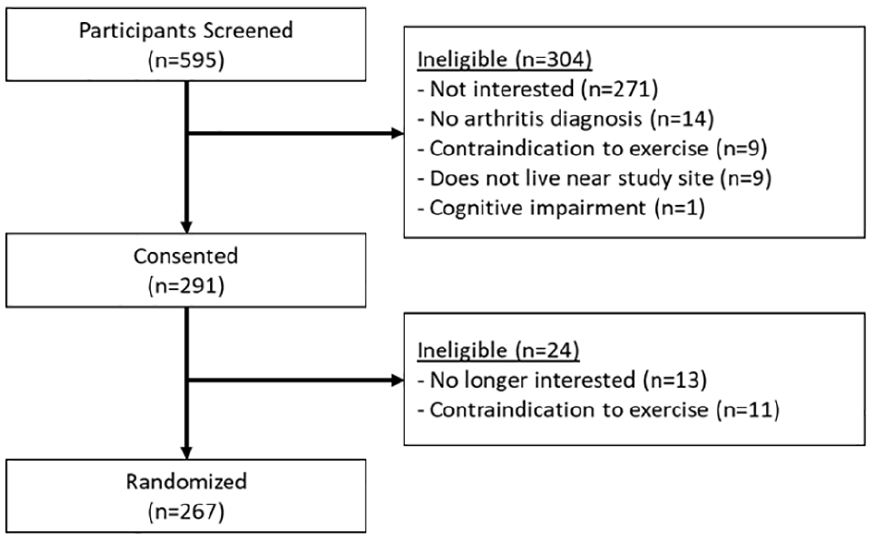
Flow of Recruitment Within a Randomized Physical Activity Trial
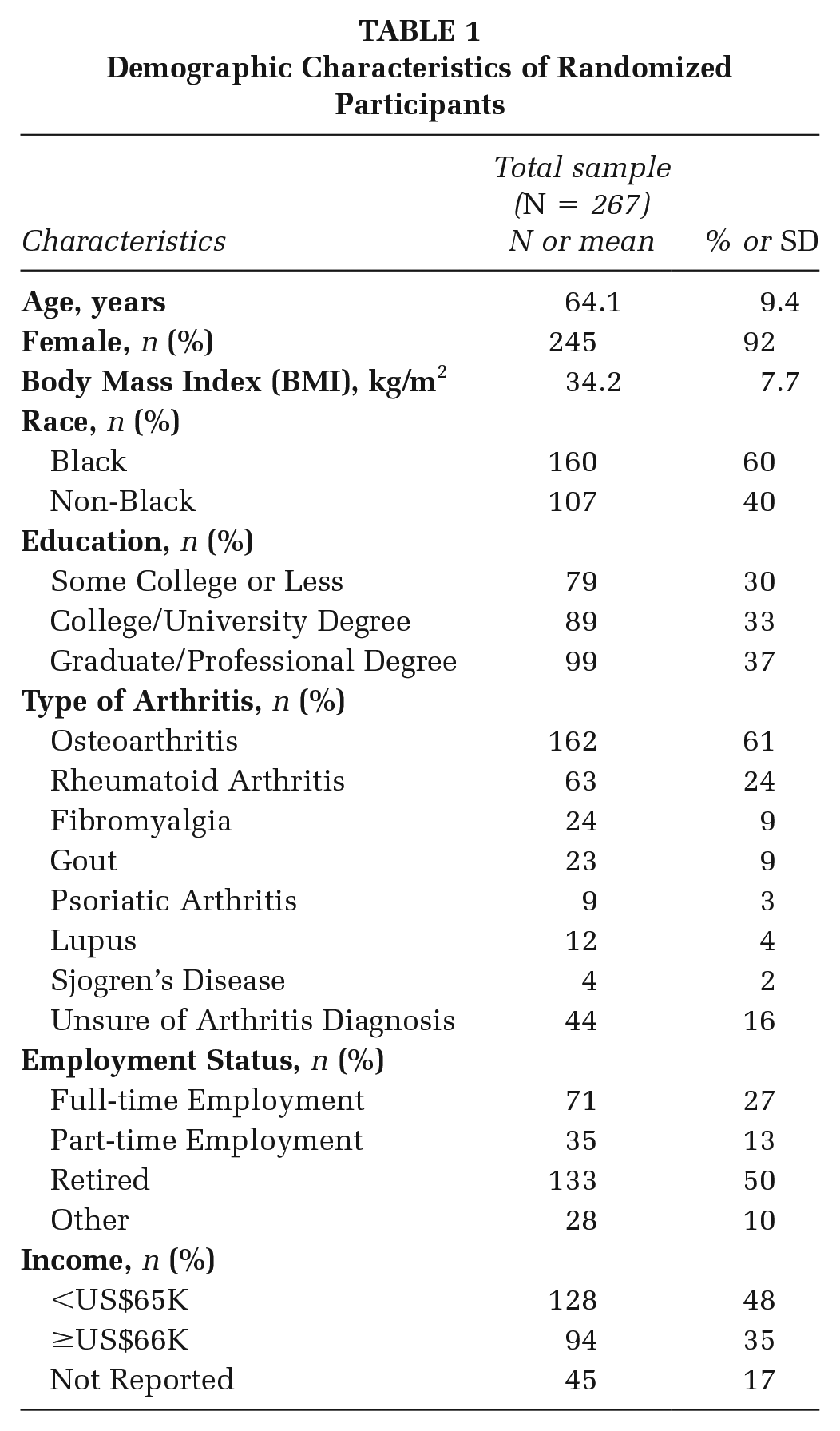
Baseline characteristics of randomized participants are presented in Table 1. Overall, participants were primarily female (92%) and Black (60%) with an average age of 64.1 ± 9.4 years. Participants had an average BMI of 34.2 ± 7.7 kg/m2.
Demographic Characteristics of Randomized Participants
Recruitment Strategies
The most successful recruitment strategy across all participants combined was Facebook (n = 86, 32%). After Facebook, the most effective strategies were radio advertisements (n = 65, 24%), word of mouth (n = 35, 13%), and community events or organizations (n = 27, 10%).
Recruitment Strategies by Participant Sociodemographic Characteristics
When comparing recruitment strategies by age, although there was no significant difference between age groups, χ2(8, N = 267) = 12.97, p = .11, the most frequent recruitment strategy for both age groups was Facebook. For those <65 years old, after Facebook (n = 46, 35%), the most effective strategies were radio advertisements (n = 36, 27%), word of mouth (n = 13, 10%), and university emails or flyers (n = 13, 10%). For those ≥65 years old, after Facebook (n = 40, 30%), the most effective strategies were radio advertisements (n = 29, 22%) and word of mouth (n = 22, 16%; Figure 2).
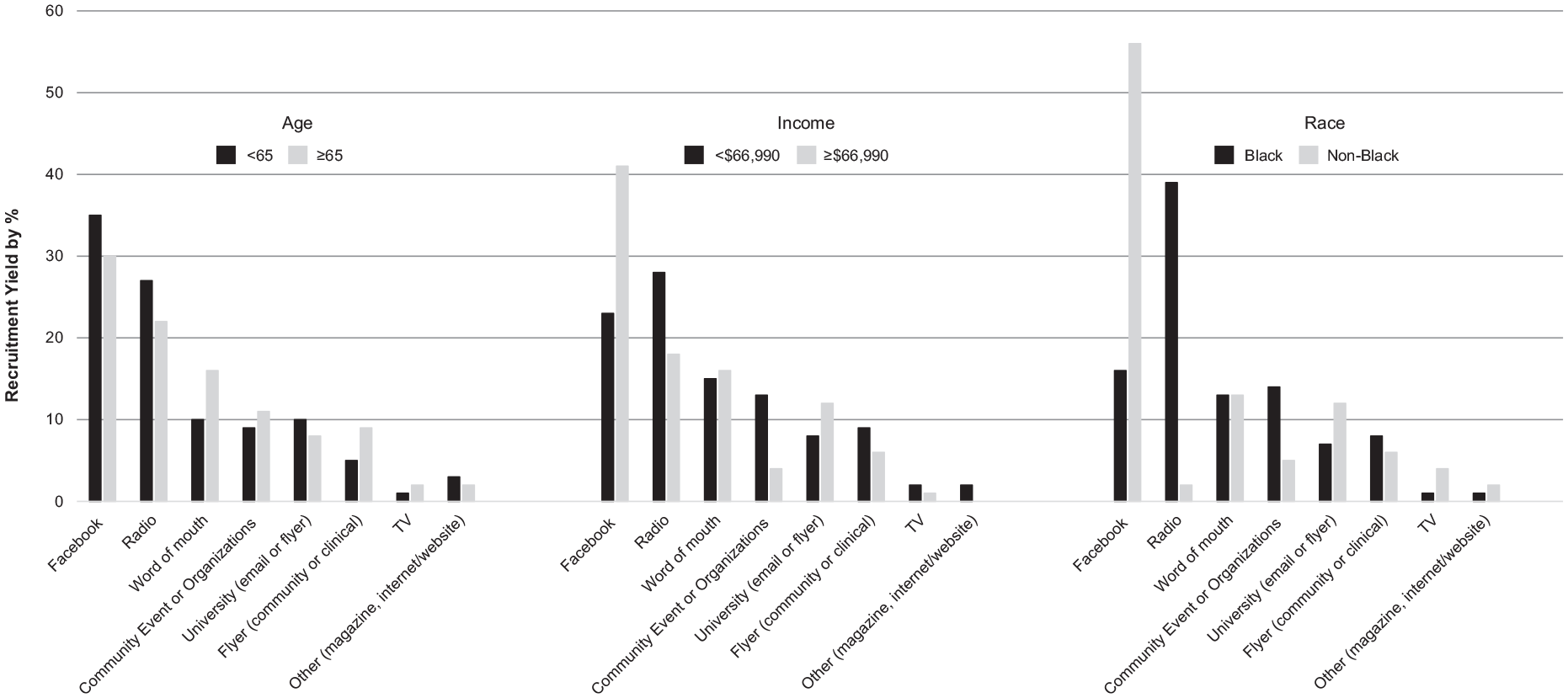
Recruitment Yield by Age, Income, and Race
Recruitment strategies by income group were significantly different from each other, χ2(8, N = 222) = 17.37, p = .03. For those in the <US$66,990 income group, the most effective strategy was radio advertisements (n = 36, 28%) followed by Facebook (n = 30, 23%) and word of mouth (n = 19, 15%). For those in the ≥US$66,990 group, the most effective strategy was Facebook (n = 39, 41%), followed by radio advertisements (n = 17, 18%) and word of mouth (n = 15, 16%; Figure 2).
There were significant differences in the most effective recruitment strategies between Black and non-Black participants, χ2(8, N = 267) = 79.83, p ≤ .0001). For Black participants, the most effective strategy was radio advertisements (n = 63, 39%), followed by Facebook (n = 26, 16%) and community events or organizations (n = 22, 14%). For non-Black participants, the most effective strategy was Facebook (n = 60, 56%), followed by word of mouth (n = 14, 13%) and University emails or flyers (n = 13, 12%; Figure 2).
Discussion
This study reported the recruitment rates by recruitment avenue to determine which strategies led to the greatest reach for a telephone-based walking program for adults with arthritis, and whether the yield of these strategies differed by sociodemographic characteristics. The results suggested that among all participants, Facebook followed by radio advertisements and word of mouth were the most effective recruitment strategies for recruiting adults with arthritis into a physical activity program. Radio advertisements were more effective at recruiting Black and lower income participants. Facebook remained the most effective recruitment strategy among non-Black and higher-income participants.
Recruitment for physical activity programs through social media has been previously reported (Pellegrini et al., 2023; Staffileno et al., 2017) as effective for recruiting younger populations, but few have examined social media among populations with arthritis (Miller et al., 2021). Results from the current study show that social media, specifically Facebook, has the potential to serve as an effective recruitment avenue. As of 2021, more than 70% of U.S. adults aged 50 to 64 and nearly half of those 65+ reported using Facebook (Auxier & Anderson, 2021). In addition to Facebook’s large reach, it provides investigators with the opportunity to post targeted ads to connect with a specific audience at an affordable cost. Therefore, when recruiting adults with arthritis for a walking program, Facebook may be a favorable avenue for all ages.
Among Black and lower income participants, radio advertisements were the most effective strategy, which is consistent with previous findings in non-arthritis populations (El Masri et al., 2022; Foster et al., 2011). Approximately 82% of Americans listen to the radio at least once per week (Forman-Katz, 2023), with the radio reaching 93% of Black adults (“The growing reach of radio among U.S. ethnic audiences,” 2017). The high percentage of Black adults listening to the radio may help to explain why radio advertisements were the most successful in recruiting this group. Utilizing radio advertisements to recruit adults with arthritis for a walking program may be effective for reaching Black and lower income adults.
Word of mouth and community events or organizations were additional strategies found to be effective at recruiting adults with arthritis for a telephone-based walking program, consistent with a previous review on recruiting underrepresented populations for research and health promotion programs (Langer et al., 2021). Providing participants with study-branded materials allowed them to bring attention/awareness to the program and share information with friends and family. If resources and incentives are limited, having postcards or flyers to give to participants to share with loved ones could be a relatively cheaper and feasible option. In addition, having study staff members spend time in the community at events and organizations may be effective in building rapport and trust with community members. Many times, these events can be free to attend and, with limited resources or money, may be a good option for recruitment.
Implications for Practice
The current findings have several implications for public health practitioners and future programs, particularly through the lens of implementation science. For practitioners, it is important to identify who the priority populations are for each health promotion program and acknowledge that the recruitment approach may have to be adjusted to reach those populations. Certain strategies may be more effective for reaching different sociodemographic groups. For example, the current study found that radio advertisements were most effective in recruiting Black and lower income participants; thus, if either of these populations is a priority, public health practitioners may consider prioritizing using more radio advertisements. The cost of each recruitment strategy varies; thus, resources and the allocated time available for recruitment should be considered. Implementation science is crucial for health promotion because it focuses on how to effectively translate research into practice, ensuring that interventions are scalable and sustainable in diverse real-world settings (Mazzucca et al., 2021). This study highlights the need for tailored recruitment strategies and demonstrates how media preference in different populations can influence recruitment into health programs.
Implications for Policy
The current study also has implications for policy. The current findings could guide the development of guidelines and recommendations for resource allocation in health promotion programs. Policymakers could consider supporting and funding more tailored, culturally appropriate recruitment strategies to ensure equitable access to health interventions. Future programs should report recruitment yields and strategies, which can help others to appropriately focus their attention and resources to the recruitment strategies that are most effective for their priority population.
Strengths and Limitations
A strength of the current study is the population. Black and lower income adults are underrepresented in arthritis interventions, which limits our ability to understand how behavioral interventions work in different subgroups of adults with arthritis. We recruited a sample with a high proportion of lower income and African American adults. In addition, many recruitment avenues were utilized and explored to better understand recruitment in adults with arthritis. However, this study is not without limitations. Results from the current study are not generalizable to non-English speaking adults or adults living outside of the southeast region of the United States. In addition, the recruitment source was only obtained during the baseline assessment, limiting our understanding of reach of participants prior to informed consent and enrollment. Future studies should consider including inquiries at screening regarding how they heard of programs and relevant sociodemographic factors.
Conclusion
In conclusion, Facebook, radio advertisements, and word of mouth yielded the highest enrollment for a telephone-delivered walking program for adults with arthritis. Future studies may benefit from using multiple or all these options but should consider the population of interest when deciding which to use. Facebook was the top recruitment strategy for non-Black and higher incomes adults, whereas radio advertisements were most effective for Black and lower income adults.
Footnotes
Authors’ Note:
This project was supported by Cooperative Agreement Number U48DP006401 from the Centers for Disease Control and Prevention. Its contents are solely the responsibility of the authors and do not necessarily represent the official views of the Centers for Disease Control and Prevention or the U.S. Department of Health and Human Services.
