



Abstract
Active lifestyles are vital for promoting health. In this practice note, we describe the implementation of an active living intervention designed to engage youth in identifying barriers to being physically active and developing recommendations to address these barriers. Youth interns were compensated for their time. Through this project, the community obtained street striping for the first time, secured a community center when the police substation building was turned over to the community, and had sidewalk funding prioritized for one of their busiest streets. Lessons learned while developing and implementing this youth internship program focused on making the internship program work well given youth schedules and focusing on supporting the voice of youth to advocate for changes to the built environment in an intentionally excluded community.
Active communities are places that make being physically active easy. Incorporating physical activity into everyday routines has proven effective in promoting health (Wolf, 2010). However, many communities—particularly low-income and communities of color—were not designed to support active living. The built environment can inhibit active living through car-centric design (Centers for Disease Control and Prevention [CDC], 2015) and the absence of sidewalks, bike paths, street lighting, and parks (Lavizzo-Mourey & McGinnis, 2003). Black and Latine communities experience higher prevalence of traffic stops (Lundman & Kaufman, 2003) and traffic fatalities per mile traveled compared with White communities (Raifman & Choma, 2022). This practice note describes a youth internship program to increase active living and thus promote health, by changing the built environment.
Program Overview
Community
Fairview is a low-income neighborhood in the rural American South, predominantly composed of African American and Latine residents. Fairview has historically faced lack of access to recreation, education, and transportation and issues with drugs, crime, and street safety. Despite this, Fairview has a rich history of civic engagement.
Youth in Action Program
The Fairview Community Watch (FCW) launched the Youth in Action Program to provide summer educational and community service opportunities to high-school aged youth living in or connected to the Fairview community. Youth were recruited via flyers, word of mouth, schoolteachers, and neighborhood newsletters. Youth were then selected via an application process. Since 2019, youth in the Youth in Action program, sponsored by the FCW, the Food, Fitness and Opportunity Research Collaborative at the University of North Carolina, Chapel Hill (UNC-CH) and Habitat for Humanity of Orange County, with support from Mobycon and the Highway Safety Research Center at UNC-CH, have worked to promote health through active living in their neighborhood. Throughout the years, program requirements have evolved, but include two 5-hour days per week of workshops and hands-on activities. Throughout the program, youth have been compensated for their time with a $1,000 stipend for successful completion of the program. Youth were allowed up to two excused absences with anticipated notice when possible. Each year, two young adult coordinators supported and engaged the youth including providing icebreaker activities, reminders, preparing snacks, and setting up the space for gatherings. Project managers developed program goals and curriculum, coordinated outreach for workshop presenters, and managed the budget and data collection. This program is funded by the USDA’s SNAP-Ed program.
Internship Components
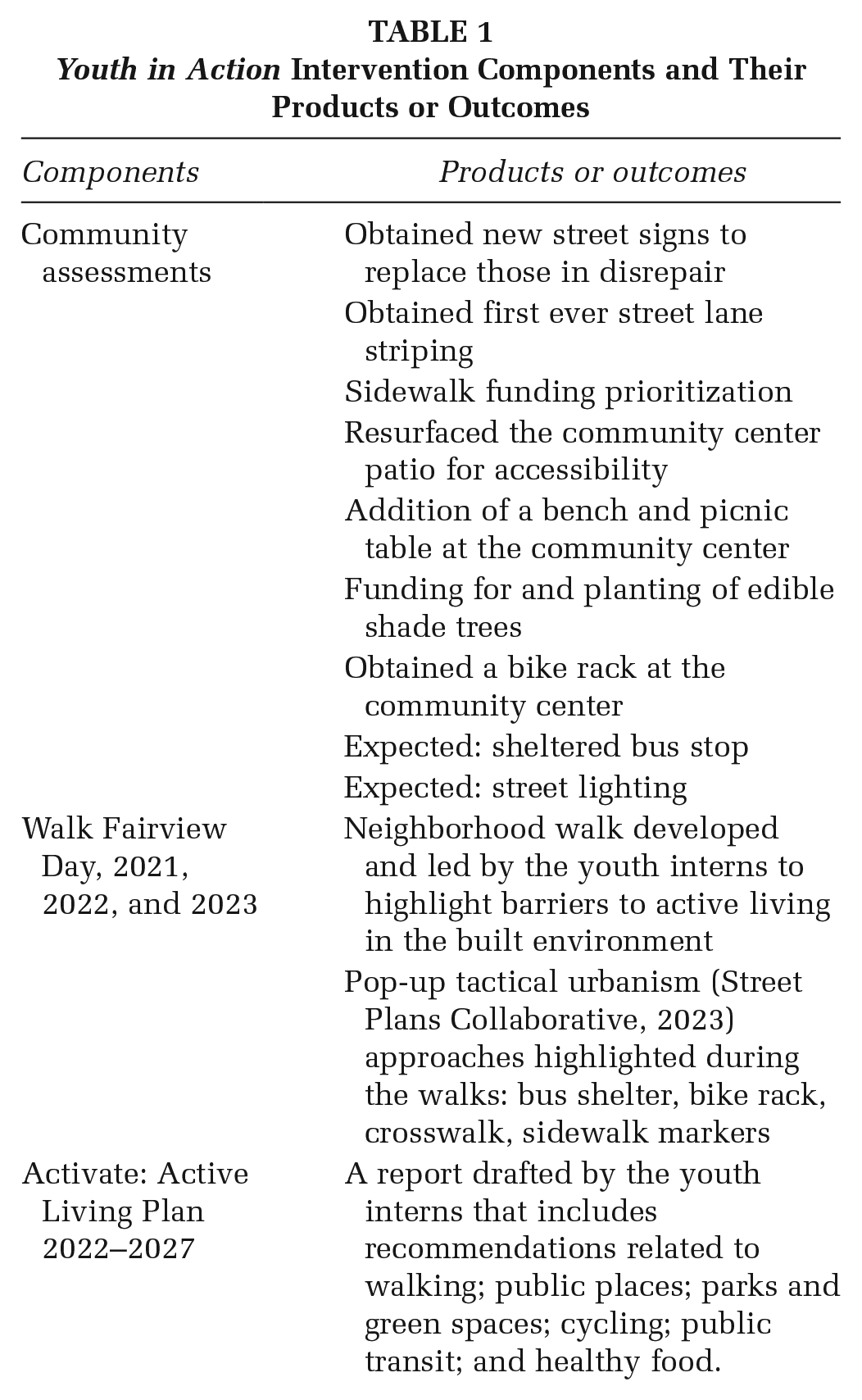
The youth interns participated in community assessment activities, planned and led community walks, and drafted a report of recommendations. These program components are described below and in Table 1.
Youth in Action Intervention Components and Their Products or Outcomes
Community Assessment Activities
Throughout the program, youth interns participated in a number of activities to assess the active living potential of their community. In initial youth intern meetings in 2019, the cohort of interns observed how litter, loose dogs, lack of sidewalks, and speeding vehicles made walking feel unsafe. To better understand these issues, the interns were asked to draw a map of their community, noting road conditions and gathering information on broken or vandalized street signs and pinpointing areas with high rates of reckless driving (using the AARP Walk Audit and the Public Place Audit Toolkit; American Association of Retired Persons [AARP], 2022). Interns also utilized community assessment tools to identify strengths, weaknesses, and opportunities for active living. The findings were used to guide the identification of needed improvements. Common themes were broken into: (a) Strengths and Opportunities, which included available open space; people invested in the community; youth involvement; history of collaboration; strong organizing groups and community leaders and (b) Weaknesses and Limitations, which included lack of sidewalks; drugs; other people’s perceptions of community; littering; loose dogs; and motorcycle racing. Youth interns conducted a series of mapping and assessment exercises to further understand the strengths, weaknesses, and opportunities for active living over the summers of 2020 to 2022 (using the Asset Mapping Toolkit; Duncan, 2018). Interns met with city planners, researchers, and politicians to learn about ways to make Fairview a safer, more inviting community. During this process, the interns expanded their focus on walkability to include biking, public transit, public places, and parks.
Walk Fairview Day
In the summers of 2021, 2022, and 2023, the interns organized Walk Fairview Day, a neighborhood walk and advocacy event highlighting findings and celebrating accomplishments. Youth led community members, including policymakers, on community walks to experience barriers to active living firsthand. Utilizing tactical urbanism approaches (Street Plans Collaborative, 2023), the interns created temporary demonstrations along the route.
Activate: Active Living Plan, 2022–2027
In 2022, the interns drafted a report entitled Activate: Active Living Plan to document their findings and recommendations. The report is the culmination of the interns’ multi-year exploration into the challenges facing their neighborhood. The plan lays out goals across six elements: Walking; Public Places; Parks and Green Spaces; Cycling; Public Transit; and Healthy Food.
Outcomes
The various components of the Youth in Action program included the community assessment activities, annual Walk Fairview Days, and an Active Living Plan. Details of these components and the products or outcomes that resulted from each are provided in Table 1.
Lessons Learned
Bolstering Youth Participation in Policymaking
Youth are often left out of the policymaking process. Engaging youth, however, in decisions made about the built environment can be beneficial as youth have a unique view of their community. For example, youth often rely on walking or rolling to navigate their communities because they do not yet drive. In our study, the youth participants’ assessments helped highlight key destinations frequented by youth (community center, park, garden, and produce market) plus the informal walking “shortcuts” used to reach them. Our youth interns shared ways to involve youth in activities, such as adding public art, hammocks, shade trees, and culturally relevant recreational opportunities like soccer. Future youth engagement interventions to promote health should connect youth to policymaking.
When and How to Engage Youth
Initially, the Youth in Action program centered around the garden growing season (March–August). However, this time frame competed with other youth commitments like sports and employment. Furthermore, extending the internship program over multiple school years complicated participant recruitment and retention. So, we adjusted the program to 10 hours/week over 10 weeks in the summer. We engaged former interns as program leaders. One has even been hired as a part-time university employee. This new leadership model has fostered deeper relationships with youth and provided professional development opportunities for older youth.
A Focus on Social Justice
This youth internship program was guided by two aspects of social justice. One, epistemic justice asserts that we must honor the lived expertise of community members in making decisions that affect them. The other, participatory justice posits that there must be representation in decision-making. The interns and the program they co-created are illustrations of both forms of social justice. The lesson they convey is that when community members can honestly share their truths and effectively convey these truths to those in power, real change can unfold.
Implications and Next Steps
Youth can be excellent key informants for how to change the built environment to promote active living because they cannot simply drive a car where they want to go. Hence, as we have seen with our Youth in Action youth internship program, engaging youth in identifying and advocating for changes in their communities can promote health through facilitation of active living. Next steps for the Youth in Action program include implementing a club during the school year where interested youth can continue to advocate for the recommendations from the interns’ Active Living Plan related to traffic calming and facilitating active living (see Table 1).
Footnotes
Authors’ Note:
We would like to thank the youth interns, past and present, in the Youth in Action program for their contributions to promote active living and share their experiences. We would also like to thank the members of the Fairview community for supporting this program. Funding for this project came from the USDA’s SNAP-Ed Program.
