



Abstract
The American Public Health Association’s Public Health Education and Health Promotion (APHA PHEHP) Section celebrates its 100th anniversary by reflecting on its humble beginnings and early contributions to the field of health education. This article highlights the often-unsung history of our field and its fledgling beginnings, which is important to scholars and students alike. First codified as the Health Education and Publicity Section in the early 1920s, we trace the history and challenges of using new modes of publicity such as motion pictures and innovative exhibits to help curb the spread of infectious diseases (e.g., tuberculosis, venereal disease). Evart G. Routzahn, credited as the Section’s father, worked tirelessly to increase the Section’s visibility (renamed the Health Education Section in 1927 and the Public Health Education and Health Promotion Section in 1990) and in advancing the professionalization of health education during a time when there were no formal professional preparation programs in health education. Over the years, the Section has played significant roles in strengthening the practice of health education and communication; advancing APHA’s overall leadership, infrastructure, and governance; and contributing to the unified voice and advocacy for the health education profession and health equity. We conclude by describing contemporary initiatives that reflect the continued spirit and vibrancy of the Section in setting the stage for the next 100 years.
Keywords
The centennial of the American Public Health Association’s (APHA’s) Public Health Education and Health Promotion (PHEHP) Section provides an important milestone for reflection and celebration. But how do you measure 100 years of progress? By size? The PHEHP Section has become the largest APHA section with more than 4,800 members as of January 2024 (Public Health Education and Health Promotion [PHEHP], n.d.). 1 Through contributions to the profession? Since its early beginnings in the 1920s, Section members have assisted in the professionalization of health education and health promotion by advancing its science, practice, and policy. Through sustained partnerships? Some 50 years ago, the Section helped establish the Coalition of National Health Education Organizations (CNHEO), which continues today as a unified voice and advocates for improving the public’s health. This article highlights the Section’s humble beginnings, key leaders, and significant contributions over the millennium to advancing the spirit and science of health education and health promotion (see Table 1).
American Public Health Association (APHA) Public Health and Health Promotion Section (PHEHP) Section Selected Historical Highlights a
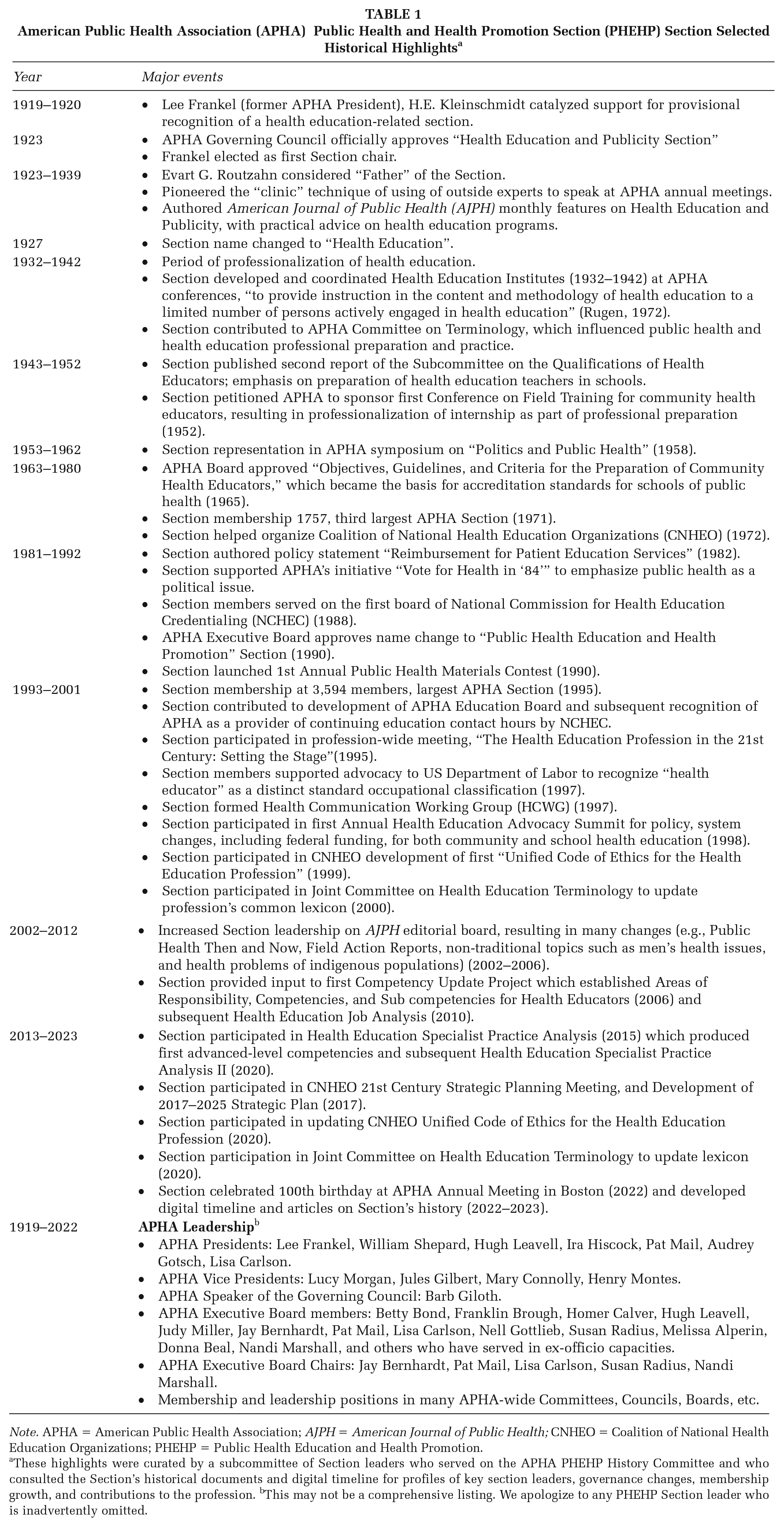
Note. APHA = American Public Health Association; AJPH = American Journal of Public Health; CNHEO = Coalition of National Health Education Organizations; PHEHP = Public Health Education and Health Promotion.
These highlights were curated by a subcommittee of Section leaders who served on the APHA PHEHP History Committee and who consulted the Section’s historical documents and digital timeline for profiles of key section leaders, governance changes, membership growth, and contributions to the profession. bThis may not be a comprehensive listing. We apologize to any PHEHP Section leader who is inadvertently omitted.
Humble Beginnings
Following WWI and the global 1918 pandemic, the nation as well as the field of public health looked to education and social welfare as avenues to address a wide variety of social justice and societal problems. The U.S. Public Health Service and various states (e.g., New York) quickly recognized the valuable role of health information and communication in radio, films, and other publicity to help attenuate disease outbreaks. Within this backdrop, an influential group of APHA members (i.e., former APHA President Dr. Lee K. Frankel and Dr. William F. Snow) successfully advocated for the creation of the “Health Education and Publicity” Section at APHA’s 52nd Annual Meeting in Boston in 1923. 2
Evart G. Routzahn, known as the father of the Section, ardently worked to increase the Section’s visibility within APHA and to support the professionalization of health education to improve the public’s health. During those nascent years, Routzahn and Section members applied their usual zeal and work ethic, using their knowledge of public health along with observations about advertising techniques to present messages and media that captured the public’s attention (Kleinschmidt, 1948; Rugen, 1972). A key project was working with the National Association of the Motion Picture Industry to use movie theaters to reach large numbers of people with accurate health information to help decrease the impact of epidemics.
Another early Section priority was to advance the knowledge and skills of the public health workforce, given that health education was not yet taught in schools of public health. Section leaders introduced lively forms of professional development at APHA meetings, which quickly attracted standing room only audiences (Rugen, 1972). The innovative “clinic” technique featured members as well as non-members with expertise in advertising and publicity who vigorously discussed and debated methods and materials in health education and public health. In connection with APHA annual meetings, the Section also began Health Education Institutes. The Institutes provided an opportunity for participants to build their skills and apply health education theory to practice applications. Today, APHA continues this legacy of providing pre-conference learning institutes that address multiple areas of public health research and practice.
The PHEHP Section also honors it mission of providing innovative professional development programs as well as serves as “a strong advocate for health education and health promotion for individuals, groups and communities, and systems and support efforts to achieve health equity in all activities of the Association” (American Public Health Association [APHA], n.d.-b).
Contributions to APHA’s Priorities
As members of the PHEHP Section continued to work toward recognition of the profession, they also contributed their expertise internally to advancing APHA’s priorities. For example, APHA’s Committee on Terminology was richly populated with PHEHP members. Section leaders published monthly features in the American Journal of Public Health (AJPH) with practical advice on Health Education and Publicity, a Motion Picture Film Review, a periodic public health bibliography, and updates on public health legislation (Rugen, 1972). The Section’s contributions in effectively using media for health improvement has continued in APHA for many years. Two examples include the public health materials contest launched in 1990 and the Health Communications Working Group (a subsection of PHEHP), which was formed in 1997. Both initiatives provide vibrant contributions to contemporary APHA annual conferences.
The PHEHP Section also was instrumental in establishing APHA’s Education Board to provide continuing education credits, and in December 1995, APHA became a recognized provider of Continuing Education Contact Hours (CECH) for certified health education specialists (CHES®) by the National Commission for Health Education Credentialing, Inc. (NCHEC). APHA’s annual meeting, webinars, and other sessions now serve as a major source of CECHs for many CHES® and master certified health education specialists (MCHES®). PHEHP members also have been active participants in writing study guides and serving on the Board of Commissioners and committees of NCHEC. Section members have actively participated in four iterations of the competencies and sub competencies that provide the framework for the successful preparation and continuing education of health educators (National Commission for Health Education Credentialing [NCHEC] and Society for Public Health Education [SOPHE], 2020).
In all, the PHEHP Section’s contributions to association leadership include more than 10 past APHA presidents and vice presidents, a long-term speaker of the Governing Council, numerous AJPH and Nation’s Health editorial board members, multiple Executive Board members and Executive Board Chairs, and many committees that help support the organization.
Contributions to the Profession
Although the PHEHP Section has made many contributions to the profession, highlighted here are major contributions in setting professional standards and terminology, partnerships, advocacy, and a unified code of ethics. In 1972, the PHEHP Section was a founding member of the CNHEO and maintains representation to this day. At the initial CNHEO meetings, the Section representatives called on its 50 years of notable work in supporting professionalization, which helped shape the coalition’s early directions. Such examples include the work of PHEHP Section members on the APHA Committee on Terminology, the 1940s report of the “Subcommittee on the Qualifications of Health Educators,” the 1965 APHA-board approved “Objectives, Guidelines and Criteria for the Preparation of Community Health Educators” and the Section’s 50 years of workforce development (PHEHP, n.d.; Rugen, 1972).
Over the years, the PHEHP Section has promoted the active participation of its members in APHA-wide advocacy efforts (e.g., “Vote for Health in ‘84’”) as well as marshaled efforts with other health education organizations in the Joint Committee on Legislatin and Advocacy in 1984 (PHEHP, n.d.). Subsequently, at a 1995 meeting in Atlanta (“The Health Education Profession in the 21st Century: Setting the Stage”), PHEHP representatives endorsed the need for public health educators to become more involved in policy and proactive in social change. At the same time, these leaders understood the importance of educating policymakers on topics of funding and creating healthy communities so that health behavior change could occur. Thus, advocacy emerged as a priority area (APHA Newswire, 2022). As a result, the PHEHP Section ultimately formed an Advocacy Committee, which assisted in gaining recognition of “health educator” as a distinct occupational classification by the Department of Labor in 1997 (Auld, 2009; PHEHP, n.d.) and helped author many APHA resolutions. In addition, the Section was a founding member of the Health Education Advocacy Summit in 1998 (Auld, 2009) and continues to support this effort as a member of the CNHEO.
PHEHP representatives participated in developing the CNHEO 2017–2025 Profession-Wide Strategic Plan (Coalition of National Health Education Organizations [CNHEO], 2021), updating profession-wide terminology (Videto & Dennis, 2021) as well as contributing seminal efforts in developing the “Unified Code of Ethics for the Health Education Profession” in 1999 and its most recent update in 2020 (CNHEO, 2020).
Contributions to Society and Moving Forward
Over the past century, health education professionals have been integrally involved in the reduction of morbidity and mortality due to infectious and chronic diseases and deaths due to injury. Many PHEHP Section members were leaders as employees or special advisors to strategic campaigns of federal agencies (e.g., CDC, NIH, ODPHP, HRSA, FDA, AHRQ, Department of Transportation), dedicating their time and talent to the U.S. Preventive Services Task Force, Healthy People Objectives for the Nation, Surgeon General Reports, and other initiatives. Other Section members devoted their careers to the private and non-profit sectors (e.g., Robert Wood Johnson Foundation, Kellogg Foundation, the American Red Cross, Safe Kids Worldwide, Asian Pacific Partners for Empowerment, Advocacy and Leadership [APPEAL], Society for Public Health Education) to address critical gaps in health programs, research, access, and services. PHEHP members also have provided leadership to credentialing bodies (e.g., Council on Education for Public Health) and served on the editorial boards of prestigious journals (e.g., Health Education and Behavior, Health Promotion Practice, Pedagogy in Health Promotion, Annual Review of Public Health, the American Journal of Preventive Medicine, Injury Prevention). The placement of PHEHP Section members on these important boards, agencies, and organizations has resulted in positive outcomes for both the growth of the profession and the improvement of societal health.
The spirit, vibrance, and accomplishments of the Section’s early days continue to motivate its current leaders in confronting the latest public health challenges. For example, supporting the growth and diversity of the future health education workforce is among the Section’s highest priorities. The awards program, mentorship initiatives, student-focused presentations and activities at annual meetings, and conference scholarships enable many PHEHP students and young professionals to get their start (APHA, n.d.-b). The Section’s Health Equity Committee organizes diversity-related presentations at APHA’s conferences and oversees the Section’s Health Equity Award, which honors extraordinary individuals or organizations that have made significant advances in health education or health communications research, programs, or practice to improve health equity and eliminate health disparities at the national, state, local, or international levels. The health communication materials contest has evolved to include distinct criteria and awards for training, print, and multi-media health communications.
An exciting Innovation Lab (IL) was launched in 2021 to provide a dedicated space for public health professionals to imagine and implement creative solutions for entrenched health challenges. Section volunteers used principles of Appreciative Inquiry, action learning, and adaptive leadership to address the involvement of health educators in COVID-19 pandemic response. They also documented their process for developing innovative solutions and lessons learned during the IL pilot to share with other APHA sections.
To commemorate this centennial, the PHEHP Section is further chronicling and publicizing its history. In addition to working with APHA’s archivist to formalize a process for other APHA units to document their memoirs, articles about the Section’s past and future have been submitted to AJPH and printed in several other APHA publications (APHA Newswire, 2022; Nicolaus, 2022). An interactive, digital timeline (APHA, n.d.-a) was developed with historical facts and photos of the Section’s leaders and journey on behalf of the health education profession.
Finally, as Shakespeare said, “What’s past is prologue.” Understanding the past is a useful guide and can help inform better decisions or inspire future visioning. Over the years, the PHEHP Section wrestled with various challenges such as overcoming opposition to its initial formation as a distinct APHA section, debating various section name changes, and weighing the potential impact of certification and credentialing on the profession. Yet, more than 100 years later, this article points with pride at what can be accomplished with dedicated leadership, vision, courage, risk-taking, advocacy, innovation, and resilience in principle and practice. These historical highlights serve as powerful lessons for the current Section leaders as well as in preparing and mentoring the next generation of health education professionals in developing their competencies related to ethics and professionalism (i.e., Health Education Specialist Practice Analysis II 2020, Area VIII, Ethics and Professionalism [NCHEC and SOPHE, 2020]).
Conclusion
As the PHEHP Section celebrates its centennial, its impact on not only APHA but also the health education and health promotion profession and on society is evident. The next 100 years of the PHEHP Section will be an era in which its leaders and members will continue as key players in the growth and governance of APHA, act as essential contributors to the success and evolution of the profession of health education, and advocate for improvements in health literacy, health equity and health outcomes for all. We look forward to meeting the future public health challenges with the same dedicated spirit, innovation, and energy as PHEHP Section founders and other leaders of the health education profession.
Supplemental Material
sj-pdf-1-hpp-10.1177_15248399241235925 – Supplemental material for 100 Years of the American Public Health Association’s Public Health Education and Health Promotion Section: Celebrating the Past, Forging the Future
Supplemental material, sj-pdf-1-hpp-10.1177_15248399241235925 for 100 Years of the American Public Health Association’s Public Health Education and Health Promotion Section: Celebrating the Past, Forging the Future by M. Elaine Auld, Regina A. Galer-Unti, Melissa Alperin and Angela Mickalide in Health Promotion Practice
Footnotes
Authors’ Note:
The authors extend their gratitude to the following individuals for their guidance in developing this manuscript and related activities commemorating the PHEHP Section’s 100th Anniversary: Donna Beal, Theresa Byrd, Pat Mail, Marla Clayman, Tyler Fuller, Julia Alber, Lauren Sandoval, Ashley Love, Samantha Cinnick, Ruta Viela, Andrea Medeiros, Karen Mancera-Cuevas, and APHA staff Wendy Shay and Mark Barna. We are especially grateful to Pat Mail for her generous support in making this article perpetually open access as a resource and reminder to all health education professionals and others that “we stand on the shoulders of giants.

Notes
References
Supplementary Material
Please find the following supplemental material available below.
For Open Access articles published under a Creative Commons License, all supplemental material carries the same license as the article it is associated with.
For non-Open Access articles published, all supplemental material carries a non-exclusive license, and permission requests for re-use of supplemental material or any part of supplemental material shall be sent directly to the copyright owner as specified in the copyright notice associated with the article.
