



Abstract
The Supplemental Nutrition Assistance Program-Education (SNAP-Ed) provides nutrition education and support for healthy living in SNAP-qualifying communities. SNAP-Ed supports policy, systems, and environmental (PSE) efforts to make the healthy choice an easier choice. SNAP-Ed implementers have widely adopted healthy eating PSE supports. However, physical activity (PA) PSE strategies are less common, with limited awareness between states of how other SNAP-Ed implementers approach PA-focused PSE work. Physical Activity Policy, Research, and Evaluation Network (PAPREN) Rural Active Living Workgroup project members sought to explore how Extension-based SNAP-Ed implements PA-focused PSE approaches. A sample of Extension-based SNAP-Ed program (n = 8) leaders were purposefully recruited from eligible universities in six of the seven SNAP-Ed regions. An interview guide to systematically collect information about current Extension SNAP-Ed implementation focused on PA PSE strategies was developed iteratively by the PAPREN Rural Active Living Workgroup Extension PA PSE project team. PA PSE Extension SNAP-Ed implementation efforts occurred at the state, county, and community levels and/or within local organizations. PA PSEs included school PA policy change, shared-use agreements, active transportation promotion, park development, walking challenges, and PA-promoting signage. All interviews highlighted the importance of partnerships at local, county, and state levels for PSE efforts. Extension-based SNAP-Ed shows potential to bring community partners together to plan and implement PA-focused PSE approaches. With a focus on SNAP-eligible people and substantial geographic reach, Extension SNAP-Ed is uniquely situated as a public health partner to broadly implement PA PSE changes.
Keywords
Introduction
Cooperative Extension is a hidden player in public health. Operating through public land-grant universities (LGUs), Extension connects communities with university resources, translates research to meet local needs, and provides community-based education. Extension emphasizes individual and social determinants of health (Braun et al., 2014) and acknowledges the importance of building capacity for policy, system, and environmental (PSE) changes (Burton et al., 2021).
The Supplemental Nutrition Assistance Program-Education (SNAP-Ed) program began in 1992, providing nutrition education to SNAP-eligible audiences. With the passage of the Healthy, Hunger-Free Kids Act of 2010 (HHFK), SNAP-Ed expanded to include obesity prevention, integrating PSE strategies to increase physical activity (PA). The SNAP-Ed Evaluation Framework reinforces PSE strategies, including objectives for population-level PA (UNC Center for Health Promotion and Disease Prevention, 2016). Every state has SNAP-Ed, and Extension serves nationally as the leading SNAP-Ed implementer, with 56 LGUs participating (Yetter & Tripp, 2020). Extension-based SNAP-Ed programs follow national SNAP-Ed guidance but are differently administered, organized, and implemented.
PA PSE strategies are endorsed but not required for SNAP-Ed implementation. Extension implementers in only 19 states reported PA PSE change initiatives in 2019 (Yetter & Tripp, 2020). There is limited evidence of the nature and impact of PA PSE work across Extension-based implementers. Some LGU Extensions publish efforts and outcomes of SNAP-Ed PA PSE strategies (Harden et al., 2018; Hardison-Moody et al., 2020; Orzech et al., 2023) or provide reports online, like the University of Arizona’s Evaluation website (https://nutritioneval.arizona.edu/results) which highlights SNAP-Ed work around built environment change (Jacobs et al., 2022). However, peer-reviewed publications on Extension SNAP-Ed PA PSE efforts are scarce.
The purpose of this study was to explore how Extension-based SNAP-Ed programs are implementing PA PSE strategies prioritized within national SNAP-Ed and Cooperative Extension systems. The study was developed as a project of the Physical Activity Policy Research and Evaluation Network (PAPREN) Rural Active Living Workgroup (https://papren.org/papren-work-groups/rural-active-living-work-group/). PAPREN is a research network of the Prevention Research Centers program of the U.S. Centers for Disease Control and Prevention that seeks to advance PA policy and translation of evidence into practice at local, state, and national levels.
Methods
Extension-based SNAP-Ed programs (n = 8) were purposefully sampled from LGU Extensions in six of the seven SNAP-Ed regions (Figure 1). Eligibility criteria included (a) LGU Extension as a state SNAP-Ed implementing agency and (b) PA identified as a focus area in Extension’s SNAP-Ed implementation plan. Interview participation criteria included holding leadership position(s) within Extension with responsibilities for plan implementation (13 participants across eight state interviews). An interview guide to systematically collect information about current Extension SNAP-Ed PA PSE strategy implementation was developed by the project team. Interview questions and informed consent were emailed in advance to participants. IRB exemption was approved by first author’s (J.S.) institution. Interviews were conducted between March and October of 2022, recorded, and auto-transcribed using Zoom and then reviewed to ensure accuracy.
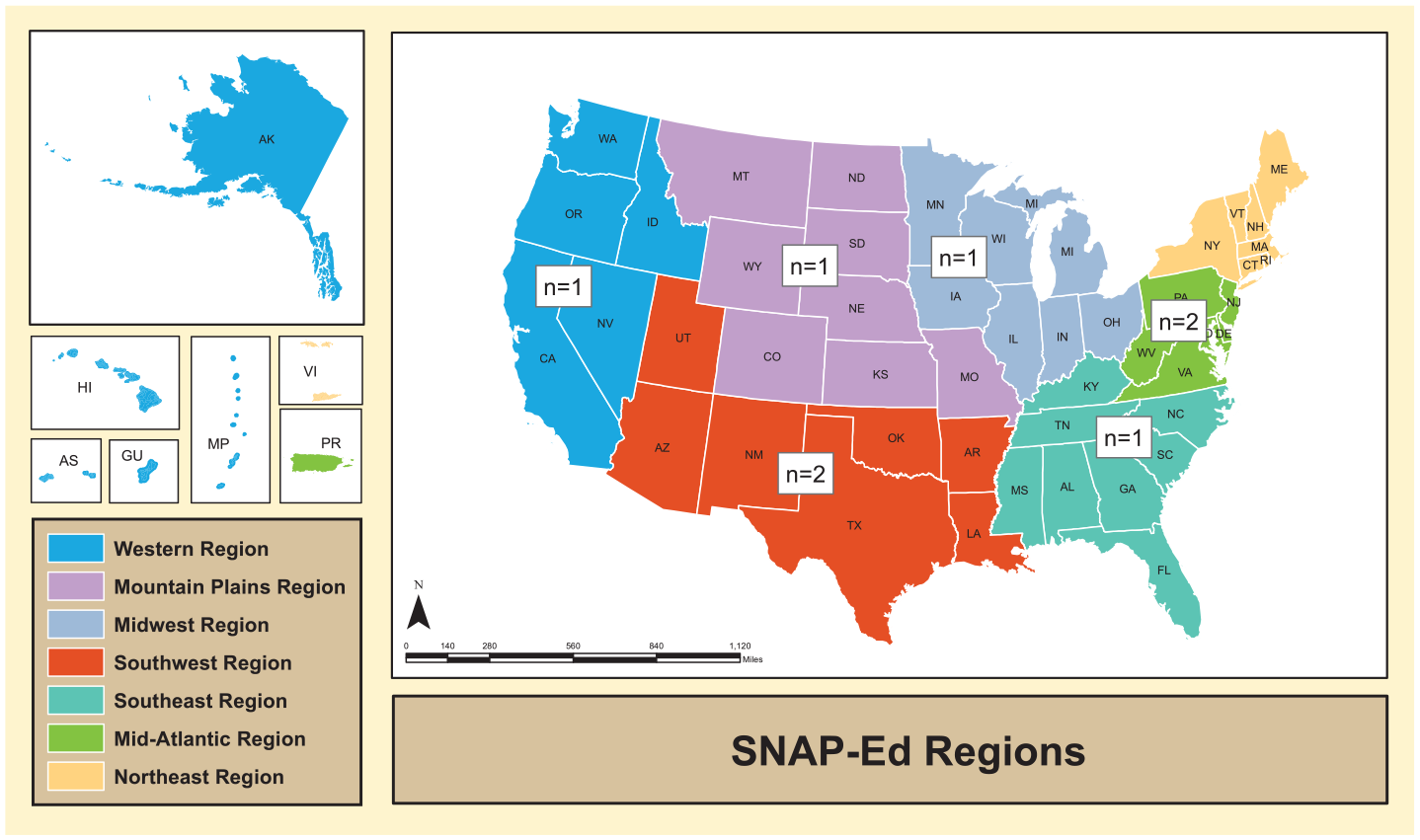
USDA Food and Nutrition Service (FNS) Regions/Supplemental Nutrition Assistance Program-Education (SNAP-Ed) Regions and Number of State Land-Grant Universities (LGU) Interviews Conducted per Region
Guided by the interview questions, two authors (K.M.O., D.H.J.) created a codebook and coded the same two interviews using NVivo. After reconciliation meetings resulting in minor adjustments, inter-coder agreement averaged 96%. Subsequently, each coder single-coded three additional interviews. To verify evidence of PA PSE changes as outcomes of Extension SNAP-Ed implementation and/or support, coding was triangulated by a third author (M.R.U.M.).
Results
Thematic analyses focused on Extension SNAP-Ed PA PSE efforts at the organization, community, county, and/or state levels. Table 1 summarizes findings. All interviews highlighted the importance of partnerships, including schools (e.g., wellness committees, administrators and educators), local coalitions and organizations (e.g., Boys & Girls Clubs), libraries, county and state public health agencies, farmers markets, community gardens, health care systems, tribal agencies, faith-based organizations, senior centers, parks and recreation departments, planning organizations, state-level departments of education, transportation, and/or advocacy networks. Findings were organized by identified policy, systems, and environmental strategies, concluding with the Extension SNAP-Ed’s role in community PSE engagement.
Policy, Systems, and Environment Efforts and Changes by Implementation Level
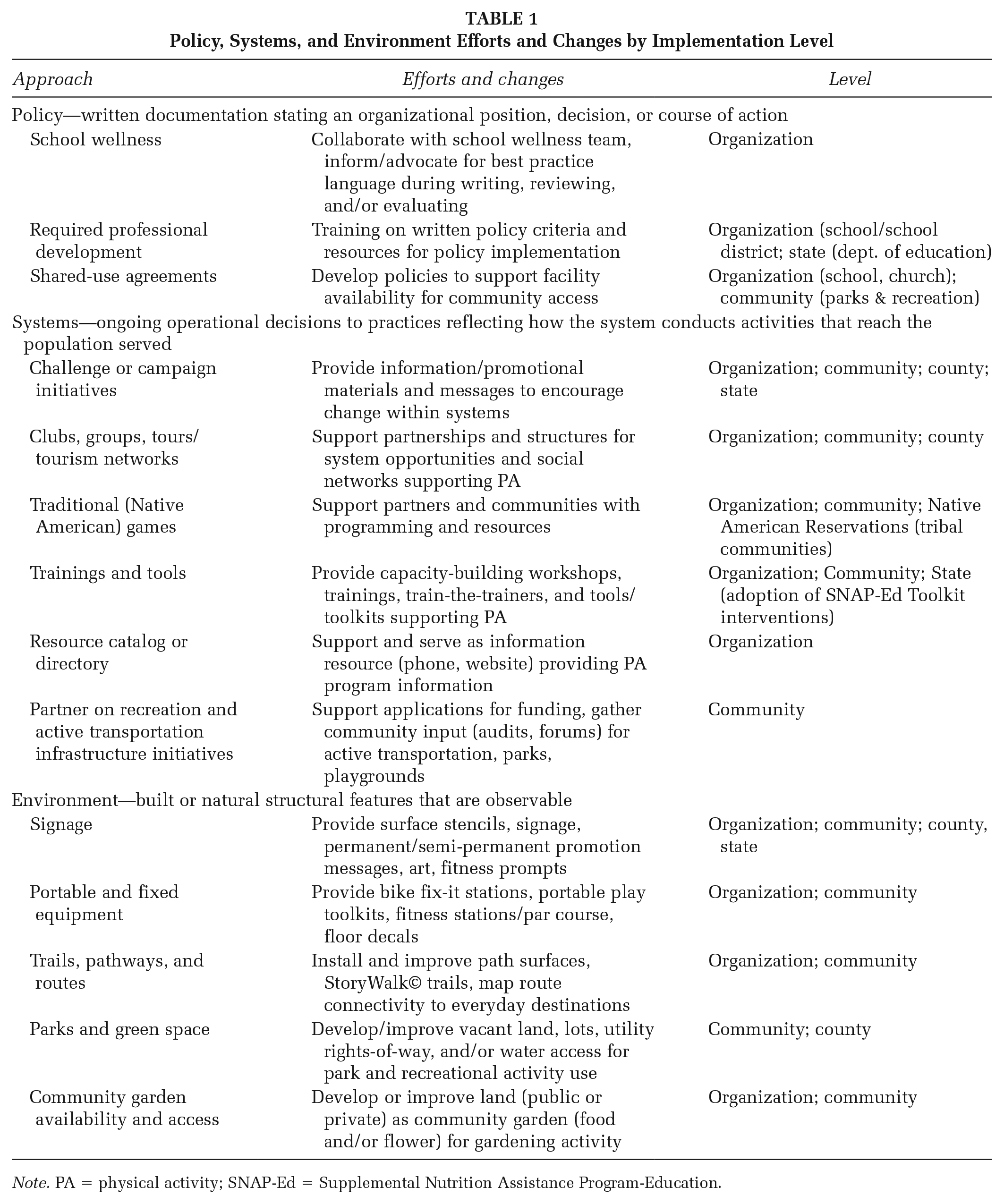
Note. PA = physical activity; SNAP-Ed = Supplemental Nutrition Assistance Program-Education.
Policy
Four of eight interviews described policy efforts in partnership with school wellness committees, with one team collaborating with the state department of education. The primary aim was to establish school policies to increase PA opportunities during the school day, including activity breaks, teacher training, or meet daily and/or weekly minimum PA minutes. Other school PA policy changes included policies to prevent “withholding recess as a punishment,” “making sure movement [is] for everybody,” and providing “PA opportunities before, during, and after school.” One interviewee described SNAP-Ed involvement in developing shared-use agreements to “open up church or school facilities to the public after hours.”
Systems
Seven of eight interviews described systems changes. Examples included incorporating PA programming in schools (e.g., PA challenges, brain breaks), training teachers and providing tools (e.g., workshops, toolkits), and advocacy for adoption of state or national PA campaigns (e.g., Safe Routes to School).
Some interviewees described systems efforts to increase PA through active transportation: “We also encourage national walk-to-school day, and get schools to think about [their] drop-off situation, would [they] be better off traffic-wise to have people drop off at a different site and have the children walk further to the schoolhouse?”
Environment
Five of eight interviews described PA environment changes. Environmental change occurred primarily in collaboration with school, local community, and sometimes county partners. Partnerships were discussed as a key factor, particularly with organizations with the power to make changes. Partners included parks and recreation, libraries, and city and county governments. Most environmental efforts focused on activating places to encourage PA. Interviewees shared similar stories, such as: In schools, what we do is try to get people to do different activities. But we also have funded things like signage. That can be decals on the floor, but we’ve also got sidewalk stencils for activities. They can be painted on, and then the kids can jump through them. Unfortunately, the way that SNAP-Ed grant monies come through, there’s nothing for playground equipment or anything like that. So, [SNAP-Ed staff] have to be a little more creative.
Most interviewees noted that federal and state policy restricts SNAP-Ed in changing the PA built environment. All interviews described the addition of signage (temporary or permanent) to existing paths or mapped routes as an environmental change.
Extension SNAP-Ed Role in Community PSE Engagement
Interviewees highlighted Extension SNAP-Ed support for community-engaged PSE approaches. These included involvement in planning (e.g., community forums, coalitions), assessment (e.g., walk audits), trainings, evaluation, applying for grant funding for PA activities and infrastructure, broader policy initiatives (e.g., county transportation plan), and systemic inclusion of PA opportunities within non–PA-focused Extension or community programs (e.g., summer feeding programs). As one interview explained: Our [Extension] agents do assessments, including community forums, walk audit[s]—things like that. From there, they gather a community coalition, and facilitate that coalition. They’re then able to identify PSE strategies that [the community] would like to implement based on assessments [agents] did with them. We’ll then use pooled resources to get those PSEs implemented based on feedback that we’ve gotten from the community. Our PSEs aren’t necessarily prescribed. Our agents are facilitating conversations around PSEs that might be recommended for some of the problems people are indicating.
Efforts to support infrastructure changes were also mentioned, such as helping neighborhoods and place-based communities develop funding applications for active transportation and/or park/playground improvements. Extension SNAP-Ed served as a community convener (e.g., gathering support for submitting bike and pedestrian funding applications), described below: It’s been a long conversation that started with “we want this bike path to go all the way around the town.” And a lot of very go-getter people got pushback from landowners that said, ‘No, that’s absolutely not going to go through my land.’ It’s like an eight-block distance from the school to the boys and girls club, and half of that doesn’t have any sidewalk, and it’s crazy busy with cars. We ended up [using] a drone. One of the community members decided, “Hey, I can help with that.” So we took drone footage right after school with kids walking to the club.
Implications for Public Health
This study sought to explore the scope of PA PSE work occurring through Extension SNAP-Ed. A major takeaway is that policy and systems changes are most effective if coupled with efforts to improve equitable, easy access to resources that facilitate PA (Yetter & Tripp, 2020), a task well-suited for Extension SNAP-Ed programs.
Our findings highlighted political and financial barriers to implementing structural changes to PA environments. Extension SNAP-Ed work generally focused on small-scale changes (e.g., signage). This aligns with past research that explored Extension staff capacity to utilize PSE approaches and reinforces that Extension SNAP-Ed PSE work is restricted by national and state funding policies as well as system readiness to adopt and evaluate PSE efforts (Holston et al., 2021; Washburn et al., 2022). Opportunities exist for SNAP-Ed to partner in substantial PA PSE changes, noted in some of our interviews (e.g., park development, state department of education policy changes, active transportation funding applications). Harden and colleagues describe Extension’s work in community education as having “high investment for low reach and low impact” and called for a system shift toward high-reach PSE approaches and impacts for “healthier, more equitable communities” (Harden et al., 2020).
Future research can build on our findings by investigating ways to increase the equitable distribution of Extension SNAP-Ed resources. Extension SNAP-Ed professionals serve SNAP-eligible (i.e., lower income) people; some Extension agents may struggle to understand how community-based PSE work aligns with SNAP-Ed requirements, as those changes benefit the entire community population (Holston et al., 2021). Research teams must investigate how empirically-supported strategies for increasing PA benefit (or not) SNAP-eligible populations.
These results can inform existing Extension SNAP-Ed efforts and public health Extension practices. Extension SNAP-Ed PSE work includes environmental change approaches. These results may be useful to promote partnering with Extension SNAP-Ed in collaborative applications for funding, gathering community feedback, hosting walk audits, or other forms of community engagement. Because SNAP-Ed relies on community partnerships to provide community nutrition education (e.g., offering programs in libraries, food pantries, churches, and senior centers), SNAP-Ed is an ideal partner to gather equitable input on community needs for bike, pedestrian, and Americans with Disabilities Act (ADA)-accessible infrastructure.
Extension SNAP-Ed is a potential partner for implementing PA PSE efforts, with an organizational structure that often features Extension specialists that serve as resources for county-based agents who partner with community organizations. By partnering with Extension specialists, SNAP-Ed can effectively disseminate efforts throughout a state (Harden et al., 2020; Strayer et al., 2020). In addition, Extension SNAP-Ed can function as a strategic community partner in identifying and prioritizing needed PSE changes (Gunter et al., 2017). With a focus on SNAP-eligible people and broad geographic reach, Extension SNAP-Ed is uniquely situated to catalyze PA PSE change.
Study limitations include interviewees’ emphasis on schools, although improving community PA spaces was also highlighted. The shift from program-centric delivery to contextual strategies, including PSE efforts, likely begins with strong existing partnerships, such as schools and community centers. In addition, while we were not able to interview any implementers in the Northeast region, our work includes perspectives of Extension staff with a detailed understanding of work in their respective states. However, participants may not be aware of every initiative; it is probable that some efforts were not reported.
This study has important strengths. We provided an overview of existing PA-focused PSE approaches led by Extension SNAP-Ed implementers. This is crucial given that PA-focused PSE interventions are now a priority for Extension SNAP-Ed programs, and there is little information-sharing across states. Our Rural Active Living Workgroup project team, with expertise in PA and PSE promotion in underresourced communities and Extension-specific experience, met regularly to develop interview guides, code transcripts, analyze results, and provide peer review.
Study findings demonstrate PA PSE approaches are being successfully employed by Extension SNAP-Ed implementers across the United States. Results can be used to increase awareness of Extension and SNAP-Ed for promoting population-level PA nationally. This study provides a PA PSE implementation snapshot from Extension staff representing the majority of SNAP-Ed regions.
Footnotes
Authors’ Note:
This work is a product of the Physical Activity Policy Research and Evaluation Network (PAPREN). PAPREN is supported by Cooperative Agreement Number U48DP006381 from the Centers for Disease Control and Prevention and is a product of the Physical Activity Policy Evaluation and Research Network, a thematic network of the Prevention Research Center network. All authors are members of the PAPREN Rural Active Living Work Group. PAPREN is an applied research and evaluation network focused on identification and implementation of local, state, and national policy approaches that influence opportunities for physical activity and built environment strategies. The findings and conclusions in this article are those of the authors and do not necessarily represent the official position of the Centers for Disease Control and Prevention. No copyrighted material is included in this work. The authors would also like to acknowledge the support of David Brown of the CDC’s Division of Nutrition, Physical Activity, and Obesity. No financial support was received for this work.
