



Abstract
We explored student and industry supervisors’ experiences of virtual work-integrated learning (vWIL) health promotion placements during the COVID-19 pandemic. Using a descriptive phenomenological qualitative methodology, we conducted semi-structured interviews with eight students and eight supervisors of undergraduate health promotion–related placements at community, not-for-profit and government organizations. We asked participants about the aspects of their placement they found most enjoyable and challenging, their preparation, workload, and thoughts on placement structure. We audio-recorded and had the interviews transcribed. Our thematic analyses revealed four key themes: (1) the impact of COVID-19 on work and study, (2) benefits of vWIL (real-world application and career clarification, transcending barriers and saving time, and feeling less intimidated), (3) challenges of vWIL (experiencing workplace culture, providing support and guidance to students, and relationship building), and (4) recommendations on the evolution of vWIL (increased preparation and consider a hybrid model). Our findings suggest that vWIL is a viable and sound mode of delivery for health promotion–related placements, particularly in situations that inhibit face-to-face learning. It has the capacity to enhance the work-readiness of health promotion graduates while adding flexibility to professional preparation workplace-based training programs, providing opportunity for capacity building locally across rural and remote areas, as well as globally. Future research should examine the effectiveness, practicality, and feasibility of implementing placements across different models including face-to-face, virtual and hybrid.
Keywords
Introduction
The COVID-19 pandemic not only dramatically changed the way in which we work, but also raised the awareness of the importance of health promotion, including the need for more health promotion–trained professionals (Fifolt et al., 2022). Work-integrated learning in the form of industry-based placements or internships is a common method of preparing graduates for the workforce. While placements have traditionally been conducted face-to-face, opportunities for them to be delivered virtually are becoming increasingly prevalent, in part due to events such as the COVID-19 pandemic (Jeske & Axtell, 2014).
Research to date has described virtual work-integrated learning (vWIL) placements in a range of disciplines (Cornelius et al., 2008; Gill, 2020; Hora et al., 2021), including public health (Fifolt et al., 2022). The majority of these studies transitioned to virtual delivery in response to the COVID-19 pandemic. While most of these studies provided thorough rationale, description, and discussion of the placements, exploration of the experiences of participating in vWIL are limited. To our knowledge, no studies have explored the impact of health promotion vWIL experiences from the perspective of both students and industry supervisors. Given the transition to online learning, and the increased need for work-ready health promotion graduates, we aimed to explore students and supervisors’ experiences of vWIL health promotion placements during the COVID-19 pandemic.
Method
Study Design
We utilized a descriptive phenomenological qualitative methodology to explore the vWIL experiences of students and supervisors in 2020 coordinated by Monash University (Melbourne, Australia). The study was approved by the Monash University Human Research Ethics Committee (#27407).
Participants
Virtual placements were delivered through two health promotion units in the latter 6 months of 2020: (1) Bachelor of Health Science/Public Health third-year Health Promotion Practicum unit (n = 13); and (2) Bachelor of Biomedicine second-year Biomedical Industry Based Learning unit (n = 18). Students completed summative assessment tasks for each placement, including reflective journals and oral presentations, alongside 80–100 hours of work placement during a 12-week semester. Prior to COVID-19, placements intended to be face-to-face.
The placements were conducted at community (n = 4), not-for profit (n = 4), and Government (n = 3) organizations, all of which had previously hosted a student or were networks of the coordinating staff. We identified students through purposive sampling and invited them to participate via email or Facebook messenger. Supervisors were invited via email.
Data Collection
We conducted semi-structured interviews between January and February 2021 via online video or phone call, depending on the participants’ preference. Student interviews were conducted by T.O.; supervisor interviews were conducted by S.Z. We utilized an interview guide which included open-ended questions. Our use of the semi-structured interview guide allowed participants to describe their experience freely, allowing us to probe and prompt for further elaboration and clarification.
Data Analysis
Audio-recordings of the interviews were sent to GoTranscript for transcription. Multiple read throughs of the transcripts were conducted by T.O. before they were openly coded. Transcripts were also read by a second researcher, B.H., for investigator triangulation. During the open coding process, we broke down the data into segments of meaning and applied labels. After grouping meanings across the transcripts, we created tables that allowed themes and codes to be documented and organized. B.H. and T.O. worked to organize themes and codes until consensus was reached. Transcripts were exported into NVivo 20.3 and coded by T.O. Any further patterns, relationships, and themes identified in this step were cross-checked by B.H. to ensure unanimity.
Results
We held interviews, varying in length from 20 to 50 minutes, with 16 participants (students n = 8, supervisors n = 8). Our thematic analysis of the interviews revealed four key themes, with subthemes and sample quotes that are most illustrative of the theme shown in Table 1.
Themes, Subthemes, and Sample Quotes Resulting From Thematic Analysis
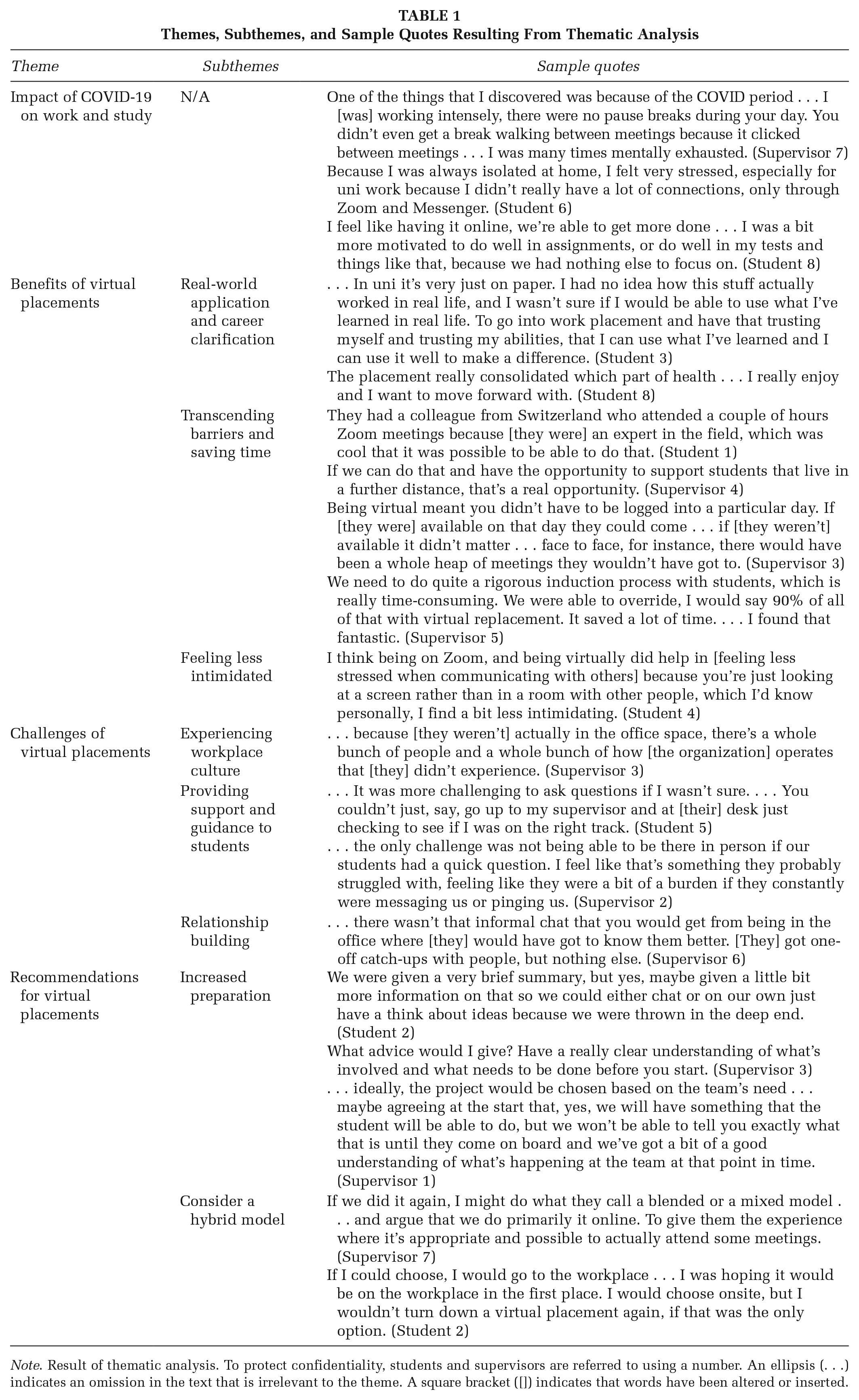
Note. Result of thematic analysis. To protect confidentiality, students and supervisors are referred to using a number. An ellipsis (. . .) indicates an omission in the text that is irrelevant to the theme. A square bracket ([]) indicates that words have been altered or inserted.
Impact of Covid-19 on Work and Study
Participants consistently described the pandemic as a challenging time characterized by uncertainty, stress, anxiety, and loneliness. Working online during the pandemic often left supervisors and their teams feeling burnout and unmotivated, which negatively impacted their capacity and the work they produced. Similarly, students described finding studying online difficult and felt unmotivated and stressed. We didn’t find universality in these sentiments, with some participants enjoying the ability to work and study from home.
Benefits of Virtual Placements
Real-World Application and Career Clarification
Students expressed that their vWIL experience helped them apply and further develop their health promotion knowledge and skills acquired through their undergraduate degree. The placements also helped students clarify their career path, particularly which area they may wish to pursue.
Transcending Barriers and Saving Time
The accessible nature of vWIL enabled students to be placed with organizations located interstate and allowed them to connect and work with individuals located around the globe. We found being able to transcend location barriers and supervise students who may have limited access to placement was a major advantage of vWIL.
The time gained by not needing to commute to a vWIL placement was a benefit we found was consistently expressed by participants. The removed need to travel, coupled with the flexible nature of vWIL, gave students more time to work on projects and the option to work when it suited them. Students were also able to attend online meetings or events on days other than their designated placement days. Supervisors also found that delivering placements virtually decreased the need for lengthy and complex setup processes such as providing access to cars.
Feeling Less Intimidated
Students shared with us that they associated stress and fear with the prospect of working with an experienced team in the workplace. In contrast, they indicated to us that vWIL was less intimidating which helped them feel confident.
Challenges of virtual placements
Experiencing Workplace Culture
Supervisors found that vWIL minimized the opportunities available for students to experience the business culture and day-to-day workings of the organization.
Providing Support and Guidance to Students
From the students’ perspective, a lack of support and guidance from supervisors was consistently expressed to us as a challenge of vWIL. Receiving support was believed to be hindered by having to email queries. The challenge of asking questions virtually was often compared with the perceived ease of asking them face-to-face. Relatedly, supervisors felt vWIL impacted their ability to provide support, empathizing with the students’ struggle with asking for help.
Relationship Building
Students also expressed that they felt the virtual environment had a negative impact on their ability to network with team members. They believed they would have made stronger connections if given the opportunity to chat informally in the office. We found this view was also shared by supervisors.
Recommendations for virtual placements
Increased Preparation
We identified lack of preparation as an area that could significantly impact the student experience. To feel better prepared, students suggested that organizations provide a defined project outline before placement commencement. Supervisors agreed with this sentiment, noting that defining the scope of the project in advance could help alleviate the uncertainties experienced by students and supervisors.
Despite recognizing the need to be prepared, participants highlighted that the nature of the field means projects and deadlines often change with community issues and needs. Consequently, it may be difficult to outline the project in advance.
Consider a Hybrid Model
To overcome the challenges of vWIL, in particular the limited opportunities for students to experience business culture and make workplace connections, supervisors spoke of adopting the hybrid model. All students, however, expressed to us that they would prefer face-to-face placements and would only choose vWIL if it was the only option.
Discussion
We explored the experiences of students who completed, and individuals who supervised, health promotion–related WIL placements, delivered virtually during the COVID-19 pandemic. When reflecting on the pandemic, participants consistently described impacts to their mental health and, by extension, their ability to work and study. This is consistent with impacts felt by those who lived through one of the longest and most onerous lockdowns globally (Dodd et al., 2021). Despite this, our findings indicate that many of the benefits of face-to-face placements, such as the application and strengthening of key skills, are likely to persist with vWIL (Gill, 2020; Pretti et al., 2020).
In support of vWIL, we noted virtual delivery was able to overcome geographic obstacles, allowing students access to placements, irrespective of their location, means of travel, or crises such as COVID-19. Previous studies concur with our findings, indicating vWIL has the potential to eliminate barriers to equitable placements, allowing those who live remotely or have carer duties to participate (Bayerlein & Jeske, 2018; Kraft et al., 2019). It is also important to consider that vWIL may facilitate equitable access of organizations to student placements (Bayerlein & Jeske, 2018; Kraft et al., 2019). For example, remotely located or small community organizations, who often have fewer resources than metropolitan located or large organizations, can access students to aid with their work.
The fact that we found vWIL to be less intimidating for students is supported by prior research. Australian and Canadian students, who completed vWIL, described the online environment as more relaxing, comfortable, and familiar (Gill, 2020; Pretti et al., 2020). However, given the vWIL experience was students’ first exposure to the workforce, the perception that the workplace is more intimidating is assumed. Without comparisons to in-person experiences, it is difficult for us to conclude if feeling less intimidated is an actual benefit of vWIL.
Avoidance of lengthy induction processes such as issuing students with security passes and IDs and giving access to systems, technology, and cars in our study is consistent with findings from science-based vWIL placement (Cornelius et al., 2008). Despite the extra time gained, there is concern that without these processes, students may feel removed and distanced from the organization (Jackson et al., 2015). Consideration for appropriate (virtual) ways to induct students and provide access to organizational infrastructure is essential to aid in the transitioning to the workplace and cultivating a sense of belonging. To do this, supervisor support is deemed as vital (Cornelius et al., 2008; Pretti et al., 2020). In contrast with our findings, a multi-case study by Hora et al. (2021) reported mean scores of perceived supervisor support did not significantly differ between American college students who completed placements face-to-face, online, or through the hybrid model. It could be that vWIL may be better suited to students who work best independently, with limited supervision and support (Bayerlein & Jeske, 2018; Jeske & Axtell, 2014).
Despite having built strong relationships with supervisors, students of our study consistently described the limited ability to network with co-workers and experience the workplace culture. Similar views have been shared by students in other vWIL studies (Hora et al., 2021; Pretti et al., 2020). Of frequent concern was the poor growth of professional networks and a lack of experience interacting in a professional working environment (Hora et al., 2021; Jackson et al., 2015). To overcome these concerns, supervisors of our study recommend adopting the hybrid model, which in a post-COVID-19 world is increasingly becoming the preferred mode of work and study (Cornelius et al., 2008). The students, however, expressed a preference for placements delivered face-to-face. This indicates vWIL that has been planned for rather than necessitated should be tailored to specific individuals, particularly those who have barriers to completing in-person (Bayerlein & Jeske, 2018; Kraft et al., 2019).
Interpretations of our study’s findings are limited by small sample size and the qualitative nature precluding generalizability. We also cannot isolate the experiences of vWIL from the impacts of COVID-19. To address this, we recommend that future research should focus on comparing vWIL to traditional or hybrid models of placement, determining if there are variations on preparedeness for the health promotion workforce.
Implications for practice
Our findings suggest that vWIL is a viable and sound mode of delivery that can adequately equip students for the health promotion workforce, particularly in situations that inhibit face-to-face learning. When determining the appropriate mode of delivery, we recommend considering the needs of the students and the organizations, aiming to deliver an equitable program. Given the health promotion workforce is significantly underfunded, student placements provide a means of aiding delivery of important programs. They also enhance health promotion graduate work readiness—something that has been essential in meeting the demands of the workforce to address complex health challenges, such as the COVID-19 pandemic.
Footnotes
Authors’ Note:
The authors thank all the participants for their time and support of this research project and the placement programs. T.O. had existing relationships with the student participants by having completed the Health Promotion Practicum unit alongside them. There were no existing relationships of the supervisors with S.Z. B.H. and C.B. were the unit coordinators of the Bachelor of Health Science/Public Health third year Health Promotion Practicum unit at the time of publication. At the time of data collection, D.I. was the course coordinator of the Bachelor of Public Health and Bachelor of Health Sciences programs.
