



Abstract
Collaborative health promotion campaigns are advantageous because they extend the resources and reach of any single organization. Yet, they can be challenging because they require partner commitment and compromise. On social media, however, these campaigns are especially beneficial due to the high demand for ongoing content that facilitates user engagement. This study is a content analysis of an annual collaborative campaign, Preteen Vaccine Week, conducted by the California Department of Public Health (CDPH) to promote preteen immunizations. Campaign partners are encouraged to use creative assets provided by CDPH and to follow a themed content calendar. Message characteristics and audience engagement were evaluated for 2 years of the campaign (2019–2020). Results indicate that when there was a specific health issue scheduled as the daily theme, 85% of posts reflected that health topic. However, when the theme was general awareness, only 15% of posts aligned. Furthermore, the majority of posts included supplemental audiovisual assets of which nearly half were provided by CDPH. These findings suggest partners attempted to work together. Analyses of message characteristics indicate there was little effort to encourage online user engagement; however, a majority of messages included a call-to-action. These findings indicate that health organizations continue to use social media much like they use mass media: for information dissemination and behavioral recommendations.
Social media are collaborative by design, intended to facilitate interaction and relationship-building among users, rather than one-way message distribution. Collaborative campaigns, in which organizations work together toward a common goal, are well suited for social media because partner collaboration is also essential to their success. By working together, organizations can share resources and amplify each other’s messages; however, these campaigns require organizational commitment and, often, compromise, which can deter partner participation (Butterfoss & Francisco, 2004; Lasker et al., 2001).
This study is a content analysis of a multiagency health promotion campaign designed to raise awareness about preteen immunizations in California. Two years of social media posts from the Preteen Vaccine Week campaign were analyzed to identify how well campaign partners collaborated by adhering to the campaign plan and using shared social media assets. The level of user engagement solicited through the posts as well as their communicative functions were also examined. The purpose of this study is to identify the opportunities and constraints of facilitating a collaborative campaign. Examining how organizations collaborate, and to what effect, will inform future campaigns interested in harnessing the reach of multiple organizations on social media.
On social media, message design and user engagement have been described as varying along a three-tiered hierarchy of engagement. Neiger et al. (2013) explain how social media posts can elicit low audience engagement (no user interaction), medium engagement (some dialogic communication), or high engagement (online or offline campaign involvement). Similarly, Lovejoy and Saxton (2012) describe a three-tiered hierarchy of the functions of nonprofit social media posts, wherein low engagement posts focus on information delivery, medium engagement posts focus on community-building, and high engagement posts focus on mobilizing action.
Beyond these broad engagement strategies, more specific messaging strategies facilitate engagement at the various levels. For example, calls-to-action are explicit tactics to mobilize behavior change and offline campaign involvement (high engagement). At the mid-level, narrative communication can facilitate online community-building (Duchsherer et al., 2020). Finally, the use of statistical evidence reflects an information delivery strategy, and this content may suffer from low engagement, particularly in comparison to narratives (De Wit et al., 2008; Loft et al., 2020). While these are not the only messaging strategies available to organizations, they reflect the various communicative functions and they are used often in health promotion.
The intervention
Since 1999, the California Department of Public Health (CDPH) has been conducting an annual preteen immunization promotion campaign that runs for 1 week. Over time, the campaign has evolved to promote preteen wellness visits and social media have become a key channel (CDPH, 2023). Currently, the campaign is a collaborative effort between the CDPH and more than 20 partners. The CDPH invites all local health departments (LHDs) in the state to participate. In addition, other external partners such as health systems, health plans, and adolescent health advocacy groups learn about the campaign and volunteer to participate.
Each year, the CDPH leads a months-long planning process with campaign partners. CDPH hosts planning conference calls and provides campaign partners with campaign assets, such as suggested social media messages, a message theme for each day, as well as infographics, photographs, and videos for partner use. During the campaign, both the CDPH and its partners engage in outreach with the primary audience, who are parents of preteens.
This study is a process evaluation of campaign outputs and user engagement for 2 years of the campaign. The following research questions guide the study:
Methods
Sample
The sample includes posts uploaded to Facebook, Twitter, and Instagram during Preteen Vaccine Week 2019 and 2020. All data were collected and analyzed during the summer of 2020, with the exception of the subsample Facebook 2019 data that were collected during the summer of 2019. Data collection methods are described below. Data were analyzed with SPSS version 27.
Owing to the inability to digitally scrape Facebook data, posts from this platform were manually collected and coded. Thus, these data may not be a census of all posts from the campaign due to the variability of the Facebook search function. This subset of data was collected by searching all posts made during the campaigns that included the 2019 campaign hashtag “PreteenVax” and the revised 2020 campaign hashtag “PreteenVaxCA”. The search was limited to public posts, and it was made from a new “dummy” Facebook account to minimize bias from a user’s previous activity.
Twitter and Instagram
These data were digitally scraped, using the same hashtags as above, and then hand-coded for campaign-specific content. For Twitter, a python package Twint (Zacharias, 2020) was used to collect all of the tweets containing the hashtag during the time frame. Instagram data were scraped using R. Arcega’s open-source tool Instagram-scraper (no longer available) by specifying the relevant hashtags.
Intercoder Reliability
Reliability for the hand-coded data was conducted on 50% of the sample from each platform. First, a subsample of data was coded and reliability was analyzed using an automated reliability calculator (Freelon, 2010). When discrepancies were discovered, they were discussed and resolved between the two coders and the principal investigator. Those data were recoded, as needed, and the remaining data set was coded by the primary coder. Moderate—substantial interrater reliability was achieved across each platform for both years of the study. Average interrater reliability across each platform and each year ranged from: 94%–100% (percent agreement) and .66–.90 (Cohen’s kappa). Cohen’s kappa was unable to be calculated for several variables due to a lack of variance and/or low frequency. For these reasons, percent agreement is also provided.
Measures
Collaboration
Daily theme
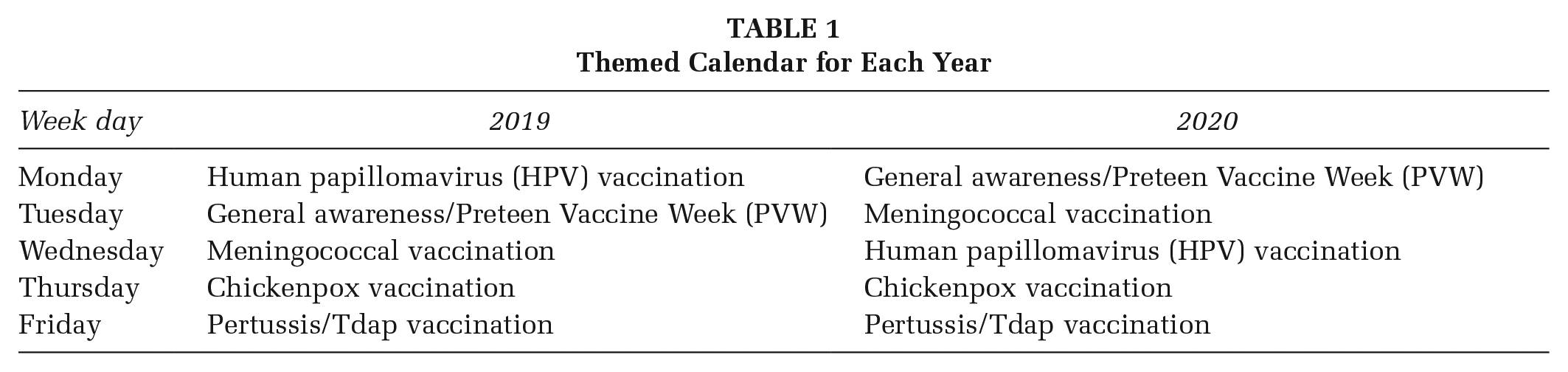
Each year, CDPH distributed themed calendars to partners that identified daily health topics on which partners were encouraged to focus their messaging. Collaboration was examined with the proportion of posts that followed the daily theme (Table 1).
Themed Calendar for Each Year
Supplemental Assets
Along with the themed calendars, CDPH provided supplemental assets to campaign partners. These included infographics, photographs, internet links, and videos. Collaboration was measured by analyzing the proportion of supplemental assets provided by CDPH that were included in the posts.
Social Media Engagement
Informed by Neiger et al. (2013), each post was coded for its attempt to engage social media users. Three levels of engagement were coded: (1) low engagement (one-way communication, primarily information dissemination), (2) medium engagement (includes opportunities for interaction, such as including a user’s handle), and (3) high engagement (reflects greater efforts to stimulate stakeholder participation, such as asking user questions, or the use of quizzes). Departing from Neiger et al. (2013), this analysis focused solely on high engagement on social media, not in offline contexts, too.
Communicative Function
Specific messaging strategies that operationalize each communicative function were coded (Lovejoy & Saxton, 2012). While these strategies are not exhaustive for each function, they provide insight into the potential effectiveness of the campaign. Posts were coded for the use of statistics (information dissemination); patient stories (community-building); and behavioral recommendations/calls-to-action (mobilization).
User Engagement
Mean user engagement was measured by averaging the likes, shares/retweets (on applicable platforms), and comments across each post.
Results
The sample consists of 330 posts across all three platforms. Twitter had the largest number of posts (n = 145), followed by Instagram (n = 96), and Facebook (n = 89).
Collaboration
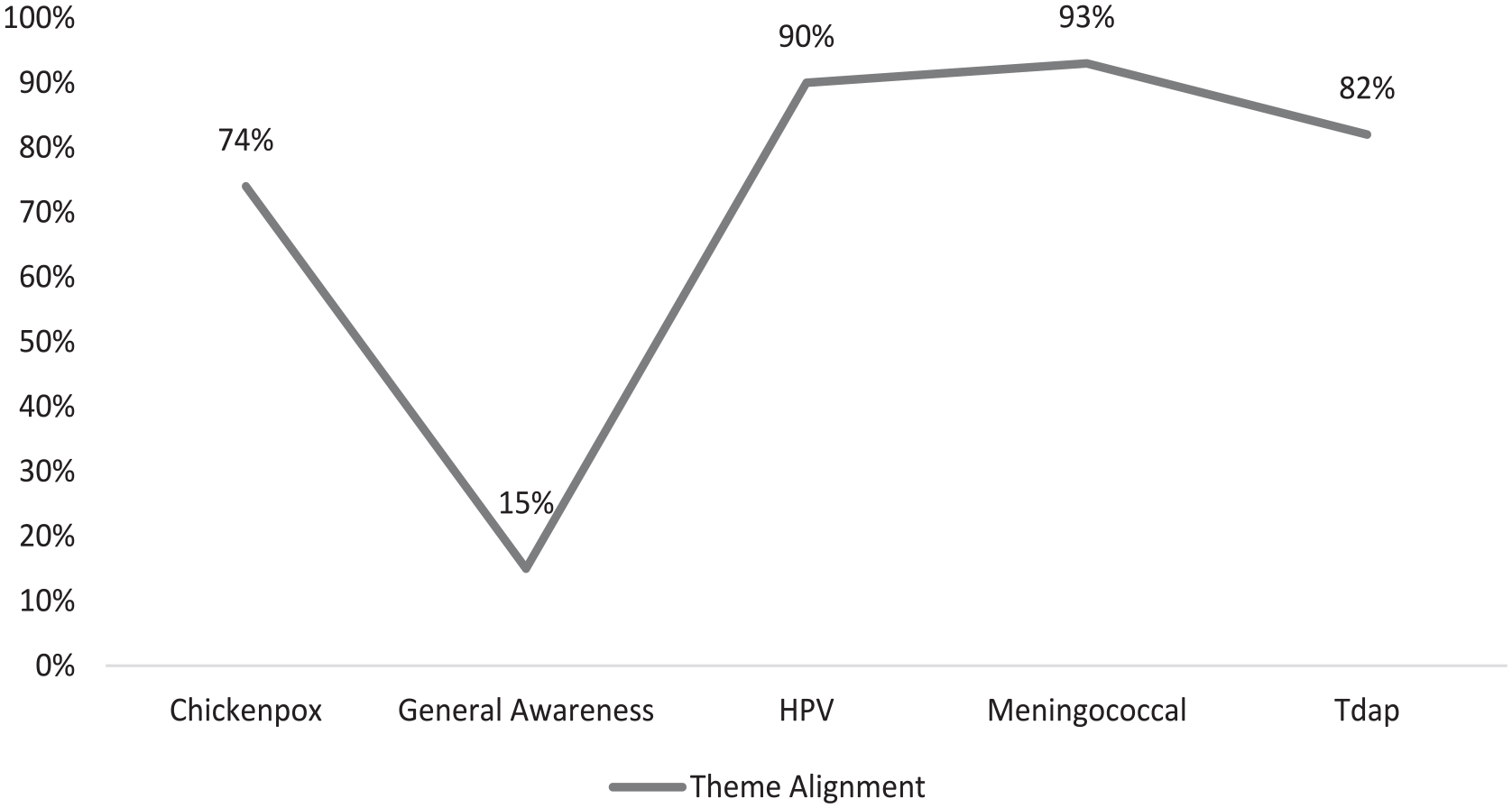
The average alignment between the daily theme and the topic in the posts was 71%. As Figure 1 illustrates, when the daily theme focused on a specific health topic, the posts aligned with it between 74% (chickenpox) and 93% (meningococcal) of the time. However, on days themed to general awareness, on average, only 15% of the posts adhered to the theme. When the general awareness days are excluded from analysis, the daily theme and the post topic align 85% of the time.
Alignment Between Schedule Theme and Published Post Topic
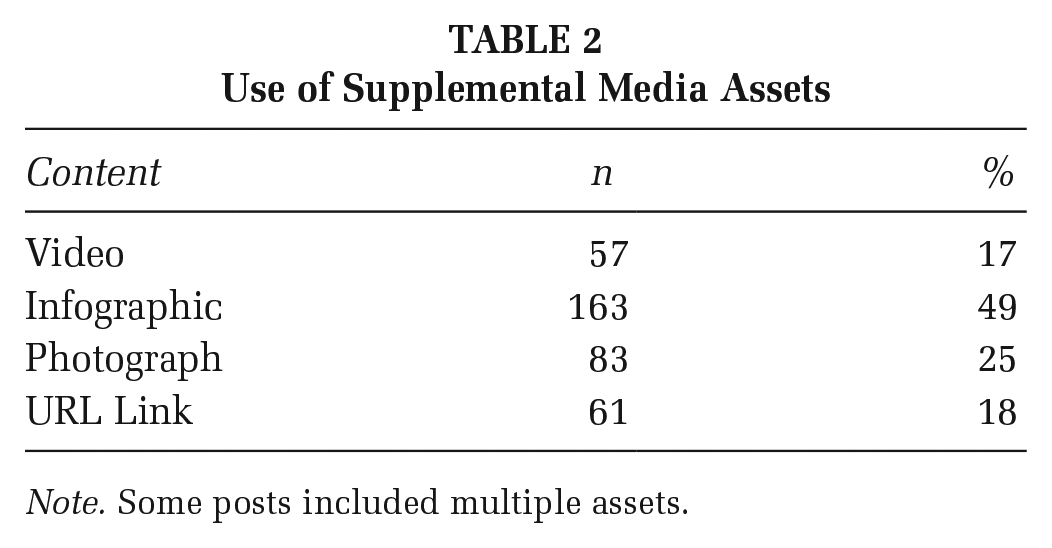
In terms of the supplemental assets, 90% of posts included supplemental assets, such as an infographic (49%), photograph (25%), internet link (18%), and/or a video (17%) (Table 2). The majority of videos (91%) and infographics (65%) were provided by CDPH, while only 7% of the photographs and 8% of the links were provided by CDPH. In total, 46% of the supplemental assets included in the posts were those provided by CDPH.
Use of Supplemental Media Assets
Note. Some posts included multiple assets.
Level of Engagement
Of the three levels of social media engagement, the majority of posts (98%) attempted a low level of engagement with users, 2% attempted a moderate level of user engagement, and less than 1% of posts attempted a high level of online user engagement.
Communicative Function
An analysis of three distinct messaging strategies found that 17% of posts included statistics (didactic information dissemination); 11% relayed a patient story (community-building); and just over three-quarters of the posts (76%) included a call-to-action/behavioral recommendation (mobilization).
User Engagement
A series of t-tests was conducted that compared differences in user engagement associated with posts that included statistics, patient stories, and a call-to-action with posts that did not. Another t-test compared differences in user engagement between medium/high engagement posts, with those that were low engagement. No significant differences in user engagement were associated with these messaging or engagement strategies.
Discussion
This study examines the outputs and user engagement of a collaborative social media campaign. While these findings are not generalizable, they provide insight into the challenges and opportunities of collaborative campaigns through a process evaluation, of which there are few. During 2 years of the intervention, 330 posts were made across three social media platforms. While the global outbreak of COVID-19 likely impacted the Year 2 subsample, considering the size of California, there remains considerable opportunity to grow this campaign.
Campaign partners made a good effort to collaborate, as evidenced by their adherence to the daily theme and their use of shared assets. The majority of posts pursued a low level of engagement from users by focusing on one-way information delivery. This suggests campaign partners are not fully leveraging the interactive affordances of social media. More posts included didactic information (statistics) than storytelling (testimonials). However, the majority of posts attempted to mobilize offline behavior with a call-to-action. This aligns with the finding that posts tended to focus on a specific health issue rather than general awareness. Together, these findings may explain why the open-ended nature of dialogic communication is more challenging: partners prefer to focus on a specific health issue and behavioral recommendation.
It is somewhat unexpected that the majority of posts included a call-to-action, given Lovejoy and Saxton’s (2012) typology that suggests mobilization occurs in a minority of posts. However, Lovejoy and Saxton’s (2012) study focused more generally on nonprofit organizations. This study examines a health promotion campaign that runs for a limited duration each year and focuses on specific health-related outcomes. Thus, the frequency of posts attempting to mobilize action is ultimately not surprising. In terms of user engagement, given the infrequent effort to engage users online at high levels, it follows there was minimal user engagement.
Implications for practice
Collaborative campaigns are challenging to facilitate and lead organizations must devote considerable resources to engage partners. However, this study illustrates that when resources are provided, such as a daily theme and supplemental assets, partners will work together. In particular, labor-intensive resources, such as videos, photographs, and infographics are especially helpful shared assets. Health agencies also gravitate toward posting about specific health issues, with clear behavioral recommendations. Thus, providing partners with more information about specific health issues is also useful. Another opportunity is to seek content contributions from partner agencies that may increase their sense of ownership of the campaign (Pedersen et al., 2020). While health organizations continue to struggle with facilitating social media engagement, more training and support will develop this skill set further.
Footnotes
Authors’ Note:
The authors thank Jane Grey of the California Department of Public Health, Immunization Branch, for her support in conducting this study. In addition, the authors thank Postdoctoral Researcher Xudong Yu at the University of Amsterdam for his help with data collection.
