



Abstract
Distracted driving, the act of focusing on something else while operating a vehicle, is a significant health problem among adolescents. Although some studies have reported on prevalence among adolescents in the United States, limited studies have examined differences by sexual identity status. The purpose of the present study was to examine past 30-day distracted driving by sexual identity status among a large, national sample of adolescents ages 14 to 18 years. A secondary analysis was conducted on the 2019 Youth Risk Behavioral Surveillance System (YRBSS) data, and associations between distracted driving and demographics (e.g., biological sex, age, race/ethnicity) were assessed with weighted logistic regression analyses. A total of 13,590 adolescents ages 14 to 18 years were part of the final analytic sample. Twenty-three percent of adolescents reported distracted driving in the past 30 days. Compared with heterosexual adolescents, gay/lesbian (14.3%), bisexual (18.1%), and questioning (12.9%) adolescents reported lower distracted driving in the past 30 days. Findings through a health equity approach may inform harm reduction efforts and behavioral interventions.
Introduction
Distracted driving, the act of operating a vehicle while taking your attention off the road and focusing on something else, is linked to nearly 1,000 accidents and nine deaths in the United States every day (National Highway Traffic Safety Administration [NHTSA], 2016). In 2017, 9% of all motor vehicle crash deaths in the United States involved some form of distracted driving (NHTSA, 2017). Moreover, drivers under the age of 20 have the highest proportion of distraction-related fatal crashes in the United States (NHTSA, 2016).
The theory of planned behavior (TPB) has been used to describe a variety of behaviors including distracted driving and driving phenomena (Bazargan-Hejazi et al., 2017; Parker et al., 1992). TPB proposes that behavioral intentions are the most influential predictors of actual behavior and comprise attitudes, subjective norms, and perceived behavioral control (Ajzen, 1991). Given that adolescents have the highest distracted driving crash rates (NHTSA, 2016) and are more likely to use technological devices behind the wheel (Pöysti et al., 2005), additional research is warranted into differences among subgroups of adolescents that might better inform targeted health behavior interventions.
While many studies have examined distracted driving among U.S. adolescents (Li et al., 2018; Olsen et al., 2013), limited studies have examined distracted driving among adolescents by sexual orientation status. Related studies examined driving behaviors by sexual minority status and found that compared with heterosexuals, sexual minority adolescents (i.e., individuals identifying as lesbian, gay, bisexual, or transgender) were less likely to wear a seatbelt (Reisner et al., 2014). Therefore, it may be plausible that this population may engage in more distracted driving compared with their heterosexual peers. To inform understanding of sexual minority adolescent health inequities (Mustanski, 2015), this study uses the most recent Youth Risk Behavior Survey to assess differences between sexual minority adolescents and their heterosexual counterparts with respect to distracted driving.
Method
Study Sample
A secondary data analysis of the 2019 Youth Risk Behavior Surveillance Survey (YRBSS) was performed. Briefly, the YRBSS is a national survey using a three-stage cluster design and conducted in the United States by the Centers for Disease Control and Prevention (CDC). The survey assesses various health behaviors, substance use, violence, psychosocial variables, and mental health status among adolescents mainly in the ninth to 12th grades (CDC, 2019). The response rate was 60.3%. For the present analyses, those aged 12 years (n = 60) and 13 years (n = 27) were excluded, making the final study population consisting of 13,590 adolescents aged 14 to 18 years or older. The study population included the minimum age of 14 because several states in the United States allow 14-year-olds to obtain their license under qualifying circumstances (Masterson, 2021).
Measures
Outcome—Distracted Driving
To measure distracted driving, the question, “During the past 30 days, on how many days did you text or email while driving a car or other vehicle?” was used. The variable was dichotomized to (“I did not text or email while driving a car or other vehicle during the past 30 days,” or ≥1 days “I did text or email while driving a car or other vehicle in the past 30 days”; CDC, 2019).
Sexual Identity
The question, “Which of the following best describes you?,” was used to measure sexual orientation. Responses were categorical (1 = heterosexual, 2 = gay/lesbian,” 3 = bisexual, 4 = not sure). All categories were included.
Covariates
Age was utilized as a categorical variable, with 16 years as the referent, given it is the legal driving age in most U.S. states. Race/ethnicity was categorized into the following groups: non-Hispanic White, non-Hispanic Black, Hispanic/Latino-only, Hispanic/Latino-Multiracial, and “other.” For the purposes of this study, “other” included Asian, non-Hispanic Multiracial, and American Indian or Alaska Native/Native Hawaiian or Other Pacific Islander. Sex was measured as a dichotomous variable with males coded as 0 and females coded as 1. Covariate selection was based on prior studies (Li et al., 2018; Olsen et al., 2013).
Analysis
Analyses revealed that between 3% and 9% of data on covariates were missing. Therefore, the analyses implemented a complete case analysis (Romero et al., 2018), due to the size of the data set (Henry et al., 2013) and the categorical coding of the variables (Allison, 2005; Audigier et al., 2017). These factors indicated comparable utility in minimizing bias across methods of handling missing data (e.g., multiple imputation). All analyses were conducted in Stata (v.16.0) and were weighted (Heeringa et al., 2017) to be representative of U.S. high school students and to account for the complex sampling design, post-stratification, and in line with recommendations for analysis by the Centers for Disease Control and Prevention YRBSS User’s Guide (CDC, 2019). The level of significance was set at p <.05. A University Institutional Review Board approved the study as exempt.
Results
Demographics
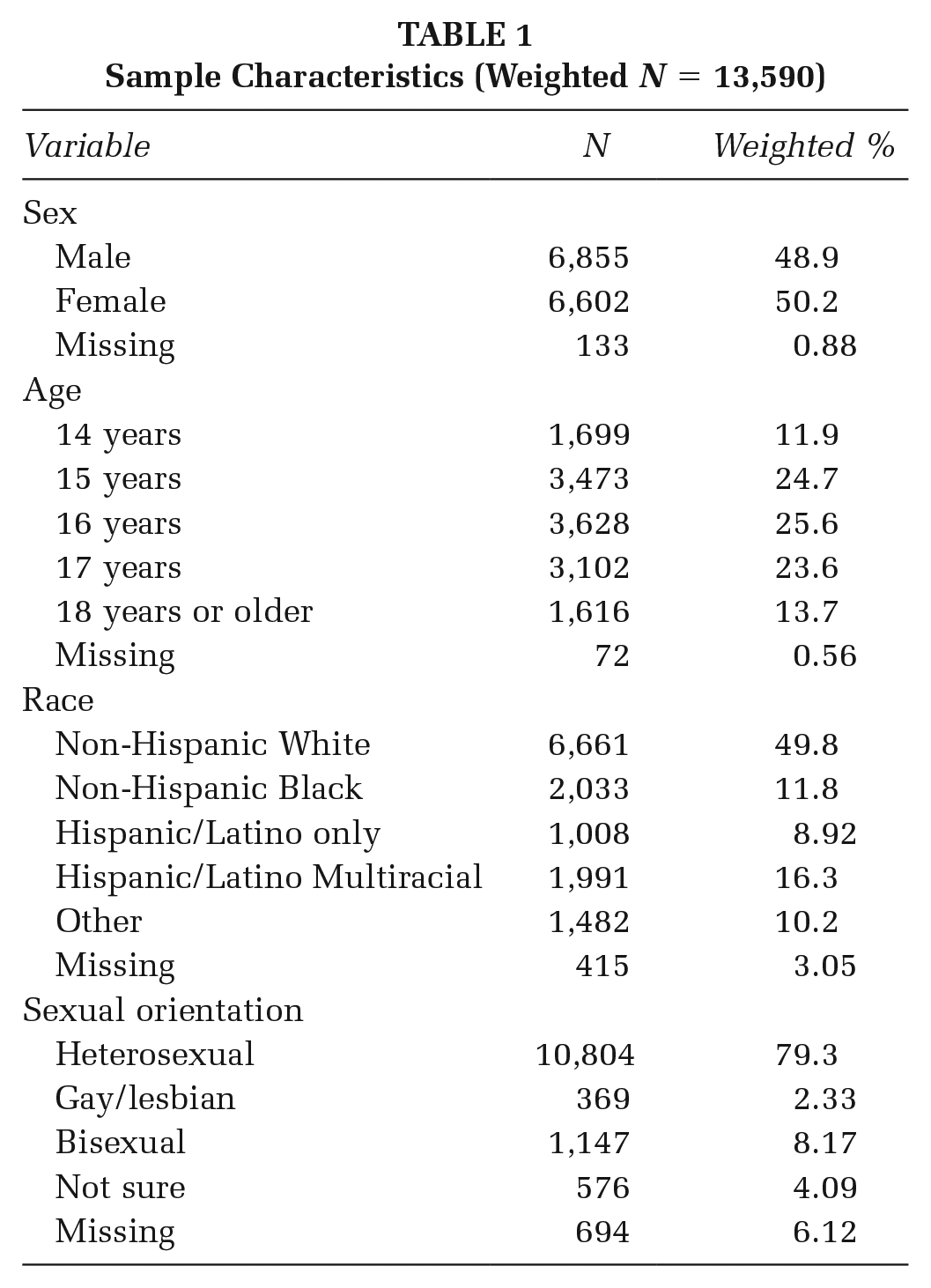
The sample consisted of nearly equal percentages of males (48.9%) and females (50.2%; see Table 1). Of the sample, weighted to match U.S. demographics, 49.8% identified as non-Hispanic White, 11.8% identified as non-Hispanic Black, 8.92% identified as Hispanic/Latino only, 16.3% identified as Hispanic/Latino Multiracial, and 10.2% were represented in the other category. The sample consisted of more adolescents who identified as heterosexual (79.3%), compared with gay/lesbian (2.33%), bisexual (8.17%), and not sure (4.09%) adolescents. Approximately one in five (21.2%) adolescents reported distracted driving in the past 30 days.
Sample Characteristics (Weighted N = 13,590)
Distracted Driving and Demographics
There were no differences based on sex and distracted driving (adjusted odds ratio [aOR]: 1.01, 95% confidence interval [CI] [0.88, 1.15]; see Table 2). Compared with 16-year-olds, 17 (aOR: 2.56, 95% CI [2.18, 3.00]) and 18 (aOR: 3.72, 95% CI [3.09, 4.49]) year olds were more likely to report distracted driving. No other differences were found based on age. Compared with Non-Hispanic White adolescents, non-Hispanic Black (aOR: 0.45, 95% CI [0.36, 0.57]), Hispanic/Latino-Only (aOR: 0.49, 95% CI [0.37, 0.65]), Multiple Hispanic/Latino (aOR: 0.66, 95% CI [0.54, 0.80]), and Other/Mixed Race (aOR: 0.48, 95% CI [0.39, 0.59]) were all less likely to report distracted driving.
Bivariate and Adjusted Comparisons to Distracted Driving Among Youth
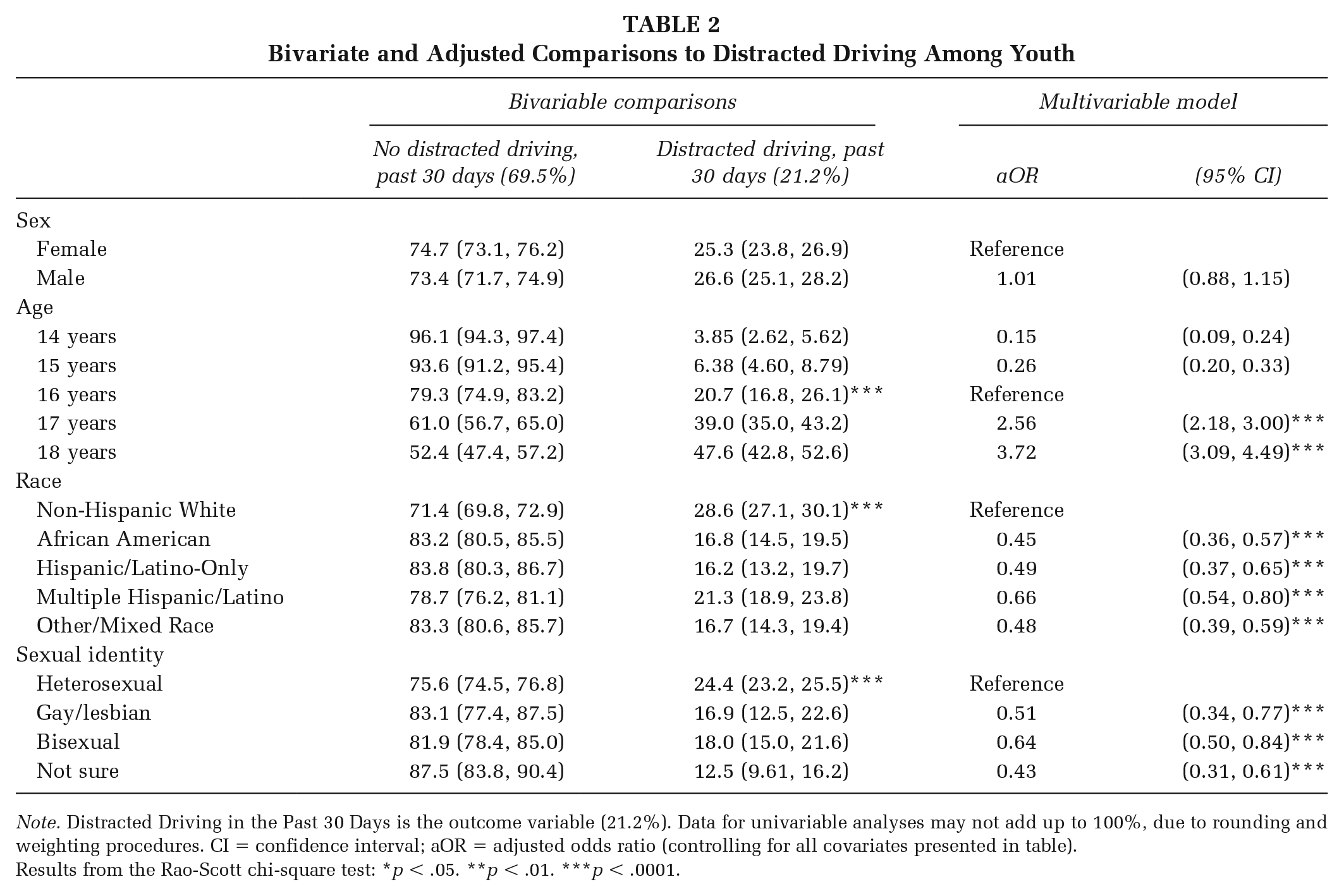
Note. Distracted Driving in the Past 30 Days is the outcome variable (21.2%). Data for univariable analyses may not add up to 100%, due to rounding and weighting procedures. CI = confidence interval; aOR = adjusted odds ratio (controlling for all covariates presented in table).
Results from the Rao-Scott chi-square test: *p < .05. **p < .01. ***p < .0001.
Distracted Driving and Sexual Identity Status
Compared with heterosexual individuals, a lower percentage of gay/lesbian, bisexual, and questioning/unsure adolescents reported distracted driving in the past 30 days. When compared with individuals who identified as heterosexual, modeling with demographic covariates, gay/lesbian (aOR: 0.51, 95% CI [0.34, 0.77]), bisexual (aOR: 0.64, 95% CI [0.50, 0.84]), and not sure adolescents (aOR: 0.43, 95% [CI 0.31, 0.61]) were less likely to report distracted driving.
Discussion
Principal Findings
Greater than one in five adolescents reported distracted driving. The prevalence of distracted driving was lower among sexual minority adolescents, compared with heterosexual adolescents. Significant patterns regarding likelihood of reporting past 30-day distracted driving were higher among older adolescents compared with 16-year-olds, and lower among minority individuals, compared with non-Hispanic White adolescents.
Results in Context
Results are consistent with a broad literature which suggests that adolescents engage in distracted driving (Li et al., 2018; Reisner et al., 2014). Furthermore, the results suggest that these estimates are higher than previous studies (Foss: 6.7%; Tucker et al.: 15.6%; Foss & Goodwin, 2014; Tucker et al., 2015). Moreover, adolescents representing certain demographics (e.g., race, age) were at increased risk for distracted driving (Li et al., 2018; Olsen et al., 2013; Reisner et al., 2014), warranting further attention and delineation into differences for distracted driving.
One of the key targets of the TPB is to change beliefs about an outcome and evaluate the attitudes associated with a risk behavior (Ajzen, 1991). Previous research highlights that adolescents overwhelmingly support legislation for banning distracted driving, with greater than 50% of a community sample recommending strong support against distracted driving (Pope et al., 2019). Furthermore, if provided some financial incentives, adolescents were more likely to reduce distracted driving, compared with those who did not reduce distracted driving practices and not paid incentives (Delgado et al., 2018). While some preventive strategies recommended by the Governor’s Highway Association include knowing the law, “x the text” (stopping texting while driving) and pulling over to a safe location (Governor’s Highway Safety Association, 2011), other technological and behavioral approaches (e.g., legislation, drug driving education) may be needed to encourage adolescent drivers to act in their own and society’s best interests and comply with the law. In addition, in alignment with the TPB, correcting inaccurate social norms (e.g., peer influences that encourage risky driving; Ouimet et al., 2015) and the propensity to engage in this behavior by using social marketing techniques may prove useful in decreasing distracted driving among adolescents.
Although there has been previous research examining disparities in driving behaviors among sexual minority youth—with sexual minority youth more likely to not wear a seatbelt (Reisner et al., 2014)—this is one of the first studies to examine distracted driving and investigate differences by sexual orientation status. Interestingly, adolescents who identified as bisexual reported the most distracted driving in the past 30 days. This finding substantiates previous literature that estimated a higher prevalence of dangerous road behaviors, compared with heterosexual adolescents (Reisner et al., 2014).
Furthermore, an intersectionality approach (Parent et al., 2013) may be useful to explain these findings. This approach suggests that overlapping identities offer researchers the opportunity to identify norms, practices, policies, and the interacting influences of social stress and heterosexism, among others, that may result in the pattern of results identified. It also offers an opportunity to identify particular strengths and resiliencies that are protective factors. While this study is an important first step in understanding distracted driving, the existing health inequities literature strongly suggests that future work should seek to understand the origins of these disparities, develop targeted interventions, inform harm reduction efforts, and address the roles of disparities and psychosocial stressors in their creation and maintenance.
Limitations
This study is not without limitations. Data were self-reported; thus, desirability/enhanced answering may be present. The data were cross-sectional, limiting causal inference. Future studies should examine trends of distracted driving and associated correlates. Wide confidence intervals were calculated for some variables, so results should be interpreted with caution. With respect to demographics, regarding sex and sexual minority, the responses were limited; future research needs to disentangle differences within these categories and expand sex to more than two categories. The limitation of only having one distracted driving question warrants more questions regarding these behaviors in national samples. Furthermore, laws for text bans were not measured and should be incorporated in future studies.
Conclusions
This is one of the first studies to examine distracted driving among a national sample of adolescents and investigate differences by sexual orientation status. The estimated prevalence of distracted driving within the past month among U.S. adolescents was 21.2%. Furthermore, between 12% and 18% of sexual minority adolescents reported distracted driving in the past 30 days. Continued research is needed to further examine the associations and estimates of distracted driving among U.S. adolescents. Future directions assessing associations could inform targeted prevention and intervention efforts. Using the TPB (Ajzen, 1991), challenging subjective norms could be used as a technique to address distracted driving among adolescents.
