



Abstract
We applied a three-step process, abstracting and analyzing program budgets to examine how Colorectal Cancer Control Program (CRCCP) awardees are structuring their programs and to assess the fidelity of program design to the CRCCP public health model. We reviewed 23 state, one tribal organization, and six university awardee budgets. We assessed resource allocations, staffing structures, and contracted partners and their activities. Awardees allocated 83% of all funds to contracts and personnel. Program managers were the most budgeted personnel type across three measures: number of people, full-time equivalency, and personnel costs. Awardees not only contracted with health care systems and clinics (39% of all contracts) but also contracted other partner types. Contractors were mainly funded to implement evidence-based interventions (25%) and conduct evaluation (24%). Program design varied among awardees in the number of staff (0–22), number of full-time equivalencies (0–5.4), and the number of contracts (1–11) budgeted. State awardees budgeted more resources to contracts, compared with university awardees (57% vs. 31%), while universities budgeted more for total personnel costs (41% vs. 30%). We learned that awardees designed their programs with fidelity to the CRCCP model. Although implementation approaches varied, overall results suggest implementation requires a combination of internal capacities and contracted partners. Budgets provide opportunities to use already existing program data to evaluate program design, partnerships, and planned activities.
This is a visual representation of the abstract.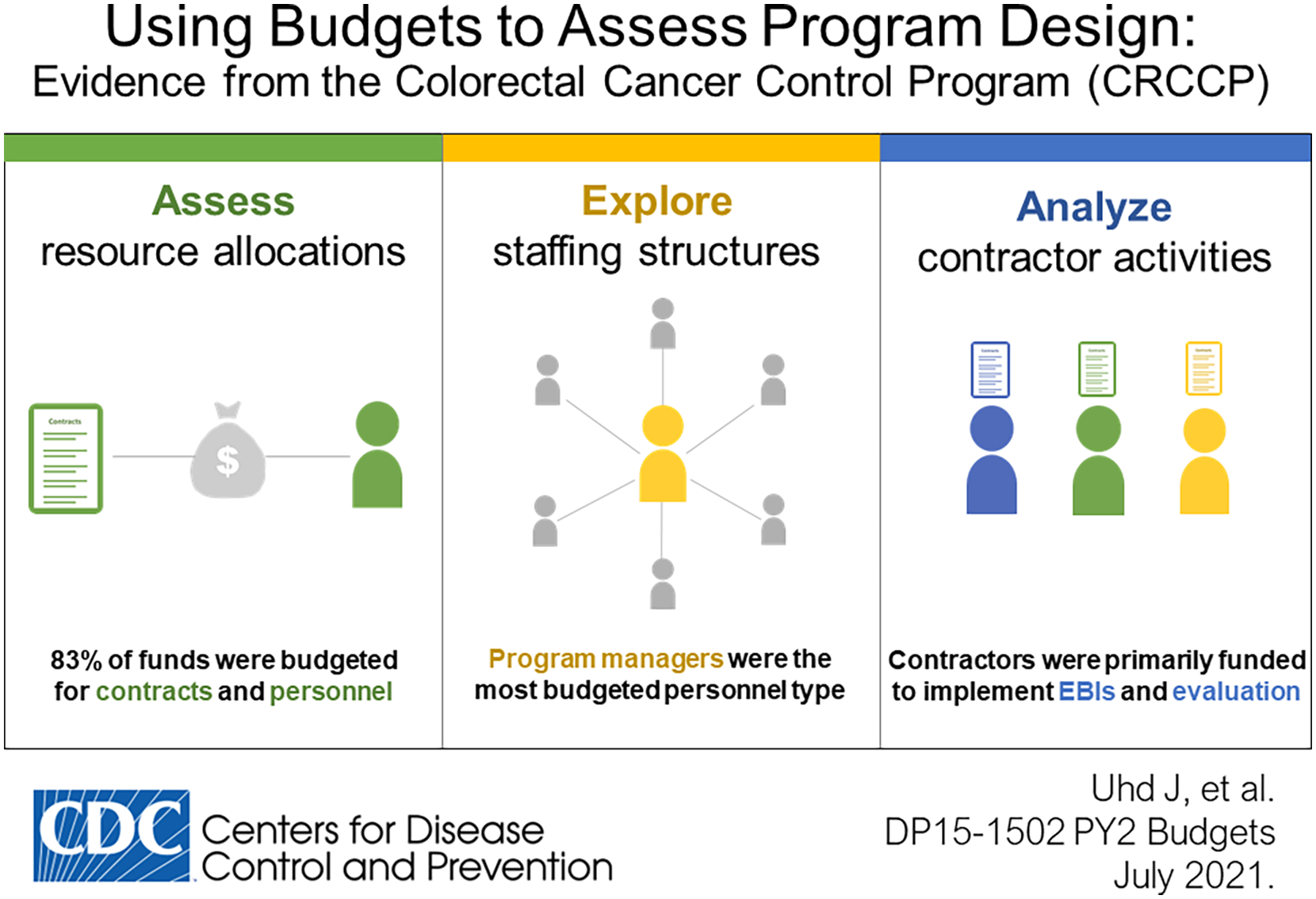
Keywords
Get full access to this article
View all access options for this article.
References
Supplementary Material
Please find the following supplemental material available below.
For Open Access articles published under a Creative Commons License, all supplemental material carries the same license as the article it is associated with.
For non-Open Access articles published, all supplemental material carries a non-exclusive license, and permission requests for re-use of supplemental material or any part of supplemental material shall be sent directly to the copyright owner as specified in the copyright notice associated with the article.
