



Abstract
The arrest of a parent can be a pivotal moment for their children. While providing opportunities to identify children in need, children may be placed at particular risk when physically present at the point of arrest. This scoping review synthesized results from existing research on the impact of witnessing parental arrest on children. Searches across three databases and two search engines yielded 6,456 references, with 29 studies meeting the inclusion criteria. One additional reference was included through citation search. The implications for children of witnessing parental arrest were twofold. Individually, children may experience emotional and behavioral difficulties, elevated posttraumatic stress (PTS) symptoms, physiological stress, poor school performance, and developmental delays. Interpersonally, their family relationships, as well as attitudes to and perceptions of police officers, were negatively affected. Furthermore, children who witnessed an arrest were more likely to be exposed to other forms of violence, compared with those who did not witness this event. Studies typically relied on data from children to report their outcomes or reactions to the arrest. This scoping review identified potential variables that can influence the impact of parental arrest on children present. These variables should be examined in future research, preferably with primary data collected, with due consideration given to the data source that is relied upon to capture children’s reaction/s and with the aim of generating context-specific knowledge. Implications for policy development and implementation are discussed.
Introduction
The prevalence of parental incarceration represents a transnational issue, as evidenced by data from North America, Europe, and other regions globally. Over 5 million children, representing 7% of the child population, in the United States (US) have had a resident parent incarcerated (Murphey & Cooper, 2015). Across Europe, approximately 2.1 million children have a parent who is incarcerated on any given day (Children of Prisoners Europe, 2025). The implications of parental incarceration on children have been widely documented by existing literature (e.g., Geller et al., 2009; Giordano, 2010; Haskins et al., 2017). However, the experience of parental incarceration for children extends beyond the imprisonment. Specific experiences related to parental incarceration, such as witnessing their parents’ arrest, criminal activity, and sentencing, are all potentially stressful and influential on children’s attachment, sense of safety and security, as well as their social and emotional development (Dallaire & Wilson, 2010). These related experiences, however, are rarely captured in criminology or sociology literature, as attested by Poehlmann-Tynan and Turney (2021), because they are typically not assessed in large longitudinal datasets with population-based samples, which inform much of our understanding of children with incarcerated parents.
Children’s experiences of witnessing the arrest of a parent deserve dedicated investigation. Research has demonstrated that this can be a potentially traumatic event for children (e.g., Phillips & Zhao, 2010). Furthermore, Article 19 of the United Nations Convention on the Rights of the Child (1989; hereafter UNCRC) mandates protection of children from ‘all forms of physical or mental violence, injury or abuse, neglect or negligent treatment, maltreatment or exploitation’. This principle could be used to guide law enforcement actions in the removal of a parent, irrespective of countries being signatories to the UNCRC (currently, the US is the only UN member state that is not a signatory). By adequately considering children at the point of parental arrest, the negative impacts of the adult criminal legal system on the child can potentially be minimized. In addition, parental arrest affects more children than incarceration, with an additional, hidden population whose parents are arrested (and held for varied periods of time) but ultimately not imprisoned. It is unknown how many children are impacted by exposure to parental arrest, because data on parental status are typically not collected at the time of arrest. However, research indicates that it is not uncommon for children to witness their parents’ arrest, with estimates ranging from 22% (Poehlmann-Tynan et al., 2017) to 70% (Kampfner, 1995). Understanding and documenting this exposure is crucial for developing policies and practices that address the welfare of a significant number of children.
Parental arrest has garnered intermittent attention over time, with some policy and practice responses emerging, particularly within US jurisdictions (Thurau, 2015). For example, New York State’s Child-Sensitive Arrest Bill was signed into law in 2024. The bill mandates that law enforcement agencies develop and implement policies and procedures for situations involving the arrest of a parent, guardian, or legal caregiver, ensuring the child’s safety and well-being during such incidents. Similarly, research attention has been growing over the past decade. This mounting research, primarily from the US, often drew on secondary data from larger studies to quantitatively analyze children’s outcomes after witnessing the arrest of a parent or a family member. These studies highlighted children’s outcomes at the individual level, such as emotional and behavioral problems, with some efforts made to establish the experience of witnessing arrest as a distinct predictor of these outcomes (e.g., Muentner et al., 2021; Philips & Zhao, 2010). Alternatively, studies undertaking qualitative analysis emphasized how the context of parental arrest may be particularly frightening for children. This body of research suggested that the timing, location, degree of violence involved, house searches, and other arrest circumstances can create specific challenges for children (e.g., Kampfner, 1995; Raikes, 2021; Smith & Jakobsen, 2014). Furthermore, some research illuminated how this experience may impact children at the interpersonal level, such as their attachment security (Poehlmann-Tynan et al., 2017).
Yet, not every child exposed to witnessing parental arrest experienced negative outcomes. Some children were described as coping well (He & Flynn, 2019) or showing no distress after witness exposure (Poehlmann-Tynan et al., 2017). These divergent findings underscore the complexity of the issue and point to the need for a more nuanced, contextually informed understanding of the effects of witnessing parental arrest.
Acknowledging the potential impact of witnessing parental arrest on children, recent research has expanded to examine a broader spectrum of outcomes related to this exposure. However, the existing research is piecemeal, with research papers and reports published sporadically over the past decades. The likely harm to a child of witnessing parental arrest has been initially established, but a synthesized or nuanced understanding of this problem remains absent. To our knowledge, there are no scoping or systematic reviews on this topic. The objective of this scoping review is to collate existing literature that explores the impact of witnessing parental arrest on children, providing a comprehensive overview of current evidence. Synthesizing this research will enhance understanding of the potential for policy and practice to mitigate the adverse effects on children, and support the development and implementation of child-sensitive arrest policies. Furthermore, it will inform future research to build a robust evidence base on this topic.
Methods
This scoping review addresses the following research question: What does the existing literature indicate about the impact of witnessing parental arrest on children? The review follows the five stages proposed by Arksey and O’Malley (2005), including identifying the research question, identifying relevant studies, study selection, charting the data, and collating, summarizing and reporting the results.
Eligibility Criteria and Source of Evidence Selection
To maintain a clear but flexible focus on children’s experiences, the review included studies that focused on children aged under 18 years at the relevant arrest, allowing for research in which adult participants shared their recollections retrospectively. Studies were deemed eligible if they focused on arrests including parents. Given the scarce research in this area, no limit was placed on the study context. Each country’s carceral context and the differing implications for children are outlined in the findings and discussion. The search was confined to studies published in English, with no limit on the publication date.
The review included only empirical studies and was open to all study designs. For quantitative studies, witnessing arrest must have been one of the specific variables examined. For qualitative studies, children’s reactions to witnessing arrest must have been presented as one of or part of the major themes. Quantitative studies examining the cumulative effects of different risks on children, of which witnessing an arrest was included as one but not analyzed separately, were excluded because data could not be disaggregated to allow comment on any specific impact of witnessing an arrest. Furthermore, qualitative studies offering limited detail on children’s reactions in the findings were excluded because they were not considered representative.
Search Strategy
The three-step search strategy recommended by the Joanna Briggs Institute (Peters et al., 2024) was utilized to locate literature on the research topic. First, a preliminary search of one relevant database, APA-PsycINFO (Ovid), was conducted, followed by an analysis of the text words (title, abstract) and subject headings. This resulted in three concepts being identified for the search – arrest, children, and witness, with search terms and subject headings then developed accordingly (see Supplemental Appendix A). A second search across APA PsycINFO (Ovid), Criminal Justice Database (ProQuest), CINAHL Complete (EBSCO), Scopus, and Google Scholar was undertaken in January 2024, using these keywords and subject headings. Third, the reference lists of identified publications were searched for additional sources.
Study Selection
At the stage of the second search, 6,456 references were retrieved. Four references were merged into two because they reported on the same studies. After deduplication, titles and abstracts of 5,713 references were scanned for relevance, with inclusion criteria kept broad. Studies selected for full-text review examined specifically children’s experiences at the point of parental arrest, or more broadly their experiences of parental involvement with the criminal justice system, with some attention to the point of arrest, or where witnessing arrest was included as one of the variables in assessing children’s outcomes. A total of 331 references were identified for full-text review, resulting in 29 studies being selected for data charting. As the last step, hand searching of citations and reference lists of the 29 studies was undertaken, during which process another 54 references were screened, with one additional source meeting the inclusion criteria and included for data charting. Another four references were identified, but the full texts of these references could not be located. The screening stages were conducted in Covidence and documented in a PRISMA flow diagram (Figure 1).
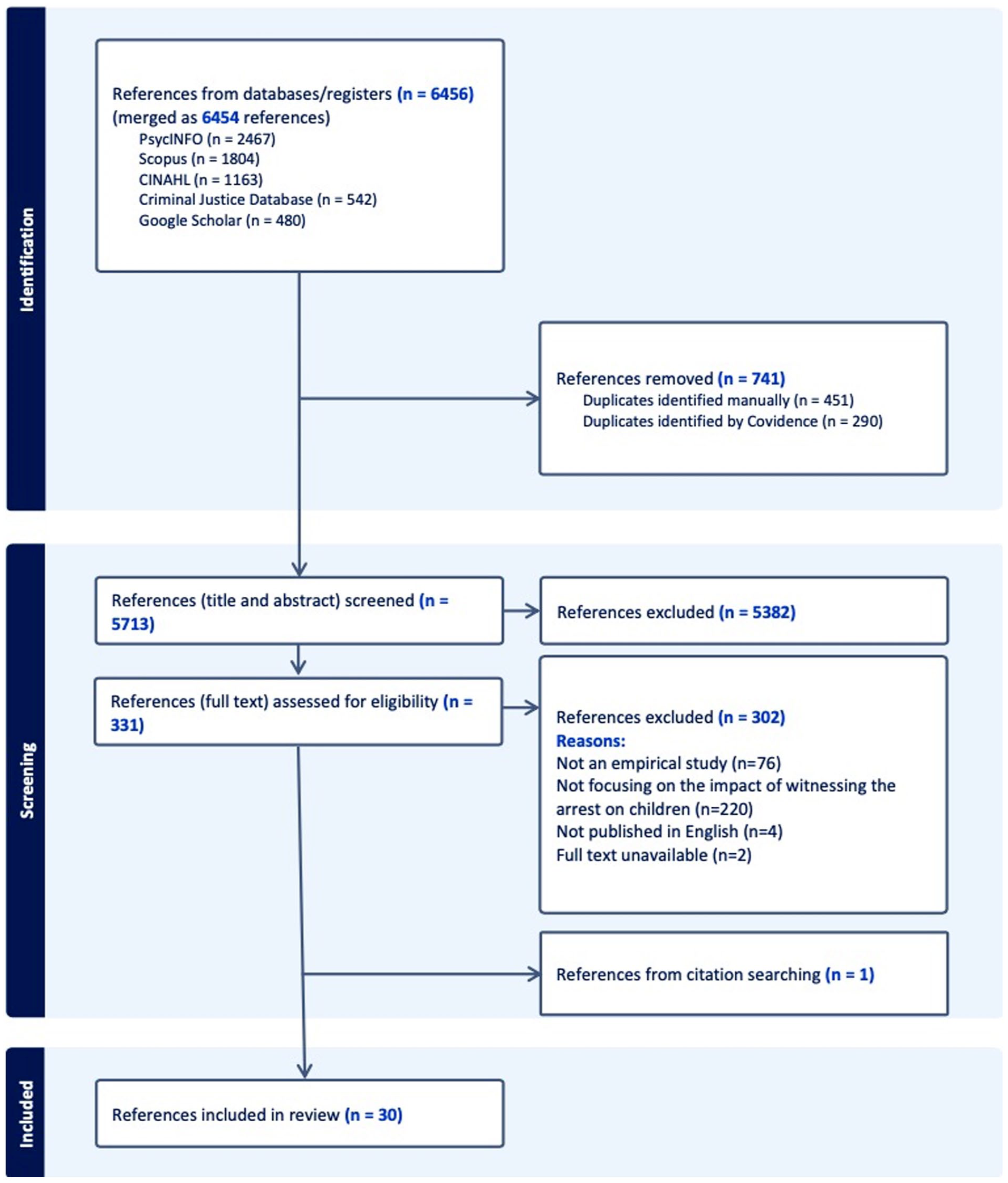
PRISMA flow diagram.
Data Charting
A final total of 30 studies were included for data charting, including six dissertations. Although not peer reviewed or published, dissertations are reviewed by two independent examiners. More importantly, new/emerging areas of research often commence with master’s or doctoral studies, so their data were considered important to capture. The data extraction process provided a descriptive summary of the studies and results addressing the review question. A template, outlining author(s), year of publication, country of origin, study aim/s, population and sample, methods, and key findings, was developed (see Supplemental Appendix B).
Results
Results are presented in three sections. The first section provides a brief overview of included studies, covering research designs, contexts, data sources, and so on. Subsequent sections respond specifically to the research question, summarizing the literature concerning impact on children in two clusters: individual-level and interpersonal-level effects.
Overview of Included Studies
Study Designs
The 30 studies included for data extraction included 11 quantitative, 14 qualitative, and 5 mixed-method studies (Table 1).
Study Contexts.

Note. N/A = not applicable.
Study Contexts
All but three quantitative studies were conducted in the US, with the remaining studies conducted in the Palestinian Occupied Territories (POT). Two of these three POT studies were conducted by the same authors, with a similar design but focusing on the impact of witnessing the paternal detention process on young children (Shehadeh et al., 2015) and adolescents (Shehadeh et al., 2016), respectively. While the contexts for qualitative studies were more varied, the majority (n = 11) were still conducted in the US.
Children of Interest
The children whose experiences were the focus of the reviewed studies had diverse characteristics. Their parents/family members had been arrested for various reasons: alleged criminal offenses (both violent and non-violent), undocumented immigration, and involvement in political conflict. While arrests typically involved criminal charges, those in the three POT studies and the Kashmir study were explicitly related to political conflict. Two US-based studies focused on arrests for undocumented immigration. The majority of studies (n = 23) focused solely on parental arrest, while the remainder broadened their scope to include other family members, such as siblings, grandparents, parents’ partners, and aunts. Half of the studies focused on children whose parents were subsequently incarcerated, with these children identified through correctional facilities.
Outcomes Reported
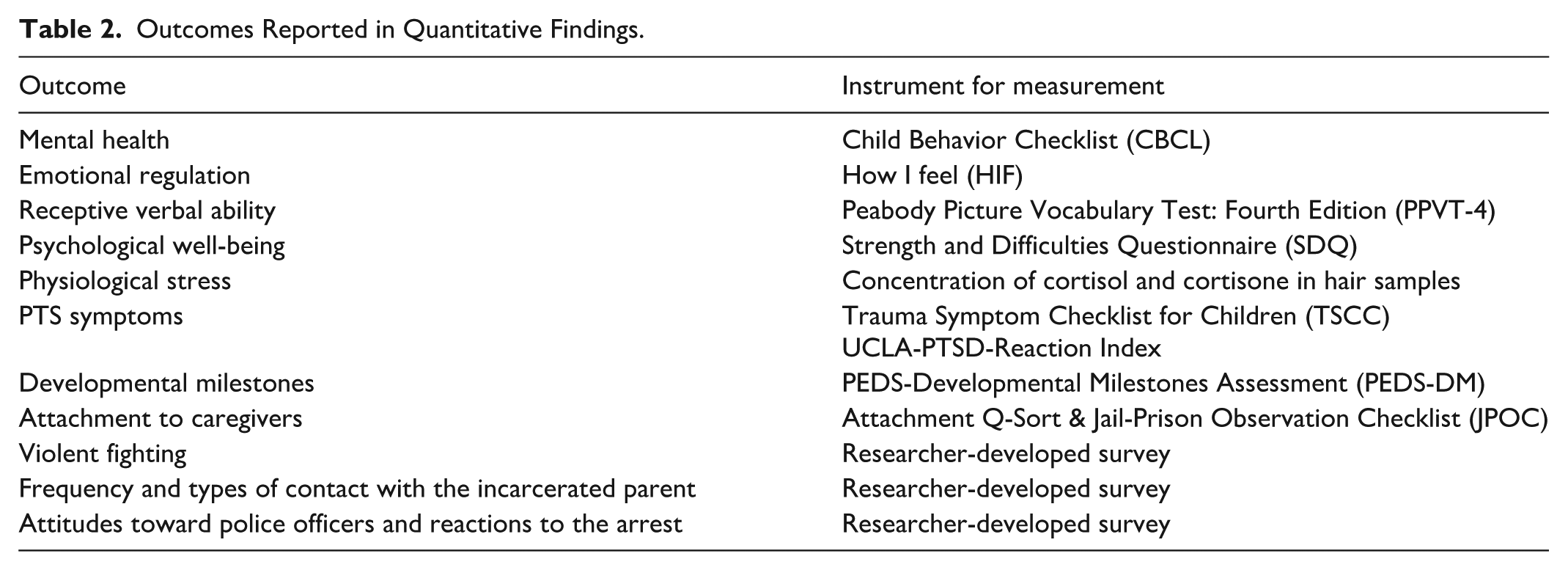
For papers including quantitative findings relevant to the scope of this review (n = 13), a range of outcome measures were utilized; these relate to children’s mental health, emotional regulation, psychological well-being, physiological stress, posttraumatic stress (PTS) symptoms, developmental milestones, attachments to caregivers, and so on (see measurement instruments in Table 2). For papers with qualitative findings in relation to witnessing parental arrest (n = 19), outcomes described related to emotional distress, behavioral changes, psychological challenges, PTS symptoms, and attitudes toward the police and service providers. Interviews were used as the primary data collection method in all but one study, supplemented by surveys and focus groups.
Outcomes Reported in Quantitative Findings.
Data Sources
For studies that generated quantitative findings, data (ratings/assessments) were typically provided by caregivers (n = 6) and children (n = 5), along with researchers, incarcerated parents, and police officers. Data on children’s exposure to parental arrest were provided by incarcerated parents, caregivers, and children quite equally, though two studies (Muentner et al., 2021; Poehlmann-Tynan et al., 2021) combined caregivers’ and incarcerated parents’ reports. For studies that reported qualitative findings, the majority (n = 14) asked children directly to describe the arrest situation and their reactions to the experience.
Impact at the Individual Level
Emotional and Behavioral Difficulties
Children’s emotional and behavioral difficulties were the most reported outcomes in the existing research on the impact of witnessing parental arrest (n = 26), and were documented across the three types of research designs.
Quantitative Studies
Nine quantitative studies examined the association between witnessing the arrest of a parent or a family member and child outcomes. Dallaire and Wilson (2010) drew on multiple data sources: incarcerated parents’ observations of children’s exposure to their criminal activity, arrest, and sentencing, caregivers’ rating of children’s behavioral and emotional maladjustment using the Child Behavior Checklist (CBCL), and children’s self-reports of emotional regulation. That study found that children aged 7 to 17 who witnessed a parent’s criminal activity, arrest, and sentencing were more likely to show maladjustment in their emotional regulation skills and exhibit greater anxious/depressed behaviors, compared to children with incarcerated parents who did not witness such events. These negative outcomes were later confirmed by Roberts et al. (2014), who also used CBCL to report on children’s mental health outcomes by caregivers. Roberts et al. (2014) disentangled the effect of witnessing arrests from witnessing criminal activity and sentencing, and further demonstrated how the impact of witnessing the arrest of a family member varied for children at different developmental stages. At the time of data collection, children aged under 6 years showed greater internalizing problems, while children aged 7 to 11 years exhibited greater externalizing behaviors. The researchers argued for a tendency among younger school-aged children to shift from internalizing to more externalizing behaviors, for example, irritability and immature behaviors, after witnessing the arrest. While the age of first-time exposure was gathered, the interval between this exposure and the evaluation of child mental health outcomes was not specified in the study, limiting further assessment of potential bias.
The above findings are complemented by a study conducted in a war-related context – the West Bank, including East Jerusalem, which analyzed secondary data from 2013 to examine the determinants of children’s health and cognitive development (Hallaq & Fallah, 2023). That study found that older school-aged children (aged 10–15 years) who were exposed to house raids or arrests of household members were 9% more likely to be involved in violent fights than their unexposed peers; this exposure effect was higher for older children. When exploring the mechanisms for these findings, Hallaq and Fallah (2023) identified two traits (neuroticism and extraversion) positively correlated with violent behavior in their regression model, and further found that the association between neuroticism and exposure to witnessing house raids/arrest of family members was statistically significant. Exacerbated neuroticism, which refers to a person’s tendency to be affected by negative emotions (including anxiety, sadness, and irritability) and reduced ability to deal with stressful events, was proposed as a moderating factor that increased children’s likelihood to experience psychological distress and engage in violent behavior.
Despite Metcalfe et al. (2023) presenting similar evidence of a link between witnessing parental arrest and greater internalizing behavior problems among children under 8 years during parental incarceration and after release, no evidence was found to show that witnessing parental arrest was associated with greater internalizing or externalizing behavior for children aged 8 to 11 years. The contradictory findings might be attributed to approaches to sampling. Both Roberts et al. (2014) and Metcalfe et al. (2023) used secondary data gathered as part of a larger study, which limited their ability to make causal statements. Unmeasured factors may also contribute to age-related differences. In addition, Metcalfe et al. (2023) used a dataset capturing children’s reactions during parental incarceration and after release, whereas Roberts et al. (2014) did not elaborate on how long it had been since children witnessed the arrest. It is likely that effects are greater when exposure to parental arrest is more recent.
Not all children experienced the arrest of a parent in the same way. By asking caregivers to report children’s exposure to paternal arrest and their level of distress, Poehlmann-Tynan et al. (2017) found that 59% of 2- to 6-year-old children who witnessed their father’s arrest exhibited ‘extreme distress,’ whereas 18% exhibited little or no distress. Reacting to witnessing the arrest of a parent in a very/extremely distressed way was more common (3 in 4 young children) in a later study conducted by Poehlmann-Tynan et al. (2021), which targeted children aged 3 to 8 years, and asked both incarcerated parents and caregivers to report on the same issue, with the higher ratings recorded. Children’s level of distress was found to further influence their attachments to caregivers, which is discussed later.
Qualitative and Mixed-Method Studies
The qualitative and mixed-method studies shed more nuanced light on the emotional and behavioral impacts on children of parental arrest circumstances. Emotional distress (Hollins, 2019; Khan et al., 2023; Long et al., 2021; Raikes, 2021; Siegel, 2011; Valenzuela, 2007), sustained and vivid recall (Kampfner, 1995; Muhammad, 2011), confusion (He & Flynn, 2019; Muhammad, 2011), and even guilt (Kampfner, 1995; Siegel, 2011) were common reactions described among children who witnessed the arrest procedure.
As early as the 1970s, Sack et al. (1976) sought to explore children’s reactions to the imprisonment of a parent by interviewing 31 prisoners and their families (spouse and children). They reported serendipitous findings that among the three cases where children observed the arrest process, several of them seemed to be upset by the experience. Sack et al. (1976) described a family in which the children and their mother expressed deep resentment over the father’s arrest at home. However, the study provides no further details on how arrests impacted families. Later research (e.g., Raikes, 2021; Siegel, 2011; Valenzuela, 2007) consistently confirmed the emotional distress of witnessing parental arrest and further presented how children’s expectation of the arrest and subsequent outcomes can moderate the negative impact. It was found that an unexpected arrest was more disturbing for children, while they can be more ‘ready’, emotionally, for an arrest where this was known to be pending or inevitable. There were also cases where repeated incarcerations made the parents’ arrest an almost routine event, so children did not experience the same level of uncertainty and were more prepared for the outcome (Siegel, 2011; Valenzuela, 2007).
Emotional distress was commonly reported among children, even where there was no force in the arrest process (Amankwaa, 2020; Long et al., 2021; Siegel, 2011; Smith & Jakobsen, 2014). They were described as afraid, shocked, and confused, mainly as a result of not knowing what would happen to their parent/s or where they themselves were being taken. However, when the arrest itself was violent, children’s responses were heightened (Golash-Boza, 2019; He & Flynn, 2019). In a study conducted in Ghana (Amankwaa, 2020), some children reported that violent treatment of their parents by police officers generated fear, with some being unable to sleep and others hallucinating, symptoms associated with PTS. The findings related to violent arrests also hold true in the context of Kashmir, where Khan et al. (2023) highlighted that when the use of force accompanies arrest, children were instilled with a subsequent fear of security forces, and screamed at the sight of police officers or the army, or when hearing sirens. The study also emphasized that children who had witnessed the arrest of their parent were prone to psychological trauma and depressive symptoms, and this caused immediate mental and physical health problems, such as anxiety, disturbed sleep, and irritability, compared with children who did not witness the arrest.
In one of the few studies to engage with the police, a Danish survey (Smith & Jakobsen, 2014) showed that 53% of officers reported observing children who remained passive and calm during parental arrest; 53% encountered children who behaved as if they did not understand what was happening; 47% experienced children who cried; and 32% witnessed children clinging to their parent. Consistent with quantitative studies (e.g., Roberts et al., 2014), some police officers in the mixed-method Danish study also reported that children’s reactions depended on the situation and children’s age, with younger children being the most passive.
In the Australian context, children’s emotional distress and limited understanding of what was occurring during their mother’s arrest were reported by mothers (He & Flynn, 2019). It was pointed out that the use of force was an issue in some instances, and although less common, some respondents believed their children coped well with the situation. For example, one mother described her children as ‘calm’ when taken by the police for questioning, and another mother found out that her daughter ‘handled it’ when the father came and got her to school.
Children may play different roles during the arrest process, which was shown to be related to their varied reactions. Children might be passive observers of the arrest, which can lead to feeling invisible, silent, and useless (Hollins, 2019; Muhammad, 2011). It should be noted that Muhammad (2011) and Hollins (2019) focused on children above the age of 7, finding that older children can be passive as well. In some instances, children went from observers to participants (Kampfner, 1995; Raikes, 2021; Siegel, 2011). They were either involved in the incident that led to their parents’ arrest, being searched for drugs or weapons, used as a witness to inform police officers about the crime or the whereabouts of their parents, or stopped police officers from taking their parents away. Common reactions among children included guilt over their perceived role in the arrest and a desire to accompany the parent. While referring to these arrest incidents as ‘the few’, Siegel (2011) described them as ‘the most troubling’.
For children of undocumented immigrants in the US, witnessing parental arrest was likewise demonstrated as a distressing experience, leaving them feeling helpless and vulnerable in the face of law enforcement (Golash-Boza, 2019). The experience was found to be associated with more noticeable and outward signs of behavioral changes, for example, short-term anger or aggression (Chaudry et al., 2010), similar to children who witness a parent’s arrest for criminal matters. However, some children seemed to adjust somewhat in the longer term, though the number and frequency of parents’ reports of children’s behavioral changes remained relatively high. Again, age was considered as a moderating factor by parents, who mentioned that some of the older children understood that immigration officers arrest people because of their immigration status, which made them constantly worried about immigration officers returning for further arrests.
Elevated Symptoms of Posttraumatic Stress
The seminal study conducted by Kampfner (1995) interviewed 36 children of incarcerated mothers and their caregivers to identify the psychological and educational difficulties children experienced, the factors increasing the risk of these difficulties, and sources of resiliency. It was found that children had vivid recall of traumatic events such as their mothers’ arrest, even after being separated from their mothers for 2 to 3 years. Children in the study reported symptoms, including depression, difficulty sleeping, concentration problems, flashbacks about their mothers’ crimes or arrests, and hearing their mothers’ voices, which have been associated with posttraumatic stress disorder (PTSD).
Later quantitative research by Philips and Zhao (2010) examined whether witnessing arrests was a distinct predictor of elevated PTS symptoms among children (aged 8 and older) who were subjects of maltreatment reports. Using children’s self-reports on the 10-item PTS subscale of the Trauma Symptom Checklist for Children (TSCC), the study found that elevated symptoms were most prevalent among children who (a) witnessed the arrest of someone with whom they lived and (b) had a recently arrested parent (27.4%), with these two factors used as a proxy for witnessing the arrest of a parent. This was followed by children who witnessed an arrest whose parents were not recently arrested (15.7%).
This demonstrated negative impact was also seen to apply to war-related contexts, where both young children (aged 3–10 years) and adolescents (aged 11–18 years) with incarcerated fathers exhibited higher risk of developing mental health problems after witnessing their father’s arrest (Shehadeh et al., 2015, 2016). Both studies used the UCLA-PTSD-Reaction Index and the Strengths and Difficulties Questionnaire (SDQ) to assess children’s PTSD symptoms and psychological well-being, though the two questionnaires were rated by caregivers in the former study, and children themselves in the latter. For young Palestinian children who saw their father’s arrest, PTSD symptoms and SDQ psychological and behavioral difficulties occurred five times more than those with incarcerated fathers who did not see the arrest process (Shehadeh et al., 2015). Similar patterns were found among Palestinian adolescents of incarcerated fathers. Those who were exposed to paternal arrest were more likely to develop PTSD symptoms than peers who did not witness the arrest (Shehadeh et al., 2016).
Finally, Long et al. (2021) found that some children and young people were able to recall one or both of their parents being arrested, but others had more blurred recollections. There was some suggestion that they may have blocked the experience from memory, indicating possible avoidance of trauma-related reminders.
Physiological Stress
Muentner et al. (2021) examined the relationship between witnessing parental arrest and children’s (2–6 years) physiological stress, measured by the concentration of cortisol and cortisone in hair, and how this association is moderated by children’s behavioral stress symptoms. They found that children had higher cumulative hair cortisol and cortisone concentrations when they had witnessed the father’s arrest prior to his incarceration, regardless of how distressed they appeared at the time. One key pattern noted was that young Black children showed higher cortisol and cortisone levels compared to young children from other racial groups.
When children exhibited low or moderate behavioral stress symptoms and they witnessed the parent’s arrest, they had higher hair cortisol and cortisone concentrations (Muentner et al., 2021). However, a concerning interaction effect was further revealed that at high levels of behavioral stress, witnessing the parent’s arrest was associated with lower cortisol and cortisone, which suggested a blunting effect associated with trauma exposure and PTSD. The findings remained significant even after controlling for other trauma exposures such as witnessing domestic violence in the home and witnessing the parent’s crime, which, similar to Philips and Zhao (2010), tentatively established witnessing the arrest of a parent as a distinct predictor of the negative outcome children experience.
Developmental Delays and School Performance
Some research documented initial evidence of an association between witnessing parental arrest and children’s developmental delays and school performance. Dallaire and Wilson (2010) found that children were more likely to perform worse on a receptive vocabulary test after witnessing parents’ criminal activity, arrest, and sentencing, compared to those with incarcerated parents who did not have such exposure. Poehlmann-Tynan et al.’s later (2021) findings also suggested that children’s higher witness arrest distress scores (indicating that children witnessed the arrest and showed increasing levels of distress about it), as rated by both incarcerated parents and caregivers, were associated with more missed developmental milestones, especially in early literacy and numeracy skills; younger children showed more delays than older children. Furthermore, children who witnessed their parents’ arrest and exhibited low levels of general emotional symptoms were also more likely to experience developmental delays, especially in their early academic skills, compared to children with incarcerated parents who did not witness the arrest. Poehlmann-Tynan et al. (2021) complemented Dallaire and Wilson’s (2010) earlier study by differentiating the effects of witnessing the parents’ crime and arrest, and establishing how witnessing parental arrest exerted negative short-term influences on the health and development of young children aged 3 to 8 years, in addition to the long-term implications studied in older children aged 7 to 17 years.
The specific mechanisms by which school performance became a problem for children were uncovered in some qualitative findings. Children are shown to have difficulty concentrating, daydream about their arrested parents, and lack motivation, resulting in poor school performance (Kampfner, 1995). Young children as young as three who were exposed to parental arrest and incarceration externalized their feelings with peers and adults during classroom activities, which were believed to result from witnessing the aggressive arrest and experiencing the loss of the parent (Collins, 2022). It is also noteworthy that some parents arrested in the US due to their undocumented immigration status expressed concern about related changes in the development and speech patterns of their young children under 6 years (Chaudry et al., 2010). Yet, further research is needed to investigate development outcomes in children, with particular attention to cognitive and attentional mechanisms that may underlie the varied outcomes (Poehlmann-Tynan et al., 2021).
Impact at the Interpersonal Level
Parent-Child Relationship
Witnessing the arrest of a parent influenced not only the relationship between the arrested parent and the child but also that between the caregiver and the child. Using incarcerated fathers’ reports on children’s exposure to incarceration-related events, Shlafer et al. (2020) found that although children’s exposure to paternal arrest was not associated with visit frequency, those who witnessed their fathers’ arrest were less likely to write to them. The researchers suggested that children who had such experiences may be more reluctant to maintain contact with their incarcerated parents or have caregivers who seek to limit contact with parents who exposed the child to unsafe behavior.
Children’s physical presence, together with police treatment, at the moment of arrest, impacted Black mothers’ decisions about communication with their children. Some mothers felt it necessary to talk to their child to help them make sense of what they had experienced if the child had witnessed police brutality or violence, whereas they expressed less need for such conversations when police officers behaved respectfully or kindly during arrests (Obus, 2019). For many mothers, giving the child accurate information about, for example, where the parent was going and who would be taking care of the child, would help reduce children’s anxiety and sense of abandonment. In addition, mothers in the study described protecting their child from viewing or perceiving the arrested parent as a ‘criminal’.
On the other hand, based on their observations of children’s interactions with caregivers at home and during jail visits, Poehlmann-Tynan et al. (2017) found that children (aged 2–6 years) who witnessed the parent’s crime and arrest, and who expressed more distress about it, were less likely to develop secure attachments to their caregivers. However, since the study was neither longitudinal nor experimental, causality cannot be attributed to this finding. It was proposed by the authors that bidirectional influences were possible. Caregivers who exposed their children to parental crime or arrest may have been less responsive, making it less likely for children to develop secure attachments. It is also possible that children’s exposure to a parent’s arrest engendered anxiety that was difficult for caregivers to assuage.
Attitudes to and Perceptions of the Police
As introduced above, a few studies illuminated how an arrest may shape children’s attitudes to and perceptions of the police. Those who witnessed an arrest often expressed a good deal of anger and resentment toward the police (Kampfner, 1995; Moore et al., 2011; Sack et al., 1976), and tended to attribute the loss of the parent to the police, which contributed to psychological distress (Fix et al., 2023; Kampfner, 1995; Muhammad, 2011). Some children who witnessed parental arrest no longer trusted the police, a finding identified in research from the US (Chaudry et al., 2010) and the United Kingdom (UK; Long et al., 2021). This distrust can extend to those in positions of authority, posing challenges for service providers in gaining the trust and participation of this group of children (Axelson et al., 2020). Negative attitudes toward the police were exacerbated by witnessing parental arrest (Muhammad, 2011).
In the Danish survey discussed earlier (Smith & Jakobsen, 2014), many police officers reported contrasting observations of children, who in arrest situations were described as either friendly toward the police (38%) or afraid of the police (44%). Quite a few police officers also reported that some children were particularly hostile (18%), with some indication that the hostility was related to ‘seeing police in action’ (p.120).
Exposure to Other Forms of Violence
Children who witnessed arrests were significantly more likely than other children to report having witnessed or been a victim of serious violence (Philips & Zhao, 2010). This included being threatened with a gun or knife (8.8% of children who witnessed an arrest in comparison to 1.7% of children who had not), seeing someone else threatened with a gun or knife (18.3% vs. 5.0%), witnessing a stabbing (12.7% vs. 1.1%), and witnessing a shooting (9.1% vs. 2.0%). The findings are consistent with Roberts et al. (2014), who found that children exposed to the arrest of a family member were more likely to also have been exposed to other types of potentially traumatic events, including family violence, illness or injury to someone close, and death of someone close, compared to those not exposed to arrest.
Discussion
This scoping review aimed to identify and synthesize the existing literature relating to the impact of witnessing parental arrest on children. Although the evidence base is not substantial and the contexts for these findings are varied, some emerging patterns have been identified.
Outcome Findings
The consequences of witnessing parental arrest are concerning and involve many different aspects of children’s lives. When assessing these outcomes, this literature considers not only children themselves but also their relationships with various ecological systems around them. At the individual level, children may experience deteriorated mental and physical health, and their overall development might be delayed. The emotional, psychological, and physiological stress may bring about behavioral challenges and adversely influence children’s ability to sleep at night, to concentrate and perform well at school, and to reach developmental milestones at a certain stage of their lives.
Children may internalize or externalize their feelings when facing mental and physical challenges, potentially affecting their functioning at the interpersonal level, that is, their relationships with people around them. Witnessing parental arrest may undermine parent-child contact during parental incarceration and weaken the child’s attachment security. The emotional quality of the child’s attachments is a key factor in predicting how a child may respond to a traumatic event (Lieberman & Knorr, 2007). Children’s emotional stress is alleviated when they perceive that their parents make efforts to protect them. However, the arrested parent may not be physically or emotionally available for a period of time, and the caregiver may also be impacted by the event and less responsive to the child. A major consequence of exposure to a traumatic stressor like this is that the child may lose trust in the parent’s/caregiver’s ability to protect them and thus experience reduced feelings of attachment.
Key Variables Influencing the Impact of Witnessing Parental Arrest on Children
Three groups of influential variables are identified in this scoping review. The first group relates to children themselves, for example, their age, gender, race, personal traits, and expectations of the arrest and subsequent outcomes. Several studies have considered the relevance of children’s age, though findings in this regard are not always consistent. Negative life events, such as parental arrest, can produce feelings of strain, anger, sadness, and other negative emotions, which may lead to adverse outcomes for children. During the early years of life, younger children are still developing language, emotion regulation, and social-emotional skills, and they have yet to transition from being primarily at home to spending much of their time at school (Young et al., 2020). Thus, they may be less able to cope with the separation associated with parental arrest and more likely to develop internalizing symptoms. By contrast, older school-aged children can experience stigma, bullying, and teasing as a result of parental arrest, and may resort to aggressive behaviors when facing these challenges (e.g., Murphey & Cooper, 2015; Roberts et al., 2014).
Notwithstanding that children’s expectation of the arrest and subsequent outcomes was demonstrated as a moderating factor in the level of distress children experience during the arrest process, it is worth noting that children may not be necessarily exempted from the negative influence of this experience. They might have more knowledge about what is going to happen with previous exposure to parental arrest and appear more composed. However, as suggested by Muentner et al. (2021), children experience physiological stress regardless of how stressed they look following parental arrest. Further research in this area is warranted, and support for this group of children should not be overlooked.
The second group of variables relates to the arrest circumstances, for example, the degree of violence involved, the role that children play during the process, and who is arrested. Studies have documented both violent and non-violent arrests, with initial findings suggesting that violent arrests are more harmful to children present at the arrest. Exposure to scenes of police officers making the arrest and using force, along with parental disempowerment, precedes psychological trauma for children (Comfort, 2007). By and large, the capture of a suspect is the priority during the arrest process, and the well-being of the families may not be well considered. Police officers may carry out the arrest suddenly, often when people are asleep, and may display weaponry or use force, such as kicking down a door. This process can incite fear and confusion among children.
Watching the removal of a loved one from home or in public can be traumatic. The scoping review findings indicate that the impact on children can extend to the arrest of other family members (Golash-Boza, 2019), though evidence suggests that witnessing the arrest of a parent may have the most significant consequences (Philips & Zhao, 2010). Paternal and maternal arrests also bring different experiences to children in terms of their physical presence as well as how the arrest was carried out (Trotter et al., 2015). This diversity of experience makes assessing the impact of witness exposure on children even more complicated.
The last group of variables is related to the broader background of parental incarceration, for example, exposure to other incarceration-specific risks and general environmental risks as defined by Dallaire et al. (2015). These risks include, but are not limited to, exposure to parents’ criminal activity and sentencing, residing in a violent community, parenting style, and so on.
Contextual factors are essential to consider, as they influence how arrest procedures are operationalized, how children react to the arrest, and what support is available for affected children and their families, among others. For instance, in the US context, although deportation begins with the arrest, most commonly carried out by local police, families of undocumented immigrants may already live in constant fear prior to the arrest and face more uncertainties afterward, compounding the impact of witnessing the event (Golash-Boza, 2019). In the context of the POT, characterized by ongoing political conflict and forcible house raids by Israeli soldiers, the impact of arrest and detention may differ significantly from that in cases involving individual criminal acts. The arrested person and their family members are rarely informed of the specific reason for the arrest, and the arrest is often accompanied by the use of force (Shehadeh et al., 2015). Moreover, political arrests may carry less social stigma for both the arrested individuals and their families compared to arrests for criminal offenses.
Although penal and policing systems vary widely across countries, the reviewed studies consistently demonstrate that the treatment of children of arrestees was not a priority for the police in the included jurisdictions. Formal responses to children during parental arrest were typically inadequate, constrained by competing obligations to police procedures and the duty of care to children. Gaps in responses are equally identified in research in the US, the UK, Australia, and Denmark, and are more evident in research from Ghana, where the situation was further exacerbated by a lack of formal family support systems. Whether there was use of force in arrest situations is generally not captured in quantitative findings and is inconsistently reported in qualitative findings. However, the issue is more likely to be mentioned in contexts involving political conflicts, such as the POT and Kashmir, and in the less developed country of Ghana.
Methodological Issues in Existing Research
The scoping review findings suggest four methodological issues requiring consideration in future research. First, many studies did not specify how long it had been since children witnessed parental arrest when data were collected, though the length of this period is shown to exert some influence on children’s outcomes (e.g., Chaudry et al., 2010). Second, the target children were typically identified through their parents in jails or prisons, meaning this literature captures mainly the experiences of those whose parents were incarcerated. There is a noticeable gap in research targeting children whose parents are arrested but not imprisoned. Third, the study designs employed to date preclude claims of causality with regard to the impact of parental arrest on children. In particular, there is a general lack of longitudinal studies and a degree of reliance on secondary data. These factors limit the ability of relevant studies to establish causal relationships.
The final issue is related to the data source used to capture children’s exposure to witnessing an arrest. Studies may ask incarcerated parents, caregivers, or children to report on their exposure. However, there may be situations where caregivers do not know about such exposure, or incarcerated parents were not aware of the presence of children at arrest (e.g., Dallaire & Wilson, 2010). It is also likely that children avoid talking about the traumatic experience and thus deny their presence at the arrest. Hence, triangulation of different data sources seems necessary. Similarly, when it comes to the measurement of outcome data, given that children may modify their behaviors in situations where they feel frightened, observations by incarcerated parents, caregivers, police officers, and other service providers may not reveal exactly how children really feel. Some subtle changes in children could make it hard for them to discern (e.g., Dallaire et al., 2015). Triangulation with different voices from children, incarcerated parents, caregivers, teachers, and other trusting adults is therefore necessary. Observations and assessment by researchers using standardized measurement may also be feasible, but it is worth further consideration on the reliability of assessment at one specific point in children’s lives.
Limitations
While this review identifies some important findings, it is not without its limitations. First, this scoping review did not include a strict quality assessment of the included studies, but emphasized synthesizing data. In addition, it only examined studies written in English, and therefore, the experiences of children in non-English-speaking countries are generally not represented. Third, due to time constraints, this review did not include a systematic search of grey literature, and a total of six references were unable to be located, which means some high-quality and pertinent research could have been missed. Lastly, although the focus of this scoping review was on the impact of witnessing parental arrest, arrests involving other family members were included in the discussion. This wider view offers additional insights into the arrest of non-parent family members, enabling identification of potential variables in the arrest process. However, a possible limitation of this approach is that it may blur the impact of witnessing the arrest of a parent with that of a family member, perhaps making it more challenging to disentangle the ultimate effects on children.
Implications for Research and Practice
On the whole, there is limited attention to knowledge building in this area. The paucity of relevant research in this area is manifested not only in the number of studies retrieved but also in the citation-searching process, when it was found that existing research is often built on a small evidence base. The fact that a handful of references could not be located also indicates that while this topic has captured the attention of the research community and the public occasionally, the body of research risks fading from public interest, despite the obvious and sustained risks to children. Actions have been slow by relevant stakeholders, though it affects a significant number of children, and concerns about this issue have been raised long ago.
In relation to diversity, the available literature is primarily based in the Global North (particularly the US), and there is a need to focus on children in non-US populations to generate more context-specific knowledge. This literature considers the relevance of a child’s age, gender, and race. However, the gaps remain. For example, the available Australian research does not appear to distinguish between the experiences of Aboriginal and Torres Strait Islander children and those of non-Aboriginal and Torres Strait Islander children, which is a significant issue given the considerable over-representation of Indigenous peoples in the Australian prison system. In the US, evidence has established that Black children are subject to higher rates of parental arrest and incarceration (Murphey & Cooper, 2015) and are more likely to experience violence from law enforcement (Fryer, 2019). Racial disparities in arrest and incarceration rates in the US, racial discrimination, and systemic oppression may structurally put Black children at particular risk of experiencing system-induced stress than other children. Future research should explore the impact of witnessing parental arrest from an intersectional lens, examining how children from multicultural communities experience arrest within specific contexts and elucidating the mechanisms underlying varied outcomes.
Although there are some complementary findings from qualitative and quantitative studies, a lack of a more comprehensive understanding of the various and sometimes conflicting findings regarding moderating factors is still evident. There is a need for both qualitative and quantitative data to reveal and examine more detailed mechanisms leading to these outcomes, and any moderating factors in this process. For instance, whether and how communication with children about the arrest may moderate the effects of witnessing parental arrest. Future research should address these gaps, including more variables that are potentially relevant to the three groups of variables considered above in the discussion, together with a wider range of narratives.
Notably, there is an uneven distribution of evidence regarding the various impacts on children. Most existing research has focused on emotional and behavioral problems that children experience after witnessing the arrest of a parent or a family member. For qualitative studies, emotional distress and behavioral problems might be the most obvious and direct reactions that can be observed among children; whereas for quantitative studies, they were often limited by the use of secondary data, which meant that researchers could only make use of what was available to them. In recent years, emerging research has begun to collect original data and examine the association between witnessing parental arrest and children’s outcomes in other aspects, such as physiological stress, parent-child relationship, and attachment to caregivers, though in many of these studies, witnessing the arrest was not the focus, but one of the contributing factors associated with the issue of concern. As discussed above, the outcomes involve both individual and interpersonal aspects, and examination of the effects of witness exposure can be expanded to, for example, children’s brain development, relationship with their incarcerated parents after release, communication with trusted adults, siblings or peers, and so on. Future research would benefit from collecting primary and longitudinal data on a wider range of outcomes among children who have witnessed the arrest of a parent.
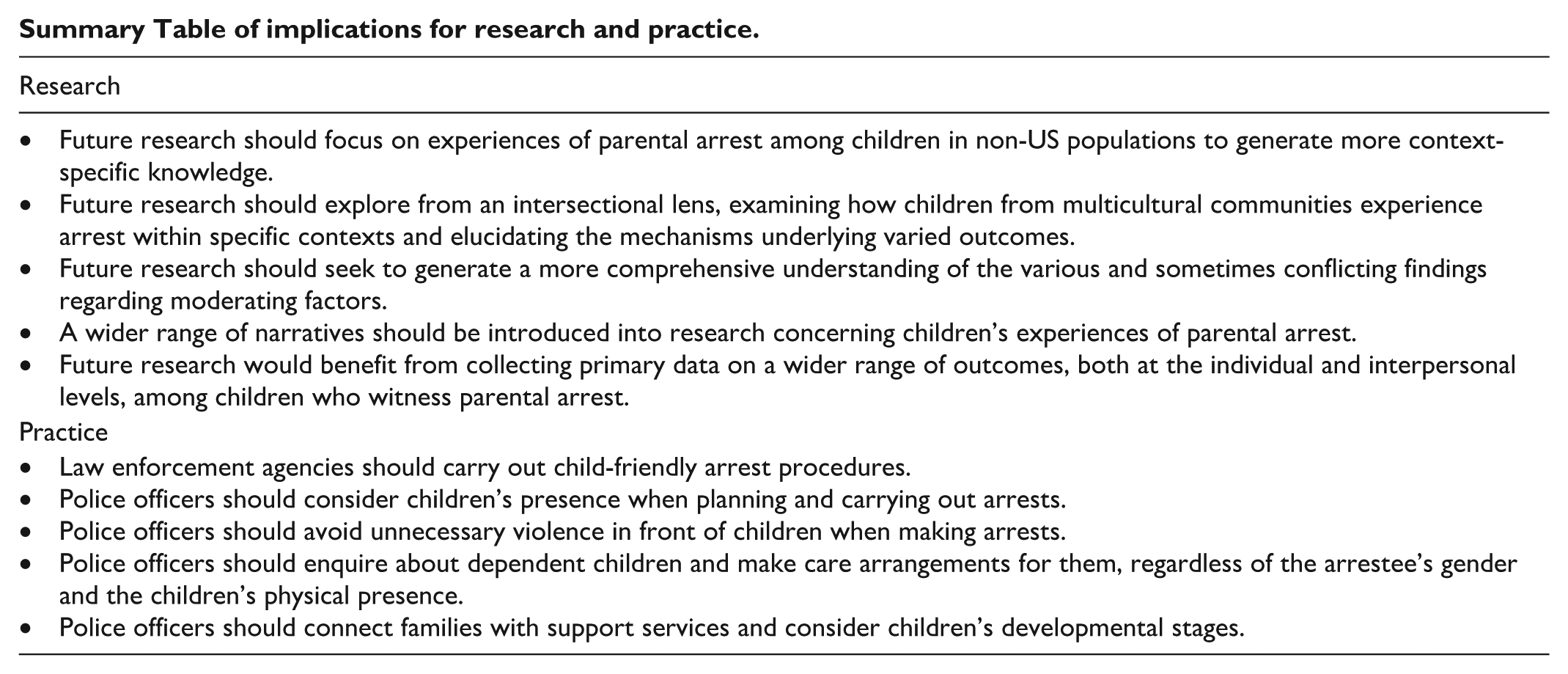
Lastly, this review reinforces the need to carry out child-friendly arrest procedures by law enforcement agencies to limit this harm on children. When planning for arrests, police officers should be mindful of children’s likely location during the planned action and whether the arrest can be carried out in the absence of children. When children are present at the point of arrest, avoid unnecessary violence that may traumatize children, for example, the use of weapons or handcuffing parents in view of them (Thurau, 2015). It is also recommended that police officers take the initiative to enquire about any dependent children, regardless of the person’s gender, and ensure that proper care has been arranged, whether the child is present or not. When necessary, police officers should connect families with appropriate support services and take children’s developmental stages into account when interacting with them.
Helpfully, there have been some initial efforts made in some jurisdictions, most notably in the US, notwithstanding its status as the only UN member state that has not ratified the UNCRC. A model policy has been developed by the International Association of Chiefs of Police (2014), suggesting the adoption of additional measures prior to and during arrests, as well as enhanced interagency collaboration to safeguard children of arrestees. In addition, the Urban Institute, together with the National Institute of Corrections, provides a toolkit for those interested in developing parental arrest programs to better support children before, during, and after their parents’ arrest, as well as implementing the policy (Kurs et al., 2015). Some jurisdictions in California and Connecticut also have directions for the police regarding children when making an arrest. For example, in San Francisco, a trauma-informed approach is adopted to arrests: considering the potential presence and ages of any children when planning arrests, asking arrestees about the presence of their children, attempting to make arrests out of view of children, and attempting to identify alternative caregivers for children of arrested parents (Thurau, 2015). Some initiatives are also evident in Europe. In Sweden, the police have a formal responsibility to inquire about (and follow-up on) the long-term care arrangements of the children of arrestees (Mulready-Jones, 2011). Best practices have begun to emerge across the UK (Children of Prisoners Europe, 2021). For instance, in 2021, Families Outside introduced accredited training programs for individuals and groups across the statutory and voluntary sectors who encounter families affected by imprisonment, including the police. An initiative where police officers left a contact card with family members during home arrests was launched in 2012 but discontinued after the formation of Police Scotland in 2013. When considered from a global perspective, these initiatives are both scant and sporadic; much more effort should be made in terms of developing and implementing child-sensitive policies and processes.
In conclusion, this review provides a panoramic view of the existing literature on the impact of witnessing parental arrest on children. It highlights the profound influence of this traumatic experience on children’s well-being and the various moderating factors that could possibly shape children’s adaptation during and following the arrest process. It offers timely suggestions for knowledge development and practice changes.
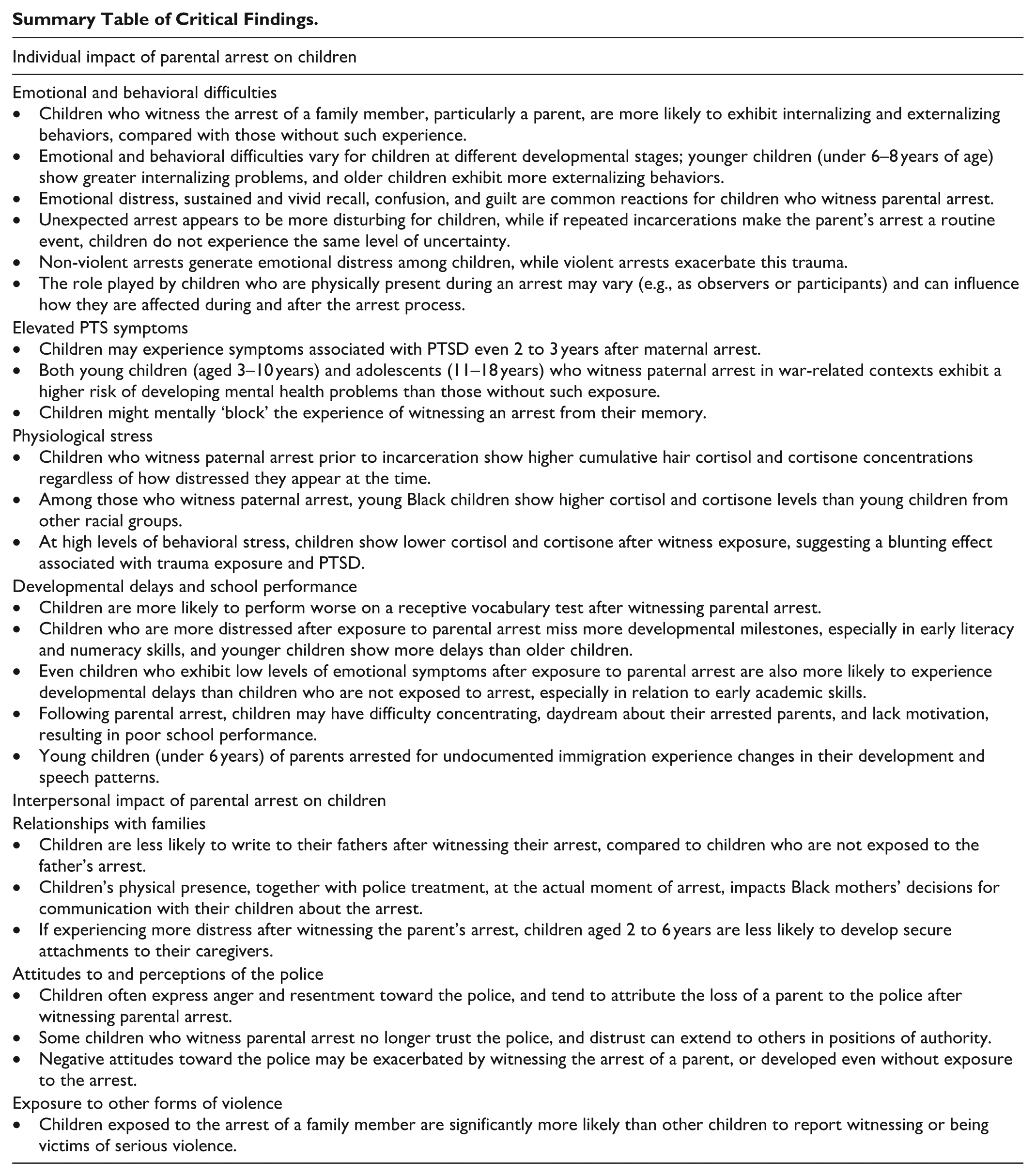
Summary Table of Critical Findings.
Summary Table of implications for research and practice.
Supplemental Material
sj-docx-1-tva-10.1177_15248380251395099 – Supplemental material for The Impact of Witnessing Parental Arrest on Children: A Scoping Review
Supplemental material, sj-docx-1-tva-10.1177_15248380251395099 for The Impact of Witnessing Parental Arrest on Children: A Scoping Review by Miaomiao He, Catherine Flynn and Susan Baidawi in Trauma, Violence, & Abuse
Supplemental Material
sj-docx-2-tva-10.1177_15248380251395099 – Supplemental material for The Impact of Witnessing Parental Arrest on Children: A Scoping Review
Supplemental material, sj-docx-2-tva-10.1177_15248380251395099 for The Impact of Witnessing Parental Arrest on Children: A Scoping Review by Miaomiao He, Catherine Flynn and Susan Baidawi in Trauma, Violence, & Abuse
Supplemental Material
sj-docx-3-tva-10.1177_15248380251395099 – Supplemental material for The Impact of Witnessing Parental Arrest on Children: A Scoping Review
Supplemental material, sj-docx-3-tva-10.1177_15248380251395099 for The Impact of Witnessing Parental Arrest on Children: A Scoping Review by Miaomiao He, Catherine Flynn and Susan Baidawi in Trauma, Violence, & Abuse
Footnotes
Acknowledgements
The authors wish to thank Gabby Lamb, Social Work Librarian at Monash University, for assistance in developing database search strategies.
Declaration of Conflicting Interests
The authors declared no potential conflicts of interest with respect to the research, authorship, and/or publication of this article.
Funding
The authors disclosed receipt of the following financial support for the research, authorship, and/or publication of this article: Miaomiao He is supported by an Australian Research Training Program scholarship.

Supplemental Material
Supplemental material for this article is available online.
Author Biographies
References
Supplementary Material
Please find the following supplemental material available below.
For Open Access articles published under a Creative Commons License, all supplemental material carries the same license as the article it is associated with.
For non-Open Access articles published, all supplemental material carries a non-exclusive license, and permission requests for re-use of supplemental material or any part of supplemental material shall be sent directly to the copyright owner as specified in the copyright notice associated with the article.
