



Abstract
There remains a paucity of European research on attitudes and responses to domestic abuse from frontline workers and professionals who regularly encounter domestic abuse or engage with domestic abuse legislation. This systematic review synthesized qualitative, quantitative, and mixed-method peer-reviewed studies that explored professionals’ knowledge, attitudes, and competencies related to domestic abuse. The professionals included medical staff (doctors, nurses, midwives), social care professionals, police officers, and criminal justice practitioners. The review was conducted on current European studies published between 2014 and 2025 and was reported in accordance with the Preferred Reporting Items for Systematic Reviews and Meta-Analyses (PRISMA) guidelines. Databases consulted included APA PsycInfo, Scopus, Web of Science, PubMed, Sociological Abstracts, International Bibliography of the Social Sciences, Social Services Abstracts, and Google Scholar. Full-text review was performed on 273 articles, of which 36 were deemed appropriate for inclusion. The review included 8 multi-country studies spanning the United Kingdom (England, Scotland, and Wales), and 28 single-country studies conducted in England, Sweden, Turkey, Portugal, the Republic of Ireland, Wales, Bosnia, Spain, Italy, Slovenia, and Hungary. A narrative and thematic synthesis categorized professional attitudes toward domestic abuse into four emergent themes: attitudes toward engagement and responsibility, attitudes toward victims, knowledge and understanding of domestic abuse, and attitudes as predictors of professional practice. This review addresses a dearth of research and provides recommendations for promoting proactive practice among professionals most likely to receive disclosures of abuse.
Introduction
Significant progress has been made in addressing domestic abuse across Europe, notably with the introduction of the Istanbul Convention in 2014. This Convention recognizes domestic abuse and gender-based violence as human rights violations and forms of discrimination, as defined by the 1979 United Nations Convention (Council of Europe, 2024). The European Union (EU) signed the Convention in 2017 and completed its accession in 2023, demonstrating its commitment to combating gender-based violence, particularly in relation to EU institutions, judicial cooperation, asylum, and non-refoulement (Council of Europe, 2024). The global cost of domestic abuse is estimated to be approximately 2% of global gross domestic product. In 2016, this cost was $1.5 trillion, and in 2025, it is projected to reach $2.3 trillion (O’Neill, 2023; UN Women, 2020). Some of these costs are linked to the loss of economic productivity within healthcare systems, as victims often suffer from physical injuries, mental health issues, and chronic health problems. Additional economic impacts extend to the criminal justice system, which incurs costs beyond those faced by the victim. These include expenses related to police investigations, legal proceedings, the incarceration of perpetrators, and the management of long-term effects, such as repeat offenses (Rothman et al., 2007).
The World Health Organization (2024) estimates that globally, one in three women will experience sexual, physical, or non-physical intimate partner violence in their lifetime. In Europe, there is a considerable lack of publicly available data on EU-wide abuse statistics. The most recent data from 2021 indicates that gender-based violence is most prevalent in Finland, Sweden, Hungary, Denmark, and Luxembourg, where over 45% of women reported experiencing physical violence (including threats) or sexual violence during adulthood by any perpetrator. These statistics are consistent for psychological violence as well, with Hungary, Romania, and Finland experiencing the highest rates (Eurostat, 2024a). Countries such as Germany, Romania, and Czechia reported that more than 45% of victims were unaware of the supports available to them, with these findings also strongly correlated with a lack of awareness about legal aid (Eurostat, 2024b, 2024c).
This lack of awareness can be particularly detrimental when victims are at their most vulnerable. Leaving an abusive relationship or challenging the perpetrator legally is one of the most dangerous times for victims and is often when they are at the highest risk of domestic homicide (Humphreys & Thiara, 2003). It is well documented that the impact of legal proceedings on victims can vary significantly depending on the quality of professional responses received (Saxton et al., 2021). Effective professional practice is characterized by listening to victims, providing empathetic, trauma-informed support, offering clear information, and ensuring access to resources (McKenna & Holtfreter, 2021). Such practices can help reduce psychological harm and facilitate recovery (Y. C. Chu et al., 2024). In contrast, poor practice typically involves professionals dismissing, discrediting, or minimizing the victim’s experiences, which can lead to secondary retraumatization and further psychological harm (Epstein & Goodman, 2019).
Badenes et al. (2023) found that inappropriate practices also affected the willingness of yet-to-qualify health professionals to intervene in cases of domestic abuse. This reluctance was influenced by heightened sexist attitudes, which, in turn, led to greater acceptance of domestic abuse and a diminished sense of its severity. Prior research has shown that reluctance to intervene among social workers and law enforcement officers can also stem from patriarchal views, personal experiences with abuse, distorted portrayals of abuse in the media, survivor-blaming, and perceptions of the “typical” survivor (Murvartian, Saavedra-Macías, & de la Mata, 2023; Murvartian et al., 2024). Such attitudes and preconceptions can retraumatize victims and are at odds with the victim’s need for trauma-informed care, which is essential for building trust in patient–provider relationships (Battaglia et al., 2003). Frontline professionals, such as those in the police service, criminal justice system, social care, and healthcare (including nurses and midwives), play a vital role in preventing and managing domestic abuse (Hill, 2020; Jaffe et al., 2020; A. Millar et al., 2022). Recognizing this, the World Health Organization (2013) has published guidelines and recommendations for professionals to ensure their practice is trauma-informed.
Research indicates that first responders’ approaches to managing and preventing domestic abuse are strongly influenced by their professional knowledge, attitudes, preparedness, and training (Ali et al., 2022; Kirk & Bezzant, 2020; Munro & Aitken, 2020). Additionally, victims’ responses to clinical practices are largely dependent on the receptiveness of the professionals involved (Trevillion et al., 2012). Health, social care, and criminal justice professionals are most likely to receive disclosures of domestic abuse and are considered the frontline professionals in this study. Their intervention is crucial to managing and preventing domestic abuse, and it often significantly influences the healing process of the victims.
The Current Review
At the time of this review, and to the best of our knowledge, only five systematic reviews have assessed public and professional attitudes, knowledge, or stigma surrounding domestic abuse. Kennedy and Prock (2018) examined female victims’ perceptions in the United States, revealing issues such as victim-blaming, denial, and discrimination by professionals. Gracia et al. (2020) reviewed general perceptions and attitudes toward domestic abuse in Europe and highlighted the need for more region-specific research.
Another U.S.-based review identified barriers to help-seeking among victims of intimate partner sexual violence, highlighting how stigma and rural isolation hinder support efforts (Wright et al., 2022). Serrano-Montilla et al. (2023) focused exclusively on police attitudes, finding that intervention was shaped by factors such as tolerance toward domestic abuse, understanding of the issue, and perceptions of professional responsibility. Finally, Murvartian, Saavedra-Macías, and Infanti (2023) global review examined stigma toward female victims of intimate partner violence in high-income countries, emphasizing both public and professional perceptions and their impact on victim outcomes. These reviews highlight that attitudes toward domestic abuse are variable and context-dependent, with negative attitudes and stigma having a profound impact on victims. However, a significant gap remains in documenting the current responses and attitudes of frontline professionals in Europe. Gracia et al. (2020) specifically called for more in-depth, region-specific research. This review addresses that gap by focusing on areas previously overlooked, such as the predominance of U.S.-based or global victim perspectives, the emphasis on public or general attitudes, the restriction to high-income countries, or the examination of a single professional group.
The present review focuses on current European studies, irrespective of country income status, and is conducted 10 years after the implementation of the Istanbul Convention. It examines a broad range of frontline professions and their responses to all forms of domestic abuse (financial, sexual, physical, psychological, and emotional abuse), and includes victims of all genders. The review also explores the mechanisms influencing frontline professionals’ responses, distinguishing between victim perceptions and professionals’ self-reported motivations. It aims to synthesize perceived inconsistencies in professional practice, as research has shown that victims’ recovery can be significantly influenced by professional attitudes (McLaughlin et al., 2024). The goal is to offer insights into how to better support both professionals and victims.
Theoretical Framework
Various theories inform this review. Lipsky’s (2010) Street-Level Bureaucracy theory emphasizes that public service workers (such as social workers, police officers, teachers, and healthcare providers) exercise considerable discretion in performing their duties. According to Lipsky, the actions and decisions of these bureaucrats are not solely dictated by formal rules and policies but are also shaped by both proximal and distal environmental factors. These may include their personal backgrounds, judgments, resource limitations, and the broader constraints or realities of their work settings. In addition, Kahn et al.’s (1964) role stress theory proposes that individuals in certain roles, including street-level bureaucrats, may experience stress when there is a misalignment between the expectations placed upon them (from both internal and external sources) and the resources or capabilities they possess to meet those demands. Both theories support the notion that role-related stress can significantly influence professional practice. Furthermore, Schein’s (1983) model of organizational culture provides a foundation for understanding how organizational culture operates not merely at a surface level but is embedded within the underlying beliefs, values, and behaviors of the organization and its members. This theory underscores the importance of the organizational environment in shaping how street-level bureaucrats perform their duties and make decisions.
Aims of Review
This review will:
(1) Identify frontline professional attitudes, responses, knowledge, and competencies regarding domestic abuse.
(2) Explore how psychosocial factors such as empathy and perceived sexism influence frontline professionals’ responses to domestic abuse.
(3) Identify the practical consequences of frontline professionals’ knowledge, attitudes, and competencies upon their professional practice within the context of trauma-informed care.
For this review, “frontline professionals” include doctors, nursing and midwifery staff, social care staff, police officers, and criminal justice practitioners (such as judges, solicitors, barristers, prosecutors, and magistrates).
Method
Study Design
This review is reported in accordance with the Preferred Reporting Items for Systematic Reviews and Meta-Analyses (PRISMA) guidelines (Kim & Royle, 2024), and the protocol is registered in PROSPERO (R. Millar et al., 2024). The strategy for data synthesis was guided by Thomas and Harden’s (2008) framework, specifically employing thematic synthesis, in which data were analyzed through the identification and integration of key themes. The umbrella terminology of “attitudes, knowledge, and competencies” used in this review was adapted from Tierney et al.’s (2022) protocol. Literature was sourced from the databases APA PsycInfo, Scopus, Web of Science, PubMed, Sociological Abstracts, International Bibliography of the Social Sciences, and Social Services Abstracts. Google Scholar was also consulted to identify additional published, non-duplicate literature.
Inclusion Criteria
Women’s Aid’s (2024a) definition of domestic abuse was used to guide the search parameters: “an incident or pattern of incidents of controlling, coercive, threatening, degrading and violent behavior, including sexual violence, in the majority of cases by a partner or ex-partner, but also by a family member or carer.” The search included studies documenting professional responses to both adult victims (aged 18 and over) and child victims (under 18). Only domestic abuse victimization within Europe was considered. Victims and professional respondents of all ethnicities, sexual orientations, and genders were eligible for inclusion. To be included, studies were required to focus on first-hand accounts of professional attitudes, knowledge, and competencies related to domestic abuse.
Attitudes referred to the responses and assessments made by medical, legal, police, and social work professionals regarding domestic abuse survivors, as measured through quantitative tools, such as the Attitudes toward Domestic Violence Questionnaire (Fox & Gadd, 2012) or explored through qualitative methodologies. Knowledge encompassed both the actual and perceived understanding of domestic abuse among frontline professionals, with a particular focus on their self-assessed readiness and perceived ability to support victims. Competence was defined as the practical application of readiness, preparedness, and capability required for professionals to effectively fulfill their roles (Tierney et al., 2022). Studies based on domestic abuse victims’ perceptions of professional attitudes were excluded from this review. Eligible studies focused exclusively on frontline professionals, defined as medical and social care staff, police officers, and criminal justice practitioners. The review included studies published between 2014 and 2025 to ensure the inclusion of contemporary European research conducted within the 10 years following the implementation of the Istanbul Convention (Council of Europe, 2024).
Qualitative, quantitative, and mixed-methods studies were eligible for inclusion. Studies were excluded if they were not written in English, did not focus explicitly on domestic abuse, lacked full-text access, were systematic or scoping reviews (including reviews of interventions), or constituted unpublished grey literature. Grey literature refers to a broad range of documents produced by government agencies, academic institutions, businesses, and industries in both print and digital formats. While such materials are often protected by intellectual property rights and may meet quality standards suitable for inclusion in institutional repositories or libraries, they are not distributed by commercial publishers. In other words, the primary purpose of the producing entity is not publication (Schöpfel, 2010).
Search Strategy
A comprehensive search and review of the literature was conducted across seven databases and Google Scholar, subsuming the fields of sociology, psychology, social work and care, medicine, and criminal justice. Three main search concepts were extracted: domestic abuse AND professionals AND responses. Related terms such as domestic violence, intimate partner violence, coercive control, and interpersonal violence were also used. Searches for the aspect of “professionals” were extrapolated into first responders, police, nurses, midwives, criminal justice, and social services. A full list of used search terms can be found in Table 1.
Search Terms Used to Find Potentially Relevant Papers.

Data Extraction and Analysis
The SPIDER (Sample, Phenomenon of interest, Design, Evaluation, and Research type) tool was used to extract and define aspects of the research question and inclusion criteria for the search strategy. Endnote and Rayyan were used to extract potentially relevant articles from the identified databases, which were reviewed independently by two researchers (R.M. and O.C.). Following PRISMA guidelines for screening and data checks, the relevant studies for inclusion were synthesized by extracting author(s), publication year, localization, participant population, methods and analysis, outcome, conclusions, and recommendations. Due to the heterogeneity of the studies’ samples and methodologies (qualitative, quantitative, and mixed-method) a narrative synthesis based on Popay et al.’s (2006) narrative guidance was employed.
Results
Study Selection
Of the 20,587 records extracted from the relevant databases, 10,001 were duplicated and removed from the search. Subsequently, two authors (R.M. and O.C.) performed screening. The second reviewer was provided with the inclusion criteria and search terms and completed 25% of title/abstract and full-text screening. When screening varied between the reviewers, discussion took place based on study inclusion and exclusion criteria, until a consensus was reached regarding study inclusion or exclusion. Any discrepancies were discussed with the wider research team. 10,586 records were screened by title and abstract, resulting in the exclusion of 10,303 records. Retrieval of full-text was conducted on 283 records, with 10 unable to be retrieved due to not being open access. Full-text review was performed on the remaining 273 records, 237 were excluded as they: (a) did not sample relevant frontline professionals (n = 35), (b) did not measure attitudes/perceptions (n = 73), (c) were a review (n = 17), (d) were not conducted in Europe (n = 44), (e) were not focused on domestic abuse (DA) (n = 26), (f) were not in English (n = 2), (g) were intervention-focused (n = 17), (h) were grey literature not previously identified (n = 13), or (i) data collection was conducted prior to 2014 (n = 10). Finally, 36 records met the full inclusion criteria and were deemed appropriate to be included in the systematic review. Figure 1 shows a breakdown of the inclusion process in a PRISMA flowchart (Moher et al., 2020).
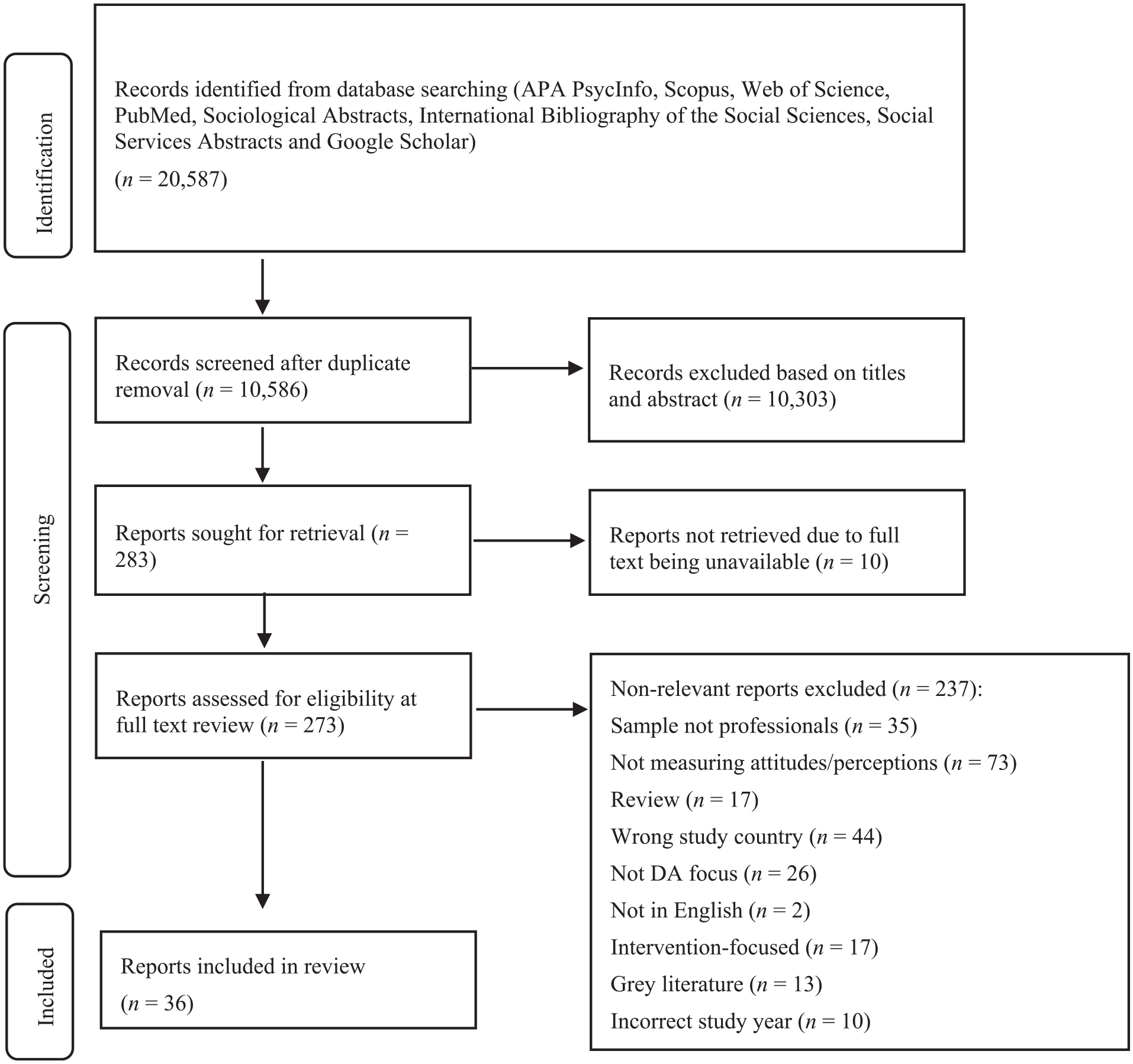
PRISMA flowchart of systematic review inclusion process (Moher et al., 2020).
Study Characteristics
The 36 articles included in the review were published between 2014 and 2024. The number of publications per year has remained relatively steady (M = 3), with the least publications occurring in 2020 and 2022 (n = 1 per year). The review included eight (22.2%) multi-country studies spanning the United Kingdom (England, Scotland, and Wales) and 28 (77.8%) single-country studies. Six were conducted in England (16.7%), six in Sweden (16.7%), five in Turkey (13.9%), two in Portugal (5.6%), three in the Republic of Ireland (1.3%), and one publication each from Wales, Bosnia, Spain, Italy, Slovenia, and Hungary (n = 1, 0.4%).
Sampling type was predominantly purposive sampling (n = 16, 44.4%). Six studies used convenience sampling (16.7%), four a combination of snowball and purposive sampling (11.1%), two snowball sampling alone (5.6%), and one random sampling (2.8%). Sampling methods for nine studies were unreported (n = 9, 25%). Study characteristics included qualitative, quantitative, and mixed-methods, and thus sample sizes varied. Of the included studies and from the available sample sizes, females were sampled significantly more frequently than males (31,854 and 1,472, respectively) across a variety of professions (nurses, midwives, social workers). Males formed most police officer samples, and criminal justice staff genders were evenly distributed.
Quantitative studies, or studies with a quantitative aspect, predominantly used surveys and questionnaires to assess attitudes and responses by frontline professionals toward domestic abuse. Samples ranged from 121 (Downie et al., 2019) to 787 participants (Lundberg & Bergmark, 2021). Qualitative studies, or those including qualitative aspects, utilized interviews or focus groups and ranged from samples of six (Naughton et al., 2015) to 61 participants (Robinson, Myhill, et al., 2018). One study conducted a synthesized analysis of 511 police records and 432 field observations (Myhill & Johnson, 2016), another performed a qualitative analysis of 350 hr of police field observations (Myhill et al., 2023). Most studies were solely conducted with police officers (n = 10, 27.8%), nurses and midwives (n = 6, 16.7%), social workers (n = 3, 8.3%), orthopedic staff (n = 1, 2.8%), doctors (n = 1, 2.8%), or judges (n = 1, 2.8%). The remaining studies used mixed sampling with various professions (n = 17, 47.2%). Table 2 shows a summary of study characteristics.
Summary of Study Characteristics.
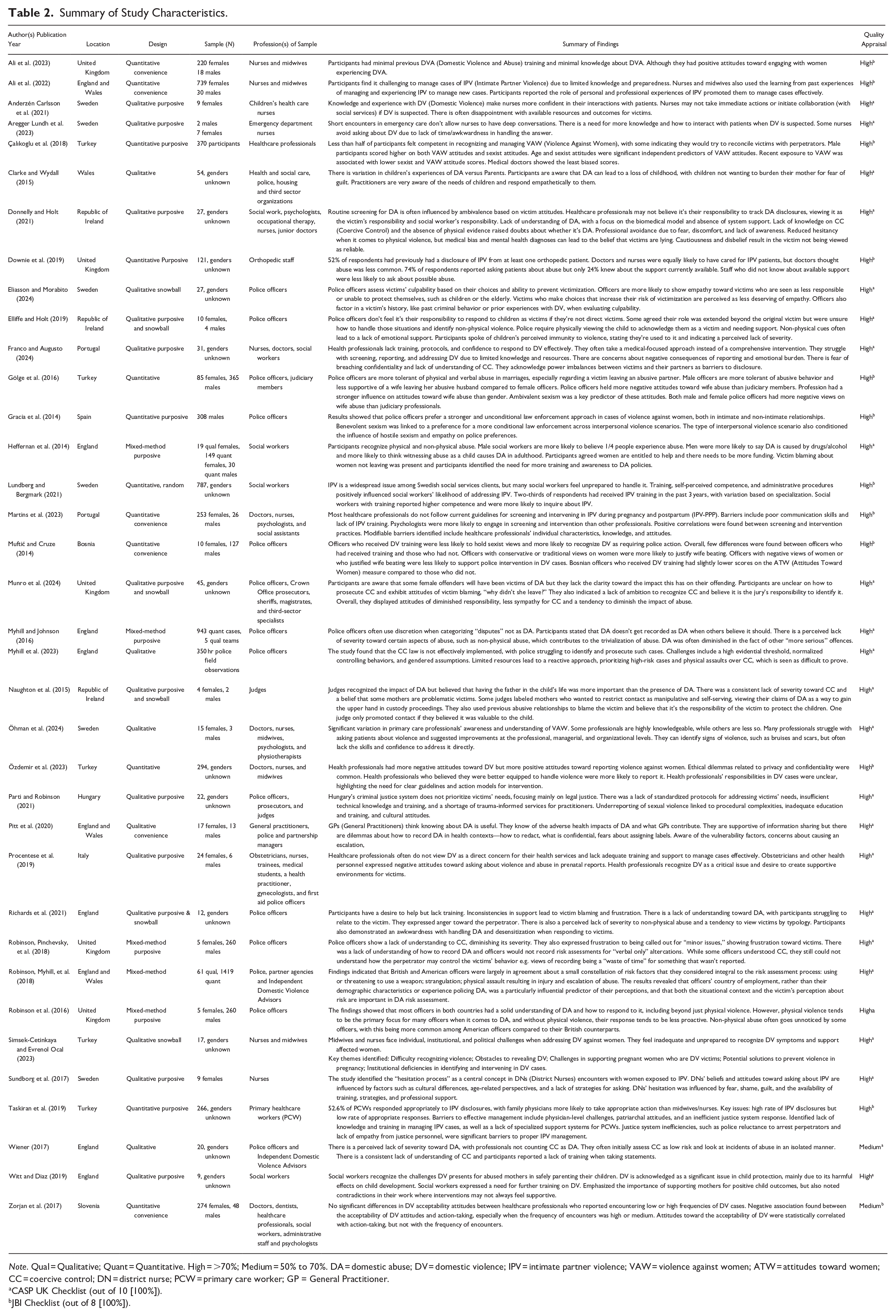
Note. Qual = Qualitative; Quant = Quantitative. High = >70%; Medium = 50% to 70%. DA = domestic abuse; DV = domestic violence; IPV = intimate partner violence; VAW = violence against women; ATW = attitudes toward women; CC = coercive control; DN = district nurse; PCW = primary care worker; GP = General Practitioner.
CASP UK Checklist (out of 10 [100%]).
JBI Checklist (out of 8 [100%]).
Quality Assessment
Two researchers (R.M. and O.C.) performed screening and quality assessments, evaluating biases in the studies identified for inclusion. Bias assessments were conducted in line with the Critical Appraisal Skills Program (CASP) and the Joanna Briggs Institute (JBI) critical appraisal checklists (CASP UK, 2024; JBI, 2024). Checklists were alternated for appropriateness based on study type (qualitative, quantitative, mixed-methods). Scores were generated based on George et al.’s (2014) quality assessment criteria: high scores were over 70% and judged to be excellent quality, medium were between 50% and 70% (satisfactory quality), and low-quality articles were less than 50% (of which there were none). Percentages were out of 10 (100%) (CASP UK, 2024) and 8 (100%) (JBI, 2024). Table 2 summarizes study quality scores.
Categories and Measures
By consensus of the reviewers, codes were manually derived through a narrative synthesis. Given their conformity and similarities to Gracia et al.’s (2020) and Villagrán et al.’s (2024) multidimensional categorization, they were incorporated into four categories: responsibility (n = 22, 61.1%) permissiveness (n = 20, 55.6%) attitudes toward domestic abuse (n = 28, 77.8%) and practice (n = 23, 63.9%). Responsibility included codes like training, duties, obligations, and accountability. Permissiveness included codes like victim blaming, minimization, and legitimization. Attitudes toward domestic abuse included codes like knowledge, perceptions, and perceived severity. Finally, practice included codes like routinization and normalization.
Most studies were qualitative (n = 19, 52.8%) or quantitative (n = 12, 33.3%), with five being mixed-method (13.9%). Of the quantitative scales used (n = 15), six used validated attitudinal measures (40%) based on existing scales (Ali et al., 2022, 2023; Downie et al., 2019; Gölge et al., 2016; Gracia et al., 2014; Özdemir et al., 2023) and nine used ad hoc scales (Çalıkoglu et al., 2018; Heffernan et al., 2014; Lundberg & Bergmark, 2021; Martins et al., 2023; Muftić & Cruze, 2014; Robinson et al., 2016; Robinson, Pinchevsky, et al., 2018; Taskiran et al., 2019; Zorjan et al., 2017). Of those availing of ad hoc scales, four investigated and reported the reliability and validity of the instruments (Çalıkoglu et al., 2018; Heffernan et al., 2014; Lundberg & Bergmark, 2021; Martins et al., 2023) while the remaining five did not report reliability nor validity.
Themes
While initially guided by the reviews of Gracia et al. (2020) and Villagrán et al. (2024), the current study’s novel findings led to the derivation of new themes. Popay et al.’s (2006) narrative synthesis and Thomas and Harden’s (2008) thematic synthesis frameworks were consulted during the theme development process. The primary researcher (R.M.) undertook the following steps: (a) developed a theory on how attitudes and perceptions are shaped by psychosocial factors and various theoretical frameworks, including Street-Level Bureaucracy (Lipsky, 2010), Role Stress Theory (Kahn et al., 1964), and the Model of Organizational Culture (Schein, 1983); (b) conducted a preliminary synthesis of the included studies through coding; (c) examined the relationships between the codes and data; (d) assessed the robustness of the synthesis; and (e) defined the final theme names.
The themes constructed were: attitudes toward engagement and responsibility, attitudes toward victims, knowledge and understanding of domestic abuse, and attitudes as predictors of professional practice. Given the iterative nature of the synthesis process and the frequent variability of attitudes, significant overlap was observed within and between studies. This overlap is highlighted throughout the results section.
Attitudes Toward Engagement and Responsibility
This theme encompassed 23 studies (63.9%) that documented frontline professionals’ attitudes, knowledge, and competencies regarding their perceived responsibilities and engagement with domestic abuse legislation, victims, and training. Attitudes toward engagement and responsibility were consistent across all nations included in the studies. The articles represented countries such as Sweden, Turkey, Portugal, Bosnia, Italy, Great Britain, and the Republic of Ireland. Within this theme, multiple attitudes toward engagement and responsibilities were identified. Of the studies, 16 depicted perceived competencies, 14 highlighted disengagement, and 9 demonstrated enthusiasm for addressing domestic abuse.
Police officers and criminal justice staff often disengaged from domestic abuse cases, frequently neglecting their responsibilities (Myhill et al., 2023; Parti & Robinson, 2021). They were more likely to perceive domestic abuse as a non-criminal matter and tended to shift the responsibility for prosecution onto the victim (Richards et al., 2021; Robinson, Pinchevsky, et al., 2018), while delegating victim support to other professionals (Munro et al., 2024; Richards et al., 2021). Similar disengagement was noted among healthcare professionals, including general practitioners, nurses, and social workers, who often did not perceive it as their responsibility to address domestic abuse (Aregger Lundh et al., 2023; Donnelly & Holt, 2021; Procentese et al., 2019; Sundborg et al., 2017; Witt & Diaz, 2019).
However, these attitudes may stem from frustration, anger, and uncertainty, with many frontline professionals citing incompetency, lack of training, time constraints, and heavy workloads as reasons for disengagement (Aregger Lundh et al., 2023; Çalıkoglu et al., 2018; Donnelly & Holt, 2021; Richards et al., 2021). Despite these challenges, many professionals also expressed positive attitudes toward supporting victims and enthusiasm for education and intervention (Ali et al., 2023; Anderzén Carlsson et al., 2021; Clarke & Wydall, 2015; Donnelly & Holt, 2021; Elliffe & Holt, 2019; Franco & Augusto, 2024; Öhman et al., 2024; Pitt et al., 2020; Simsek-Cetinkaya & Evrenol Ocal, 2023). Some police officers saw their role as extending beyond prosecution, in contrast to others who minimized their responsibilities (Elliffe & Holt, 2019; Muftić & Cruze, 2014; Myhill et al., 2023; Richards et al., 2021). Social workers and medical professionals were generally more enthusiastic about supporting victims (Ali et al., 2023; Anderzén Carlsson et al., 2021; Clarke & Wydall, 2015; Donnelly & Holt, 2021; Franco & Augusto, 2024; Öhman et al., 2024; Pitt et al., 2020; Simsek-Cetinkaya & Evrenol Ocal, 2023).
Attitudes Toward Victims
This category included 20 articles (55.6%) depicting professionals’ perceptions of victims and victimization. Attitudes toward victims were frequently crosscutting between articles, with 13 articles reflecting attitudes of empathy and understanding, 10 focusing on minimization and dismissal of experiences, and 13 highlighting victim-blaming. These articles represented studies from Turkey, Slovenia, Sweden, England, and Bosnia. As with other themes in this review, many articles presented more than one attitude, with frequent overlap.
Attitudes of dismissal, minimization, victim-blaming, and lack of empathy were common among police officers and criminal justice professionals (Eliasson & Morabito, 2024; Elliffe & Holt, 2019; Gölge et al., 2016; Muftić & Cruze, 2014; Munro et al., 2024; Myhill et al., 2023; Naughton et al., 2015; Richards et al., 2021; Robinson, Myhill, et al., 2018; Robinson, Pinchevsky, et al., 2018). Police officers were found to dismiss domestic abuse callouts as “minor issues” and often lacked empathy (Robinson, Pinchevsky, et al., 2018). Despite recognizing the complexities of domestic abuse, they tended to minimize its impact (Richards et al., 2021). These attitudes led to victim-blaming, with officers questioning why victims didn’t leave or accusing repeat victims of “crying wolf” (Eliasson & Morabito, 2024; Munro et al., 2024; Richards et al., 2021). Richards et al. (2021) identified that frontline professionals categorized victims based on perceived “believability,” such as the “Genuine Victim,” or “Manipulative Victim.”
Negative attitudes were also present among some health and social care professionals (Çalıkoglu et al., 2018; Clarke & Wydall, 2015; Donnelly & Holt, 2021; Heffernan et al., 2014; Özdemir et al., 2023; Taskiran et al., 2019; Witt & Diaz, 2019), with some questioning victims’ experiences when physical evidence was lacking (Donnelly & Holt, 2021) or blaming victimized parents for inadequate child protection (Clarke & Wydall, 2015). However, attitudes varied, with some professionals recognizing the complexities of abusive relationships (Clarke & Wydall, 2015; Heffernan et al., 2014; Zorjan et al., 2017). Nurses, midwives, and general practitioners were generally more empathetic and aware of factors that might prevent victims from disclosing abuse (Ali et al., 2023; Pitt et al., 2020; Zorjan et al., 2017). Yet, some medical staff minimized victims’ experiences, particularly when co-morbidities like mental health issues or disabilities were present, labeling victims as “unreliable witnesses” (Donnelly & Holt, 2021). This suggests that vulnerable victims may face additional barriers in being believed and supported.
Knowledge and Understanding of Domestic Abuse
Most articles included in this review demonstrated professionals’ knowledge and understanding of domestic abuse (n = 24, 66.7%). However, expressions of knowledge and understanding were often contradictory and crosscutting between articles. Fifteen articles included frontline professionals’ perceptions of a severity scale for domestic abuse, 12 displayed informed or misinformed perceptions, and 6 articles noted the routinization of domestic abuse. Most articles within this category focused on professionals in Great Britain and the Republic of Ireland (n = 16), with three in Sweden, and one each in Spain, Turkey, and Bosnia.
The categorization of domestic abuse incidents was often based on a perceived severity scale, with misinformation and routinization of domestic abuse incidents present across all professions sampled. While professionals acknowledged coercive control and non-physical abuse, they frequently categorized abuse severity, with physical abuse considered the most severe (Anderzén Carlsson et al., 2021; Munro et al., 2024; Robinson et al., 2016; Wiener, 2017). For example, police officers tended to show more empathy for vulnerable victims, such as children or the elderly (Eliasson & Morabito, 2024), but this was often coupled with minimizing the impact of non-physical abuse and a lack of understanding of coercive control (Donnelly & Holt, 2021; Heffernan et al., 2014; Myhill & Johnson, 2016; Myhill et al., 2023; Robinson, Myhill, et al., 2018). This trend was most common among police and criminal justice professionals but was also observed in healthcare and social care staff (Anderzén Carlsson et al., 2021; Aregger Lundh et al., 2023; Özdemir et al., 2023).
In contrast, some medical and social care professionals recognized coercive control as a major risk factor for intimate partner homicide and the escalation of abuse (Clarke & Wydall, 2015; Downie et al., 2019; Robinson, Pinchevsky, et al., 2018), though some failed to recognize the subtle signs of domestic abuse (Aregger Lundh et al., 2023). Interestingly, a Spanish study showed that some police officers were aware of the severity of coercive control (Gracia et al., 2014). Medical and social care professionals were also generally more attuned to the challenges victims face in disclosing abuse (Clarke & Wydall, 2015; Pitt et al., 2020).
These factors contributed to the routinization and normalization of domestic abuse in practice. Police, criminal justice staff, and social workers often underestimated abuse rates and effects (Elliffe & Holt, 2019; Heffernan et al., 2014; Lundberg & Bergmark, 2021; Muftić & Cruze, 2014; Richards et al., 2021). Some officers referred to domestic abuse as their “bread and butter” and only took notice of exceptional cases (Richards et al., 2021). Social workers in Sweden reported not asking about domestic abuse unless there was a “special reason” (Lundberg & Bergmark, 2021), while officers in Ireland often dismissed the effects of abuse on children unless the child was visibly upset (Elliffe & Holt, 2019). Judges in Ireland also prioritized maintaining “nuclear family” structures, often minimizing coercive control and viewing it as less serious compared to other forms of abuse (Naughton et al., 2015).
Attitudes as Predictors of Practice
Each of the attitudes, knowledge and competencies identified within the preceding themes were significant predictors of practice within all frontline professionals sampled, and were representative of the first aim of this review. Twenty-six articles explored the third aim of the study, identifying the practical consequences of professionals’ knowledge, attitudes, and competencies. Professional practice can be categorized into two types: reactive and proactive. The studies included in this section were representative of Great Britain, Spain, the Republic of Ireland, Turkey, Hungary, Slovenia, Portugal, and Bosnia.
Proactive intervention in domestic abuse cases was linked to professionals’ ability to empathize, relate, and recognize the need for interventions. Around 25% of articles (n = 9) demonstrated professionals taking proactive action, particularly those with prior experience or specialized domestic abuse training (Ali et al., 2022; Downie et al., 2019; Gracia et al., 2014; Lundberg & Bergmark, 2021; Muftić & Cruz, 2014; Pitt et al., 2020; Robinson, Pinchevsky, et al., 2018; Sundborg et al., 2017; Witt & Diaz, 2019). Training enhanced empathy, proactive intervention, and recognition of non-physical abuse as a risk factor for homicide (Downie et al., 2019; Lundberg & Bergmark, 2021; Muftić & Cruz, 2014; Robinson, Pinchevsky, et al., 2018; Sundborg et al., 2017). In contrast, reactive practices, found in 47.2% of articles (n = 17), involved minimizing or disregarding victims’ experiences, leading to callousness, disengagement, desensitization, and victim blaming (Ali et al., 2023; Çalıkoglu et al., 2018; Clarke & Wydall, 2015; Donnelly & Holt, 2021; Elliffe & Holt, 2019; Gölge et al., 2016; Martins et al., 2023; Munro et al., 2024; Myhill & Johnson, 2016; Naughton et al., 2015; Özdemir et al., 2023; Parti & Robinson, 2021; Richards et al., 2021; Robinson et al., 2016; Robinson, Myhill, et al., 2018; Wiener, 2017; Zorjan et al., 2017). These attitudes were often influenced by a lack of training, insufficient professional practice knowledge, frustration, and heavy workloads (Martins et al., 2023; Parti & Robinson, 2021).
Exploring the second aim of this study, psychosocial variables like gender, sexism, empathy, and conservative beliefs impacted professional practices. A Spanish study (Gracia et al., 2014) found that male police officers with fewer sexist beliefs were more likely to enforce laws strictly and provide more victim support. Empathy was also a key predictor of proactive intervention. Additionally, male professionals, particularly in healthcare and law enforcement, were more likely to exhibit negative attitudes, including victim blaming, compared to female professionals (Çalıkoglu et al., 2018; Gölge et al., 2016; Özdemir et al., 2023). Culture also played a role, with Bosnian police officers holding liberal, pro-feminist attitudes, while conservative beliefs were associated with the justification of “wife beating” (Muftić & Cruze, 2014). These psychosocial factors reflect broader social, organizational, and cultural influences, rather than being profession-specific, and contribute to the complexities of professional responses to domestic abuse.
Discussion
This review is the first, to our knowledge, to focus on professional responses to all forms of domestic abuse across European countries, regardless of income level, and to consider victims of any gender. It also examines the psychosocial factors shaping these responses. Our findings reveal a significant lack of domestic abuse-specific training for front-line professionals and criminal justice practitioners, which leads to negative attitudes with serious consequences for both professionals and victims (Gracia et al., 2020; Serrano-Montilla et al., 2023; Villagrán et al., 2024). This review spans a range of professions and offers crucial insights into improving professional practices and policies. Based on the frameworks of Serrano-Montilla et al. (2023) and D. C. Chu & Sun (2014), two key attitudinal domains—reactive and proactive—emerge from the studies, with both observed in the findings.
Training and the Impact on Professional Practice
This review confirms existing research indicating that health and social care staff, police officers, and criminal justice professionals often lack the specialized training necessary to identify domestic abuse, resulting in frustration and inappropriate interventions (Christensen et al., 2021). The global gap in training is evident, with minimal undergraduate education on the topic and limited opportunities for ongoing professional development (Kirk & Bezzant, 2020). This lack of training diminishes professional competency in handling domestic abuse cases, while proactive responses, fueled by training, lead to increased empathy and fewer negative attitudes. Recent legislative changes have led to more police and criminal justice training; however, its effectiveness is contingent upon officers’ willingness to adapt the training beyond their personal views and organizational culture, as highlighted by Dempsey (2002) and Schein’s (1983) Model of Organizational Culture. There is a clear need for continuous, domestic abuse-specific professional development to ensure trauma-informed responses (A. Millar et al., 2022). A lack of professional efficacy contributes to disengagement, emphasizing the need for clear protocols and organizational support to improve proactive responses and enhance frontline professionals’ competence and confidence in addressing domestic abuse (Cleaver et al., 2019).
Interpersonal Barriers Toward Professional Practice
Training alone does not fully explain reactive or proactive professional practice. Some healthcare professionals expressed concerns about making mistakes, such as incorrectly assuming someone is experiencing domestic abuse (Sundborg et al., 2017), while others hesitated to initiate conversations out of fear of offending or retraumatizing victims (Bradbury-Jones, 2015). These concerns are valid, as inappropriate responses can indeed lead to retraumatization (McLaughlin et al., 2024). Interpersonal barriers, such as a reluctance to pry or overstep, also contribute to disengagement, indirectly harming victims (Aregger Lundh et al., 2023; Murvartian, Saavedra-Macías, & Infanti, 2023). Previous research suggests that frontline professionals who acknowledge their responsibility in domestic abuse intervention tend to respond more empathetically and proactively (Roush & Kurth, 2016). Organizational and interpersonal barriers, such as heavy workloads and limited access to mental health resources, were also found to reduce sensitivity toward victim care, aligning with previous research (Maclean et al., 2024). These barriers can lead to desensitization, inadequate victim responses, systemic retraumatization, and negative outcomes for both victims and professionals.
Psychosocial Factors and Cultural Norms
It is important to note that ratifying the Istanbul Convention (Council of Europe, 2024) does not necessarily mean that a country is effectively implementing the laws and policies it introduces. Therefore, an organization’s culture and its approach to addressing domestic abuse may not align with the country’s ratification status. The influence of organizational culture and street-level bureaucracy is evident in countries like Hungary, which has the highest rates of domestic abuse in the EU (Eurostat, 2024a). Despite this, Hungary has resisted adopting the Istanbul Convention, claiming its existing laws already protect women (European Parliament, 2020). However, Parti and Robinson (2021) found that Hungary’s criminal justice system does not prioritize victim needs and lacks standardized protocols. The focus on physical violence within these systems leads to a reactive professional approach, often misinterpreting coercive control and minimizing the impact of witnessing abuse on children (Elliffe & Holt, 2019; Myhill et al., 2023).
Psychosocial factors, such as sexism, gender stereotypes, and traditional beliefs, were common in the studies reviewed. These factors were associated with more negative attitudes toward domestic abuse, including victim-blaming and reactive practices. Research shows that gender roles and sexism predict tolerance of violence (Agadullina et al., 2022; Çalıkoglu et al., 2018), and male students in particular may justify abuse (Kerman & Ozturk, 2022). Gender-role attitudes, rather than gender alone, may shape perspectives on domestic abuse (Reidy et al., 2014).
Cultural differences, such as those found in cultures of honor in Turkey, Bosnia, and Hungary, may also contribute to reactivity. In these cultures, patriarchal standards emphasizing family reputation and male dominance hinder effective responses to abuse (Çalıkoglu et al., 2018; Tarhan et al., 2017). The review suggests that such organizational and cultural gender hierarchies influence professional practices, particularly in policing and criminal justice, where patriarchal norms impede domestic abuse responses (Carrillo, 2021). In contrast, healthcare systems, which often promote proactive, trauma-informed approaches and have more female representation, tend to offer more empathetic responses. However, acceptance and minimization of abuse were seen across all professions, indicating that professional practices are shaped by factors such as training availability, personal experiences, and the recognition of roles in addressing domestic abuse.
Theoretical Implications for Practice
The theories of Lipsky’s (2010) street-level bureaucracy, Kahn et al.’s (1964) role stress theory, and Schein’s (1983) model of organizational culture provide valuable frameworks for interpreting the findings of the current review. Lipsky’s theory posits that public service workers, such as police officers and healthcare providers, possess significant discretion in their roles, influenced by personal experiences, judgments, and environmental factors. This aligns with the review’s findings, where frontline professionals’ responses to domestic abuse were shaped by individual experiences, training, and trauma-informed organizational structures. Kahn et al.’s (1964) Role Stress Theory highlights the stress professionals face when the demands on them exceed their available resources or capabilities. This pattern emerged in the review, where excessive workloads, understaffing, and inadequate funding led to frustration and reactive behaviors.
Finally, Schein’s (1983) model of organizational culture demonstrates how organizational values, beliefs, and behaviors shape professional practices. This was evident in the review, where health and social care professionals, influenced by trauma-informed organizational cultures, exhibited more proactive responses, while criminal justice and police professionals, shaped by different organizational values, tended to display more reactive behaviors. Together, these theories help explain the variability in professional responses to domestic abuse, as identified in the review.
Implications for Research
This systematic review offers a novel perspective on the factors influencing professional practice in addressing domestic abuse, filling a gap in existing literature. It enhances understanding by examining how individual psychosocial factors, such as gender, empathy, sexism, and job role, interact with workplace factors and professional hierarchies to shape either proactive or reactive responses. The findings emphasize the importance of social ecology within the microsystem and mesosystem, highlighting how factors like gender, empathy, sexism, profession type, training, abuse experience, and country of origin contribute to disparities in professional responses. While distal influences, such as organizational policies, country-specific patriarchal or feminist ideologies, departmental resources, and bureaucratic barriers, were not fully explored, qualitative insights suggest these factors warrant further investigation (Clarke & Wydall, 2015; Gracia et al., 2014; Heffernan et al., 2014; Richards et al., 2021).
Implications for Practice
The term “expert by experience” is often used for victims of domestic abuse, recognizing how their lived experience shapes policy and legislative development (Women’s Aid, 2024b). However, this term is not applicable to frontline professionals. This review introduces the concept of “novices by experience” to describe professionals who, through repeated exposure to domestic abuse, develop cynical, desensitized attitudes. Such mindsets often lead to victim-centered dehumanization or disengagement from the issue (Richards et al., 2021; Serrano-Montilla et al., 2023). These attitudes were compounded by a lack of multi-agency cohesion, where professionals frequently shifted responsibility to others, undermining effective intervention.
The review highlights key areas for improving professional training, particularly the need for clearly defined roles and responsibilities for each professional involved in addressing domestic abuse. Training should be tailored to the specific roles’ professionals hold within their organizations (Robinson, Myhill, et al., 2018). Interestingly, novice police officers were found to be more proactive in policing domestic abuse than their supervisory counterparts, who were more likely to minimize non-physical abuse and coercive control (Robinson, Myhill, et al., 2018). In contrast, healthcare and social care staff’s tolerance for domestic abuse was positively linked to their experience and staff ranking (Downie et al., 2019). This suggests that empathy is integral to addressing domestic abuse, with caregiving roles fostering a more empathetic response. Conversely, exposure to trauma in policing may diminish empathy, emphasizing the need for mandatory mental health support for police and criminal justice professionals. The review stresses that fostering proactive attitudes relies on timely, role-specific domestic abuse training and mental health support. It is recommended that all professionals receive targeted training early in their careers, with continuous support, to prevent the development of disengaged, late-career attitudes and ensure sustained empathetic practice.
Implications for Policy
Not all studies included in this review were subject to the ratification of the Council of Europe’s (2024) Istanbul Convention. As ratification status varies, this review cannot fully clarify the specific roles and responsibilities of police officers, criminal justice practitioners, or healthcare professionals within their respective countries. Feedback from the studies suggests that organizational policies are often either non-existent or unknown to staff, highlighting the need for greater awareness and development of localized, organization-specific policies and procedures.
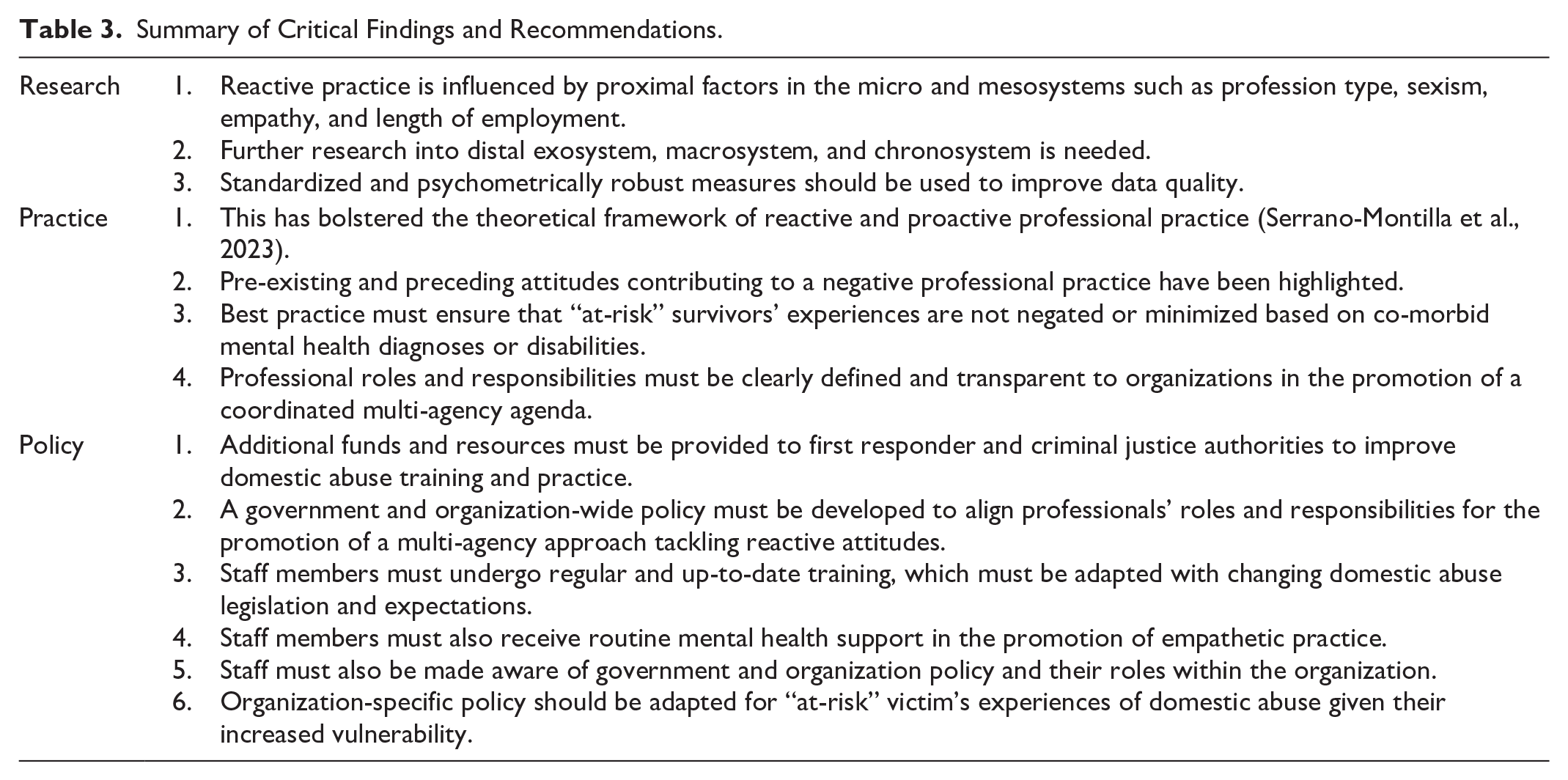
Ethical ambiguity in professional practice arises from policy deficiencies and undefined job roles, which undermine proactive interventions. Government and organizational policies should address these gaps by ensuring that funding, training, support, and resources are appropriately allocated to police, criminal justice, medical, and social care sectors. Furthermore, policies should encourage the development of a cohesive multi-agency approach, with clearly defined roles across professional bodies. The attitudes identified in this review emphasize the importance of these recommendations in enabling professionals to effectively handle domestic abuse cases, support victims, and enhance professional self-efficacy. Transparent roles and responsibilities within multi-agency coordination are critical for addressing organizational deficits and improving responses to domestic abuse. Table 3 presents a summary of the critical findings and recommendations.
Summary of Critical Findings and Recommendations.
Limitations
This review has several limitations that should be acknowledged. Reflexivity plays a key role, as the researchers’ inclusion criteria and search strategies were influenced by their own knowledge and experiences with domestic abuse research. Coming from a victim-centered perspective, the researchers are particularly sensitive to the needs and experiences of those affected by violence. Furthermore, the researchers operate within a post-conflict society, where they have observed victim-perceived reactivity in frontline professionals, particularly in relation to domestic abuse cases. While the researchers aimed to conduct the research objectively, their personal experiences and understanding of systemic issues may have influenced the analysis, particularly with an emphasis on reactive responses from police, criminal justice, and social work professionals. The findings, which highlight patterns of reactivity in these sectors, reflect these insights, emphasizing a victim-centered approach.
Another limitation was the restriction of the search criteria to “knowledge, attitudes, and competencies,” which may have excluded relevant articles using alternative terms such as “myths,” “stigma,” or “beliefs,” potentially offering valuable insights. This limitation was evident when a general literature search revealed additional studies that would have been included had they appeared in the initial search. Future research could expand the search criteria to include a broader range of relevant studies (Murvartian et al., 2024; Roush & Kurth, 2016). Additionally, limiting the review to European published studies excluded relevant studies and grey literature from other regions, contributing to a limited pool of literature.
Conclusion
With the introduction of the Istanbul Convention (Council of Europe, 2024), Europe has seen an increase in policies and protocols targeting domestic abuse and violence against women and girls. Previous European and international research has highlighted the inconsistent and contradictory professional attitudes, knowledge, and competencies regarding domestic abuse (Gracia et al., 2020). Gracia et al. (2020) called for further research to better understand the causes of these variations. This study expands on existing knowledge by identifying factors such as profession type, sexism, empathy, and training as key influences on professional attitudes toward domestic abuse within European frontline professionals (Gracia et al., 2020; Serrano-Montilla et al., 2023; Villagrán et al., 2024). However, a gap remains in understanding the complexities of domestic abuse among professionals, with organizational stigma and misinterpretation of abuse being central issues. The absence of consistent protocols has led to professionals downplaying the issue or shifting responsibility, rooted in ethical ambiguity. This review argues that domestic abuse should be considered as everyone’s responsibility, and policies should reflect this collective duty.
Footnotes
Acknowledgements
We would like to thank Carol Dunlop, subject librarian in Queen’s University, who provided invaluable guidance during the search formation stage.
Data Availability Statement
The data supporting the findings of this systematic review are derived from previously published studies, which are referenced within the manuscript. The review protocol is available on PROSPERO (CRD42024542363) and can be accessed at  . Due to the nature of the review, no primary datasets are generated or analyzed in this study.
Declaration of Conflicting Interests
The author(s) declared no potential conflicts of interest with respect to the research, authorship, and/or publication of this article.
Funding
The author(s) disclosed receipt of the following financial support for the research, authorship, and/or publication of this article: This work was supported by the NINE Doctoral Training Program [grant number ES/P000762/1].