




Abstract
Literature on stress and intimate partner violence (IPV) has primarily focused on stress as an outcome of women’s experience of IPV. However, stress may also be a predictor of male-perpetrated IPV. To improve our understanding of how theoretical approaches to stress have been applied to IPV research, we conducted a sub-analysis of a broader systematic review to identify published literature that examines theoretical approaches to stress as a predictor of male-perpetrated IPV. We conducted a search of nine electronic databases and assessed title/abstract and full texts according to pre-defined inclusion and exclusion criteria. Two reviewers categorized included studies into different theoretical groupings and sub-groupings. Data were extracted according to a data extraction template developed for the review, establishing consistency in a pilot data extraction phase. The review identified 27 articles that addressed the following theories of stress: general stress theory, life course theory, occupational stress theory, vulnerability theory, and family stress theory. Each of these sub-theories focuses on different forms of stress, for example, life course theory specifically focuses on stressful early life experiences, including adverse childhood events, whereas occupational stress theory focuses on workplace-related stressors that may result in increased male-perpetrated IPV. Analysis of measurement of stress variables indicated that measurement of stress varies widely across studies and primarily relies on self-reports. Consideration of stress as a predictor of IPV provides important insights into preventable and modifiable targets for intervention. Additional research on mechanisms and pathways between stress and IPV is needed.
Keywords
Background
Stress is associated with a number of detrimental mental and physical health outcomes across the life course and is implicated in unhealthy and risky behaviors (Lovallo, 2005). There is a considerable evidence base on the associations between adverse childhood experiences (ACEs)—a set of stressors including poor caregiver mental health, physical and emotional neglect, and family members’ use of alcohol or drugs—and poor physical and mental health throughout the life course (Nelson et al., 2020). These ACEs have also been found to be associated with an increased risk of perpetrating interpersonal violence (Brown et al., 2023; Duke et al., 2010).
Intimate partner violence (IPV) is a highly prevalent human rights violation and global public health concern (Sardinha et al., 2022). While IPV can be experienced and perpetrated by both men and women, women are more likely to sustain serious injuries due to male-perpetrated IPV (Felson & Cares, 2005), and men are more likely to perpetrate severe and chronic IPV in the context of seeking and maintaining control and power within an intimate relationship (Kimmel, 2002; Warner, 2010). The vast majority of literature that focuses on stress and IPV considers IPV itself as the stressor and examines the mental health and coping outcomes of women who experience IPV (Chandan et al., 2020; Oram et al., 2017; Trevillion et al., 2012). For example, multiple studies have focused on how IPV experiences shape women’s mental health, and how stressors related to stigma, community norms, and socio-economic deprivation may limit women’s help-seeking behaviors following IPV experience (Murvartian et al., 2023; White et al., 2023; Wood et al., 2019; Wright et al., 2021).
Stress is defined as “a process by which external, environmental, or psychological demands” overwhelm an individual’s coping capacity and can result in social, biological, and psychological changes that are detrimental to health (Surachman & Almeida, 2018). Stress research posits that stress is comprised of three components: (a) stressors, which are external or environmental demands; (b) stress appraisals, which are individual perceptions and subjective experiences of the severity of the stressors; and (c) response to stressors, which may be behavioral, biological, or psychological (Cohen et al., 1997). Stress theorists emphasize that stress results in a physiological or behavioral response due to external stimuli, which may be unpredictable and/or uncontrollable (Koolhaas et al., 2011).
Cohen et al. note that there are three over-arching theoretical approaches to stress. The psychological stress perspective is focused on “individuals’ appraisals of stressors and the availability of coping resources to manage the overwhelming demands of such stressors,” while the social stress perspective emphasizes “the way that environmental or external demands precipitate individuals’ stress and how such demands are contingent upon contextual factors or social circumstances.” The third theory, the biological stress perspective, focuses on “how and when physiological systems become activated by stress processes” (Cohen et al., 1997).
Khrone, in contrast, outlined two paradigmatic approaches to stress: the systemic theory of stress, primarily based on psychobiology and physiology, and the psychological approach, developed by Lazarus (Krohne, 2001). While the systemic theory of stress, developed by Selye, hypothesized a general response pattern to stress, Lazarus’ theory emphasizes that stress is an interaction between the individual and the environment, and that stress appraisal—the individual’s perception of a particular event or experience—is key in determining how stress will relate to future health and well-being (Lazarus, 1991). Differences in individual appraisals of specific stressors can explain how individuals are differentially impacted by the same stressors and point to a role for situational and personal factors in determining responses to stress (Krohne, 2001). Lack of capacity to cope with stress can result in maladaptive behaviors, which occur when stressors “overburden” the capacities of an individual to cope (Gordon et al., 2021). Resource theories of stress, which focus on how well-being can be maintained in the presence of stressors, examine variables such as social support and self-efficacy as factors that can buffer the impacts of stressors on well-being (Krohne, 2001).
Stress is clearly an outcome of women’s IPV experience, but may also play an important role as a predictor of men’s perpetration of IPV against women. There are a number of potential explanatory mechanisms through which stress may influence male IPV perpetration. Some evidence indicates a biological process; a study, comparing IPV perpetrators to non-perpetrators, found differences in autonomic nervous system activation, whereby proactively violent men exhibit a different pattern of autonomic nervous system dysregulation than reactively violent men (Vitoria-Estruch et al., 2018). Hormonal and neuropsychological impairment when encountering stress may be higher among men who perpetrate IPV, and specific cognitive patterns, including poor empathetic skills and lack of problem-solving skills, that emerge in response to stressful events or circumstances may correlate with IPV perpetration (Romero-Martínez et al., 2013, 2021).
Mechanisms also include linkages between childhood adversity, other stressors, and IPV perpetration among men. Childhood experience of adversity is often associated with subsequent stressful life events and processes, such as men’s experience of financial stress, which in turn “may undermine their capacity to manage problems or conflicts effectively,” resulting in increased IPV perpetration (Hammett et al., 2020). Literature on economic factors predictive of male perpetration of IPV has found that stressors such as unemployment and absolute lack of resources are significantly associated with increased IPV perpetration (Awungafac et al., 2021; Gibbs et al., 2018; Hatcher et al., 2022). Another potential mechanism linking stress and male IPV perpetration is masculinity discrepancy stress, a form of stress emerging from self-perceived failure to adhere to dominant norms of masculinity; Reidy et al. (2014) found associations between discrepancy stress and male-perpetrated physical, psychological, and sexual IPV (Reidy et al., 2014). In addition, stress may influence male IPV perpetration through relationship quality and dynamics. A range of stressors can have a negative impact on interpersonal relationships, which in turn results in increased male IPV perpetration (Bradley, 2007; Jones, 2012).
Some existing systematic reviews have addressed the role of stress in IPV perpetration. Yim and Kofman’s systematic review of psychological and biological correlates of IPV experience identified 53 studies that included either a biological correlate (endocrine and immune/inflammatory system outcomes) or a psychological stress correlate (including perceived stress, stressful life events, and chronic stress) of IPV. Their review found that the vast majority of studies examined stress as an outcome of IPV, whereas only two studies using psychological stress correlates examined stress as a precursor to IPV experience longitudinally (Yim & Kofman, 2019). Keilholtz et al.’s meta-analysis assessed the association between a range of common life stressors (general stress, work stress, unemployment, low income, mental and/or physical health problems, and relationship distress) and male- or female-perpetrated IPV (Keilholtz et al., 2022), finding that all these forms of stress were significantly associated with male IPV perpetration. The same study also found that general stress, low income, mental health distress, and unemployment were all associated with elevated risk for women’s experience of IPV (Keilholtz et al., 2022). Their meta-analysis was based on Lazarus’ transactional theory of stress, and only included a specific set of life stressors. The systematic review presented in this article differs from the existing reviews in that the focus is on stress as a predictor of IPV, in contrast to Yim and Kofman’s review, and also, that it is inclusive of any form of stress theory or set of stressors, in contrast to Keilholtz’s review.
The operationalization and measurement of stress within empirical studies have been largely influenced by the varied theoretical conceptualizations of stress utilized in specific studies. Given the impact of how stress is measured on relevant research findings regarding the role of stress as a predictor of IPV against women, a description of how stress is measured and operationalized within empirical studies is central to improving the evidence base. Keenan et al. pointed out that stress exposure is often measured using events scales, which ask the respondent whether or not they have experienced a specific event. Events scales do not consider “type, timing, or chronicity of exposure,” which may have important impacts on how or if stress is associated with male IPV perpetration (Keenan et al., 2021). Which measure is selected depends largely on how specific stress theories define and operationalize stress. For example, utilization of an event’s scale emerges from a systemic stress approach (Selye, 1976), which assumes that the same life stressor will have a similar impact on any individual, whereas appraisal of stressful events and coping mechanisms would be assessed if a psychological approach to stress is being employed (Lazarus, 1966).
Schwartz et al. (2011) highlight a number of limitations concerning the measurement of stress, including the assumption that stress exposures are independent of each other and that the risk of impact of stress exposure on health outcomes is independent of the dosage of exposure. A recent review of the measurement of adult retrospective reports of ACEs identified major challenges in the measurement of stress exposure, including a lack of rigor in assessing timing and chronicity, reliance on retrospective recall, and lack of consistency in measurement (Krinner et al., 2021). Koolhaas et al. (2011) emphasize that poor measurement of stress can result in definitional challenges, given the presence of a stress response does not indicate the presence of a stressor, and accurate measurement of a stressor is needed in order to establish the association between exposure to a stressor and the stress response. Individuals’ subjective perceptions of a stressful event or stressor may be predictive of the severity of subsequent psychological and physiological responses, but subjective perception is less commonly measured in stress research (Koolhaas et al., 2011). Forms of coping, which broadly encompass emotion-focused and problem-focused coping, can be challenging to capture using self-reports, given individuals may not accurately recall or understand their own coping responses (O’Driscoll, 2013).
Where stress is implicated as a predictor of men’s perpetration of IPV against women or women’s experiences of IPV, it is essential for researchers, policymakers, and program designers and implementers to understand what type(s) of stress are important, how stress may intersect with other factors predictive of male perpetration of IPV, and what mechanisms link stress and IPV. Research on stress as a predictor of male perpetration of IPV is evident in the literature; however, comprehensive and systematic mapping of specific theoretical approaches to stress as a predictor of IPV is lacking. We conducted a systematic review of all theories that account for predictors of male-perpetrated IPV against women (Prospero registration: CRD42022316584) and analyze in this manuscript all articles that included a focus on stress theories. The systematic review focuses specifically on male-perpetrated IPV against women. There are major gaps in understanding men’s experiences of IPV, whether perpetrated by female or same-sex partners (Scott-Storey et al., 2022). Patterns and dynamics of IPV are influenced by gender and power dynamics, which entails that different theories may be needed to explain male versus female experience of IPV. Application of stress theory to understanding predictors of IPV overall is nascent, and therefore a focus solely on male-perpetrated IPV against women was deemed the most useful contribution to evidence synthesis. The objectives of the systematic review are (a) to identify and describe stress theories that account for predictors of IPV against women and (b) to describe how these stress theories operationalize and measure key concepts in IPV research.
Methods
We define predictors as variables that may increase or decrease the risk of women’s experience of IPV or men’s perpetration of IPV against women. The original protocol indicated that full data extraction would be conducted for quantitative empirical studies only if they were conducted in low- and middle-income countries (LMICs); however, the analysis deviated from the protocol in that full data extraction was conducted for all quantitative empirical studies, regardless of location.
Search Strategy
The following electronic databases were searched, using a structured search strategy: PubMed, PsycINFO, Embase, CINAHL, Social Work Abstracts, Social Services Abstracts, ProQuest Criminal Justice, Web of Science, and Applied Social Sciences Index and Abstracts. The search strategy included two key aspects: (a) search terms for IPV, and (b) terms for theory, theories, and theoretical, specifying that the theory term had to be included in the title or abstract. A full search strategy for one database, PubMed, is included as Supplemental File 1.
Eligibility Criteria and Screening
Eligibility criteria are described in the registered protocol. Briefly, studies were included if they presented empirical research addressing one or more theories of IPV against women or focused on theoretical discussions of predictors of IPV. Further inclusion and exclusion criteria are listed in Table 1. Inclusion criteria were selected to ensure that included articles had sufficient discussion and focus on theory, and that the subject was men’s perpetration of IPV against women (for reasons described earlier). Only peer-reviewed publications in the English language were included, given resources and time-frame available for the review. All search results were downloaded into Rayyan systematic review software, and duplicates were removed. Each title/abstract and full text was screened by two reviewers from the reviewer team. Where necessary, conflicts were resolved through discussions with the full team of co-authors, and a member of the team was designated as a third reviewer for every conflict, in order to determine inclusion or exclusion. Two reviewers (S.R.M., S.H.) conducted the categorization of studies into specific theories and sub-theories. Each study was read to identify the over-arching theory(ies) addressed in the study (sociological theory, economic theory, feminist theory, psychological theory, biological theory, and dynamics and typologies of violence). Each study was labeled with the over-arching theory(ies) it addressed, as well as any sub-theory or sub-theories. Conflicts in this process of categorization were not resolved by a third reviewer due to limitations of time and capacity; however, both reviewers discussed any conflicts to come to a final consensus.
Inclusion and Exclusion Criteria.

Note. IPV = intimate partner violence.
Data Extraction and Analysis
For the purposes of the over-arching systematic review, we developed and piloted a data extraction template. Review team members extracted data from the same four articles in order to pilot the template, and the template was then refined based on comparing data extraction results to ensure consistency. For studies with quantitative empirical data, data were extracted on research objectives, study design, sample size and sampling approach, country, key theoretical constructs, measurement approaches, primary findings, and interpretation in relation to theory. We then used descriptive synthesis to explore and explain stress theories of predictors of IPV (Blundell, 2014).
Results
Database searches for the overall systematic review including all theoretical approaches identified 7,663 unique records, of which 6,922 were excluded during the title and abstract screening (see Figure 1). Seven hundred twenty-two records were retrieved for full-text review. Nineteen full texts could not be retrieved despite multiple efforts, including searching multiple databases and contacting authors directly. After a full-text review of the 722 full texts, 420 articles addressing any theories of predictors of IPV were included. Following theory categorization, 27 full texts were labeled as addressing stress theories, 19 of which included quantitative empirical data.
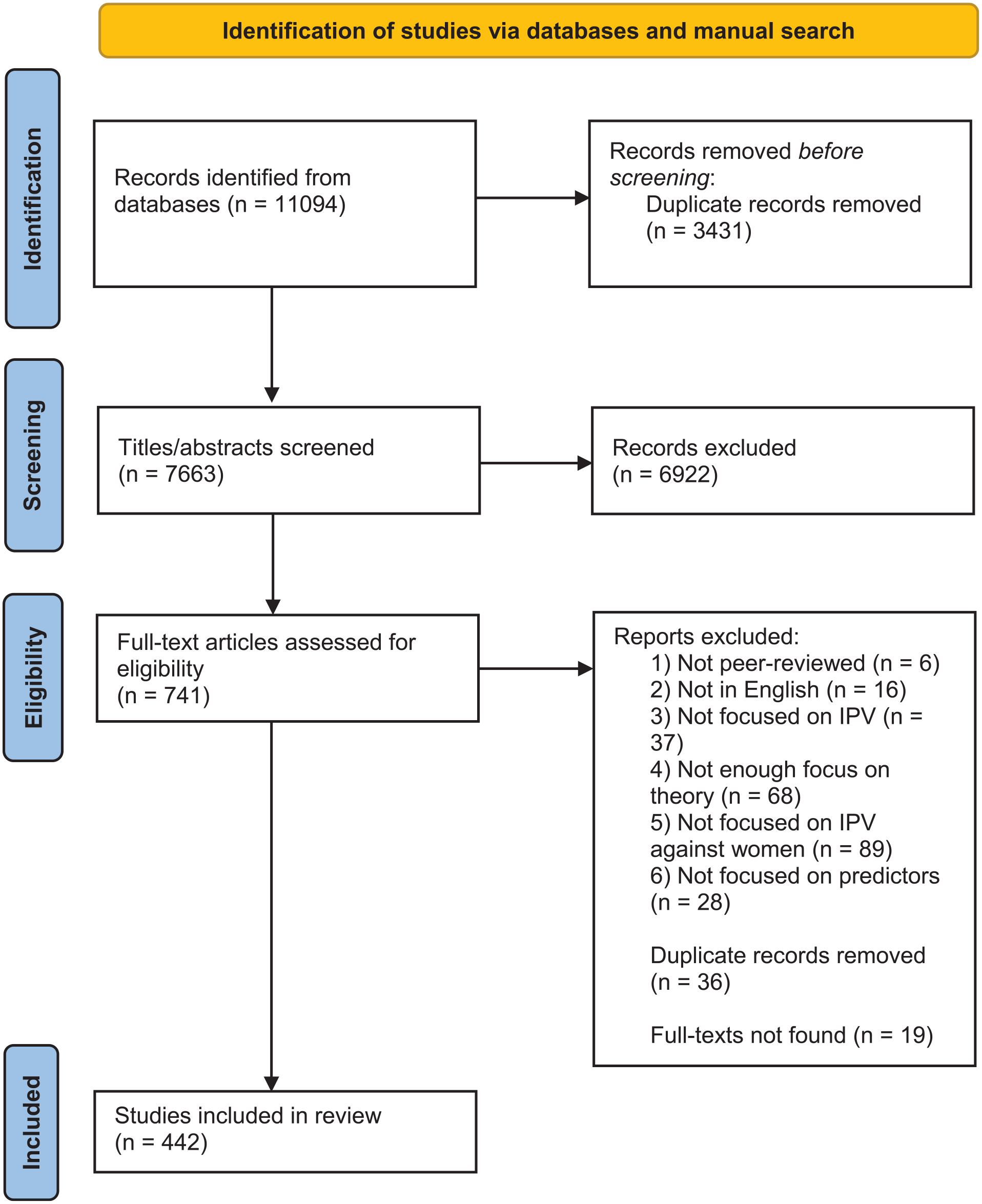
PRISMA 2020 flow diagram for new systematic reviews that included searches of databases and registers only.
Table 2 displays which non-stress theories the included studies also addressed. Two of the included studies were published in the 1980s, 3 in the 1990s, 2 in the 2000s, 15 in the 2010s, and 5 thus far in the 2020s. The research objectives, study design, and country in which the study was conducted are displayed in Table 3 for manuscripts that employed quantitative empirical data. Five of the 19 empirical studies (26%) took place in or included LMICs, whereas 12 were conducted in the United States of America alone (44%).
Included Articles and Theories.

Empirical Studies: Study Design, Research Objective(s), and Setting.
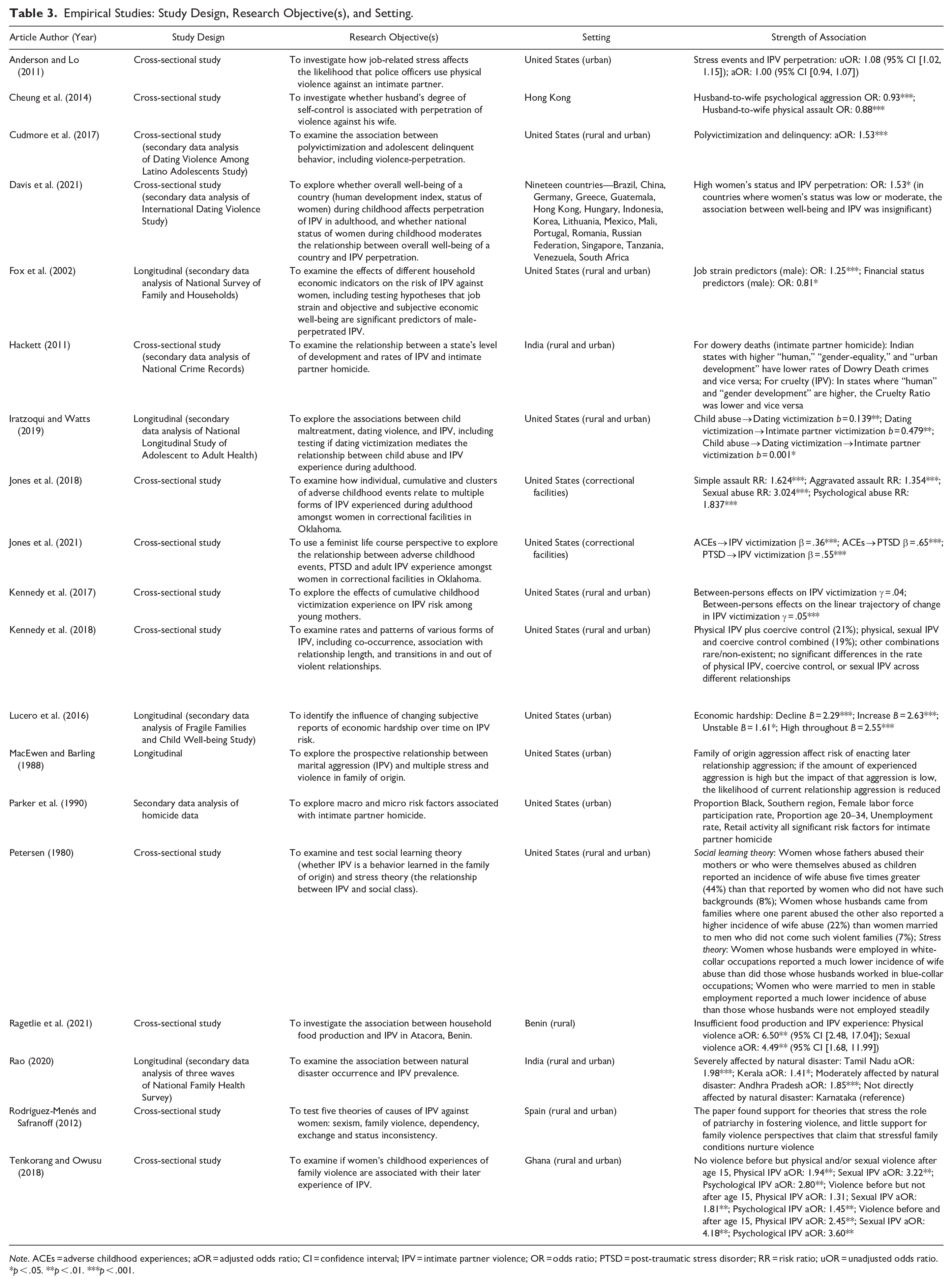
Note. ACEs = adverse childhood experiences; aOR = adjusted odds ratio; CI = confidence interval; IPV = intimate partner violence; OR = odds ratio; PTSD = post-traumatic stress disorder; RR = risk ratio; uOR = unadjusted odds ratio.
p < .05. **p < .01. ***p < .001.
Descriptive Synthesis of Theories
Several sub-theories emerged through our analysis of included studies that addressed stress theory: general strain theory, life course theory, occupational stress theory, vulnerability theory, and family stress theory. These are each described in turn (Table 4).
Measurement of Key Variables.
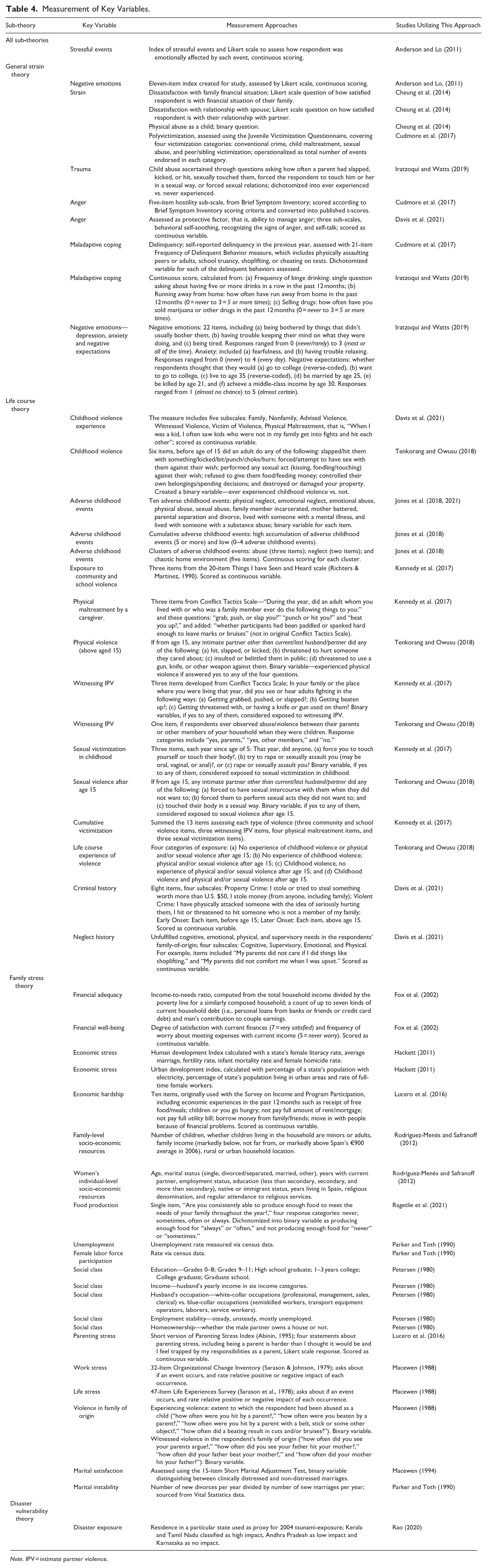
Note. IPV = intimate partner violence.
General strain theory was first developed by Agnew (1992) to expand traditional strain theories to include frustrating aspects of daily life (Agnew, 1992; Cudmore et al., 2017). Sources of strain often revolve around the family and include child maltreatment, financial matters, household decisions, parenting approaches, marital satisfaction, infidelity, loss of a child, and relationship separation (Cheung et al., 2014; Eriksson & Mazerolle, 2013). General strain theory argues that strain produces negative emotions, and without effective coping mechanisms, this can lead to maladaptive coping, which includes “delinquent behavior” (Agnew, 1992). Corvo and Johnson (2013) describe coping as the ability to regulate internal states while under stress and identify IPV perpetration as a maladaptive coping strategy.
Several empirical studies tested the general strain theory. Cheung et al. (2014) utilized general strain theory to operationalize strain as dissatisfaction with family financial situation, childhood experience of physical abuse by parents, and dissatisfaction with marital relationship. Their results indicate that childhood experience of physical abuse and dissatisfaction with the marital relationship were significantly associated with male perpetration of IPV in Hong Kong. Iratzoqui and Watts (2019) found that maladaptive coping and negative emotions and expectations related to childhood experience of violence, a core form of strain within general strain theory, significantly predicted dating violence and IPV experience. This indicated support for the general strain theory’s concept that associations with IPV are not only due to the presence of stress but also about how individuals respond to these stressful experiences. Two studies assessed general strain theory among law enforcement officers in Baltimore, Maryland. One found a significant positive association between stressful events, self-reported negative emotions, and self-reported physical IPV perpetration (Anderson & Lo, 2011), and the other found that strain was indirectly associated with domestic violence through negative affect (anger and depression) (Gibson et al., 2001).
Life course theory was first developed by Elder as a theory focusing on developmental processes from childhood through adolescence to adulthood, and the social pathways, such as family, education, and work, that influence these developmental patterns within historical, sociocultural, and economic contexts (Elder, 1994; Elder et al., 2003). Life course theory proposes stressful life events can have significant impacts on processes and dynamics across the life course.
Given the important role of parental influence over the life course, early life experiences with violence can have long-lasting negative outcomes. A few of the included studies, conducted in both high-income and LMIC settings used life course theory and found that ACEs, including experiencing or witnessing family violence in early childhood, are positively associated with women experiencing adolescent dating violence or adult IPV (Jones et al., 2018, 2021; Kennedy et al., 2017; Tenkorang & Owusu, 2018). For example, one study with incarcerated women in Oklahoma found that post-traumatic stress disorder (PTSD) mediated the association between ACEs and adult IPV (Jones et al., 2021). Results from Tenkorang et al.’s study in Ghana were supportive of life course theory, in that both ACEs (violence experienced before the age of 15) and violence experienced after age 15 were predictive of women’s IPV experience (Tenkorang & Owusu, 2018).
Other stress theories focus on specific sources of stress. For instance, occupational stress theory examines stressors that individuals experience as part of their work. Certain occupations may inherently be more stressful than others. For instance, the military is generally considered a dangerous and stressful workplace environment. This occupational stress can negatively influence the home environment and interpersonal relationships (Perry-Jenkins et al., 2000). Men in such stressful, male-dominated occupations may be more likely to exert control using physical force in the course of their work and echo workplace behaviors through exerting violence against their partners at home (Jones, 2012), a process referred to as occupational violence spillover (Melzer, 2002).
Vulnerability theory, developed by O’Keefe et al. (1976), suggests that the impact of natural disasters is shaped by social determinants, and according to disaster vulnerability theory, systemic and societal factors increase the susceptibility of certain individuals and communities to greater harm and loss as a result of a natural disaster (Rao, 2020; Wisner, 2016). One study employed vulnerability theory, focusing on the prevalence and correlates of IPV in four Indian states after the 2004 Indian Ocean tsunami. Results indicated that IPV increased more in states more directly and severely affected by the tsunami, highlighting that gender inequality and women’s economic disadvantage may have been compounded by the disaster (Rao, 2020). Results also indicated that within states, regardless of tsunami impact, women from minority religions and historically disadvantaged caste groups were at higher risk of IPV, indicating intersections of stress and contextual factors.
Family stress theory pays close attention to stress markers, including class and gender inequality, within the family system. Applying family stress theory to IPV perpetration, Gelles explains that the family forms the primary social institution where social norms on violent behavior are taught and learned (Gelles, 1985). Gelles focused on the family unit as a location of potential stress, with family stress theory positing that the concentration of stressors due to economic deprivation and financial stress in lower socio-economic classes explains the higher prevalence of IPV among families with lower socio-economic status. These families may also have fewer resources—material, emotional, and social—to support coping with stress.
Several studies have tested the association of these family-level stressors, which include socioeconomic status, poverty, unemployment, low incomes, increased financial distress, unmet role expectations leading to frustration, economic hardship, and IPV (Fox et al., 2002; Hackett, 2011; Hoffman et al., 1994; Lucero et al., 2016; Parker & Toth, 1990; Peterson, 1991). For instance, Hoffman et al. (1994), in their study on men’s perpetration of IPV in Thailand, found that husbands with fewer socioeconomic resources (high financial stress) were more likely to physically abuse their wives. In another study, Lucero et al. (2016) examine the longitudinal impact of economic hardship on the incidence of IPV among 941 women in the United States of America. They found that economic hardship decreased a couple’s coping resources and that changes in household economic status predicted IPV over time. Lucero et al. were able to show that not only was absolute low economic status a stressor that was associated with male-perpetrated IPV over time, but that fluctuations in economic status also were associated with elevated IPV over time, suggesting that “the fluctuations themselves may be additive stressors on top of the actual stress of experiencing economic hardship” (Lucero et al., 2016). In contrast, a longitudinal study with over 13,000 men and women found that neither the employment status of the man nor the woman was directly linked to the odds of violence (Fox et al., 2002).
Measurement of Stress
Mirroring the general field of stress research, studies that employed stress theory to examine male IPV perpetration and/or female IPV experience operationalized stress, and other key variables, in a range of ways. Studies that employed general strain theory measured strain as dissatisfaction with financial situation and the spousal relationship, as well as experience of childhood physical abuse using a single binary measure (Cheung et al., 2014). Another measurement approach, in a study employing general strain theory, assessed polyvictimization (conventional crime, child maltreatment, sexual abuse, and peer/sibling victimization) using the Juvenile Victimization Questionnaire (Cudmore et al., 2017). General strain theory proposes that strain results in negative emotions, which, combined with poor coping mechanisms, can produce maladaptive behavior. As such, several studies using general strain theory measured anger (Cudmore et al., 2017; Davis et al., 2021), maladaptive coping (physically assaulting peers or adults, shoplifting, binge drinking, and selling drugs) (Cudmore et al., 2017; Iratzoqui & Watts, 2019) and negative emotions such as (depression, anxiety, and negative expectations) (Iratzoqui & Watts, 2019).
In studies employing life course theory, the primary focus of measurement was on exposure to violence and other ACEs, during childhood and adulthood. Studies employed gold-standard measures of experiences of violence in childhood and adulthood, assessing multiple forms of childhood experience of violence (Davis et al., 2021; Tenkorang & Owusu, 2018), including specific scales for physical violence (Kennedy et al., 2017), sexual violence (Kennedy et al., 2017), witnessing IPV (Kennedy et al., 2017; Tenkorang & Owusu, 2018), and experiences of neglect (Davis et al., 2021). Experiences of violence in adulthood also included measures of physical violence and sexual violence (Tenkorang & Owusu, 2018). Studies operationalized exposures to stressful events in a range of ways. In one study, ACEs were assessed using a binary variable for each of the 10 separate events, using a cumulative variable and then grouped into high, medium, and low exposure, and using clusters of events (abuse, neglect, and chaotic home environment) (Jones et al., 2018). In another study, the authors summed 13 different exposure items to create a cumulative violence exposure measure (Kennedy et al., 2017), and in another study, the authors created 4 different categories of exposure based on the life course stage of exposure: no experience of childhood violence or physical and/or sexual violence after age 15; no experience of childhood violence; physical and/or sexual violence after age 15; childhood violence, no experience of physical and/or sexual violence after age 15; and childhood violence and physical and/or sexual violence after age 15 (Tenkorang & Owusu, 2018).
Studies employing family stress theory focused on economic aspects of family well-being, including individual-level measures such as social class (Petersen, 1980), financial adequacy and financial well-being (Fox et al., 2002), and women’s socioeconomic resources (Rodríguez-Menés & Safranoff, 2012), whereas a study conducted in India assessed economic stress using state-level indices (i.e., human development index, calculated using state’s female literacy rate, average marriage rate, fertility rate, infant mortality rate, and female homicide rate) (Hackett, 2011). Across all studies, exposure to stressors was largely measured via self-report; one study, using disaster vulnerability theory, used residence in a particular state in India as a proxy for tsunami exposure level (Rao, 2020). Studies did not include external validation of the exposure and/or assessment of the degree of impact of the exposure, for example, by asking the respondent to rate the degree to which the stressor impacted them.
Discussion
In this systematic review of studies employing stress theories to explain predictors of male IPV perpetration and/or female IPV experience, studies primarily employed general strain theory, life history theory, and family stress theory. In contrast to existing evidence syntheses, the focus of this review is on stress as a predictor, rather than an outcome, of IPV. IPV experience is clearly a highly stressful event and process, and evidence concerning lifelong physical and mental health impacts on women indicates the urgent need to prevent IPV globally (Lagdon et al., 2014). Understanding potential predictors of male IPV perpetration and/or women’s experience of IPV is essential to developing, refining, and implementing effective prevention programming. Stress theories focusing on IPV shed light on potential individual- and community-level stressors, many of which are preventable and modifiable. The World Health Organization’s framework for preventing violence against women, RESPECT, outlines a series of evidence-based interventions that address key predictors of IPV and have been found to be effective or promising in their impact on IPV prevention (World Health Organization, 2019). Stress theories include predictors that can be addressed by several strategies within the RESPECT framework, including reduction of poverty and prevention of child and adolescent abuse. This review has identified research that employs stress theories; further analysis of this evidence-based focusing on the level of empirical support for stressors, as potentially modifiable factors to be targeted by prevention interventions, can inform program and policy development.
The included studies were identified as addressing stress theory if the authors themselves defined their research as drawing on stress theories. Some of the included articles, in particular those focused on life course theory, overlap considerably with theoretical approaches toward the role of trauma as a predictor of IPV perpetration or experience. Many ACEs, as well as experiences of violence in adulthood, can be considered traumatic events, and chronic stressors also may have the same impact on health as single traumatic events. Traumatic events can cause poor mental health (Jouriles et al., 2012), including PTSD, which has symptoms including heightened aggression and poor affect tolerance, that are in turn associated with IPV perpetration (Corvo & deLara, 2010). Trauma theories may also explain how stress exposure can heighten women’s risk of IPV experience, whereby PTSD may interfere with risk perception or result in maladaptive coping strategies that can heighten IPV risk (Iratzoqui & Watts, 2019; Stockdale & Nadler, 2012).
There is considerable overlap between life course theory and trauma theories: one of the included studies employed feminist life course theory to examine the mechanisms between ACEs and adult IPV and PTSD among incarcerated women. The findings indicate that PTSD mediated the association between ACEs and women’s risk of IPV experience (Jones et al., 2021). Integration of stress theories in general, and life course theory in particular, with trauma theories can highlight some of the mechanisms through which events—which are conceptualized within life course theory as stress, and within trauma theories as a traumatic event—may increase male perpetration of IPV or heighten women’s risk of IPV experience. Moreover, consideration of trauma theories within IPV research that employs stress theories could also lead to the integration of biomarker measurement within the evidence base (Djuric et al., 2008; Noushad et al., 2021). Physiological mechanisms between early trauma/stress exposure and subsequent IPV perpetration include that trauma/stress exposure can lead to overstimulation of the hypothalamic-pituitary-adrenal axis, resulting in over-production of cortisol, which is associated with aggressive behavior and limited impulse control (Chesworth, 2018). Integration of biomarkers within stress and IPV research could strengthen attempts to validly measure stress and elucidate mechanisms between stress and IPV.
The question of how to understand, conceptualize, and measure “coping” within research on IPV, and in particular, on predictors of men’s perpetration of IPV, is not adequately addressed in the literature identified in this systematic review. Lazarus and Folkman’s transactional theory of stress and coping emphasizes that individuals initiate coping in response to stressors, which is influenced by individual and environmental factors (Lazarus & Folkman, 1984). The transaction between the environmental and individual factors informs an individual’s capacity to “appraise, identify, respond to stress” (Keilholtz et al., 2022). Keilholtz et al. (2022) propose that within transactional theory, IPV perpetration can occur when individuals either respond to stressful emotions using IPV or view using IPV as a means to manage a stressor. Assessment of coping within research on IPV that uses stress theories is important, as not all individuals exposed to the same stressor will respond in the same way. Analysis of how individual characteristics, household- and community-level structures and supports, and broader societal influences inform coping is needed, in order to understand how individuals navigate stressors that they experience, in interaction with their environment. In particular, this systematic review’s analysis of measurement variables indicates that the vast majority of variables are self-report measures of experiencing stressful events, and largely do not assess whether individuals found the event stressful, whether they employed specific coping mechanisms, or whether they had social support when they experienced the event.
There is extensive research on predictors of male-perpetrated IPV which has employed a feminist theoretical perspective. A small number of the included articles explicitly compared feminist perspectives with stress theories. For example, Rodríguez-Menés and Safranoff (2012) contrast family stress theory with other theoretical perspectives, including the feminist perspective, economic theories of status inconsistency, and exchange theory. However, a gender perspective is lacking from many of the stress theories, including the extent to which men and women may experience particular stressors differently due to gender norms and patriarchal structures. Research on masculinity discrepancy stress indicates that this may be a factor driving male perpetration of IPV and that understanding prescribed gender norms, as well as the degree to which failure to adhere to these norms is experienced as stressful for men, is central to unpacking predictors of IPV perpetration (Reidy et al., 2014, 2015; Sileo et al., 2022).
Limitations
While representing the first comprehensive systematic review of stress theories applied to predictors of IPV, there are some limitations to this review. As noted, there is an overlap between trauma and stress theories, and it is possible that some relevant studies were not included as they referred to trauma, rather than stress. In addition, it is likely that existing relevant empirical studies were excluded, as they did not have the word “theory” or “theories” in the abstract; therefore, we cannot conclude that this review includes all empirical data on stress as a predictor of IPV. The review does not include a quality assessment, as the objective did not include assessing the strength of the existing empirical evidence for stress theories. Therefore, there is also no discussion of the methodological strengths and weaknesses of the included studies. The included studies utilized a wide range of measures for a variety of variables, and consequently in-depth analysis of the psychometrics of the measures and assessment of limitations of the measures was not possible.
Conclusion
Stress theories provide insights into potential predictors of male-perpetrated IPV. The studies identified and synthesized in this systematic review indicate that stressful events and experiences may heighten men’s propensity to perpetrate IPV and/or increase women’s risk of IPV. Overall, stress theories have not adequately engaged the gendered nature of IPV, and feminist theories should be more comprehensively integrated into research on stress and IPV. Improved measurement of stress variables, through integration of measures of perceptions of stressful experiences and biomarkers of stress, could strengthen this field of research. Research on the intersection between stress and IPV perpetration and experience has important practical implications. Women and their partners need to receive support, especially as they navigate major life changes, such as pregnancy, or other stressful experiences, such as financial insecurity. Both mental health and IPV-focused organizations need to target mental health stigma and prevailing masculinity norms so that men are more likely to seek help when faced with stressful circumstances.
Critical Findings.

Note. IPV = intimate partner violence.
Implications for Practice, Policy, and Research.

Note. IPV = intimate partner violence.
Supplemental Material
sj-docx-1-tva-10.1177_15248380241297325 – Supplemental material for A Systematic Review of Theories of Stress as a Predictor of Intimate Partner Violence
Supplemental material, sj-docx-1-tva-10.1177_15248380241297325 for A Systematic Review of Theories of Stress as a Predictor of Intimate Partner Violence by Sarah R. Meyer, Selina Hardt, Rebecca Brambilla and Heidi Stöckl in Trauma, Violence, & Abuse
Footnotes
Declaration of Conflicting Interests
The author(s) declared no potential conflicts of interest with respect to the research, authorship, and/or publication of this article.
Funding
The author(s) disclosed receipt of the following financial support for the research, authorship, and/or publication of this article: The systematic review was supported by H2020 European Research Council (716458): ERC Starting Grant IPV_Tanzania to Prof. Heidi Stöckl.

Supplemental Material
Supplemental material for this article is available online.
Author Biographies
References
Supplementary Material
Please find the following supplemental material available below.
For Open Access articles published under a Creative Commons License, all supplemental material carries the same license as the article it is associated with.
For non-Open Access articles published, all supplemental material carries a non-exclusive license, and permission requests for re-use of supplemental material or any part of supplemental material shall be sent directly to the copyright owner as specified in the copyright notice associated with the article.
