




Abstract
Violence against children affects children in every region, nation, and community in the world. Despite a significant body of literature about the victims of such violence, there has been little empirical research, particularly in Sub-Saharan Africa, focused on perpetrators, their relationship to victims, and interventions that might alter their behavior. This scoping review sought to identify and summarize the scholarly literature on perpetrators of violence against children in Sub-Saharan Africa and their relationship with victims. Using a keyword search of academic databases, we included peer-reviewed studies published from January 2013 to June 2023 that focused on physical, sexual, or emotional violence against children in Sub-Saharan Africa and included prevalence data about victim–perpetrator relationships. Eighteen of the 42 studies that met eligibility criteria shared one or more primary data sources with other studies included in this review, most frequently using data from Violence Against Children Surveys (10), the Uganda Good Schools Project (7), and the National Child Homicide Study (3). The most common classifications of perpetrators, in order of frequency, were caregivers/family members, intimate partners, peers, teachers/school staff and strangers, and the most common settings in which research took place were schools. Wide variability in the taxonomies used to define and report frequencies for age, victim, perpetrator, and type of violence obscures our ability to form a complete picture of victim–perpetrator relationships. Research emphasis on victims of violence may lead to missed opportunities to disrupt the perpetration of violence against children through interventions that specifically target its source.
Despite the global recognition of a child’s inherent right to grow up free from violence, a right enshrined in the 1989 Convention on the Rights of the Child (Convention on the Rights of the Child, 1989), violence against children continues in every region and nation of the world. It is estimated that as many as 50% of all children globally, or roughly one billion children, have experienced some form of violence in the past year (Hillis et al., 2016). Violence against children (VAC), defined as any “deliberate, unwanted and non-essential act, threatened or actual, against a child. . . that either results in or has a high likelihood of resulting in death, injury, or other forms of physical and psychological suffering” (Cappa, 2023), can occur in any setting and can be perpetrated by a wide range of actors. Recognition of the moral and legal imperative to end VAC is reflected in the Sustainable Development Goals targets 5.2 (eradicate violence against women and girls), 5.3 (elimitate child marriage and female genital mutilation), and 16.2 (end violence against children; Garcia & Amin, 2016) and in major global partnerships that coalesce around a shared commitment to disrupt VAC and to advocate for its prevention (End Corporal Punishment, n.d.; End Violence Against Children, n.d.; Together for Girls, n.d.; Violence Against Children, n.d.). Exposure to and experiences of violence in childhood have both immediate and long-term consequences, affecting physical and emotional health, neurodevelopment, relationships with others, success in school and the workplace, and risk of perpetrating violence against others in the future (Anda et al., 2010; Devries, Child, et al., 2014; Hillis et al., 2017; Hughes et al., 2017).
A growing number of surveillance instruments now exist to inform our understanding of VAC (Chiang et al., 2016), with many empirical studies, most of them cross-sectional, taking place in low- and middle-income (LMIC) countries. The majority of these studies, however, focus on victims of violence, and what little we know about perpetrators is extracted from victim-level data. Notable exceptions include two recent systematic reviews that, in one instance, synthesized global prevalence data on types of perpetrators (Devries, Knight, et al., 2018) and, in another, looked at the regional prevalence of perpetration in Latin America and the Caribbean by type (Devries et al., 2019). Although the largest number of studies focused on VAC interventions in LMIC countries have taken place in Sub-Saharan Africa (SSA; Pundir et al., 2020), there exists little empirical perpetrator-level data in SSA countries from which to derive a nuanced and meaningful picture of who the perpetrators are and what their relationships are to their victims. Without a clear understanding of the relational and cultural contexts in which VAC occurs, it is difficult to develop interventions that may encourage perpetrators of violence to alter their behavior or address social norms that perpetuate VAC (Ligiero et al., 2019).
Methods
A scoping review was undertaken in 2023 to map research conducted in the past decade on perpetrators of VAC in SSA and to identify any existing gaps in knowledge that may impede the development of evidence-based interventions with which to address it. The review protocol followed the recommendations contained in the Preferred Reporting Items for Systematic Review and Meta-Analysis Protocols (PRISMA) 2015 Statement (Moher et al., 2015). In this review, a child was defined in accordance with the United Nations Convention on the Rights of the Child to include any individual under 18 years of age (Convention on the Rights of the Child, 1989). However, studies with older young people were included if they either (a) took place in secondary school settings and, while focused on “children,” reported findings for students ages 13 to 19 years or (b) included retrospective data collected from adults ages 18 to 24 years on the violence they experienced as a child. We operationalized VAC using definitions from the World Health Organization to include all forms of violence–physical, sexual, and emotional violence–against individuals younger than 18 years, whether perpetrated by parents, other caregivers, other family members, peers, romantic partners, authority figures, community members, or strangers (Krug et al., 2002; World Health Organization, n.d.a, n.d.b).
The following bibliographic databases were searched for journal articles of potential relevance published from January 2013 to June 2023 using Boolean terms for perpetrator AND child/adolescent AND (Sub-Saharan) Africa: Applied Social Science Index and Abstract (ASSIA), CINAHL, EBSCOhost EmBASE, ERIC, International Bibliography of Social Sciences (IBSS), JSTOR, OVID, PsychINFO, PubMed, SafetyLit, SciELO, and Web of Science. Articles identified in each database were downloaded to reference management software (https://www.zotero.org) and then uploaded to Covidence (https://www.covidence.org) for systematic review management. After the system-removal of duplicates, both authors screened titles and abstracts for relevance according to an agreed-upon set of inclusion and exclusion criteria (See Table 1) and manually removed any remaining duplicate articles. A full-text review using the same criteria yielded a final subset of 42 journal articles to be included in the review. The first author then abstracted data from the included articles using a data-extraction chart developed by both authors. Data were abstracted on article characteristics (date of publication, date/s of data utilized, country/countries of focus), data source, type of data (victim-level or perpetrator-level), sample size, and characteristics by age and sex, type of relationship of victim to perpetrator, and prevalence by relationship type. These data were then exported from Covidence into an Excel spreadsheet for analysis by both authors.
Inclusion and Exclusion Criteria.

We report our findings using three terms of conceptual importance. When victims supply information about their experiences of violence and the perpetrators of that violence, we have used the term “victim-level” data. Information obtained directly from perpetrators of VAC is described as “perpetrator-level” data. Throughout this study, we use the term “victim–perpetrator relationship” to describe “who” the perpetrator is in relation to the victim, and do not intend to imply any connection between the two that is consensual or mutual.
Results
As illustrated in the PRISMA Flow Chart (Figure 1), 282 unique articles were returned from the databases using the search terms and 148 were excluded during title and abstract screening. Of the 134 articles screened during full-text review, 42 met the study’s eligibility criteria. Primary reasons for exclusion included a lack of prevalence data on victim–perpetrator relationships and findings that were not disaggregated by age to permit identifying VAC prevalence rates.
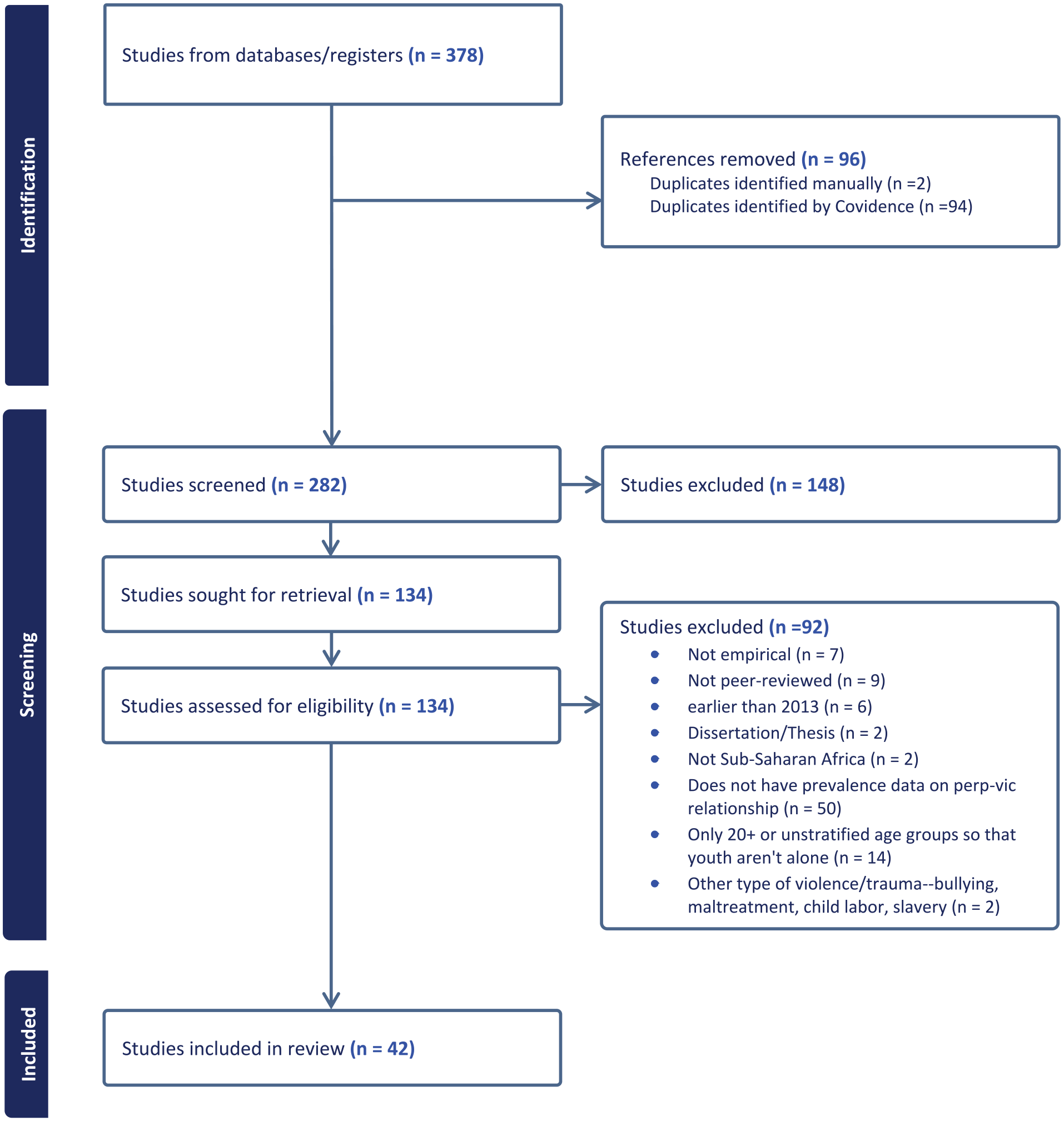
PRISMA flow chart.
The data sources of the 42 articles are described in Tables 2 and 3. Thirteen SSA countries are represented in these studies, with the most frequently studied being South Africa (10), Uganda (10), and Nigeria (6). Most studies (63%) used secondary data, 42% of which used data from Violence Against Children Surveys (VACS), and the vast majority collected data from both male and female children (81.58%; Table 2). There were four multi-country studies: two used primary data (Dekel et al., 2019; Kidman & Kohler, 2020) and two used existing data from secondary sources (Kidman & Palermo, 2016; Stark et al., 2019). Two of the multi-country studies only sampled female children and two sampled children of both sexes. Four of the studies asked participants about perpetration as well as victimization (Devries, Child, et al., 2014; Kidman & Kohler, 2020; Mason-Jones et al., 2016; Stark et al., 2020), and one study asked perpetrators about their use of violence (Dekel et al., 2019). All of the quantitative studies included in the review were cross-sectional, and of these, only those that used data from VACS surveys or the Demographic and Health Surveys were national in scope. The majority of the studies used quantitative analyses (95%); only two studies used qualitative methods (5%). Of note, while our initial search yielded many qualitative studies, only the two included here reported the victim–perpetrator relationships for their sample.
Distribution of Single-Country Studies.
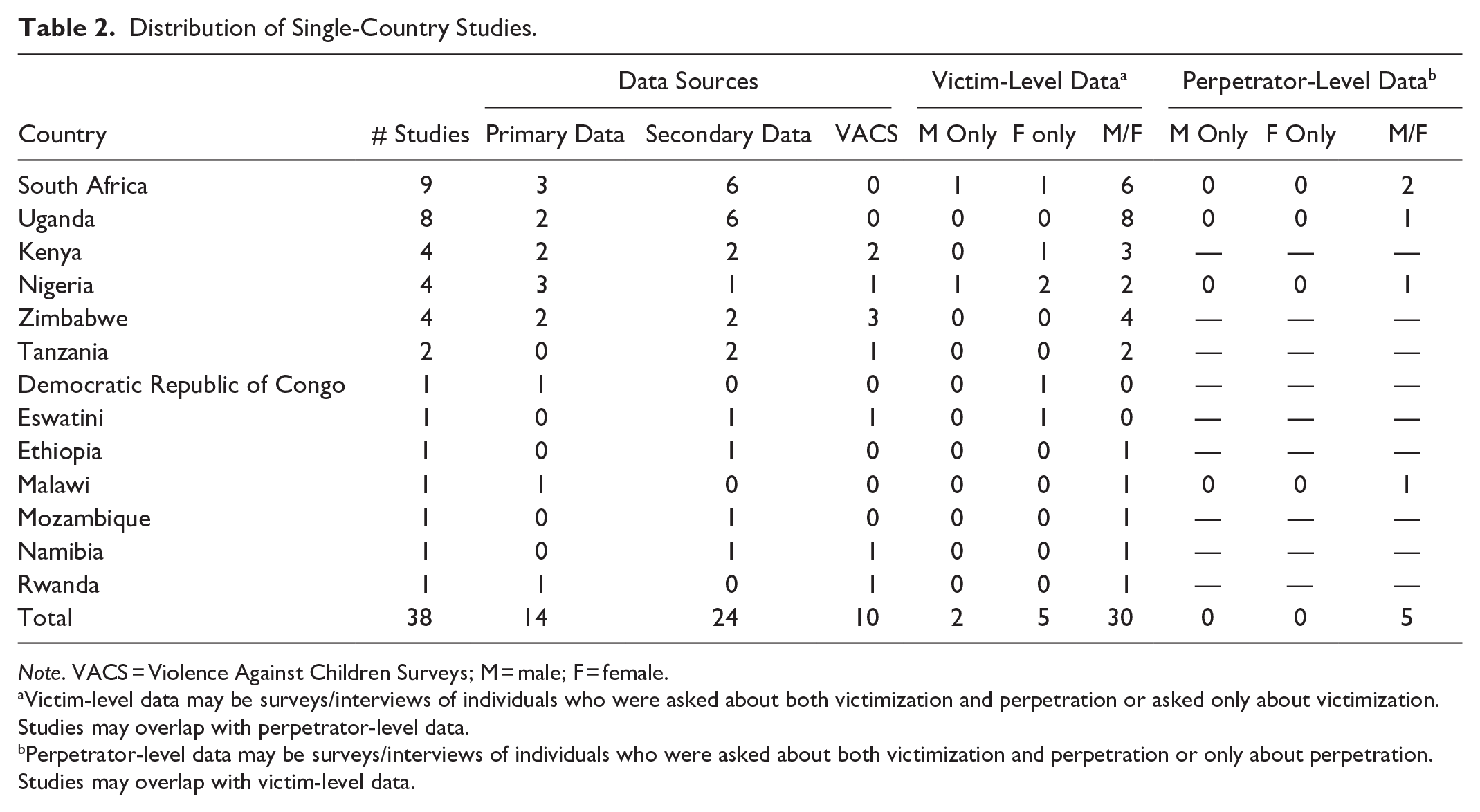
Note. VACS = Violence Against Children Surveys; M = male; F = female.
Victim-level data may be surveys/interviews of individuals who were asked about both victimization and perpetration or asked only about victimization. Studies may overlap with perpetrator-level data.
Perpetrator-level data may be surveys/interviews of individuals who were asked about both victimization and perpetration or only about perpetration. Studies may overlap with victim-level data.
Distribution of Multi-Country Studies.

Note. DHS = Demographic and Health Surveys; VACS = Violence Against Children Surveys; M = male; F = female.
Victim-level data may be surveys/interviews of individuals who were asked about both victimization and perpetration or asked only about victimization.
Studies reporting victim-level data and those reporting perpetrator-level data are reported chronologically in Tables 4 and 5, respectively. On average, studies examined 2.38 (±0.91) types of violence and ranged from one to four types of violence studied. A majority examined non-partner sexual violence (83%), intimate partner violence (62%), and non-partner physical violence (PV) (60%). One-third examined non-partner emotional violence (EV) (33%). The manner in which violence types were operationalized varied by study, for example, measuring only severe PV (Girgira et al., 2014), or classifying any form of neglect as a type of EV (Devries, Kyegombe, et al., 2014; Mathews et al., 2013). Eighteen share data sources with other studies in our sample. Of these, eleven used VACS survey data: two from Kenya 2010 (Mwangi et al., 2015; Sumner et al., 2016), three from VACS-Zimbabwe 2011 (Chigiji et al., 2018; Devries et al., 2023; Rumble et al., 2015), and one each from VACS-Eswatini 2007 (Meinck et al., 2017), VACS-Namibia 2019 (Velloza et al., 2022), VACS-Nigeria 2014 (Stark et al., 2020), VACS-Rwanda 2015 (Nyandwi et al., 2022), and VACS-Tanzania 2009 (Vagi et al., 2016); one multi-country study used VACS data from three countries (Malawi, Kenya, and Tanzania; Stark et al., 2019). Six studies used data collected as part of the Uganda Good Schools Project in 2012 (Devries et al., 2017; Devries, Child, et al., 2014; Devries, Kuper, et al., 2018; Devries, Kyegombe, et al., 2014; Namy et al., 2017; Wandera et al., 2017). Three studies used data from the 2009 National Child Homicide Study in South Africa (Abrahams et al., 2016, 2017; Mathews et al., 2013).
Studies Containing Victim-Level Data on Perpetrators.
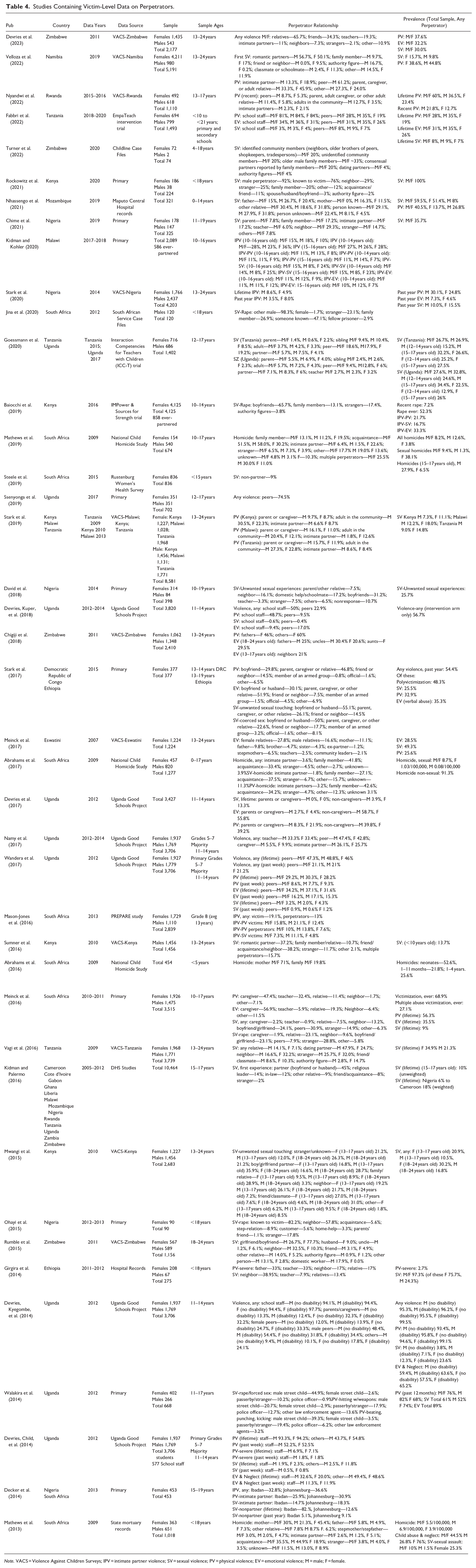
Note. VACS = Violence Against Children Surveys; IPV = intimate partner violence; SV = sexual violence; PV = physical violence; EV = emotional violence; M = male; F = female.
Studies with Perpetrator-Level Data.

Note. VAC = violence against children; VACS = Violence Against Children Surveys; IPV = intimate partner violence; SV = sexual violence; PV = physical violence; EV = emotional violence; M = male; F = female.
On average, studies measured four types of victim–perpetrator relationships and ranged from one to eight relationship types. The most frequently studied relationships, often within the same study, were intimate partners (62%); general “family members,” including both nuclear and extended family members (52%); and strangers (45%). The category “Other” was included in 74% of the studies. Operationalization of victim–perpetrator relationships varied considerably in classification across studies. For example, sometimes acquaintances were reported as a stand-alone category of perpetrator (Abrahams et al., 2017; Mathews et al., 2013, 2019; Ohayi et al., 2015); in others they were included under “friends” (Kidman & Palermo, 2016; Rockowitz et al., 2021); in still others they were merged with “friend/acquaintance/neighbor” (Sumner et al., 2016). In eight studies, teachers were classified as a stand-alone class (Chime et al., 2021; David et al., 2018; Devries et al., 2023; Girgira et al., 2014; Goessman et al, 2020; Meinck et al., 2017; Meinck et al., 2016; Namy et al., 2017), while two studies appeared to have used a broader classification in which teachers were included within the broader category of “school staff” (Devries, Kuper, et al., 2018; Fabbri et al., 2022). Eight studies included in this review (Abrahams et al., 2017; Baiocchi et al., 2019; Chime et al., 2021; Jina et al., 2020; Mathews et al., 2019; Rockowitz et al., 2021; Turner et al., 2022; Velloza et al., 2022) report perpetrators as “family members” without disaggregation according to those individuals’ specific relationships to victims (e.g., mother, fathers, aunts). Another two studies simply refer to “parents” (David et al., 2018; Goessmann et al., 2020), while four others refer to “parent or caregiver” (Devries et al., 2017; Devries, Kyegombe, et al., 2014; Stark et al., 2017, 2019). A full list of classifications and their frequencies is included in Supplemental Table 1.
Thirty-one studies included in this review reported numerical age, while four studies used grade level as a proxy for age. There were 21 unique age ranges, the most frequent age categories reported were 0 to 17 years (6, 14%) and 13 to 24 years (9, 21%), with those respondents 18 years and over in the VACS surveys asked to answer questions about VAC retrospectively. Four studies did not give an age range but rather reported sample grades in primary school: grade 8 (1, 2%) and grades 5 to 7 (3, 7%) (Devries, Child et al., 2014; Fabbri et al., 2022; Namy et al., 2017; Wandera et al., 2017).
Discussion
VAC affects half the world’s children and can have long-lasting consequences for child, family, and community health (Hillis et al., 2017). The development of effective multi-sector interventions for VAC, particularly in LMIC countries, requires a nuanced understanding of VAC dynamics, particularly the relationship of victim to perpetrator and the context in which violence occurs (Hillis et al., 2016; Ligiero et al., 2019; Pundir et al., 2020; Sood et al., 2022). To that end, this scoping review aimed to map the current knowledge of the relationships between perpetrators and child victims in Sub-Saharan Africa. We identified 42 primary studies on VAC in SSA published between January 2013 and June 2023 that reported data on the frequency of victim–perpetrator relationships. Our findings indicate a paucity of studies that contribute to our understanding of who the perpetrators of VAC are and what their relationships are with their victims. The preponderance of what we do know about such relationships has been derived from studies using data collected from or about victims. This issue is further compounded by the tendency of researchers to report findings on victim experiences and characteristics alone, omitting victim–perpetrator relationship data even when such data are available. The VACS, for example, are rich, but largely unmined, sources of victim-level data about who perpetrated violence against them and the contexts—both physical, structural, and circumstantial—in which that violence occurred.
Particularly challenging is the wide variability in the classification of perpetrators, and in the manner in which frequencies are reported for age, victim, perpetrator, and type of violence. Such lack of consistency in reported classifications renders it virtually impossible to have a clear, let alone in-depth, understanding of the relational contexts in which violence is perpetrated (Ligiero et al., 2019). The high level of variation in the classifications used to describe relationships between victims and perpetrators of VAC poses a serious barrier to intervention development, as the lack of specification on the sources of harm makes it difficult to craft tailored interventions. For example, across the studies examined, nine different terms were used to describe some form of intimate partner. While these terms may be similar, they are not exact matches and vary by the sexual nature of the relationship, age of parties, and marriage. Moreover, non-specific relationships like “adult,” “persons known,” and “non-partner” hinder the ability of practitioners to identify points for intervention. While a strict typology of perpetrators might decrease sensitivity to local experiences, a generalized taxonomy for how we conceptualize and report relationships of victims and perpetrators could assist researchers and practitioners interested in VAC to identify avenues for intervention and estimate prevalences across localities.
School studies offer insight into such a possible taxonomy—one that emphasizes setting rather than the relationships between children and those that perpetrate violence against them, as relationships may be unique to or vary in meaning across cultural contexts. Operationalizing VAC based on its occurrence in the home, at school, or in the community, for example, would help to identify the types of interventions that could be offered, the settings in which they could be implemented, and the systems with which one must work to deliver them. For example, imagining a household-oriented intervention, practitioners might develop interventions delivering in-home care, parenting education, or family therapy. They could operate from a community-based organization, through child welfare systems, or with family medical providers. Additionally, a taxonomy that includes the ages of perpetrators would inform practitioners whether they are designing an intervention for peer-level violence or adult–child violence. A setting-based taxonomy would allow interventionists to identify the contexts that most put children at risk for violence and suggest a direction for resources and funding.
For numerous logistical and epistemological reasons, VAC has historically focused on gathering data from individuals experiencing violence rather than those perpetrating the violence. Yet VAC occurs in relational contexts between victims and perpetrators. If we continue to emphasize research and intervention on one side of this relationship, that is, on the receiving end of the violence, it may be hard to intervene at the level needed to curb the prevalence of VAC in communities.
Only one study included in this review sought to understand why perpetrators commit acts of VAC (Dekel et al., 2019). More studies that gather data from perpetrators and that specify their relationships to victims are needed if we are going to identify how their identities, roles, and experiences may precipitate violence and tailor interventions to those points of opportunity accordingly. For example, our study found that mothers are often the perpetrators of VAC; we know very little about why mothers may use violence against their children—precipitating factors to violence may be parental stress, enforcement of patriarchal norms, reenactment of learned behaviors from their own childhood, displacement and forced migration, or a host of other potential antecedents (Lotto et al., 2023; Peltonen et al., 2014; Sim et al., 2023). Unless communities can better understand the pathways to perpetration, across relationships and settings, effective intervention development may be stymied.
Limitations
While this scoping review contributes to the literature by examining what is known about victim–perpetrator relationships in VAC in SSA, it is not without its limitations. Sub-Saharan Africa contains 48 countries and many more cultural and ethnic subgroups. Due to the lack of representation in the study sample, we cannot presume that the findings here reflect the realities of the region or that findings from one country, community, ethnicity, or tribe, can be generalized to another, or that, by implication, that an intervention that works in one context will be equally effective in another (Edwards et al., 2024). As part of our exclusion criteria, we excluded non-peer-reviewed work, including governmental and non-governmental reports. This exclusion meant that we could have missed more detailed analyses of perpetration, notably in the VACS country reports issued by national governments and reports filed by UN agencies.
A further, unexpected, limitation of this review lies in our inability to estimate the cross-study prevalence of violence by victim–perpetrator type. While our initial intention had been to capture prevalence at a regional level through meta-analyses of data, we found we were prevented from doing so by the presence of wide variability in how studies reported and classified essential data, including age, victim-perpetrator relationship, and type of violence. Similar challenges were reported in formulating global prevalence estimates in a 2018 systematic analysis of VAC perpetration (Devries, Knight, et al., 2018).
Lastly, this search using keywords in English and French to identify relevant scholarship on Anglophone and Francophone African countries. Articles in national languages other than French and English may not have been included in the databases searched or captured by the search terms used. Similarly, articles in African academic journals not indexed in one or more of the databases searched would have been excluded from the review, and this important perspective is not fully represented in the findings and discussion.
Conclusion
To effectively disrupt VAC in SSA, interventions will need to target both victims and perpetrators. VAC researchers can contribute much to the design of such interventions by expanding their inquiries to include both victim- and perpetrator-level data. While the taxonomy of victims, perpetrators, ages, and settings will continue to require customization and specification suited to local populations and contexts, the collection and reporting of findings using some common classifications and measures would improve prevalence estimates of various perpetrators, whom they target as victims, and the settings in which perpetration occurs.
Supplemental Material
sj-docx-1-tva-10.1177_15248380241291900 – Supplemental material for Violence Against Children in Sub-Saharan Africa: A Scoping Review of Literature on the Victim–Perpetrator Relationship
Supplemental material, sj-docx-1-tva-10.1177_15248380241291900 for Violence Against Children in Sub-Saharan Africa: A Scoping Review of Literature on the Victim–Perpetrator Relationship by Francis H. Barchi and Millan A. AbiNader in Trauma, Violence, & Abuse
Footnotes
Declaration of Conflicting Interests
The author(s) declared no potential conflicts of interest with respect to the research, authorship, and/or publication of this article.
Funding
The author(s) received no financial support for the research, authorship, and/or publication of this article.

Supplemental Material
Supplemental material for this article is available online.
Author Biographies
References
Supplementary Material
Please find the following supplemental material available below.
For Open Access articles published under a Creative Commons License, all supplemental material carries the same license as the article it is associated with.
For non-Open Access articles published, all supplemental material carries a non-exclusive license, and permission requests for re-use of supplemental material or any part of supplemental material shall be sent directly to the copyright owner as specified in the copyright notice associated with the article.
