




Abstract
Exploitation is a form of abuse that occurs when one person unfairly manipulates another for profit or personal gain. Various individual and social characteristics have the potential to increase an individual’s risk of being exploited. Cognitive impairment is one potential vulnerability factor that has received minimal research attention. This scoping review aimed to investigate cognitive impairment as a factor that may increase an individual’s vulnerability to exploitation. Study inclusion criteria were: (a) empirical studies; (b) studies presenting extractable data related to cognitive impairment and exploitation; (c) studies exploring cognitive impairment as a vulnerability factor for exploitation; (d) studies published after 1998; and (e) studies available in English. A six-step search strategy was employed: (a) electronic searches of bibliographic databases; (b) screening reference lists of included studies; (c) forward citation tracking in Google Scholar; (d) expert recommendations; (e) website searches of relevant Non-Governmental Organizations (NGOs); and (f) a call for evidence. Twenty studies met the inclusion criteria. Three types of exploitation were reported: sexual (n = 10), financial (n = 8), and criminal (n = 2). Intellectual disability (n = 8) and mental health (n = 8) were the most frequently described forms of cognitive impairment. The results indicate that cognitive impairment is a factor that increases vulnerability to exploitation. However, the limited number and disparate nature of the studies means that it is impossible to disentangle all the complexities in the relationship between cognitive impairment and exploitation. Further research is needed to understand if cognitive impairment increases vulnerability to all types of exploitation or if it results in varying levels of susceptibility to different types of exploitation.
Introduction
Exploitation is a form of abuse. Exploitation takes place when one person, either opportunistically or premeditatedly, unfairly manipulates another person for profit or personal gain, including financial, social, or political recompense. A victim may be exploited by one individual or group of individuals, and exploitation may take the form of coerced criminal, sexual, financial, spiritual, or labor-related activities. It has been argued that exploitation is often nurtured within social networks and subcultures in which initial relationships of trust and loyalty (or even friendship and love) are exploited, and exploitative behaviors become normalized (Roe-Sepowitz et al., 2014). Some observers increasingly regard exploitation as a continuum, ranging from extreme forms such as slavery, servitude, and forced/compulsory labor—in which the victim loses control over many/most aspects of their life—to less all-encompassing, but by no means insignificant, crimes involving property or finance (Skrivankova, 2010). Research evidence suggests that exploitation of an individual may increase over time, with victims subjected to experiences and conditions that gradually worsen (Boersma & Nolan, 2022). Research also suggests that exploitation normally occurs in the context of a power disparity (UN, 2017; Wake & Reed, 2019), wherein the relative powerlessness of the victim is taken advantage of by the more powerful exploiter. Vulnerabilities that have been identified as having the potential to increase an individual’s risk of being exploited include a wide range of factors such as age, disability, sex/gender, poverty and financial need, and citizenship status.
Some aspects of vulnerability to exploitation are beginning to be relatively well understood. For example, in the United Kingdom, “failed” asylum seekers and irregular migrants who have neither the legal right to work nor any access to public services are known to be at an increased risk of labor exploitation (Latham-Sprinkle et al., 2019; Lewis et al., 2015; Waite, 2017). Similarly, it is increasingly well-established that physically disabled people are at higher risk of exploitative familiarity, including “mate crime” (where victims are exploited by people who pretend to be their friends) and “cuckooing” (also known as “home-based exploitation”, where the victim’s property is taken over, often for illegal purposes such as drug dealing) (Doherty, 2020; Macdonald et al., 2022). An exploratory study of one English local authority in the United Kingdom found that people with intellectual disabilities and/or mental health issues were particularly vulnerable to exploitation: 30% of all cases of exploitation recorded that the victim was known to have either an intellectual disability and/or mental health issues, and in a further 26% of cases, professionals involved in the case believed that the victim had an undiagnosed intellectual disability and/or mental health issues, which had contributed to their vulnerability (Robinson et al., 2021). Connecting and broadening intellectual disability and mental ill-health as aspects of the wider category of “cognitive impairment”, this review is an attempt to scope the current state of research knowledge regarding the relationship between cognitive impairment and vulnerability to exploitation.
For this review, cognitive impairment has been defined as broadly as possible, to include both developmental and acquired impairment affecting one or more of the six domains of cognitive function set out in The Diagnostic and Statistical Manual of Mental Disorders, Fifth Edition (DSM-V) (albeit specifically in relation to dementia), that is, executive function, learning and memory, perceptual-motor function, language, complex attention, and social cognition (American Psychiatric Association, 2013). This meant that conditions as varied as intellectual disability, dementia, brain injury, autistic spectrum disorders, Attention Deficit Hyperactivity Disorder (ADHD), functional mental health disorders, and substance misuse were included in the search. This wide remit aimed to ensure that the intersections between a broad range of conditions and exploitation could be explored, including those which may often be overlooked (Robinson et al., 2021). It is acknowledged that these diverse conditions may affect an individual’s cognition in different ways. For example, profound intellectual disability or late-stage dementia may affect all six domains of cognitive function noted above. By way of contrast, autistic spectrum disorder or neurodivergence may affect fewer domains, often in more subtle ways (McGee, 2012). Functional mental health disorders may have either an ongoing or an intermittent impact on an individual’s capacity and functioning (Castaneda et al., 2011; Vicent-Gil & Portella, 2021). Substance misuse may for some, only affect cognition when an individual is directly under the influence of drugs or alcohol (Bruijnen et al., 2019).
A Note on Terminology
As this scoping review has been undertaken by United Kingdom-based academics, United Kingdom terminology relating to exploitation has been used throughout, except when directly quoting from work derived from other national contexts. For the benefit of international readers, the term “labor exploitation” is used in the United Kingdom to refer to the phenomenon which in the United States and some other countries is commonly called “forced labor”, and the term “criminal exploitation” is used in the United Kingdom, which refers to what may elsewhere be known as “forced criminality”.
The term “intellectual disability” is used throughout as this term is most widely understood internationally. Additionally, while “learning disability” is more commonly used in the United Kingdom, it has different meanings in other national contexts. (Cluley, 2017).
Review Aim
To investigate cognitive impairment as a factor that may increase an individual’s vulnerability to exploitation.
Review Objectives
To develop an overview of the range of literature available that has explored cognitive impairment as a possible factor that increases an individual’s vulnerability to exploitation.
To identify knowledge gaps and areas for future research.
Methodology
To address the study’s aim and objectives, a five-stage review process following the Preferred Reporting Items for Systematic Reviews and Meta-Analyses extension for Scoping Reviews was used (Tricco et al., 2018). The scoping review methodology was selected due to the extensive and heterogenous nature of the subject matter. In comparison to systematic reviews, scoping reviews answer broader questions about the size, variety, and nature of the evidence base. Mai et al. (2014) suggest that scoping reviews are widely viewed as useful starting points for synthesizing, overviewing, and summarizing diverse evidence and information in a particular area. To aid transparency in reporting, the protocol for the scoping review was prospectively published on the study website: https://exploitationandci.org/scoping-review/.
Search Strategy
A multi-stage search strategy was used to identify relevant literature for inclusion. This comprised of the following: (a) an electronic search of 12 bibliographic databases; (b) screening of reference lists of included studies; (c) forward citation tracking in Google Scholar; (d) expert recommendation; and (e) website searches of relevant United Kingdom Non-Governmental Organizations (NGOs). Due to challenges in establishing a representative sample and considering the available resources, NGOs were selected if the focus of their work met the review’s definition of cognitive impairment or exploitation, were based in the United Kingdom, and had a national focus (United Kingdom-wide or devolved nations)—organizations were identified via a rapid web search, expert recommendations, and a call for evidence distributed via social media and project partner organizations—the Human Trafficking Foundation (http://www.humantraffickingfoundation.org) and the Ann Craft Trust (http://www.anncrafttrust.org).
A controlled vocabulary index and free text terms were used to search the electronic databases. This included terms relating to exploitation (e.g., “exp. Exploit*,” “exp. modern slavery,” “exp. human traffick*,” “slav*,” “sexual exploit*,” “forced labo*”), cognitive impairment (e.g., cognitive AND [impair* OR disability* OR declin*]), intellectual disability (e.g., intellectual OR learning AND [impair* OR difficult* OR disabilit*]), and mental health (e.g., “exp. mental health,” “mental disorder*,” “mental illness*,” “schizo*,” “suicid*”). The search terms were developed in consultation with the Library Support Team at the University of Nottingham. Free text terms were used in cases where a controlled vocabulary index did not exist for a database or website.
Searches were limited to retrieving citations post-1998 when the Human Rights Act came into force in the United Kingdom. This cut-off date was chosen due to the importance of the Human Rights Act in both prohibiting slavery and forced labor (Human Rights Act, 1998, Article 14) and providing a legal means of redress for individuals whose human rights have been violated, whether through exploitation or otherwise. Since its inception, the Human Rights Act has remained influential, being used both as the basis of compensation cases for individuals whose rights have been violated and by professionals (e.g., social workers) as part of the framework for assessing whether to intervene when a person with cognitive impairment is identified as having potentially been exploited.
The searches were completed in a two-week period in January 2023. All identified citations were downloaded into a reference managing software Mendeley (Elsevier, London).
Selection Criteria
Consistent with a scoping review approach, the inclusion criteria were broad and comprised of the following for both peer-reviewed and grey literature (i.e., NGO reports). Papers which met the inclusion criteria were those which:
(1) reported original data collected via quantitative, qualitative, or mixed methodological approaches;
(2) presented extractable data related to people who have a cognitive impairment and have experienced exploitation; and
(3) explored cognitive impairment as a vulnerability or precipitating factor for exploitation.
To be clear, papers did not need to have exploitation and/or cognitive impairment as their sole or main focus, but they did need to contain extractable data relating to these two factors.
While the electronic database searches were global in focus, the language abilities of the research team meant that only papers written in English could be included in the review. Other reasons for exclusion were: (a) published prior to 1998; (b) single case studies, conference abstracts, editorials, opinion articles, book reviews, literature reviews, theses, or dissertations; (c) presented no extractable data related to people with cognitive impairment who have experienced exploitation; (d) presented data related to people with cognitive impairments but there was no evidence of exploitation; (e) presented data related to exploitation but there was no evidence of cognitive impairment; or (f) discussed cognitive impairment only as a consequence of exploitation. Studies that were correlational and did not indicate whether cognitive impairment was a vulnerability factor for exploitation or had arisen as a consequence of exploitation were also excluded.
Screening and Data Extraction
After the removal of duplicates, the titles and abstracts of all identified citations were screened by one reviewer. A second reviewer checked 20% or 250 returns (whichever was the lower). Full texts were single-screened, with the first 20% or 20 papers (whichever was the lower) reviewed by a second reviewer. Data extraction was completed using the Qualtrics survey software. The following topics were included in the extraction form: bibliographic information; type of cognitive impairment, exploitation type, study design, methods, country, sample size, sample characteristics, summary of findings, and advances and limitations. Initial data extraction was completed by one reviewer. This was checked by a second reviewer, and any disagreements were moderated by the involvement of a third reviewer.
Data Synthesis
Due to study heterogeneity related to population, study design, and outcomes reported, statistical pooling of data for meta-analysis was not possible. Instead, a narrative approach to synthesis was undertaken based on the guidance for the conduct of narrative synthesis in systematic reviews developed by Popay et al. (2006). This team-based approach involved discussion and critical reflection to develop a preliminary synthesis, explore the relationships between and within studies, and assess study robustness.
Results
The search strategy identified a total of 6,789 results (6,671 via electronic database searches and 118 from the grey literature). After removing duplicates (222) and non-empirical studies (495), titles and abstracts were screened for potential eligibility. Following the screening, 5,671 citations were removed, with the remaining 106 full texts reviewed. A further 86 articles were excluded at the full-text stage. There were two main reasons for excluding full-text papers: not reporting empirical data and not focusing on cognitive impairment as a vulnerability to exploitation.
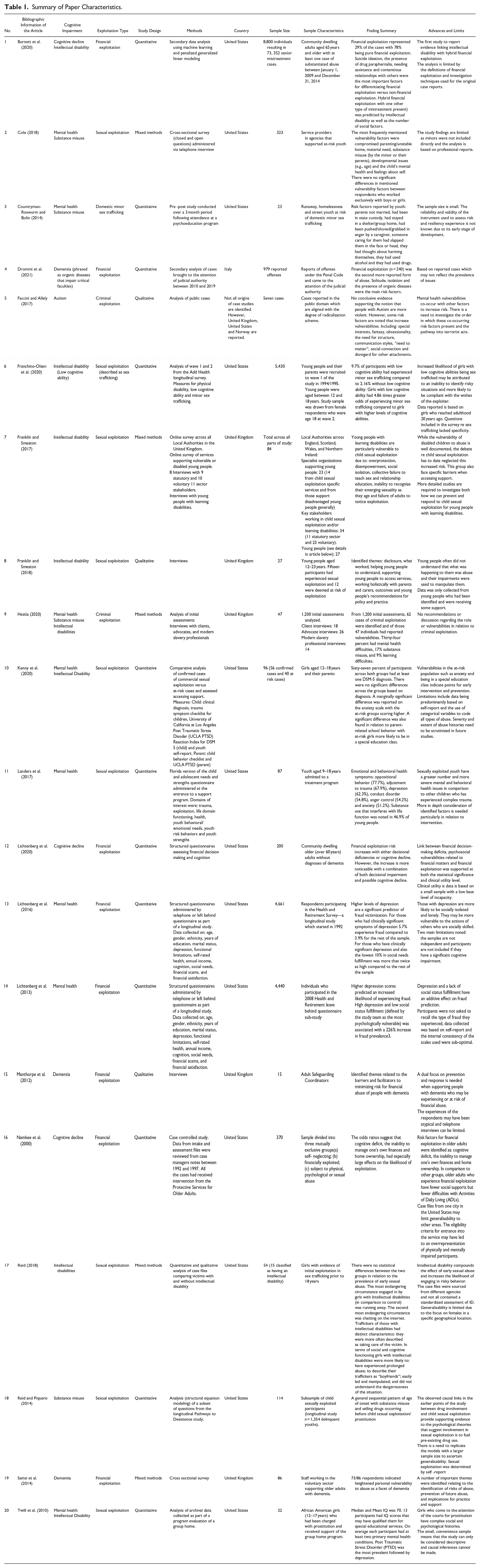
A total of 20 studies met the inclusion criteria (see Table 1). As per the narrative synthesis approach, the studies were initially grouped by study design and population. They were then re-grouped by type of exploitation and the most common cognitive impairments were explored. The results of the analysis will, therefore, be presented firstly by briefly considering the study design and population and, secondly by providing a more detailed thematic analysis by type of exploitation, in descending order of research quantity—that is, starting with those types of exploitation which have garnered most research attention. In analyzing and reporting each type of exploitation, the focus is on identifying what evidence (if any) exists of an association between that type of exploitation and the social or personal characteristics of the victim of exploitation. Social characteristics include confounding factors, such as unemployment, poverty, and homelessness. Personal characteristics include any type of cognitive impairment, and characteristics such as gender, ethnicity, and age. The analysis will not draw on every paper identified by the scoping review as full information is provided in Table 1. Rather, the focus is on drawing out the main themes which emerged from the evidence available.
Summary of Paper Characteristics.
Study Design and Population
Of the included studies, the majority (n = 12) used a quantitative study design, five were mixed methods and three qualitative. Sample sizes ranged from 7 to 8,800. Most of the included studies were from the United States (n = 13), with several from the United Kingdom (n = 5), one from Italy, and one which included data from multiple geographical locations. Seven studies focused on children and young people aged 25 or younger, 2 on working-age adults and 6 on older adults; 3 considered service provider perspectives. One paper included young people and their parents, and another paper included young people and service providers. Three papers focused on a female-only sample.
The types of exploitation reported included sexual (n = 10), financial (n = 8), and criminal (n = 2) exploitation. Intellectual disability (n = 8) and mental health (n = 8) were the most widely reported forms of cognitive impairment, but there were also a smaller number of papers which addressed substance misuse (n = 4), cognitive decline (n = 3), dementia (n = 3), and autism (n = 1). Several papers reported more than one type of cognitive impairment; for example, intellectual disability and cognitive decline, or mental health and substance misuse (see Table 1 for full details).
Sexual Exploitation
Sexual exploitation is a contested area, with some arguing that all sex work is a form of exploitation and others that a distinction can be made between those who choose sex work and those who are coerced and exploited into sex work (Gerassi, 2015). In line with our definition of exploitation, we included papers where individuals were either forced into engaging in sex work by a third party, traded sex for goods or services (e.g., illicit drugs or alcohol), or were minors. A total of 10 papers were included in the review. All the included papers focused on sexual exploitation of children or young people with cognitive impairment. Of these, most papers were explicitly focused on girls or young women (aged 25 or younger), but some papers did not provide information about sex/gender and may have included participants of both sexes/all genders.
Within the literature on sexual exploitation, intellectual disability was the most frequently reported cognitive impairment (n = 4) (Franchino-Olsen et al., 2020; Franklin & Smeaton, 2017, 2018; Reid, 2018). Mental health was considered in one paper (Landers et al., 2017), and one explored substance misuse (Reid & Piquero, 2014). Two papers examined both substance misuse and mental health (Cole, 2018; Countryman-Roswurm & Bolin, 2014), while two others investigated mental health and intellectual disabilities (Kenny et al., 2020; Twill et al., 2010). Twill et al. specifically focused on the experiences of African American girls. Contextual factors associated with further increased vulnerability to sexual exploitation included living in an unstable home, being in state custody, staying in a shelter, and running away from home (Cole et al., 2016; Countryman-Roswurm & Bolin, 2014; Reid, 2018).
In comparison to other children who had experienced complex trauma, those who were sexually exploited had more mental and behavioral health issues (Landers et al., 2017; Twill et al., 2010). Twill et al. explored the experiences of African American girls who had been charged with prostitution and received support from a group home. Of the 22 participants, 13 had psychological or psychiatric records which could be used to determine whether a mental health issue was present (the other nine participants had incomplete records) (Twill et al.). On average, participants had a diagnosis of at least two primary mental health problems. Three participants were identified as having at least three Axis One mental health disorders (Twill et al.). In Landers et al. study, similar findings were noted with 77.7% of participants exhibiting traits related to oppositional behavior, 62.3% with depression, and 51.2% with anxiety. Problematic substance misuse (defined as interfering with life functioning) was found in 46.9% of participants (Landers et al. 2017).
Studies by Franchino-Olsen et al. (2020), Franklin and Smeaton (2017, 2018), and Reid (2018) identify the presence of an intellectual disability as increasing the likelihood of sexual exploitation. For example, girls with “low cognitive ability” were found to have 4.86 times greater likelihood of experiencing sex trafficking as a minor compared to participants with higher levels of cognitive ability (Franchino-Olsen et al.). Potential reasons for this increased level of vulnerability proposed by Franklin and Smeaton include overprotection, disempowerment, social isolation, a failure to teach sex and relationship education, and a failure on the part of adults to notice exploitation. Girls with intellectual disabilities were also found to be more likely to engage in activities such as running away and chatting to people on the Internet (in comparison to controls) which puts them at greater risk of exploitation (Reid, 2018). Other factors that increased vulnerability to sex trafficking were being easily led and manipulated and not understanding the gravity of the situation (Reid, 2018). Reid also suggests that exploiters of those with intellectual disabilities had specific characteristics and were more often described as “taking care of the victim”.
Financial Exploitation
Financial exploitation refers to the use of coercion or deception to facilitate the exchange of money or assets. A total of eight studies discussed financial exploitation and, for all, the population of interest was older adults living with cognitive impairment (defined either as dementia, cognitive decline, or intellectual disability). Hybrid financial exploitation (financial exploitation with one other type of maltreatment present) was predicted by the presence of intellectual disability and other social factors (Burnett et al.). These include being unable to afford housing, food, medical care, and medications (Burnett et al., 2020). Other contextual vulnerability factors highlighted in the papers were being close to retirement, having worries about retirement, social isolation, physical health issues, being a homeowner, and lower socioeconomic status (Manthorpe et al., 2012; Namkee et al., 2000; Samsi et al., 2014).
Samsi et al. (2014) interviewed frontline practitioners who identified that dementia was a vulnerability factor for financial exploitation. For individuals experiencing cognitive decline, Lichtenberg et al. (2013, 2016) highlighted that the presence of other mental health issues such as depression and psychological vulnerabilities (e.g., susceptibility to undue influence) increased the likelihood of exploitation occurring. While not related to intellectual/cognitive ability per se, factors such as financial decision-making capacity, ability to understand financial choices, and carrying out activities of daily living were highlighted as factors that both increase the likelihood of exploitation and as potential mitigators and points for preventative intervention (Lichtenberg et al., 2020; Namkee et al., 2000).
Criminal Exploitation
Two studies focused on criminal exploitation. Also known as forced criminality, this form of exploitation involves the use of coercion and control to force individuals to engage in illicit activities such as forced begging, pick pocketing, shoplifting, drug trafficking for another’s financial gain, or terrorism. Hestia (2020), a United Kingdom-based NGO, found that out of 47 clients who experienced criminal exploitation and reported vulnerabilities, 60% had some degree of cognitive impairment, including mental health problems (34%), misuse of drugs and/or alcohol (17%), and learning difficulties (9%). Autism was identified as a “contextual vulnerability” in cases of radicalization examined by Faccini and Allely (2017), where individuals were criminally exploited by being groomed toward undertaking acts of terrorism. No conclusive evidence was noted which suggested people with autism were more violent. However, characteristics such as having special interests, obsessionality, a need for structure and social connection, and disregarding other attachments made it easier for an individual to engage in these activities (Faccini & Allely).
Discussion
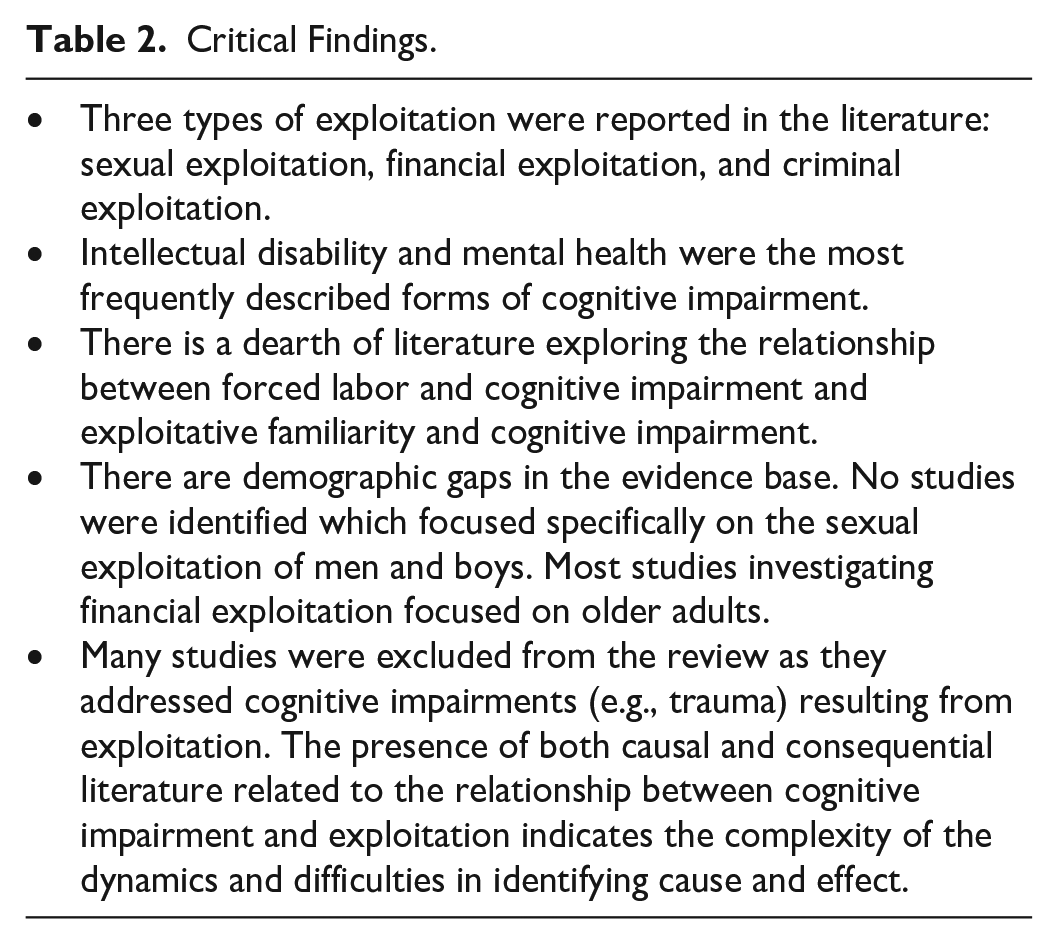
Given the prevalence of cognitive impairment within society and increasing awareness of exploitation, only a small amount of research exploring cognitive impairment as a vulnerability to exploitation was found. The limited available evidence was partial in its coverage both of different types of exploitation and of different types of cognitive impairment (see Table 2).
Critical Findings.
Gaps in Knowledge: Types of Exploitation
The largest, and perhaps most unexpected, gap in knowledge revealed by this scoping review was that there were no peer-reviewed studies that directly addressed the relationship between cognitive impairment and labor exploitation. The only work which considered this at all was a single research study conducted by a United Kingdom-based NGO (Hestia, 2020). This is despite the fact that labor exploitation is one of the types of exploitation most commonly identified both in the United Kingdom (Home Affairs Committee on Human Trafficking, 2023) and globally (see the International Labour Organisation’s Forced Labour Observatory (International Labor Organization, n.d.)), and despite there being clear examples of labor exploitation of people with cognitive impairment known to United Kingdom authorities and reported in the mainstream United Kingdom media (BBC News, 2019; Lincolnshire Safeguarding Adults Board, 2019). Perhaps just as surprisingly, there were also no studies identified, that explored the relationship between cognitive impairment and exploitative familiarity (“mate crime” and “cuckooing”). Although there is a small but burgeoning literature on exploitative familiarity, so far this is limited either to think pieces (e.g., Doherty, 2020; Grundy, 2011) or studies that talk in general terms about disabled people rather than explicitly considering learning disability, autism, or any other cognitive impairment (see e.g., Macdonald et al., 2022).
Of all forms of exploitation, it was sexual exploitation that had garnered the most attention from researchers. However, even within this field, it was notable that more attention has been paid to some groups than others. Importantly, all papers that addressed vulnerability to sexual abuse either had an explicit focus on girls and young women (defined as those aged 25 years or older) or failed to report the sex/gender of victims. No papers were identified that focused on the sexual exploitation of boys, young men or women aged older than 25 years with cognitive impairments. This may reflect the fact that girls and women are more vulnerable to sexual exploitation than boys and men. However, another gap, given aging populations, was that no papers addressed the sexual exploitation of older people with dementia or cognitive decline. Earlier studies have suggested that sexual abuse of older adults is something which society would prefer to pretend did not occur (Jeary, 2004).
By contrast, most papers (6/8) which explored financial exploitation of people with cognitive impairments focused on older people with either dementia or cognitive decline. This area of research interest may reflect the increasing wealth of the now-aging “baby boomer” generation (those born in the aftermath of WW2, roughly from 1946 to 1964) and their commensurate vulnerability to financial exploitation. Such exploitation may take many forms—for example, a recent paper in the British Medical Journal (Hamilton & West, 2021) highlighted the emergence of “predatory marriage”, whereby older, typically home-owning, adults with dementia or cognitive decline are targeted by exploiters who marry them in order to inherit their property and other financial assets. However, working-age adults with cognitive impairments may also be vulnerable to financial exploitation and the literature here was much scarcer. There were just two papers, both quantitative, which considered vulnerability to financial exploitation among people with mental health difficulties (Cole, 2018; Countryman-Roswurm & Bolin, 2014) and just one which considered intellectual disability (this was in addition to cognitive decline and not as the sole factor considered) (Burnett et al., 2020). This is despite the fact that financial abuse is known to be more prevalent among people with intellectual disabilities than among the general population (Abbott & Marriot, 2013; Fisher et al., 2016). This may reflect a disconnect within practice and research between the general concept of “abuse” and the specific concept of “exploitation.”
Only two papers examined cognitive impairment in relation to criminal exploitation, with one focusing on autism and grooming for terrorist offenses (Faccini et al., 2017) and the other considering intellectual disability, mental health, and substance misuse in relation to modern slavery (Hestia, 2020). Much therefore remains to be understood about how cognitive impairment impacts vulnerability to criminal exploitation. For example, in the United Kingdom, criminal exploitation of young people is well understood to be associated with the trade in illegal drugs (see, e.g., Robinson et al., 2019; Wroe, 2021), and this is linked to “cuckooing” (Stone, 2018). However, the relationship between this type of exploitation and cognitive impairment has yet to be properly explored.
Gaps in Knowledge: Cognitive Impairments and Other Demographic Characteristics
There were further gaps in the literature regarding specific types of cognitive impairments, including brain injury, autism spectrum disorders and ADHD, and their relationship to exploitation, and the relationships between cognitive impairment and other demographic characteristics.
Only one paper (Twill et al., 2010) considered the experiences of exploitation among people with cognitive impairments from racially minoritized groups, but this was not a comparative study. It is not known whether or how the experiences of racially minoritized people with cognitive impairments differ from those of white people. However, through an intersectional lens (c.f., Crenshaw, 1994), it can be hypothesized that race/ethnicity may add a further layer of potential disadvantage and vulnerability.
As noted, papers on sexual exploitation focused on girls/women. Papers that considered other types of exploitation overlooked sex/gender as a factor, so it is not known, for example, whether there are sex-/gender-based vulnerabilities in relation to the financial exploitation of older people with dementia or cognitive decline. Likewise, no papers compared people from different age groups and therefore the impact of age as an additional vulnerability remains moot. Much remains to be understood about the intersections between exploitation, cognitive impairment, and ethnicity, age, or sex/gender; comparative studies that compare key characteristics are needed.
Other Complexities of the Literature
Several studies included in this review were conducted by health and allied professions such as psychiatrists and clinical psychologists. This is noteworthy because although these professional backgrounds afford unparalleled access to invaluable clinical data, the focus of health professionals is largely on individual rather than social factors. Therefore, some papers, particularly those that adopted a quantitative approach, provided useful evidence of association and correlations between different types of exploitation (sexual, criminal, and financial) and various individual characteristics, such as sex/gender and age, but seldom afforded an analysis of wider societal factors, that is, the socioeconomic context, including contexts—such as poverty—which are believed to increase vulnerability to exploitation. By contrast, the qualitative papers tended to provide rich contextual data that exposed the impacts of poverty and other societal factors but involved small sample sizes and may not be generalizable.
It was also notable that many papers were excluded from this review because they addressed trauma/mental health difficulties that arose as a consequence of exploitation (particularly trauma arising from sexual exploitation and human trafficking) but did not provide evidence that trauma/mental health difficulties had been present as a pre-existing cognitive impairment that increased vulnerability to exploitation (which was the focus of this review). The presence of both causal and consequential literature on the relationship between cognitive impairment and exploitation highlights the complexity of the dynamics at play, and it is unarguably the case that cognitive impairment may be both a cause and a consequence of exploitation. For example, among the excluded papers there were studies that evidenced the negative mental health impacts of human trafficking and sexual exploitation (Abas et al., 2013; Mekeila et al., 2018), but could not provide evidence of a causal relationship between cognitive impairment and vulnerability to exploitation.
Conclusion
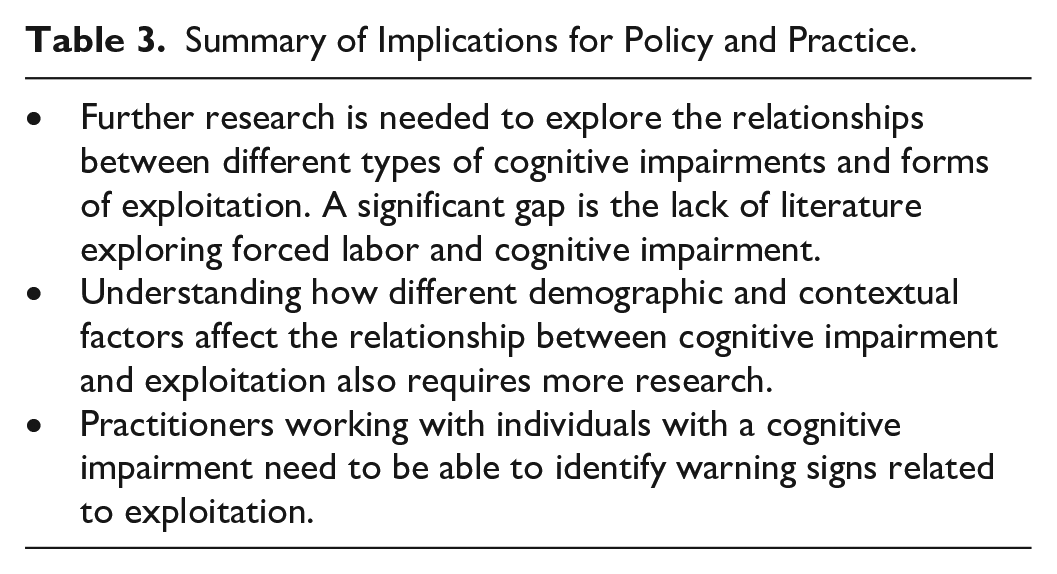
Cognitive impairment does increase vulnerability to exploitation. However, there is no simple relationship between these two variables. Personal characteristics, such as race, sex/gender, and age, also appear to have an impact on an individual’s cumulative vulnerability to exploitation (French et al., 2009), but the extent of these influences is unclear. Societal factors, including unemployment, poverty, homelessness, and adverse experiences during childhood, appear to be contextual factors that contribute to individual vulnerability to exploitation (see Table 3). All of these factors, plus happenstance, will determine whether any given individual is exploited and the manner in which they are exploited.
Summary of Implications for Policy and Practice.
This scoping review has found evidence that cognitive impairment is a factor that increases vulnerability to exploitation. However, the limited number and disparate nature of the studies mean that it is not possible to draw definitive conclusions about how or whether cognitive impairment increases vulnerability to all types of exploitation, or how or whether different types of cognitive impairment result in varying increases in vulnerability to different types of exploitation. Moreover, while many of the studies came from the United States, and their findings are valuable and may be applicable elsewhere, they are also situated in a specific context, and there is a need for further research in different geographical settings.
Review Limitations
There are several limitations to this review. The studies have diverse methodologies and sample sizes, and we did not conduct a quality review for studies beyond the inclusion criteria of containing primary research. For reasons of access, books were excluded from the review. Due to the language capabilities of the research team, we only included studies published in English. While every effort was made to capture all relevant papers within this review, some admissible studies may not have been caught by the search terms. While we used a range of alternative terms that could be used to describe various forms of exploitation, these were not exhaustive. Therefore, it is possible that the review may have missed studies where the phenomenon being studied was not described as exploitation but would have met our definition of exploitation.
Footnotes
Acknowledgements
Declaration of Conflicting Interests
The author(s) declared no potential conflicts of interest with respect to the research, authorship, and/or publication of this article.
Funding
The author(s) disclosed receipt of the following financial support for the research, authorship, and/or publication of this article: Study part of a two-year project on cognitive impairment and exploitation funded by the Nuffield Foundation, running from September 2022 to 2024.
Author Biographies
