



Abstract
A metasynthesis was performed on 15 qualitative studies to document the experience of revictimization by an intimate partner among women, based on survivors’ perspectives on their sustained childhood sexual abuse and intimate partner violence victimization. Results identified two main conceptual categories: (a) Barriers to action: A belief system reflecting learned helplessness that hinders women’s abilities to protect themselves and prevent further abuses, and (b) Broken internal compass: Cognitive elements blurring women’s risk evaluation capacities and reference points limiting their ability to break the cycle of revictimization. These findings support the need to examine cognitive distortions and false beliefs in intervention practices and suggest valuable guidelines for practitioners. As the responsibility for violence always lies with the perpetrator, this study should not be interpreted as blaming women for their victimization, but instead, as a way to give women a voice about their experiences and give them a sense of power in the prevention of violence.
Keywords
Introduction
Childhood sexual abuse (CSA) is an endemic problem affecting nearly one in five girls worldwide before the age of 18 (Stoltenborgh et al., 2011). Quantitative and qualitative empirical literature recognizes CSA as an important risk factor for a variety of physical and psychological difficulties in survivors (Maniglio, 2009). An important and deleterious repercussion is the increased risk of being revictimized within the context of intimate relationships in adolescence and adulthood (Hébert et al., 2021; Herrenkohl et al., 2022), especially among women survivors (Brassard et al., 2020). Intimate partner violence (IPV) revictimization, which refers to sexual, physical, or psychological victimization by an intimate partner after the CSA, constitutes an important public health problem linked to numerous consequences (Kimerling et al., 2007). However, not all female CSA survivors will experience later IPV revictimization. Thus, revictimization constitutes a serious issue that deserves to be studied to better understand the mechanisms women CSA survivors express while questioned on their trajectories and thus help survivors break the cycle of violence from their own standpoint.
Although few studies have focused specifically on IPV revictimization among CSA survivors, quantitative studies demonstrated worrying prevalence rates of this phenomenon. For example, a study conducted among adolescent girls showed that CSA survivors are significantly more at risk to experience psychological, physical, and sexual violence within their intimate relationships compared to non-victims (Hébert et al., 2017). In fact, female CSA survivors were almost twice (47.7%) as likely to experience victimization in the context of an intimate relationship than non-victims (34.1%; Hébert et al. 2017). Among adult samples, a survey conducted on 16,993 individuals currently in a relationship or having recently been in a relationship revealed that CSA survivors are at least two times more at risk to experience violence within their intimate relationship than non-victims (Daigneault et al., 2009). More specifically, women CSA survivors were two times more at risk of being psychologically revictimized (OR = 2.40), almost three times more at risk of being physically revictimized (OR = 2.85), and almost five times more at risk of being sexually revictimized (OR = 4.78) by their intimate partner or ex-partner than non-victims (Daigneault et al., 2009). Similar rates were found in another study (Desai et al., 2002), highlighting the importance of paying particular attention to IPV revictimization among female CSA survivors. Furthermore, as victimization perpetrated by an intimate partner implies a breach of trust or a betrayal and a potential close physical relationship (i.e., living together) that typically allows ongoing experiences of violence, IPV revictimization should be examined as a phenomenon distinct from general or sexual revictimization per se (Testa et al., 2007).
While the scientific corpus based on quantitative data demonstrated the associations between CSA and IPV revictimization in women (e.g., Herrenkohl et al., 2022), this phenomenon has yet to be fully understood. As such, qualitative research can bring to light new information and nuances regarding victimization experiences, based directly on the narratives of survivors, thus offering a better and more contextualized understanding of the phenomenon (Lindhorst & Tajima, 2008). For instance, survivors could offer their own understanding of their experiences of multiple victimizations throughout their lifetime and what aspects they see as contributing factors. In fact, some qualitative studies conducted on female CSA and/or IPV survivors have hinted at the trajectories of violence that these women seem to experience (e.g., Cervantes & Sherman, 2021; Matos et al., 2015; Valdez et al., 2013). For example, some authors noted that many women survivors of IPV experienced cycles of lifelong violence victimization starting in childhood (Cervantes & Sherman, 2021). Those studies offered crucial but partial knowledge of this phenomenon. Therefore, it would be important to compile their results to provide a more complete portrait of what stands out from the narratives of these women. A synthesis of qualitative data (i.e., metasynthesis) would offer an integrative picture of this fragmented piece of literature and help identify the remaining gaps. As such, a metasynthesis of qualitative studies could identify commonalities in how women understand their experiences of childhood and adult victimization experiences based on their views of themselves, of others, and of the world and translate the results obtained into a single integrative reinterpretation offering a richer and more complete understanding of the phenomenon (Erwin et al., 2011).
Aims of the Present Metasynthesis
Using qualitative data on IPV revictimization in female CSA survivors, the aims of this metasynthesis are to (a) document how women make sense of their experiences of CSA and IPV revictimization based on their perceptions of themselves, others, and the world, and (b) to better understand the meanings that women survivors give to their victimization histories. This study could allow the identification of common features in the perception of one’s own victimization trajectory among women survivors. Findings will offer new insights for researchers and practitioners, that may guide prevention and intervention practices aimed at women survivors of CSA and IPV to prevent further victimization and end the cycle of violence.
Method
Procedure and Sample
A systematic review of qualitative studies on IPV revictimization among women survivors of CSA was conducted using four databases (i.e., PsycINFO, SAGE journals online, PubMed, and Google Scholar) from February 2021 to May 2022. No year period was specified in the parameters in the search for publication (i.e., no limitation in publication release dates), but all relevant articles were published in the last 20 years (i.e., oldest study in the sample was published in 2004), respecting proposed guidelines for systematic reviews (Xiao & Watson, 2019). The research, led by the first author, was done using a combination of the following search terms: women, revictimization, CSA, child* sexual abuse, domestic violence, IPV, sexual abuse, re-victimization, relationship*, intimate relationships*, survivor, qualitative, and qualitative study. Found articles’ reference lists were examined to identify additional potential articles. Since IPV revictimization was rarely the focus of research, or the term “revictimization” was not always explicitly stated, articles mentioning the experience of women survivors of sexual violence or violence by an intimate partner were also examined.
Studies were included according to five criteria: (a) used a qualitative methodology incorporating semi- or unstructured interviews with verbatim excerpts; (b) written in English; (c) included women aged 18 years old or older; (d) documented the experience (i.e., insights about themselves, their experiences, others, and the world) of women CSA survivors from their own perspective (e.g., not from the perspective of their romantic partner or healthcare professionals); and (e) detailed the experiences of victimization and IPV revictimization (e.g., when, how, and by whom) endured by the participants. Publications were excluded if they did not address CSA, IPV, or revictimization. Publications were also excluded if verbatim excerpts could not be associated with a specific participant, as trajectory of abusive events was necessary in the current study (i.e., sexual victimization in childhood and IPV in adulthood). Since the current study was specifically interested in the experience of women, it was necessary that the articles treated the experience of victimization in a gender-specific way (i.e., participants had to identify as women or be considered as such in the original study). Although this was not a criterion for inclusion, all the selected articles covered violence perpetrated within heterosexual couples.
A total of 276 potential articles were retrieved from all databases and bibliographies of screened studies. After verification, 18 duplicates were removed. A total of 258 articles were screened based on titles and abstracts, from which 234 were removed for not meeting all the criteria. Researchers identified 24 qualitative studies on IPV revictimization among women as meeting some of the criteria and were reviewed more attentively. This full-text screening led to the removal of nine articles. A final sample of 15 articles that met the inclusion criteria were analyzed. Scientific quality scores were established by an inter-judge reliability process led by two authors. For clarity, the detailed selection process is also presented in a flowchart (Figure 1). A summary of included studies (i.e., research design, sampling strategy, number and characteristics of participants, approach to data analyses, and quality scores) is presented in Table 1.
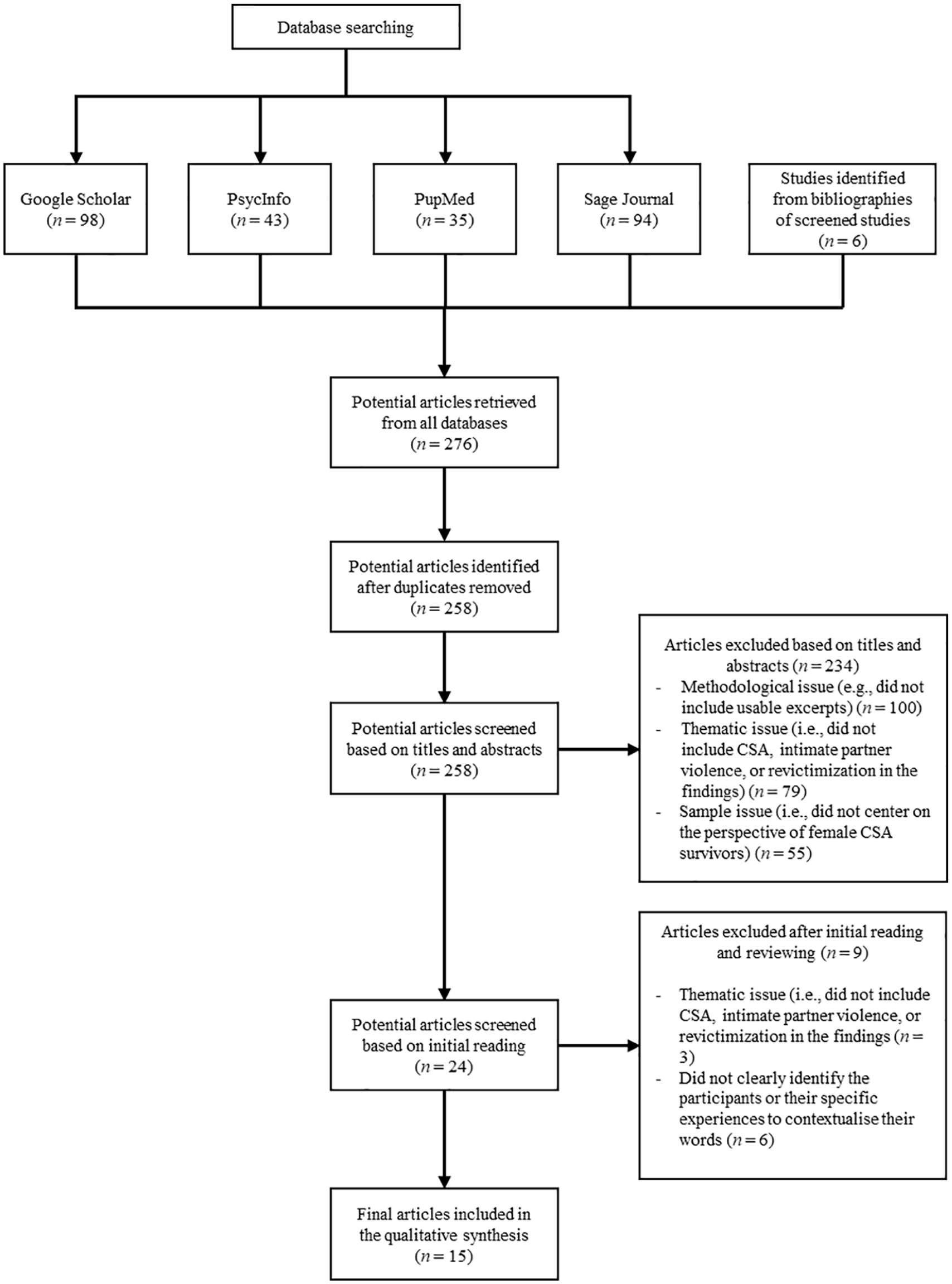
Flowchart illustrating the process of retrieving and screening articles.
Studies Included in Metasynthesis.
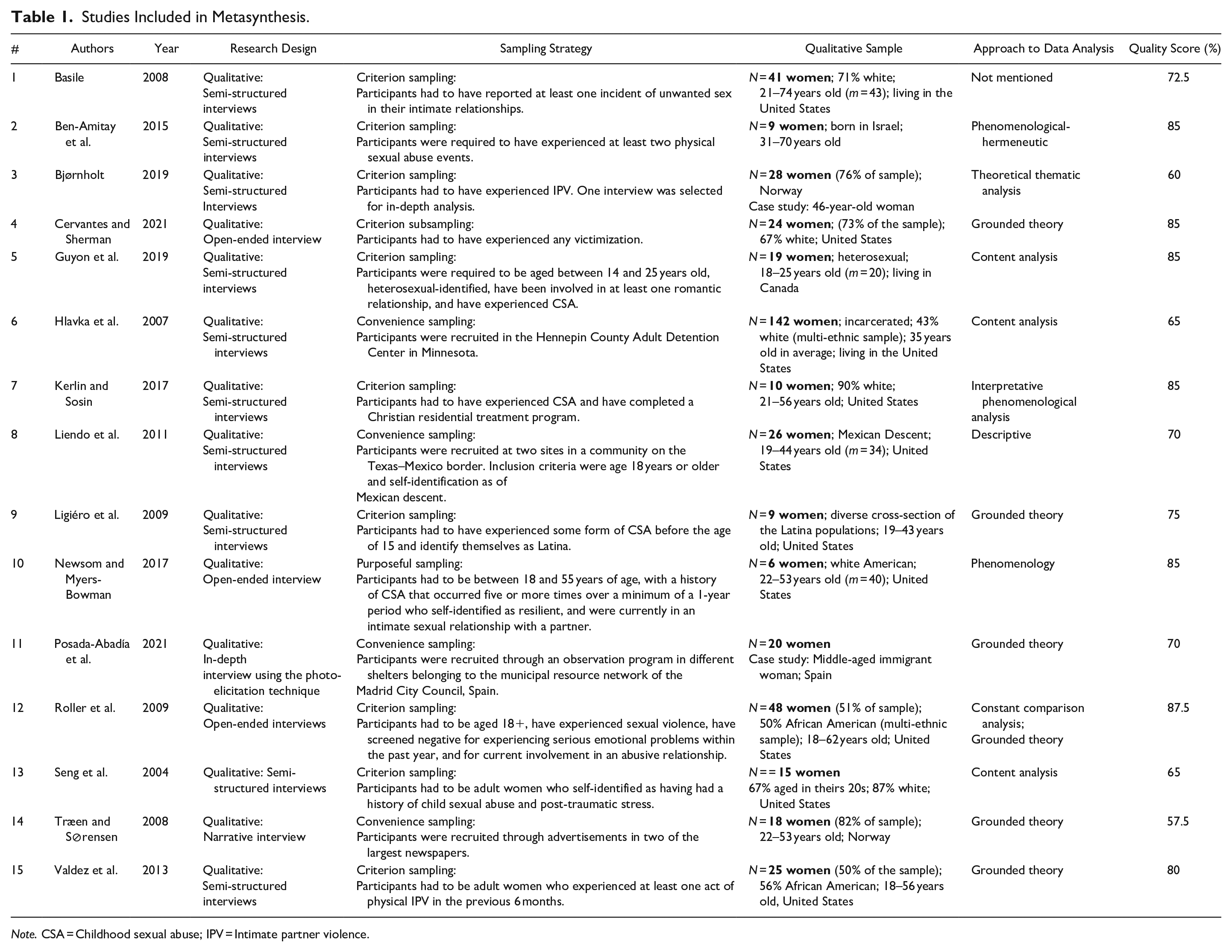
Note. CSA = Childhood sexual abuse; IPV = Intimate partner violence.
All included articles were published within the last two decades. Studies were mostly conducted in the United States (n = 10). Samples comprised adult women aged between 18 and 74 years old. Eleven studies only included female survivors and four studies comprised a mixed sample of both male and female survivors. Eight studies were conducted with participants from diverse ethnic origins or with an exclusively non-white sample of participants. The samples of participants included between 6 and 142 women, but two studies (i.e., Bjørnholt, 2019; Posada-Abadía et al., 2021) selected only one participant for the analysis (i.e., study case). Most of the studies (n = 10) reported semi-structured interviews as data collection method. Varied approaches to data analysis were used, including grounded theory, phenomenology, and theoretical thematic analyses.
Research Team
The research team made considerate efforts to be aware of their own influence on the findings by a process of reflexivity. Reflexivity refers to a general introspection of the role of one’s subjectivity in the research process by questioning and acknowledging “the changes brought about in themselves as a result of the research process and how these changes have affected the research process” (Palaganas et al., 2017, p. 426). As such, researchers should be aware of their personal (e.g., our position based on socio-economic class, gender identity, ethnicity, race, and political leaning) and methodological inclinations that could influence the study conduction or the results interpretation (Palaganas et al., 2017). The first author is a woman doctoral candidate and researcher in sexology who specializes in sexual victimization and IPV among girls and women. The second author is a woman researcher in sexology and public health issues who specializes in sexual victimization issues among adolescent and adult survivors and qualitative methods through a feminist lens. The third author is a woman clinical psychologist and a researcher in sexology who has several years of clinical expertise with adult CSA survivors and specializes in relational and sexual problems among complex trauma survivors. All three authors yearn to give survivors a voice and a sense of empowerment in the prevention of violence against women and see survivors as active participants in their recovery process. Thus, the authors of this paper have a situated standpoint on the topic of this study (i.e., sexual victimization), which has oriented the research method employed and the data analysis process.
Data Analysis
This metasynthesis was led by the first author and conducted using Noblit and Hare’s (1988) seven-phasis method. First, the phenomenon of study was identified, which was the experience of IPV revictimization among women CSA survivors in our current study. Second, relevant empirical publications were searched and identified by the first author (see flow chart). Third, each empirical publication was thoroughly examined to detect key metaphors, themes, concepts, and phrases, led by the first author (single-coded). This phase resembles Glaser and Strauss’ (2009) open coding for grounded theory, as it involves creating codes and breaking down the texts into small elements, while also noting the wording used in each publication. Fourth, the studies were evaluated in relation to one another by synthesizing previously detected metaphors, themes, concepts, or phrases. Fifth, the publications were translated into or compared to each other. This step indicates that researchers transposed the studies into one another to allow comparison and maintain the central concepts and how they relate to other concepts (i.e., translations). An open coding process led to codes that were then regrouped to form conceptual categories. As per Glaser and Strauss’ (2009) axial coding, conceptual categories were later compared, and interactions between studies were examined. These conceptual categories were designed to be parsimonious, mutually exclusive, and ideally saturated and revised by all authors (i.e., subjected to an inter-rater reliability test). Empirical saturation is attained when no new information is discovered with the analyses of more data (Mason, 2010). This redundancy or absence of new information signals that data collection, or the coding of conceptual categories, may cease. Sixth, translations were synthesized by comparing them and identifying their differences and similarities, as well as developing a storyline or new interpretations that could facilitate a better understanding of the phenomenon. Seventh, the synthesis was adapted for the targeted audience in the form of an article appropriate for researchers and practitioners. NVivo software (QSR International Pty Ltd., 2020) was used to support the qualitative analyses. For further information on these phases, see Noblit and Hare (1988) and France et al. (2014).
Results
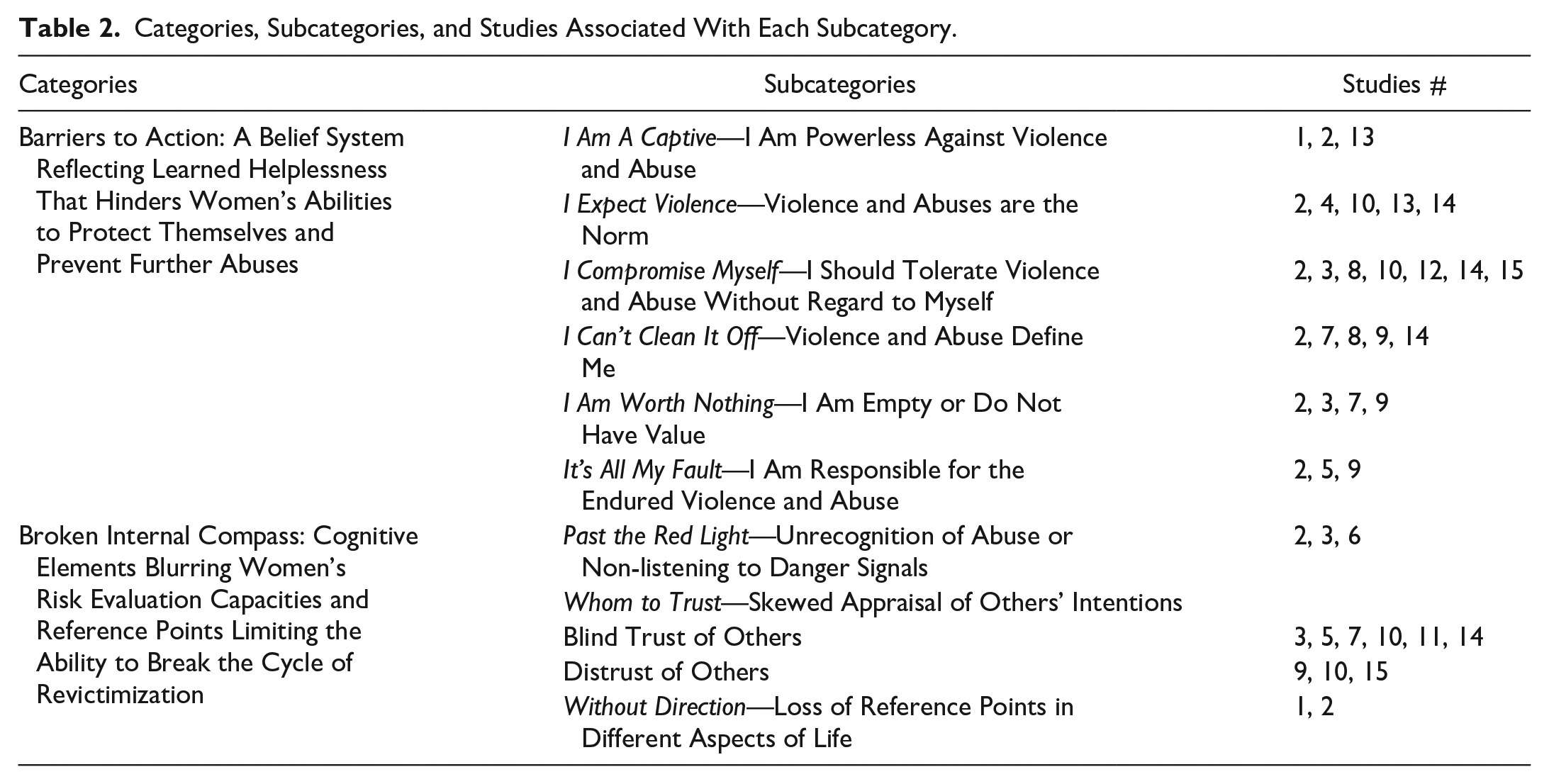
The current metasynthesis yielded two main conceptual categories, each with sub-categories. Conceptual categories, sub-categories, and the studies associated with each of them are presented in Table 2 and described in the following section.
Categories, Subcategories, and Studies Associated With Each Subcategory.
Barriers to Action: A Belief System Reflecting Learned Helplessness That Hinders Women’s Abilities to Protect Themselves and Prevent Further Abuses
Through the analysis of the studies, CSA survivors who have been revictimized within the context of intimate relationships expressed many false beliefs about themselves, about interpersonal relationships, and about the world around them that have been developed through multiple experiences of victimization and crystallized over time. Survivors reported endorsed beliefs that suggest little hope in a future free from violence for them, which may act as a barrier to taking action and protecting themselves from further victimization. These endorsed beliefs included myths such as:
that they are weak and powerless against violence and abuse perpetrated toward them;
that violence and abuse are a normal and expected part of one’s daily and romantic life;
that one should tolerate violence and abuse without regard for oneself;
that victimization experiences mark one’s identity and become part of who they are as a person;
that they are not worth of a life without violence and abuse;
and that they are responsible for the violence and abuse endured.
I Am A Captive—The Belief That I Am Powerless Against Violence and Abuse
Results of reviewed studies showed that participants (n = 4) across three studies expressed that they felt trapped, powerless against the violence and abuse they endured, and without any way out of the abusive situation. In Ben-Amitay and Colleagues’ (2015) study, multiple survivors mentioned the feeling of being in “captivity” at the hands of their abusers. For example, one participant described being captive by the abusive men in her life, her unfortunate circumstances, and even herself, a situation that she believed to be unchangeable and having no control over: It is also being the captive of the circumstances and of my father and being a captive of myself and of my internal captors. . . it is as if there are loads of heavy chains that bind me, that don’t let me be myself. . . trapped in the past, there is no here and now, it relates to revictimization. [. . .] When you are a captive, you are not alive, you are imprisoned; you are closed inside some room or cell. I don’t know, whatever will be. . . when the outside is full of other life. . . For all these reasons, all types of captivity, can’t put a foot outside. (Michal cited in Ben-Amitay et al., 2015, p. 922).
Similarly, another participant declared: “That’s not the problem; [the problem] is the internal captivity” (Alma cited in Ben-Amitay et al., 2015, p. 921), implying that she is her own captive in the abusive relationship, as she did not want nor felt able to disclose the abuse to the police. In Basile’s (2008) study, another participant talked about how she felt trapped as she “froze” and was not able to defend herself during a violent episode she endured: “It’s like I think of myself as the little field mouse, being pursued by the snake, and you’re just within striking distance, you’re just frozen, [you] just sit there and stare, you can’t do anything, you can’t move” (unnamed participant cited in Basile, 2008, p. 38).
I Expect Violence—The Belief That Violence and Abuse are the Norm
Across five studies, survivors (n = 5) expressed the belief that violence is “normal” in their lives and in their intimate relationships, reflecting a passive acceptance of the abusive context in which they find themselves: “I accepted the situation [ongoing abuse by her partner] as normal. It didn’t seem OK to me, but it seemed to me. . . I didn’t really think about it. . .” (Alma cited in Ben-Amitay et al., 2015, p. 921). Many survivors across studies also stated to be expecting violence and abuse from their intimate partners, as if violence perpetrated against them is anticipated or predictable: “I expected physical violence, I expected emotional violence. You know, when you grow up, you think that’s normal. So, I expected those things” (Jessie cited in Newsom & Myers-Bowman, 2017, p. 936). This sentiment was shared by one participant in another study: “So that’s why I didn’t just up and leave and walk away. . .because I was familiar [from childhood sexual abuse] with that pain, of just staying there and allowing someone to treat me the way they wanted to treat me” (Terry cited in Seng et al., 2004, p. 611). Those excerpts seem to indicate that survivors find solace in the familiar, which is violence and abuse.
I Compromise Myself—The Belief That I Should Tolerate Violence and Abuse Without Regard to Myself
Across seven of our examined studies, survivors (n = 9) voiced their belief that they “must” tolerate the violence and abuse perpetrated against them; survivors often evoked that their safety or protection is not a priority for them: “I did everything he asked me to and tolerated so much, but compromised myself” (Hanna cited in Træen & S⊘rensen, 2008, p. 384). The belief that they should tolerate the abuse without any regard to their own well-being appears to stem from various myths, such as they should be content with the relationship they have with their current abusive partner because the latter is less abusive than they could be or the partner before them: “As long as he wasn’t hitting me, that was the threshold for me. If he wasn’t hitting me, then that was a good marriage. Isn’t that bad?” (Jessie cited in Newsom & Myers-Bowman, 2017, p. 936). Another similar case can be observed in Liendo and Colleagues’ (2011) study, when this survivor said: “I am with him because he does not beat me up like your father, [referring to her first abusive partner] that is why I am with him. But, well I am tired that he insults me. . .” (unnamed participant cited in Liendo et al., 2011, p. 212). An additional myth that seems to induce or cement the belief that one should tolerate violence and abuse appears to be judging that one’s own well-being is not a priority. For example, survivors across five studies (n = 5) revealed that the choices they make are not always the best for themselves but still make them even if they know it could be detrimental for them, suggesting indifference or devaluation of their comfort at the expense of the needs or wants of others: “I would stay [in relationships] because I wanted to please them [men]” (unnamed participant, Roller et al., 2009, p. 57). This other participant from Træen and S⊘rensen’s (2008) study also demonstrated this line of thoughts: He [her doctor] made me realise that you are the one who decides over your own body; and you should try to feel good. You aren’t supposed to just take what is thrown at you. You have to state your needs and you can’t let yourself be abused like that. (Jean cited Træen & S⊘rensen, 2008, p. 385)
I Can’t Clean It Off—The Belief That Violence and Abuse Define Me
Analysis revealed that survivors (n = 8) across five studies reported believing they are defined, even tainted, by their experiences of victimization. In fact, survivors expressed the belief that these violent experiences are an integral part of them, of their identity, and determine who they are as an individual and the lives they will lead. As such, IPV revictimization survivors may believe that the multiple victimization experiences are defining for one’s identity. Several survivors evoked the feeling of being forever “contaminated” by the violence perpetrated against them: “I feel as though I am walking and there is this weight behind me that I can’t. . . not a weight, but a stain that I cannot clean off. Kind of like a mark of Cain” (Smadar cited in Ben-Amitay et al., 2015, p. 926). The belief of being “damaged” or “soiled” by the victimization experiences, the belief that one’s body no longer belongs to them, and the belief that the abuses have propelled one in a tumultuous and violence-filled life trajectory appear endorsed by many women (n = 5) through numerous studies. For example, one survivor mentioned believing that an “internal rapist was sown within me” (Alma cited in Ben-Amitay et al., 2015, p. 922), such that the abuses are being perceived as inseparable from oneself. With this quote, the survivor tried to explain how confusing it was for her to understand herself and her behavior with the abuser, as she may feel as if she failed to escape the abuses, or even that she sought abusive men unconsciously, something part of her that she could not truly understand.
Another participant believes the CSA is the reason her whole life is difficult and violence-filled: “I feel that this [CSA] is why I am leading the life that I’m living” (unnamed participant cited in Liendo et al., 2011, p. 211). Some women who have been revictimized by an intimate partner also felt that the violence perpetrated against them dispossessed them of their body and their identity by taking an important part of who they are: “When you’ve been beaten in several relationships, in addition to other things oppressing you, you lose part of yourself” (Hanna cited in Træen & S⊘rensen, 2008, p. 385).
I Am Worth Nothing—The Belief That I Am Empty or Do Not Have Value
Survivors (n = 6) in four different studies expressed believing that they feel as though they have no personal value or that they are “empty”. Indeed, some survivors suggested an inner void: “There’s always that void and you try to fill it up with something” (Bella cited in Kerlin & Sosin, 2017, p. 200). Other survivors also evoked self-hatred: “I didn’t like myself, so it was very hard for me to value myself for who I was. . . [. . .] I thought that people only liked me because they wanted to sleep with me” (Consuelo cited in Ligiéro et al., 2009, p. 76). These excerpts may denote a belief that they are not worth “saving” from the violence perpetrated against them, that their existence is futile for them, as this woman explained: “I felt my life was worth so little if I did not get along with him that he might as well. . . I was willing to take the risk that he could kill me” (Helga cited in Bjørnholt, 2019, p. 101). The perception of having no personal worth can be so pervasive that a survivor even expressed having only value for her abuser: My worth is measured by his gaze; how he [abusive man] sees me. . . I am worth nothing if they’re not looking at me. [. . .] My existence, I have no existence, only when I am with him. [. . .] His gaze confirms my value, meaning that I exist. (Naomi cited in Ben-Amitay et al., 2015, p. 920)
It’s All My Fault—The Belief That I Am Responsible for the Endured Violence and Abuse
Many participants (n = 3) across three distinct studies expressed feeling responsible for the violence committed against them and the consequences that resulted from it: “I felt that I ruined everything [by filing a complaint to the police against her ex-boyfriend. . . [. . .] Sometimes, I felt that it was my fault” (Britney cited in Guyon et al., 2019, p. 14). Several excerpts bear witness to the feeling of guilt about the violence they experienced, sometimes even accusing themselves of provoking the perpetrator, for example: I am saying that there is a meeting here with the perverted, even not the very perverted, but borderline. Here, the perverted meets the victim and they notice each other. I even used to do things to make them start with me. (Naomi cited in Ben-Amitay et al., 2015, p. 925)
Similarly, another participant felt that the CSA was her fault because she was a bad person, which would also explain the subsequent abusive experiences in her life: “I thought it [the sexual abuse] was my fault, that I was a bad person. . .” (Consuelo cited in Ligiéro et al., 2009, p. 74)
Broken Internal Compass: Cognitive Elements Blurring Women’s Risk Evaluation Capacities and Reference Points Limiting the Ability to Break the Cycle of Revictimization
Across studies, the accounts of women survivors of CSA and IPV revictimization suggest that several cognitive elements could hinder their capacities to detection of dangerous or risky situations, skew their evaluation of the trustworthiness of others, and alternate their reference points in life. These cognitive elements are summed up as the failure in recognizing violence or in listening to danger signals, the biased appraisal of others’ intentions due to the need to be loved, or being constantly on guard in front of others and losing one’s reference points in different aspects of one’s life.
Past the Red Light—Unrecognition of Abuse or Non-listening to Danger Signals
Across three studies, many survivors (n = 4) expressed the impression of not having a functional internal “alarm” indicating when a situation is risky or dangerous. This cognitive element could hinder their capacity to recognize a violent experience or decrease their tendency to listen to their intuition in situations where they feel uncomfortable or threatened as they believe it to be faulty: I think that I didn’t know where to set my boundaries and I didn’t know that they were overstepping my boundaries. . . I think that when my red lights began to flash, it was already past the red light stage, and the device was already broken. (Alma cited in Ben-Amitay et al., 2015, p. 923)
Moreover, many survivors find it difficult to establish adequate boundaries as they believed their instincts are unreliable because of the cumulative abuses. The “alarm” signal can also be hampered by avoidance strategies such as substance abuse as it may impede awareness: “I’ve never really thought about how violent our relationship is until now; I’ve never really been sober enough to think about it I guess” (unnamed participant cited in Hlavka et al., 2007, p. 910). Several survivors across studies also addressed the shock they experienced after the violent incident when they realized they had been victimized as if they didn’t trust their internal “alarm” signal: “The shock comes afterward. No, while it is happening, I argue with myself. The voice of the urge and the need and the desire to break through these boundaries is much stronger than the voice of alarm. . .” (Sharon cited in Ben-Amitay et al., 2015, p. 924).
Whom to Trust—Skewed Appraisal of Others’ Intentions
Across many studies, survivors reported having difficulties with their appraisal of others’ trustworthiness, especially with a potential partner within the context of intimate relationships. Some women expressed that they repeatedly mistook the intentions of the men in their lives, either by a tendency to trust them easily to fill a need to receive love and affection or by a tendency to not trust others due to the accumulation of negative or abusive relationship experiences they have.
Blind Trust of Others
Across six studies, several survivors (n = 7) described being quick to trust a potential intimate partner or misguided in their appraisal of an intimate partner’s intentions (i.e., what would be expected in the relationship) and behaviors toward them by their need to be loved, their need for attention, connection, and affection they seek to fill. For example, one woman said: “I looked for someone to take care of me, but they would take advantage of and control me.” (Martina cited in Newsom & Myers-Bowman, 2017, p 936). Another survivor added: “I had no self-respect, but I think I was searching for love. Maybe what I could not get at home. But the more I searched, the more they wanted to exploit me” (Jean cited in Træen & S⊘rensen, 2008, p. 385). One participant expressed: “I longed for love and intimacy, which I’d never found in my previous relationships because of all the violence” (Hanna cited in Træen & S⊘rensen, 2008, p. 385). Survivors across studies expressed complete trust in their intimate partner before the latter “betrays” them or before realizing that they are experiencing abuse at their hands. Other women extrapolated their sentiment that their constant need to be loved puts them at particular risk for tumultuous relationships or even being targeted by ill-intentioned intimate partners who will exploit them, as this survivor testifies: And that made me a rather easy prey, as someone who was already. . . seeking attention and contact. [. . .] And that became a truth. It was the way I felt: wow; how I needed closeness and attention, and to be taken care of and to belong to something, so I was an easy target for. . . him [aggressive boy in her class]. (Helga cited in Bjørnholt, 2019, p. 96)
Distrust of Others
Across three studies, multiple survivors (n = 3) discussed their history of abusive or unsupportive relationships that resulted in their difficulty in trusting others. One participant described being generally on guard in her interpersonal relationships as a response to the abuse she suffered and her CSA disclosure that was not believed: “[My relationships] have been negative—whether they have been friendships or intimate relationships. I never really had that trust. You know, I was 8 when I was molested and nobody believed me, and so I didn’t feel like people were trustworthy. . .” (Anna cited in Newsom & Myers-Bowman, 2017, p. 936). Similarly, another participant shared her lack of trust toward her friends and the lack of support they gave her when she wanted to divorce her abusive husband: “I think a lot of people, like some friends, who were around me then [were not helpful]. I felt I could not trust them” (Consuelo cited in Ligiéro et al., 2009, p. 76). One more participant explained how her negative view of others as part of the reason she might tolerate abuse by her intimate partner: “I just choose to work it out with him [implying her partner] than go through this all over again with someone new. . . I don’t trust nobody else” (participant 14 cited in Valdez et al., 2013, p. 137).
Without Direction—Loss of Reference Points in Different Aspects of Life
In two studies, survivors (n = 2) indicated that they feel as if they have lost their reference points in different aspects of their lives. For example, a woman mentioned feeling as if her world was falling apart when she experienced a threatening episode with her husband, as she linked this experience to her past sexual assault: “[I am] without direction, without knowledge. My world had collapsed.” (Ahuva cited in Ben-Amitay et al., 2015, p. 920), excerpt that can also evoke the sentiment of not having a way out through all the violence that surrounds her. Another survivor discussed a more specific impact that the CSA had on her view of sexuality as if she should not listen to her own judgment about her sex life: “The [molestation] had a definite impact on how I look at sex. . . I just have to put it out of my mind because I know that it has warped my thinking” (unnamed participant cited in Basile, 2008, p. 38). These two narratives expose that victimization experiences can profoundly affect the understanding of reality among survivors. These quotes may reveal how survivors of multiple experiences of abuse can think that their perceptions are biased about everyday elements (e.g., sexuality). A sort of disorganization may be present, which can lead survivors to doubt every decision, to want to be taken by the hand for simple tasks that seem like a mountain to tackle and may need more support to adequality function in their day-to-day life.
Discussion
The present metasynthesis had the objective to identify commonalities in how women find meanings in their experiences of CSA and intimate relationships based on their views of themselves, others, and the world into a single integrative portrait of the phenomenon. The present study provided an integrative synthesis and reinterpretation of fragmented pieces of qualitative data on IPV revictimization that offers a richer and more complete understanding of the phenomenon while identifying the remaining gaps in literature. As such, current findings shed light on beliefs and cognitive elements that CSA survivors revictimized within the context of intimate relationships may express about their experiences. The crystallization of such thoughts throughout the many experiences of victimization can reduce survivors’ sense of empowerment and hope for a future free of violence. Indeed, such thoughts can act as a barrier to taking action and protecting oneself against further violence, by reducing survivors’ feeling of personal efficiency, self-esteem, sense of a reachable goal, and overall resilience capacities (Bogar & Hulse-Killacky, 2006; Breno & Galupo, 2007). Results highlighted the survivors’ acceptance of some rape myths that may alter their view of themselves, of intimate relationships, and of the world and may interfere with their healing. Beyond behavioral risk factors that are often examined in quantitative studies about sexual revictimization (e.g., risky sexual behaviors; Messman-Moore et al., 2010), our study put forward cognitive elements in survivors that could act as precursors of behaviors specifically in the context of intimate relationships.
Results of the current metasynthesis are reminiscent of the conceptual model of Finkelhor and Browne’s traumagenic dynamics (1985). This theoretical model, which details the specific consequences of CSA on the survivor, states that the survivor can experience a variety of repercussions according to four traumagenic dynamics: betrayal, powerlessness, traumatic sexualization, and stigmatization. Each of these dynamics represents a typical profile of impacts on the survivor. This conceptual model seems all the more relevant, as many survivors in the current metasynthesis expressed similar elements. Indeed, a sense of powerlessness was evoked several times by the participants, which coincides with the powerlessness dynamic that can emerge when one sees his or her will, desires, and sense of personal effectiveness continually undermined during the experience of CSA. Furthermore, participants often brought up themes related to shame, self-blame, and a sense of being damaged by the abuse, elements reminiscent of the stigmatization dynamic that can emerge when one blames themselves for CSA. Other participants mentioned a sense of betrayal of their trust and an altered view of sexuality in response to traumatic memories, elements that remind respectively the dynamics of betrayal and traumatic sexualization.
Moreover, many elements evoked by survivors are also found in Noll and Grych’s (2011) Read-React-Respond theory of sexual revictimization. This conceptual framework incorporates several CSA repercussions that can increase the risk of being sexually revictimized in survivors, such as an inability to appropriately assess the risk level of a situation that can lead to an avoidance or non-assertive response rather than a defensive response in the context of violence, as mentioned numerous times by the survivors in the current study. Thus, this conceptual framework theorized that some CSA survivors may present some characteristics that may put them more at risk of being revictimized within the context of intimate relationships, like difficulty in detecting “red flags” and violent or risky situations and the tendency to not prioritizing their own safety (Noll & Grych, 2011), two core elements also reported by the participants part of this project.
Additionally, the conceptual categories identified in this metasynthesis strongly echo the Self-Trauma Model (Briere, 2002), and the notion of complex posttraumatic stress disorder (CPTSD). The self-trauma model suggests that childhood interpersonal trauma like CSA impedes or hinders a child’s optimal development, leading to disturbances or deficits in the three key aspects of self-capacities: emotional regulation, identity development, and relatedness to others (Briere, 2002). Those self-capacities represent the areas affected by the diagnosis of CPTSD proposed by the ICD-11 in 2018 (Cloitre et al., 2018; World Health Organization, 2022), which describes the complex spectrum of symptoms experienced by survivors of chronic trauma. The words of survivors presented in the current study showed the impact of multiple victimizations on their identity (e.g., poor self-esteem or self-worth), affect regulation (e.g., poor detection of danger signals), and interpersonal relationships (e.g., lack of trust in others and love-seeking).
Furthermore, it is interesting to note that many survivors involved in the current study referred to an erroneous and mostly negative view of themselves, along with a fundamental need to be loved, which can lead them to misjudge the intentions or the trustiness of the people around them, notably their intimate partners. Both the way one can see oneself and see others are center elements of attachment theory (Bowlby, 1969; Hazan & Shaver, 1987). Indeed, adult attachment theory, based on the work of Bowlby (1969), stipulates that an infant’s relational experiences with their attachment figures, often parents, forge the development of an attachment system guiding the relational functioning in adulthood. As such, abuse survivors, like CSA survivors, may develop an insecure attachment pattern that could later affect their intimate relationships. Such insecurity may present itself as abandonment concerns, marked by a vision of oneself as being inferior to others, a tendency to “sacrifice” oneself for the maintenance of interpersonal relationships, a deep-rooted fear of being abandoned or rejected by one’s partner, and a great desire for emotional closeness leading to less discrimination in the choice of intimate partners (Mikulincer & Shaver, 2018). Among samples of women, associations have been demonstrated between CSA experience, abandonment concerns, and IPV revictimization (Zerubavel et al., 2018). The present study illustrates this phenomenon using the perspective of women survivors of their own relational experiences.
Empirical and Intervention Implications
Many implications emerge from this research. First, our findings provide a better understanding of the phenomenon of IPV revictimization among women survivors of CSA from their own perspective, highlighting the erroneous beliefs that survivors may endorse as a result of their multiple abuse experiences. Such discouraging beliefs may impair survivors’ ability and motivation to take action against the violence they sustain. These findings add to the empirical body of research on long-term CSA repercussions by overcoming certain limitations. Indeed, a large proportion of studies on revictimization among female CSA survivors have focused on sexual revictimization experienced outside of an intimate or couple relationship (Classen et al., 2005). However, violence suffered in the context of an intimate relationship among women, especially CSA survivors, is a widespread phenomenon that includes several other forms (e.g., physical and psychological), and thus deserves sustained research attention.
Second, our findings offer an empirical basis to guide prevention and intervention practices aimed at female CSA and IPV survivors and violence. More specifically, the current results support the need to emphasize the deconstruction of false beliefs and cognitive distortions in intervention programs destined for female survivors in order to potentially reduce the risk of IPV revictimization and increase their chances of breaking the cycle of violence. As such, it would be beneficial to offer treatments tailored to survivors of multiple or complex trauma, such as trauma-focused cognitive behavioral therapy (e.g., Brillon, 2017; Resick et al., 2016). Such treatment promotes the reduction of negative effects of trauma on one’s life by challenging and modifying unhelpful beliefs related to trauma (e.g., self-blaming thoughts).
Finally, our findings also highlight the importance of consent education, with emphasis on basic human rights, and healthy and equal functioning within intimate relationships among female CSA survivors. For example, the Enhanced, Assess, Acknowledge, Act Sexual Assault Resistance Program (Senn et al., 2021) provides tools to empower women, such as ways to better recognize danger signals in risky situations, to overcome personal barriers to prioritize their own safety and well-being, and to develop effective strategies to set personal boundaries. Such programs could promote women’s sense of self-efficacy and empowerment by having more control in their intimate relationships. Thus, prevention and intervention practices should be adapted to the specific needs and vulnerabilities of these women and target the beliefs and cognitions endorsed by them that may interfere with their recovery and action taking.
Limitations, Strengths, and Future Studies
The present metasynthesis has both limitations and strengths that must be considered. First, the samples within the included studies have many similar characteristics. Indeed, most of the participants were cisgendered young or middle-aged women (i.e., between the ages of 18 and 55 years old), self-identified as heterosexual or currently in an intimate relationship with a man, and living in the United States. The homogeneity of the participants between studies does not allow to observe the intersections of individual, interpersonal, and systemic oppressions that women of cultural, sexual, and gender diversity can experience. Future qualitative studies should examine IPV revictimization among samples of female CSA survivors derived from more diverse backgrounds. For example, those studies could further explore the experiences and perspectives of sexual minority women (e.g., lesbians and bisexual women) and non-binary individuals, who are particularly at risk of having been victimized in their childhood and revictimized in adulthood (López & Yeater, 2021). Future studies could also focus on the experience of IPV revictimization among men CSA survivors, a distinct population that presents specificities that need to be better understood to guide well-tailored practices (Guyon et al., 2020). However, to our knowledge, no study has focused on the perception of lived experience of IPV revictimization in multiple female CSA survivors across studies as was done in the current metasynthesis. This innovative method constitutes the first step toward the establishment of future studies pertaining to this phenomenon and establishing a solid foundation to lead future projects.
Second, it seems important to note that most of the samples used in the present study were limited to women who had sought help services (e.g., centers specializing in domestic or sexual violence) or who had disclosed their experience of CSA, which is not the case for all survivors. As a matter of fact, a study demonstrated that approximately one adult CSA survivor out of five had never disclosed the abuse before the study (Hébert et al., 2009). Thus, current findings should not be generalized to all female CSA survivors. In addition, as only studies conducting narrative, non-directed, or semi-directed interviews were found and included in the metasynthesis, future studies could benefit from using innovative data collection methods, such as qualitative anonymous surveys, to triangulate the data. Nevertheless, the use of several samples from various studies for the present metasynthesis constitutes a strength.
Third, data saturation (i.e., when no new information is discovered when analyzing more data; Mason, 2010) could not be achieved for all conceptual categories, as this metasynthesis relied on topics covered in published studies. Since we only found a total of 15 articles that met our criteria, some subcategories did not attain empirical saturation, namely subcategory “Without direction—Loss of reference points in different aspects of life.” As such, the present study offers a possible avenue to guide future studies, such as examining elements related to the loss of “grounding” to guide one's life among women survivors of CSA and IPV revictimization. Future research could include diverse literature such as unpublished theses and dissertations to have a broader corpus of studies.
Finally, a metasynthesis integrates both the points of view of the researchers who conducted the original studies and those of the researchers who carried out the present analysis. Thus, the personal characteristics of the researchers (e.g., age, gender, social status, professional, and personal background) may have influenced the conceptualization of the study and the data analysis. Indeed, this article is situated in a feminist point of view that sought to empower female CSA survivors while giving them a voice to speak up about their own experiences and perspectives. As such, the present metasynthesis may not offer a complete and definitive view of the phenomenon of IPV revictimization.
Conclusion
In conclusion, revictimization within intimate relationships among female CSA survivors is accompanied by a set of beliefs that can undermine the feeling of hope and thus increase their vulnerability to other victimization experiences by an intimate partner. This metasynthesis highlights the importance of exploring cognitive distortions and endorsed false beliefs on identity, relationships, and the world among women survivors of CSA and violence in the context of intimate relationships. Findings highlight the importance of providing IPV revictimization survivors with violence prevention tools, including improved risk evaluation capacities, and to deconstruct the feeling of helplessness to help them break the cycle of violence.
It is important to emphasize that results of this study should not be interpreted as blaming women for their victimization nor increasing their burden of protecting themselves from IPV revictimization. The responsibility for violence lies with the perpetrator. Rather, it is hoped that acknowledging CSA and its long-term consequences on women’s relational well-being might help to better understand revictimization and prevent subsequent victimization. This metasynthesis is intended as an opportunity to give women a voice about their experiences of sustained violence and to offer avenues in order to give them the power to act in the prevention of subsequent victimization.
Footnotes
Acknowledgements
Marianne Girard was supported by a Doctoral scholarship from the Social Sciences and Humanities Research Council of Canada (SSHRC).
Declaration of Conflicting Interests
The author(s) declared no potential conflicts of interest with respect to the research, authorship, and/or publication of this article.
Funding
The author(s) disclosed receipt of the following financial support for the research, authorship, and/or publication of this article: This research project was funded in part by grants from the Interdisciplinary Research Centre on Intimate Relationship Problems and Sexual Abuse (CRIPCAS) and The Fonds de recherche du Québec—Santé (FRQS) (# 29051 PI: N. Godbout). The funding source(s) had no involvement in this study.
