



Abstract
Family violence may be experienced at any stage of the lifespan; however, these experiences are often understood differently based on the age of the victim and who perpetrates the abuse. The significance of age is evident in the three categories of child abuse, domestic and family violence (DFV), and elder abuse. Each of these categories has its own definition which determines who is considered a victim or a perpetrator, and the behaviors counted as violent and abusive. These definitions influence how practitioners view victim-survivors’ experiences of violence, and the subsequent available responses. This article reports the findings of a scoping review of international literature published between 2011 and 2021, which explored how family violence is categorized and defined. The review was conducted as part of a larger study exploring how violence against women in intimate and family contexts is conceptualized and experienced, as well as the available responses. Forty-eight articles were included in the final review, and five categories of violence in family and intimate contexts were identified. These were child abuse, DFV, elder abuse, adolescent-to-parent violence, and sibling abuse. Comparison of definitions across categories found similarities in terms of the relationship between victim and perpetrator, behavior, intention, and harm caused to the victim. Review findings suggest that definitions of various forms of family violence do not differ greatly. Further research is needed to determine whether responses to family violence across the lifespan can and should be streamlined.
Introduction
Internationally, family violence is recognized as a major social and public health issue with a significant economic burden. Most recent estimates of the global cost of violence against women alone were approximately US$1.5 trillion in 2016, with the true cost likely to be significantly higher in 2023 given inflation and increases in prevalence during the coronavirus disease 2019 (COVID-19) pandemic (Commonwealth Secretariat, 2022). This figure increases again when other populations who experience violence, such as children and older people, are also included. Though there is substantial evidence that abuse occurs across all demographics, family violence remains separated into three distinct sectors based on the age of the victim: child abuse, domestic and family violence (DFV), and elder abuse. These forms of violence have been present throughout history, but have come to public and policy attention at different times, and developed in different disciplines, leading to differences in how they are defined, explained, and responded to (Hamby & Grych, 2013; Johnson et al., 2010).
Though there have been protections for children, in particular, since the nineteenth century (Goldsworthy et al., 2015), contemporary public and policy attention to family violence began in the 1960s, with the identification of child abuse, or “battered child syndrome” by medical practitioners (Brandl et al., 2006; Krug et al., 2002). DFV became the focus of attention the following decade, as the “battered women movement” began gaining momentum (Brandl et al., 2006; Murray & Powell, 2009; Simic, 2019). Finally, in the mid-1970s, elder abuse, or “granny battering” (Baker, 1975; Burston, 1975) began being identified through nursing, medical, and criminal justice frameworks. As a result of their histories, each category of abuse has its own response framework. Abuse of children and older people are predominantly responded to child and adult protection frameworks (Brandl et al., 2006; Goldsworthy et al., 2015). Due to its feminist origins, DFV conceptualizations and responses are largely gender-specific, which has led to the formation of a wide range of women’s services aimed to prevent DFV and respond to victim-survivors (Malik et al., 2008; Murray & Powell, 2011).
As the evidence bases of each of these forms of family violence have grown, research has increasingly found that, not only does violence occur across the lifespan, but also that lifetime experiences of violence may be linked. Children who experience abuse are now known to be more likely to become a victim and/or perpetrator of other forms of violence in adolescence and adulthood (Butler et al., 2020; Fulu et al., 2017; Guedes et al., 2016; World Health Organization [WHO], 2014). Furthermore, there is significant evidence to suggest that many adult women who experience violence report multiple forms of victimization (Armour & Sleath, 2014; Kuijpers et al., 2012; Rees et al., 2011), with past experiences of family violence now recognized as risk factors for experiencing both DFV and elder abuse (Quigg et al., 2020). However, the true prevalence of family violence across the lifespan is difficult to determine, as different theoretical frameworks and explanations for violence at different ages mean that abuse is not defined and measured consistently across the lifespan. For example, some child abuse and DFV prevalence research focuses solely on physical or sexual abuse, whereas others also include emotional abuse. Focusing on physical and/or sexual abuse consistently finds that girls and women are more likely to experience abuse (WHO, 2014, 2020, 2021), whereas the inclusion of emotional abuse typically leads to higher rates of men reporting violence (Karakurt & Silver, 2013). Another definitional difference, which influences prevalence rates, is considering who the abuse has been perpetrated by. DFV data often focus on violence perpetrated by a current or former intimate partner (WHO, 2021), whereas child and elder abuse data may include both family and nonfamily as perpetrators (WHO, 2014; Yon et al., 2017). However, the greatest issue in trying to understand the prevalence of family violence across the lifespan is that prevalence data often does not distinguish between different experiences of violence. For example, some prevalence studies focus only on experiences of abuse in the last 12 months (such as Yon et al., 2017), whereas others may ask about violence at a certain age (such as WHO, 2021, which asked about experiences of violence since the age of 15), but often only ask participants if they have ever experienced violence in this time period, not how many perpetrators they have experienced violence and abuse from. Although data from different sectors may indicate the prevalence of family violence at a particular stage of the lifespan, definitional differences mean that prevalence cannot be compared across sectors, and therefore, it is impossible to know the true prevalence of family violence across the lifespan.
More recently, attention has been paid to intersections between abuse sectors, leading to growing bodies of work on overlapping issues, such as children’s exposure to DFV (Murray & Powell, 2009) and older women’s experiences of partner violence (Band-Winterstein, 2012). Despite recognition of similarities and overlap between sectors (Chesterman, 2016), and evidence that women are likely to experience violence from multiple different perpetrators across their lifetime (Armour & Sleath, 2014; Kuijpers et al., 2012; Rees et al., 2011), there remains a lack of research on violence across the lifespan. There is even less research considering whether various categories of family violence are the same phenomenon experienced at different life stages, or whether there are fundamental differences that warrant separate research, policy, and practice approaches. This review aims to address this gap, by exploring and comparing definitions of categories of abuse across the lifespan.
Method
This article reports on an international scoping review examining conceptualizations of family violence at various points across the lifespan (i.e., child abuse, DFV, and elder abuse). These three abuse categories were chosen as they form the main areas of family violence research, policy, and practice. Other types of violence, such as adolescent-to-parent violence (ATPV) and sibling abuse, were not specifically searched for but were included under the broader category of family violence. For this study, the term “conceptualization” encapsulated understandings, definitions, constructions, and characteristics of family violence. The scoping review was conducted in 2020 and 2021, as part of a larger study exploring violence against women across the lifespan. The review framework drew on the work of Arksey and O’Malley (2005) and consisted of three stages: literature scoping, article screening, and data analysis and synthesis. Initially, the scope of the review was broader and included experiences of and responses to family violence, in addition to conceptualizations; however, the volume of literature this yielded proved too large. As a result, the review’s focus was narrowed during the abstract screening stage to only include literature related to conceptualizations of family violence.
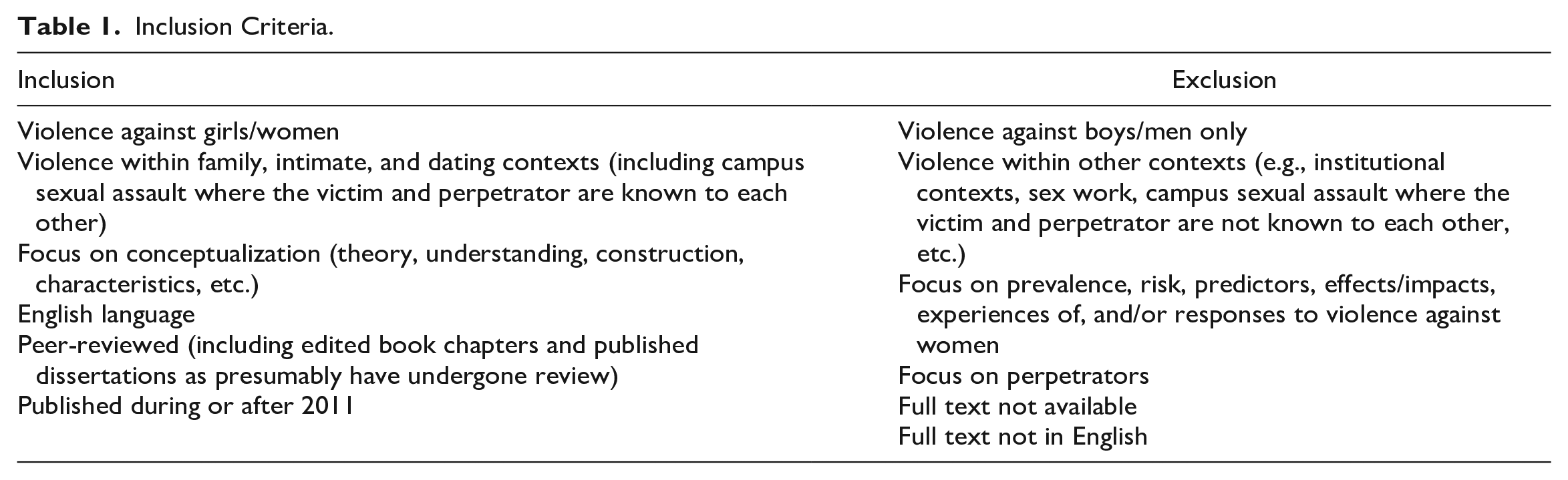
Initial searches included literature published during or after 2000; however, due to the volume of literature this yielded, inclusion was restricted to articles published after 2011. This date was chosen as it coincides with the conclusion of the Australian Law Reform Commission’s (ALRC) inquiry into family violence (2010) in November 2010, which marked the beginning of a shift in understandings and public attention to violence against women in Australia, where the larger research project was conducted. The final inclusion criteria for abstract and full-text screening are in Table 1. Though boys and men also experience family violence, particularly in childhood and old age, the broader research project this review was conducted as part of is focused on the intersections in experiences of family violence victimization across the lifespan. Women are the focus of the research project, as evidence suggests that women who experience violence are more likely to be revictimized than men (Armour & Sleath, 2014; Kuijpers et al., 2012; Rees et al., 2011). As such, articles that focused solely on violence toward men or boys were excluded. However, most of the articles included in the final review from the child and elder abuse sectors considered abuse toward both girls/women and boys/men (n = 19).
Inclusion Criteria.
Literature scoping was conducted in May 2020 using the Scopus, ProQuest, CINAHL, Medline, and PsycInfo databases. A range of keywords related to various types of family violence (e.g., child abuse, DFV, intimate partner violence, elder abuse, gender-based violence, etc.) and the key components of the review (e.g., conceptualization, experience, and response) were used. The searches yielded a total of 101,059 references, all of which were exported into EndNote. Duplicates were manually removed, and then 47,553 references were subjected to two rounds of title screening (as depicted in Figure 1). The second round of title screening was necessary to narrow the scope of the review and further reduce the volume of literature to keep it to a manageable size for the researchers.
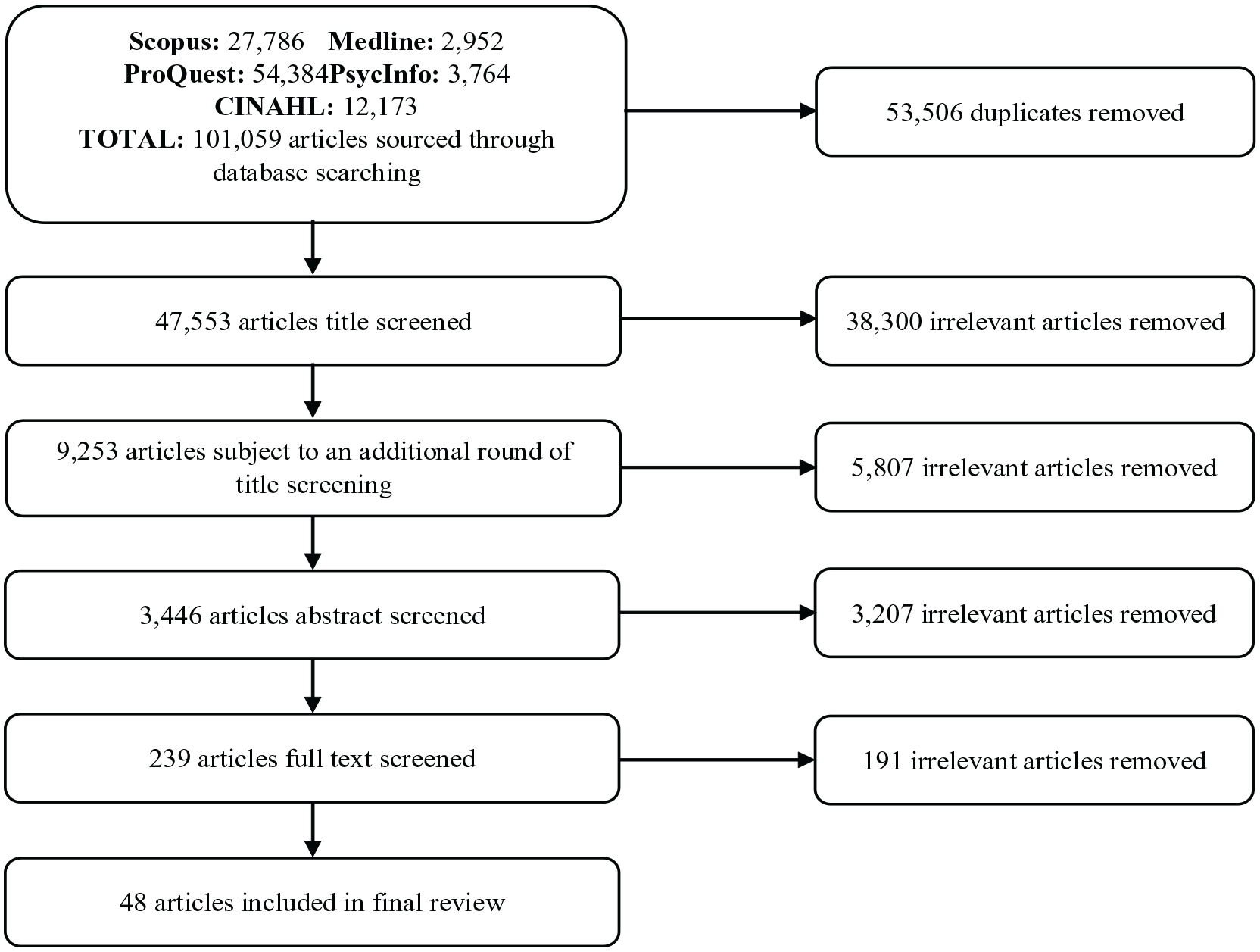
PRISMA diagram.
For initial abstract screening, the first 500 references were uploaded to Covidence (https://www.covidence.org/), an online scoping review tool, and independently screened by two of the researchers, to ensure consistency in screening and the application of the inclusion criteria. The researchers met regularly throughout the screening process to discuss and resolve any conflicts. Given the large volume of literature allocated for abstract screening, Research Screener (Chai et al., 2021), an online tool that semi-automates abstract screening for systematic and scoping reviews through machine learning and natural language processing, was also used to assist. Research Screener only became available to the team toward the end of the abstract screening process; as such, 1,960 abstracts were screened manually, with the final 986 uploaded to Research Screener. Of these, one reference was removed due to only having a short abstract (less than 100 words), and 18 were removed for not having an abstract. Each round of screening via Research Screener presented 50 abstracts, in order of most relevant. Eight rounds of screening were completed, with screening ceased after two rounds where no further relevant articles were identified.
Two hundred and thirty-nine articles were allocated for full-text screening. Thirty-eight articles were not available to the researchers, even after requests were made to the researchers’ institution for access, and another three were excluded as they were not written in English. Forty-eight articles were included in the final review (see Table 2 for summary).
Overview of Reviewed Literature.
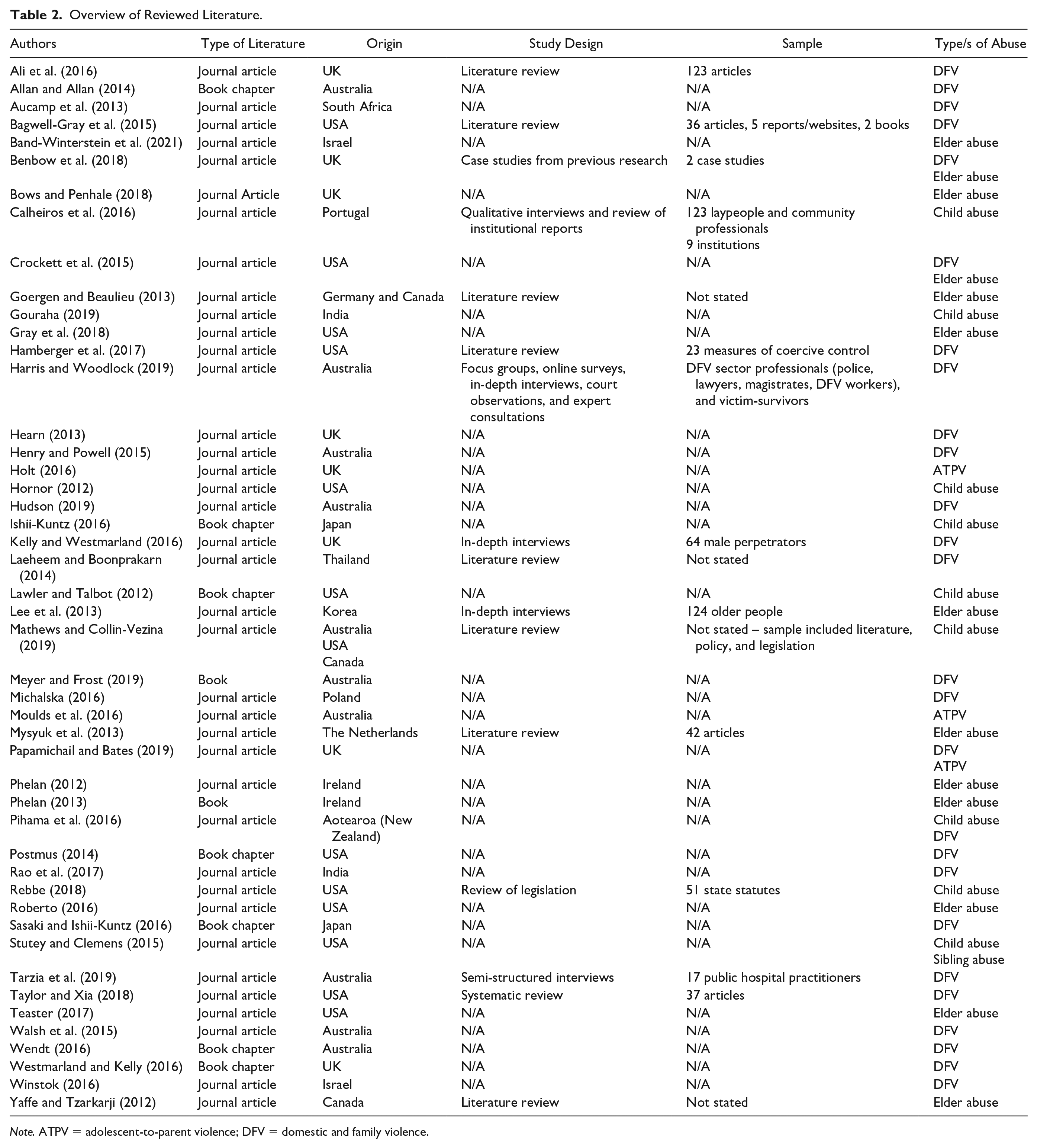
Note. ATPV = adolescent-to-parent violence; DFV = domestic and family violence.
Results
Five categories of violence in family and/or intimate contexts were identified in the 48 articles included in the review. These were child abuse, DFV, elder abuse, sibling abuse, and ATPV. Categorizations were primarily based on the age of the victim, and in the cases of DFV, sibling abuse, and ATPV, the relationship between the victim and the perpetrator. Of the 48 articles reviewed, most (n = 33) defined one or more categories of abuse. A small number of articles (n = 3) did not define abuse but did define the types of behaviors that constitute abuse. The remainder of the articles (n = 12) focused on a specific form of abusive behavior (e.g., sexual abuse). A summary of terms and definitions used for each type of violence is outlined below, followed by a discussion of definitional issues and inconsistencies, and a summary of abusive behaviors across categories.
Terms and Definitions
The review identified a range of terms and definitions used to describe the different categories of family violence. A summary of these is included in Table 3. Four terms were used to describe the abuse of children, and six for the abuse of older people, though child abuse and elder abuse were the most consistently used throughout the literature. Seventeen terms were used to describe violence against mostly adult women, with domestic violence (DV) and intimate partner violence being the most common. Many of the terms used to describe this type of violence focused on intimate relationships (e.g., “partner,” “spousal,” “wife”), with distinctions made between violence perpetrated by partners and violence perpetrated by other family members. Although only a small proportion of literature (n = 4) focused on violence from children under 18 toward their parents, there was no consistency among authors, with each article using a different term to describe this category of violence. Only one article spoke about sibling abuse, thus only one term for this form of abuse was identified.
Summary of Terms and Definitions (Most Commonly Used Terms, Definitions and Behaviors Bolded).
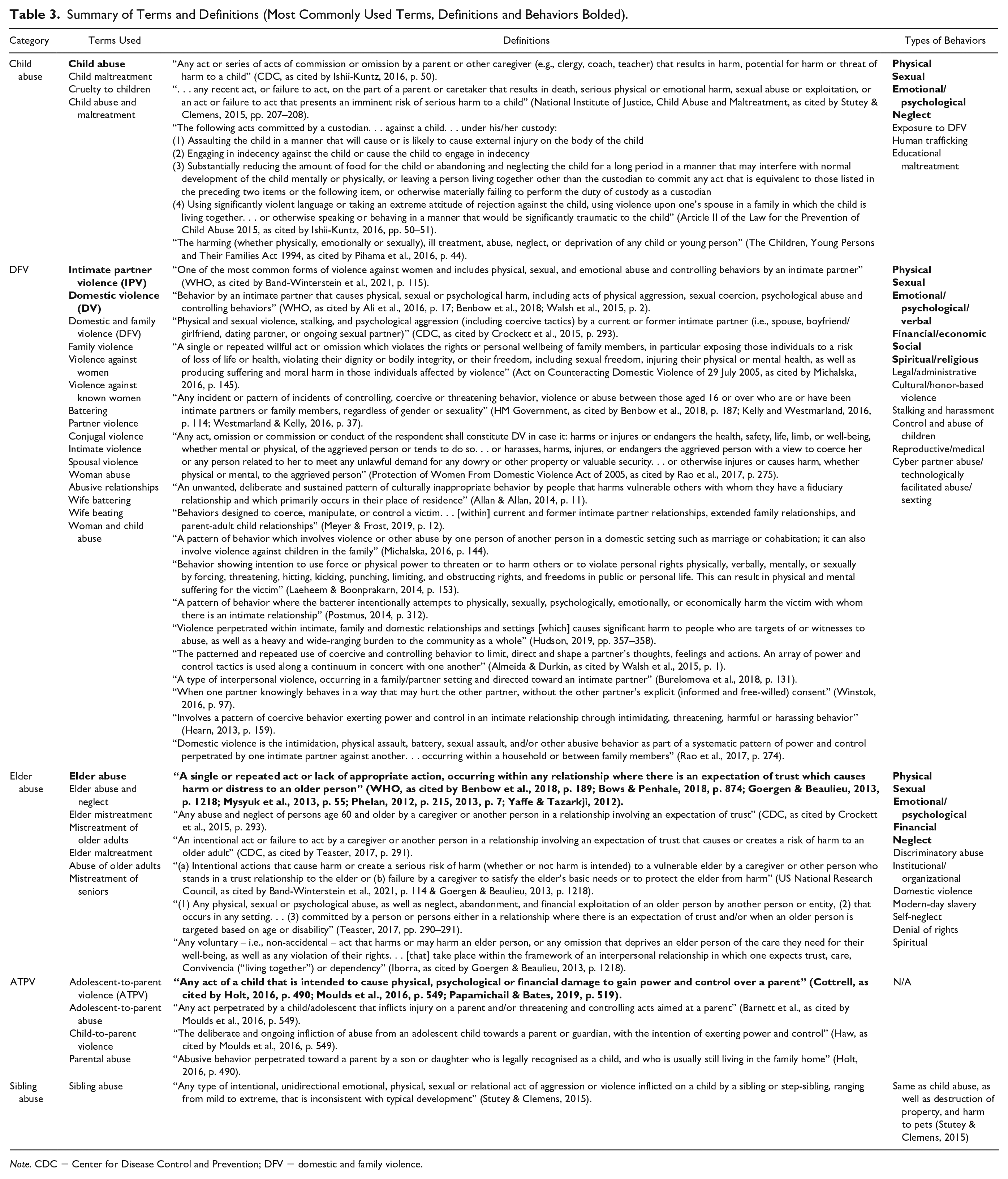
Note. CDC = Center for Disease Control and Prevention; DFV = domestic and family violence.
A total of 32 definitions across the five categories of abuse were identified in the literature, most of which came from the DFV sector (n = 17). Where an article provided multiple definitions of abuse, each was included and analyzed separately. All definitions were categorized as either theoretical or applied, with applied definitions including organizational, and legal or policy definitions. Most definitions identified in the review were theoretical definitions, which were those definitions proposed by or attributed to a particular author or author/s. Organizational definitions included those from the WHO, Center for Disease Control and Prevention (CDC), and research bodies. Legal or policy definitions came from several countries, including Poland, the United Kingdom, Australia, and India. Organizational definitions were the most consistently used across the child abuse (n = 2), DFV (n = 3) and elder abuse (n = 4) sectors, though most DFV definitions were theoretical definitions (n = 11). All four of the definitions given for ATPV and the single definition of sibling abuse were theoretical. No organizational or legal definitions for these types of abuse were found.
Definitional consistency within categories of abuse
Though multiple definitions were found for each category of abuse, certain key concepts were common across definitions. Child abuse definitions identified in the literature contained three key concepts: (a) child abuse can be a single act or series of acts, and/or failure to act (CDC, as cited by Ishii-Kuntz, 2016, p. 50; National Institute of Justice, Child Abuse and Maltreatment, as cited by Stutey & Clemens, 2015, pp. 207–208); (b) the failure to act is associated only with individuals who have a key caring role for the child, such as parents, caregivers, and other adults with caring responsibilities toward a child or young person (CDC & Article II of the Law for the Prevention of Child Abuse 2015, as cited by Ishii-Kuntz, 2016, pp. 50–51; National Institute of Justice, Child Abuse and Maltreatment, as cited by Stutey & Clemens, 2015, pp. 207–208); and (c) it must cause potential, actual, or threatened physical or emotional harm (CDC & Article II of the Law for the Prevention of Child Abuse 2015, as cited by Ishii-Kuntz, 2016, pp. 50–51; The Children, Young Persons and Their Families Act 1994, as cited by Pihama et al., 2016, p. 44; National Institute of Justice, Child Abuse and Maltreatment, as cited by Stutey & Clemens, 2015, pp. 207–208). Stutey and Clemens (2015) framed sibling abuse as a subcategory of child abuse as there is a child victim; however, they are referring only to situations where both siblings are under the age of 18. It, therefore, differs from the majority of child abuse definitions, where the perpetrator is an adult with caregiving responsibilities.
Similarly, DFV is also defined as a single incident or pattern of incidents (HM Government, as cited by Benbow et al., 2018, p. 187; Kelly & Westmarland, 2016, p. 114; Michalska, 2016; Westmarland & Kelly, 2016, p. 37; Protection of Women From Domestic Violence Act of 2005, as cited by Rao et al., 2017, p. 275), though some definitions exclude single incidents and only focus on patterns of behavior (Allan & Allan, 2014; Hearn, 2013; Michalska, 2016; Postmus, 2014; Rao et al., 2017; Almeida & Durkin, as cited by Walsh et al., 2015, p. 1). DFV definitions focus on acts, rather than failures to act, as adults are generally not seen as requiring care from their partner or other family members, unlike children (WHO, as cited by Ali et al., 2016, p. 17; Band-Winterstein et al., 2021, p. 115; Allan & Allan, 2014; Walsh et al., 2015, p. 2; HM Government, as cited by Benbow et al., 2018, p. 187; Kelly & Westmarland, 2016, p. 114; Westmarland & Kelly, 2016, p. 37; CDC, as cited by Crockett et al., 2015, p. 293; Hearn, 2013; Hudson, 2019; Laeheem & Boonprakarn, 2014; Meyer & Frost, 2019; Michalska, 2016; Postmus, 2014; Rao et al., 2017; Winstok, 2016), except for legislation from Poland (as cited by Michalska, 2016) and India (as cited by Rao et al., 2017), which also consider failures to act as a form of DFV. Several theoretical definitions emphasize the intentionality of the behavior and actions as critical to defining DFV, as something that is willfully perpetrated (Allan & Allan, 2014; Laeheem & Boonprakarn, 2014; Act on Counteracting Domestic Violence of 29 July 2005, as cited by Michalska, 2016, p. 145; Postmus, 2014; Winstok, 2016). The overwhelming majority of DFV definitions focus solely on abuse perpetrated by an intimate partner (WHO, as cited by 2016, p. 17, Band-Winterstein et al., 2021, p. 115; Benbow et al., 2018; Burelomova et al., 2018; Walsh et al., 2015, p. 2; CDC, as cited by Crockett et al., 2015, p. 293; Hearn, 2013; Hudson, 2019; Meyer & Frost, 2019; Michalska, 2016; Postmus, 2014; Rao et al., 2017; Winstok, 2016), though several also include violence perpetrated by other adult family members (Allan & Allan, 2014; Hudson, 2019; Meyer & Frost, 2019; Michalska, 2016; Rao et al., 2017). The impact of the actions are also critical to deciding if a situation is DFV, as it must cause or have the potential to cause physical or emotional harm (Allan & Allan, 2014; Hearn, 2013; Hudson, 2019; Laeheem & Boonprakarn, 2014; Act on Counteracting Domestic Violence of 29 July 2005, as cited by Michalska, 2016, p. 145; Postmus, 2014; Protection of Women From Domestic Violence Act of 2005, as cited by Rao et al., 2017, p. 275; Winstok, 2016). Allan and Allan (2014) and Winstok (2016) distinguished between harmful or potentially harmful acts that are consensual (e.g., masochistic activities) and DFV. In more contemporary definitions of DFV, coercive control is also central, described as abusive behaviors that are intended to gain control over the victim (WHO, as cited by Ali et al., 2016, p. 17; Band-Winterstein et al., 2021, p. 115; Benbow et al., 2018; Hamberger et al., 2017; Hearn, 2013; Walsh et al., 2015, p. 2; HM Government, as cited by Kelly & Westmarland, 2016, p. 114; Meyer & Frost, 2019; Postmus, 2014; Westmarland & Kelly, 2016, p. 37; Almeida & Durkin, as cited by Walsh et al., 2015, p. 1). Hamberger and colleagues (2017) highlighted that coercive control is both an intention on the part of the perpetrator and an outcome of the combination of abusive behaviors used by perpetrators.
Several authors highlighted the lack of a consensus definition of elder abuse within the sector; however, most draw on the WHO definition of elder abuse, with 7 of the 10 articles including this definition (Benbow et al., 2018; Bows & Penhale, 2018; Goergen & Beaulieu, 2013; Mysyuk et al., 2013; Phelan, 2012, 2013; Yaffe & Tazarkji, 2012). Other definitions of elder abuse do not differ significantly from that proposed by the WHO. Similar to child abuse, elder abuse can be single or repeated acts, or lack of appropriate action (US National Research Council, as cited by Band-Winterstein et al., 2021, p. 114; Goergen & Beaulieu, 2013, p. 1218; CDC, as cited by Crockett et al., 2015, p. 293; Iborra, as cited by Goergen & Beaulieu, 2013, p. 1218). To be considered elder abuse, the act or acts must be perpetrated by a family member, caregiver, or other person in a relationship of trust toward an older person (US National Research Council, as cited by Band-Winterstein et al., 2021, p. 114; Goergen & Beaulieu, 2013, p. 1218; CDC, as cited by Crockett et al., 2015, p. 293; Iborra, as cited by Goergen & Beaulieu, 2013, p. 1218; Teaster, 2017). The acts must also cause harm and/or distress to the older person (US National Research Council, as cited by Band-Winterstein et al., 2021, p. 114; Goergen & Beaulieu, 2013, p. 1218 ; Teaster, 2017, p. 291; CDC, as cited by Crockett et al., 2015, p. 293; Iborra, as cited by Goergen & Beaulieu, 2013, p. 1218). Several theoretical definitions also highlight that the behavior must be intended to be abusive and neglectful to be defined as elder abuse (US National Research Council, as cited by Band-Winterstein et al., 2021, p. 114; Goergen & Beaulieu, 2013, p. 1218; CDC, as cited by Crockett et al., 2015, p. 293; Teaster, 2017, p. 291; Iborra, as cited by Goergen & Beaulieu, 2013, p. 1218). This is an advance on the WHO definition, which does not include perpetrator intention in the definition.
Though previously subsumed under the category of family violence, ATPV is increasingly recognized as its own form of violence. This is an emerging area of study, with definitions, prevalence and responses still being studied and/or developed. Regardless, it is a form of violence that may occur across the lifespan, and as such, has been included. Several definitions of ATPV were also identified in the literature. Of the four articles that defined ATPV, three referred to the definition proposed by Cottrell in 2004 (as cited by Holt, 2016; Moulds et al., 2016; Papamichail & Bates, 2019). Barnett and colleagues’ (as cited by Moulds et al., 2016, p. 549) definition was largely consistent with Cottrell’s (2004) definition, agreeing that ATPV is any abusive act perpetrated by a child or adolescent toward a parent that causes harm or is intended to gain power and control over the parent. In comparison, both Haw (as cited by Moulds et al., 2016, p. 549) and Holt (2016) excluded single incidents from their definitions of ATPV, focusing solely on ongoing patterns of behavior.
Commonly defined forms of violence and abuse across the lifespan
Three types of violent and abusive behaviors were common across the child abuse, DFV, and elder abuse categories: physical, sexual, and emotional abuse (also known as psychological or verbal abuse). Neglect is a form of both child and elder abuse. DFV and elder abuse also include economic or financial abuse. A summary of these abusive behaviors is included in Table 4.
Summary of Abusive Behaviors.
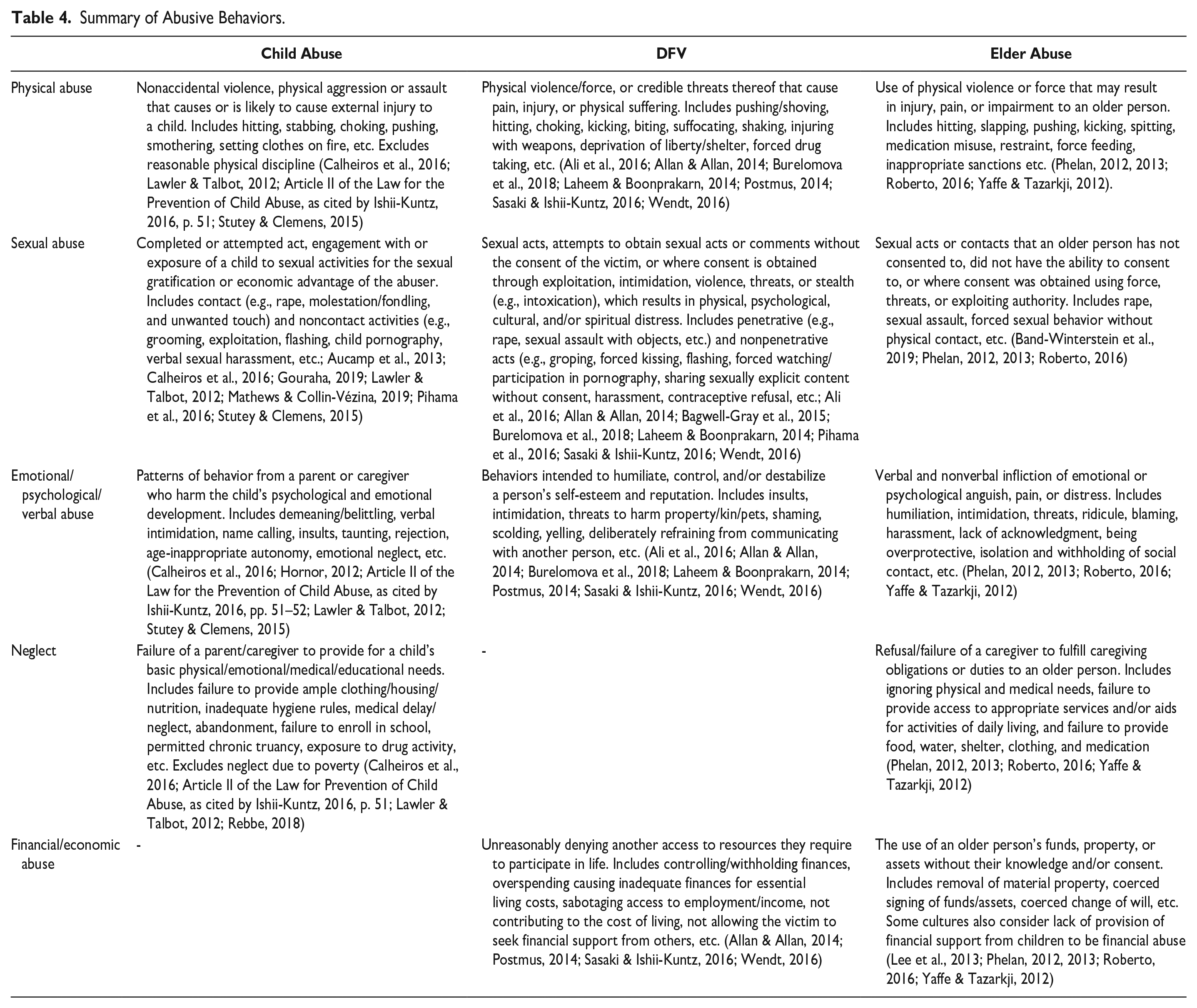
Other violent and abusive behaviors were only included in one of the categories. Six additional abusive behaviors were identified: five from definitions of DFV and one in child abuse. In DFV literature, these were social abuse (tactics used to isolate or prevent a victim from having contact with others outside of the relationship; Allan & Allan, 2014; Sasaki & Ishii-Kuntz, 2016; Wendt, 2016), spiritual abuse (use of the victim’s and/or perpetrator’s religious beliefs to abuse or justify abuse; Allan & Allan, 2014; Gray et al., 2018; Wendt, 2016), legal or administrative abuse (actual or threatened use of the legal system to abuse a victim and/or to affect their ability to practice in their profession; Allan & Allan, 2014), technologically facilitated abuse (tech abuse; the use of technology and digital media to stalk, harass, threaten, control, and abuse partners and/or ex-partners; Harris & Woodlock, 2019; Henry & Powell, 2015; Taylor & Xia, 2018), and reproductive coercion (any behavior that intentionally interferes with reproductive autonomy and decision-making; Tarzia et al., 2019). Importantly, all but one of the articles considered DFV in heterosexual relationships. The sole article that considered DFV in lesbian relationships (Hudson, 2019) critiqued framings of intimate and family relationships in current legislation as heteronormative and unsuitable for LGBTQI+ victim-survivors and perpetrators, but did not explore specific forms of violence that may be perpetrated in these relationships. As such, context-specific forms of DFV such as identity abuse were not included as abusive behaviors. In practice, social abuse is also considered a form of elder abuse (APEA:WA, 2017); however, this was not identified in any of the literature included in the review. Amongst child abuse definitions, exposure of children to DFV was included in more recent literature (Article II of the Law for Prevention of Child Abuse, as cited by Ishii-Kuntz, 2016, p. 51; Postmus, 2014). In the past, this was subsumed within emotional and/or physical abuse. Literature about ATPV did not describe any specific behaviors, and the sole article on sibling abuse framed it as a subcategory of child abuse, and thus referred to the types of behaviors included in this category (Stutey & Clemens, 2015).
There were inconsistencies within the child abuse and DFV literature about how certain abusive behaviors were classified. In child abuse, emotional neglect and threats of harm are classified as both neglect (Rebbe, 2018) and emotional or psychological abuse (Hornor, 2012; Stutey & Clemens, 2015). Rebbe (2018) classified exposure to DFV to be a form of neglect, whereas Postmus (2014) saw this as its own distinct form of abusive behavior. In the DFV sector, there is some overlap between tech abuse and other forms of abuse (e.g., sexual abuse, as both of these include sharing of sexual images/videos with consent; Allan & Allan, 2014; Harris & Woodlock, 2019; Henry & Powell, 2015; Taylor & Xia, 2018). This is because tech abuse is the method through which abuse is perpetrated, rather than the act of abuse itself. There is also an overlap between reproductive coercion and sexual abuse, with multiple authors including refusal to use contraception as a form of sexual abuse (Bagwell-Gray et al., 2015; Sasaki & Ishii-Kuntz, 2016). Tarzia and colleagues (2019) highlighted that reproductive coercion may also occur in relationships where other forms of DFV are not present, and, importantly, distinguished this abusive behavior from other sexual abuse behaviors where pregnancy is not the intention of the perpetrator.
Discussion
Though multiple definitions of child abuse, DFV, elder abuse, and ATPV were identified in the literature, analysis has demonstrated some consensus within categories concerning relationship, behavior, intention, and harm. These defining features have been used as a framework for comparison of the concept of “abuse” across the five categories of family violence (as displayed in Figure 2).
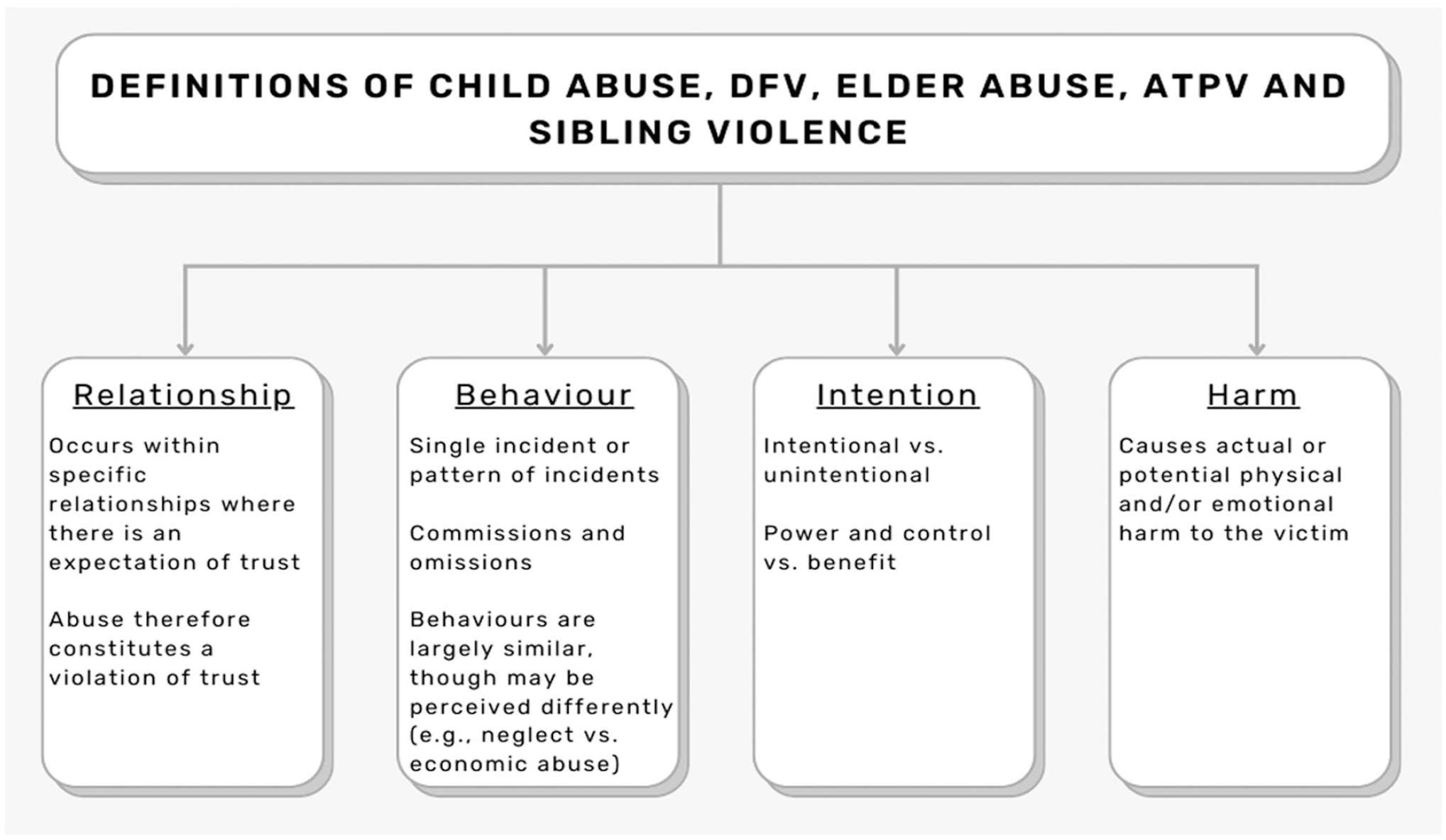
Critical findings: Defining features of abuse definitions.
Relationship
The first defining feature in abuse definitions to consider is the relationship between the victim and the perpetrator. There are some differences in the exact relationships abuse may occur across categories, which are largely associated with the point in the lifespan in which abuse occurs. Child and elder abuse may occur in both familial and nonfamilial caregiving relationships, whereas DFV only occurs in intimate or family relationships and both ATPV and sibling abuse only occur within specific family relationships (from a child to a parent or caregiver, or between minor-aged siblings or stepsiblings, respectively). However, all five categories primarily occur within family and/or intimate relationships, with the perpetrator being someone the victim cares about, who has been given access to deeply personal information about the victim (Allan & Allan, 2014). This information is shared with the expectation of trust. Abuse, therefore, constitutes a violation of that trust. This trust distinguishes family violence from other forms of violence and abuse, such as violence perpetrated by a stranger, in that it heightens victims’ feelings of guilt and shame, which adds a layer of complexity to responding to both the victim and the perpetrator.
Behaviors Defined as Violent and Abusive
The review highlights a set of core behaviors, which are considered abusive, as well as the fact that some forms of violence and abuse are only identified as occurring at particular times during the lifespan. Definitions of child abuse, DFV, and elder abuse overwhelmingly highlight that abuse may be a single incident or a pattern of incidents. Contemporary DFV definitions focus exclusively on patterns of behavior. Focusing on patterns of behavior rather than single incidents means that all abusive behavior is captured. This includes those behaviors which, on their own, may not be considered abusive, but when considered in the context of the relationship, are part of a pattern of coercive control designed to entrap, dominate and control partners (Stark, 2009).
Both child and elder abuse include failures to act (omissions) as well as actions (commissions), whereas DFV, ATPV, and sibling abuse only include commissions. This distinction is also reflected in the types of behavior that are considered abusive, with both child and elder abuse including neglect as a form of abuse. Neglect is the failure to provide necessities and/or fulfill caregiving obligations to another person, and often constitutes omissions, rather than commissions. The concept of neglect is linked to notions of dependence and caregiving, in that a perpetrator can only neglect someone dependent on them for care. If there is no dependence, there can be no neglect, which is why this type of abuse is not included as a form of DFV, as the relationships in which DFV occurs are often thought of as not including the same levels of dependence and obligation to care as the relationships in which child and elder abuse occur. It should be noted that excluding neglect as a form of DFV silences the experiences of people with disability/ies and/or chronic illness who may be dependent on a perpetrator for care, and therefore may experience neglect (Thiara et al., 2011). It also fails to recognize that people without disability or chronic illness may temporarily require care (e.g.,, during pregnancy, or due to injury or sickness), at which time they may be at risk of experiencing neglect. Some of the neglectful behaviors that may be perpetrated toward people with and without disability are captured as economic or financial abuse in DFV, such as denying a partner food or adequate clothing. This fails to consider that the victim may be financially dependent on the perpetrator, in which case the behavior may also constitute neglect.
Financial or economic abuse was only included in the DFV and elder abuse categories, with children generally not owning any funds or assets that can be controlled or misused, and therefore being unable to experience financial abuse as victims. It should be noted that children are able to perpetrate financial abuse against their parents, as reflected in the ATPV literature. Economic abuse behaviors in the DFV category focused more on perpetrators controlling joint funds or assets and preventing acquisition of funds or assets, whereas elder abuse focused more on perpetrators stealing or misusing older people’s funds or assets. This reflects a different fiduciary relationship between victim and perpetrator in DFV, where funds and assets are more likely to be shared or jointly owned, compared to elder abuse, where funds are more likely to be owned solely by the victim. Older people are also less likely to be able to acquire more funds and/or assets through employment. As highlighted in the review findings, physical, sexual, emotional, psychological, or verbal abuse were all included as abusive behaviors in the child abuse, DFV, and elder abuse categories. The types of acts that constitute these behaviors were largely similar.
Intention
Intention is another defining feature of abuse definitions. Both DFV and ATPV are explicitly stated to be deliberately perpetrated and intended to obtain and exert control over the victim, and in the case of DFV, to entrap partners in relationships and make it difficult for them to escape. Sibling abuse is also viewed as intentional behavior, though the intent to control is not considered. Intention is more contested in the elder abuse space, with some definitions only including abuse that is deliberately perpetrated, and others not referring to intention at all. Unlike DFV and ATPV, when elder abuse is deliberately perpetrated, it is more likely to be motivated by some kind of benefit (e.g., convenience, financial benefit, sexual gratification, etc.) rather than a desire for power and control over the older person. Similar benefits may be gained by perpetrators of DFV; however, they are less likely to act abusively solely for their own benefit and more likely to be motivated by a desire for power and control over the victim. Intention was also missing from child abuse definitions. As such, it may be assumed that child abuse includes both intentional and unintentional abuse.
Harm to the Victim
The final key concept in abuse definitions to consider is the harm caused by the abusive behavior. Definitions of abuse across all categories, except for sibling abuse, state that, for behavior to be considered abusive, it must cause actual or potential physical and/or emotional harm to the victim. No explanation or definition of harm was offered in any of the abuse categories, raising questions as to how harm is identified in practice. Control over the victim is also highlighted as an outcome of DFV by Hamberger and colleagues (2017).
Implications
The findings of this review have implications for family violence practice responses, policy, and research (as shown in Table 5). Current child abuse, DFV, and elder abuse service systems are designed to respond to abuse within particular relationships. The child protection and elder abuse systems predominantly work with parent–children relationships (Goldsworthy et al., 2015; Qu et al., 2021), and the DFV sector with heterosexual intimate partner relationships (Malik et al., 2008). However, as demonstrated by this review, violence and abuse occurs within a range of family relationships across the lifespan. Thus, there is an incongruence between the ways in which family violence across the lifespan is conceptualized in literature and the ways in which it is conceptualized and responded to in practice. Furthermore, the ability of the service system to be responsive to violence that occurs in other relationships (e.g., from siblings or adolescent children) is diminished.
Practice, Policy, and Research Implications.
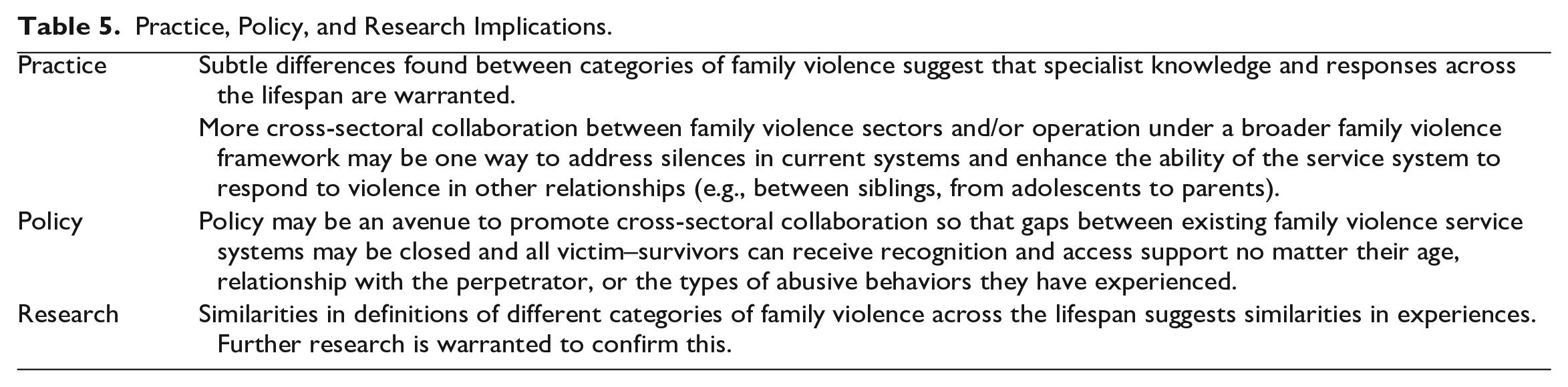
This study found some subtle differences between categories of abuse that warrant specialist knowledge and responses. However, the similarities found between conceptualizations suggests that family violence is largely the same phenomenon, regardless of when it is experienced across the lifespan. Further research is warranted to confirm this. Bringing these sectors together and operating under a broader family violence framework in both policy and practice domains may be one way to address current silences in service systems, though consideration as to how best to do this while also preserving specialist knowledge is warranted.
Conclusion
Literature review findings highlight that there are considerable similarities in how abuse in intimate and family contexts is defined at various ages and from various perpetrators. A comparison of definitions found consistencies in the types of relationships abuse occurs in, the types of behaviors considered abusive (though these may be perceived differently across sectors), and the resulting harm these behaviors cause to the victim. There were some differences across categories as to whether abuse is limited to patterns of behavior, rather than single incidents, as well as whether both intentional and unintentional behaviors are included. Also important to consider is whether abuse is motivated by a desire for power and control, as is often seen in DFV and ATPV, or motivated by a potential benefit gain, as more commonly seen in elder abuse.
Regardless of these distinctions between categories, family violence can be broadly defined as any violent incident or pattern of incidents, which includes both actions and failures to act, perpetrated by a family member or intimate partner, which causes or has the potential to cause physical and/or emotional harm to the victim. Though understandings of how abuse may operate differently across the lifespan are critical, the similarities between definitions of these categories of abuse, particularly the types of abusive behaviors included, raises a question as to whether experiences of abuse are also similar at various stages in the lifespan, and thus whether policy and practice responses to both victims and perpetrators of abuse at these stages should also be similar. As such, further research in this area is warranted.
Limitations
Most articles included in this review were from research in the Global North, such as North America, the United Kingdom, Australia, and New Zealand (n = 39). As only a small number of articles from developing countries were included (n = 9), cultural nuances in definitions of abuse were not able to be captured. Only one of the articles which considered DFV did so in the context of same-sex relationships, as such the unique abuse experiences of LGBTQI+ victim-survivors (such as identity abuse) were also not captured. There were a number of articles (n = 38) that were not able to be sourced by the researchers and were thus excluded from the review. As such, it is possible that there may be some aspects of violence and abuse that are absent from the findings. Another limitation of the review is that hand searching, as prescribed by the Arksey and O’Malley (2005) method, was not able to be conducted, due to the large volume of literature yielded through database searching.
Footnotes
Declaration of Conflicting Interests
The authors declared no potential conflicts of interest with respect to the research, authorship, and/or publication of this article.
Funding
The authors disclosed receipt of the following financial support for the research, authorship, and/or publication of this article: This research was supported by an Australian Government Research Training Program (RTP) Scholarship.
