



Abstract
This literature review focused on homicide bereavement (HB) risk factors. A content analysis was conducted on 83 empirical papers published in English from January 2000 to December 2021 in peer-reviewed journals. Extracted HB risk factors were synthesized according to six main dimensions: individual level; situational homicide-related factors; and micro, meso, exo, and macro social levels. The review demonstrates that macro-level and situational homicide-related risk factors are in special need of further study. In addition, how HB risk factors interact with one another to influence HB also requires further study. Future research may benefit from examining whether and how individuals experiencing HB influence related factors at various social levels. Last, given that almost all reviewed studies were conducted in Western societies, the sociocultural and ethnic diversity in HB risk factors is in dire need of future study.
Contextualizing Homicide Bereavement
The study of homicide bereavement (HB)—that is, grief stemming from the loss of a loved one in violent criminal circumstances—is closely related to growing interest in the field of secondary victims. Until recent decades, the basic criminal typology focused on perpetrators and direct victims alone. As the field advanced, the notion of victimhood has expanded, along with the recognition that a crime’s reach goes beyond direct and immediate victims and has ramifications of great relevance to the victims’ relatives (Condry, 2010). With time, the conceptualization and integration of secondary victims into the study of criminal effects has been substantiated. One such substantiation regarding the relevance and importance of secondary victims pertains to homicide’s secondary victims.
Indeed, if asked about secondary victims, the group that often first comes to mind for most people is relatives of homicide victims (Rock, 1998). Homicide secondary victims can include the victim’s children, siblings, parents, other family members, and friends who are left to cope with the trauma and aftermath of the homicide. Overall, these secondary victims may suffer more than individuals experiencing other forms of bereavement (Connolly & Gordon, 2015), and the repercussions of such suffering for their and their families’ well-being are not negligible.
Compared to people experiencing non-HB, those experiencing HB suffer from more frequent, severe, and complex posttraumatic stress disorder (PTSD) and other pathogenic psychological effects such as complicated grief, behavioral changes, and negative emotional reactions (e.g., Armour, 2002; Rando, 1996; Redmond, 1996; Rynearson & McCreery, 1993; Spungen, 1998). Such effects may include feelings of rage, guilt, blame, reoccurring dreams or thoughts about the event or homicide victim, memory loss, sleep problems, and a lack of interest in important life activities (e.g., Janoff-Bulman, 1992; Rando, 1993; Rynearson & McCreery, 1993; Spungen, 1998). Realizing the immense devastation that homicide inflicts on the victim’s relatives, victimology theories have gradually transformed their approach toward such victims, reconceptualizing them from “relatives” to “co-victims” and “murder survivors” (Connolly & Gordon, 2015, p. 494).
Secondary victims are forced to restructure their lives amid damage to their and their family’s mental, social, financial, and physical health (e.g., Huggins & Hinkson, 2022; Huggins et al., 2020; Levy & Wall, 1996; Malone, 2007; Paterson et al., 2007). These secondary victims experience bereavement in a significantly different way because they need to attend to a sudden and unexpected death (e.g., Dyregrov et al., 2016; Johnsen & Dyregrov, 2016; Malkinson et al., 2005; Pfeffer et al., 2007). Furthermore, they are often left fearful of and disenchanted with a dreadful world, and they need to deconstruct and constantly reconstruct the meaning of their loss (e.g., King, 2004; Mahat-Shamir & Leichtentritt, 2016; Miller, 2009; Pitcho-Prelorentzos et al., 2021). Moreover, their grieving is complicated by the tormenting visualization of the brutal and horrifying way their loved one was killed (e.g., Malkinson et al., 2005; Miller, 2009; Rynearson & McCreery, 1993; Spungen, 1998; Witztum et al., 2016). In addition, and in contrast to those experiencing non-HB, they are often compelled to supervise criminal proceedings to ensure that justice, however meager and postmortem, is achieved for their loved one (e.g., Adkins, 2003; Clements & Vigil, 2003; Dawson & Riches, 1998). They may also need to seek compensation for their injuries, face social stigma regarding the criminal circumstances by which they lost their loved one, and more (e.g., Hinkson et al., 2020; Huggins et al., 2020; Sharpe & Boyas, 2011). Often, such complicated circumstances of grief linger for the rest of their lives (e.g., Boelen & Prigerson, 2007; Silverman et al., 2000) and can have dire consequences for their occupational and educational careers, affect their ability to produce income, and impede their family’s and close friends’ well-being (e.g., Buzzi & DeYoung, 2003; Charmaine & Mahoney, 2004; Clements & Vigil, 2003; Evans et al., 2002; Miller, 2009).
Indeed, psychological and psychiatric studies have confirmed the existence of an array of pathogenic effects of bereavement—such as trauma, PTSD, complicated grief, prolonged grief disorder, anxiety, depression, anger, and irritability—including for people experiencing HB, albeit with much greater severity (e.g., Burke & Neimeyer, 2014; Douglas et al., 2021; Kaltman & Bonanno, 2003; Kaplow et al., 2021; Morall et al., 2011; Neimeyer & Burke, 2017; Powell et al., 2010; Tasker & Wright, 2020). Conducted among mixed samples of individuals experiencing HB and other forms of bereavement, with the exception of Tal et al. (2017), studies substantiated and validated observations pertaining to the increased pathogenic effects of HB (Burke & Neimeyer, 2014; Douglas et al., 2021; Hinkson et al., 2020; Kaltman & Bonanno, 2003; Kaplow et al., 2021; Lenferink, de Keijser, et al., 2017; Lenferink, van Denderen, et al., 2017; Matthews & Marwit, 2004; Miller, 2009; Morall et al., 2011; Neimeyer & Burke, 2017; Powell et al., 2010; Rheingold & Williams, 2015; Rheingold et al., 2012; Tasker & Wright, 2020; van Denderen et al., 2016; Varga et al., 2020). Scholars conducting studies on HB’s mental health’ report that PTSD symptoms among individuals experiencing HB seem to be more persistent and lingering than PTSD symptoms among non-HB grieving individuals (van Wijk et al., 2017; Williams et al., 2012; Zinzow et al., 2009, 2011) and that these individuals tend to increase their use of prescribed psychotropic medication (Mezey et al., 2002) and substance abuse (Englebrecht et al., 2016; Kaplow et al., 2021). In addition, studies have reported the more complex path of meaning reconstruction that individuals experiencing HB face amid their loss (Armour, 2003; Bellet et al., 2019; Lichtenthal et al., 2013; Mahat-Shamir & Leichtentritt, 2016; Pitcho-Prelorentzos et al., 2021).
Previous reviews dealt with various aspects of HB, such as coping strategies (Edwards et al., 2021), prevalence of pathogenic symptoms (Djelantik et al., 2020), effects of homicide on victims’ families (Connolly & Gordon, 2015; da Costa et al., 2017), children’s HB (Alisic et al., 2015; Menezes & Borsa, 2020), interventions for HB treatment (Alves-Costa, Hamilton-Giachristis, Christie, et al., 2021; Pastrana et al., 2022), and the influence of informal support on HB (Scott et al., 2020). Given the noted gravity of HB and the fact that its risk factors have yet been systematically reviewed, this paper aimed to contribute to current knowledge on HB risk factors, that is, antecedents that might have a causal role in the increase in homicide survivors’ risk for developing severe posttraumatic sequelae. In addition, this paper aimed to identify potential gaps in HB risk factors, requiring further research. As Table 1 demonstrates, most prior empirical studies on HB have not focused specifically on HB risk factors. Therefore, this review extracted reported HB risk factors and synthesized them into a six-dimension corpus of knowledge consisting of six main levels that need to be examined when exploring and examining human phenomena and behavior. As the results demonstrate, the multilevel synthesis of empirical findings identified a main gap in current knowledge pertaining to how situational factors—that is, homicide-related factors—possibly increase or decrease a homicide survivor’s risk of developing posttraumatic sequelae.
Characteristics of the Reviewed Papers.
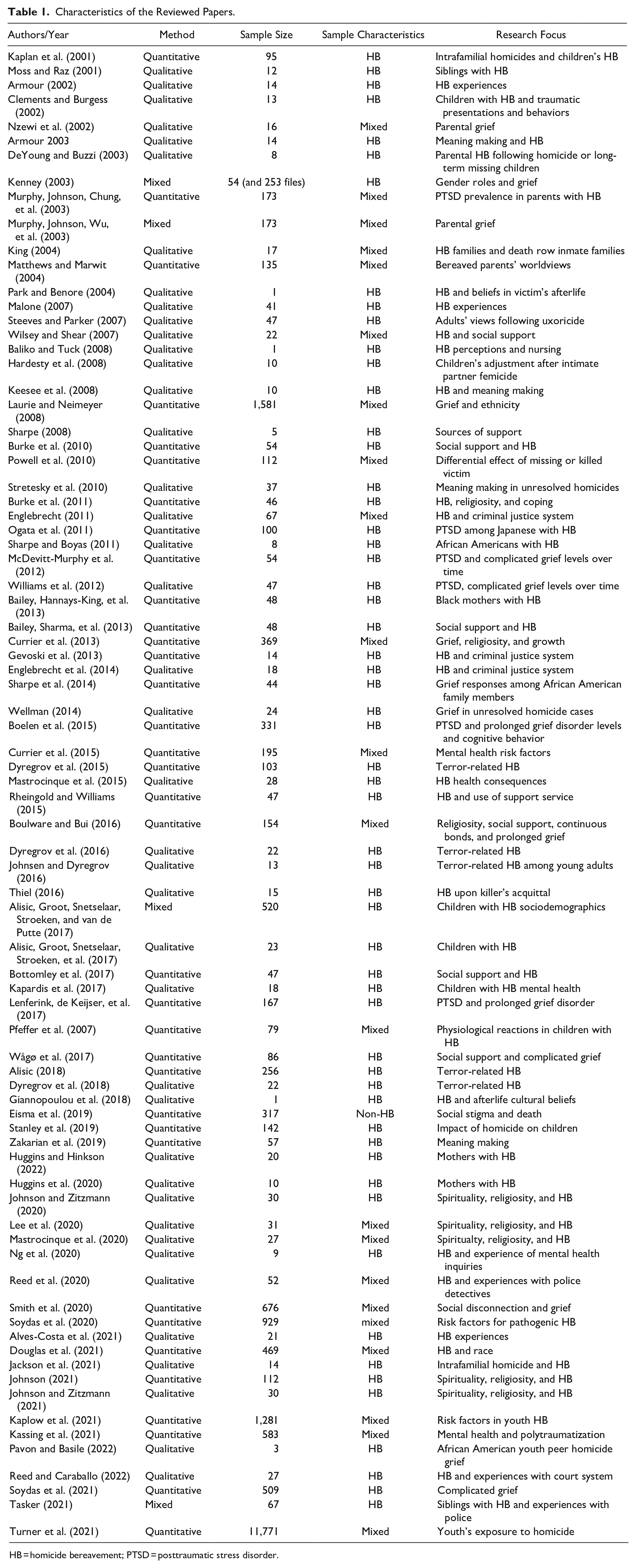
HB = homicide bereavement; PTSD = posttraumatic stress disorder.
Method
The literature review’s inclusion criteria were empirical research reporting identified risk factors for HB. The search included empirical research papers using quantitative, qualitative, and mixed methods. The search excluded papers focusing on death as a result of suicide, automobile or other accident, or medical negligence. Given that empirical studies on HB started in the 1990s (Armour, 2002) and a surge of empirical studies began in 2000 (Connolly & Gordon, 2015), this review was limited to empirical papers published in English from January 2000 to December 2021 in peer-reviewed journals.
Bronfenbrenner’s (1995, 2005) ecological model was used as a framework for synthesizing the various HB risk factors. The choice to use this model stems from the fact that this multilevel socioecological framework of analysis proved fruitful when analyzing a crime’s risk factors (Collin-Vézina et al., 2015; Harvey, 2007; Hong et al., 2012; McClaren & Hawe, 2005; Refaeli et al., 2019; Stout, 1992) and its effects on victims (Campbell et al., 2009; Neville et al., 2004). Bronfenbrenner’s (1995, 2005) conceptualization identifies four main interrelated social systems that an individual is both influenced by and influences micro, meso-, exo-, and macro-systems. The microsystem includes a person’s immediate situation—that is, other persons with whom individuals interact in a face-to-face manner in their immediate setting, such as close family. The mesosystem refers to linkages or overlap between settings in which an individual participates, such as school, workplace, or community. The exosystem refers to linkages between settings such as local politics, medical coverage, legal system, police forces, and so forth. The macrosystem is the overarching system that includes societal norms, values, expectations, beliefs, ideologies, and organizations that characterize a given society or social group.
To these four social levels, the review added two additional levels: the individual level and the situational homicide-related factors level. The individual level was included due to the review topic dealing with the nature of HB experienced by individuals. The situational level was added due to criminological research noting the link between characteristics of a crime and its effects on the victim (Campbell et al., 2009). In addition and given the salience of ethnicity in crime diversity (Dayan, 2022; Dayan et al., 2022), the review included ethnicity as a relevant social factor at both the individual and macro social levels. Consequently, the review synthesized HB risk factors into six main dimensions: individual level; situational homicide-related factors; and micro, meso, exo, and macro social levels.
The following databases were used for the literature search: Google Scholar, Medline, Proquest, PubMed, Sociological Abstracts, and PsycInfo. Systematic reviews were excluded but their references were screened. Keywords and search terms used included “grief” OR “bereavement” OR “loss of a loved one” OR “traumatic grief” OR “traumatic bereavement” AND “homicide” OR “murder” OR “killing” OR “violent death” OR “criminal death” OR “terror attack” OR “survivors” OR “co-survivors” OR “secondary victims” OR “family” OR “family member” OR “sibling” OR “homicide victims’ families” OR “children” OR “parents.” Altogether, 159 papers were identified through the search.
Next, the 159 identified papers were distributed among two independent trained research assistants (RAs) and were subjected to title, abstract, and method screening to verify potential inclusion as an empirical paper dealing with HB. The author resolved disagreements between the two RAs. In all, 55 papers that did not meet this inclusion criterion were excluded. Despite focusing on HB, these papers did not report empirical findings on HB risk factors or were reviews; conceptual model, reflective, or interpretive papers; or papers evaluating HB therapy, interventions, or research tools and methods.
Next, the remaining 104 empirical papers on HB were distributed among the two independent trained RAs and subjected to results screening to identify potential inclusion as papers reporting on HB risk factors. In total, 21 papers that did not meet this inclusion criterion were excluded. Despite being empirical studies on HB, these papers did not report findings on HB risk factors. In cases of doubt pertaining to a paper reporting an identified HB risk factor, the paper’s method, results, and discussion were read by the author to verify inclusion criteria.
Next, 83 papers that met the inclusion criteria (i.e., an empirical paper on HB that reported an HB risk factor) had their full text screened independently by the two RAs. The two RAs extracted data from the relevant papers, combining the data into a spreadsheet. Extracted data included authors, year of publication, method (quantitative or qualitative), sample size, sample characteristics (HB or mixed), research focus, reported HB risk factor, and risk factor social level (individual, situational homicide-related factor, micro, meso, exo, macro). The author resolved disagreements between the extracts of the two independent RAs. As Table 1 demonstrates, except for three papers (Currier et al., 2015; Kaplow et al., 2021; Soydas et al., 2020), most reviewed studies focused not on HB risk factors but rather on other topics related to HB. Thus, most reported HB risk factors were incidental to the topic of the reviewed studies. About half of the reviewed studies used qualitative methods (n = 41), and about a third (n = 29) of the studies involved small samples of convenience (n = 1–24).
Results
The results describe HB risk factors as extracted and synthesized according to six main dimensions: individual level; situational homicide-related factors; and micro, meso, exo, and macro social levels.
Individual Level
Studies focusing on the individual level noted the following HB risk factors: prior mental health or emotional fluctuation (Alves-Costa, Hamilton-Giachritsis, & Halligan, 2021; Soydas et al., 2020; Williams et al., 2012); immigration (Alisic, Groot, Snetselaar, Stroeken, & van de Putte, 2017); prior health or physical problems (Currier et al., 2015; Soydas et al., 2020; Williams et al., 2012); low socioeconomic status (Douglas et al., 2021); belonging to an ethnic or racial minority (Douglas et al., 2021; Kaplow et al., 2021; Kassing et al., 2021; Keesee et al., 2008; McDevitt-Murphy et al., 2012; Williams et al., 2012); prior victimization or stressful life events (Douglas et al., 2021; Kassing et al., 2021; Park & Benore, 2004; Soydas et al., 2021); female gender, with mothers and sisters grieving more intensely over time than fathers and brothers (Dyregrov et al., 2015; Kaplow et al., 2021; Kassing et al., 2021; Soydas et al., 2020, 2021); and being younger (Murphy, Johnson, Wu, et al., 2003; Pfeffer et al., 2007; Stanley et al., 2019). Additional HB risk factors noted as having more pathogenic effects include negative cognitions (Alves-Costa, Hamilton-Giachritsis, & Halligan, 2021; Bailey, Sharma, et al., 2013; Boelen et al., 2015), attachment anxiety and avoidance (Currier et al., 2015), a sense of social disconnection (Smith et al., 2020), lesser ability to construct meaning (Zakarian et al., 2019), and low level of spirituality and religiosity (Boulware & Bui, 2016; Burke et al., 2011; Currier et al., 2013; Johnson, 2021; Johnson & Zitzmann, 2020, 2021; Lee et al., 2020; Mastrocinque et al., 2020).
Situational Level: Homicide-Related Factors
Various studies have indicated that a homicide’s characteristics have an influence on HB. The following homicide-related factors have been reported as HB risk factors: close familial relations with the victim (Alisic, 2018; Alves-Costa, Hamilton-Giachritsis, & Halligan, 2021; Johnsen & Dyregrov, 2016; Kaplow et al., 2021; Matthews & Marwit, 2004; Moss & Raz, 2001; Ogata et al., 2011; Soydas et al., 2020); close domestic relations with both the victim and killer (Alisic, 2018; Alisic, Groot, Snetselaar, Stroeken, & van de Putte, 2017; Clements & Burgess, 2002; Hardesty et al., 2008; Kapardis et al., 2017; Kaplan et al., 2001; Stanley et al., 2019; Steeves & Parker, 2007); continuing bonds with victim (Moss & Raz, 2001); the killer being the bereaved person’s parent (Kapardis et al., 2017); interfamilial homicide (Jackson et al., 2021); the victim and bereaved person belonging to a racial minority (Douglas et al., 2021; Kaplow et al., 2021; Kassing et al., 2021; McDevitt-Murphy et al., 2012; Williams et al., 2012); being the parent of a child who was killed at a young age (Matthews & Marwit, 2004; Murphy, Johnson, Chung, et al., 2003; Murphy, Johnson, Wu, et al., 2003; Nzewi et al., 2002); the homicide scene being the bereaved person’s home (Alisic, Groot, Snetselaar, Stroeken, et al., 2017; Alisic, Groot, Snetselaar, Stroeken, & van de Putte, 2017); children hearing or witnessing the killing (Clements & Burgess, 2002); the homicide resulting in multiple victims (Huggins & Hinkson, 2022; Kaplow et al., 2021; Lenferink, de Keijser, et al., 2017); the homicide being related to terror circumstances (Dyregrov et al., 2016; Johnsen & Dyregrov, 2016; Pfeffer et al., 2007); the killer’s criminal process resulting in acquittal (Thiel, 2016); and the killing being an unresolved homicide, known as a cold case (DeYoung & Buzzi, 2003; Huggins & Hinkson, 2022; Keesee et al., 2008; Powell et al., 2010; Stretesky et al., 2010; Wellman, 2014). Studies also reported the victim’s engagement in crime or the victim or killer having a mental health disorder as a risk factor for HB social stigma (Bailey, Hannays-King, et al., 2013; Eisma et al., 2019; Huggins et al., 2020; Ng et al., 2020; Sharpe et al., 2014).
At the same time, several studies reported mixed findings when comparing HB stemming from manslaughter or murder (Alves-Costa, Hamilton-Giachritsis, & Halligan, 2021) or when HB-related PTSD symptoms were compared to the manner of death (Ogata et al., 2011; Soydas et al., 2020). Despite mixed findings in some studies, research on homicide-related factors seems to suggest a link between the manner of homicide and an individual’s HB.
Micro-Level
Studies examining this social level all validated the importance of family support to an individual’s ability to cope with HB and suffer less from its pathogenic effects (Bottomley et al., 2017; Boulware & Bui, 2016; Burke et al., 2011; Jackson et al., 2021). More studies seem to be needed to explore the link between family structure (like single-parent families) and an individual’s ability to cope with HB.
Meso-Level
Studies examining the effect of social factors at the meso-level, such as peers, school, neighborhood, and community, emphasized the importance of social support in these networks to an individual’s ability to cope with HB (Bailey, Hannays-King, et al., 2013; Bottomley et al., 2017; Burke et al., 2010; Dyregrov et al., 2018; Sharpe, 2008; Turner et al., 2021; Wilsey & Shear, 2007). This pattern seems to echo findings from micro-level studies stressing the importance of social support to an individual’s ability to cope with HB’s pathogenic effects.
Exo-Level
Studies on this social level explored both informal social institutions (such as media coverage and victim support organizations) and formal social institutions (such as medical personnel, police forces, health and welfare departments, and legal procedure representatives). The studies reported recurring secondary victimization in the bereaved person’s interactions with both formal and informal institutions, which add further complexity to their challenge of coping with HB. This secondary victimization seems to stem from experiencing insensitive and unsupportive interactions with exo-level institutions, leaving the bereaved individuals feeling marginalized, stigmatized, and lonely (Alves-Costa, Hamilton-Giachritsis, & Halligan, 2021; Armour, 2002; Eisma et al., 2019; Englebrecht, 2011; Englebrecht et al., 2014; Gevoski et al., 2013; Huggins & Hinkson, 2022; King, 2004; Malone, 2007; Mastrocinque et al., 2015; Ng et al., 2020; Reed & Caraballo, 2022; Reed et al., 2020; Stretesky et al., 2010; Tasker, 2021; Thiel, 2016). In addition, and similar to micro and meso studies reporting the importance of social support, exo-level studies also noted the importance of social support in both informal and formal institutions to an individual’s ability to cope with HB (Alves-Costa, Hamilton-Giachritsis, & Halligan, 2021; Bailey, Sharma, et al., 2013; Bottomley et al., 2017; Douglas et al., 2021; Wågø et al., 2017).
Macro-Level
Studies focusing on the influence of macro-level social factors reported the importance of HB’s alignment with sociocultural perceptions, assumptions, and expectations (Baliko & Tuck, 2008; Pavon & Basile, 2022). People experiencing HB who do not live up to sociocultural expectations regarding grief are prone to social sanctions and marginalization (Armour, 2002, 2003; Johnsen & Dyregrov, 2016; Laurie & Neimeyer, 2008). A similar effect was noted regarding bereaved individuals who do not behave according to accepted and expected grief-related coping strategies (Sharpe & Boyas, 2011; Sharpe et al., 2014). An additional sociocultural macro-level risk factor pertained to individuals experiencing HB who believe in an afterlife and the continuation of their relationship with the dead victim (Giannopoulou et al., 2018; Park & Benore, 2004). Macro-level studies also noted the special burden of gendered social norms, whereby men are marginalized if breaching expectations to grieve less and women are socially sanctioned and marginalized if breaching expectations to suffer from never-ending grief (Kenney, 2003).
In addition to the powerful influence of sociocultural expectations on people experiencing HB, several studies noted the influence of ethnicity and race on an individual’s HB. Belonging to a socially discriminated and marginalized ethnic or racial minority was reported to be an HB risk factor (Pavon & Basile, 2022; Stretesky et al., 2010). These studies linked racial or ethnic minority status as an HB risk factor to the recurring secondary victimization bereaved people face from society and support systems (Burke et al., 2010; Hinkson et al., 2020; Huggins et al., 2020; Laurie & Neimeyer, 2008; Sharpe, 2008; Sharpe & Boyas 2011; Sharpe et al., 2014) (Table 2).
HB Risk Factors by Social Levels.
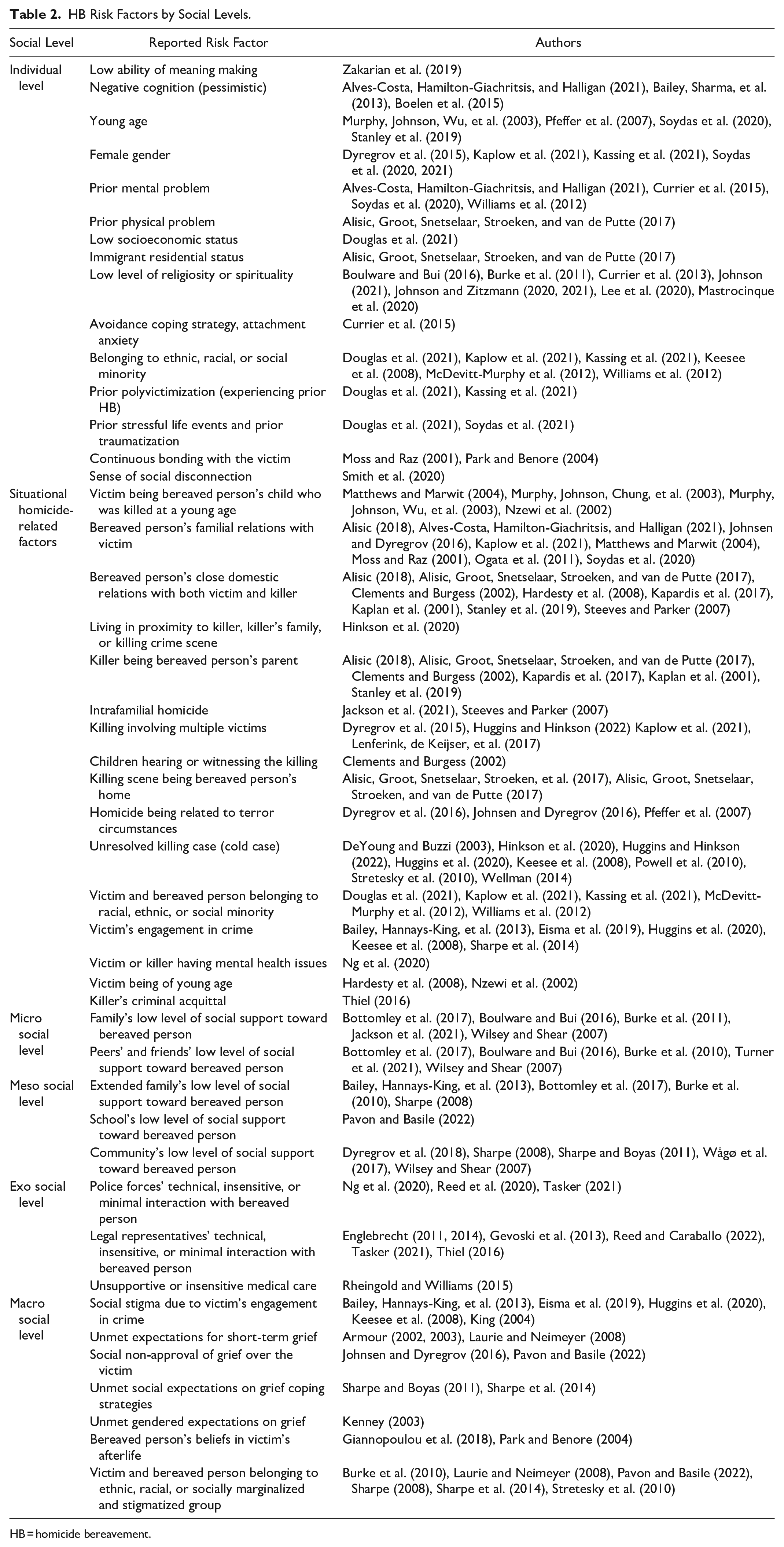
HB = homicide bereavement.
Discussion
Most studies so far were conducted on the individual level, and fewer were conducted on all other five dimensions: situational and micro, meso, exo, and macro social levels. There seems to be a particular need for further study of possible HB risk factors at the macro-level and situational homicide-related factors level. Situational risk factors related to homicide seem to be especially in need of future research. Such research is particularly needed given that criminological researchers have noted the link between characteristics of a crime and the effects on the victim (Campbell et al., 2009). For example, in the realm of sexual crimes, scholars have noted differential pathogenic effects on the victims, depending on the criminal aspects of the crime. Thus, sexual crimes committed by close family members are noted as more detrimental than nondomestic sexual crimes (Edwards & Donalson, 1989). Similarly, sexual crimes committed at a younger age seem especially detrimental and prone to causing complex trauma and PTSD (Kinzl & Wilfried, 1992), as are recurring and repetitive sexual crimes perpetrated by one offender (Edwards & Donalson, 1989; Kinzl & Wilfried, 1992). Thus, it is plausible that homicide’s particular criminal characteristics influence HB.
Further examination of possible situational homicide-related risk factors may include the killing weapon; aggravating circumstances (such as brutality); crime scene (other than the bereaved person’s home); bereaved–killer relations (other than the intrafamilial generic category); bereaved–victim relations; killer’s and victim’s sociodemographic characteristics (age, race, ethnicity, gender, education, social stratum, and so forth); killing motive (other than intimate partner homicide); killer’s mens rea (mental intention, e.g., murder, manslaughter, involuntary manslaughter, reckless manslaughter); killer’s mitigating factors (mental health problems, self-defense, provocation, intoxication, young age); killer committed suicide; bereaved witnessed the killing; bereaved tried to assist the victim; bereaved survived a homicide attempt; bereaved testified in police investigations or criminal procedures; and with the exception of the killer’s criminal acquittal, which has already been identified and reported, factors related to the nature of the criminal procedure (charges, conviction, sentence, appeal).
Also, macro-level HB risk factors seem to need further research. Studies may benefit from including factors such as macro-politics; type of regime; intersocietal or intrasocietal social, racial, or ethnic conflicts; nature of social stratification; legislation; victims’ rights and compensation policies; social assumptions regarding sexual orientation; and cultural dimensions (individualist or collectivist).
Although previous research offered both qualitative and quantitative insights on HB risk factors, most studies focused on a particular social level of analysis. A multilevel framework of analysis integrating risk factors from various social levels would assist in disentangling how various factors from different social levels interact to produce homicide-related distress. For example, situational factors related to terror attacks may result in more pathogenic HB both for being terror-related homicides (Dyregrov et al., 2016; Johnsen & Dyregrov, 2016; Pfeffer et al., 2007) and for resulting in multiple victims (Dyregrov et al., 2015; Huggins & Hinkson, 2022; Kaplow et al., 2021; Lenferink, de Keijser, et al., 2017). However, a multilevel framework of analysis integrating HB macro-level factors, in the Israeli context for example, would possibly suggest that terror-related homicide factors may result in lesser levels of pathogenic HB. Such lower HB pathogeny may be moderated by Israeli cultural notions of the Israeli–Arab conflict and its resulting homicides, which are particularly significant, socially supported, and appraised in the collective consciousness (Malkinson et al., 2005; Witztum et al., 2016). This social support may interact with additional social factors such as positive media coverage, greater legal victims’ rights, greater financial compensation, sensitive and positive experiences with police, legal authorities, medical services, social support groups, and so forth—which may all moderate terror-related HB pathogeny.
Another example demonstrating the importance of examining the interactions between various HB risk factors and their influence on HB pertains to female honor killing. HB related to the killing of a woman for alleged breach of family honor may be an amalgam of HB risk factors moderated by sociocultural norms and assumptions related to such killings. Based on the literature on female honor killings (Chesler, 2010; Dayan, 2021; Kressel, 1981), these homicides tend to be perpetrated by the victim’s agnatic family members, who often plan the killing ahead with the aid of several co-offenders. In these circumstances, female honor killings may have greater pathogenic effects on victim’s parents or siblings due to the following factors: close familial relations with the victim (Alisic, 2018; Alves-Costa, Hamilton-Giachritsis, & Halligan, 2021; Johnsen & Dyregrov, 2016; Kaplow et al., 2021; Matthews & Marwit, 2004; Moss & Raz, 2001); close domestic relations with both the victim and killer (Alisic, 2018; Alisic, Groot, Snetselaar, Stroeken, & van de Putte, 2017; Clements & Burgess, 2002; Hardesty et al., 2008); the killing being intrafamilial (Jackson et al., 2021; Steeves & Parker, 2007); the killing scene being in their home (Alisic, Groot, Snetselaar, Stroeken, et al., 2017; Alisic, Groot, Snetselaar, Stroeken, & van de Putte, 2017); and the social disapproval of grief (Johnsen & Dyregrov, 2016; Pavon & Basile, 2022), which in this case pertains to grief over a victim who allegedly tarnished the family’s honor. On the other hand, given that these killings tend to align with cultural expectations relating family honor (Chesler, 2010; Dayan, 2021; Hasan, 2002), community social support extended to these families may moderate the pathogenic effects of HB on these families.
An additional gap in current knowledge on HB risk factors pertains to the exploration of possible influences of an individual’s HB on multilevel-related factors. Most studies reviewed in this paper explored the influence of certain factors on an individual’s HB. The only exception to this framework of analysis pertained to studies at the individual level, which examined both how HB influences an individual, and how individual characteristics, such as gender, age, economic status, negative and pessimist world view, social disconnection, attachment anxiety, prior mental health problems, and so forth, influenced the nature and severity of their HB. This mode of influence on HB’s pathogeny is worthy of study at the micro, meso, exo, and macro social levels, too. For example, certain HB individuals may elicit meso-level changes in schools and workplaces. Furthermore, at times, certain HB individuals may mobilize social action and changes in exo-level social institutions such as local politics, police forces, media, and legal institutions. Sometimes, certain HB individuals may even trigger macro-level social changes pertaining to ethnic and racial conflict, victims’ rights, crime prevention, and legislation. Such future exploration may further our understanding of the complex and possible dyadic influences of various multilevel social factors and HB.
Last but not least, current knowledge would benefit from studies exploring diversity in HB risk factors. With the exception of Ogata et al.’s (2011) study in Japan and Huggins and Hinkson’s (2022) and Huggins et al.’s (2020) studies in Trinidad, empirical studies on HB predominantly have been conducted in Western countries, mainly across the United States and Europe. The Western inclination of these studies renders the generalizability of identified HB risk factors questionable. This is because as with all human phenomena, including HB risk factors, sociocultural, and ethnic diversity prevails. Consequently, HB risk factors identified thus far may not be generalizable to individuals experiencing HB in non-Western societies.
Preliminary observations on HB risk factors’ diversity can be extrapolated from several of the reviewed studies. For example, intrasocietal diversity in HB risk factors was noted in relation to age, with younger children suffering from more pathogenic HB (Kapardis et al., 2017; Murphy, Johnson, Wu, et al., 2003; Pfeffer et al., 2007); gender, with mothers and sisters tending to suffer greater HB pathogeny than brothers and fathers (Dyregrov et al., 2015; Kaplow et al., 2021; Kassing et al., 2021; Soydas et al., 2020, 2021); residential status, with immigrants’ tending to suffer from greater pathogenic HB (Alisic, Groot, Snetselaar, Stroeken, & van de Putte, 2017); socioeconomic status, with low status tending to generate greater pathogenic HB (Douglas et al., 2021); and being a member of an ethnic, racial, or social minority, with reports on such individuals’ tendency to suffer greater HB pathogeny (Douglas et al., 2021; Kaplow et al., 2021; Kassing et al., 2021; McDevitt-Murphy et al., 2012; Williams et al., 2012). Additional intrasocietal diversity may be extrapolated from Black Americans’ predisposition to opt for informal social support systems when experiencing HB (Sharpe & Boyas, 2011). Such cultural tendency implies that circumstances lacking informal social support might exacerbate HB pathogeny among Black Americans. Lack of social support also might be related to intersocietal diversity pertaining to gender minorities. How gender minorities experience HB lacks empirical study and is in need of further research.
In addition to these observations and extrapolations on intrasocietal diversity in HB risk factors and given scholars’ attestation to the crucial link between HB risk factors and macro sociocultural norms and expectations (Armour, 2002, 2003; Johnsen & Dyregrov, 2016; Laurie & Neimeyer, 2008; Pavon & Basile, 2022; Sharpe & Boyas, 2011; Sharpe et al., 2014), reports on intersocietal diversity across societies and cultures should come as no surprise. For example, contrary to findings in Western societies reporting greater pathogenic effects among grief related to homicide, Ogata et al. (2011) noted that in Japan, HB may occur irrespective of the manner of death, because any unusual loss of a Japanese family member can remind surviving members of the traumatic event (p. 532).
Huggins and Hinkson (2022) and Hinkson et al. (2020) noted additional intersocietal diversity in HB risk factors in their studies on HB in Trinidad. These studies’ findings suggest that Trinidad’s small size and tight-knit society may act as HB risk factors due to publicity regarding the homicide, which can be “followed by an involuntarily ‘disaster identity’” whereby HB is forever associated with death (Huggins & Hinkson, 2022, p. 919). According to Hinkson et al. (2020), Trinidad’s small size may add excess pain to mothers experiencing HB, because in a small island state where poorer communities are cramped and densely populated, mothers of victims and killers may live in close proximity. Consequently, such mothers might have daily encounters with the killer’s family or crime scene where their child was killed, or even worse, the killer. The risk of frequent encounters with the killer is all the more probable in Trinidad due to its high rate of unsolved homicide cases (Hinkson et al., 2020; Huggins & Hinkson, 2022; Huggins et al., 2020), which as noted, is in and of itself, an HB risk factor (DeYoung & Buzzi, 2003; Keesee et al., 2008; Powell et al., 2010; Stretesky et al., 2010; Wellman, 2014). The pain related to unresolved homicide cases might be all the more accentuated in Trinidad, given its historic roots and culture steeped in colonialism and slavery. According to Hinkson et al. (2020), “for Blacks who have experienced the historical trauma of slavery and have had the unanswered questions of missing family members, this pain is intense and can permeate all aspects of their lives including child rearing of the remaining children” (p. 413).
Further diversity in HB risk factors has been noted pertaining cultural metaphysical beliefs. For example, Filipinos experiencing HB may have a special cultural burden influenced by a combination of Christian and animistic beliefs associated with afterlife. According to Giannopoulou et al. (2018), such combined beliefs result in ongoing interactions of spirits with the living, and may be especially tormenting for people in cases they lost their loved one to violent death (p. 202). Furthermore, if the homicide was caused by an unknown killer, it might exacerbate Filipinos’ HB pathogeny. According to Giannopoulou et al. (2018), this exacerbated HB-related pain stems from Filipinos’ cultural tendency to spend countless tormenting hours trying to understand why a stranger chose to kill their loved one while considering scenarios embedded in the belief that their loved one’s homicide was due to a curse (p. 203).
Together, these intrasocietal and intersocietal observations on diversity in HB risk factors suggest the relevance of the sociocultural circumstances in which people bereave. Conjointly, these examples imply that HB risk factors are not a homogeneous phenomenon but rather a heterogeneous amalgam of ongoing interactions among the place, gender, age, culture, and society in which HB occurs. Such implied diversity awaits further focused exploration (Table 3).
Implications for Future Research.
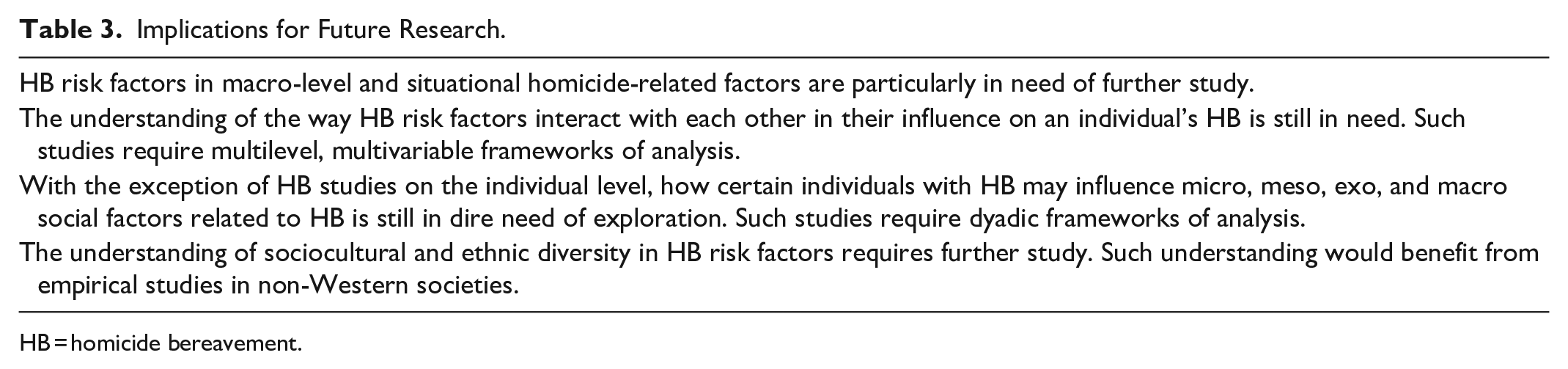
HB = homicide bereavement.
Conclusion
This review had several limitations. To begin, additional literature might not have been identified through this research method. Second, with the exception of the individual level, many reviewed studies tended to have small samples of convenience. Therefore, study findings reviewed in this paper may not be generalizable to the larger population experiencing HB. An additional limitation pertains to the considerable variability in the methodologies of the reviewed studies, which may have impeded the validity of this review. Finally, with the exception of several studies conducted on HB at the individual level, most studies were not longitudinal over an extended period. Consequently, possible yet unidentified changes in HB risk factors over time may not have been addressed in this paper.
Notwithstanding this paper’s limitations, the extracted and synthesized HB risk factors contribute to the corpus of knowledge in this domain. In addition, the review generated indications of current gaps in the knowledge on HB risk factors, signaling avenues for further research.
Footnotes
Declaration of Conflicting Interests
The author declared no potential conflicts of interest with respect to the research, authorship, and/or publication of this article.
Funding
The author received no financial support for the research, authorship, and/or publication of this article.
