



Abstract
A systematic review of research assessing rape myth acceptance (RMA) interventions within institutional settings was conducted. The aim of this review was to inform the development of an educational intervention for jurors in rape trials that addresses rape myths, given previous evidence that RMA can affect decision-making and verdicts (Dinos et al., 2015; Gravelin et al., 2019; Leverick, 2020). 12 databases were searched, filtered to return peer-reviewed journals, published from 1980 to 2020, written in English. After removing duplicates from the 5,093 search results returned, 2,676 studies were screened for inclusion. Research studies were included in the review if they assessed the impact of a naturalistic intervention on RMA within an institutional setting. Studies that did not compare an experimental condition to a control condition or did not randomly allocate participants to conditions were excluded. Studies were also excluded if they used a non-validated, or adapted, RMA measure. 20 Research studies were included within the review and were critically appraised according to an author-created critical appraisal tool. It was concluded that RMA interventions can have a short-term impact upon individuals' RMA. Intervention types that were effective in reducing RMA included those that presented RM information; those that contained an empathy component; and bystander programmes. With regards to duration and format, short interventions led to reductions in RMA, and most successful interventions were presented via videos. Implications for policy and practice, and recommendations for future research, are discussed.
An Attitude Problem
Conviction rates for rape are low in many countries (Daly & Bouhours, 2010; Jehle, 2012). For example, rape convictions fell to an all-time low in England and Wales in 2020 with only 2.6% of rapes recorded by the police resulting in a conviction (Topping & Barr, 2020). While there are several challenges associated with investigating allegations of rape, which undoubtedly contribute towards low conviction rates, there is said to be an ‘attitude problem’ among many of those working within criminal justice systems (CJS) that also has an impact and acts as a barrier to justice (Temkin & Krahe, 2008; Willmott et al., 2021). Scholars have argued that rape myths (RMs) can inform the views of CJS stakeholders regarding rape, which in turn affects their decision-making and the subsequent progression and outcome of cases. As such, belief in RMs is said to contribute to the disparity between the number of reported rapes and the number of cases that result in convictions, commonly referred to as the justice gap (Temkin & Krahe, 2008) or the attrition problem (Lees, 2002).
Rape Myths
The concept of Rape Myths (RMs) was first introduced in the 1970s. Schwendinger and Schwendinger (1974) discussed common false beliefs around rape, calling them ‘sexist myths’ or ‘fallacies’ (p. 18), and Brownmiller (1975) discussed ‘male myths of rape’ describing them as 'distorted proverbs' (p. 312). Examples of myths outlined include the notion that rape can be prevented by verbal or physical resistance, and that women ‘ask for it’ via their actions. Various formal definitions of RMs have now been proposed. Burt (1980) defined RMs as 'prejudicial, stereotyped, or false beliefs about rape, rape victims, and rapists' (p. 217). Further definitions have incorporated the varied damaging functions of such myths. For instance, Lonsway and Fitzgerald (1994) defined rape myths as 'attitudes and beliefs that are generally false but are widely and persistently held,’ adding that they ‘serve to deny and justify male and sexual aggression against women’ (p. 134). Bohner (1998) similarly described them as ‘descriptive or prescriptive beliefs about rape… that serve to deny, downplay, or justify sexual violence…’ (p. 14). As well as having such functions, RMs arguably mold subjective expectations of rape scenarios, culminating in narrow definitions of rape that diverge from the legal definition, and thereby influence stakeholders’ decisions (Ryan, 2011; Temkin & Krahe, 2008).
Brownmiller (1975) and Schwendinger and Schwendinger (1974) highlighted the damaging effects of RMs, arguing that they represent norms that govern women’s actions, and they influence the responses victims received when disclosing assaults, such as victim blaming (Amir, 1967). Brownmiller further argued that the perpetuation of RMs across society increased the incidence of rape.
Impact of Rape Myths within the Criminal Justice System
The first point at which RMs can influence attrition is the reporting stage. Based on internalized belief in rape myths, victims may not acknowledge their experience of unwanted sex as rape (LeMaire et al., 2016; Reed et al., 2020), which can lead to self-blame, in turn rendering victims reluctant to report to the police (Dardis et al., 2018; Halstead et al., 2017; Orchowski et al., 2009; Weiss, 2010; Zinzow & Thompson, 2011). Victims may also be deterred from reporting to the police if they fear not being believed due to the police accepting RMs (Daly & Bouhours, 2010; Jones et al., 2009; Lorenz et al., 2019; Pearson & Barker, 2018; Sable et al., 2006).
RMs also impact upon reported cases, via the experience of ‘secondary victimisation’ (Orth, 2002; Williams, 1984), or what Lees (1993) termed ‘judicial rape’. That is, victims who perceive the police to be victim-blaming, questioning their credibility, or scrutinizing their character may withdraw their support for the prosecution (Hohl & Stanko, 2015; Jordan, 2001; McMillan, 2018).
RMs also affect both police (Dhami et al., 2018; Hine & Murphy, 2019; O’Neal, 2019; Wentz & Keimig, 2019) and prosecutor decision-making (Beichner & Spohn, 2005; Jordan & Mossman, 2019). Police officers' decisions may be influenced by RMs directly, in terms of their own views, and indirectly due to their expectations of prosecutors' belief in RMs. Similarly, prosecutors' decisions may be influenced by their personal RMA and their anticipation of jurors' beliefs (Daly & Bouhours, 2010; Hohl & Stanko, 2015).
Finally, RMs can have an impact upon jury decision-making in cases that are progressed to trial. Several reviews have reported that it has been consistently shown that RMs can affect judgements of guilt, responsibility, and blame and final verdicts (Dinos et al., 2015; Gravelin et al., 2019; Leverick, 2020). Jurors have also been reported to express views in line with RMs when deliberating their verdicts (Leverick, 2020).
With regards to research concerning genuine trials and jurors, Lundrigan et al. (2019) examined 394 stranger-rape cases to determine whether certain factors could distinguish between convicted and acquitted cases. They concluded that convictions could be predicted by factors concordant with the ‘real rape’ myth (Estrich, 1987), suggesting that jurors may have assessed cases based on expectations held in line with this myth.
How to Address the Issue of RMs Influencing Jury Decision-Making
As research has consistently shown that RMA has the potential to impact upon jury decision-making, there have been several proposals made as to how this issue could be addressed. Proposals have included screening jurors and excluding those who hold belief in RMs from service (Willmott, 2017; Willmott et al., 2021), the use of judge-only trials (Dripps, 2009; Finn et al., 2011) and the routine introduction of expert witnesses (Office for Criminal Justice Reform, 2006). However, the most recent suggestion made in England and Wales is to present a video regarding RMs to jurors pre-trial (Gillen, 2019; HM Government, 2021), a proposal which is also supported by scholars who have conducted research in this area and have concluded that there is a need to provide jurors with such educational material (Dinos et al., 2015; Willmott et al., 2021).
Aim of Current Review
It is imperative that the development of any educational materials for jurors is empirically informed. As such, this review was conducted to explore existing interventions designed to challenge RMA, as to provide recommendations for the development of such materials to be used with jurors. Thus, the primary aim of this review was to synthesise research findings from studies that had assessed interventions aiming to reduce RMA. A further aim of the review was to critically appraise the included articles to determine their methodological strengths and weaknesses and provide recommendations for future research evaluating RMA interventions.
This review builds upon the existing literature in several important ways. Previous reviews have been conducted concerning wider rape prevention programmes implemented within universities, which provide some evidence as to the effectiveness of interventions that aim to address RMA. Although such reviews provide valuable insights regarding wider rape prevention programmes, they are limited in several respects. First, such reviews were restricted to incorporating research concerning interventions conducted in university settings only, whereas the current review incorporated all relevant research conducted in any institutional/naturalistic setting. Second, while the wider rape prevention programmes assessed in such reviews have contained a component that address RMA, RMA has often not been the focus of the reviews, as is the case in the current review. For example, in exploring rape prevention programmes implemented within universities, Fellmeth et al. (2013) assessed other variables, such that RMA was not measured in each piece of research included in their review. Third, many such reviews have investigated only one specific program type such as male-only (Wright et al., 2018) or bystander programmes (Jouriles et al., 2018; Katz & Moore, 2013), rather than synthesizing research into several types of programs that included an RMA element. Beyond this, the current review is the first to consider how findings regarding RMA interventions might apply to the court setting in terms of an intervention for jurors in rape trials. Finally, the present review’s inclusion criteria mean that only studies with high scientific rigour are included. As such, the recommendations made are based on the best available evidence.
Method
A systematic review of research assessing RMA interventions was conducted. Initially, the authors intended to review articles concerning RMA interventions implemented within any setting. This included both naturalistic settings and non-naturalistic settings. Examples of interventions implemented within naturalistic settings included RMA interventions implemented within universities as part of wider university rape prevention programmes, which were being utilized independently of the research being conducted. Non-naturalistic settings included laboratory-based mock-trial studies. It became apparent, however, that research exploring interventions within naturalistic settings was distinct from research exploring RMA interventions provided to mock-jurors within a mock-trial paradigm. For example, mock-trial research often requires the collection and analysis of qualitative data, whereas such data was not seen as pertinent to research conducted within naturalistic settings. Additionally, it was clear that the critical appraisal of research conducted in a naturalistic setting would necessitate consideration of separate criteria to that of mock-trial research. Given the divergence in necessary inclusion and exclusion criteria for articles reporting on naturalistic research conducted in institutional settings compared to research conducted in laboratory settings utilizing a mock-trial paradigm, and the need to utilize separate critical appraisal checklists for the two types of research, the decision was made to produce two separate reviews. The first systematic review is presented here, whereas the systematic review of research concerning mock-trials is presented elsewhere.
Since the initial aim of the review was to explore research conducted in any setting (i.e. naturalistic and laboratory-based/mock-juror paradigms), the search terms produced were initially necessarily broad. Indeed, terms were included concerning mock juries and mock trial simulations. However, such studies were subsequently excluded from the current review as they have been synthesized elsewhere in a second review concerning RMA interventions implemented exclusively within such settings. In addition, numerous general terms were included such as ‘lower*’ to return the majority of relevant results. This was felt necessary as several titles and abstracts did not specifically reference an ‘intervention’ or ‘program’ despite one being implemented.
The following search terms were combined into search strings: rape AND myth(s), belief(s), view(s), attitude(s) and misconception(s); ‘rape supportive’; ‘rape accepting’; AND program*; intervention; address*; reduc*; educa*; chang*; debunk*; prevent*; lower*; decreas*; mock trial; mock simulation; mock jury; and mock juror*.
Twelve electronic databases were then searched. They were selected upon the basis of their content. Databases consisted of psychological, educational, criminal justice or general sources. The databases that were searched were British Education Index, Child Development and Adolescent Studies, CINAHL, Criminal Justice Abstracts, Educational Administration Abstracts, ERIC, MEDLINE, PsycArticles, PsycInfo, PubMed, Scopus and Social Care Online. Searches of titles, abstracts and keywords were made and were filtered such that only peer-reviewed journals, written in English, published between November 1980 (the publication date of Burt’s 1980 RMA paper) and August 2020 were returned.
Once searches were completed, duplicate results were removed. Articles were then screened based on their titles and abstracts. Articles were included within the review if they concerned research that had assessed an intervention that aimed to reduce RMA that had been implemented within a naturalistic setting. Research that assessed manipulations within an experimental setting, or using a mock-trial design, was therefore excluded from the current review. Research studies were also excluded where no comparison of the intervention and control conditions took place, allocation to conditions was not randomized, non-validated or adapted RMA measures had been used, a specific date rape attitudes measure was used, or where the details of the RMA measure were not clearly reported (Figure 1). A flowchart to show the screening process undertaken.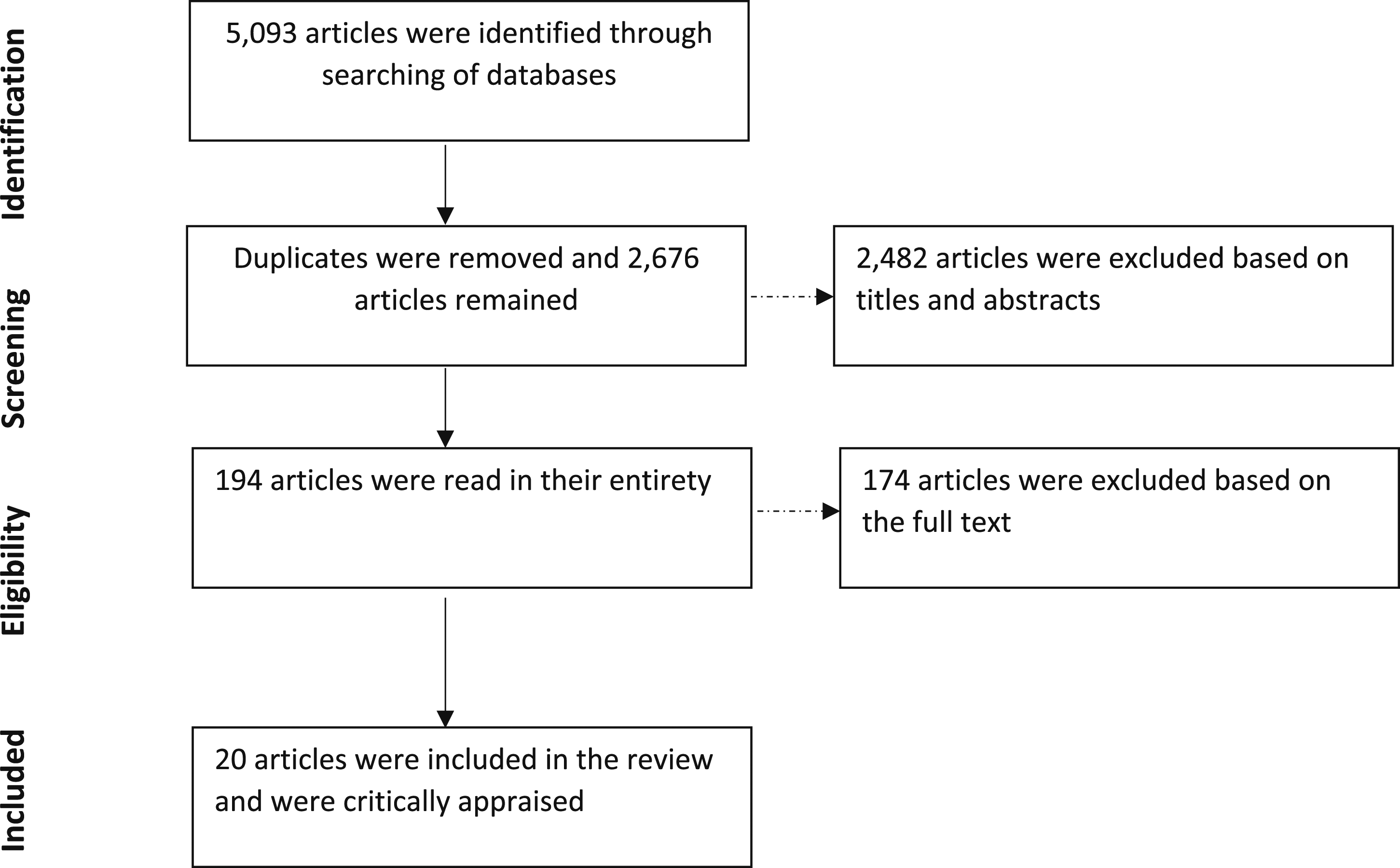
Data extracted from included articles.

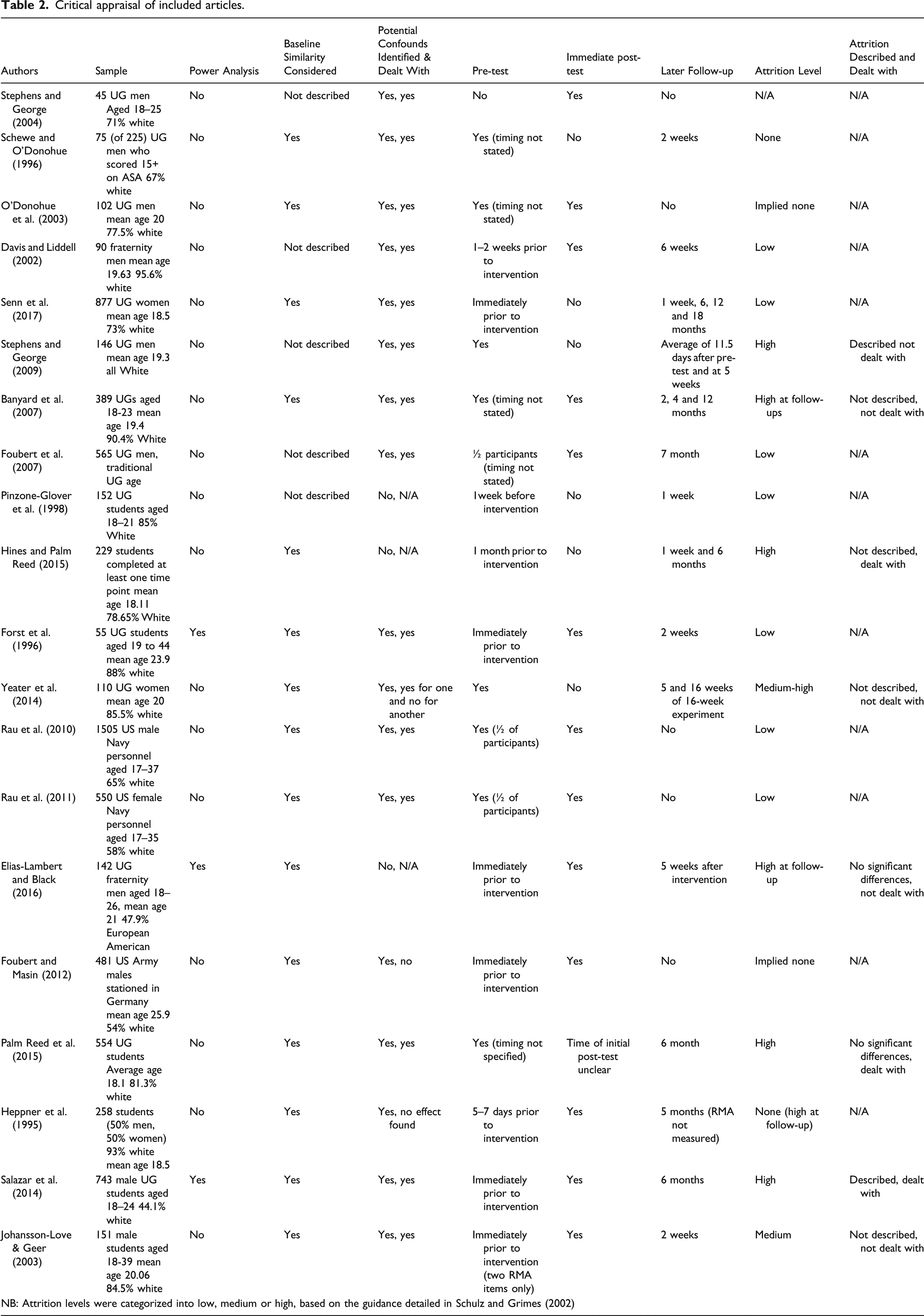
Critical appraisal of included articles.
Results
Interventions
Content
Though there were several distinct components included within each of the interventions, and the interventions were varied in focus and format, several broad clusters of interventions could be discerned based on their content, whilst acknowledging overlap between these groupings for some programs. Common intervention types included bystander training programs, gender-role programs and those that focused on risk-factors and risk-reduction techniques. Most of such programmes also presented general information about rape, typically regarding acquaintance rape of women by men. Such information covered legal definitions of rape and consent, prevalence of rape, and sexual communication issues. Other key components included RM information and victim-empathy training.
With regards to bystander intervention training, such programs aimed to equip participants to feel confident in intervening should they witness sexual violence (SV) or believe SV is about to occur. Participants were taught how to identify potential SV situations and intervene safely. All eight studies that assessed interventions containing bystander training, reported that participants exhibited lower RMA scores post-intervention (Banyard et al., 2007; Elias-Lambert & Black, 2016; Foubert & Masin, 2012; Foubert et al., 2007; Hines & Palm Reed, 2015; Palm Reed et al., 2015; Salazar et al., 2014; Stephens & George, 2009).
Victim-empathy training and information about RMs were also provided within bystander training programs to enhance participants’ motivation to become active bystanders. Such components were also included in other assessed interventions. Overall, assessment of interventions that contained a victim-empathy component produced mixed findings regarding the impact on RMA. O’Donohue et al. (2003) assessed one such intervention, which also provided participants with RM debunking information, reporting that it was successful in reducing RMA. However, Schewe and O’Donohue (1996) found that although an intervention containing an empathy component led to increases in participant’s empathy, it did not impact upon RMA, whereas an intervention that focused on RM information did.
Although victim-empathy training may be an important component of wider rape prevention programmes, such as bystander training initiatives that aim to reduce the occurrence of SV, it may not have a direct impact upon RMA. Rather, in programmes comprising both empathy training and RM information, the RM component may have been instrumental in producing observed RMA reductions. This notion is supported by the fact that eight of the ten assessed interventions that presented specific RM information were reported to be successful in reducing participants’ RMA. Although this finding suggests that direct RM information may be important in reducing RMA, such information presented within a self-help book did not successfully reduce RMA (Yeater et al., 2014).
Finally, research assessing other approaches has produced mixed findings. This is true of both specific gender-socialization–focused interventions and those that incorporated information regarding the link between gender-role socialization and rape. Some authors reported that such interventions reduced RMA (Davis & Liddell, 2002; Salazar et al., 2014), whereas Heppner et al. (1995) did not. Additionally, studies assessing interventions that focused on equipping participants to detect, acknowledge, and avoid ‘risky’ dating behaviours, and interventions that did not focus on risk-reduction but highlighted risk-factors, reported mixed results. Some authors reported that such interventions led to reductions in RMA (Pinzone-Glover et al., 1998; Rau et al., 2011; Senn et al., 2017), whereas others reported they did not reduce RMA (Forst et al., 1996; Yeater et al., 2014).
Format
Interventions were delivered in a variety of formats, from traditional teaching methods, namely via face-to-face presentations (typically supplemented by lecture slides and discussions), an interactive web-based program, and a self-help book, to improvisational theatre shows throughout which the actors engaged with participants. Other less interactive methods included presentation of videos, film-clips, and audio-clips. Often, several formats were used within one intervention. The most common format was video. Of the 13 assessed interventions that utilized videos, 11 were reported to have reduced RMA. Importantly, only one of the successful interventions presented a video alone, and 11 of the remaining 12 video interventions were supplemented with interactive tasks. It may be that the effectiveness of a passive video intervention can be enhanced with the incorporation of more interactive tasks such as group discussions.
An interactive, web-based intervention was also reported to have led to reduced RMA (Salazar et al., 2014). These authors noted several benefits of web-based programs, including that they are cost-effective, can potentially reach larger numbers of participants, and the content can be tailored to different groups. Given such benefits of web-based programs, the demonstrated reduction in RMA following this interactive intervention is promising.
Two other interactive methods – a self-help book (Yeater et al., 2014) and programs containing theatrical dramatizations with live actors – demonstrated less success (Forst et al., 1996; Heppner et al., 1995). As both studies assessing theatrical dramatizations were relatively dated, it may be that the interventions were less influential than more recent interventions as the information was at odds with SV norms at the time. Additionally, Forst et al.’s (1996) findings may have been an artefact of the sample used. Forst et al. noted that scores may not have decreased from pre- to post-test owing to most participants having low pre-test scores.
Duration and number of sessions
Intervention duration may also impact upon effectiveness. Most interventions (n = 17) were 90 minutes or less. Of such interventions, only two were ineffective (Heppner et al., 1995; Forst et al., 1996), demonstrating that even relatively brief interventions can lead to a reduction in RMA. Further, several successful programmes consisted of only one session. Nevertheless, Banyard et al. (2007) found that post-intervention levels of RMA for participants in a three-session condition were lower than those of participants in a one-session condition, thus multiple session programmes may be more beneficial. Banyard et al. also administered follow-up booster sessions to all participants.
Intervention presenters
Researchers investigating university-based rape prevention programmes have considered the impact of types of presenters facilitating such programs. Drawing upon attitude change research (Hines & Palm Reed, 2015), such researchers have examined whether peer presenters are more effective presenters than professionals (Paul & Gray, 2011). Eight articles reported the use of peer educators (Banyard et al., 2007; Elias-Lambert & Black, 2016; Foubert et al., 2007; Foubert & Masin, 2012; Heppner et al., 1995; Hines & Palm Reed, 2015; Stephens & George, 2009; Pinzone-Glover et al., 1998). Six specifically stated that peer educators were used, and two reported that doctoral students facilitated the presentation of interventions to undergraduate students. Of the interventions that were presented by peer educators, all but two (Heppner et al., 1995; Pinzone-Glover et al., 1998) led to reductions in participants’ RMA. Heppner et al.’s (1995) intervention may have been ineffective due to the format and measure used, rather than the presenter type. Nevertheless, of the three interventions presented by professional presenters, all but one (Forst et al., 1996) were also reported to be effective. Importantly, the intervention implemented by Forst et al. (1996) may have been ineffective due to other previously discussed issues, such as those concerning the sample. Overall, though, research exploring this factor has not provided definitive findings.
Theoretical underpinnings
Four of the articles referred to the assessed intervention’s theoretical basis with regards to attitude change theories (Foubert et al., 2007; Foubert & Masin, 2012; Heppner et al., 1995; Stephens & George, 2009). Several interventions were embedded within the Elaboration Likelihood Model (ELM, Petty & Cacioppo, 1981, 1986a, 1986b), which proposes two routes to attitude change, each associated with a distinct processing style; the ‘peripheral route’, linked with heuristic processing, and the ‘central route’, associated with systematic, thoughtful processing. The model posits that long-term attitude change is more likely when central processing has occurred. Further, the model assumes that the greater the motivation to attend to a message, the more likely individuals are to systematically process, engage with and evaluate it.
Based on the ELM, several factors were incorporated in Heppner et al.’s (1995) improvisational theatre intervention to facilitate systematic processing. A typical dating scenario was used as this was personally relevant to participants and this feature may have increased their motivation to listen to the message. Participants were also required to brainstorm ideas regarding the scenario so as to actively involve them within the session.
Foubert (2020) states that The Men’s Program (Foubert, 2000, 2005, 2011) is based upon both the ELM and Belief Systems Theory (BST, Grube et al., 1994). However, Foubert and Masin (2012), Foubert et al. (2007), and Stephens and George (2009) referred only to BST (Grube et al., 1994) as the theory underpinning the program’s development. BST suggests that interventions must maintain participants’ self-perceptions to produce attitude change. Thus, to do so, participants were approached as potential helpers rather than potential perpetrators, thereby avoiding defensiveness and encouraging co-operation.
Though not in relation to The Men’s Program itself, Stephens and George (2009) also considered the ELM by adding an introduction to their intervention designed to capture participants’ attention and demonstrate that it was of personal relevance to them. Including this information at the outset also allowed for repetition of key information at other time points; this may be important for attitude change given the link between repetition and retention (Hintzman, 2010). Participants were also asked to recall information presented during the intervention, in the belief that this would increase central route processing.
As well as considering the ELM and BST, Stephens and George (2009) considered Cognitive Dissonance Theory (CDT, Festinger, 1957). According to CDT, an individual experiences cognitive dissonance when they hold two contradictory beliefs or are aware that their behaviour is not in line with their beliefs. It is posited that when individuals experience this, they are likely to change either their beliefs or their behaviour. Given this, Stephens and George presented a cognitive dissonance task at the close of their intervention.
Those examining the Men’s Program reported its success, demonstrating some support for the use of BST (Grube et al., 1994). Additionally, Stephens and George (2009) reported a positive correlation between scores on a measure of central route processing and larger RMA changes, supporting use of the ELM. Heppner et al. (1995) reported that although an increase in central route processing was observed, there was no evidence that this led to more lasting RMA change. Nevertheless, the authors suggested that, as the RMA measure could have lacked the sensitivity to detect subtle RMA changes, the results should not be taken to suggest that the ELM intervention is not useful. Finally, the intervention that considered CDT was successful, suggesting it may also be a useful theory to consider when developing interventions.
Methodological factors
Samples
Demographics
All studies were conducted in North America, and none used community samples. All samples were relatively homogenous, thus lacking diversity. Seventeen were student samples, eight of which consisted of psychology students only (Forst et al., 1996; Heppner et al., 1995; Johansson-Love & Geer, 2003; Pinzone-Glover et al., 1998; Stephens & George, 2004, 2009; Schewe & O’Donohue, 1996; Yeater et al., 2014). Eleven samples consisted of men only, and three consisted of women only. It was the case that most samples (n = 17) comprised only white participants, or white participants represented the largest ethnic group within a sample. The sample ages often ranged from 18–25 years.
Sample size and power analyses
Sample size ranged from 45 to 1505. The mean sample size was 361. Only three studies reported using power analyses to determine sample sizes (Elias-Lambert & Black, 2016; Forst et al., 1996; Salazar et al., 2014).
Baseline similarity
Five articles did not state whether similarity of participants across conditions was assessed at baseline. All others reported at least one variable that was compared across groups. Reported differences included those in rape empathy, bystander behaviour (Hines & Palm Reed, 2015), RMA, adversarial sexual beliefs (Forst et al., 1996), income (Yeater et al., 2014), history or risk of coerciveness (Rau et al., 2010; Stephens & George, 2009), hostility towards women and SV perpetration (Salazar et al., 2014). The authors did not report controlling for these factors. Rau et al. (2011) reported their study conditions were unequal in terms of the number of participants from each ethnic group, though analyses were conducted to control for this within both studies.
Participant characteristics
Several studies explored the moderation effect of the participants’ characteristics. Differences found between participant types included that: male’s RMA changed whereas female’s RMA did not (Heppner et al., 1995); those categorized as non-coercive showed a reduction in RMA, whereas those categorized as coercive did not (Stephens & George, 2004); those at high risk of SV perpetration responded more favourably to interventions than those with low risk (O’Donohue et al., 2003); and that an intervention had less impact on men that were at high risk for using sexually coercive behaviour than those who were at low risk of using such behaviours (Elias-Lambert & Black, 2016). The observed differential impact suggests that tailoring interventions to certain groups may be beneficial.
Potential confounds
A range of participant and design factors were identified as potential confounds. Participant factors rarely affected outcome variables or were controlled for in analyses. Similarly, regarding design factors, potential order effects were mitigated through counterbalancing in one study (Foubert et al., 2007) and video length was controlled in another (Rau et al., 2011). Nevertheless, three articles did not discuss any potential confounds or approaches to deal with them (Elias-Lambert & Black, 2016; Hines & Palm Reed, 2015; Pinzone-Glover et al., 1998).
One crucial issue to consider when evaluating interventions is the potential for pre-test effects. A pre-test effect is when participants who were pre-tested obtain ‘better’ scores on a post-intervention test than those who were not. Foubert et al. (2007) reported such an effect, demonstrating the importance of acknowledging this as a possibility.
Given the sensitive nature of the views assessed during RMA intervention research, socially desirable responding should also be considered (Edwards et al., 2011). Both Banyard et al. (2007) and Davis and Liddell (2002) reported a correlation of social desirability and RMA, however only Banyard et al. controlled for this.
Follow-up periods
Time of post-tests
Timing of post-test administration is important as responses in tests presented immediately after an intervention and pre-test may be affected by demand characteristics. Ideally, post-tests should not be administered in the same session as a pre-test, as demonstrated by Davis and Liddell (2002); they found that RMA scores were reduced at an immediate post-test, although scores rebounded for each group including the control. This suggests that participants may be more likely to provide socially desirable responses, or a response that they feel is in line with the experimenter’s hypothesis, at an immediate post-test than they would at a later follow-up. Six articles reported administering immediate post-tests only, whereas the majority administered an additional longer-term follow-up, or a longer-term follow-up alone.
In the context of the present review, the long-term effects of interventions on RMA were not crucial since the aim was to explore the applicability of the findings to the development of educational guidance for jurors, which only necessitates a short-term impact. Nevertheless, long-term follow-ups should be considered when evaluating the efficacy of RM interventions when they are part of primary rape prevention programs, where it is hoped that lower RMA will be associated with favourable behavioural changes or in training professionals, such as the police.
Attrition
Of 15 articles that reported a level of attrition, seven reported high levels at one or more time-points. Of such studies, five described the attrition, or reported that either attrition had no effect on outcomes or it was dealt with during analyses (Elias-Lambert & Black, 2016; Hines & Palm Reed, 2015; Palm Reed et al., 2015; Salazar et al., 2014; Stephens & George, 2009), whereas two did not (Banyard et al., 2007; Yeater et al., 2014).
Measures
RMA questionnaires used included the R-Scale (Costin, 1985), Rape Myth Acceptance Scale (RMAS; Burt, 1980), Rape Myth Scale (RMS; Lonsway & Fitzgerald, 1995) and Illinois Rape Myth Acceptance Scale/Illinois Rape Myth Acceptance Scale-Short Form (IRMA/IRMA-SF; Payne et al., 1999). Payne et al. (1999) questioned the validity of the RMAS due to the wording used and subsequently developed the IRMA/IRMA-SF. The authors specifically questioned whether the same responses made to RMAS items from different participants may reflect different beliefs as colloquialisms were used and some items covered more than one issue. They also criticized the RMAS for focusing on victims, failing to address other relevant issues such as perpetrators, and because two items assess knowledge of SV statistics rather than attitudes.
The IRMA/IRMA-SF has also been criticized on grounds of its wording (McMahon & Farmer, 2011). Gerger et al. (2007) argued that use of older measures often resulted in large numbers of participants reporting low scores, suggesting that this may be the result of responding based on social desirability due to items being ‘obvious’ and overt. Thus, both the updated IRMA (McMahon & Farmer, 2011) and the Acceptance of Modern Myths about Sexual Aggression (AMMSA; Gerger et al., 2007) were developed to improve the wording of traditional measures, capturing modern, subtler myths. Assessment has shown that the AMMSA is a reliable and valid measure that produces higher means and normally distributed scores (Gerger et al., 2007). A further advantage of the AMMSA is that the sample used during its development was more representative than the student sample employed in developing the updated IRMA. Given this, the language may be applicable to a wider variety of individuals (Schlegel & Courtois, 2019).
Comparison conditions
The importance of the type of comparison condition used in evaluations has been raised. The use of an alternative intervention to that under assessment is deemed superior to designs in which no-treatment control conditions are utilized as this latter arrangement allows for factors such as time and social desirability. As such, it increases confidence that observed effects are the result of the intervention itself as opposed to participants merely being in an active treatment condition (Palm Reed et al., 2015). As per the inclusion criteria, each study compared an intervention group to a control group. Further, only one study utilized a no-intervention control group only, and the intervention assessed was not found to be successful (Schewe & O’Donohue, 1996). Thus, the results of this review cannot be said to be based on results that had the potential to be inflated by such a study design.
Conclusion
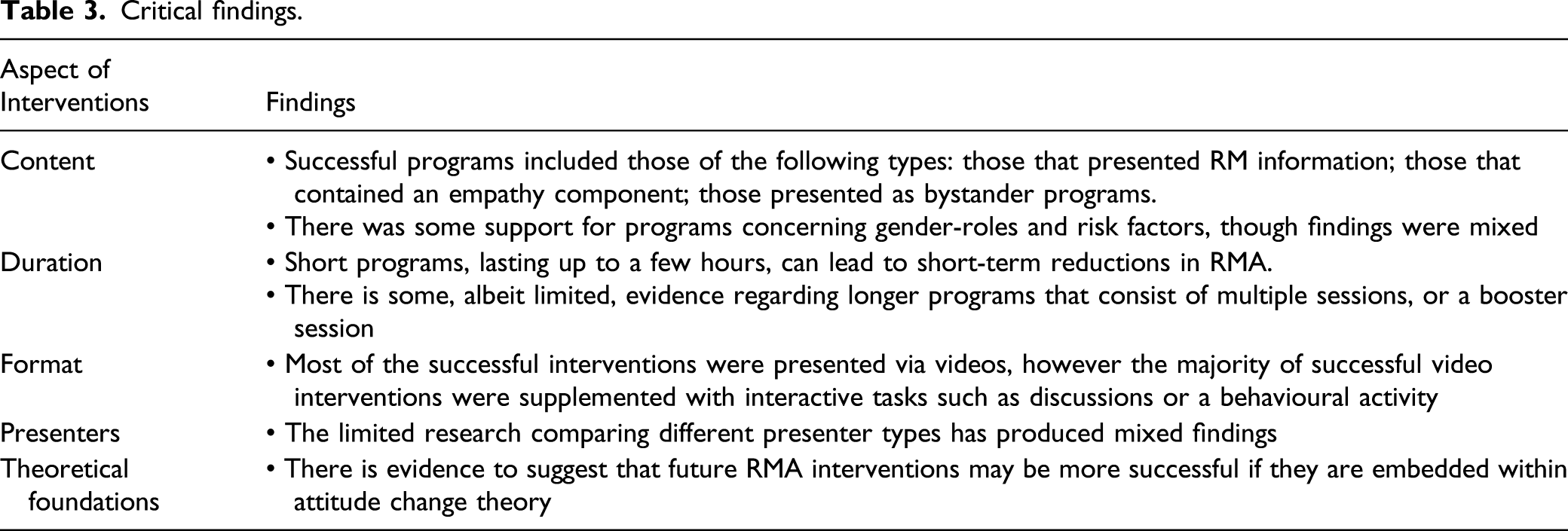
Critical findings.
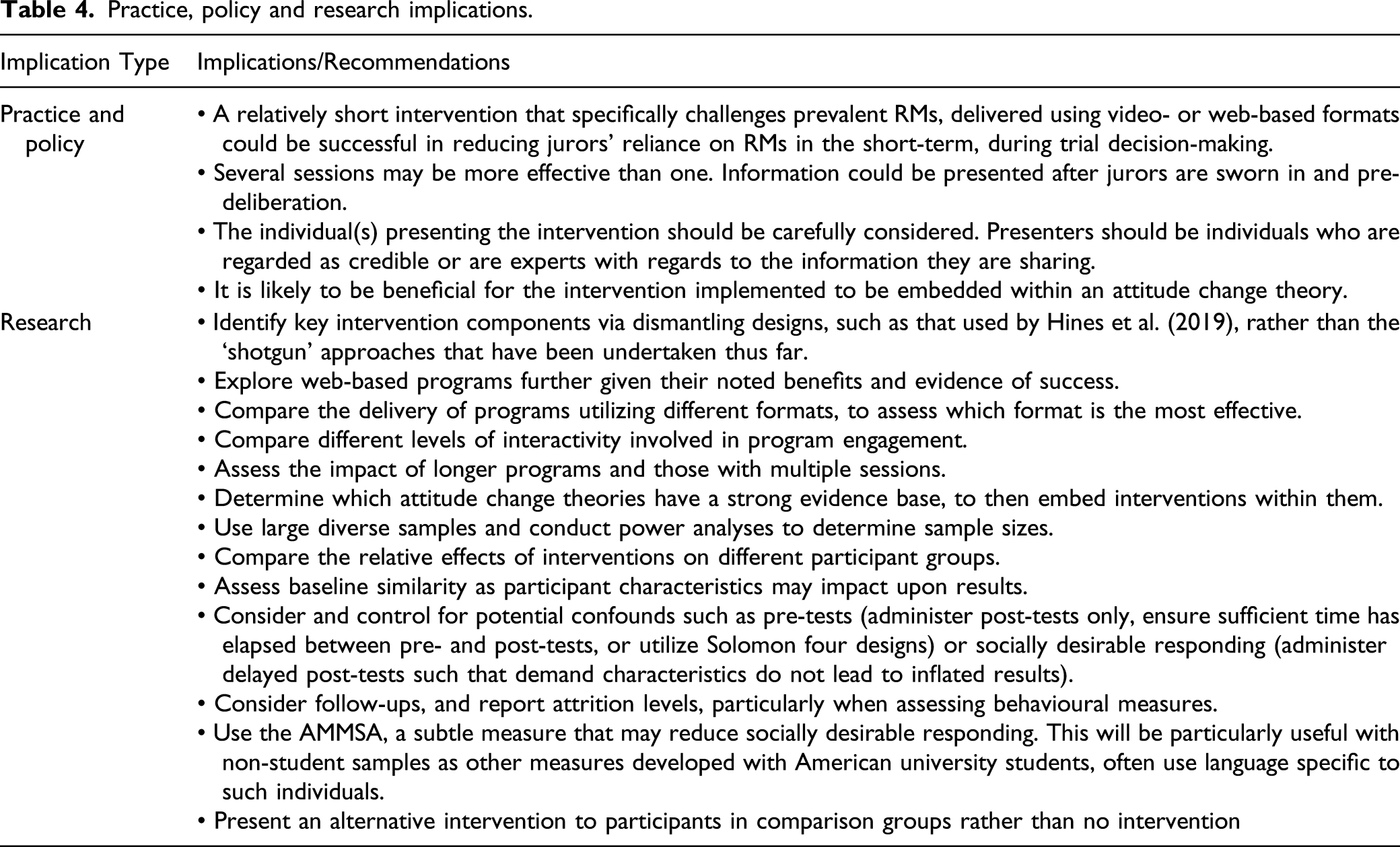
Practice, policy and research implications.
Most interventions that incorporated explicit RM information were successful. Bystander training programs were also successful, as were those containing a victim-empathy component. However, bystander programs may have been successful in reducing RMA as they directly addressed RMs. This is concordant with the conclusion of Anderson and Whiston’s (2005) meta-analysis that programs that discussed RMs had more of a positive impact on attitudes towards rape than empathy-focused programmes. Davis and Liddell (2002) also highlighted the importance of explicit RM information as they reported that a program which contained such information lowered RMA more than a gender-socialization programme did. This review also found support for programs concerning gender-role socialization and risk-factors, though findings were mixed.
It can be concluded that short programmes, lasting up to a few hours, can lead to reductions in RMA. However, the impact of implementing longer programmes, perhaps with multiple sessions, should be assessed, particularly with regards to wider rape prevention programmes that aim to lead to long-term attitude and behaviour change.
Most of the successful interventions were presented via videos (n = 13); however, the majority of these were supplemented with interactive tasks (n = 12). An intervention presented via a web-portal was also successful. As only one web-based intervention was assessed, future research should consider assessing such interventions. Interventions using improvisational theatre presentations (n = 2) were unsuccessful, as was the self-help book intervention. Future research should compare programs utilizing formats that differ with regards to their level of interactivity.
There has been limited research investigating the relative effect of different presenter types and it is unclear how findings of research comparing peer to professional presenters can be applied beyond research assessing RMA interventions implemented with university students. Such findings cannot be directly applied to interventions to be used with jurors given that a presenter who would be seen as a peer to one juror may not be considered as such by another. Paul and Gray (2011) argue that it may be of higher importance that presenters are seen as credible by the audience. This should be explored throughout further research.
Finally, the research findings suggest that future RMA interventions may be more successful, if they are embedded within attitude change theory. Future research should determine which theories have a strong evidence-base, to then embed interventions within them.
Based on such conclusions, recommendations can be made regarding the design of a program for jurors. First, a relatively short intervention that specifically challenges prevalent RMs, delivered using video or web-based formats, could be successful in reducing their reliance on RMs in the short-term during trial decision-making. Second, as many of the effective interventions that utilized videos were also supplemented with interactive tasks, using a format with elements of interactivity rather than presenting a video for jurors to passively watch, could also be explored. Third, although a short intervention has the potential to be successful, as a program with several sessions was shown to be more effective than one with only one session, presenting information both after jurors are sworn in and pre-deliberation could be considered. Fifth, the individual(s) presenting the intervention should be carefully considered. Presenters should be individuals who are regarded as credible or are experts with regards to the information that they are sharing. Sixth, it is likely to be beneficial for the intervention implemented to be embedded within an attitude change theory. Although it is expected that interventions will reduce the impact of RMs on individual decision-making, they will not entirely eliminate the problem as jurors who strongly endorse RMs may influence those who do not by introducing such rape mythology during deliberation (Munro, 2019).
Footnotes
Declaration of Conflicting Interests
The author(s) declared no potential conflicts of interest with respect to the research, authorship, and/or publication of this article.
Funding
The author(s) disclosed receipt of the following financial support for the research, authorship, and/or publication of this article: With thanks to the University of Huddersfield for providing Doctoral Training Alliance Funding which enabled this research to be conducted
