



Abstract
Sexual assault continues to be a prevalent and consequential experience for university students. The aim of this systematic review was to synthesize the literature on the academic consequences of the sexual assault for university students. There is currently no comprehensive review of the literature focusing on the academic consequences for university students who experienced sexual assault. This review was conducted based on searches from five databases including Academic Search Complete, Education Search Complete, Education Resources Information Center (ERIC), PsycINFO, and Google Scholar. We identified 13 articles that examined academic consequences of sexual assault during university. Across all studies, sexual assault was associated with more academic problems including lower grade point average, dropping out of university, and self-regulated learning problems. Although the number of articles is small, the results are consistent. Practically, this means that universities, those providing psychological services, and victims themselves need to understand that the consequences are not just physical and psychological but can also negatively impact academic achievement. Our review also identifies limitations in the literature regarding this topic such as methodological concerns, diversity and inclusion concerns, and the need for future work to investigate mediators of the relationship between sexual assault and academic outcomes. We offer recommendations for future research to combat the concerns identified. Development of interventions to support those who experience sexual assault during university necessitates overcoming the limitations identified.
Sexual assault is a prevalent and consequential issue affecting millions of people globally (Benoit et al., 2015; Walters et al., 2013). The effects of experiencing a sexual assault are profound because the effects can last for an extended period of time, contribute to lower mental health, can result in lower psychosocial functioning (e.g., Dworkin, 2020; Dworkin et al., 2017; Rothman et al., 2019), and is one of the strongest contributors to developing post-traumatic stress disorder (PTSD; Dworkin, 2020). Moreover, PTSD is associated with decreased neurocognitive functioning in areas such as verbal learning, information processing, working memory, and verbal memory (Scott et al., 2015). Therefore, the experience of sexual assault is likely to negatively impact an individual’s ability to learn and succeed educationally. Indeed, a systematic review (Fry et al., 2018) shows that the experience of sexual assault significantly negatively affects children’s academic achievement. Although we now have a better understanding of the consequences of sexual assault on children’s academic achievement, there has yet to be a systematic review of the literature focusing on sexual assault and its relation to academic achievement in university.
A more comprehensive understanding of the consequences of sexual assault on university academic achievement is needed because the age at which individuals attend university puts them into a group most at risk for being a victim to sexual assault. According to the National Center for Education Statistics, in 2018, 41% of individuals in the United States who are between the ages of 18 and 24 attend postsecondary education. Individuals under 25 years old generally are at most risk for sexual assault than any other age-group, with the age range of 18–24 being particularly at risk for experiencing various types of sexual assault (Sinozich & Langton, 2014; Walters et al., 2013). Therefore, it is not surprising that sexual assault is a pervasive problem on university campuses (Fedina et al., 2016).
This systematic review addresses a call by Kaukinen (2014) to systematically search for, appraising the quality of, and synthesizing results of studies that have looked at the interaction between sexual assault and academic outcomes for students in a university. The experience of sexual assault itself and the psychological distress associated with the assault are likely negative contributors to academic achievement in university. Additionally, this systematic review aims to provide future guidance for research and policy to strengthen understanding of impacts of sexual assault on postsecondary students.
Current Study
The purpose of the current study is to provide a systematic review of the literature on university academic outcomes for women who have been sexually assaulted. To conduct our review, we followed the best practices of systematic reviews (Siddaway et al., 2019). In line with previous reviews (Dworkin et al., 2017), we did not have a restrictive definition of sexual assault and looked at various forms of unwanted sexual behavior. The academic outcomes examined in the current study were grade point average (GPA), rates of dropping out, and self-reported academic problems. The main findings of each study, research design, methods, and measures for each study included in the review are presented and synthesized. In the end, we provide implications for practice and policy regarding sexual assault on college campuses.
Method
In accordance with systematic review best practice as defined by Cochrane Handbook for Systematic Reviews of Interventions (Higgins et al., 2019), we began our data collection by identifying the scope and focus of our research question, predetermining our eligibility criteria for our systematic search, and finding key articles also referred to as seed articles. The question guiding this research is “how does sexual assault impact the academic outcomes of female students in post-secondary education?” Our population was defined as female university students not restricted by age. We did not search for victims of high school sexual assault, but we did not exclude studies where the assault occurred during high school in our search. Our search was global in scope and did not exclude any areas by geography or date ranges. However, we only chose articles that were published in English. We limited our results to peer-reviewed publications and excluded graduate thesis and dissertations. Our searches were completed at three stages. In Stage 1, we conducted our first search in September and October 2019, with a gray literature search conducted in November 2019. In Stage 2, an updated search was completed on September 25, 2020. In Stage 3, a final updated search was completed on May 4, 2021, to ensure currency and broaden the population for all gender identities and sexual orientations.
Prior to conducting the searches, we narrowed our target databases to Academic Search Complete, Education Search Complete, ERIC, PsycINFO, and Google Scholar. These were chosen to provide us with the disciplinary perspective from an educational as opposed to medical standpoint. We conducted our searches with the aid of a librarian and tracked our results through the use of an Excel spreadsheet. After our searches were complete, we removed all duplicates and consulted our seed papers to ensure that our search was robust. We also did a manual citation search within our included papers to ensure comprehensiveness.
To break down our searches within our chosen databases, we had a discussion on how to break our research question into Population, Intervention, Comparison, Outcomes elements. Our chosen population was students in higher education. Our search terms included female and male students, undergraduates, graduates, and college students and synonyms of Lesbian, Gay, Bisexual, Transgender, Queer (LGBTQ+). Our intervention was sexual assault and included terms such as sexual assault, rape, sexual abuse, sex offences, sexual violence, and sexual victimization. The outcome we were examining was academic performance and included such terms as academic performance, GPA, academic success, academic achievement, and academic outcomes.
Our Supplemental Material has our complete search strategies and results. After our database searches were complete, we were left with 663 results, of which 244 were duplicates. Our final number after manually deduplicating our results was 419 studies. Gray literature searching was manually performed by identifying key governmental bodies, educational and policy think tanks, and manually searching for relevant organizations.
For the next stage of data collection, two independent reviewers examined the titles and abstracts of the 419 studies for relevance and applicability to the research question. After the first screen, the researchers examined the full texts for relevance. The final number of papers that was included in this review was nine after the title and abstract and full-text screening stage. Data extraction was conducted by the two independent reviewers, and the extraction criteria were developed by reading the seed papers. The reviewers extracted data based on participants, study design, definition of sexual assault, definition of academic achievement, sample size, and results. Although there are quite a few studies that examine the relationship between alcohol use and sexual assault in university students, this was not the focus of this review, so they were only included if the outcome was focused on academic achievement. Figure 1 shows our Preferred Reporting Items for Systematic Reviews and Meta-Analyses flowchart, which visually depicts this process.
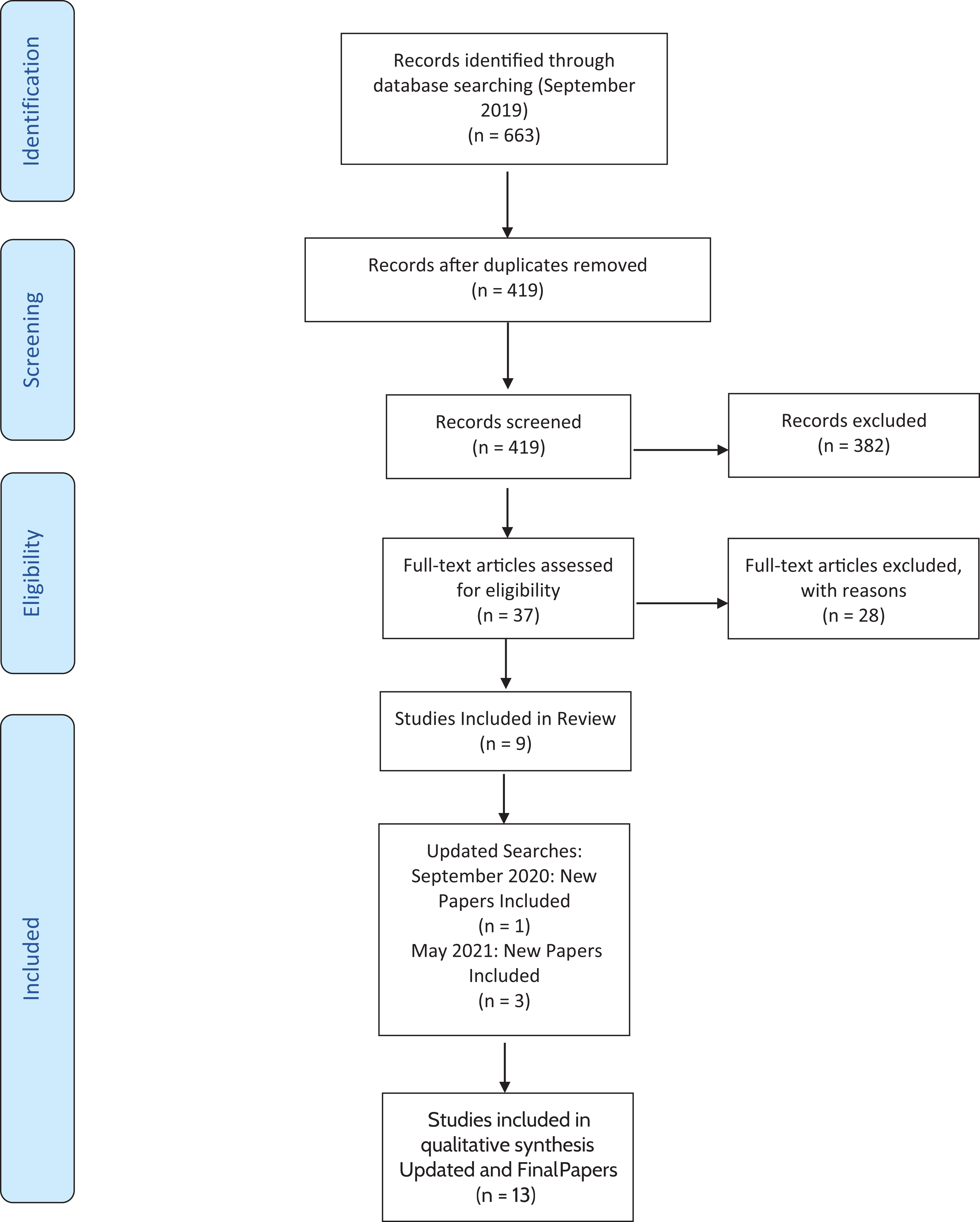
Preferred Reporting Items for Systematic Reviews and Meta-Analyses flowchart. Source: Moher et al. (2009).
An updated search was completed on September 25, 2020. The search was replicated for all of the databases, and there were 10 new publications with three duplicates that were published in 2020. Of those 10, two were already included in the review as online first publications (Banyard et al., 2020; Wood et al., 2020), and one was deemed to be relevant for this systematic review and is included in the data extraction process, resulting in 10 papers.
A final updated search was completed on May 4, 2021, to be up-to-date and in response to a reviewer comment. For this search, we sought to ensure our search did not miss papers that focused on men, transgender individuals, and nonbinary individuals. Our Supplemental Material has our complete search strategy code. This updated search returned 364 papers, after removing duplicates and irrelevant papers, and this resulted in three additional papers. Therefore, the final number of papers in this review is 13.
Results
Table 1 contains detailed results for each of the 13 papers included. Table 1 contains information on the authors, participants, sample size, study design, operationalization of sexual assault used, operationalization of academic achievement used, and key results from the study.
Systematic Review Results.
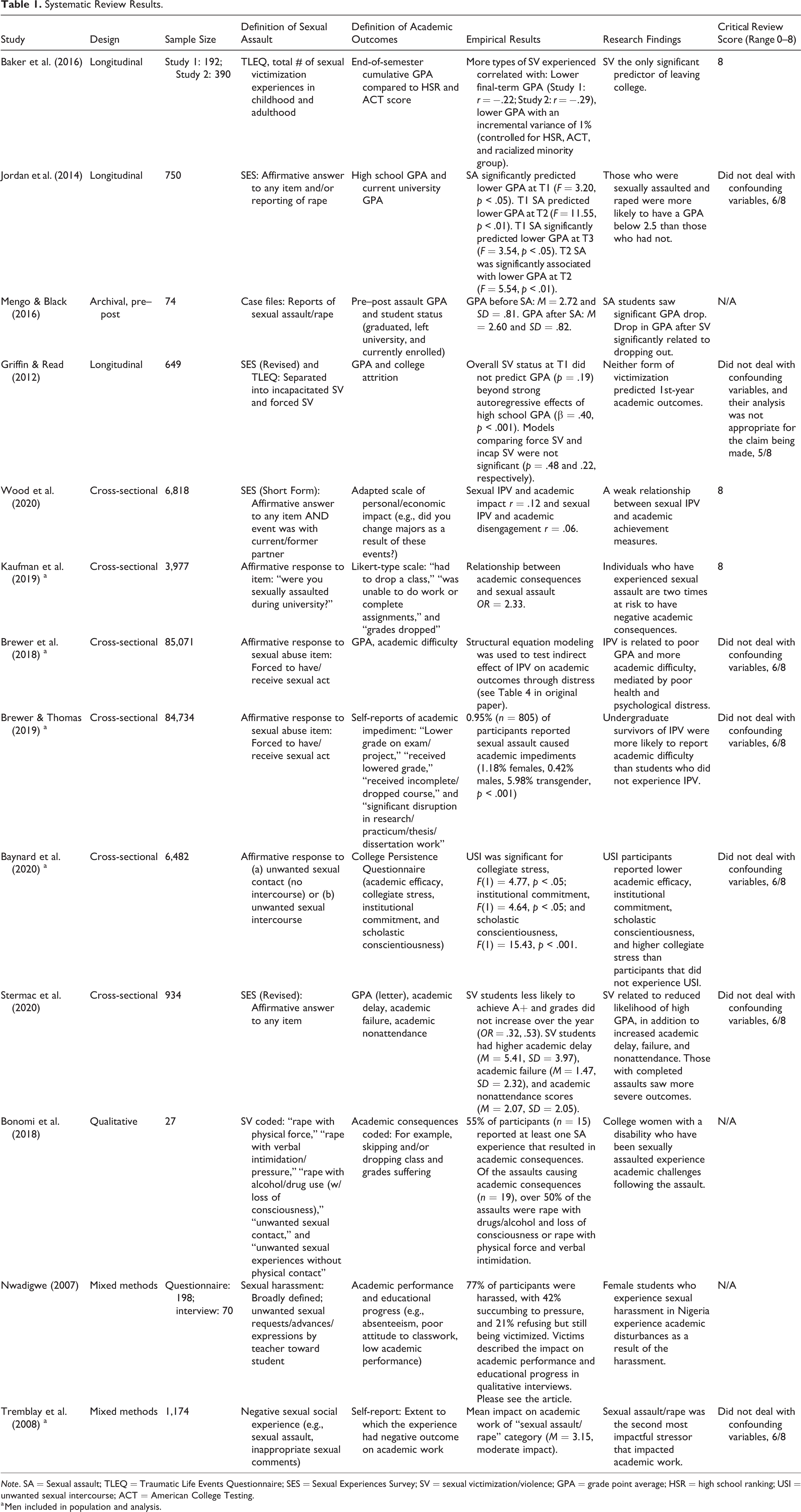
Note. SA = Sexual assault; TLEQ = Traumatic Life Events Questionnaire; SES = Sexual Experiences Survey; SV = sexual victimization/violence; GPA = grade point average; HSR = high school ranking; USI = unwanted sexual intercourse; ACT = American College Testing.
a Men included in population and analysis.
Study Participants
Sample sizes varied from 27 to 85,071, with a mean sample size of 14,728.5. One study had two samples in the study. Another study had different sample sizes for qualitative interviews and questionnaires. There were eight samples with under 1,000 participants, and the remaining five samples had over 1,000 participants. Participants in all studies were from North America, except for Nwadigwe (2007) with participants from Nigeria.
Critical Appraisal of Studies
To appraise each of the papers that made it into our review, we used the Joanna Briggs Institute) Checklist for Cross-Sectional Studies (Moola et al., 2017) for all papers with the exception of Mengo and Black (2016) that used case reports. The checklist is used to ensure that a study clearly stated their sample, identified the setting, used valid and reliable measures, confounding factors were identified and dealt with, and appropriate analyses were conducted. The score on the checklist is from 0 to 8. A number of studies did not adequately deal with confounding variables. However, other than this issue, overall, the final studies were rated satisfactorily according to the checklist (Table 1).
Qualitative Review of Results From Included Papers
Pre–post and longitudinal cross-sectional design
Four papers in our review either used a pre–post design or were longitudinal (Baker et al., 2016; Griffin & Read, 2012; Jordan et al., 2014; Mengo & Black, 2016). Although there was variety in the way these designs were employed, they provide insight into the lasting effects of sexual assault, can give researchers insight into how sexual assault predicts future consequences, and reduce common method variance (Podsakoff et al., 2003). Although there are limitations to these designs, and they are still passive observational studies (Shadish et al., 2002), because of the nature of the research topic, alternative designs that are considered more valid are not ethical nor possible.
Baker et al. (2016) conducted two studies to explore whether sexual victimization resulted in lower academic performance in university. Sexual victimization was measured by using the Traumatic Life Events Questionnaire (Kubany et al., 2000). In an effort to understand the unique contribution sexual victimization has on academic performance, the authors measured conscientiousness, cumulative GPA both in high school and university from school records, and composite GPA. These are all well-known predictors of university academic performance (Richardson et al., 2012). This paper was the only paper in our review that took this methodological step and helped us better understand the unique contribution of sexual assault on academic outcomes above and beyond relevant predictors of academic performance. Across two studies, they measured sexual victimization and conscientiousness at the start of the semester to predict end-of-the-semester GPA. Participants who reported multiple types of sexual victimization and multiple incidents of victimization had lower GPAs even after controlling for variables known to predict academic. Finally, the authors found that sexual victimization was the only significant predictor of leaving college without graduating.
Jordan et al. (2014) measured academic outcomes and sexual assault across three time points. Sexual assault was considered responding yes to any item on the Sexual Experience Survey (SES; Koss et al., 2007). Participants reported the experience of sexual assault using the SES and their GPA. Sexual assault before university and during university was predictive of GPA during university; 10.6% of participants with a history of sexual assault prior to starting college had a GPA below 2.5, while only 3.0% of participants who did not have a history of sexual assault reported GPAs below 2.5. Moreover, 14.9% of participants who experienced sexual assault in high school reported a GPA below 2.5 at the end of their second semester of college compared to 5.6% of those without a report of sexual assault. Finally, 14.3% of those who had experienced sexual assault during the first semester had a GPA below 2.5 at the end of the second semester compared to 5.9% of those who had not been sexually assaulted.
Mengo and Black (2016) examined records of university students who used a campus Relationship and Violence Sexual Assault Program. The sample consisted of 74 case files that had GPA, attrition, and academic level before and after the physical or sexual violence. Sexual victimization was measured from case report files from a sexual assault program at a university, with any experience of sexual assault and rape. It should be noted that 12.2% of the sample identified as men, and results were not separated by gender. Academic outcomes were measured through student records. The authors found that GPA after experiencing sexual victimization dropped from a mean of 2.72 (SD = .81) to 2.60 (SD = .82), which roughly translates in going from a B− average to a C+ average. Furthermore, 34.1% of individuals who experienced sexual victimization dropped out of university compared to the university dropout rate of 29.8%. First-year students experiencing sexual victimization were more likely to drop out than at other academic levels.
Griffin and Read (2012) investigated whether there were differences in outcomes for female students who had experienced forced sexual victimization compared to incapacitated sexual victimization. Their sample consisted of 159 female students who reported either forced sexual victimization or incapacitated sexual victimization. Therefore, the women included in the study were those who experienced one type of sexual victimization and excluded those who reported both. To measure sexual victimization, the authors used the Revised Sexual Experiences Survey (Koss et al., 2007) and the Traumatic Life Events Questionnaire (Kubany et al., 2000), and academic outcomes were then measured using GPA after the 1st year of university and attrition at the start of the 2nd year of university. The authors found that there was no difference between women who reported incapacitated sexual victimization compared to forced sexual victimization on GPA or attrition.
It should be noted that Griffin and Read (2012) only investigated women who have reported either type of sexual victimization. They do not compare women who have reported either type of sexual victimization to women who have not reported sexual victimization. Therefore, in the paper, they incorrectly conclude, “Therefore, it appears that academic performance is not significantly impaired for women who start college with a sexual victimization history—at least not in the 1st year of college” (p. 2517). This inference can only be made if women who reported sexual victimization of either kind were compared to women who report no sexual victimization. The reported analysis in their paper only indicates that type of sexual victimization does not have an effect on GPA or attrition. Therefore, we can only conclude from this data and analysis that there is a nonsignificant difference between women who report forced versus incapacitated sexual victimization on academic outcomes.
Cross-sectional design
Wood et al. (2020) examined the impact intimate partner violence (IPV) has on academic outcomes with a sample of 6,818 female students from a single university. In addition to investigating intimate partner sexual violence, they examined physical, psychological, and cyber violence, which are beyond the scope of this review. The authors measured sexual violence through the Sexual Experiences Survey Short Form Victimization (Koss et al., 2007). Wood and colleagues’ results show that in the presence of other types of violence and control variables in the model, sexual violence accounts for unique variance in academic disengagement and absenteeism.
Kaufman et al. (2019) examined multiple types of victimization and the consequences of victimization during university with 3,977 participants from a single university. In regard to victimization type, they investigated the consequences stalking, abusive/controlling relationship, and sexual assault have on physical health, behavioral issues, academic achievement, and mental health. This study included men in their sample, which accounted for 38% of the sample. Analysis was not done separating men and women, but no differences for consequences were found as a function of gender. Their results found that 34.6% of those who had been sexually assaulted at university experienced academic consequences (e.g., dropping a class, inability to complete assignments, and drop in grades) as a result. Finally, in a multivariate analysis controlling for demographic variables, all four forms of victimization were significantly related to having negative academic consequences. In regard to sexual assault, the odds of having negative academic outcomes as a result of sexual assault (relative to not experiencing sexual assault) are 2.33 to 1.
Brewer et al. (2018) examined the effects of IPV on academic outcomes for heterosexual and sexual minority undergraduates with a national sample of 85,071 participants from 128 universities. This study included both those who identified as men and women. IPV was defined as experiencing emotional abuse, physical abuse, sexual abuse, and stalking. The authors measured self-reported GPA and academic difficulties and physical and mental health. Regardless of sexual orientation, the authors found that the relationship between IPV, and academic difficulties and GPA was mediated by physical health and psychological distress. Therefore, the experience of IPV results in greater physical and psychological distress that negatively impacts students’ academic performance. Brewer and Thomas (2019) using the same sample broke down their analysis by gender and found that sexual assault was significantly related to academic problems for both men and women. Moreover, transgender individuals report that sexual assault had a more severe negative impact on academics than male or female individuals.
Banyard et al. (2020) used a sample of 6,482 undergraduate students from eight universities in New England to explore the relationship between sexual violence and academic outcomes in college students. This paper used both male and female population for their sample, although male participants made up only 34%. Academic outcomes were measured through the subscales from the College Persistence Questionnaire (Davidson et al., 2009), including academic efficacy, collegiate stress, institutional commitment, and scholastic conscientiousness. The findings showed that there was a significant relationship between experienced unwanted sexual intercourse and all four subscales of academic outcomes. Specifically, sexual victimization was related to lower academic efficacy, higher collegiate stress, lower institutional commitment, and lower scholastic conscientiousness even after controlling for all other forms of victimization. It should also be noted that other types of victimization like relationship abuse, stalking, and unwanted touching also had negative effects on academic outcomes, but the effect of unwanted sexual violence had the most pronounced negative effect on academic outcomes.
Stermac et al. (2020) used a cross-sectional design to explore how sexual violence impacts academic performance in 934 undergraduate women in Canadian universities. The authors explored both how sexual violence impacts academic measures of performance generally and how the type of sexual violence experienced impacts academic performance. Students who had experienced sexual violence were three times less likely to achieve an A+ and two times less likely to have their grades increase than those who did not experience sexual violence. In addition, participants who experienced sexual violence had higher scores of academic delay, academic failure, and academic nonattendance than those who did not experience sexual violence. Students with sexual violence experiences had higher absenteeism, thought of dropping out, and were intoxicated in class more than students without sexual violence experiences, t(870) = 5.66, p < .0001. Additionally, students with sexual violence experiences failed more courses, assignments, and exams t(866) = 2.32, p = .013. Finally, those who experienced completed assaults had more academic problems than those who experienced attempted assault or nonconsensual touching and kissing. These findings show that there is an increased negative risk for those with more severely violent experiences.
Mixed methods and qualitative
Tremblay et al. (2008) examined exposure to abuse and violence during university and its relationship with emotional, social, and academic problems with a sample of 1,174 students from Ontario, Canada. This study explored how different types of abuse and violence contribute to academic impacts on university students. The authors asked participants to describe the extent to which the experience negatively impacted their academic work. The results showed that sexual assault/rape had the largest total negative impact on their life and the second largest negative impact on academic achievement second only to university policy changes.
Nwadigwe (2007) examined the prevalence and consequences of sexual harassment and sexual violence against women in Nigerian universities by faculty across two universities. Results indicate widespread and severe sexual harassment and assault in the sample of 198 women—77% of women in the sample experienced some form of sexual harassment by faculty members. Indeed, 42% of women reported succumbing to pressure to engage in sexual activity with faculty, and 21% of women reported refusing faculty members but still being victimized. In further interviews with 70 students, women detail severe personal and academic outcomes from assault by faculty members. For example, one woman details multiple attempts to distance herself from a faculty member after repeated instances of the faculty member inviting her to his house, resulting in her avoiding taking classes with him altogether the subsequent semester. Overall, this type of harassment creates a hostile academic environment for female students and begins to show the cross-cultural issues regarding sexual assault during university.
Bonomi et al. (2018) using semistructured clinically trained interviewers examined the physical, personal, and academic outcomes after experiencing sexual violence/IPV for female individuals with a physical or mental disability. Participants were randomly sampled from the university registrar records and must have had experience with sexual violence/IPV and a physical or mental disability, 41 women were eligible, and 27 agreed to participate. Academic problems after sexual assault were present for 14 of the women. For example, one woman stated, “Academics, that was a nightmare.” Moreover, a victim reported that her academic situation was made worse by the university and their policies, I had extreme academic trouble.…withdrew from classes.…and I’m still in the process of trying to get a medical withdrawal.…the worst part was class because I had a lot of classes with him.…I was told like I have the left side of the room and he had the right side of the room, but then that’s like the hypervigilance sets in and I can’t pay attention because I’m always keeping an eye on him.
Discussion
Across all studies included in this review, sexual assault had a significant negative impact on students’ academic achievement in university as measured by GPA and graduation rates. These effects were replicated across different samples and different designs. Although there are methodological deficiencies in the studies included in the review, a number of studies have large samples, use longitudinal designs, and/or control for other known predictors of academic outcomes. However, more rigorous research designs should be used in the future to better understand the nature of the problem. Specifically, researchers should measure and take into account confounding variables such as known predictors of academic outcomes (Richardson et al., 2012), examine the effect of gender, sexual orientation, and race; measure psychological distress; and measure social and university support. Therefore, more nuances can be gained about the effects of sexual assault on academic outcomes in the presence of controls and moderators.
Our review reveals that although there are a small number of studies examining the impact of sexual assault on university academic outcomes, the effect is consequential. In addition to more work examining this relationship with more controls and larger samples, future research may benefit from exploring potential underlying factors that contribute to poorer academic outcomes after sexual assault. This is necessary to work toward programs that will aid victims of sexual assault through their academic careers and onward after trauma. Specifically, one review found that up to 52% of those who are sexually assaulted experience PTSD (Dworkin, 2020), and literature has shown that these women lose confidence, have attendance issues, and struggle with unintended financial consequences, which contributes to poor academic outcomes (Potter et al., 2018). Moreover, studies have shown that PTSD negatively impacts students’ GPA. Bachrach and Read (2012) found that students who developed PTSD in their 1st year of university had lower grade point averages by the end of 1st-year studies. Therefore, more research is needed to examine how sexual assault and potential outcomes of sexual assault such as PTSD mediate or moderate one another. Understanding how sexual assault and PTSD are related will provide greater insight as to how to develop interventions for students suffering through these issues.
Future intervention research should include elements that target victims’ academic performance. A meta-analysis of what contributes and predicts GPA (Richardson et al., 2012) showed that motivation factors, self-regulatory learning strategies, and psychosocial contextual influences all contribute to GPA. Motivation factors included constructs such as locus of control, optimism, and self-esteem. Examples of self-regulatory learning strategies are concentration, test anxiety, help-seeking behavior, and peer learning. Psychosocial contextual influences include general stress, depression, and social support.
Future research regarding practice-based implications should be focused on as well. The current systematic review underscored the impact sexual assault has on educational outcomes in postsecondary students. DeGue et al.’s (2014) systematic review found that the majority of prevention strategies are short psychoeducational-based programs that have not been found to be effective in reducing sexual assault. The authors suggest only three prevention strategies show significant impacts on sexually violent behavior, indicating a disparity between the programs being implemented and the actual prevention occurring. Effective supportive interventions following sexual assault have also been explored with previous research identifying that survivors would benefit from campuses developing a “culture of caring,” having one place to acquire all available resources, having all interventions consider survivors control and agency over their supports, a validating environment to receive resources and/or interventions, and emphasizing confidentiality as a cornerstone of any intervention (Munro-Kramer et al., 2017).
Sexual assault victims typically lose self-esteem and feel a loss of control after the assault (Kucharska, 2017; Rape, Abuse & Incest National Network [RAINN], n.d.), which may bring a disadvantage to sexually victimized students. Sexual assault victims often withdraw as a result of trauma (RAINN, n.d.), meaning they do not seek help or come forward with sexual assault. A study by Campbell et al. (2009) showed that women who have been sexually assaulted display maladaptive coping. Maladaptive coping can be linked to avoidance such as staying at home, withdrawal, disengagement, and substance abuse. The GPA boosting effects of peer learning and help seeking might not be used by victims of sexual assault due to withdrawal and disengagement. Finally, the meta-analysis found that psychosocial influences such as stress and depression hold negative effects on GPA. Due to the increased rates of depression and stress in victims of sexual assault, victims may experience a decrease in GPA from these symptoms (Mengo & Black, 2016). Social support was found to show a positive influence on GPA (Richardson et al., 2012), highlighting that social support is needed and imperative for students recovering from sexual assault to be able to succeed academically.
The studies in this review were lacking in their representation of racial and sexual minorities. The studies were largely comprised of predominately Caucasian ethnicities, with 40.5% as the lowest percentage of Caucasian participants (Mengo & Black, 2016; Stermac et al., 2020) and most being between 60% and 80%. Given that research has found that there is substantial variability between populations, and that samples of educated Caucasians are often outliers when compared to other populations (Henrich et al., 2010), future research should focus on creating increasingly diverse samples in order to remove potential confounds and increase cultural generalizability. Most studies in this review similarly lacked sexual minority representation. Only three studies included transgender participants in their demographics (Brewer et al., 2018; Brewer & Thomas, 2019; Kaufman et al., 2019), and one study noted that their study was 82% heterosexual (Baynard et al., 2020). Individuals who are part of the LGBTQA+ community experience significantly higher rates of sexual assault. Bisexual Canadians were found to be nine times more likely than heterosexuals to be sexually assaulted (Simpson, 2018), and 40%–47% of gay/bisexual men experience sexual violence in their lifetime compared to 20% of heterosexual men (Walters et al., 2013). Moreover, individuals who are transgender, gender-neutral, or other sexual minorities have increased risk for experiencing sexual assault than those who are cisgendered. Hoxmeier (2016) found that transgendered individuals had higher odds of experiencing nonconsensual touch and attempted or completed nonconsensual penetration than cisgendered females in the same study.
Although larger percentages of women were in most studies, sexual assault also has consequences for men. Some populations of men including gay/bisexual, veterans, inmates, and men seeking mental health treatment experience higher rates of sexual assault (Peterson et al., 2011). Peterson and colleagues’ review also found that men who experience sexual assault face greater psychological issues such as anxiety, depression, and suicidal ideation compared to men who have not experienced sexual assault. Future research on this topic should include men in their studies unless it goes against the purpose of the study and should ensure that gender issues are taken into account in the analysis.
Finally, only one study (Bonomi et al., 2018) in this review discussed disability as a contributing factor to poor academic outcomes for those who have been sexually assaulted. Therefore, future studies need to examine disability. Individuals with disabilities are at a higher risk for sexual violence (Basile et al., 2016). Therefore, future research would benefit from exploring how gender, sexual orientation, and disability influence academic outcomes after experiencing sexual assault.
Conclusion and Critical Findings
Across the studies in the review, there was consensus among findings that victims of sexual assault suffer academic outcomes.
Individuals who have been sexually assaulted are more likely to drop out of university, have lower GPA, and experience self-regulated learning problems.
Longitudinal studies in the review show that academic performance declines after sexual assault. Moreover, controlling for factors related to academic such as conscientiousness, it was shown that sexual assault was still associated with negative academic outcomes
Our review highlights that the consequences of sexual assault are not just physical and psychological but also negatively impact academic outcomes.
Implications for Practice, Policy, and Research
Practice
Enhance postsecondary institutions’ understanding of the depth and breadth of negative outcomes for students who have experienced sexual assault.
Training individuals working in universities that social support for individuals who have experienced sexual assault can be helpful for reducing the negative academic consequences.
Integrating survivors’ needs and requests into current postsecondary resources may increase the utilization of these services and increase their effectiveness.
Evidence-based and effective primary interventions to reducing the prevalence of sexual assault within postsecondary population are limited. Postsecondary institutions must stay up-to-date on current literature in order to use effective preventative programming.
Policy
Increase organizational support from universities to understand the depth of the consequences of students who have experienced sexual assault.
Developing academic resources and educational accommodations that are applicable to aid those who have experienced sexual assault in education.
Research
Further work exploring social support, isolation, and PTSD as mediating mechanisms accounting for the relationship between sexual assault and academic outcomes is needed.
The development and validation of evidence-based psychoeducational interventions targeted to university students who have experienced sexual assault are needed.
More research is needed to understand the differential consequences sexual assault has on academic performance based on gender, sexual orientation, disability, socioeconomic status, culture, and race. Two-year postsecondary educational institutions are most varied demographically and are not represented in the current literature. As per suggestions from Howard et al. (2019), future work should use a community college population to provide insight on the experiences of diverse postsecondary students.
Further work should expand beyond academic outcomes and explore the consequences sexual assault has on cognitive functioning generally. Recent qualitative work by Potter et al. (2018) explored this, but further work is still needed to provide greater understanding of the impact of sexual assault on cognitive functioning.
Supplemental Material
Supplemental Material, sj-pdf-1-tva-10.1177_15248380211030247 - Sexual Assault as a Contributor to Academic Outcomes in University: A Systematic Review
Supplemental Material, sj-pdf-1-tva-10.1177_15248380211030247 for Sexual Assault as a Contributor to Academic Outcomes in University: A Systematic Review by Taylor D. Molstad, Justin M. Weinhardt and Rihannon Jones in Trauma, Violence, & Abuse
Footnotes
Declaration of Conflicting Interests
The author(s) declared no potential conflicts of interest with respect to the research, authorship, and/or publication of this article.
Funding
The author(s) received no financial support for the research, authorship, and/or publication of this article.

Supplemental Material
The supplemental material for this article is available online.
References
Supplementary Material
Please find the following supplemental material available below.
For Open Access articles published under a Creative Commons License, all supplemental material carries the same license as the article it is associated with.
For non-Open Access articles published, all supplemental material carries a non-exclusive license, and permission requests for re-use of supplemental material or any part of supplemental material shall be sent directly to the copyright owner as specified in the copyright notice associated with the article.
