




Abstract
Identifying and understanding factors that promote or inhibit child sexual abuse (CSA) disclosures has the potential to facilitate earlier disclosures, assist survivors to receive services without delay, and prevent further sexual victimization. Timely access to therapeutic services can mitigate risk to the mental health of survivors of all ages. This review of the research focuses on CSA disclosures with children, youth, and adults across the life course. Using Kiteley and Stogdon’s literature review framework, 33 studies since 2000 were identified and analyzed to extrapolate the most convincing findings to be considered for practice and future research. The centering question asked: What is the state of CSA disclosure research and what can be learned to apply to practice and future research? Using Braun and Clarke’s guidelines for thematic analysis, five themes emerged: (1) Disclosure is an iterative, interactive process rather than a discrete event best done within a relational context; (2) contemporary disclosure models reflect a social–ecological, person-in-environment orientation for understanding the complex interplay of individual, familial, contextual, and cultural factors involved in CSA disclosure; (3) age and gender significantly influence disclosure; (4) there is a lack of a life-course perspective; and (5) barriers to disclosure continue to outweigh facilitators. Although solid strides have been made in understanding CSA disclosures, the current state of knowledge does not fully capture a cohesive picture of disclosure processes and pathways over the life course. More research is needed on environmental, contextual, and cultural factors. Barriers continue to be identified more frequently than facilitators, although dialogical forums are emerging as important facilitators of CSA disclosure. Implications for practice in facilitating CSA disclosures are discussed with recommendations for future research.
Introduction
Timely access to supportive and therapeutic resources for child sexual abuse (CSA) survivors can mitigate risk to the health and mental health well-being of children, youth, and adults. Identifying and understanding factors that promote or inhibit CSA disclosures have the potential to facilitate earlier disclosures, assist survivors to receive services without delay, and potentially prevent further sexual victimization. Increased knowledge on both the factors and the processes involved in CSA disclosures is timely when research continues to show high rates of delayed disclosures (Collin-Vézina, Sablonni, Palmer, & Milne, 2015; Crisma, Bascelli, Paci, & Romito, 2004; Easton, 2013; Goodman-Brown, Edelstein, Goodman, Jones, & Gordon, 2003; Hershkowitz, Lanes, & Lamb, 2007; Jonzon & Lindblad, 2004; McElvaney, 2015; Smith et al., 2000).
Incidence studies in the United States and Canada report decreasing CSA rates (Fallon et al., 2015; Finkelhor, Shattuck, Turner, & Hamby, 2014; Trocmé et al., 2005, 2008), while at the same time global trends from systematic reviews and meta-analyses have found concerning rates of CSA, with averages of 18–20% for females and of 8–10% for males (Pereda, Guilera, Forns, & Gómez-Benito, 2009). The highest rates found for girls is in Australia (21.5%) and for boys in Africa (19.3%), with the lowest rates for both girls (11.3%) and boys (4.1%) reported in Asia (Stoltenborgh, van IJzendoorn, Euser, & Bakermans-Kranenburg, 2011). These findings point to the incongruence between the low number of official reports of CSA to authorities and the high rates reported in prevalence studies. For example, a meta-analysis conducted by Stoltenborgh, van IJzendoorn, Euser, and Bakermans-Kranenburg (2011) combining estimations of CSA in 217 studies published between 1980 and 2008 revealed rates of CSA to be more than 30 times greater in studies relying on self-reports (127 in 1,000) than in official report inquiries, such as those based on data from child protection services and the police (4 in 1,000) (Jillian, Cotter, & Perreault, 2014; Statistics Canada 2013). In other words, while 1 out of 8 people retrospectively report having experienced CSA, official incidence estimates indicate only 1 per 250 children. In a survey of Swiss child services, Maier, Mohler-Kuo, Landholt, Schnyder, and Jud (2013) further found 2.68 cases per 1,000 of CSA disclosures, while in a recent comprehensive review McElvaney (2015) details the high prevalence of delayed, partial, and nondisclosures in childhood indicating a persistent trend toward withholding CSA disclosure.
It is our view that incidence statistics are likely an underestimation of CSA disclosures, and this drives the rationale for the current review. Given the persistence of delayed disclosures with research showing a large number of survivors only disclosing in adulthood (Collin-Vézina et al., 2015; Easton, 2013; Hunter, 2011; McElvaney, 2015; Smith et al., 2000), these issues should be a concern for practitioners, policy makers, and the general public (McElvaney, 2015). The longer disclosures are delayed, the longer individuals potentially live with serious negative effects and mental health problems such as depression, anxiety, trauma disorders, and addictions, without receiving necessary treatment. This also increases the likelihood of more victims falling prey to undetected offenders. Learning more about CSA disclosure factors and processes to help advance our knowledge base may help professionals to facilitate earlier disclosures.
Previous literature reviews examining factors influencing CSA disclosure have served the field well but are no longer current. Important contributions on CSA disclosures include Paine and Hansen’s (2002) original review covering the literature largely from the premillennium era, followed by London, Bruck, Ceci, and Shuman’s (2005) subsequent review, which may not have captured publications affected by “lag to print” delays so common in peer-reviewed journals. These reviews are now dated and therefore do not take into account the plethora of research that has been accumulated over the past 15 years. Other recent reviews exist but with distinct contributions on the dialogical relational processes of disclosure (Reitsema & Grietens, 2015), CSA disclosures in adulthood (Tener & Murphy, 2015), and delayed disclosures in childhood (McElvaney, 2015). This literature review differs by focusing on CSA disclosures in children, youth, and adults from childhood and into adulthood—over the life course.
Method
Kiteley and Stogdon’s (2014) systematic review framework was utilized to establish what has been investigated in CSA disclosure research, through various mixed methods, to highlight the most convincing findings that should be considered for future research, practice, and program planning. This review centered on the question: What is the state of CSA disclosure research and what can be learned to apply to future research and practice? By way of clarification, the term systematic refers to a methodologically sound strategy for searching literature on studies for knowledge construction, in this case the CSA disclosure literature, rather than intervention studies. The years spanned for searching the literature were 2000–2016, building on previous reviews without a great deal of overlap. Retrieval of relevant research was done by searching international electronic databases: PsycINFO, PsycARTICLES, Educational Resources Information Center, Canadian Research Index, International Bibliography of the Social Sciences, Published International Literature on Traumatic Stress, Sociological Abstracts, Social Service Abstracts, and Applied Social Science Index and Abstracts. This review searched peer-reviewed studies. A search of the gray literature (unpublished literature such as internal agency documents, government reports, etc.) was beyond the scope of this review because unpublished studies are not subjected to a peer-review process. Keyword search terms used were child sexual abuse, childhood sexual abuse, disclosure, and telling.
A search of the 9 databases produced 322 peer-reviewed articles. Selected search terms yielded 200 English publications, 1 French study, and 1 Portuguese review. The search was further refined by excluding studies focusing on forensic investigations, as these studies constitute a specialized legal focus on interview approaches and techniques. As well, papers that focused exclusively on rates and responses to CSA disclosure were excluded, as these are substantial areas unto themselves, exceeding the aims of the review question. Review articles were also excluded. Once the exclusion criteria were applied, the search results yielded 33 articles. These studies were subjected to a thematic analysis as described by Braun and Clarke (2006). This entailed (1) multiple readings by the three authors; (2) identifying patterns across studies by coding and charting specific features; (3) examining disclosure definitions used, sample characteristics, and measures utilized; and (4) major findings were extrapolated. Reading of the articles was initially conducted by the authors to identify general trends in a first level of analyses and then subsequently to identify themes through a deeper second-level analyses. A table of studies was generated and was continuously revised as the selection of studies was refined (see Table 1).
Child Sexual Abuse (CSA) Disclosure Studies: 2000–2016.

Note. SCL-90 = Symptom Check List-90; SES = socioeconomic status; LIM = long interview method; CSA = child sexual abuse; NICHD = National Institute of Child Health and Human Development; USE = unwanted sexual experiences; NSA = National Survey of Adolescents; NWS = National Women’s Study; QIDS = Questionnaire informattsé sur les délinquants sexeuls.
Key Findings
First-level analysis of the studies identified key study characteristics. Trends emerged around definitions of CSA disclosure, study designs, and sampling issues. First, in regard to definitions, the term “telling” is most frequently used in place of the term disclosure. In the absence of standardized questionnaires or disclosure instruments, telling emerges as a practical term more readily understood by study participants. Several examples of this usage were found in the research questions, interview guides, and surveys examined: “How and when do people decide to tell others about their early sexual experiences with adults?” (Hunter, 2011, p. 161); “Some men take many years to tell someone that they were sexually abused. Please describe why it may be difficult for men to tell about/discuss the sexual abuse” (Easton, Saltzman, & Willis, 2014, p. 462). “Participants were asked a series of open-ended questions to elicit a narrative regarding their experiences of telling…” (McElvaney, Greene, & Hogan, 2012, p. 1160). “Who was the first person you told?” (Schaeffer, Leventhal, & Anes, 2011, p. 346).
There was sound consistency between studies, defining disclosure in multifaceted ways with uniform use of categories of prompted, purposeful, withheld, accidental, direct, and indirect. However, defining the period of time that would delineate a disclosure as delayed varied widely across studies, wherein some studies viewed 1 week or 1 month as a delayed disclosure (i.e., Hershkowitz et al., 2007; Kogan, 2004; Schönbucher, Maier, Moher-Kuo, Schnyder, & Lamdolt, 2012). Other studies simply reported average years of delay sometimes as long as from 20 to 46 years (Easton, 2013; Jonzon & Linblad, 2004; Smith et al., 2000).
Second, the number of qualitative studies has increased significantly over the last 15 years. This rise is in response to a previous dearth of qualitative studies. Based on Jones’s (2000) observation that disclosure factors and outcomes had been well documented through quantitative methods; in a widely read editorial, he recommended “Qualitative studies which are able to track the individual experiences of children and their perception of the influences upon them which led to their disclosure of information are needed to complement…” (p. 270).
Third, although a few studies strived to obtain representative samples in quantitative investigations (Hershkowitz, Horowitz, & Lamb, 2005; Kogan, 2004; Smith et al., 2000), sampling was for the most part convenience based, relying on voluntary participation in surveys and consent-based participation in file reviews (Collings, Griffiths, & Kumalo, 2005; Priebe & Svedin, 2008; Schönbucher et al., 2012; Ungar, Barter, McConnell, Tutty, & Fairholm, 2009a). Therefore, generalizability of findings is understandably limited. The qualitative studies used purposive sampling as is deemed appropriate for transferability of findings to similar populations. Some of those samples contained unique characteristics, since they were sought through counseling centers or sexual advocacy groups. These would be considered clinical samples producing results based on disclosures that may have been delayed or problematic. This might presumably produce data skewed toward barriers and bring forward less information on disclosure facilitators.
Through an in-depth, second-level analysis, this review identified five distinct themes and subthemes beyond the general trends as noted earlier.
Disclosure as an ongoing process: Iterative and interactive in nature
Disclosure is now generally accepted as a complex and lifelong process, with current trends showing that CSA disclosures are too often delayed until adulthood (Collin-Vézina et al., 2015; Easton, 2013; Hunter, 2011). Knowledge building about CSA disclosure has moved in the direction of understanding this as an iterative and interactive process rather than a discrete, one-time event. Since the new millennium, disclosure is being viewed as a dynamic, rather than static, process and described “not as a single event but rather a carefully measured process” (Alaggia, 2005, p. 455). The catalyst for this view originates from Summit (1983) who initially conceptualized CSA disclosures as process based, although this notion was not fully explored until several years later. Examinations of Summit’s (1983) groundbreaking proposition of the CSA accommodation (CSAA) model produced varying results as to whether his five stages of secrecy, helplessness, entrapment and accommodation, delayed, conflicted, and unconvincing disclosures, and retraction or recantation, hold validity (for a review, see London, Bruck, Ceci, & Shuman, 2005). However, the idea of disclosure as a process has been carried over into contemporary thinking.
Recently, McElvaney, Greene, and Hogan (2012) detailed a process model of disclosure wherein they describe an interaction of internal factors with external motivators which they liken to a “pressure cooker” effect, preceded by a period of containment of the secret. Moreover, this and other studies strongly suggest disclosures are more likely to occur within a dialogical context—activated by discussions of abuse or prevention forums providing information about sexual abuse (Hershkowitz et al., 2005; Jensen, Gulbrandsen, Mossige, Reichelt, & Tjersland, 2005; Ungar et al., 2009a). The term dialogical simply means to participate in dialogue. Key dialogical vehicles identified in these studies were providing sexual abuse information through prevention programs, being asked about sexual abuse, and being prompted to tell (McElvaney et al., 2012; Ungar et al., 2009a).
Contemporary models of CSA disclosure reflect a social-ecological perspective
Knowledge on CSA disclosure has been steadily advancing toward a holistic understanding of the complex interplay of individual, familial, contextual, and cultural factors (Alaggia & Kirshenbaum, 2005; Brazelton, 2015; Fontes & Plummer, 2010). Where at one time factors examined and identified were predominantly of intrapersonal factors of child victims, knowledge construction has shifted to fuller social–ecological, person-in-environment explanations (Alaggia, 2010; Collin-Vézina et al., 2015; Easton et al., 2014; Hunter, 2011; Ungar, Tutty, McConnell, Barter, & Fairholm, 2009b). Social–ecological explanations open up more opportunities to intervene in facilitating earlier disclosures. Alaggia (2010) proposes an ecological mapping of what individual, interpersonal, environmental, and contextual influences impede or promote CSA disclosures based on analysis of in-depth interview data of 40 adult survivors. Subsequently, based on a sample of 67 adult survivors, Collin-Vézina, Sablonni, Palmer, and Milne (2015) identified three broad categories, closely aligned with an ecological framework that impede CSA disclosure: (1) barriers from within, (2) barriers in relation to others, and (3) barriers in relation to the social world which can be aligned to intrapersonal, interpersonal, and contextual factors.
A summary of knowledge building using a social–ecological framework follows. Knowledge gained in the intrapersonal domain includes expanded conceptualization of disclosure by building on previous categories of accidental, purposeful, and prompted disclosure to also include behavioral and indirect attempts to tell, intentionally withheld disclosure, and triggered and recovered memories (Alaggia, 2004). Categories of indirect behavioral disclosure patterns have been further verified in follow-up research by Hunter (2011), and through an extensive file review that used Alaggia’s (2004) disclosure framework to analyze their data (Collings et al., 2005) for verification.
Interpersonal factors have also emerged in regard to certain family characteristics as disclosure barriers. Families with rigidly fixed gender roles, patriarchal attitudes, power imbalances, other forms of child abuse and domestic violence, chaotic family structure, dysfunctional communication, and social isolation have been found to suppress disclosure (Alaggia & Kirshenbaum, 2005; Collin-Vézina et al., 2015; Fontes & Plummer, 2010). In addition, relationship with perpetrator is a factor whereby research indicates that disclosure is made more difficult when the perpetrator is a family member or close to the family (Dumont, Messerschmitt, Vila, Bohu, & Rey-Salmon, 2014;Easton, 2013; Goodman-Brown et al., 2003; Hershkowitz et al., 2005; Priebe & Svedin, 2008; Schönbucher et al., 2012). This is especially a barrier when the perpetrator lives with the victim (LeClerc & Wortley, 2015).
In terms of environmental factors, one study revealed that neighborhood/community conditions can hinder disclosure when there is lack of school involvement in providing a supportive environment, such as in following up on troubling student behavior (Alaggia, 2010). Additionally, a child victim’s anticipation of a negative response to disclosure, especially that they may not be believed by others outside their family such as neighbors or other community members, has shown to deter disclosure (Collin-Vézina et al., 2015).
Cultural factors influencing CSA disclosure have been studied to a much lesser degree. Despite this, a few important studies examining critical sociocultural factors now exist for better understanding CSA disclosure within a cultural context (Brazelton, 2015; Fontes & Plummer, 2010). Among these important contributions, Brazelton’s (2015) research has delineated CSA disclosure processes as “shaped by relational, racial, socio-cultural, historical, and developmental factors” (p. 182). In a unique study using culturally focused research literature as data triangulated with clinical case material, culturally based belief systems in many cultures have been found to foster family climates that can silence children from disclosing abuse (Fontes & Plummer, 2010). Taboos about sexuality, patriarchal attitudes, and devaluation of women are among some of the cultural barriers that inhibit disclosure (Fontes & Plummer, 2010).
Clearly, disclosure conceptualizations are being integrated into a social–ecological model of individual and developmental factors, family dynamics, neighborhood, and community context as well as cultural and societal attitudes toward better understanding disclosure barriers and facilitators (Alaggia, 2010), although more data are needed on cultural and contextual factors.
Age and gender as predictors of disclosure
Age
Age is consistently found to be an influential factor in CSA disclosure, making the life stage of the victim/survivor a critical consideration. Studies draw distinctions in age-groups falling into either under or over 18 years of age. Eighteen years of age was the common age cutoff point that investigators chose in order to distinguish child/youth populations from adult samples. Sixteen of the studies drew on samples of children and youth, while the other 15 studies sampled adults over the age of 18, and a further two studies used mixed age-groups (refer to Table 1). Among the child and youth samples, the age ranges spanned from preschool to late adolescence (3–17 years of age), with varying methodological approaches implemented across age cohorts. For younger cohorts, file reviews and secondary data analyses of CSA reports were typically undertaken. Adolescents were most often given surveys. Sometimes children and youth were interviewed as part of administering a survey or as a follow-up (Crisma et al., 2004; Hershkowitz et al., 2005; Ungar et al., 2009b). In the majority of child and adolescent samples, sexual abuse concerns were already flagged to investigative authorities. However, the work of Ungar, Barter, McConnell, Tutty, and Fairholm (2009a, 2009b) is one exception, whereby their survey elicited new disclosures.
Adult studies typically had a mean age between 40 and 50 years. Interviews were the main data collection method with a few exceptions using survey designs (i.e., Easton, 2013; Kogan, 2004; Smith et al., 2000) and case file reviews (i.e., Collings et al., 2005; Goodman-Brown et al., 2003). Results show a clear trend toward increased likelihood of disclosure in older youth, and findings from adult samples showing a preponderance of disclosures in adulthood, with the large majority of participants of adults reporting never having had a sexual abuse complaint filed with investigative authorities as a child or an adolescent (i.e., Hunter, 2011; Gagnier & Collin-Vézina, 2016; Sorsoli, Kia-Keating, & Grossman, 2008; Ungar et al., 2009b).
With children and youth under the ages of 18 distinct patterns emerged. First, accidental detection, rather than purposeful disclosure, is more likely to occur with younger children. For example, in one large-scale study of over 1,737 file reviews, over half of the CSA-related cases were identified through accidental and eyewitness detection (61%), while less than one third were purposeful disclosures initiated by the child victim (Collings et al., 2005). A second pattern which emerged is that rates of disclosure increase with age, especially into adulthood, which is supported by persistent findings of high rates of delayed disclosure reported later in the life course by adult survivors (Collings et al., 2005; Collin-Vézina et al., 2015 ; Easton, 2013; Jonzon & Linblad, 2004; Kogan, 2004; Leclerc & Wortley, 2015; Sorsoli et al., 2008). While gender and relationship with the perpetrator are considerable factors in CSA disclosure, age is consistently a stronger predictor of disclosure (or nondisclosure) (Hershkowitz et al., 2005; Leclerc & Wortley, 2015). Third, younger children who disclose are more likely to do so in an interview situation or other environment that provides prompts or questions about sexual abuse (Hershkowitz et al., 2005; McElvaney, Greene, & Hogan, 2014; Schaeffer et al., 2011), but this trend can also be seen in older youth (Ungar et al., 2009a, 2009b).
Gender
A number of studies have recently focused on CSA disclosures with male victims, since males have been an understudied population (Alaggia, 2005; Easton, 2013; Easton et al., 2014; Gagnier & Collin-Vézina, 2016). Most investigations that sampled both sexes show females outweighing male participants. Although women are at double the risk of being subjected to CSA, the ratio of women to men in most disclosure studies has not been representative. This finding may be indicative of male victims more likely delaying disclosing their CSA experiences, leaving male disclosure in child and youth samples underrepresented (Hébert, Tourigny, Cyr, McDuff, & Joly, 2009; Ungar et al., 2009b).
Easton, Saltzman, and Willis (2014) have been developing gender-specific modeling of disclosure examining male disclosures. Their proposed model groups male disclosures into barrier categories as determined by individual factors, interpersonal issues, and factors that are sociopolitical in nature. These authors suggest that predominant gender norms around masculinity reinforce the tendency for male victims of CSA to blame themselves for the abuse, resulting in no disclosure. Male participants in a subsequent study also relayed that gender norms and stereotypes contributed to them concealing the abuse because they were abused by a woman (Gagnier & Collin-Vézina, 2016). In the one study that compared male and female disclosures, investigator found that men’s fears of being viewed as homosexual; profound feelings of stigmatization or isolation because of the belief that boys are rarely victimized; and fear of becoming an abuser acted as disclosure barriers. Whereas females felt more conflicted about who was responsible for the abuse and more strongly anticipated being blamed and not believed (Alaggia, 2005).
Lack of a life-course perspective
Given that the study of CSA disclosure draws on age-groups ranging from samples of very young children to retrospective studies of adult survivors, with significant developmental considerations, this area of study lacks an intentional cohesive life-course perspective. Most data are derived from either cross-sectional or retrospective designs, with few longitudinal studies. There are a series of sound, yet disconnected, studies focusing on specific age-groups of children and adolescents, along with adult retrospective studies. Thus, the available knowledge base does not allow for a cohesive picture of CSA disclosure processes and pathways over the life course to emerge.
The life-course perspective has long been recommended as a critical lens for the study of child abuse (Browning & Laumann, 1997; Williams, 2003). For example, a life-course perspective has been utilized to understand the immediate- and long-term effects of CSA on the developing child victim (Browning & Laumann, 1997). Further, a life-course perspective is important in terms of examining age of onset of CSA to explain the differential effects of sexual victimization and developmental impacts in terms of understanding their ability to disclose—effects that need to be understood within a developmental context, especially for designing appropriate interventions for disclosure at critical transitions from early childhood through to adolescence and into adulthood. In addition, important “turning points” in life may facilitate disclosures. For example, entry into adulthood given that delayed disclosure occurs more often in adulthood. Alaggia (2004, 2005) found that being in a committed relationship or the birth of children acted as facilitators for some survivors to disclose, especially to their spouses. These significant life events, as contributing to disclosures, bear further examination.
Summary of barriers and facilitators
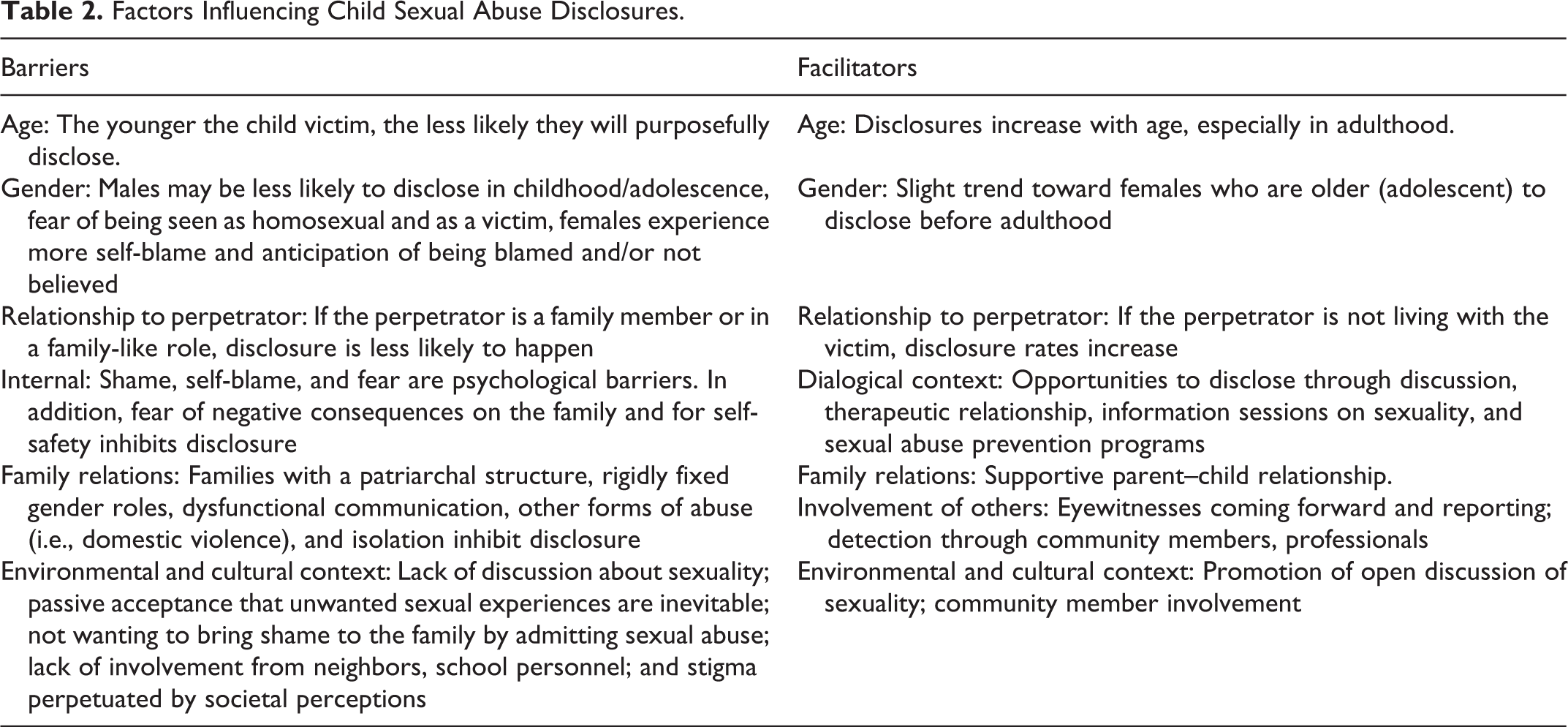
Research over the past 15 years continues to uncover barriers to CSA disclosure at a higher frequency than that of facilitators. As stated previously, this might be the result of sampling methods whereby participants who volunteer for disclosure research may have had more negative disclosure experiences, especially since many report delays in disclosure. The following section outlines the major trends in both barriers and facilitators (see Table 2).
Factors Influencing Child Sexual Abuse Disclosures.
Barriers
Age and gender were found to contribute to barriers as covered in Theme 3. Disclosures generally increase with age as children gain more developmental capacity, understanding of sexual abuse as victimization, and increased independence. Males are somewhat less likely to disclose, but this is often in interaction with other factors in the environment such as societal attitudes that promote hypermasculinity as desirable, attitudes that perpetuate negative views of boys and men who are victims, and homophobic attitudes (Alaggia, 2010; Easton et al., 2014; Gagnier & Collin-Vézina, 2016).
Victims of intrafamilial abuse when the offender is a parent, caregiver, significant family member, or someone in a family-like role are less likely to disclose immediately or at all in childhood/adolescence because of obvious power differentials and dependency needs (Collings et al., 2005; Dumont et al., 2014; Hershkowitz et al., 2005; Kogan, 2004; Leclerc & Wortley, 2015; Paine & Hansen, 2002; Schaeffer et al., 2011).
Further, the perpetrator residing with their victim(s) increases the likelihood of no disclosure (Leclerc & Wortley, 2015).
Internalized victim-blaming, mechanisms to protect oneself (such as minimizing the impact of the abuse), and developmental immaturity at the onset of abuse constituted internal barriers. Further, shame, self-blame, and fear have been identified as significant factors deterring disclosure (Collin-Vézina et al., 2015; Crisma et al., 2004; Goodman-Brown et al., 2003; Hunter, 2011; Kogan, 2004; McElvaney & Culhane, 2015; McElvaney et al., 2014). However, aspects of shame, self-blame and fear, and have not been fully explored in research. Since these are strong predictors of disclosure suppression, they bear further examination in future research to understand more fully how they operate in disclosure processes.
In terms of interpersonal and environmental factors, family dynamics can play a part in deterring disclosure. As previously mentioned, families characterized by rigidly defined gender roles, patriarchal attitudes that perpetuate power imbalances between men and women, parents and children, presence of other forms of child abuse and/or domestic violence, chaotic family structure, dysfunctional communication, and social isolation have been found to suppress disclosure (Alaggia & Kirshenbaum, 2005; Collin-Vézina et al., 2015; Fontes & Plummer, 2010). In regard to broader environmental factors, disclosure can be hindered when involved and supportive community members are not available, or not trained in sensitive responses, or when child victims anticipate not being believed by neighbors and other people outside the family (Alaggia, 2010; Collin-Vézina et al., 2015). Further, barriers in relation to the social world were identified as stigmatization, the negative labeling of sexual abuse victims, and taboos surrounding sexuality and talking about sex as driven by cultural norms (Collin-Vézina et al., 2015; Fontes & Plummer, 2010).
Identification of cultural barriers is important recent contribution to understanding disclosure processes—and in particular to the obstacles. Findings related to cultural barriers included themes of children’s voices not being heard leading to silencing, the normalization of the sexualization and objectification of girls and women, and the perpetuation of hypermasculinity in men—all acting as barriers in terms of stigma to disclosure (Alaggia, 2005, 2010; Easton et al., 2014). Brazelton (2015) similarly found that lack of discussions about sex, young age at the onset of sexual abuse, therefore not having the language to express what was happening to them, and preserving the family good name by not talking about abuse in the family were also barriers to disclosure.
Finally, it may be the case that more barriers continue to be identified over facilitators of CSA disclosure perhaps because of the methods employed in studies—particularly those drawing on adult populations who delayed disclosure. These samples may not be representative of the overall population of CSA victims, since they may have had more negative disclosure experiences, consequently more readily identifying barriers. On the other hand, these findings may speak to the actual imbalance between facilitating factors and barriers for disclosure, the latter carrying more weight in the victims/survivors’ experiences, thus, explaining the high rates of disclosures delayed until adulthood.
Facilitators
Although fewer disclosure facilitators are identified in this review, very important facilitators were nonetheless uncovered—ones that should be noted for professionals in this field of practice. Internal factors that facilitate disclosures include symptoms that become unbearable, getting older with increased developmental efficacy, and realizing that an offence was committed (Collin-Vézina et al., 2015; Crisma et al., 2004; Easton, 2013; Hershkowitz et al. 2007; McElavaney, Greene, & Hogan, 2014; Schaeffer et al., 2011). Circumstantial facilitators are those where the child discloses because there has been evidence provided, eye-witnessing has occurred, and a report has been made. Environmental factors include settings that provide opportunities such as counseling, interviews, information sessions and educational forums/workshops, and prevention programs for children and youth to disclose.
To elaborate, dialogical contexts about CSA for children and youth can provide opportunities for discussion that may facilitate disclosures (Jensen et al., 2005). The research shows creating open dialogue in relationship contexts, to offset the power and influence of the perpetrator, can facilitate earlier disclosure. Among disclosure facilitators is being asked about abuse and given the opportunity to “tell” (McElavaney et al., 2014); workshops on abuse and sexual abuse, in particular, can facilitate disclosures (Ungar et al., 2009b); and using culturally sensitive probes and questions (Fontes & Plummer, 2010). In Gagnier and Collin-Vézina’s (2016) study, positive disclosure experiences were described by participants as those where they felt that they had been listened to, were safe, were believed, and were not judged by the person they disclosed to. Further, family members and friends (peers) of the child victim can act as key supports to creating an open relational context and fostering positive responses (Jensen et al., 2005; Priebe & Svedin, 2008; Schönbucher et al., 2012; Ungar et al., 2009b). In particular, as children grow older, they are more likely to disclose to a peer, as shown in a number of studies, and this is an important reality for counselors and educators to be aware of (Dumont et al., 2014; Kogan, 2004; Schönbucher et al., 2012; Ungar et al., 2009b).
Discussion
Through examination of 33 studies published since the year 2000, this review identified five distinct themes regarding CSA disclosure: (1) Disclosure is best viewed as an iterative, interactive process rather than a discrete event done within a relational context; (2) contemporary models reflect a social–ecological, person-in-environment framework for understanding the complex interplay of individual, familial, contextual, and cultural factors involved in CSA disclosure; (3) age and gender are significant disclosure factors; (4) there is a lack of a life-course perspective; and (5) barriers to disclosure continue to outweigh facilitators. Based on these themes, a number of conclusions are drawn from this review. First, disclosure as a process is emphasized throughout contemporary research. Advances have been made in understanding these complex processes. However, the disclosure process over time—for example, how the first detection of CSA or attempts to disclose in childhood impact later disclosures—are not well understood. This is the result of the absence of a cohesive life-course perspective in investigations, although age consistently surfaces as significantly influencing CSA disclosure. Using a life-course perspective through the use of longitudinal studies is recommended.
The use of varied methodological designs, depending on the developmental stage of the victims/survivors, influences the data generated and subsequent findings. For example, most studies on children and youth are based on file reviews of cases that have been brought to the attention of authorities, or surveys, with only a few studies using interviewing of younger children. Therefore, there is less information available on process issues with children and youth. In contrast, research on adult populations largely favors the use of qualitative interview methods for retrospective inquiry producing important process findings. In addition, investigations have not yet captured the disclosure experiences of adults in the “emerging adult” stage given that adult studies have failed to recognized that the age range of 18–24, which is now considered a developmental phase defined by neurobiological developmental uniqueness. As well, late adulthood has not been given attention as shown by the absence of participants representing this age-group in current research (70+). With a swelling geriatric population in North America, issues of historic CSA can be expected to surface and, with that, new disclosures. This trend is also anticipated due to attitudinal shifts that have presumably occurred over the last two generations about revealing such traumas and changing views about discussing sexual victimization.
Interview guides used in a number of studies intentionally probed for facilitators, producing notable findings. For example, one such finding focuses on the importance of creating a contextually supportive environment to promote disclosure across the life course. These include developing therapeutic relational contexts for disclosure by providing information about sexuality, sexual abuse, prevention programming, and by asking directly. Disclosures to professionals are positive outcomes of how therapeutic contexts work; however, for forensic purposes prompting such disclosures would be viewed as problematic in legal settings, seriously compromising testimonies for trial proceedings. This is one example that speaks to the structural barriers victims and survivors run up against time and time again. Facilitators that show evidence to promote disclosure in one domain (therapeutic) are seen to work against CSA survivors in another domain—such as legal settings when perpetrators face prosecution. Defense attorneys will use this as evidence that the disclosure was prompted, and therefore the disclosure is potentially seen as not credible. Broadcasting of the frequency of acquitted cases or rulings in favor of the perpetrator through media outlets, often sensationalized, become a further compounding barrier. Given the review findings, we conclude that barriers and facilitators to CSA disclosures are nuanced and clearly embedded within intrapersonal, interpersonal, environmental, contextual, and cultural domains—often interlocked in complex ways.
Limitations
Although comprehensive in nature with its life-course coverage, this review may be limited by its qualitative, thematic focus rather than providing an evaluative, quantitative accounting of CSA disclosures. However, because of the recent focus on disclosure processes, the authors chose a suitably compatible approach—qualitative in nature. As well, a traditional checklist approach in rating the studies was not employed for interrater reliability, since two of the authors hold expertise in CSA disclosure research and are well versed with the literature. This expertise, and through closely following a systematic review framework (Kiteley & Stogdon, 2014), assures that a thorough adjudication of the research literature was completed.
Implications for Research and Practice
These review findings have implications that can be useful in guiding future research and practice: Solid strides are being made in the use of a social–ecological framework to underpin investigations in the CSA disclosure investigations. Research efforts and practice considerations should continue in this vein. Investigating environmental factors and contextual and cultural forces is understudied, necessitating more research in these areas to more fully fill out understanding of CSA disclosure from a social–ecological perspective. There is good evidence that CSA disclosures are more likely to occur in a dialogical context—formal helping relationships but as well as other relationships such as peers and trusted adults. Providing information and education on topics of sexuality in general, and sexual abuse specifically, can help children and youth to disclose. Raising awareness and prevention programs can promote disclosures of sexual violence committed against children and youth. Goals of therapeutically supported disclosures (i.e., through therapy) may need to take precedence over forensic approaches, if well-being of child victims and adult survivors is to be made paramount. Legal processes may act to facilitate disclosures but can also act as barriers because of the negative outcomes experienced in the court process. Practitioners need to keep in mind that the legal system is lagging far behind in knowledge uptake of recent evidence on CSA disclosures so that victims and survivors continue to be systemically and structurally disadvantaged in legal proceedings. Health-care practitioners (i.e., child abuse pediatricians, family practice doctors, clinical nurse specialists, and public health nurses) should be made aware of the evidence in the CSA disclosure literature to create environments for facilitating therapeutic disclosures. Given that age is a stable predictor of disclosure of CSA, more studies are needed that make use of a life-course perspective. More longitudinal studies are needed to better identify trends over different life stages. The emerging young adult as a developmental age group needs specific investigation. Neuroscience research has established that ages 18–24 is a distinct developmental phase. Late adulthood is another life stage that deserves to be researched. Gender needs to be more fully investigated in relation to impact on disclosure. Awareness that boys and girls have unique challenges and barriers in disclosing CSA should be paramount for practitioners. Intervention planning should take note that disclosures increase when perpetrators no longer reside with victims, and this finding should be heeded by policy and law makers. Shame, self-blame, and fear are intrapersonal factors that persistently emerge as barriers to CSA disclosures and warrant more research to understand how to redress these barriers for earlier disclosures.
Conclusion
There are still a substantial number of children and youth who are subjected to sexual abuse, despite preventative efforts. Just as concerning is the fact that many victims continue to suffer in silence as evidenced by the high numbers of delayed disclosure. These hidden cases should not be overlooked, and these victims should not be forgotten. Despite significant progress in bringing the issue of CSA to the forefront, improving facilitation of disclosure and increasing positive influences on disclosure processes are still critical in order to protect current and future generations of children and youth from the grave effects of sexual violence. Further, the focus should not be simply on strengthening and shoring up intrapersonal resources of victims to disclose but rather to change environmental conditions to create a more supportive and safer context for CSA victims and survivors to disclose.
Footnotes
Declaration of Conflicting Interests
The author(s) declared no potential conflicts of interest with respect to the research, authorship, and/or publication of this article.
Funding
The author(s) received no financial support for the research, authorship, and/or publication of this article.