



Abstract
Problem
HRD and HRM can sometimes operate in silos or at cross-purposes. The increasingly FRAGILE world order confronting business (i.e., Fragmenting boundaries; Resurgent populism; Accelerated digitalisation; Growing inequality; Inverted populations; Loss of Trust; and the Ecological crisis) mandates greater collaborative engagement across HRD and HRM.
Solution
Following a detailed review of the skills-based implications of the FRAGILE world order, the article unpacks the nascent skills-based agenda, detailing the transition from traditional job to task-based understanding, and outlining some examples of what it can look like in practice. Ultimately, to effectively navigate the FRAGILE world order organizations must have a clear understanding of both their current skill demands and deficiencies, and equally skills required of the future.
Stakeholders
This conceptual article will be of interest to HRD and HRM professionals, but equally hold broader insights for organizations and policy makers engaged in navigating the FRAGILE world order through a skills-based agenda.
Even though human resource development (HRD) and human resource management (HRM) draw on common multi-disciplinary foundations, they have at times been uncomfortable bedfellows. A lack of shared perspectives has been identified as inhibiting understanding across both HRM (Harney & Collings, 2021) and HRD respectively (Seo et al., 2021). This “uneasy tension” (Werner, 2014, p. 127) between HRD and HRM is surprising on a number of fronts. First, no matter what the pressure for change, be it the recovery from the global pandemic, on-going digital disruption and/or navigating geo-political uncertainties, people management issues are consistently highlighted as a critical priority for organizations (Deloitte, 2019, 2023a). Exemplar is a recent global survey of nearly 7000 people professionals and senior business leaders which identified talent shortages and skills gaps as the top challenge confronting business (Baier et al., 2023). This points to widespread recognition of the strategic significance of HRD and HRM in enabling business to survive and thrive. Second is the reality that emerging topics impacting the people management agenda including people analytics (Yoon et al., 2023), diversity and inclusion (Sim & Jeong, 2023), sustainability and employee well-being (Cafferkey et al., 2021) stem from areas with a broad multi-disciplinary underpinning requiring holistic thinking and solutions (Hughes & Niu, 2021). Third, technological disruption, in particular, generative AI offers a plethora of opportunities and challenges for people management from automation to augmentation, skills deficiencies to skill resets, and efficiency to ethics. Finally, both HRD and HRM have their origins in applied backgrounds of military warfare and industrialisation respectively, while their currency is reflected in the status and traction of dedicated professional bodies such as the Association for Talent Development (ATD) and Society for Human Resource Management (SHRM). That both HRD and HRM hold such practical import highlights the prospects for further exchange and interaction.
Drawing on these realities this article aims to foster greater collaborative conversations and awareness between HRD and HRM. Leaving technical issues of definitions aside (see Kuchinke, 2023; Osolase et al., 2023a; Werner, 2015; Yoon et al., 2024), few would question the merits of greater engagement and collaborative opportunities between HRD and HRM for the benefit of improving work and working lives (Byrd, 2023). In this spirit, in the first section of this article, we develop the analogy of FRAGILE (Fragmenting boundaries; Resurgent populism; Accelerated digitalisation; Growing inequality; Inverted populations; Loss of Trust; and the Ecological crisis) to capture key mega-trends which serve as critical drivers for change in work and ways of working. These reinforce why HRD and HRM should work together to solve emerging people management challenges for the benefit of employees, organizations and society. The second section explores the cross-pollination of ideas in action in the form of a skills-based agenda. While crossing disciplinary divides is no doubt challenging on many fronts, it is a task that offers reward in terms of renewed and refreshed thinking, enabling greater understanding, and resilience to navigate an increasingly FRAGILE world order.
A FRAGILE World Order
The challenges impacting organizations cannot be understated, with change mandates rarely as stark. With disruptions predicted to only “increase in frequency and severity” (Baier et al., 2023) it is critical to appreciate and navigate key people management implications which, by definition, bridge both HRD and HRM. There have been various attempts to capture mega-trends including with respect to macro descriptors (PESTLE-Political, Economic, Social Technological, Legal and Ecological), conditions (VUCA-Volatile, Uncertain, Complex and Ambiguous), and more recently vulnerability in the context of uncertainty (BANI-Brittle, Anxious, Non-Linear and Incomprehensible). In a similar vein we depict the key dimensions shaping the world of work founded upon the concept of FRAGILE (i.e., Fragmenting boundaries; Resurgent populism; Accelerated digitalisation; Growing inequality; Inverted populations; Loss of Trust; and the Ecological crisis). FRAGILE captures the inherent risk, uncertainty and instability evidenced in the macro-environment and their prospective impact on the people management agenda. It equally points to a mode of organizational understanding more sensitive to humility, learning and change thereby more naturally embracing the realities of transient advantage (McGrath, 2013), skill obsolescence and failures rather than assuming them out of existence. In the following section we outline each component of FRAGILE, highlighting their specific implications in terms of the changing nature of skills (see Figure 1 for a summary). Building on this foundation the second half of the article outlines a nascent skills-based agenda as holding particular promise in navigating the FRAGILE world order and providing an opportunity for HRD and HRM to further collaboration. A FRAGILE world order.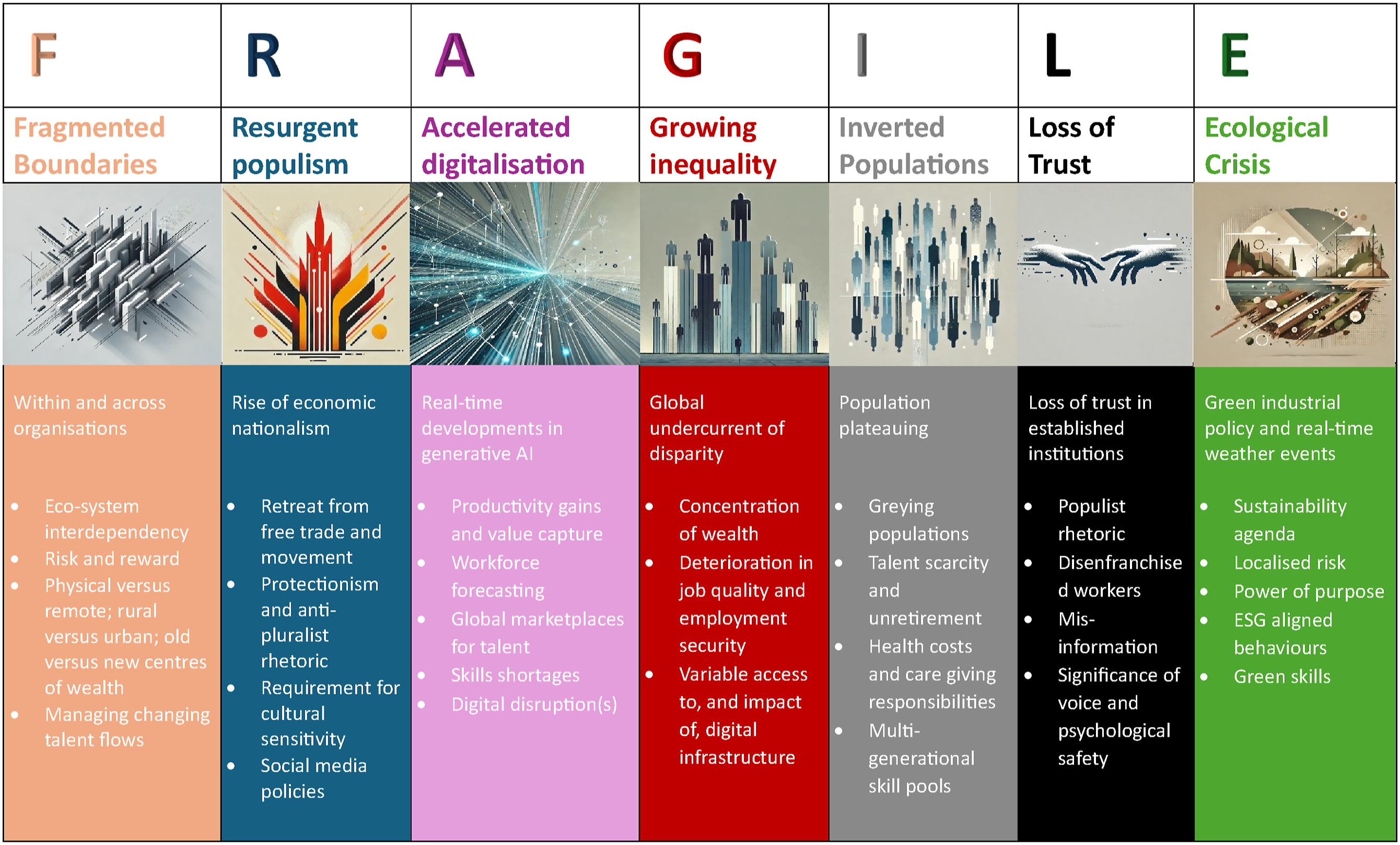
Fragmenting Boundaries
Organization should no longer be seen as the sole or dominant unit of analysis. Various forms of gig and platform work erode boundaries both within and across organizations. Corporate practices such as “renting talent,” “just in time staffing” and the “liquid workforce” depict more modular work arrangements “beyond employment” as traditionally understood (Boudreau et al., 2015; Harney, 2023). In this context, people management challenges are best understood through an eco-system lens appreciating key interdependencies and complementarities between partners, people and technology (Altman et al., 2021; Snell & Morris, 2019). The implications for talent are profound and still contested depending on the nature of the role, sector and perspective under consideration. Those taking an optimistic view point to the opportunity for greater autonomy, choice and meaningful work engagements (Wood et al., 2018). By contrast, others caution about the transfer of risk, uncertainty and accountability from the firm to the individual, including the responsibility and costs of up-skilling and development. Layered onto this are fragmenting boundaries with respect to traditional fault lines for example physical versus remote work, artificial intelligence and actual intelligence, rural versus urban, and equally with respect to traditional centres of wealth and power. Notably, half of world’s largest companies (revenue in excess of 1 billion) are headquartered in emerging markets (Dobbs et al., 2015) underscoring how the powerhouses of global GDP continue to migrate away from the west. Effective navigation of these fragmenting boundaries implies greater agility and dynamism in managing flows of talent (Jooss et al., 2023) enabled by a frame of reference that embraces eco-systems and stakeholder relations, while accommodating the fragmentation of employment as traditionally conceived.
Resurgent Populism
The promise of globalization to enable free flowing talent pipelines and wide-ranging availability of skills (Cascio, 2019) has been tempered by resurgent populism, economic nationalism and the rise of geo-political conflict. Organizations must confront new global realities, including a retreat away from free trade and freedom of movement towards fracturing relations, centralised supply chains and protectionist migration policies. These trends are underscored by shifting global dynamics related to wealth and energy. Even in the context of slower growth, by 2030 China’s GDP is projected to surpass the combined economic growth of the European Union (EU), the Association of Southeast Asian Nations (ASEAN), South Korea, and Japan. Other countries will continue to consolidate their interests and create new institutional capacity evidenced in the extension of the BRICs block (Brazil, Russia, India, China and South Africa) to BRICS+ (encompassing Saudi Arabia, Egypt, the United Arab Emirates, Iran, and Ethiopia) now controlling some 43% of global oil production (BCG, 2024).
A wave of resurgent populism and protectionism has forced employers to reevaluate strategies for talent acquisition and retention, undermining norms concerning the mobility of talent and sources of value creation (Horak et al., 2019). The rise of an “anti-pluralist” rhetoric is likely to result in growing hostility to immigrants and minority groups resulting in further systematic exclusion and diminished opportunities (Cumming et al., 2020). Violent protests, civil confrontation and hate crimes are likely to become more prevalent across all societies. The impact will be felt through changing national policy around migration of talent, emphasis on local/national skills development, more active government intervention in areas deemed critical to national importance, slowbalization, and altered supply chain and partnership dynamics focused on regaining economic control and attempts to reduce the impact of geo-political uncertainty. Corporate progress on diversity, equity and inclusion (DEI) may well be threatened by new societal narratives. Organizations will have to consider ways to navigate waves of change and foster awareness of the impact of such global dynamics. This might include training for cultural sensitivity, ensuring a climate of psychological safety, managing expectations around values and respect, transparent policies around social media usage as well as teasing out boundaries between professional and personal communication.
Accelerated Digitalization
The acceleration of digitalization is the most immediate challenge on people management professional’s desk/screens. The acceleration label is significant as we see real-time improvements in generative AI (GenAI) framed as a “general-purpose technology akin to electricity, the steam engine, and the internet” (McAfee et al., 2023, p. 44). Further dramatic progress is predicted in quantum computing, clean-energy technologies and the metaverse amongst others. A recent consultancy report suggests that in the immediate term alone, GenAI has the potential to enable 30% increased productivity across the people management value chain (BCG, 2023). This includes workforce forecasting based on skills gaps, next generation positioning, L&D learning nudges, customized learning journeys, micro daily learning all the way through to content creation. It is impossible for organizations to avoid the talent implications of broader digital eco-systems and platform developments. Already global marketplaces provide for just-in-time talent and technology to deliver identified tasks or unbundled distributed work. A direct product of technological innovation is that the nature, meaning and ways of work continue to evolve with direct implications for the type of skills required (Connelly et al., 2020; Roumpi & Delery, 2019). The World Economic Forum (WEF) estimates that the world will create 150 million new technology jobs over the next five years and by 2030, 77% of jobs will require digital skills. Despite these developments research suggests that both companies and individuals remain ill-prepared (Baier et al., 2023). Reports highlight that only 33% of technology jobs globally are filled by appropriately skilled labour, with digital skill shortages identified as a critical concern by business leaders globally (Capgemini & LinkedIn, 2022).
Acknowledging that with digital acceleration comes much hype as well as real (or meta) development, it is clear that the skills required of, and open to, HRD and HRM professionals are ever expanding (Harney & Collings, 2021). Associated with accelerated digitalization, is the generation of big and real time data. This is a critical enabler for more informed people management decisions with the potential to boost productivity, personalize employee experiences, and enable data-driven talent ecosystems (Gubbins et al., 2018; Yoon et al., 2023). Increasingly organizational attention is directed towards the digital disruption challenges including the impact of remote working on organizational innovative capacity versus employee well-being, ethical considerations around employee data and technological monitoring, regulatory intervention as well as the blurring between employee influencers and organizational branding (Lee & Hannah, 2020). Further, there is a growing responsibility on both employers and employees to be alert to prospective technological threats from the likes of cybersecurity risks, misinformation, and deep fakes. Debates abound concerning the extent to which technology as it impacts work can, or should, be regulated. Particularly relevant are concerns that technological development and adoption is moving faster than our knowledge of its impact on humans for example the risk of reducing human communication and social skills, or creating dependencies on AI or machine learning at the expense of the other form of AI (i.e., actual intelligence).
Growing Inequality
A critical factor underpinning resurgent populism and social unrest is a global undercurrent of disparity and inequality both across and within societies. In financial terms, a global elite accounting for less than 1% of the world’s population now holds two-thirds of all new global wealth (Taylor, 2023). The ratio of CEO to employee pay continues to grow well beyond anything that is logical or justifiable to employees. While the COVID-19 showcased the merits of digital innovation, it equally highlighted key fault lines with respect to access, gender, ethnicity, and class (Spicer, 2020) drawing attention to those front line workers deemed essential by society but silenced or underrepresented in scholarship and still struggling for appropriate pay and conditions (Harney & Collings, 2021). Indeed, despite surface level progress there is a growing sense of inequality, coupled with deterioration in job quality and security of employment for many employees (Colfer et al., 2023). These realities are furthered by the impact of financialization and short-termism which rewards cost-cutting and lay-offs with elevated stock prices, even in the context of revenue growth (Cushen & Harney, 2014). In this context, it is interesting that the OECD has called for a “redefining” of growth narratives to recenter attention on wellbeing, happiness and enhancing inclusion (Cafferkey et al., 2021; Ellsmoor, 2021). Much heralded waves of digital innovation and a digital society risk furthering digital divides, digital exclusion and deficits in digital literacy (Lythreatis et al., 2022). The UN’s International Telecommunication Union (ITU) notes a significant global population of so called “digital excluded” who lack access to basic (reliable) infrastructure, from electricity through to broadband, while for others there is a digital skills deficit in terms of awareness and insight, especially across generations (Lloyd & Payne, 2023). Equally within organizations there are suggestions of a “digital disconnect” between the “powered productive” outlook of managers who see a “flourishing partnership” between people and technology and the fragmented “platform plugin” pessimism of employees centred on automation and replacement (Citrix, 2020). It is important therefore that future of work initiatives are sensitive to material inequalities and do not assume infrastructure, understanding, and digital readiness as a given (Davey & Harney, 2023).
Inverted Populations
While the world has seen a dramatic population explosion over the last number of years the reality is that populations, especially in developing countries, are plateauing fuelled by diminishing fertility and reproduction rates on one hand, and longevity in terms of healthy ageing on the other (Dobbs et al., 2015). By way of example, the EU estimates that by 2060 Germany’s population will shrink by 20%, while a child born in Japan in 2007 will have a more than 50% chance of living past the age of 107 (Deloitte, 2022). Globally by 2060 one third of every hundred people will be 65 or older (Cascio, 2019), while by 2030 for the first time the US population older than 65 will outnumber those under the age of 18. The Taylor report in the UK highlights a significant statistic; 65% of the 2030 workforce have already left full-time education (2017). The implications are multifaceted with greater social and health care costs, projected pension shortfalls and equally a “talent scarcity” manifest in terms such as the “great unretirement.” A key consequence is dramatic shifts in the way that people will manage their workflows and careers, with greater risk of further social and digital exclusion for ageing cohorts (Lloyd & Payne, 2023). Already over 55% of the US workforce balance work and caregiving responsibility, a trend that will only become more prevalent (Fuller, 2024). People management professionals therefore need to consider the skills-sets and talent required to deliver value and how this can leverage opportunities created by changing demographics. They equally must be sensitive to multi-generational implications of their workforce, as well as the inevitable demands that will be placed on employees attempting to balance work, personal health and caregiving requirements. Ultimately there is a need to facilitate and map more sustainable careers (Gubbins & Garavan, 2022).
Loss of Trust
Serving as both an input into, and outcome of, the factors identified above is a global loss of trust in the established institutions of society. An undercurrent of disenchantment is fuelled by populist rhetoric, disenfranchised workers and misinformation as perpetuated by social media (Baum & Haveman, 2020). The World Economic Forum identified trust as one of the key challenges confronting society in 2024, especially pertinent in a year that sees more than 50% of the world population going to the polls in elections. Unless successfully managed, growing distrust and loss of integrity in the institutions and the mechanisms of governance hold stark prospects; “if our prevailing institutions can’t adapt, they could lose the right to lead” (Sheppard & Droog, 2019, p. 101). In an organizational context, trust is identified as critical to the successful development and maintenance of effective working relationships (Legood et al., 2023), however prominent trust barometers indicate that less than 50% of employees trust their organization, while there is also declining trust in leadership (Edelman, 2024). This presents both a dilemma and an opportunity for people management professionals who are tasked with, for example, enshrining culture, creating learning communities, fostering psychologically safe work environments, facilitating cohesive, collaborative organisational relationships, encouraging employee voice and enhancing accountability, all of which are fundamentally grounded in trust.
Ecological Crisis
It is indicative of the current global climate that extreme weather ranks as a top economic concern. Governments are wrestling with green industrial policy and efforts to reduce carbon emissions, while at the same time firefighting in real-time with extreme, non-cyclical weather events. Across the fragmenting boundaries, resurgent populism, accelerated digitalisation, growing inequality, inverted populations, and loss of trust, the ecological crisis is the force with the most obvious, visibly manifest impact.
In 2020 the OECD pointed to the accelerating environmental crisis as the most urgent factor facing the globe, while the WEF highlights extreme weather events as one of three top global concerns. Organizations can longer avoid the harsh realities of the ecological crisis confronting the planet and beyond, something only re-affirmed by the announcement that 2023 was the hottest year on record. Organizations not only have to embrace the sustainability agenda with a force that has been so far lacking (Stahl et al., 2020), but equally consider the localized risks and implications on their doorstep from flooding through to fire. The ecological crisis has reinforced the role of organizational purpose to the people management agenda, and equally the significance of fostering and rewarding environmental, social and governance (ESG) aligned behaviours. Going forward it is expected that organizational (in)action in the context of the ecological crisis will be a critical factor determining organizational attractiveness and employer branding.
The people management implications of the FRAGILE megatrends identified above are significant, with notable impacts on employee experiences and expectations, especially as related to employee well-being (Cafferkey et al., 2021). Moreover, the interdependent nature of FRAGILE factors prompt powerful and reinforcing consequences and inherent tensions. It is hard to disagree with the sentiment from a few years ago that “it is doubtful that the world will return to a relatively simple global multilateral order” (Sheppard & Droog, 2019). Appreciating the FRAGILE world order in this fashion helps to better capture the evolving practice, professional needs, skill requirements and priorities that unite the HRM and HRD agenda (Byrd, 2022). While some trends are long-recognized, they have taken on additional significance and motivate more urgency in action. For example, employers estimate that 44% of workers’ skills will be disrupted in the next five years (WEF, 2023). It is equally important not to be deterministic, recognizing bounded automation (Fleming, 2019) and that the opportunity that exists for progressive organizations and progressive approaches to people management, something we turn to next in the context of an emerging skills first agenda. In this vein it is worth remembering a lesson imparted by Katz (1964) some 60 years ago that “an organization which depends solely upon its blue-prints of prescribed behaviour is a very fragile social system” (p. 134).
Towards Some Common Ground for HRD and HRM: A Skills Based Agenda
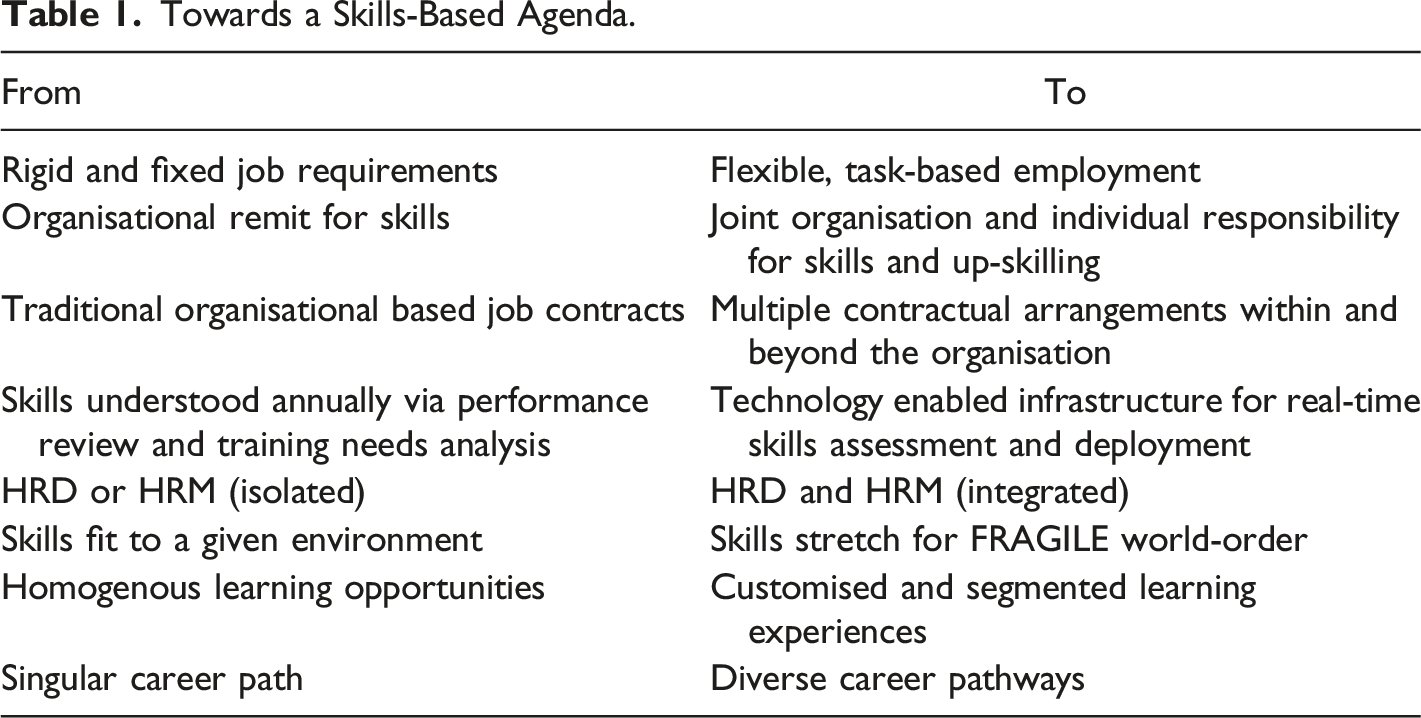
HRD and HR professionals face inevitable challenges in navigating the disruptions brought about by a FRAGILE world order (Gubbins & Garavan, 2022). While some organizations have made great strides in realising innovative and interdisciplinary solutions, this remains the exception (Harney & Collings, 2021). One path to progress can be found in the nascent “skills-based agenda” the motivation for which can be found in a number of professional and practice outlets. As one report outlines: the boundaries that delineated job from job, grouping tasks and categorizing workers into narrow roles and responsibilities, are now limiting organizational outcomes, such as innovation and agility. Many are experimenting with using skills, not jobs, as the baseline for how workforce decisions are made. When unboxed from jobs, workers have the opportunity to better utilize their capabilities, experiences, and interests in ways that advance organizational and worker outcomes. (Deloitte, 2023a, p. 5)
The key premise of the skill-based agenda is that the concept of “job” and associated “titles” has limited utility and so should be replaced by a focus on a collection of tasks and the skills required for effective performance of same (Roslansky, 2023). Assessment therefore moves from to whether someone has the right skills and competencies as opposed to the proxy of relying on how these were obtained (World Economic Forum, 2024). This is variously referred to as a “skills-first approach,” “skills-based agenda” or the overall quest towards a “skills-driven organization (SDO).” Yet while the significance of skills and realities of skill deficits are increasingly recognized, in many cases this has yet to translate into specific actions. It is thus common to read that: 77% of business executives agree their organization should help their workers become more employable with relevant skills, but only 5% strongly agree they are investing enough in helping people learn new skills to keep up with the changing world of work. (Deloitte, 2023b, p. 7)
Of course, this also heralds a huge opportunity to advance a people management agenda that reframes what careers, competencies and development look like in a contemporary context. A skills-based agenda moves away from pre-determined, fixed requirements for specific jobs (e.g., specific educational credentials or performance). Instead the focus is on in-demand skills, allowing organizations to access talent from a much broader and inclusive talent pool. This can include talent developed through internal development programs, but equally workers Skilled Through Alternative Routes (STARs) for example underrepresented talent, veterans, multiple-generations, and those without formal education requirements or from adjacent fields (McRae et al., 2024).
Towards a Skills-Based Agenda.
A Skills-Based Agenda in Practice
So if that is how a skills based agenda can be understood, what does it look like in practice? Organizations are experimenting with approaches, but some areas where it has found utility include: • In technology companies an increasingly disparate range of data engineers and technologists with varying levels of skills, compensation, and experience has mandated a more “precise calibration of skills” to ensure distinctive and appropriate recognition (McKinsey, 2023). A skills-based approach recognises and accommodates diverse career paths as a basis for reward and development, including distinguishing between those who might want to build further technical skills on an expert-based career track versus those that seek greater leadership responsibility. • The people management agenda is enabled and refined via an appreciation of people analytics and insights leveraged and aggregated from micro-tasks, network analysis, machine learning and simulations (Yoon et al., 2024) Skills based organizations create internal based marketplaces or centralized “skills hubs” enabled by platforms and dashboards which provide for real-time assessment and allocation of skills. Organizations focused on skills are said to be 57% more likely to anticipate and effectively respond to changes (Korn Ferry, 2023). Importantly these tools are pro-active in assessing emerging skill requirements and alignment with strategy. This agile and dynamic talent management facilitates matching to high value add activities while providing transparency and accountability (Jooss et al., 2023). Sieman’s uses “My Skills” which is integrated into the learning platform and provides data insights on in-demand roles and skills to empower the workforce in identifying and closing skills gaps. Encouraged by over 200 “skill champions,” since 2021 58,000 people have engaged with the platform (World Economic Forum, 2024). • A core aspect of the skill-based agenda concerns accessibility. According to one analysis of 18 global economies, the shift to a skills-first approach could benefit over 100 million people by affording opportunities to those currently underemployed in their current roles or those with perceptions of being ineligible to apply (World Economic Forum, 2024). This includes efforts in the public sector to encourage apprenticeships across technology, service and automotive occupations (e.g., Kentucky in the US and national policy in the UK) and also developing pathways to expand the IT workforce (e.g. Colorado, USA). • A skills-based agenda allows for the direct and immediate incorporation of pro-green knowledge and competencies focusing on acquiring of relevant green skills (Osolase et al., 2023b). This helps organizations quickly access and demonstrate a commitment to serving the communities in which they operate (Sethi et al., 2022). In terms of accentuating purpose, skills-based organizations are said to be 98% more likely to have a reputation as a great place to work in affording opportunity for growth and development (Deloitte, 2023b). • Areas where substantial progress has been made include the development of skills-based talent ecosystems. A notable example is the talent triad in Alabama, USA. This enables employers to create skills-based, customised job templates; allows individuals to create and curate a digital wallet of learning and development combining skills, credentials and experiences; and includes a dynamic credential registry of validated learning opportunities (https://www.talentplaybook.org/issue-01-playbook-states). • While the skills-based agenda certainly involves a reframing of HR and HRD, it also re-emphasises signature calls including the significance of alignment with business strategy requirements as well as the need to recognise, encourage and reward upskilling. In this vein, organizations such as IBM have moved towards skills-based performance management, thinking about the “skill shift” that they will need to be competitive in the future and rewarding those who are investing in this direction (World Economic Forum, 2024). Important also is the concept of horizontal alignment that is that practices talk to, and build upon each other. For example, “with skills-based hiring you could fine-tune your learning and development strategy to be more specific in terms of addressing the skills gaps that you have, because you’ll have a much clearer view of what those skills gaps are in the first place” (Hancock et al., 2024, p. 7). • HR and HRD tend to focus on the content or “what” of the functional practice in place (e.g., recruitment methods or types of training and development) versus the “how” as the actual practice of management. A skills-based agenda provides a means to bring the agency, perceptions and capability of managers firmly into the equation (Raffiee & Coff, 2016). In research terms this is likely to require more intensive research approaches founded on shadowing or ethnography, but equally can be facilitated via digital and biometric technologies. A focus on HR as practice (HaP) opens up in-depth understanding into the daily practices and challenges of managers and employees.
Challenges of a Skills-Based Agenda
Reflecting on the above benefits of a skills-based agenda, it is also important to acknowledge that many of the claims are made by consultancies and stakeholders with vested interests. Rigorous research is required to assess key assumptions and demonstrate impact. Equally those who have moved to adopt a skills-based approach report a number of challenges highlighting that progress will be uneven and variable (Sigelman et al., 2024). While the formal removal of barriers of entry to employment for example as related to educational attainment are widely welcomed, this does not automatically equate to vanishing criterion inputting into ultimate selection. A change in one practice is unlikely to overcome the legacy and interdependent “inequality regimes” of organizations made up of “loosely interrelated practices, processes, actions, and meanings that result in and maintain class, gender, and racial inequalities within particular organizations” (Acker, 2006, p. 443). Questions also remain as to what will constitute equitable and transparent pay and conditions in the absence of traditional and more objective markers. Equally, if jobs are disaggregated into tasks there is a risk that people become more readily replaceable and that cumulative efforts across a job overtime which might recognise personal circumstances and the investment in some areas at the expense of others are lost, leaving workers bereft of supports and protection in the context of change or perceived lack of performance. Some might question whether the context of a task-based skill versus a traditional job ultimately hands employers greater control in terms of optimising labour, further reducing or eliminating employment protection (Cappelli, 2020) and thereby facilitating employer desires for flexibility under a superficial guise of employee opportunity (Godard, 2020; Harney, 2023).
Conclusion
In the crosswinds of HRD and HRM lies much opportunity for cross fertilisation of ideas and learning. This article has argued that this is especially important given an increasing FRAGILE world order. In this context we need to move away from legacy conceptions implying a “sovereign economic big boat captain going upwind in rough seas with his (seldom her) sure hand on the tiller” [read traditional job-based approaches] to better accommodate a “fragile managerial surfer on the wave of developments” [read a skills-based agenda] (Mayrhofer, 2004, pp. 182–183). Exploring a skills-based agenda provides an interesting avenue to highlight the merits of collaborative understanding, reinforcing the importance of relational approaches in effective people management, communication and information exchange (Jo, 2024). Clearly this task is not without challenge given straitjacket definitions and historical positioning, coupled with efforts to guard professional identity and gain influence (Kuchinke, 2023). Yet arguably those operating in HRD and HRM should be positively disposed to shared learnings and insights for the purpose of bettering the opportunities and working conditions for people, organizations and societies (Byrd, 2023). Ultimately, this all occurs in a context where progress comes from diverse viewpoints, challenging assumptions and conflicted collaborations. A FRAGILE world-order only serves to reinforce the old adage that practical people management challenges do not respect disciplinary boundaries.
Footnotes
Declaration of Conflicting Interests
The author(s) declared no potential conflicts of interest with respect to the research, authorship, and/or publication of this article.
Funding
The author(s) disclosed receipt of the following financial support for the research, authorship, and/or publication of this article: HORIZON EUROPE Marie Skłodowska-Curie Actions (MSCA); Grant agreement ID: 101130572.
