



Abstract
The Problem
Organizations struggle to find effective ways to identify needs and consequently develop the leadership skills of leaders. At the same time, veterans are entering the civilian workforce with significant, valuable non-technical leadership skills that are rarely studied as leadership attributes. As a result, there is scant research on the contribution of leadership attributes from military leadership.
The Solution
This article will introduce the Be-Know-Do framework used in the U.S. Army’s leadership development program. The premise of the model is that when the attributes and competencies of the leader are developed, organizational results will be produced through the people they lead.
The Stakeholders
Human resource development (HRD) scholars and practitioners, human resource management (HRM) practitioners, professionals, and trainers
Given the competitive nature of the global business environment in which U.S. organizations operate, the need to hire, develop, and retain highly skilled leaders is paramount for growth and sustainability (Pollack et al., 2020). Although limited, HRD scholars and others have highlighted the unique leadership skills and competencies that former military officers bring to the civilian workforce as an untapped source of talent (Davis & Minnis, 2017; Kirchner, 2018; Kirchner & Akdere, 2017).
While leadership skills and competencies are needed to perform tasks and thereby enhance organizational performance, developing attributes of leaders to navigate disruptions, crises, and ultimately change are paramount for today’s dynamic environment (Riggio & Newstead, 2023). Attributes are desired internal leader characteristics; competencies are skills and behaviors that a leader acquires, demonstrates, and continually enhances (Field Manual 6-22, 2022). Leader attributes convey characteristics such as ethical values, resilience, and critical thinking, to name a few.
In 2017, a Special Issue of Advances in Developing Human Resources was devoted to veterans with an emphasis on skills and competencies for the career transitioning to the civilian workforce. The purpose of this article is to contribute to previous conversations by highlighting leader attributes from a military context to organizational contexts.
Attributes that Enhance the Employability of Military Officers as Leaders
The leadership literature abounds with defining the varying constructs of the term leader. Cronin (1984) described leaders as “people who perceive what is needed and what is right and know how to mobilize people and resources to accomplish mutual goals” (p. 26). In essence, a leader helps to create options and opportunities while helping stakeholders to clarify problems and make choices to bring resolve to those problems. A leader builds alliances while inspiring others through a creative vision of possibilities and promise of a better organization (Mumford, et al., 2000). Leadership development (LD) is a macro-level process that refers to “expanding the collective capacity of organizational members to engage effectively in leadership roles and processes” (McCauley et al., 1998, p. 10). It is a “process of development that inherently involves multiple individuals (e.g., leaders and followers or among peers in a self-managed work team)” (Day et al., 2014, p. 64). For example, organizations need proven leaders who can handle the fiercely competitive business environment, and applicants with military experience may do well to fill these roles. Studies have shown that military training produces a foundation for leadership that can be valuable in civilian settings (Benmelech & Frydman, 2015).
However, to understand the transfer of military leadership attributes to a civilian context, it is more useful to consider the micro-level process of leader development or “developing individual leaders” (Day et al., 2014, p. 64). Leader development is an important human resource development (HRD) intervention for promoting values, behaviors, and hence responsible organizational leaders (Ahern et al., 2015; Blakeley & Higgs, 2014). Leader development is a fundamental process that is grounded in the principles of HRD learning and performance. The field of HRD scholars, researchers, and practitioners should be open to novel and innovative approaches to developing leaders (Ardichvili & Manderscheid, 2008).
The Be, Know, Do (BKD) Leadership Development Model
The U. S. Armed Forces have a structured sequential leadership training program that combines education with on-the-job experiences to develop leadership skills in every member of the team (Franke & Heinecken, 2001). The level and intensity of hands-on leadership experience acquired through military service is difficult to acquire through traditional leadership educational programs. Additionally, the skills acquired through military service prepare individuals to make better decisions under pressure or in a crisis.
The U. S. Army’s Be, Know, Do (BKD) leader development model is applied in this article to illustrate the attributes and competencies that “provide leaders the basis to assess their strengths and developmental needs and to determine goals for improvement” (Field Manual 6-22, 2022, p. 1–3). The BKD is a foundation for leader development that contains many elements consistent with academic studies of LD; however, the model contains distinctive elements that set it apart from traditional approaches (Campbell et al., 2004). Human resource development researchers and scholars have argued the need to support veterans transitioning to the civilian workplace and have emphasized their unique experience, skills, and talent as untapped sources of competitive advantage (Davis & Minnis, 2017; Dirani, 2017; Ford, 2017). These researchers have emphasized competencies that promote leadership development (leads, develops, achieves), yet attributes reflect internal characteristics that organizations expect leaders to represent (character and presence) and cognitive perspectives leaders are expected to apply (intellect). The essence of BKD is the weaving together of personal values and knowledge. Character consists of values and attributes. Values are crucial to leader development because values tell the leader what guiding principles should be employed to guide everyday actions. Furthermore, shared organizational values tend to form the identity of the organization, thus binding together all members of the organization toward a common goal. As a result, the organization is much greater than the sum of its parts.
Figure 1 is a representation of the BKD leader development model (Field Manual 6-22, 2022). BKD Leadership Development model adapted from Field Manual 6-22 (2022).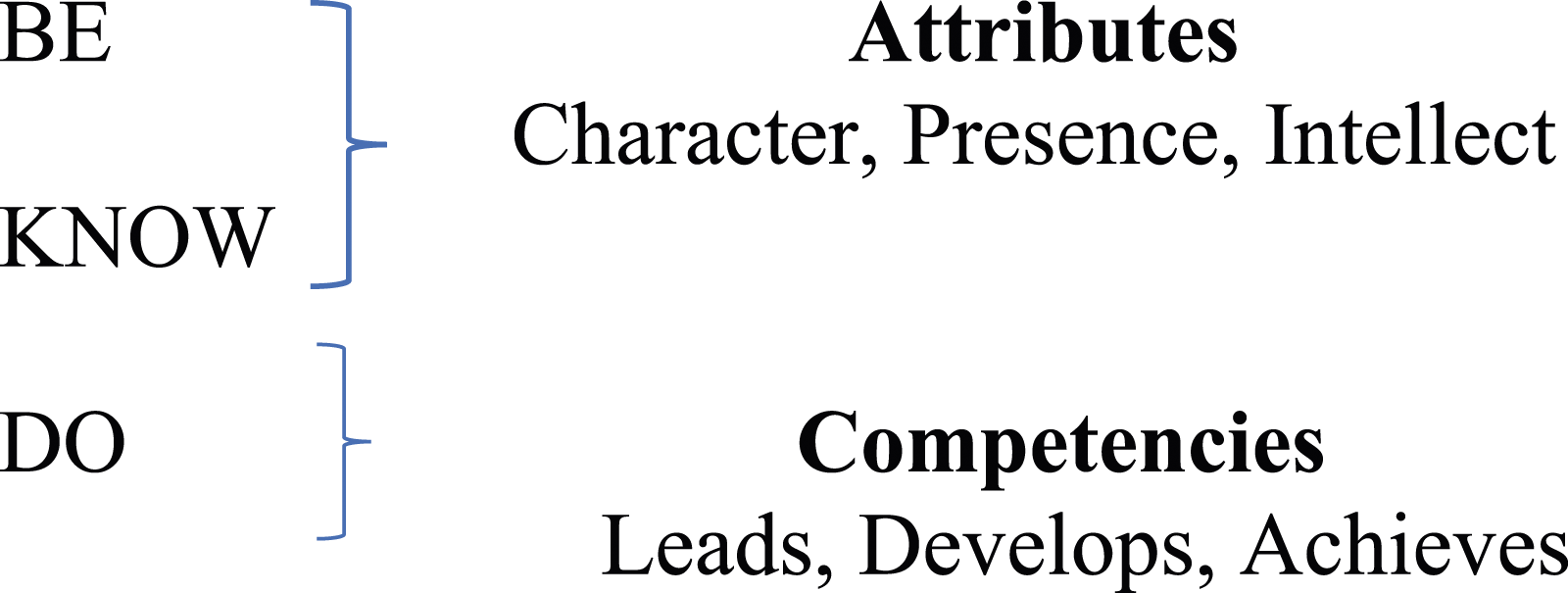
Character
Character shapes what we notice about people in the context they operate (Seijts et al., 2015). Character represents a person’s true nature comprised of their morals, virtues, values, consciousness, and sense of purpose, which make up their core and are the mindset and moral foundation behind actions and decisions (Field Manual 6-22, 2022). A person’s character is developed through individual actions like goal setting, active practice, and reflection. The BKD places significant emphasis on character-based leadership (Campbell et al., 2004). Because people are “sensitive to the values and attributes explicitly and implicitly displayed by leaders… they are at least partially influenced by the example leaders set” (p. 27). Therefore, attributes are critical elements in the development process and require careful cultivation. Character can be demonstrated in several ways: being trustworthy, ethical, courageous, authentic, humble, and respectful of diversity, to name a few. The BKD model clearly stresses the importance of authenticity, vulnerability, and agility as character traits that most bridge the gap between leaders and employees.
Trust is one of the most vital character traits of a leader (Bennis & Nanus, 1985; Mishra & Mishra, 2013). Building trust is of the utmost importance in the military to ensure strong working relationships with subordinates, peers, and superiors (Meinert, 2016). Trust is a dynamic, interpersonal link between people, with unique implications for the workplace (Bligh, 2017). Furthermore, trust is essential to team building. The leader who has the capacity to earn the trust of team members has the reciprocal capacity to instill trust among the team. In the military, trust is crucial for working together and learning to predict what the other person will do to accomplish the mission (Field Manual 6-22, 2022). When trust is instilled in an organization tasks are accomplished with less difficulty because people are more likely to communicate with each other in collaborative and productive ways (Bennis & Nanus, 1985; McCauley, 2001). Consistency is a valuable foundation for trust, as it establishes predictability, reliability, and commitment. Consistency reinforces the belief that the current circumstances will continue into the future. Trust and consistency are essential in the BKD model as they encourage honesty, transparency, competence, and genuine care for others’ well-being.
Being an authentic leader has emerged as a character attribute that emphasizes a leader’s self-awareness as well as high ethical and moral standards (Ciulla, 2005; Gardner et al., 2005). In demonstrating self-awareness, a leader displays humility and the understanding they are not self-serving but are working towards something more important than self (Field Manual 6-22, 2022). Courage is a virtue that gives a leader the confidence to “enact bold leadership practices, translating the first human quality (courage) into effective and inspiring actions of true excellence” (Lee & Elliott-Lee, 2006, p. 3). Leaders exhibit courage not only in perseverance when facing adversity, but moral courage to do the right thing because excellence of character permits nothing less.
Military leaders understand that implementation of diversity initiatives provides an organization with a strategic direction that leads to the successful alignment of organizational efforts (Kirchner & Akdere, 2017). Diversity and inclusion programs and policies encourage goals for equal opportunities in the military similar to those found in civilian settings (Kamarck, 2017). Advocates believe that the military should reflect the nation it serves and “strive for diversity that mirrors the shifting demographic composition of civil society” (p. 2). In the Armed Forces, diversity is acknowledged and respected as the foundation of an inclusive organization that nurtures the development of agile and adaptive leaders who can operate effectively in any environment (Jayne & Dipboye, 2004; Liggans et al., 2018).
Presence
Leader presence is more easily experienced rather than defined. It is a blend of a person’s perceived status and their natural ability to take control of a situation—and others can sense it (Kyle, 1998; Sanders, 2022). “Presence is the impression a leader conveys to others through their appearance, demeanor, actions, and words” (Field Manual 6-22, 2022, p. 2–8). Leaders can demonstrate presence through attributes such as resilience, self-confidence, and professional image, to name a few. In addition, mentorship has a significant impact on a leader’s sense of presence. Presence under the BKD model refers to the state of being fully engaged, focused, and attentive in the current moment. A leader’s ability to be present fosters confidence amongst the team they lead.
Veterans exhibit high levels of resiliency (Haynie, 2016). Resilience is the capacity to bounce back and adapt from organizational stressors, negative events, or failed experiences (Haynie, 2016; Mendy, 2020). Resilience is an attribute that has one primary goal: recover quickly from adversity while maintaining focus (Field Manual 6-22, 2022). Therefore, resilience is a crucial characteristic of high-performing teams (Erickson, 2015; Faberman & Foster, 2013). “Resilient leaders learn and grow from experiencing adversity and use that growth to ensure positive outcomes for mission accomplishment” (Field Manual 6-22, 2022, p. 4–16).
“Self-confidence is our judgment of whether or not we can do something. It is a judgment, based on weighing all our capabilities – our abilities, our motivation, all the resources we can muster – versus the requirements of the task at hand” (Hall, 2004, p. 257). Confident leaders who demonstrate composure help moderate self-doubt and reduce anxiety when facing conflict or adversity (Field Manual 6-22, 2022). Similarly, in civilian settings, high levels of self-confidence enable leaders to influence followers to develop confidence in performing tasks (Axelrod, 2017).
Intellect
Intellect is “a leader’s brainpower and knowledge that enables them to think creatively and critically to gain situational understanding, make sound judgments, solve problems, and act” (Field Manual 6-22, 2022, p. 2–10). Leaders demonstrate intellect through sound decision-making practices and using critical thinking to solve problems. Other attributes of a leader’s intellect include being mentally agile, tactful around others, and having relevant subject matter expertise.
Decision-making is a critical skill for all military commanders at any level of command and is especially critical in combat. Accordingly, it is the commander’s estimation that is used to make combat plans and decisions (MacLean, 2017; Mumford et al., 2000). Since combat leaders sometimes have to make combat decisions in the absence of information or the presence of a formally recognized leader they are expected to analyze the situation and make the best possible decision (McGarry et al., 2015; Minnis, 2017). In today’s global business world leaders often find themselves operating independently with little to no direct supervision from a manager. Thus, requiring leaders to be confident when making decisions on their own. The BKD model promotes hands-on experience which relies on uniformly knowing standards and applying them consistently. Intellect and knowing are interconnected and paramount under BKD. On a practical level, the BKD model speaks to how intellect represents the cognitive capacity for thinking and reasoning, while knowing pertains to the state of being informed and taking an action step toward that which is known.
Leaders are often presented with ill-structured problems for which there is no clear solution (Novelli & Taylor, 1993). Critical thinking means framing and evaluating solutions using a multilogical view achieved by “acknowledging and embracing divergent and conflicting perspectives” (p. 142). Critical thinking requires a leader to analyze, compare, contrast, make inferences and predictions, evaluate the strength of evidence, and draw conclusions (Field Manual 6-22, 2022). Given the highly influential nature of decision-making, the link between leadership and critical thinking is a natural and necessary process for analyzing and solving problems (Facione et al., 1997; Ricketts, 2005).
Applying the BKD Model: A Holistic Approach to Leader/Leadership Development
The BKD model integrates attributes and competencies at the individual (leader) and organizational (leadership) levels. Leaders are therefore expected to produce organizational results through the people they lead. Therefore, leading high-performing teams is essential to leader development.
Leader development is a complex, dynamic, and adaptive process that links the individual leader with situations and circumstances in a broader environment (Magnusson, 2001). A basic premise of the integrative, holistic model is that it “supports the achievement of the most desirable outcomes for the leadership unit (organization, group, or individual)” (Best, 2011, p. 9). Therefore, the total process of leader/leadership development cannot be understood by investigating one factor in isolation, but as an adaptive process that examines attributes in relation to other elements in the environment for leading, developing self and others, and achieving results for a greater purpose (Field Manual 6-22, 2022; Magnusson, 2001). Holistic, integrative models place emphasis on unity and team cohesion. A military- inspired application is unit-cohesion which is the bonding together of the team to sustain their desire and vow to each other and the mission, despite the circumstances faced in combat (Batka & Hall, 2016; Bender, 2014; Benmelech & Frydman, 2015).
For years, organizations have invested time and money into ineffective leadership development initiatives or programs that did not produce results (Dirani, 2017; Gurdjian et al., 2014; Stone & Stone, 2015). Finding ways to evaluate, measure, and review the impact on leadership attributes and competencies is crucial (Black & Earnest, 2009; Bolden, 2010). A significant contribution of the BKD model is its evaluation and assessment process. To evaluate and assess how leader/leadership development programs are impacting practice, a development scorecard with relevant indicators should be used to identify deficiencies as well as successes (Field Manual 6-22, 2022). The military development scorecard is consistent with the balanced scorecard, a basic human resource strategy. “The basic premise of the balanced scorecard is simple--measurement motivates” (Sharma, 2009, p. 8). In other words, what gets measured, gets done.
Implications for HRD Researchers and Practitioners
Ardichvili et al. (2016) emphasized the significance of not only discovering new leader development frameworks and models but also highlighting the importance of the world of practice in applying the models. Supportive practices (e.g., employee resource groups) help create a culture of belongingness and an environment of inclusion (LePage, 2020; Liggans et al., 2019). This finding is consistent with recent authors who have advanced the inclusive leadership paradigm (Booker & Williams, 2022; Boutwell & Smith, 2023; Canlas & Williams, 2022).
Collaboration among HRM and HRD teams in areas of mutual interest fosters an organizational culture of cooperation and alignment amongst the two functions. The BKD model is an excellent framework because it primarily promotes continuous learning among leaders and improves recruitment and workforce personal development. The following section is dedicated to presenting a series of strategies to enhance collaboration between HRM and HRD.
Enhancing Collaboration Between HRM and HRD
Identify Common Goals and Objectives
Common goals and objectives in a business or organizational context often revolve around improving the organization’s performance, culture, and effectiveness. For example, these objectives may include improving employee recruitment, enhancing unity amongst teams, or promoting a culture of continuous learning. An organization’s ability to identify common goals and objectives will foster a cohesive and collaborative work environment. Therefore, to maximize the benefits of the established common goals and objectives it is essential to ensure that team goals and objectives are well-defined measurable and understood by all team members.
Establish Open Communication Channels between HRD and HRM Teams
To help teams stay informed about each other’s challenges and initiatives, regularly scheduled meetings are essential. When an organization is diligent about fostering an environment of openness among communication channels, teams are well informed about each unit’s challenges and initiatives, which ultimately contributes to the organization’s success. Therefore, establishing clear communication channels and measuring improvements in cross-functional collaboration is vital to the success of an organization’s collaborative efforts. Clear communication channels have the potential to enhance customer satisfaction and loyalty levels that drive up revenue and growth.
Conduct Joint Assessments to Identify Skills Gaps within the Organization
Conducting joint assessments to identify skills gaps within an organization is a crucial step in ensuring that employees have the necessary skills and competencies to meet the organization’s goals and objectives. HRD can design programs to address gaps, while HRM can help eliminate the gaps by incorporating training and development solutions into performance management plans. Together HRD and HRM teams determine the objectives of the assessment, the scope, and the specific skills and competencies they want to assess. By conducting joint assessments and integrating the findings into both HRD and HRM functions, organizations ensure that they not only identify skills gaps but also take proactive steps to address them, ultimately enhancing overall employee performance.
Align Training and Development Plans with a Focus on the Organizations’ Strategic Plan and Objectives
Ensuring that the workforce acquires skills through training and direct application to their roles and career progression, contributes to the overall success of the organization. Therefore, a periodic review of the alignment between training and development plans the strategic plan and adapting the plans as necessary to address changing business needs and goals is vital. By doing this the organization is ensuring that employees acquire the skills and training needed to contribute effectively to the organization’s strategic objectives. This alignment will ultimately benefit both employees and the organization as a whole.
Create a feedback Loop Where HRM Provides Insights on Workforce Performance and HRD uses the Feedback to Adjust Training Plans
Creating a feedback loop between HRM and HRD is essential for optimizing workforce performance and continuously improving training plans. Sharing insights and trends in workforce performance between HRM and HRD could identify skills gaps, areas of improvement, and high-performing teams and individuals. Feedback is used to adjust and enhance training plans. HRD designed training plans can be tailored to address the deficiencies identified in assessments. After the training programs are implemented, HRM could monitor workforce performance tasks using KPIs and evaluation methods. HRD and HRM could review the post-training performance and feedback to assess where the training programs have improved workforce performance in the targeted areas. The feedback loop is a continuous process with HRD and HRM making adjustments and improvements to the training plans and performance management process when necessary. Throughout the process, clear communication between HRM and HRD is crucial. Both teams should assess data and insights to ensure the feedback loop is serving the organization efficiently.
Collaborate with HRD and HRM to Identify High-Performing Teammates and Develop Leadership Development Programs and Opportunities to Job Shadow Leadership Roles
Collaboration between HRM and HRD to identify high-performing teammates and develop leadership development programs and job shadowing opportunities can be a strategic and effective approach to nurturing future leaders within an organization. HRD can play a key role in identifying high-performing employees through performance appraisals and regular performance reviews. While HRM could conduct assessments to evaluate the leadership potential of identified high-performing employees. This could involve personality assessments, leadership assessments, and competency evaluations. HRD could work with identified high performing teammates to create personalized development plans. The plans would outline specific skills, knowledge, and experiences they need to develop in order to be prepared for leadership roles. HRD can set up mentoring and coaching relationships between high-performing employees and experienced leaders. This provides guidance and support as they develop their leadership skills. By combining the strengths of HRD and HRM, an organization creates a well-rounded approach to identifying, developing, and promoting high-potential individuals into leadership roles, ultimately contributing to the long-term success of the organization.
Encourage Joint Projects or Initiatives that Involve Both HRD and HRM
For example, these units can collaborate on diversity and inclusion programs, leadership development, or culture-building initiatives. When these groups collaborate, they ensure that talent development aligns with the organization’s strategic goals, resulting in a more skilled and capable workforce. To facilitate collaboration between HRD and HRM, organizations should encourage open communication, establish clear roles and responsibilities, and provide opportunities for cross-functional training and development. When these units work together effectively, they can create a more agile, responsive, and people-centric organization.
Assess the Effectiveness of Collaboration Efforts Regularly and Make Necessary Adjustments
Continuous improvement ensures that collaboration remains a priority and evolves with changing organizational needs. Assessing the effectiveness of collaboration efforts regularly and making necessary adjustments is a fundamental aspect of maintaining productive and efficient teamwork within the organization. It is critical that organizational leaders recognize and celebrate successes, best practices, and lessons learned from collaboration efforts. Knowledge sharing within the organization is essential to facilitate learning and improvement. Fostering a culture of continuous improvement where team members are encouraged to suggest and implement changes to enhance collaboration ensures an organization maintains a robust environment of growth and innovation.
In summary, regularly assessing the effectiveness of collaboration efforts and making necessary adjustments is essential to ensure that collaboration remains a priority and progresses with the ever-changing needs of the organization. By employing a structured approach that incorporates feedback, data-driven analysis, and a commitment to continuous improvement, organizations can enhance their collaborative capabilities and achieve better outcomes. An organization's dedication to encouraging collaboration between HRD and HRM is a strategic approach that can yield numerous benefits for the organization. By working together on various projects and initiatives, these units can leverage their respective strengths to create a more holistic and effective approach to talent management.
Implications for Further Research
Though it was not the scope of this article, a search for theoretical models that highlight the transfer of learning and development from a military environment to the civilian workforce would offer more evidence-based explanations for leader/leadership development practical application. In addition, a military leader’s performance, and management of stressful situations during military action could offer explanations for handling organizational dilemmas and crises (Benmelech & Frydman, 2015).
The BKD model introduced in this is strongly grounded in team cohesion and unity. Critical human resource development scholars and researchers would challenge how military teams are not isolated from social justice issues (e.g., racism, sexism, disability, and homophobia) that are prevalent in the civilian workforce. Therefore, consideration should be given to leader/leadership development processes that include social justice education.
Finally, research should investigate crisis readiness as an executive leadership development topic. Leaders who bring a record of military service to the workforce may be better prepared to lead during difficult periods of industry crisis.
Conclusion
The U. S. Army’s BKD model introduced in this article, integrates leader development attributes (be and know) with leadership development competencies (do). The BKD model is a convenient and useful model, providing guidance for how organizations can meet their leadership development goals. The model stresses mentorship and behavior modeling amongst leaders, hands-on workforce experiences, systematic feedback for all, and self-reflection and evaluation. Since HRD and HRM are two interconnected functions within an organization employing the BKD model’s practice of collaborating in areas of mutual interest will lead to a more cohesive and productive workforce.
Footnotes
Declaration of Conflicting Interests
The author(s) declared no potential conflicts of interest with respect to the research, authorship, and/or publication of this article.
Funding
The author(s) received no financial support for the research, authorship, and/or publication of this article.
